Key Highlights
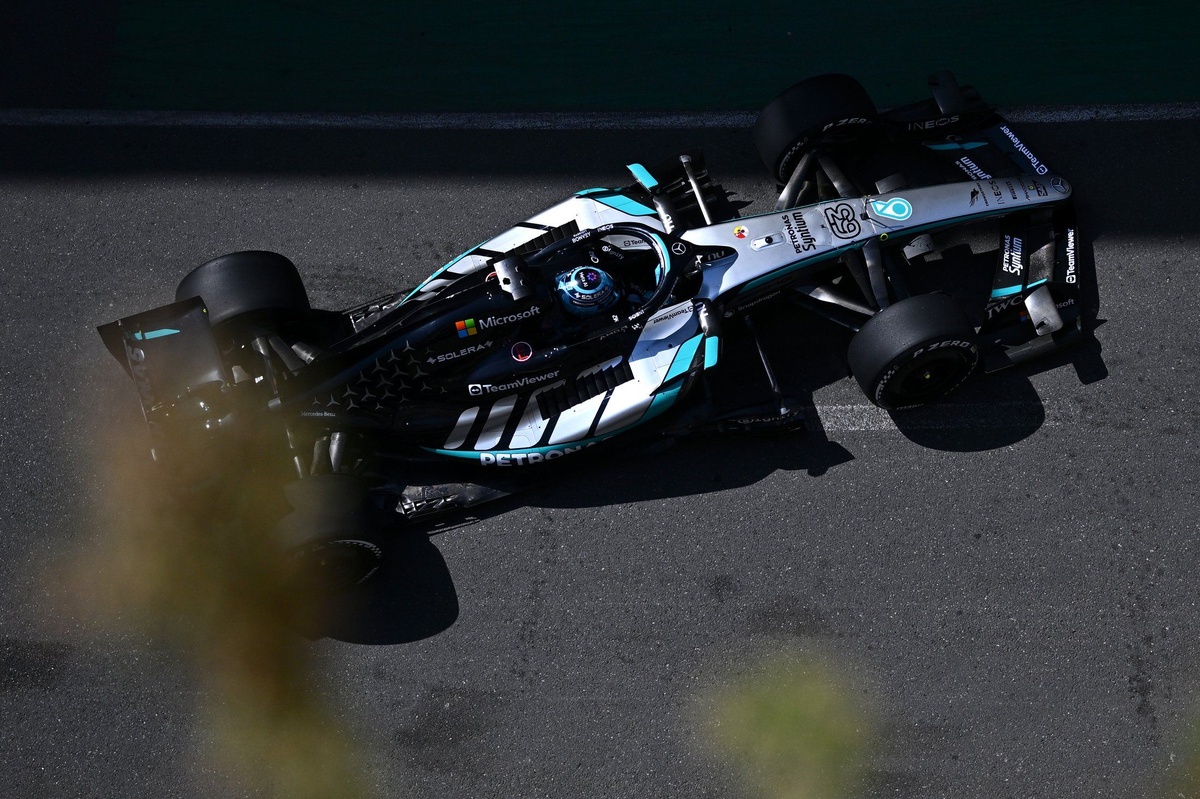
- George Russell topped the opening practice session for the Azerbaijan Grand Prix with a 1m45.387s lap for Mercedes, leading Max Verstappen (Red Bull) and Charles Leclerc (Ferrari).
- Championship leader Kimi Antonelli suffered a hydraulic failure on his Mercedes W17 at Turn 7, bringing out a virtual safety car and ending his running prematurely.
- McLaren, Williams, and Audi all introduced substantial upgrade packages for the Baku street circuit, with McLaren’s revised sidepods, floor edge, and diffuser drawing particular attention.
Russell Leads Mercedes 1-2 as Verstappen and Leclerc Chase
George Russell set the pace in the first free practice session for the Formula 1 Azerbaijan Grand Prix, delivering a benchmark 1m45.387s on soft tyres with 20 minutes remaining to secure top spot for Mercedes. The Briton’s final effort edged out Max Verstappen’s Red Bull by a comfortable margin, while Charles Leclerc placed third for Ferrari to round out a tightly contested leading trio. The session, held on Thursday ahead of Saturday’s race to accommodate a national holiday, began cautiously on the dusty Baku city circuit, which sees Formula 1 action only once per year.
Antonelli Hydraulic Failure Triggers Early Virtual Safety Car
The session’s first major incident arrived before the halfway mark when championship leader Kimi Antonelli ground to a halt at Turn 7 with smoke billowing from his Mercedes W17. “a hydraulic issue,” the 20-year-old Italian reported over team radio, prompting a virtual safety car period while marshals cleared the car without requiring a red flag. The failure cost Antonelli valuable track time on a circuit where every lap counts, and he ultimately settled for fifth in the classification despite having briefly topped the timesheets with a 1m46.265s on harder rubber earlier in the hour.
Upgrade Packages Debut as McLaren, Williams, and Audi Seek Gains
Thursday’s running served as a critical shakedown for several significant technical updates. McLaren introduced new sidepods, a revised floor edge, and an updated diffuser aimed at addressing the MCL39’s low-speed weakness, though Oscar Piastri and Lando Norris endured a messy session—Norris languished in 14th without a representative soft-tyre lap as both cars underwent damage checks. Williams debuted its long-awaited package featuring a redesigned floor and lighter chassis, but brake overheating limited Carlos Sainz’s mileage. Audi’s upgraded machinery proved immediately competitive, with Nico Hulkenberg and Gabriel Bortoleto both reaching the top ten and displacing the Williams duo.
Red Bull Brake Concerns and Rookie Impressions
Verstappen reported early that “the brakes on his RB22 were pulling,” a concern echoed by returning team-mate Isack Hadjar, who also grappled with an apparent power unit issue on his first appearance since a wrist fracture sidelined him for three weekends. Verstappen briefly jumped to the top of the order with a rapid lap before Russell responded, though the Dutchman locked his fronts at Turn 1 and used the escape road on his subsequent push. At Racing Bulls, Liam Lawson returned to form in seventh ahead of rookie Arvid Lindblad, whose late spin at Turn 7—combined with Hulkenberg’s Turn 4 issue—brought out a second virtual safety car in the closing minutes.
Why This Matters
The Azerbaijan Grand Prix’s unusual Thursday-to-Saturday schedule compresses preparation time, making FP1 data disproportionately valuable for teams validating upgrades on a unique street circuit. Russell’s strong showing suggests Mercedes’ recent development direction is paying dividends on low-speed layouts, while Antonelli’s reliability setback underscores the fragility of his championship lead. McLaren’s aggressive update suite signals their intent to arrest a recent performance slide, and Audi’s immediate competitiveness with Hulkenberg and Bortoleto hints at a potential midfield shake-up. With track evolution rapid on the dusty Baku surface, Friday’s second practice—held under representative evening conditions—will be critical for tyre degradation analysis and race simulation ahead of Saturday’s grand prix.
Frequently Asked Questions
- Why is the Azerbaijan Grand Prix being held on a Saturday?
- The race weekend was shifted forward by one day to accommodate a national holiday in Azerbaijan on Sunday, moving the grand prix from its traditional Sunday slot to Saturday.
- What caused Kimi Antonelli to stop during FP1?
- Antonelli suffered a hydraulic failure on his Mercedes W17 at Turn 7, reporting “a hydraulic issue” before his car stopped on track and triggered a virtual safety car period.
- Which teams brought major upgrades to Baku?
- McLaren introduced new sidepods, a revised floor edge, and an updated diffuser; Williams debuted a redesigned floor and lighter chassis; and Audi ran an upgraded specification on both cars.
Leave a Reply