Tag: Max Verstappen

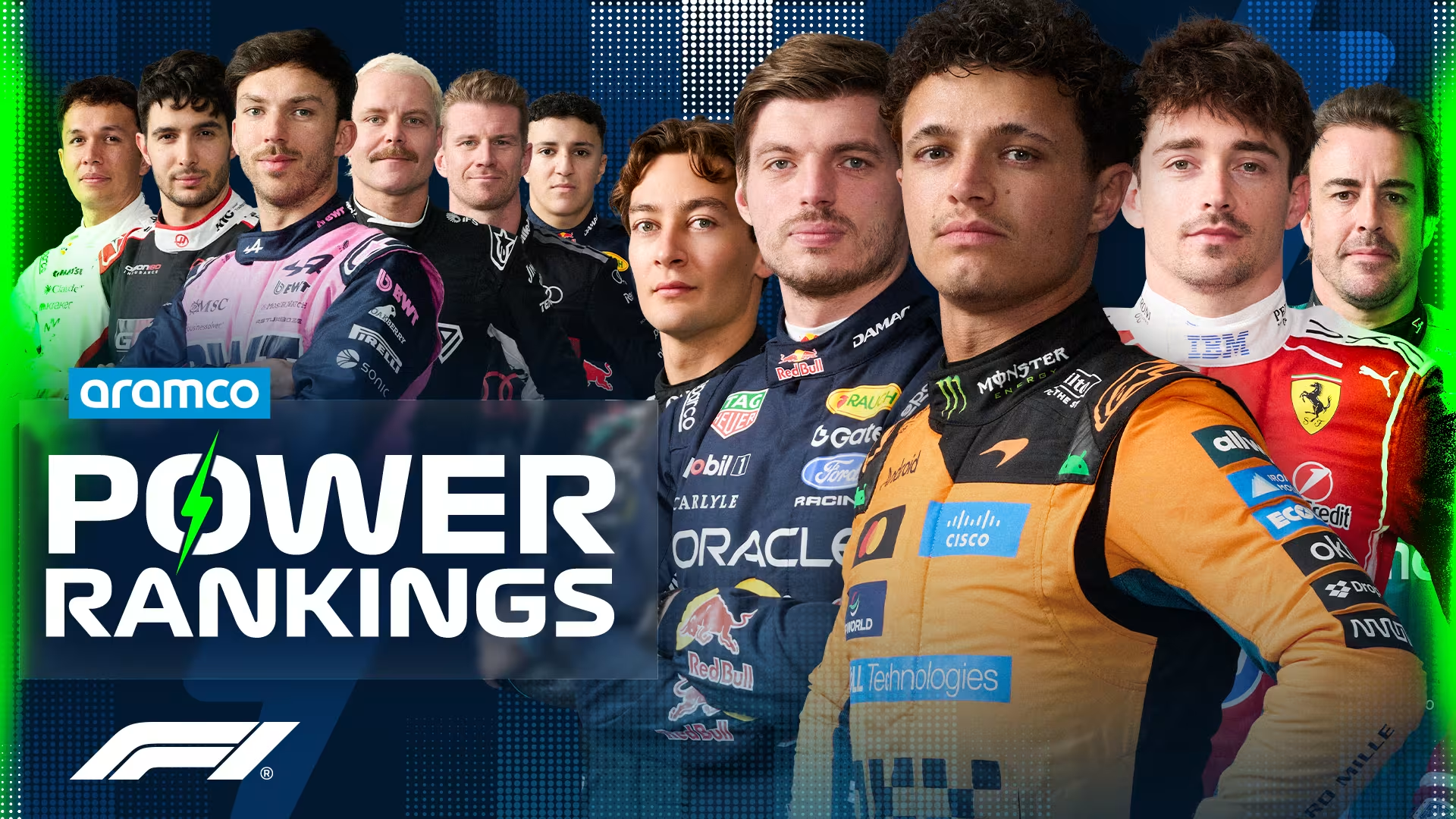
  • Power Rankings: Who Impressed the Judges at the Azerbaijan Grand Prix?

    Power Rankings: Who Impressed the Judges at the Azerbaijan Grand Prix?

    Key Highlights

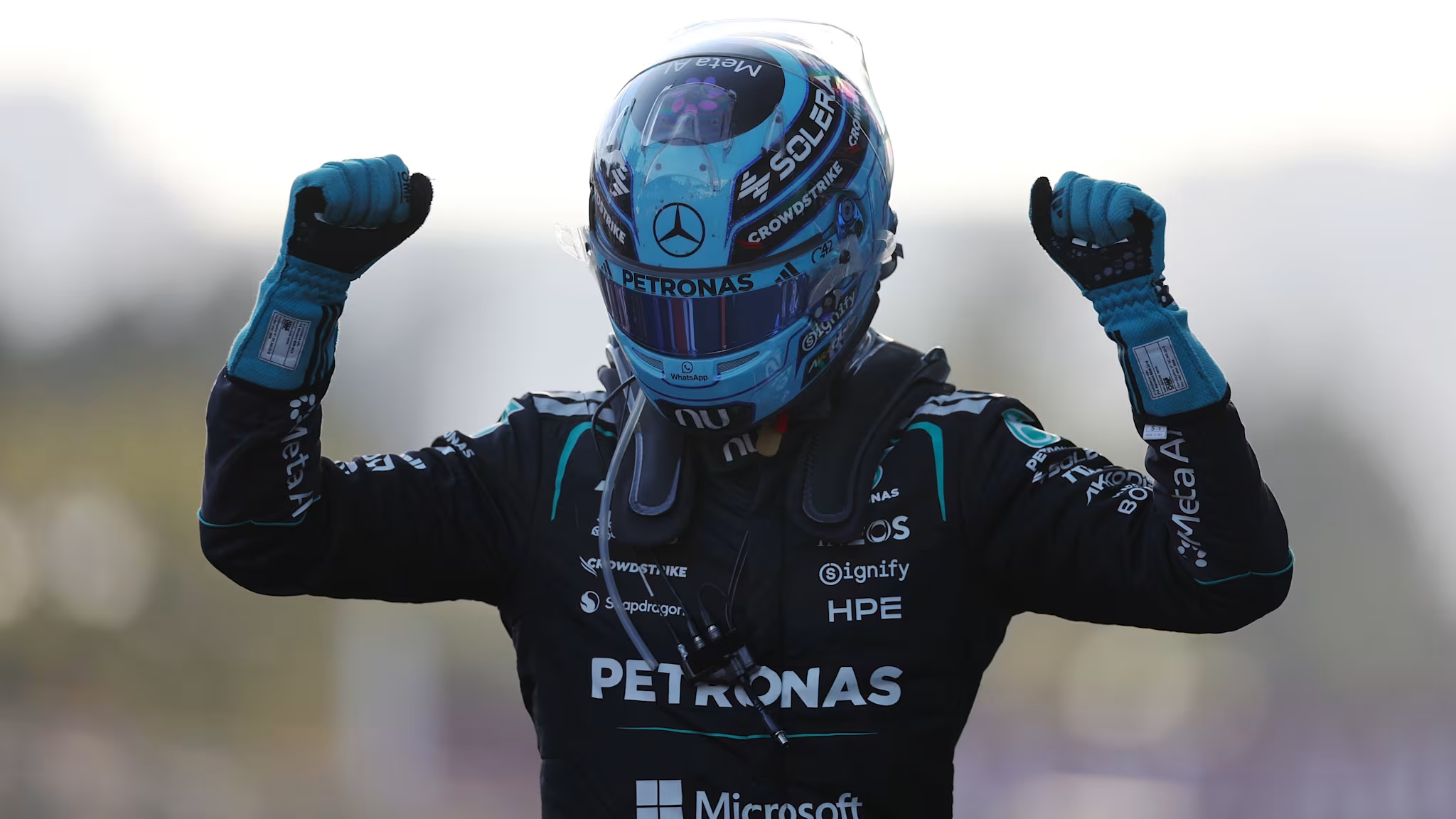
    • George Russell dominated the Azerbaijan Grand Prix weekend, taking pole position and converting it into victory.
    • Max Verstappen recovered from eighth on the grid to finish second, while Isack Hadjar secured his first proper podium on pure pace in Formula 1.
    • Esteban Ocon, Ollie Bearman, Arvid Lindblad and Carlos Sainz also impressed in the Baku Power Rankings contenders.

    George Russell Leads the Azerbaijan Grand Prix Power Rankings

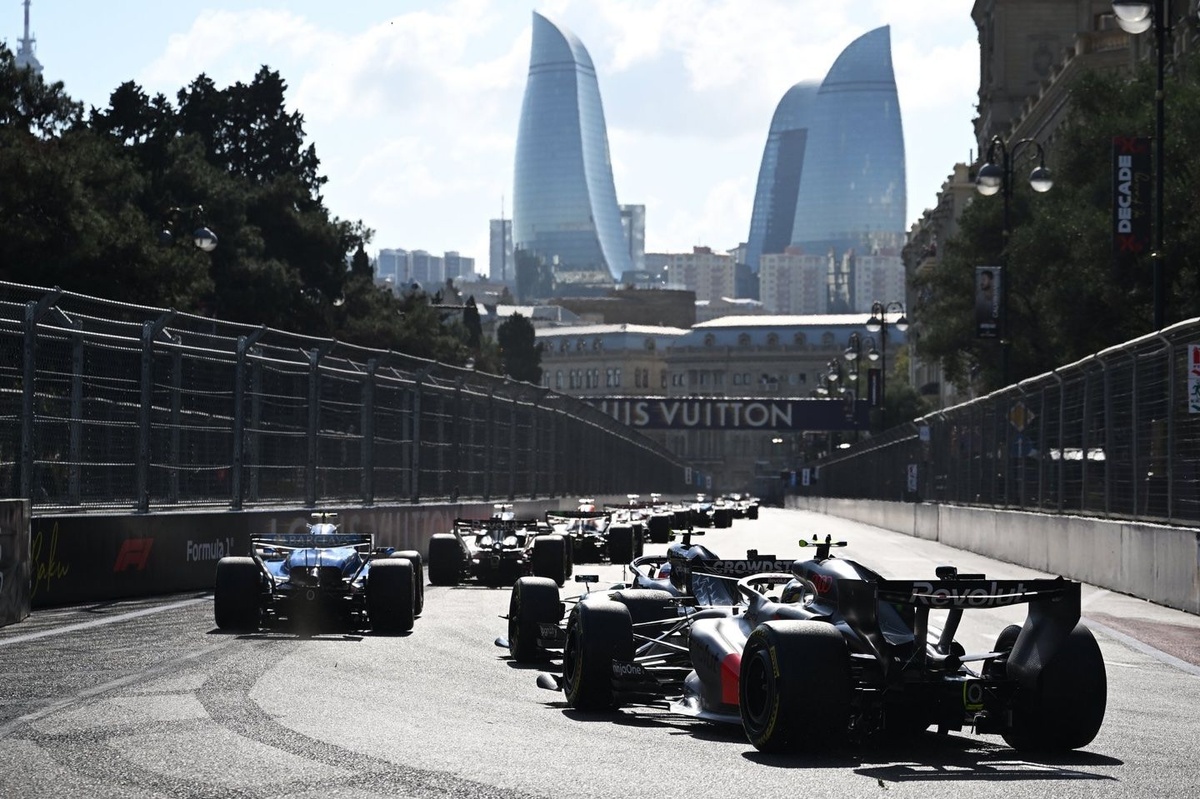
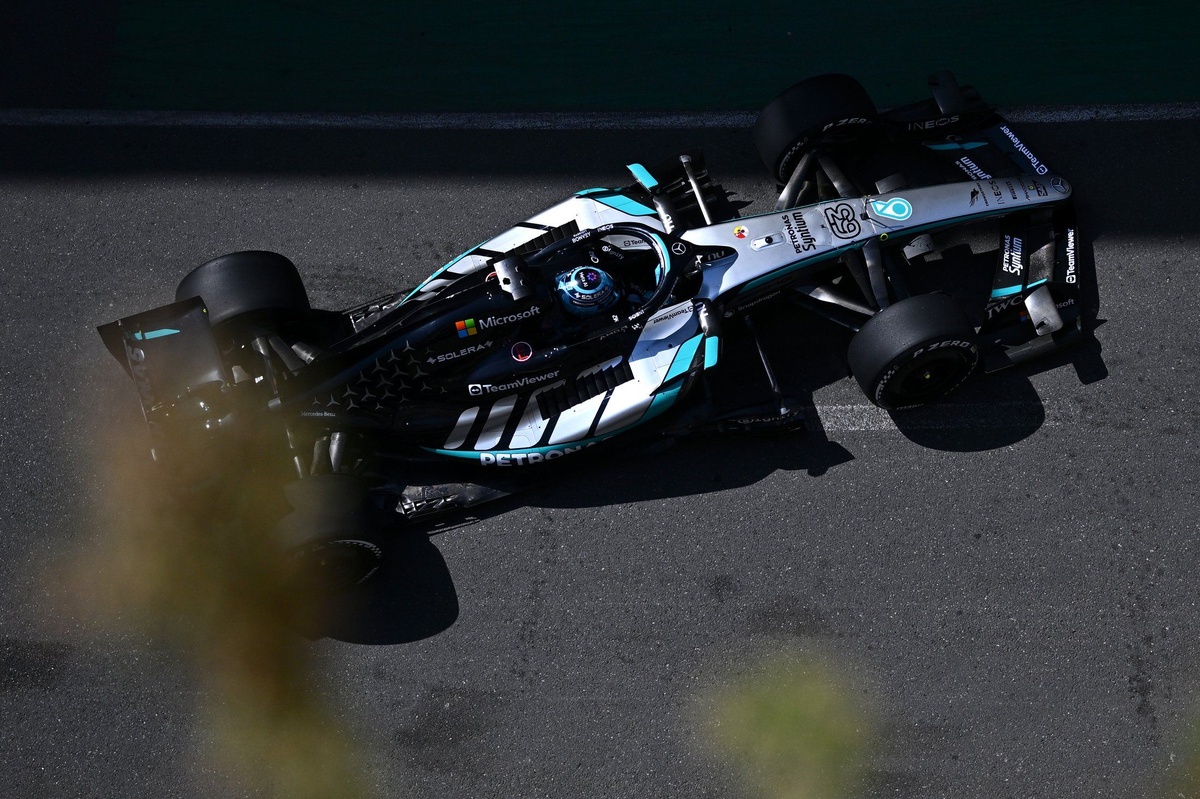
    George Russell was the standout performer at the Baku City Circuit, producing a dominant Azerbaijan Grand Prix weekend. The Mercedes driver led Thursday practice, took pole position by eight tenths of a second and converted his qualifying advantage into victory despite intense late pressure from Red Bull’s Max Verstappen.

    With Russell delivering across every major session, the Power Rankings judges found little to criticize in his performance. Verstappen, meanwhile, endured a difficult qualifying session after apparent power unit and battery issues left him eighth on the grid, despite having topped final practice earlier that day. The Dutchman responded strongly in the race, moving through the field to finish second and coming close to challenging Russell for victory.

    Hadjar Delivers a Breakthrough Performance

    Isack Hadjar made an immediate impression after spending six weeks away from racing because of a wrist injury sustained during summer-break training. The Formula 1 rookie steadily increased his pace through practice before qualifying fourth in Baku.

    Hadjar maintained that form in the race and converted his strong starting position into what was described as a “first proper podium on pure pace” in F1. His performance placed him among the leading names in the latest Azerbaijan Grand Prix Power Rankings.

    Pierre Gasly also showed strong potential during the weekend, qualifying seventh and aiming for another significant points haul. However, the Alpine driver’s race ended after contact with team mate Franco Colapinto. Gasly was visibly disappointed afterward, saying, “I don’t think I really have words, and I don’t need the words now,” as both Alpine cars finished without points.

    Ocon and Bearman Put Haas in the Points

    Esteban Ocon arrived in Azerbaijan describing himself as a “free agent” for 2027, with his time at Haas appearing likely to end. After starting 14th because yellow flags affected his qualifying lap, Ocon produced a strong recovery drive to finish eighth.

    Ocon finished ahead of Haas team mate Ollie Bearman and was narrowly beaten to the finish line by Racing Bulls driver Arvid Lindblad. Bearman had qualified 11th, just short of reaching Q3, and led the Haas challenge for much of the race. His prospects were affected when he made contact with Kimi Antonelli at a Safety Car restart, allowing Ocon to move ahead.

    Bearman nevertheless finished ninth, giving Haas both cars in the points. The result represented a solid overall recovery for the team and helped underline the strength of its race pace in Baku.

    Lindblad Impresses Despite a Difficult Baku Weekend

    Arvid Lindblad endured a turbulent weekend on the streets of the Azerbaijani capital. The Formula 1 rookie crashed in FP2 for the second consecutive event and then qualified 15th. Reflecting on his approach, Lindblad admitted to “trying to be too special”.

    His race was also complicated by contact with Racing Bulls team mate Liam Lawson at the first Safety Car restart. Lindblad recovered effectively, however, and crossed the line seventh to claim an impressive result despite the setbacks.

    Lawson had been the lead Racing Bulls driver in Azerbaijan after returning from Red Bull, but the collision with Lindblad sent him into a spin. He later remarked sarcastically over team radio, “I love getting taken out by my team mate. That’s pretty sick,”. Lawson recovered some of the lost ground but ultimately finished 12th.

    Leclerc and Sainz Salvage Strong Results

    Charles Leclerc had mixed feelings after qualifying second in Baku. The Ferrari driver was pleased with his grid position but acknowledged that Russell’s pole advantage was considerably larger than expected. In the race, Leclerc was unable to prevent Oscar Piastri and the Red Bull cars from moving ahead, although he regained fourth place when Piastri locked up into Turn 1 late in the race.

    Williams introduced a substantial package of updates at the Baku City Circuit in an effort to improve its difficult 2026 campaign. Both drivers progressed to Q2, while Carlos Sainz produced a powerful lap to reach Q3.

    Sainz was initially set to start ninth, but a post-qualifying penalty for failing to follow yellow-flag requirements dropped him to 14th on the grid. He still capitalized on the events of the race to secure a morale-boosting point for Williams.

    Perez Heads Cadillac’s Azerbaijan Effort

    Sergio Perez described the Azerbaijan Grand Prix as “one of my best weekends” in the sport after “driving at a high level” from FP1 through to the chequered flag. The Cadillac driver comfortably led the team’s performance with its latest Ferrari power unit.

    Perez mixed it with several midfield competitors and finished 14th. Several retirements contributed to his final position, but his performance still represented a respectable showing for Cadillac in Baku.

    Why This Matters

    The Azerbaijan Grand Prix highlighted the importance of qualifying performance, race recovery and execution around the demanding Baku City Circuit. Russell converted a commanding pole position into victory, while Verstappen demonstrated how strongly a driver can recover from a difficult qualifying result.

    The weekend also provided encouraging signs for several teams and drivers. Hadjar’s podium-level performance, Haas’s double points finish, Lindblad’s recovery to seventh and Sainz’s point after a grid penalty all carried significance in the Power Rankings assessment. Williams’s upgrades also appeared to improve its competitiveness, with both cars reaching Q2 and Sainz making Q3.

    Frequently Asked Questions

    Who led the Azerbaijan Grand Prix Power Rankings?

    George Russell led the Power Rankings after taking pole position and winning the Azerbaijan Grand Prix at the Baku City Circuit.

    How did Max Verstappen perform in Azerbaijan?

    Max Verstappen started eighth after qualifying issues but recovered to finish second, putting pressure on Russell during the closing stages.

    Which drivers narrowly missed the Power Rankings list?

    Audi’s Nico Hulkenberg, Oscar Piastri and Kimi Antonelli narrowly missed inclusion. Hulkenberg finished within one second of a point, while Piastri’s score was affected by a late lock-up and Antonelli’s by his Q1 accident.
  • Max Verstappen: ‘I was trying everything’ after missing 2026 Azerbaijan Grand Prix victory

    Max Verstappen: ‘I was trying everything’ after missing 2026 Azerbaijan Grand Prix victory

    Key Highlights

    • Max Verstappen finished second at the Azerbaijan Grand Prix, losing to George Russell by just one-tenth of a second after starting eighth on the grid.
    • The Red Bull driver recovered through the field on medium tyres before a safety car allowed a switch to softs, where he matched Russell’s pace but could not complete the overtake.
    • Verstappen remains without a victory in the 2026 season, admitting he “was trying everything” including brushing the wall at Turn 16 on the final laps.

    Verstappen’s Baku Charge Falls Short by a Tenth

    From Eighth on Grid to a Photo-Finish Duel

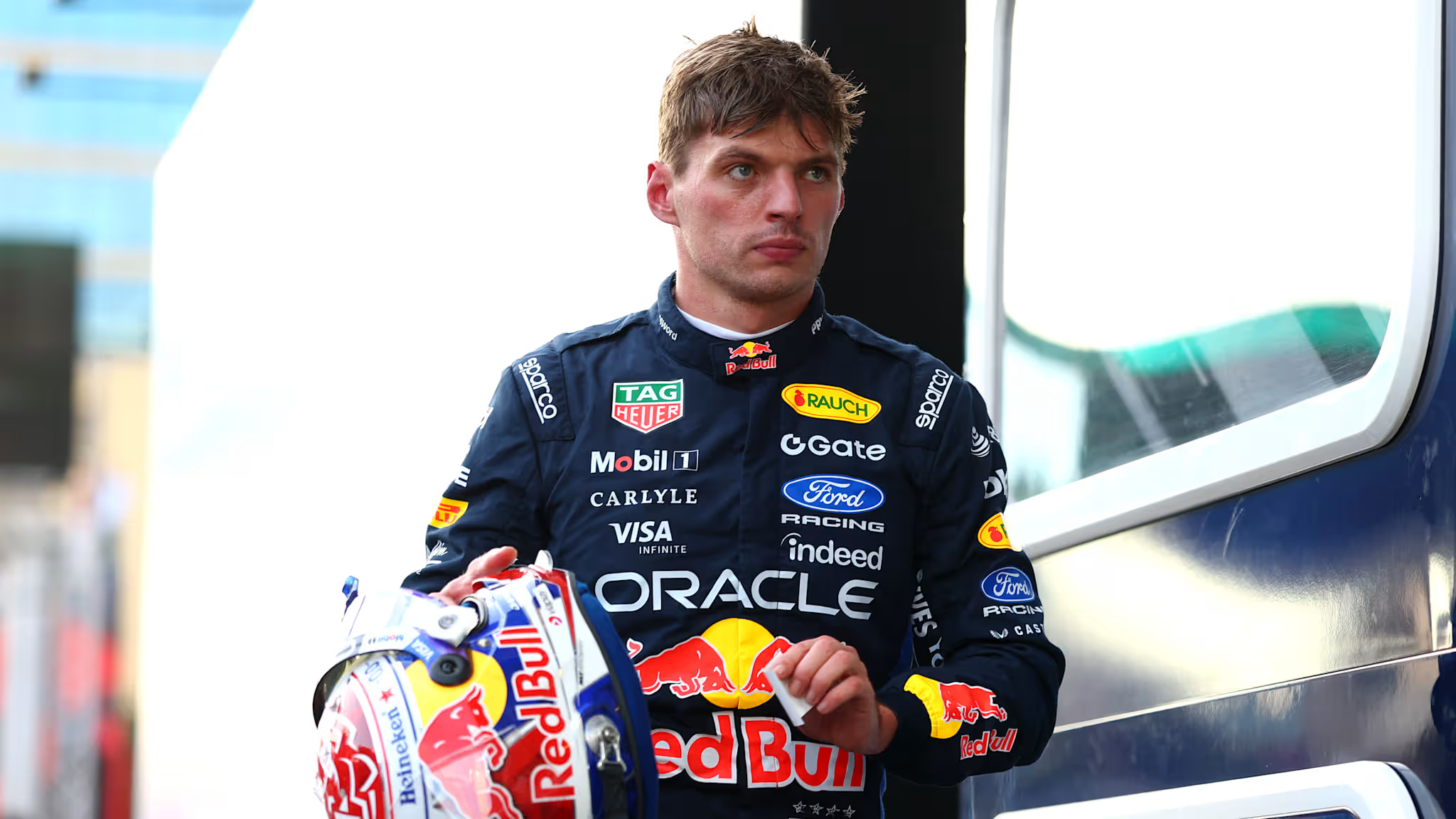
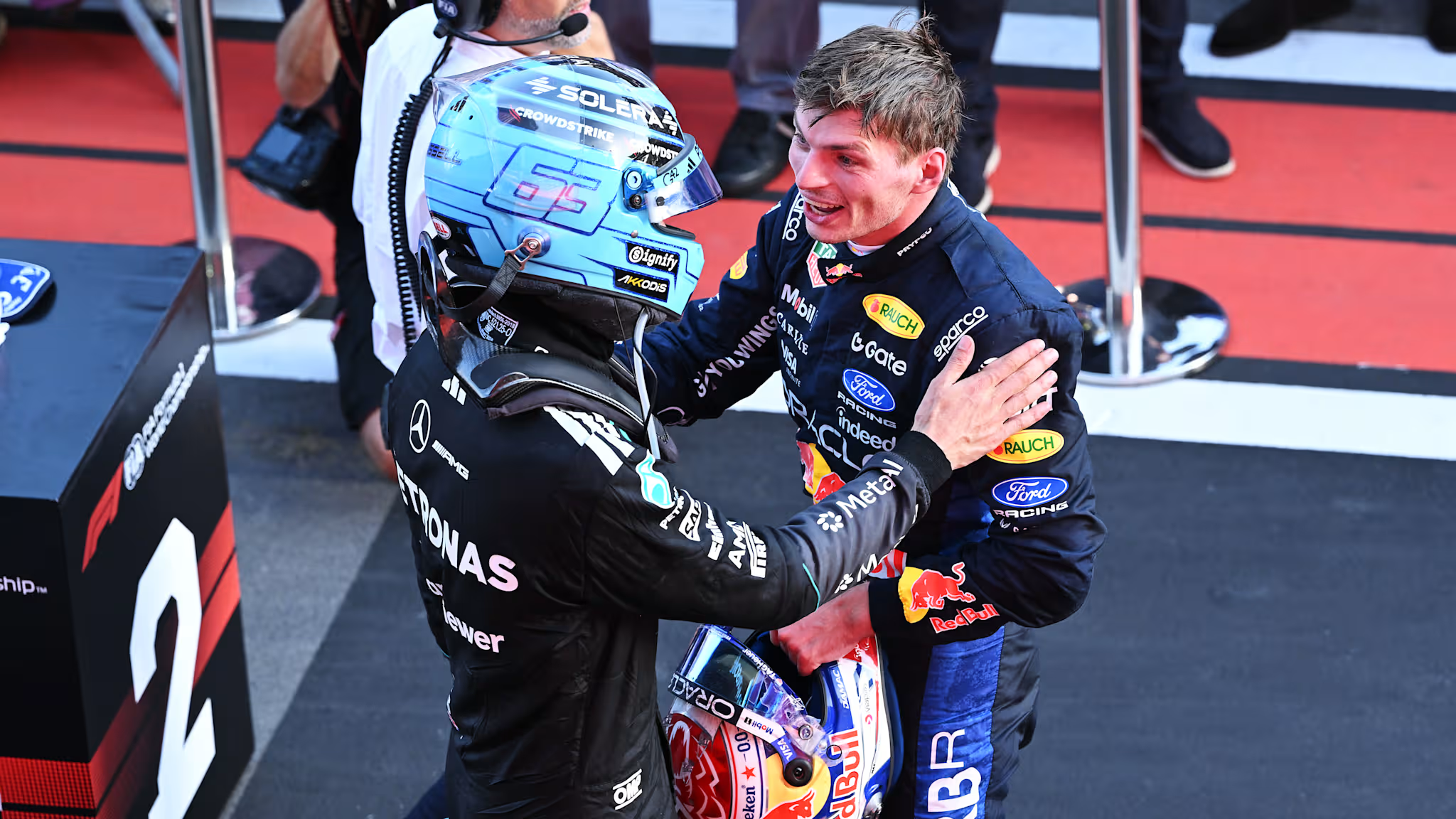
    Max Verstappen conceded he “was trying everything” to claim victory on the streets of Baku, the Red Bull driver eventually falling short by just one tenth against George Russell. The Dutchman was left a frustrated eighth on the grid for Saturday’s 51-lap race after issues in Qualifying, but Verstappen quickly began to make progress with the medium tyre. Moving into third, Verstappen demoted Oscar Piastri’s McLaren for second at the first of two Safety car restarts, allowing him to challenge race leader Russell in the closing stages.

    Tyre Strategy and the Medium-Stint Struggle

    Reflecting on the difficult opening phase, the four-time World Champion explained: “Starting in P8 I knew it wasn’t going to be that straightforward but we worked our way quite nicely up into the top three but that first stint was very tricky.” He added: “That medium tyre was just not very good, not having the grip that I think the soft tyres had so was just trying to survive on that stint to try and stay with the guys on the soft.” The intervention of the Safety Car transformed the race dynamics. “I think that Safety Car came at the right time for everyone to box onto that soft, because once we were on that soft tyre, it felt a lot better, just miles faster.” Verstappen noted the pace advantage was clear: “I think that also showed once George and I were on the soft, we were pulling away quite a lot over everyone else.”

    Final-Lap Drama and a Missed Opportunity

    Verstappen stayed on the cusp of a one-second gap to Russell over the final laps down the main straight, with Red Bull enjoying straight-line speed during the race. A yellow flag at Turn 15 after Valtteri Bottas crashed gifted Verstappen the chance to gain an even stronger slipstream on the run to the line for the final time. But the Dutchman ultimately fell short by just one tenth, meaning he has still yet to record a victory during the 2026 season. “I was trying everything that I have available,” said Verstappen in his quest to pass Russell, which included glancing the wall on the entry to Turn 16 several times. “Of course on the last lap because there was a yellow, I think George picked up a bit of boost lag, so he didn’t pull out of Turn 15 and that gave me a little bit more of an opportunity and that’s why it was so close to the line. We were constantly one second, so we were very close to each other.”

    Why This Matters

    The result extends Verstappen’s winless start to the 2026 campaign, placing added pressure on Red Bull to unlock race-winning performance across varying circuit layouts. While the team demonstrated strong straight-line speed in Baku, the inability to convert a recovery drive from P8 into victory highlights the fine margins separating the leading contenders. Russell’s ability to manage tyre degradation and defend under late-race pressure strengthens Mercedes’ championship credentials, while the safety car timing and yellow-flag dynamics underscore how unpredictable street circuits remain. With the championship still in its early stages, both drivers and teams will analyse the tyre-phase data from Baku to refine strategies for upcoming rounds.

    Frequently Asked Questions

    Why did Verstappen start eighth in Baku?

    Verstappen qualified eighth after encountering issues during the qualifying session, which compromised his grid position for the 51-lap race.

    What role did the safety car play in Verstappen’s charge?

    The safety car allowed Verstappen and the leaders to switch from the struggling medium compound to the soft tyre, which Verstappen described as “miles faster,” enabling him to close the gap to Russell and pull away from the rest of the field.

    How close was the finish between Verstappen and Russell?

    Verstappen finished just one-tenth of a second behind Russell, with a late yellow flag for Valtteri Bottas’ crash giving the Red Bull driver a stronger slipstream on the final run to the line.

  • Russell Narrowly Holds Off Verstappen to Win Chaotic Azerbaijan GP

    Russell Narrowly Holds Off Verstappen to Win Chaotic Azerbaijan GP

    Key Highlights

    • George Russell secured his third victory of the 2025 season and eighth career win at the Azerbaijan Grand Prix, holding off Max Verstappen by a mere 0.1 seconds in a dramatic finish.
    • The race featured seven retirements—including Lando Norris, Alex Albon, and both Aston Martin drivers—and three Safety Car periods that reshuffled the order and created a chaotic finale.
    • Red Bull achieved a double podium with Isack Hadjar claiming third, while Kimi Antonelli recovered from a qualifying crash to finish fifth from 16th on the grid.

    Russell Survives Verstappen Assault to Win in Baku

    George Russell converted a dominant pole position into a hard-fought victory at the Azerbaijan Grand Prix, crossing the line just one-tenth of a second ahead of a charging Max Verstappen. The Mercedes driver controlled the opening stint after a superb launch, building a lead that peaked near ten seconds before a series of Safety Car interventions erased his advantage and set up a thrilling final-lap duel. The win marks Russell’s third of the season and his first since the Austrian Grand Prix in Round 8.

    Qualifying Masterclass Sets the Stage

    The foundation for victory was laid on Saturday when Russell delivered what the team described as a “superlative lap” in Q3, securing pole position by a massive 0.837-second margin over Charles Leclerc’s Ferrari—the largest gap of the year. The front row was completed by Oscar Piastri and Isack Hadjar on the second row, with Lando Norris and Lewis Hamilton lining up behind. The session was not without drama: championship leader Kimi Antonelli crashed heavily at Turn 1 in Q1, damaging his car and consigning him to a P16 start, significantly adrift of his dominant teammate. Pre-race penalties further shuffled the grid, with Carlos Sainz demoted five places for a yellow flag infringement and both Aston Martin drivers relegated to the back row for power unit element changes.

    Safety Cars and Chaos Rewrite the Race

    The Grand Prix was defined by attrition and intervention. An early stoppage for Lance Stroll’s water pressure issue was a mere prelude. On Lap 9, Alex Albon locked up and hit the barriers at Turn 6, bringing out the first full Safety Car and prompting a round of pit stops. Red Bull executed a flawless double stack to maintain Hadjar ahead of Verstappen. The restart saw Verstappen finally pass Piastri for second, but chaos erupted immediately behind: Franco Colapinto locked up at Turn 1, colliding with Alpine teammate Pierre Gasly and collecting Norris in a three-car pileout that neutralized the race again.

    A second restart handed Russell a cleaner getaway, but disaster struck Piastri when he, too, locked up at Turn 1 while running third, spinning to the rear of the field. Amid the turmoil, Antonelli methodically carved through the order, passing Hamilton for fifth with eight laps remaining. At the front, Verstappen hounded Russell relentlessly, the pair separated by mere tenths. A late yellow flag for Valtteri Bottas’s crash threatened to freeze the order, but the race stayed green for a final-lap shootout. Verstappen pulled alongside down the main straight but could not complete the pass.

    Red Bull Podium and Antonelli’s Damage Limitation

    Behind the leading duo, Hadjar held on for a career-best third place, delivering Red Bull a double podium. Leclerc finished a lonely fourth for Ferrari, while Antonelli’s recovery drive from P16 to P5 stood as one of the drives of the day, limiting the championship damage from his qualifying error. Hamilton crossed the line sixth for Ferrari, ahead of a fierce battle for seventh where Arvid Lindblad edged Esteban Ocon at the line. Haas celebrated a double points finish for the first time since Monaco, with Ollie Bearman ninth and Carlos Sainz tenth. Nico Hulkenberg and Liam Lawson missed out in eleventh and twelfth, the latter left frustrated after contact with Racing Bulls teammate Hadjar, who sarcastically remarked, I love getting taken out by my team mate. That’s pretty sick.

    Why This Matters

    The Azerbaijan Grand Prix underscored the extreme competitiveness of the 2025 field, where track position and tyre management are amplified by the Baku City Circuit’s unforgiving walls. Russell’s ability to manage a failing turbo issue on the final laps—revealing post-race that when the yellow flag came out, I lifted off the power, and when I went back, I had no turbo, so then I had no power—highlights the mechanical fragility underpinning the sporting spectacle. For Red Bull, the double podium signals strong race pace despite Verstappen’s early tyre struggles, while Mercedes will take confidence from Russell’s control and Antonelli’s resilience. The high attrition rate—seven non-finishers including both Aston Martins and both Alpines—emphasizes the premium on reliability as the championship heads into a critical triple-header sequence.

    Frequently Asked Questions

    Who won the 2025 Azerbaijan Grand Prix?
    George Russell won the race for Mercedes, securing his third victory of the season and eighth career win, finishing 0.1 seconds ahead of Max Verstappen.
    How many drivers retired from the Azerbaijan Grand Prix?
    Seven drivers failed to finish: Alex Albon, Franco Colapinto, Pierre Gasly, Lando Norris, Fernando Alonso, Lance Stroll, and Valtteri Bottas.
    What is the next race on the 2025 Formula 1 calendar?
    The next stop is the Bahrain Grand Prix at the Sepang International Circuit in Malaysia, scheduled for October 2–4, as part of a triple-header sequence.
  • Five Quick Takeaways from the Azerbaijan Grand Prix

    Five Quick Takeaways from the Azerbaijan Grand Prix

    Key Highlights

    • George Russell converted pole position into victory in Baku, modestly improving his Formula 1 championship prospects.
    • Isack Hadjar delivered a strong Red Bull comeback, qualifying fourth and supporting Max Verstappen on the way to the podium.
    • Franco Colapinto’s restart mistake damaged Alpine’s points chances, while Sergio Perez impressed on the Baku street circuit.

    George Russell makes the most of Mercedes’ Baku advantage

    George Russell produced one of his most convincing weekends of the year at the Azerbaijan Grand Prix, converting a dominant pole position into victory and taking full advantage of a rare difficult weekend for Mercedes team-mate Kimi Antonelli.

    The result does not transform Russell’s Formula 1 championship prospects. His chances may have increased from roughly one percent to about two percent, but there is still no clear championship battle. Given Mercedes’ advantage over its rivals in Baku, expectations of a major title resurgence would be excessive.

    Even so, Russell did everything required of him. He secured pole by a substantial margin, controlled the race and capitalised on Antonelli’s early Q1 mistake, which prevented the Italian from showing his full potential. The weekend was arguably Russell’s strongest of the season apart from Australia.

    Russell’s victory does not prove that he can still win the championship this year. It does, however, serve as an important reminder that the Mercedes driver remains quick and should not be dismissed completely.

    Isack Hadjar validates Red Bull’s long-term confidence

    Isack Hadjar’s position at Red Bull was not considered under serious threat during his recovery from a wrist injury. However, the contract extension handed to the French driver before his Formula 1 return prompted questions about the source of the team’s confidence.

    His performance in Baku provided a strong answer. Hadjar qualified fourth and stayed close to the action after Max Verstappen encountered mechanical problems. He then followed Red Bull’s strategic expectations in the race, giving up a promising position early on to support his team-mate.

    Hadjar acted as Verstappen’s wingman and even urged the reigning Red Bull driver to increase his pace, a dynamic not seen since Sergio Perez’s early years with the team. He handled two Safety Car restarts and pressured Oscar Piastri into a mistake before following Verstappen onto the podium.

    The result marked an impressive comeback for Hadjar and demonstrated why Red Bull has selected him as a long-term team-mate for Verstappen.

    Williams’ FW48 B-spec shows promise but falls short

    Williams arrived in Baku with significant expectations surrounding its long-awaited FW48 B-specification car. The package included an all-new, lighter chassis and a redesigned floor, although the team had described the update as a step toward stronger performance in 2027 rather than a revolutionary transformation.

    The Azerbaijan weekend broadly confirmed that assessment. Williams returned to the midfield fight, and Carlos Sainz progressed to Q3, providing encouragement after a period away from the competitive centre of the field.

    However, the high-speed Baku street circuit appeared well suited to the Mercedes-powered team’s natural strengths. With that advantage, remaining well outside the points picture on Saturday felt like a missed opportunity. The FW48’s performance at the higher-downforce circuits in Malaysia and Singapore will offer a clearer indication of whether the B-spec package can deliver consistent progress.

    Alpine loses points after Franco Colapinto’s costly error

    Alpine appeared set to secure another strong result as the leading team behind the frontrunners for a third consecutive race weekend. Both Franco Colapinto and Pierre Gasly were on course to score points, but the Baku race demonstrated how quickly Formula 1 fortunes can change.

    Following the Safety Car period caused by Alex Albon’s crash, Colapinto arrived too quickly at Turn 1 during the restart. He hit Gasly, who then made contact with Lando Norris’s McLaren, turning a promising Alpine result into a costly setback.

    Colapinto quickly apologised to Gasly and the entire Alpine team. The incident came while Alpine is engaged in a close battle with Racing Bulls for fifth place in the constructors’ championship, increasing the significance of the lost opportunity.

    The team’s response will attract attention after the tension between Gasly and Colapinto at the end of the previous race in Madrid, followed by online abuse aimed at Gasly. Alpine’s handling of the latest incident, both internally and publicly, will be closely watched.

    Sergio Perez underlines his strength on street circuits

    Sergio Perez showed his street-racing expertise in Baku, finishing 13th in Thursday’s second practice session and running one second per lap faster than Cadillac team-mate Valtteri Bottas. Bottas had a new floor and dampers for qualifying, which he described as transformative, but Perez was significantly stronger in the race, pulling away from him by between one and two seconds per lap.

    Perez’s precise driving style is particularly effective on street circuits. He can manipulate the rear axle into a controlled slide without putting the car into the barriers, and he has moved beyond the unruly approach that characterised the early part of his Formula 1 career. His ability to manage his tyres has made him an archetypal ‘tyre whisperer’.

    While watching FP2 from the Cadillac garage, the team observed Perez’s technique closely. At one stage, race engineer Carlo Pasetti asked Perez about what appeared to be an unusual braking approach into Turn 1.

    “Baku style,” replied Perez, keeping a few secrets in his box.

    In the race, Perez initially shadowed the Audi cars and opened a gap of more than 20 seconds to Bottas. The Safety Car disruption briefly gave him an opportunity to take 13th place from faster cars, but Gabriel Bortoleto and Oscar Piastri eventually passed him.

    Perez finished 15th, a modest result that did not reflect the quality of his drive. His performance received less attention because the focus was on the leading battle between George Russell and Max Verstappen, but the large gap to Bottas before the Finn’s final-lap crash was notable for the Cadillac pit wall.

    Why This Matters

    The Baku weekend highlighted several important trends across the Formula 1 field. Russell’s win keeps a small possibility of a championship recovery alive while confirming that Mercedes can exploit its performance advantage when its lead driver executes cleanly. Red Bull’s confidence in Hadjar was also reinforced by a podium-supporting performance under pressure.

    Further down the field, Williams still needs to establish whether its FW48 B-spec can provide reliable gains beyond circuits naturally suited to its package. Alpine’s clash showed how quickly points can disappear in a constructors’ battle, while Perez’s pace underlined the value of street-circuit expertise even when the final result does not reflect the quality of the performance.

    Frequently Asked Questions

    Did George Russell become a serious championship contender after winning in Baku?

    No. Russell’s victory modestly improved his already small title prospects, but it did not create a clear championship battle.

    Why was Isack Hadjar’s Red Bull performance significant?

    Hadjar qualified fourth, supported Max Verstappen during the race, handled two Safety Car restarts and finished on the podium. The result supported Red Bull’s decision to extend his contract and plan for him as Verstappen’s long-term team-mate.

    What happened between Alpine’s Franco Colapinto and Pierre Gasly?

    Colapinto arrived too quickly at Turn 1 during a Safety Car restart and hit Gasly. Gasly then made contact with Lando Norris, costing Alpine a strong chance of scoring points.

  • Max Verstappen Slams Red Bull as ‘Not Good Enough’ After ‘So Much Trouble’ in 2026 Azerbaijan GP Qualifying

    Max Verstappen Slams Red Bull as ‘Not Good Enough’ After ‘So Much Trouble’ in 2026 Azerbaijan GP Qualifying

    Key Highlights

    • Max Verstappen qualified eighth for the Azerbaijan Grand Prix after engine and battery issues cost him over 1.5 seconds to pole position.
    • Verstappen revealed his power unit was down half a second on straights compared to teammate Isack Hadjar from Q1, with an additional battery deployment failure in Q3.
    • Hadjar delivered a career-best qualifying result with fourth place on his return from a three-race absence due to a wrist injury.

    Verstappen’s Championship Challenge Hit by Power Unit Gremlins in Baku

    Max Verstappen’s bid for a fifth consecutive Formula 1 world championship suffered a significant setback on the streets of Baku as a cascade of power unit failures relegated the four-time title holder to eighth on the grid for the Azerbaijan Grand Prix. After dominating Friday’s final practice session — topping the timesheets ahead of the Mercedes duo of George Russell and Kimi Antonelli — Verstappen entered qualifying as the clear favorite for pole position. Instead, he found himself 1.5 seconds adrift of the front row, watching his championship lead come under renewed pressure.

    Engine Deficit and Battery Failure Derail Q3 Campaign

    The problems began immediately. From the opening segment of qualifying, Verstappen’s Honda power unit was delivering significantly less straight-line speed than the identical unit in his teammate’s car. The deficit — approximately half a second per lap on the long Baku straights — left Red Bull engineers baffled and the Dutch driver permanently on the back foot.

    Any hope of recovery evaporated in Q3. On what Verstappen described as his “middle lap, which is normally a good lap,” the energy recovery system failed to deploy fully exiting Turn 16, the final corner before the start-finish straight. “My battery just didn’t charge to 100%, so I had to abort the lap, which means you lose tyre temperature and around here that’s killing,” Verstappen explained. The aborted lap cost precious tyre temperature on a circuit where heat retention is critical. A subsequent yellow flag triggered by Lando Norris running off track further compromised his final attempt.

    “The whole Qualifying was not how it should be,” Verstappen said. “Already from Q1, my engine is already half a second down on the straight compared to my team mate and they can’t understand why, so you’re just on the back foot. Then in Q3, on my middle lap, which is normally a good lap, exiting the final corner Turn 16, my battery just didn’t charge to 100%, so I had to abort the lap, which means you lose tyre temperature and around here that’s killing. [I] tried to put as much temperature in it, tried to push on the final lap but of course being down on top speed and I had a yellow flag from Lando [Norris off] in front of me meant that’s where we are. It’s not good enough. The whole weekend we are running really well, the car was feeling well and then we run into so much trouble in Qualifying. It’s not good enough.”

    Verstappen acknowledged that matching Russell’s benchmark — eight tenths clear of the field — was likely unrealistic, but insisted second place was achievable. “When you have that many issues, you also don’t deserve to be there,” he added. “We need to be more robust and we need to be on top of these things.”

    Hadjar Shines on Injury Return as Red Bull’s Bright Spot

    While Verstappen struggled, the second Red Bull garage delivered a remarkable performance. Isack Hadjar, returning to Formula 1 after a three-round absence caused by a wrist injury sustained in a practice shunt at Zandvoort, qualified fourth — his best grid position of the season and only the fourth occasion in 2024 he has outqualified his world champion teammate.

    Hadjar’s measured approach paid dividends on a circuit notorious for punishing mistakes. “I’m actually even surprised to be that close from second,” Hadjar said. “It’s good. Even though I feel like there’s still more to come. I feel like I was building up the whole weekend, I didn’t take many risks [in practice], it’s a risky track, I don’t want to hit the wall with my conditions right now. Honestly, I took it quite easy but I felt like there was still more to unlock, even in Q3 I wish we had more laps. All in all, it’s still good.”

    Why This Matters

    Verstappen’s qualifying disaster arrives at a pivotal moment in the championship. With McLaren’s Lando Norris and Oscar Piastri consistently challenging at the front, and Mercedes showing resurgent form through Russell and Antonelli, Red Bull’s constructor lead has evaporated. The Baku street circuit offers limited overtaking opportunities, meaning Verstappen’s eighth-place start severely compromises his race-day points haul. More concerning for Red Bull is the unexplained power unit discrepancy between the two cars — a reliability concern that could resurface across the remaining flyaway races. Meanwhile, Hadjar’s strong showing validates Red Bull’s decision to retain him despite his rookie errors earlier in the season, providing a data baseline for 2025 driver lineup discussions.

    Frequently Asked Questions

    What caused Verstappen’s poor qualifying performance in Baku?

    A combination of an unexplained engine power deficit — approximately half a second per lap on straights compared to his teammate — and a battery deployment failure in Q3 that forced him to abort a flying lap, followed by a yellow flag on his final attempt.

    How did Isack Hadjar perform on his return from injury?

    Hadjar qualified fourth, his best grid position of the 2024 season, and outqualified Verstappen for only the fourth time this year. He adopted a conservative practice program to manage his recovering wrist before delivering a strong qualifying performance.

    What are the championship implications of Verstappen starting eighth?

    Starting eighth at Baku — a circuit with limited overtaking — significantly reduces Verstappen’s chance of a high points finish, allowing title rivals Lando Norris, Oscar Piastri, and George Russell to potentially close the gap in the drivers’ standings.

  • Why Mercedes’ Huge Baku Practice Advantage May Not Be the Real Picture

    Why Mercedes’ Huge Baku Practice Advantage May Not Be the Real Picture

    Key Highlights

    • George Russell topped both Thursday practice sessions at the Baku City Circuit, with Mercedes holding a 0.827-second advantage over Max Verstappen’s Red Bull.
    • Red Bull technical director Pierre Waché admitted the deficit was larger than expected, particularly on straight-line speed, while Mercedes deputy principal Bradley Lord cautioned against reading too much into the times.
    • Championship leader Kimi Antonelli lost critical track time due to a hydraulic failure requiring an engine change, though Mercedes avoided a grid penalty as the replacement unit was from the existing pool.

    Mercedes Dominates Opening Practice in Baku as Russell Sets Pace

    Mercedes delivered a commanding performance during Thursday’s two practice sessions at the Baku City Circuit, with George Russell leading the timesheets in both FP1 and FP2. The British driver’s benchmark left the first non-Mercedes entry — Max Verstappen’s Red Bull — trailing by 0.827 seconds, a margin that immediately caught the attention of rival teams. The session unfolded without Mercedes’ long-awaited upgrade package for the W17, which is slated for debut in Malaysia, making the outright pace on the existing specification all the more striking for the competition.

    Red Bull Concedes Unexpected Straight-Line Deficit

    The scale of the gap prompted a candid assessment from Red Bull technical director Pierre Waché, who acknowledged the deficit exceeded pre-weekend expectations.

    “Yes, I didn’t expect this big gap, mainly on the straights. Afterwards we have to analyse if it’s coming from a tow [or something else]. But yes, we have work to do to achieve what they have achieved”,

    Waché told Motorsport.com. He added that while Red Bull will introduce its final major upgrade package for the RB22 this weekend, the current picture looks challenging.

    “I hope that it’s closer, but it looks like they are a lot quicker than us. We will see what we can do to make the car quicker, but if this is the real delta, then it will be tough for us.”

    Red Bull junior Isack Hadjar, returning to the cockpit after illness, echoed the sentiment, describing Mercedes as “out of touch” relative to the rest of the field.

    “A bit, [and thinking] why they are so far away. I think that’s very impressive. I think we have a good car, we’ve been in the mix with McLaren and Ferrari, but yeah, Mercedes, they are out of touch.”

    Mercedes Urges Caution Despite Commanding Display

    Despite the dominant showing, Mercedes deputy team principal Bradley Lord — standing in for Toto Wolff this weekend — moved quickly to temper expectations. Lord attributed much of the apparent advantage to program differences, noting Mercedes completed more timed laps on the soft compound during FP2.

    “I don’t think it’s a representative gap, honestly. We ran more timed laps on the soft tyre in FP2. Max only had one go, so did the McLarens.

    “Probably don’t read too much into it, because every timed lap you did, the lap times were improving. We did one more than everyone else, and therefore probably found a bit more in the track and a bit more in the tyre than they were able to.”

    Lord highlighted Russell’s strong track record at Baku, where the driver finished second last year despite illness, as a factor in the team’s confidence.

    “George was pretty sick here last year and still finished P2. So it’s a circuit… I mean, he goes well at every circuit, but this is one where traditionally he’s had some really strong results”,

    Lord said. He also emphasized the value of having both cars performing at the front.

    “And that’s what you’re looking for as a team, that if one car hits trouble, the other one’s right up there and leading the way. He’s done that today and hopefully can continue doing that through the rest of the weekend.”

    Antonelli Loses Track Time to Hydraulic Issue

    The “trouble” Lord referenced befell championship leader Kimi Antonelli, who suffered a hydraulic failure during FP1 that forced an unscheduled engine change. The mechanics completed the swap in roughly 15 minutes, readying the car just as a red flag halted FP2.

    “Obviously it’s put him behind the curve a little bit, so he’s just missing laps and missing time out on track, but equally, it was a mega job from the mechanics”,

    Lord explained.

    “The car came back, I think, 15 minutes after practice, and it was ready to go just as the red flag came out in FP2. So they did an epic job to swap the engine, get the old one out and the new one in.

    “No penalty, because it’s one that’s already in the pool, and yeah, we were ready to go. So we’ve at least salvaged as much of the session as we could.”

    The lost running is particularly costly on a street circuit where track evolution is rapid and confidence-building laps are at a premium.

    Rivals Play Down Thursday Significance

    Ferrari team principal Frederic Vasseur dismissed the relevance of Thursday’s timesheet with characteristic bluntness.

    “I’m getting too old to pay too much attention to Friday!”

    When reminded the session took place on Thursday, Vasseur laughed and added:

    “Friday is useless, imagine the Thursday!”

    Why This Matters

    Mercedes’ unexpected pace in Baku reshapes the narrative around the 2025 championship fight. After a season where McLaren and Ferrari have regularly challenged Red Bull, a Mercedes resurgence — especially without its planned upgrade — introduces a three-way battle at the front that few predicted. For Red Bull, the straight-line deficit highlighted by Waché suggests a fundamental aerodynamic or power-unit installation discrepancy that upgrades may not fully resolve at this circuit. Antonelli’s lost track time could prove decisive in a tight qualifying battle, where street-circuit experience and rhythm are critical. With Mercedes’ upgrade still to come in Malaysia, the competitive hierarchy may shift again before the flyaway races conclude.

    Frequently Asked Questions

    Why was Mercedes so far ahead in Baku practice without its new upgrade package?

    Mercedes’ advantage likely stems from a combination of George Russell’s exceptional suitability to the Baku street circuit, a favorable tire preparation strategy that included more soft-compound timed laps than rivals, and strong baseline performance of the current W17 specification. Deputy team principal Bradley Lord explicitly cautioned that the gap is not fully representative.

    Will Kimi Antonelli face a grid penalty for the engine change?

    No. The replacement power unit was drawn from Mercedes’ existing pool allocation, meaning no penalty applies. The mechanics completed the swap during the FP1/FP2 break, allowing Antonelli to participate in the remainder of FP2, albeit with reduced running.

    What is Red Bull’s plan to close the gap this weekend?

    Red Bull is introducing its final major upgrade package for the RB22 at Baku. Technical director Pierre Waché acknowledged the team has “work to do” to match Mercedes’ straight-line speed and overall pace, but the new parts are expected to address some of the aerodynamic shortcomings exposed on Thursday.

  • F1 Azerbaijan Grand Prix Friday Schedule, Weather Forecast and How to Watch

    F1 Azerbaijan Grand Prix Friday Schedule, Weather Forecast and How to Watch

    Key Highlights

    • Mercedes dominates Azerbaijan GP Friday practice with George Russell topping FP2 by over half a second ahead of championship leader and teammate Kimi Antonelli.
    • Opening day disrupted by multiple incidents: Arvid Lindblad crashed at the castle section, Oliver Bearman suffered a power unit failure, and Fernando Alonso completed just nine laps due to a suspected oil leak.
    • Friday brings significantly cooler, windier conditions with northerly gusts up to 75 km/h and possible light showers, creating unpredictable car balance ahead of qualifying.

    Mercedes Sets Early Pace in Baku

    Formula 1 arrives at Friday’s running in Baku with Mercedes firmly in control after a commanding second practice session for the 2026 Azerbaijan Grand Prix. George Russell led the way with a benchmark lap that placed him more than half a second clear of the field, while championship leader Kimi Antonelli secured a Mercedes 1-2 in his second season with the Silver Arrows. The performance underscores the team’s strong adaptation to the 2026 technical regulations and positions both drivers as early favorites for pole position.

    Max Verstappen split the Mercedes duo in third for Red Bull, though the gap of over 0.5 seconds to Russell suggests the reigning champions have work to do overnight. Charles Leclerc followed in fourth for Ferrari, with Lewis Hamilton rounding out the top five in the second Ferrari. Lando Norris led McLaren’s efforts in sixth after the Woking squad spent Thursday evaluating a substantial upgrade package introduced for the Baku weekend.

    Incidents Disrupt Opening Running

    The first day of track action was far from straightforward for several competitors. Arvid Lindblad brought out the red flags after crashing at the narrow castle section, a notorious pinch point on the Baku City Circuit where the historic walls leave zero margin for error. Shortly after the session resumed, Oliver Bearman reported a power unit failure that ended his running prematurely.

    Perhaps most concerning for Aston Martin, Fernando Alonso managed just nine laps before a suspected oil leak sidelined the two-time champion’s AMR26. The limited mileage leaves Alonso and the team with a compressed timeline to dial in the car setup during Friday’s sole remaining practice hour before qualifying.

    McLaren Works Through Upgrade Package

    McLaren’s Thursday focus centered on correlating wind tunnel and CFD data with on-track performance for their latest development package. Norris’s sixth-place finish suggests the updates are functioning as intended, though the team will use FP3 to further optimize aerodynamic balance and tire management across Baku’s unique blend of high-speed straights and tight, twisty sectors. Teammate Oscar Piastri’s session data will provide crucial comparative feedback as McLaren targets a return to the sharp end of the grid.

    Friday Schedule and Broadcast Details

    The Baku City Circuit hosts final practice at 12:30 pm local time (AZT) on Friday, September 25, followed by qualifying at 4:00 pm AZT. For international viewers, the sessions translate to 9:30 am BST / 1:00 pm BST in the United Kingdom and 4:30 am ET / 8:00 am ET for US Eastern Time audiences.

    Broadcast coverage varies by region: Apple TV serves as the primary US broadcaster for the 2026 season under a multi-year agreement, with all sessions streaming live on the platform. F1 TV remains the championship’s global subscription streaming service. UK viewers can watch every session live on Sky Sports, with streaming via Sky Go or NOW, while Channel 4 provides free-to-air highlights. Motorsport.com will deliver live text coverage and updates throughout the weekend.

    Weather Could Play Decisive Role

    Meteorological forecasts indicate a significant shift in conditions for Friday. Temperatures are expected to drop to around 24°C during FP3 before falling into the low-20s for qualifying, accompanied by increased cloud cover and substantially stronger northerly winds. Gusts could reach 75 km/h during final practice and 65 km/h during qualifying, posing a distinct challenge on Baku’s exposed 2.2-kilometer main straight and heavy braking zones.

    Light showers are possible toward the end of FP3 and during qualifying, though only minimal precipitation is currently predicted. The wind factor may prove more influential, potentially destabilizing car balance under braking and through the high-speed turns of Sector 2. Saturday’s race day is forecast to improve considerably, with clearer skies and temperatures around 25°C.

    Why This Matters

    The Azerbaijan Grand Prix has historically produced unpredictable outcomes due to the Baku City Circuit’s unique characteristics: a street layout combining ultra-fast straights with tight, wall-lined sections that punish the slightest error. Mercedes’ Friday pace suggests they have extracted strong performance from the 2026 regulation package, but the compressed Saturday schedule — with just one practice hour before qualifying — amplifies the importance of overnight setup work. The forecast wind conditions add a variable that could shuffle the competitive order, particularly for teams struggling with aerodynamic sensitivity. With the championship battle still in its early phases, a strong result in Baku could set the tone for the European swing of the 2026 calendar.

    Frequently Asked Questions

    What time is qualifying for the 2026 Azerbaijan Grand Prix?

    Qualifying begins at 4:00 pm local time (AZT) on Friday, September 25. That corresponds to 1:00 pm BST in the UK and 8:00 am ET in the US Eastern Time zone.

    How can I watch the Azerbaijan GP in the United States?

    All sessions are available live on Apple TV, which is Formula 1’s primary US broadcast partner for the 2026 season under a multi-year deal. F1 TV also streams every session globally via subscription.

    Why is wind such a factor at the Baku City Circuit?

    Baku features a 2.2-kilometer main straight and several exposed sections where strong crosswinds and headwinds can destabilize cars under braking and through high-speed corners. Gusts forecast up to 75 km/h could make car balance unpredictable, particularly during qualifying when teams run low fuel and maximum engine modes.

  • F1 Azerbaijan GP: George Russell tops FP1 as Kimi Antonelli suffers Mercedes trouble

    F1 Azerbaijan GP: George Russell tops FP1 as Kimi Antonelli suffers Mercedes trouble

    Key Highlights

    • George Russell topped the opening practice session for the Azerbaijan Grand Prix with a 1m45.387s lap for Mercedes, leading Max Verstappen (Red Bull) and Charles Leclerc (Ferrari).
    • Championship leader Kimi Antonelli suffered a hydraulic failure on his Mercedes W17 at Turn 7, bringing out a virtual safety car and ending his running prematurely.
    • McLaren, Williams, and Audi all introduced substantial upgrade packages for the Baku street circuit, with McLaren’s revised sidepods, floor edge, and diffuser drawing particular attention.

    Russell Leads Mercedes 1-2 as Verstappen and Leclerc Chase

    George Russell set the pace in the first free practice session for the Formula 1 Azerbaijan Grand Prix, delivering a benchmark 1m45.387s on soft tyres with 20 minutes remaining to secure top spot for Mercedes. The Briton’s final effort edged out Max Verstappen’s Red Bull by a comfortable margin, while Charles Leclerc placed third for Ferrari to round out a tightly contested leading trio. The session, held on Thursday ahead of Saturday’s race to accommodate a national holiday, began cautiously on the dusty Baku city circuit, which sees Formula 1 action only once per year.

    Antonelli Hydraulic Failure Triggers Early Virtual Safety Car

    The session’s first major incident arrived before the halfway mark when championship leader Kimi Antonelli ground to a halt at Turn 7 with smoke billowing from his Mercedes W17. “a hydraulic issue,” the 20-year-old Italian reported over team radio, prompting a virtual safety car period while marshals cleared the car without requiring a red flag. The failure cost Antonelli valuable track time on a circuit where every lap counts, and he ultimately settled for fifth in the classification despite having briefly topped the timesheets with a 1m46.265s on harder rubber earlier in the hour.

    Upgrade Packages Debut as McLaren, Williams, and Audi Seek Gains

    Thursday’s running served as a critical shakedown for several significant technical updates. McLaren introduced new sidepods, a revised floor edge, and an updated diffuser aimed at addressing the MCL39’s low-speed weakness, though Oscar Piastri and Lando Norris endured a messy session—Norris languished in 14th without a representative soft-tyre lap as both cars underwent damage checks. Williams debuted its long-awaited package featuring a redesigned floor and lighter chassis, but brake overheating limited Carlos Sainz’s mileage. Audi’s upgraded machinery proved immediately competitive, with Nico Hulkenberg and Gabriel Bortoleto both reaching the top ten and displacing the Williams duo.

    Red Bull Brake Concerns and Rookie Impressions

    Verstappen reported early that “the brakes on his RB22 were pulling,” a concern echoed by returning team-mate Isack Hadjar, who also grappled with an apparent power unit issue on his first appearance since a wrist fracture sidelined him for three weekends. Verstappen briefly jumped to the top of the order with a rapid lap before Russell responded, though the Dutchman locked his fronts at Turn 1 and used the escape road on his subsequent push. At Racing Bulls, Liam Lawson returned to form in seventh ahead of rookie Arvid Lindblad, whose late spin at Turn 7—combined with Hulkenberg’s Turn 4 issue—brought out a second virtual safety car in the closing minutes.

    Why This Matters

    The Azerbaijan Grand Prix’s unusual Thursday-to-Saturday schedule compresses preparation time, making FP1 data disproportionately valuable for teams validating upgrades on a unique street circuit. Russell’s strong showing suggests Mercedes’ recent development direction is paying dividends on low-speed layouts, while Antonelli’s reliability setback underscores the fragility of his championship lead. McLaren’s aggressive update suite signals their intent to arrest a recent performance slide, and Audi’s immediate competitiveness with Hulkenberg and Bortoleto hints at a potential midfield shake-up. With track evolution rapid on the dusty Baku surface, Friday’s second practice—held under representative evening conditions—will be critical for tyre degradation analysis and race simulation ahead of Saturday’s grand prix.

    Frequently Asked Questions

    Why is the Azerbaijan Grand Prix being held on a Saturday?
    The race weekend was shifted forward by one day to accommodate a national holiday in Azerbaijan on Sunday, moving the grand prix from its traditional Sunday slot to Saturday.
    What caused Kimi Antonelli to stop during FP1?
    Antonelli suffered a hydraulic failure on his Mercedes W17 at Turn 7, reporting “a hydraulic issue” before his car stopped on track and triggered a virtual safety car period.
    Which teams brought major upgrades to Baku?
    McLaren introduced new sidepods, a revised floor edge, and an updated diffuser; Williams debuted a redesigned floor and lighter chassis; and Audi ran an upgraded specification on both cars.
  • Max Verstappen’s blunt reaction to F1 Monaco GP sprint race: “No emotion attached to it”

    Max Verstappen’s blunt reaction to F1 Monaco GP sprint race: “No emotion attached to it”

    Key Highlights

    • Formula 1 has confirmed a 2027 calendar featuring 10 sprint weekends, including the season opener in Bahrain and the finale in Abu Dhabi.
    • The designation of Monaco as a sprint venue caught drivers by surprise, with Sergio Perez learning of the decision via the drivers’ WhatsApp group.
    • Max Verstappen reiterated his opposition to sprint races regardless of venue, while Arvid Lindblad argued Baku would be a far more suitable sprint location.

    Monaco Sprint Selection Shocks Paddock as F1 Unveils 2027 Sprint Calendar

    Formula 1’s recently presented 2027 calendar reveals a logical sequence of grands prix, yet the selection of sprint race venues has sparked considerable debate within the paddock. The sport has not only expanded the number of sprint weekends to 10 — a move widely viewed as commercially inevitable — but has also chosen locations that challenge conventional thinking about the format’s suitability. Notably, both the season-opening Bahrain Grand Prix and the season-closing Abu Dhabi Grand Prix have been designated as sprint weekends, a significant shift in how the championship’s bookend events will be structured.

    However, the inclusion of the Monaco Grand Prix as a sprint venue generated the most immediate astonishment. During media day in Baku, Cadillac driver Sergio Perez disclosed that he only became aware of the decision through the flurry of reactions in the Formula 1 drivers’ WhatsApp group. “I found out through our [WhatsApp] group, actually. There were some comments there,” Perez said, smiling. “It was a bit busy in the group! I didn’t pay much attention, other than what happened in the group. And that stays in the group, as you can imagine.” The revelation underscores how unexpected the choice was even for the participants themselves.

    Drivers Debate Risk vs. Reward on Monte Carlo’s Streets

    On the record, driver opinions on a Monaco sprint are divided. Proponents argue the format brings the intensity of qualifying to the principality’s streets twice, theoretically doubling the spectacle. Critics, however, point to the fundamental disruption of the traditional weekend build-up. On a circuit where drivers traditionally leave margin during Friday practice and progressively push closer to the barriers at corners like Tabac and Piscine before the Saturday qualifying crescendo, the sprint format compresses that progression.

    Racing Bulls driver Arvid Lindblad articulated the strategic dilemma: “Maybe you take a bit less risk… If you’re P15, maybe you don’t try as hard, but the top teams, they’d always have to push. I think it would just mean that you can’t build as nicely as you’d want towards qualifying. You just have to get outside your comfort zone a bit earlier in the weekend.” With overtaking virtually impossible in Monaco, a poor sprint qualifying result effectively locks in a non-points finish for both the sprint and the main race, incentivizing caution over aggression for much of the field.

    Verstappen Remains Unmoved: ‘I Have No Emotion Attached to Winning a Sprint Race’

    Four-time world champion Max Verstappen offered the most definitive rejection of the format, irrespective of venue. “Yeah, more sprint races… Personally, I’m not a fan of it, but I understand the reasoning behind it, of course,” Verstappen stated in Baku. “It brings more action throughout the weekend, so yeah, we’ll participate… But, for me, I always think about the grand prix and that’s where my main focus is.”

    The Dutchman views sprint races as a spoiler for Sunday’s main event — a concern amplified in Monaco where two processional races would replace one. “About the sprint in Monaco, yeah, it’s the same scenario as what happens in the main race, right? Like, you are excited for the start and then you can’t pass. That’s quite straightforward.” Asked if the Monaco selection surprised him, Verstappen dismissed the relevance of location entirely: “I don’t know. For me, I honestly don’t care where the sprint races are… I just participate and of course you try to do the best you can. But I have no emotion attached to winning a sprint race or not winning it. From when I was a kid, you look forward to the grand prix. That’s normally on a Sunday or sometimes on a Saturday,” he added, referencing the 2024 Azerbaijan Grand Prix’s Saturday scheduling.

    Lindblad Champions Baku as Ideal Sprint Venue

    While Monaco’s selection perplexes many, Lindblad argued that the Baku City Circuit — absent from the sprint calendar for both 2026 and 2027 — possesses the characteristics the format demands. “This should be a sprint, this would be an amazing sprint race… In the end, it’s a track we can pass and the whole point of a sprint race is the idea of a flat-out race and passing. I think this should be one.” The Racing Bulls driver highlighted Baku’s combination of entertaining qualifying and genuine overtaking opportunities as the antithesis of Monaco’s limitations.

    Why This Matters

    The 2027 sprint calendar reveals Formula 1’s strategic priorities: maximizing commercial inventory through high-profile weekends in Bahrain and Abu Dhabi, and leveraging the unique prestige of Monaco despite its unsuitability for sprint racing’s core premise — overtaking. The drivers’ reactions expose a growing tension between the format’s commercial rationale and its sporting integrity. Verstappen’s emotional detachment and Lindblad’s tactical concerns about risk management in Monaco illustrate how the format alters competitive incentives. With Baku excluded through 2027, F1 appears to prioritize marketable venues over circuits that naturally produce the “flat-out race and passing” Lindblad identifies as the sprint’s purpose. The upcoming seasons will test whether fans accept processional sprints at iconic venues as a worthwhile trade-off for increased weekend content.

    Frequently Asked Questions

    How many sprint weekends are scheduled for the 2027 Formula 1 season?

    Ten sprint weekends are scheduled for the 2027 Formula 1 season, an increase from the current format.

    Which races have been confirmed as sprint weekends for 2027?

    The season opener in Bahrain and the season finale in Abu Dhabi are confirmed as sprint weekends, along with the Monaco Grand Prix. The full list of ten venues was referenced but not exhaustively detailed in the source material.

    Why are drivers critical of a sprint race in Monaco?

    Drivers criticize the Monaco sprint because overtaking is virtually impossible at the circuit, rendering the sprint a procession that duplicates Sunday’s race. The format also disrupts the traditional progressive build-up to qualifying, forcing drivers out of their comfort zone earlier with little reward for risk-taking given the likelihood of a non-points starting position.

  • Kimi Antonelli admits ‘it’s not over until it’s over’ in ‘intense’ title battle

    Kimi Antonelli admits ‘it’s not over until it’s over’ in ‘intense’ title battle

    Key Highlights

    • Mercedes driver Kimi Antonelli holds an 81-point championship lead over teammate George Russell after securing eight Grand Prix victories and four podiums this season.
    • The 20-year-old Italian insists he is not losing focus despite Russell’s admission that he is “not in the fight for the drivers’ title” following Antonelli’s win in Madrid.
    • Ahead of the Azerbaijan Grand Prix at the Baku City Circuit, Antonelli acknowledges McLaren, Red Bull, and Ferrari have closed the performance gap to Mercedes, requiring flawless execution to extend his advantage.

    Antonelli Maintains Championship Discipline Amid Growing Title Talk

    Kimi Antonelli has conceded that while the Drivers’ Championship occupies his thoughts, he remains steadfast in his refusal to look beyond the immediate challenge of each race weekend. The 20-year-old Italian, who has dominated the current campaign with eight Grand Prix victories and a further four podium finishes, has constructed a commanding 81-point lead over his Mercedes teammate George Russell. That margin was underscored in Madrid, where Antonelli’s victory prompted Russell to declare he is not in the fight for the drivers’ title. Yet the championship leader is deliberately avoiding any sense of inevitability.

    One Race at a Time: The Tennis Analogy

    Speaking ahead of the upcoming Azerbaijan Grand Prix, Antonelli articulated a philosophy centered on process over outcome. It’s not over until it’s over,” he said. “Until you cross that finish line, it’s not over. It’s like tennis, one point at a time, here one race at a time. He elaborated that despite the natural temptation to calculate permutations as the season progresses, his analysis consistently returns to the same imperative: maintain current performance levels. Keep giving your best and keep trying to raise that bar, keep delivering results and see where we end up at the end of the year. As we’re getting closer, I’ve thought about the championship and stuff, but by thinking about it I’ve always come to the final conclusion that I need to keep driving like I am and delivering the results. The Mercedes driver added that while an early title conclusion would be welcome, he anticipates a demanding conclusion to the campaign. The sooner it’s over, the better it is. Still a long way and it’s not going to be easy. It’s going to be intense but I’m ready to give my best and to keep having fun.

    Baku Challenge: Managing Expectations Amid Converging Competition

    The Azerbaijan Grand Prix at the Baku City Circuit presents Antonelli with an opportunity to add to his victory tally, though he is keen to temper optimism. Last season, he narrowly missed a podium finish at the venue, finishing behind Carlos Sainz of Williams. However, the competitive landscape has shifted significantly. Antonelli acknowledged that rival teams McLaren and Red Bull have joined Ferrari in closing the performance gap to the Silver Arrows, creating a scenario where victory is no longer assured.

    Zero Margin for Error on Baku’s Streets

    Antonelli offered a candid assessment of the weekend ahead, naming specific rivals who could challenge Mercedes’ supremacy. I think it could be a good track for us but if McLaren have the upperhand, or Red Bull with Max [Verstappen] or even with Isack [Hadjar], then it might be one of those weekends where you have to be satisfied with maybe a podium or a P4. Of course the goal is always to win but we’ll see. He emphasized the unforgiving nature of the street circuit, where the margin for error is virtually non-existent. You have no margin for mistakes, or very little, and it’s going to be important to build up throughout the weekend, and when it matters to squeeze everything out of it. Always keep that tiny margin in case something happens. It is a cool track, very challenging. Hopefully we’re going to be fast.

    Why This Matters

    Antonelli’s 81-point lead represents a substantial buffer, but Formula 1 history is replete with championships lost through complacency or mechanical misfortune in the closing rounds. The convergence of McLaren, Red Bull—fielding both reigning champion Max Verstappen and rising talent Isack Hadjar—and Ferrari creates a multi-front threat that demands Mercedes extract maximum performance from every session. Baku’s high-speed straights and tight castle section historically produce chaotic races with frequent safety car periods, amplifying the importance of the “tiny margin” Antonelli referenced. For Mercedes, the remainder of the season serves as both a coronation opportunity for their rookie phenom and a critical development phase for 2025 car concepts under new technical regulations.

    Frequently Asked Questions

    How large is Kimi Antonelli’s championship lead over George Russell?

    Antonelli leads his Mercedes teammate George Russell by 81 points in the Drivers’ Championship standings.

    What did George Russell say after the Madrid Grand Prix?

    Following Antonelli’s victory in Madrid, Russell stated he is not in the fight for the drivers’ title, effectively conceding the championship to his teammate.

    Which teams does Antonelli identify as the primary threats at the Azerbaijan Grand Prix?

    Antonelli specifically named McLaren and Red Bull—highlighting both Max Verstappen and Isack Hadjar—as teams that have closed the gap to Mercedes and could hold the upper hand at Baku, alongside Ferrari.