Tag: Formula 1

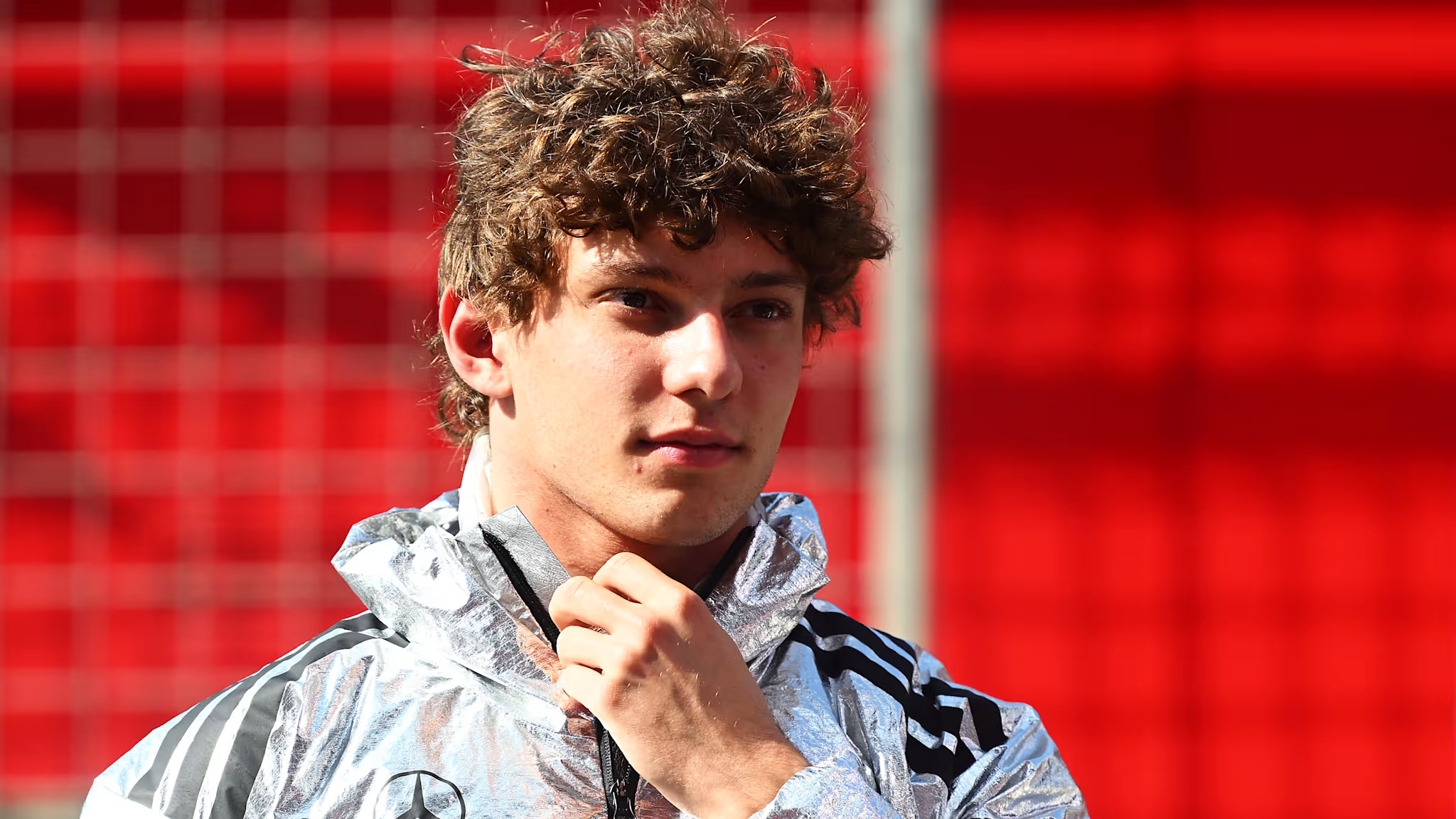
  • Kimi Antonelli Vows to Learn from ‘worst weekend of the season’ in Azerbaijan

    Kimi Antonelli Vows to Learn from ‘worst weekend of the season’ in Azerbaijan

    Key Highlights

    • Kimi Antonelli endured his “worst weekend of the season” at the Azerbaijan Grand Prix, crashing in qualifying and starting 16th before recovering to fifth.
    • Teammate George Russell’s pole-to-victory drive reduced Antonelli’s championship lead from 81 points to 66.
    • Antonelli revealed he carried “big floor damage” after contact with Ollie Bearman at the Safety Car restart, limiting his race pace.

    Disastrous Start in Baku Sets Tone for Difficult Weekend

    Kimi Antonelli’s Azerbaijan Grand Prix weekend unraveled early, with the Italian driver characterizing the event as his “worst weekend of the season” by a significant margin. Technical problems plagued his practice sessions before a dramatic crash in the opening phase of Qualifying relegated him to 16th on the grid. The setback stood in stark contrast to teammate George Russell, who secured pole position for Mercedes, highlighting the fine margins that defined the weekend for the championship leader.

    Race Day Recovery Amid Significant Floor Damage

    Despite the compromised grid slot, Antonelli mounted a determined recovery drive to finish fifth. However, the race was far from straightforward. Contact with Haas driver Ollie Bearman at the Safety Car restart inflicted substantial aerodynamic damage, a factor Antonelli identified as critical to his inability to challenge further forward.

    “I think it’s one of those days where you have to be happy with P5. Obviously it was the worst weekend, by far, of the season.”

    “I was just… I felt always a step behind, and especially with the mistake in Qualifying, the confidence level was not high. In today’s race I just tried to… today was about damage limitation.”

    “I didn’t have strong pace, and also after [contact with Haas’ Ollie Bearman at] the Safety Car restart I was carrying big damage, big floor damage.”

    “It was not easy out there, but I just did my best.”

    Championship Lead Cut as Russell Capitalizes

    The weekend’s championship implications were significant. Russell’s flawless execution—converting pole position into victory—slashed Antonelli’s title advantage from 81 points to 66. The 15-point swing underscores how quickly momentum can shift in a tightly contested season, placing added pressure on Antonelli to maximize every remaining opportunity.

    Antonelli Focused on Mental Reset for Asian Swing

    Looking ahead, the Formula 1 circus heads to Malaysia and Singapore over the next two weekends, marking a busy final phase of the campaign. Antonelli remains confident that Baku represents an anomaly rather than a trend, emphasizing the lessons learned.

    “I think this weekend taught me a lot.”

    “I think in many occasions this weekend… I don’t know, probably also with the mindset I was not in the best pace.”

    “I’ll just make sure that next weekend we get back at the right level.”

    Why This Matters

    The Azerbaijan weekend exposed vulnerabilities in Antonelli’s otherwise dominant season. While a single bad weekend is statistically inevitable over a long championship, the combination of a qualifying error, race-day damage, and a teammate’s maximum score creates a perilous narrative shift. With the championship lead now at 66 points—still substantial but no longer insurmountable—the psychological dynamic changes. Russell has demonstrated he can deliver a perfect weekend when the car is beneath him, and the upcoming street circuits in Singapore (and potentially Malaysia, per the current schedule) demand the precision and confidence Antonelli lacked in Baku. How he responds mentally over the next fortnight will likely define the championship’s final chapter.

    Frequently Asked Questions

    What caused Kimi Antonelli’s poor qualifying performance in Baku?

    Antonelli crashed heavily in the opening phase of Qualifying after technical problems hampered his practice running, leaving him 16th on the grid while teammate George Russell took pole position.

    How much did Antonelli’s championship lead decrease after the Azerbaijan Grand Prix?

    George Russell’s victory from pole reduced Antonelli’s championship lead from 81 points to 66 points, a swing of 15 points in a single weekend.

    What damage did Antonelli sustain during the race?

    Antonelli reported “big floor damage” following contact with Haas driver Ollie Bearman at the Safety Car restart, which he said compromised his pace for the remainder of the race.
  • Five Quick Takeaways from the Azerbaijan Grand Prix

    Five Quick Takeaways from the Azerbaijan Grand Prix

    Key Highlights

    • George Russell converted pole position into victory in Baku, modestly improving his Formula 1 championship prospects.
    • Isack Hadjar delivered a strong Red Bull comeback, qualifying fourth and supporting Max Verstappen on the way to the podium.
    • Franco Colapinto’s restart mistake damaged Alpine’s points chances, while Sergio Perez impressed on the Baku street circuit.

    George Russell makes the most of Mercedes’ Baku advantage

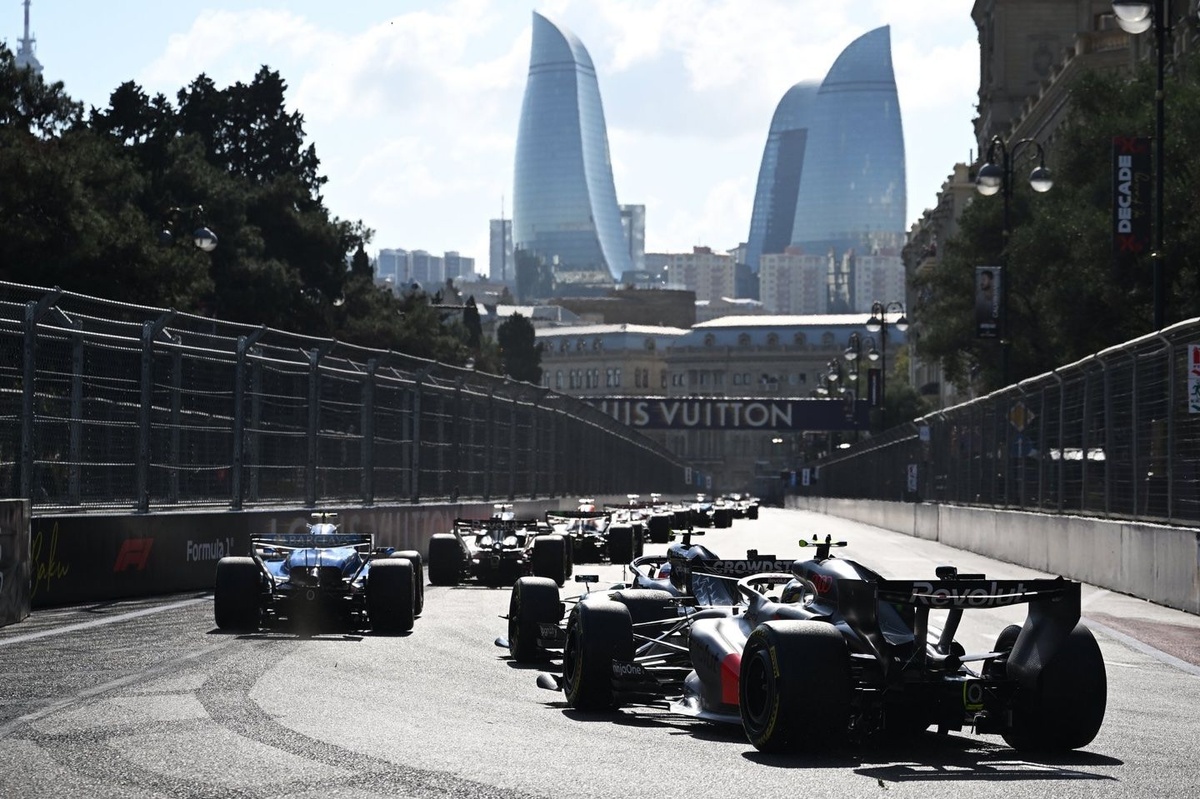
    George Russell produced one of his most convincing weekends of the year at the Azerbaijan Grand Prix, converting a dominant pole position into victory and taking full advantage of a rare difficult weekend for Mercedes team-mate Kimi Antonelli.

    The result does not transform Russell’s Formula 1 championship prospects. His chances may have increased from roughly one percent to about two percent, but there is still no clear championship battle. Given Mercedes’ advantage over its rivals in Baku, expectations of a major title resurgence would be excessive.

    Even so, Russell did everything required of him. He secured pole by a substantial margin, controlled the race and capitalised on Antonelli’s early Q1 mistake, which prevented the Italian from showing his full potential. The weekend was arguably Russell’s strongest of the season apart from Australia.

    Russell’s victory does not prove that he can still win the championship this year. It does, however, serve as an important reminder that the Mercedes driver remains quick and should not be dismissed completely.

    Isack Hadjar validates Red Bull’s long-term confidence

    Isack Hadjar’s position at Red Bull was not considered under serious threat during his recovery from a wrist injury. However, the contract extension handed to the French driver before his Formula 1 return prompted questions about the source of the team’s confidence.

    His performance in Baku provided a strong answer. Hadjar qualified fourth and stayed close to the action after Max Verstappen encountered mechanical problems. He then followed Red Bull’s strategic expectations in the race, giving up a promising position early on to support his team-mate.

    Hadjar acted as Verstappen’s wingman and even urged the reigning Red Bull driver to increase his pace, a dynamic not seen since Sergio Perez’s early years with the team. He handled two Safety Car restarts and pressured Oscar Piastri into a mistake before following Verstappen onto the podium.

    The result marked an impressive comeback for Hadjar and demonstrated why Red Bull has selected him as a long-term team-mate for Verstappen.

    Williams’ FW48 B-spec shows promise but falls short

    Williams arrived in Baku with significant expectations surrounding its long-awaited FW48 B-specification car. The package included an all-new, lighter chassis and a redesigned floor, although the team had described the update as a step toward stronger performance in 2027 rather than a revolutionary transformation.

    The Azerbaijan weekend broadly confirmed that assessment. Williams returned to the midfield fight, and Carlos Sainz progressed to Q3, providing encouragement after a period away from the competitive centre of the field.

    However, the high-speed Baku street circuit appeared well suited to the Mercedes-powered team’s natural strengths. With that advantage, remaining well outside the points picture on Saturday felt like a missed opportunity. The FW48’s performance at the higher-downforce circuits in Malaysia and Singapore will offer a clearer indication of whether the B-spec package can deliver consistent progress.

    Alpine loses points after Franco Colapinto’s costly error

    Alpine appeared set to secure another strong result as the leading team behind the frontrunners for a third consecutive race weekend. Both Franco Colapinto and Pierre Gasly were on course to score points, but the Baku race demonstrated how quickly Formula 1 fortunes can change.

    Following the Safety Car period caused by Alex Albon’s crash, Colapinto arrived too quickly at Turn 1 during the restart. He hit Gasly, who then made contact with Lando Norris’s McLaren, turning a promising Alpine result into a costly setback.

    Colapinto quickly apologised to Gasly and the entire Alpine team. The incident came while Alpine is engaged in a close battle with Racing Bulls for fifth place in the constructors’ championship, increasing the significance of the lost opportunity.

    The team’s response will attract attention after the tension between Gasly and Colapinto at the end of the previous race in Madrid, followed by online abuse aimed at Gasly. Alpine’s handling of the latest incident, both internally and publicly, will be closely watched.

    Sergio Perez underlines his strength on street circuits

    Sergio Perez showed his street-racing expertise in Baku, finishing 13th in Thursday’s second practice session and running one second per lap faster than Cadillac team-mate Valtteri Bottas. Bottas had a new floor and dampers for qualifying, which he described as transformative, but Perez was significantly stronger in the race, pulling away from him by between one and two seconds per lap.

    Perez’s precise driving style is particularly effective on street circuits. He can manipulate the rear axle into a controlled slide without putting the car into the barriers, and he has moved beyond the unruly approach that characterised the early part of his Formula 1 career. His ability to manage his tyres has made him an archetypal ‘tyre whisperer’.

    While watching FP2 from the Cadillac garage, the team observed Perez’s technique closely. At one stage, race engineer Carlo Pasetti asked Perez about what appeared to be an unusual braking approach into Turn 1.

    “Baku style,” replied Perez, keeping a few secrets in his box.

    In the race, Perez initially shadowed the Audi cars and opened a gap of more than 20 seconds to Bottas. The Safety Car disruption briefly gave him an opportunity to take 13th place from faster cars, but Gabriel Bortoleto and Oscar Piastri eventually passed him.

    Perez finished 15th, a modest result that did not reflect the quality of his drive. His performance received less attention because the focus was on the leading battle between George Russell and Max Verstappen, but the large gap to Bottas before the Finn’s final-lap crash was notable for the Cadillac pit wall.

    Why This Matters

    The Baku weekend highlighted several important trends across the Formula 1 field. Russell’s win keeps a small possibility of a championship recovery alive while confirming that Mercedes can exploit its performance advantage when its lead driver executes cleanly. Red Bull’s confidence in Hadjar was also reinforced by a podium-supporting performance under pressure.

    Further down the field, Williams still needs to establish whether its FW48 B-spec can provide reliable gains beyond circuits naturally suited to its package. Alpine’s clash showed how quickly points can disappear in a constructors’ battle, while Perez’s pace underlined the value of street-circuit expertise even when the final result does not reflect the quality of the performance.

    Frequently Asked Questions

    Did George Russell become a serious championship contender after winning in Baku?

    No. Russell’s victory modestly improved his already small title prospects, but it did not create a clear championship battle.

    Why was Isack Hadjar’s Red Bull performance significant?

    Hadjar qualified fourth, supported Max Verstappen during the race, handled two Safety Car restarts and finished on the podium. The result supported Red Bull’s decision to extend his contract and plan for him as Verstappen’s long-term team-mate.

    What happened between Alpine’s Franco Colapinto and Pierre Gasly?

    Colapinto arrived too quickly at Turn 1 during a Safety Car restart and hit Gasly. Gasly then made contact with Lando Norris, costing Alpine a strong chance of scoring points.

  • Alex Albon and Carlos Sainz Reveal Plans for F1 Boys’ Trip

    Alex Albon and Carlos Sainz Reveal Plans for F1 Boys’ Trip

    Key Highlights

    • Alex Albon and Carlos Sainz say a small group of Formula 1 drivers plans to remain in Asia for a boys’ trip between the Bahrain and Singapore Grands Prix.
    • Williams introduced a major FW48 upgrade package at the Azerbaijan Grand Prix, with Sainz qualifying ninth and Albon 13th.
    • Sainz will start the Baku race from 14th after receiving a five-place grid penalty for failing to slow under yellow flags.

    Alex Albon and Carlos Sainz reveal F1 drivers’ Asia trip plans

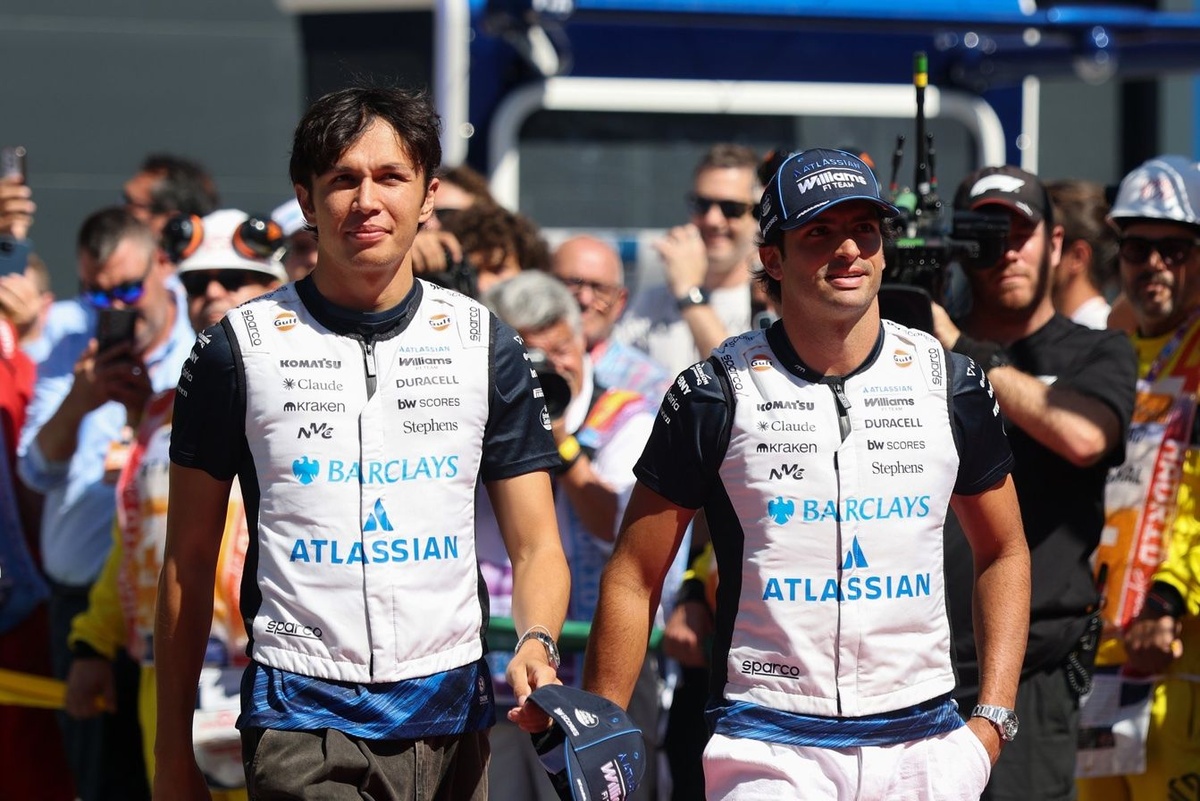
    Williams team-mates Alex Albon and Carlos Sainz have revealed that a small group of Formula 1 drivers will use the gap between the rescheduled Bahrain Grand Prix and the Singapore Grand Prix for a boys’ trip.

    The Bahrain Grand Prix will be held at the Sepang International Circuit in Malaysia because of the conflict in the Middle East. The revised schedule has given drivers the opportunity to remain in Asia between the two races instead of returning to their team bases.

    “We’re going to go on like a boys’ trip, I guess,” Albon said during an interview in the Fan Zone ahead of the Azerbaijan Grand Prix. “I think there are a few drivers where we’re going to hang out.”

    Sainz added: “Yeah, it’s going to be [a boys’ trip]. We just realised no one’s bringing their girlfriend. But it’s not like we’re going to do anything exciting. We’re going to be in a resort in the middle of nowhere.”

    Williams brings major FW48 upgrade to Baku

    The drivers’ travel plans come during an important weekend for Williams, which has introduced a major upgrade package for its FW48 at the Azerbaijan Grand Prix. After arriving at pre-season testing in Bahrain with an overweight car, the Grove-based team has worked on a B-specification car for Baku.

    The upgraded Williams machinery helped Sainz qualify ninth and Albon qualify 13th for the Azerbaijan Grand Prix. However, Sainz will begin the race from 14th after being handed a five-place grid penalty for failing to slow under yellow-flag conditions.

    The Spaniard also received two penalty points, taking his total to four points during the 12-month period. Sainz and Albon currently occupy 16th and 17th in the drivers’ championship, with six and five points respectively.

    Why This Matters

    The revised Formula 1 calendar has created an extended period in Asia between the Bahrain and Singapore races, allowing drivers to avoid returning to their bases between events. For Williams, the Azerbaijan Grand Prix is also an early test of whether its FW48 upgrade can improve the team’s performance after concerns over the car’s weight during pre-season testing.

    The Azerbaijan Grand Prix will take place at the Baku City Circuit at 3pm local time, which is noon UK time. Sainz’s grid penalty means Williams’ qualifying results will not translate directly into its starting positions for the race.

    Frequently Asked Questions

    Which Formula 1 drivers are planning the trip?

    Williams drivers Alex Albon and Carlos Sainz said that a small group of drivers will spend time together in Asia between the Bahrain and Singapore Grands Prix. They did not identify the other drivers involved.

    Why is the Bahrain Grand Prix being held in Malaysia?

    The Bahrain Grand Prix has been rescheduled to the Sepang International Circuit because of the conflict in the Middle East.

    Where will Carlos Sainz and Alex Albon start in Baku?

    Sainz qualified ninth but will start 14th after a five-place grid penalty. Albon qualified 13th and is set to start from that position.

  • Azerbaijan Grand Prix Preview: Russell’s Golden Opportunity Amid Expected Interruptions at Baku City Circuit

    Azerbaijan Grand Prix Preview: Russell’s Golden Opportunity Amid Expected Interruptions at Baku City Circuit

    Key Highlights

    • George Russell targets a third victory of the 2026 season as Mercedes performance potential aligns with Baku’s circuit characteristics
    • Formula 1 marks ten years of competition at the Baku City Circuit, adding historical significance to the Azerbaijan Grand Prix weekend
    • Russell enters the race second in the Drivers’ Championship following a mid-season slump and renewed form since the summer shutdown

    Baku’s Decade Milestone Sets Stage for Critical Championship Weekend

    Formula 1 arrives at the Baku City Circuit this weekend to commemorate a decade of Grand Prix racing on the Caspian Sea coastline. Since its debut in 2016, the Azerbaijan street circuit has established itself as one of the calendar’s most unpredictable venues, combining high-speed straights with a treacherous castle section that has produced dramatic championship moments. The 2026 edition carries heightened stakes as the championship enters its decisive phase, with the circuit’s unique demands offering opportunities for drivers and teams to alter the title trajectory.

    Russell’s Mercedes Resurgence Creates Winning Opportunity

    George Russell approaches Baku with what represents a golden opportunity to secure his first victory in seven rounds. Despite the demonstrated performance potential of the Mercedes W16 throughout the 2026 campaign, the British driver has converted that pace into just two wins to date. Russell endured a challenging mid-season period that stalled his championship challenge before an uptick in form coinciding with the return from the summer shutdown. The Mercedes package has historically suited Baku’s blend of power sensitivity and aerodynamic efficiency, and Russell’s current momentum positions him as a leading contender to capitalize on the circuit’s overtaking opportunities and frequent safety car interventions.

    Championship Implications Intensify at Azerbaijan Grand Prix

    Russell’s position as runner-up in the Drivers’ Championship adds strategic complexity to his Baku weekend. With the title fight entering its critical closing stages, every point carries amplified significance. The Azerbaijan Grand Prix has historically delivered high-attrition races where championship leaders have lost ground, and Russell’s recent form trajectory suggests he possesses the machinery and momentum to exploit any vulnerabilities among his rivals. The convergence of Mercedes’ technical suitability, Russell’s rediscovered rhythm, and Baku’s propensity for race-changing incidents creates a compelling narrative for the sport’s tenth visit to the Azerbaijani capital.

    Why This Matters

    The 2026 Azerbaijan Grand Prix represents a pivotal junction in the championship calendar. As Formula 1 celebrates ten years at Baku, the circuit’s reputation for unpredictability intersects with a title fight that has seen momentum shift repeatedly. Russell’s pursuit of a third victory is not merely a statistical milestone; it would signal Mercedes’ sustained competitiveness and potentially reset the championship dynamics heading into the final flyaway races. For the broader paddock, Baku serves as a litmus test of racecraft under pressure, where strategic acumen and adaptability often outweigh pure pace. The outcome will likely influence development trajectories and driver market perceptions as the season approaches its conclusion.

    Frequently Asked Questions

    How many wins does George Russell have in the 2026 Formula 1 season?

    George Russell has won two races during the 2026 Formula 1 season entering the Azerbaijan Grand Prix weekend.

    What is George Russell’s current position in the 2026 Drivers’ Championship?

    Russell sits second in the 2026 Drivers’ Championship standings ahead of the Baku round.

    Why is the 2026 Azerbaijan Grand Prix significant for Formula 1?

    The 2026 Azerbaijan Grand Prix marks the tenth anniversary of Formula 1 racing at the Baku City Circuit, celebrating a decade since the venue joined the calendar in 2016.

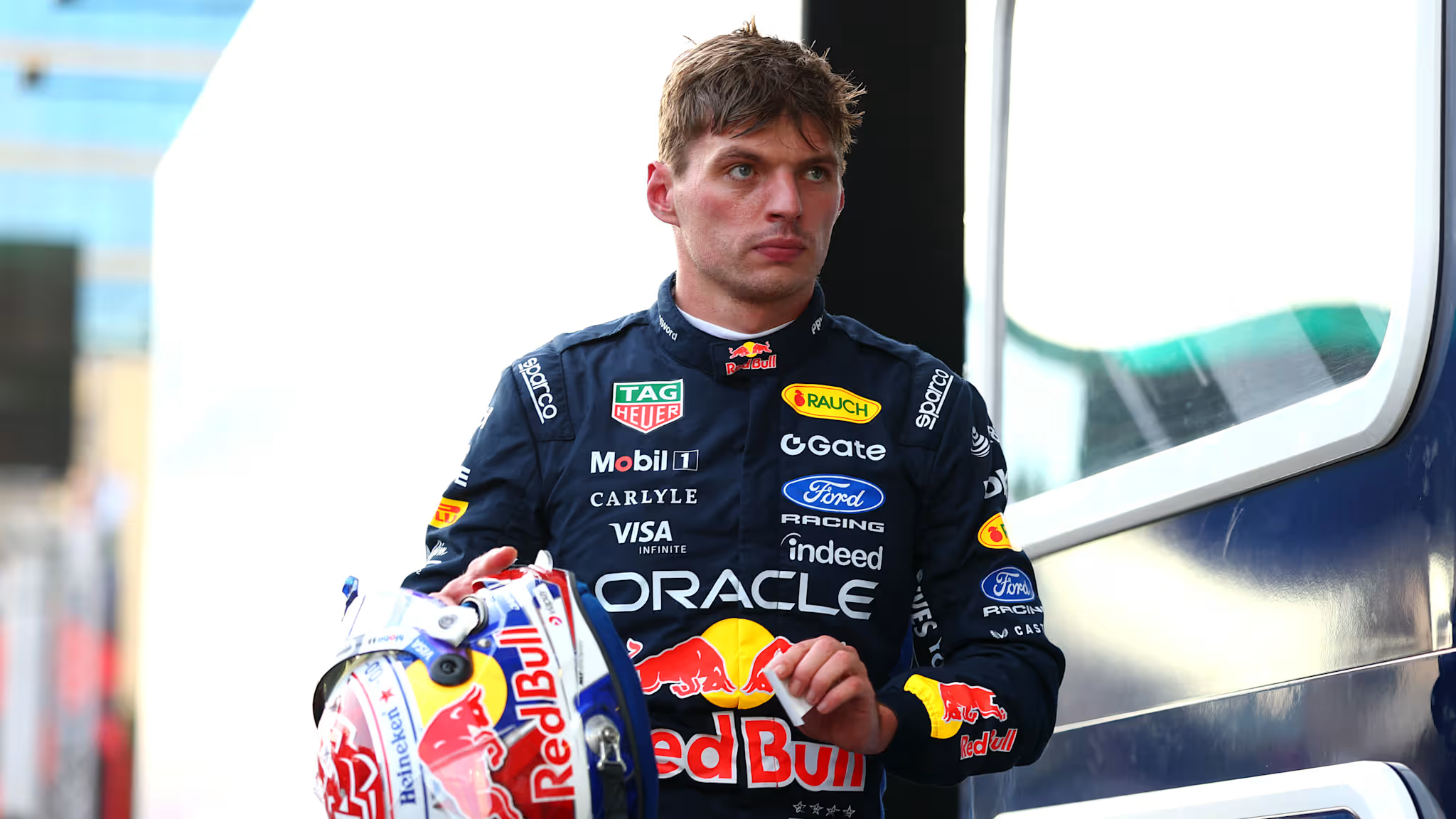
  • Max Verstappen Slams Red Bull as ‘Not Good Enough’ After ‘So Much Trouble’ in 2026 Azerbaijan GP Qualifying

    Max Verstappen Slams Red Bull as ‘Not Good Enough’ After ‘So Much Trouble’ in 2026 Azerbaijan GP Qualifying

    Key Highlights

    • Max Verstappen qualified eighth for the Azerbaijan Grand Prix after engine and battery issues cost him over 1.5 seconds to pole position.
    • Verstappen revealed his power unit was down half a second on straights compared to teammate Isack Hadjar from Q1, with an additional battery deployment failure in Q3.
    • Hadjar delivered a career-best qualifying result with fourth place on his return from a three-race absence due to a wrist injury.

    Verstappen’s Championship Challenge Hit by Power Unit Gremlins in Baku

    Max Verstappen’s bid for a fifth consecutive Formula 1 world championship suffered a significant setback on the streets of Baku as a cascade of power unit failures relegated the four-time title holder to eighth on the grid for the Azerbaijan Grand Prix. After dominating Friday’s final practice session — topping the timesheets ahead of the Mercedes duo of George Russell and Kimi Antonelli — Verstappen entered qualifying as the clear favorite for pole position. Instead, he found himself 1.5 seconds adrift of the front row, watching his championship lead come under renewed pressure.

    Engine Deficit and Battery Failure Derail Q3 Campaign

    The problems began immediately. From the opening segment of qualifying, Verstappen’s Honda power unit was delivering significantly less straight-line speed than the identical unit in his teammate’s car. The deficit — approximately half a second per lap on the long Baku straights — left Red Bull engineers baffled and the Dutch driver permanently on the back foot.

    Any hope of recovery evaporated in Q3. On what Verstappen described as his “middle lap, which is normally a good lap,” the energy recovery system failed to deploy fully exiting Turn 16, the final corner before the start-finish straight. “My battery just didn’t charge to 100%, so I had to abort the lap, which means you lose tyre temperature and around here that’s killing,” Verstappen explained. The aborted lap cost precious tyre temperature on a circuit where heat retention is critical. A subsequent yellow flag triggered by Lando Norris running off track further compromised his final attempt.

    “The whole Qualifying was not how it should be,” Verstappen said. “Already from Q1, my engine is already half a second down on the straight compared to my team mate and they can’t understand why, so you’re just on the back foot. Then in Q3, on my middle lap, which is normally a good lap, exiting the final corner Turn 16, my battery just didn’t charge to 100%, so I had to abort the lap, which means you lose tyre temperature and around here that’s killing. [I] tried to put as much temperature in it, tried to push on the final lap but of course being down on top speed and I had a yellow flag from Lando [Norris off] in front of me meant that’s where we are. It’s not good enough. The whole weekend we are running really well, the car was feeling well and then we run into so much trouble in Qualifying. It’s not good enough.”

    Verstappen acknowledged that matching Russell’s benchmark — eight tenths clear of the field — was likely unrealistic, but insisted second place was achievable. “When you have that many issues, you also don’t deserve to be there,” he added. “We need to be more robust and we need to be on top of these things.”

    Hadjar Shines on Injury Return as Red Bull’s Bright Spot

    While Verstappen struggled, the second Red Bull garage delivered a remarkable performance. Isack Hadjar, returning to Formula 1 after a three-round absence caused by a wrist injury sustained in a practice shunt at Zandvoort, qualified fourth — his best grid position of the season and only the fourth occasion in 2024 he has outqualified his world champion teammate.

    Hadjar’s measured approach paid dividends on a circuit notorious for punishing mistakes. “I’m actually even surprised to be that close from second,” Hadjar said. “It’s good. Even though I feel like there’s still more to come. I feel like I was building up the whole weekend, I didn’t take many risks [in practice], it’s a risky track, I don’t want to hit the wall with my conditions right now. Honestly, I took it quite easy but I felt like there was still more to unlock, even in Q3 I wish we had more laps. All in all, it’s still good.”

    Why This Matters

    Verstappen’s qualifying disaster arrives at a pivotal moment in the championship. With McLaren’s Lando Norris and Oscar Piastri consistently challenging at the front, and Mercedes showing resurgent form through Russell and Antonelli, Red Bull’s constructor lead has evaporated. The Baku street circuit offers limited overtaking opportunities, meaning Verstappen’s eighth-place start severely compromises his race-day points haul. More concerning for Red Bull is the unexplained power unit discrepancy between the two cars — a reliability concern that could resurface across the remaining flyaway races. Meanwhile, Hadjar’s strong showing validates Red Bull’s decision to retain him despite his rookie errors earlier in the season, providing a data baseline for 2025 driver lineup discussions.

    Frequently Asked Questions

    What caused Verstappen’s poor qualifying performance in Baku?

    A combination of an unexplained engine power deficit — approximately half a second per lap on straights compared to his teammate — and a battery deployment failure in Q3 that forced him to abort a flying lap, followed by a yellow flag on his final attempt.

    How did Isack Hadjar perform on his return from injury?

    Hadjar qualified fourth, his best grid position of the 2024 season, and outqualified Verstappen for only the fourth time this year. He adopted a conservative practice program to manage his recovering wrist before delivering a strong qualifying performance.

    What are the championship implications of Verstappen starting eighth?

    Starting eighth at Baku — a circuit with limited overtaking — significantly reduces Verstappen’s chance of a high points finish, allowing title rivals Lando Norris, Oscar Piastri, and George Russell to potentially close the gap in the drivers’ standings.

  • Formula 1 Urged to Rethink Sprint Points System as 2027 Calendar Expands

    Formula 1 Urged to Rethink Sprint Points System as 2027 Calendar Expands

    Key Highlights

    • F1 presenter Will Buxton calls for a points system overhaul and aerodynamic testing reassessment ahead of the 2027 calendar’s expansion to 10 sprint weekends.
    • Buxton argues current sprint points—capped at eight for the winner and only awarded to the top eight—are insufficient and should be extended deeper into the field.
    • Increased sprint races intensify cost cap pressures, potentially requiring revised wind tunnel and CFD allocations tied to championship standings.

    Buxton Demands Sprint Points Reform as 2027 Calendar Expands

    Formula 1 faces mounting pressure to restructure its sprint race points allocation and revisit aerodynamic testing restrictions as the sport prepares for a significantly expanded sprint calendar in 2027. The call comes from veteran motorsports presenter and journalist Will Buxton, who outlined his concerns during an appearance on the Up To Speed podcast alongside co-host and Sky Sports analyst Naomi Schiff.

    The 2027 Formula 1 calendar is slated to feature 10 sprint race weekends across Bahrain, Australia, Japan, Canada, Monaco, Great Britain, Italy, Brazil, Qatar, and Abu Dhabi. Under the current framework, sprint races award points only to the top eight finishers on a descending scale from eight points for the winner down to one point for eighth place. Buxton contends this structure no longer reflects the increased weight of Saturday competition.

    Current Points Structure Deemed Inadequate for Expanded Sprint Role

    “You should get more points. It should go down further. They should reallocate the point structure between sprints and the main one,”

    Buxton asserted. He emphasized that the talent pool is already conditioned for multi-race weekends, noting that nearly every driver on the grid progressed through junior categories such as GP2—now Formula 2—which routinely featured two races per event.

    “Don’t forget as well, every single driver in that field other than Fernando [Alonso] came through junior formulas from GP2, which is now Formula 2, with two races in a weekend. So, it’s not like they’re not used to it.”

    Cost Cap and Aerodynamic Testing Limits Complicate Development

    Beyond points allocation, Buxton highlighted the cascading impact of additional sprint events on the sport’s financial regulations. The introduction of more high-intensity weekends forces teams to recalibrate spending under the existing budget cap, potentially shifting resources toward simulation and wind tunnel work.

    “To your point about development, it might then lead, under the budget cap, to teams having to rethink again how they allocate their spending throughout the year.”

    He explained that aerodynamic development—already concentrated in Computational Fluid Dynamics (CFD) and wind tunnel testing—is governed by a sliding scale of allocated hours based on the previous season’s constructors’ championship finish. More sprint races could necessitate a “rejigging” of these limits to preserve development capacity.

    “The vast majority, which is already the case, but even more of a focus on R&D going through CFD and wind tunnel, and obviously you have the limitations on that based on where you finish the previous championship season.”

    “So that might need a bit of rejigging as well in order to allow a little more time to go into CFD and a little bit more time in the wind tunnel because that’s where the development will ultimately be done.”

    Rookie Session Mandate Adds Further Scheduling Complexity

    Co-host Naomi Schiff, a former W Series driver, added another layer to the operational challenge: the mandatory inclusion of rookie drivers in free practice sessions.

    “Don’t forget we’ve got to get six rookie sessions in. Let’s not forget that as well. Each team has to give away six sessions to a rookie.”

    This requirement, combined with an expanded sprint format, compresses the already limited track time available for race preparation and car setup, intensifying the strategic burden on team principals and sporting directors.

    Why This Matters

    The 2027 sprint expansion represents a fundamental shift in Formula 1’s competitive architecture. With nearly one-third of the calendar designated as sprint weekends, the distinction between “support” events and championship-defining races continues to blur. The current points gradient—designed when sprints were experimental—risks undervaluing performances that increasingly influence title outcomes. Simultaneously, the intersection of the cost cap, aerodynamic testing restrictions (ATR), and mandatory rookie running creates a multi-variable optimization problem for teams. Any recalibration of points or testing allowances will require consensus among the FIA, Formula One Management, and the teams, likely becoming a focal point of Sporting Advisory Committee discussions throughout 2025 and 2026.

    Frequently Asked Questions

    How many sprint weekends are scheduled for the 2027 Formula 1 season?
    The 2027 calendar includes 10 sprint race weekends in Bahrain, Australia, Japan, Canada, Monaco, Great Britain, Italy, Brazil, Qatar, and Abu Dhabi.
    What is the current sprint race points distribution?
    Points are awarded to the top eight finishers: eight for first, seven for second, six for third, descending to one point for eighth place.
    How do aerodynamic testing restrictions (ATR) work under the cost cap?
    ATR allocate CFD and wind tunnel hours on a sliding scale based on the previous season’s constructors’ championship position; lower-placed teams receive more development time to promote convergence.
  • Why Mercedes’ Huge Baku Practice Advantage May Not Be the Real Picture

    Why Mercedes’ Huge Baku Practice Advantage May Not Be the Real Picture

    Key Highlights

    • George Russell topped both Thursday practice sessions at the Baku City Circuit, with Mercedes holding a 0.827-second advantage over Max Verstappen’s Red Bull.
    • Red Bull technical director Pierre Waché admitted the deficit was larger than expected, particularly on straight-line speed, while Mercedes deputy principal Bradley Lord cautioned against reading too much into the times.
    • Championship leader Kimi Antonelli lost critical track time due to a hydraulic failure requiring an engine change, though Mercedes avoided a grid penalty as the replacement unit was from the existing pool.

    Mercedes Dominates Opening Practice in Baku as Russell Sets Pace

    Mercedes delivered a commanding performance during Thursday’s two practice sessions at the Baku City Circuit, with George Russell leading the timesheets in both FP1 and FP2. The British driver’s benchmark left the first non-Mercedes entry — Max Verstappen’s Red Bull — trailing by 0.827 seconds, a margin that immediately caught the attention of rival teams. The session unfolded without Mercedes’ long-awaited upgrade package for the W17, which is slated for debut in Malaysia, making the outright pace on the existing specification all the more striking for the competition.

    Red Bull Concedes Unexpected Straight-Line Deficit

    The scale of the gap prompted a candid assessment from Red Bull technical director Pierre Waché, who acknowledged the deficit exceeded pre-weekend expectations.

    “Yes, I didn’t expect this big gap, mainly on the straights. Afterwards we have to analyse if it’s coming from a tow [or something else]. But yes, we have work to do to achieve what they have achieved”,

    Waché told Motorsport.com. He added that while Red Bull will introduce its final major upgrade package for the RB22 this weekend, the current picture looks challenging.

    “I hope that it’s closer, but it looks like they are a lot quicker than us. We will see what we can do to make the car quicker, but if this is the real delta, then it will be tough for us.”

    Red Bull junior Isack Hadjar, returning to the cockpit after illness, echoed the sentiment, describing Mercedes as “out of touch” relative to the rest of the field.

    “A bit, [and thinking] why they are so far away. I think that’s very impressive. I think we have a good car, we’ve been in the mix with McLaren and Ferrari, but yeah, Mercedes, they are out of touch.”

    Mercedes Urges Caution Despite Commanding Display

    Despite the dominant showing, Mercedes deputy team principal Bradley Lord — standing in for Toto Wolff this weekend — moved quickly to temper expectations. Lord attributed much of the apparent advantage to program differences, noting Mercedes completed more timed laps on the soft compound during FP2.

    “I don’t think it’s a representative gap, honestly. We ran more timed laps on the soft tyre in FP2. Max only had one go, so did the McLarens.

    “Probably don’t read too much into it, because every timed lap you did, the lap times were improving. We did one more than everyone else, and therefore probably found a bit more in the track and a bit more in the tyre than they were able to.”

    Lord highlighted Russell’s strong track record at Baku, where the driver finished second last year despite illness, as a factor in the team’s confidence.

    “George was pretty sick here last year and still finished P2. So it’s a circuit… I mean, he goes well at every circuit, but this is one where traditionally he’s had some really strong results”,

    Lord said. He also emphasized the value of having both cars performing at the front.

    “And that’s what you’re looking for as a team, that if one car hits trouble, the other one’s right up there and leading the way. He’s done that today and hopefully can continue doing that through the rest of the weekend.”

    Antonelli Loses Track Time to Hydraulic Issue

    The “trouble” Lord referenced befell championship leader Kimi Antonelli, who suffered a hydraulic failure during FP1 that forced an unscheduled engine change. The mechanics completed the swap in roughly 15 minutes, readying the car just as a red flag halted FP2.

    “Obviously it’s put him behind the curve a little bit, so he’s just missing laps and missing time out on track, but equally, it was a mega job from the mechanics”,

    Lord explained.

    “The car came back, I think, 15 minutes after practice, and it was ready to go just as the red flag came out in FP2. So they did an epic job to swap the engine, get the old one out and the new one in.

    “No penalty, because it’s one that’s already in the pool, and yeah, we were ready to go. So we’ve at least salvaged as much of the session as we could.”

    The lost running is particularly costly on a street circuit where track evolution is rapid and confidence-building laps are at a premium.

    Rivals Play Down Thursday Significance

    Ferrari team principal Frederic Vasseur dismissed the relevance of Thursday’s timesheet with characteristic bluntness.

    “I’m getting too old to pay too much attention to Friday!”

    When reminded the session took place on Thursday, Vasseur laughed and added:

    “Friday is useless, imagine the Thursday!”

    Why This Matters

    Mercedes’ unexpected pace in Baku reshapes the narrative around the 2025 championship fight. After a season where McLaren and Ferrari have regularly challenged Red Bull, a Mercedes resurgence — especially without its planned upgrade — introduces a three-way battle at the front that few predicted. For Red Bull, the straight-line deficit highlighted by Waché suggests a fundamental aerodynamic or power-unit installation discrepancy that upgrades may not fully resolve at this circuit. Antonelli’s lost track time could prove decisive in a tight qualifying battle, where street-circuit experience and rhythm are critical. With Mercedes’ upgrade still to come in Malaysia, the competitive hierarchy may shift again before the flyaway races conclude.

    Frequently Asked Questions

    Why was Mercedes so far ahead in Baku practice without its new upgrade package?

    Mercedes’ advantage likely stems from a combination of George Russell’s exceptional suitability to the Baku street circuit, a favorable tire preparation strategy that included more soft-compound timed laps than rivals, and strong baseline performance of the current W17 specification. Deputy team principal Bradley Lord explicitly cautioned that the gap is not fully representative.

    Will Kimi Antonelli face a grid penalty for the engine change?

    No. The replacement power unit was drawn from Mercedes’ existing pool allocation, meaning no penalty applies. The mechanics completed the swap during the FP1/FP2 break, allowing Antonelli to participate in the remainder of FP2, albeit with reduced running.

    What is Red Bull’s plan to close the gap this weekend?

    Red Bull is introducing its final major upgrade package for the RB22 at Baku. Technical director Pierre Waché acknowledged the team has “work to do” to match Mercedes’ straight-line speed and overall pace, but the new parts are expected to address some of the aerodynamic shortcomings exposed on Thursday.

  • Racing Bulls’ Mixed Fortunes: Liam Lawson Returns, Arvid Lindblad Crashes in 2026 Azerbaijan GP Practice

    Racing Bulls’ Mixed Fortunes: Liam Lawson Returns, Arvid Lindblad Crashes in 2026 Azerbaijan GP Practice

    Key Highlights

    • Liam Lawson returns to Racing Bulls after a three-race stint at Red Bull, finishing 12th in FP2 and targeting a top-10 qualifying spot.
    • Rookie Arvid Lindblad crashed heavily in FP2 at the castle section, bringing out red flags and causing significant right-side damage to his car.
    • Team Principal Alan Permane refused to punish Lindblad, calling it “rookie enthusiasm” and emphasizing support over criticism.

    Lawson Returns to Familiar Surroundings as Racing Bulls Reset in Baku

    Racing Bulls experienced a Thursday of contrasting fortunes on the streets of Baku, with Liam Lawson settling back into the squad after his temporary promotion to Red Bull Racing while rookie Arvid Lindblad learned a harsh lesson on the unforgiving Azerbaijan circuit. The New Zealander completed a solid FP1 in seventh place before slipping to 12th in the afternoon session, while the British youngster’s day ended prematurely against the barriers.

    Lindblad’s Rookie Error Brings Out Red Flags

    The second practice session told a dramatically different story for the team’s newest addition. Twenty minutes into FP2, Lindblad clouted the walls through the castle section, bringing out the red flags and causing significant damage to the right-hand side of his machinery. The incident echoed his previous FP2 crash in Madrid, raising questions about his adaptation to street circuits. The British driver radioed his team to apologise, saying he’d just clipped the wall by a millimetre. He also faced a scary moment earlier in the session when the Ferrari of Lewis Hamilton suddenly appeared in front of him in the final sector while he was on a hot lap, forcing him to take avoiding action.

    Permane Offers Support Over Punishment for Young Driver

    Speaking after the session, Team Principal Alan Permane made it clear he would not come down hard on his rookie. “It’s not the time to come down on him like a ton of bricks, it’s the time to support him. It was a millimetre. It’s a bit of a shame. It’s certainly not the right time to crash like that, if that was Q3 and he was absolutely going for it, you can understand it. But it’s a little bit of ‘the car was feeling good’. I think it’s just a little bit of rookie enthusiasm, but nothing more than that.” Permane added that Lindblad was looking quick on that lap and the team are going to take that as a positive going into the rest of the event.

    Welcome Return for Lawson After Red Bull Loan Spell

    Permane also welcomed the fact the squad have Lawson back after a three-race stint covering Isack Hadjar at sister team Red Bull Racing. “Much as we love Yuki [Tsunoda] — and the whole team does, he’s a very popular figure – it’s good to have Liam back in his car, in the team, working very, very well with Arvid, and those two lift each other up through the weekend.” Lawson himself expressed satisfaction at the reunion. “Honestly, it was good. This morning we were quite strong. We definitely didn’t have the same performance in FP2, where everybody else made a decent step, so we have to look at that and try and improve things for tomorrow. But overall, it’s good. It’s nice to be back in my car. It feels like home, but we have some work to do to match those guys.” The New Zealander confirmed the team will be working overnight to improve in the low speed corners to try and get themselves into the top 10 in Qualifying on Friday.

    Why This Matters

    The Azerbaijan Grand Prix represents a critical juncture for Racing Bulls’ driver development strategy. With Lawson’s return from his Red Bull Racing audition, the team gains valuable experience and a benchmark for car performance, while Lindblad’s baptism of fire on a street circuit highlights the steep learning curve facing rookie drivers in Formula 1. The team’s decision to support rather than sanction Lindblad signals a long-term developmental approach, prioritizing confidence-building over immediate results. As the only practice session before Friday qualifying under the sprint format, Thursday’s running carried outsized importance, and the overnight work on low-speed corner performance will determine whether Racing Bulls can translate their FP1 promise into a competitive grid position.

    Frequently Asked Questions

    Why was Liam Lawson driving for Red Bull Racing recently?

    Lawson completed a three-race stint at Red Bull Racing covering for Isack Hadjar before returning to his regular Racing Bulls seat for the Azerbaijan Grand Prix weekend.

    What caused Arvid Lindblad’s crash in FP2?

    Lindblad clipped the wall by a millimetre through the castle section of the Baku street circuit, bringing out red flags and causing significant damage to the right-hand side of his car.

    What are Racing Bulls’ priorities for Friday qualifying?

    The team will work overnight to improve performance in low-speed corners, with Lawson targeting a top-10 qualifying position after the car lost pace relative to competitors in FP2.

  • F1 Azerbaijan Grand Prix Friday Schedule, Weather Forecast and How to Watch

    F1 Azerbaijan Grand Prix Friday Schedule, Weather Forecast and How to Watch

    Key Highlights

    • Mercedes dominates Azerbaijan GP Friday practice with George Russell topping FP2 by over half a second ahead of championship leader and teammate Kimi Antonelli.
    • Opening day disrupted by multiple incidents: Arvid Lindblad crashed at the castle section, Oliver Bearman suffered a power unit failure, and Fernando Alonso completed just nine laps due to a suspected oil leak.
    • Friday brings significantly cooler, windier conditions with northerly gusts up to 75 km/h and possible light showers, creating unpredictable car balance ahead of qualifying.

    Mercedes Sets Early Pace in Baku

    Formula 1 arrives at Friday’s running in Baku with Mercedes firmly in control after a commanding second practice session for the 2026 Azerbaijan Grand Prix. George Russell led the way with a benchmark lap that placed him more than half a second clear of the field, while championship leader Kimi Antonelli secured a Mercedes 1-2 in his second season with the Silver Arrows. The performance underscores the team’s strong adaptation to the 2026 technical regulations and positions both drivers as early favorites for pole position.

    Max Verstappen split the Mercedes duo in third for Red Bull, though the gap of over 0.5 seconds to Russell suggests the reigning champions have work to do overnight. Charles Leclerc followed in fourth for Ferrari, with Lewis Hamilton rounding out the top five in the second Ferrari. Lando Norris led McLaren’s efforts in sixth after the Woking squad spent Thursday evaluating a substantial upgrade package introduced for the Baku weekend.

    Incidents Disrupt Opening Running

    The first day of track action was far from straightforward for several competitors. Arvid Lindblad brought out the red flags after crashing at the narrow castle section, a notorious pinch point on the Baku City Circuit where the historic walls leave zero margin for error. Shortly after the session resumed, Oliver Bearman reported a power unit failure that ended his running prematurely.

    Perhaps most concerning for Aston Martin, Fernando Alonso managed just nine laps before a suspected oil leak sidelined the two-time champion’s AMR26. The limited mileage leaves Alonso and the team with a compressed timeline to dial in the car setup during Friday’s sole remaining practice hour before qualifying.

    McLaren Works Through Upgrade Package

    McLaren’s Thursday focus centered on correlating wind tunnel and CFD data with on-track performance for their latest development package. Norris’s sixth-place finish suggests the updates are functioning as intended, though the team will use FP3 to further optimize aerodynamic balance and tire management across Baku’s unique blend of high-speed straights and tight, twisty sectors. Teammate Oscar Piastri’s session data will provide crucial comparative feedback as McLaren targets a return to the sharp end of the grid.

    Friday Schedule and Broadcast Details

    The Baku City Circuit hosts final practice at 12:30 pm local time (AZT) on Friday, September 25, followed by qualifying at 4:00 pm AZT. For international viewers, the sessions translate to 9:30 am BST / 1:00 pm BST in the United Kingdom and 4:30 am ET / 8:00 am ET for US Eastern Time audiences.

    Broadcast coverage varies by region: Apple TV serves as the primary US broadcaster for the 2026 season under a multi-year agreement, with all sessions streaming live on the platform. F1 TV remains the championship’s global subscription streaming service. UK viewers can watch every session live on Sky Sports, with streaming via Sky Go or NOW, while Channel 4 provides free-to-air highlights. Motorsport.com will deliver live text coverage and updates throughout the weekend.

    Weather Could Play Decisive Role

    Meteorological forecasts indicate a significant shift in conditions for Friday. Temperatures are expected to drop to around 24°C during FP3 before falling into the low-20s for qualifying, accompanied by increased cloud cover and substantially stronger northerly winds. Gusts could reach 75 km/h during final practice and 65 km/h during qualifying, posing a distinct challenge on Baku’s exposed 2.2-kilometer main straight and heavy braking zones.

    Light showers are possible toward the end of FP3 and during qualifying, though only minimal precipitation is currently predicted. The wind factor may prove more influential, potentially destabilizing car balance under braking and through the high-speed turns of Sector 2. Saturday’s race day is forecast to improve considerably, with clearer skies and temperatures around 25°C.

    Why This Matters

    The Azerbaijan Grand Prix has historically produced unpredictable outcomes due to the Baku City Circuit’s unique characteristics: a street layout combining ultra-fast straights with tight, wall-lined sections that punish the slightest error. Mercedes’ Friday pace suggests they have extracted strong performance from the 2026 regulation package, but the compressed Saturday schedule — with just one practice hour before qualifying — amplifies the importance of overnight setup work. The forecast wind conditions add a variable that could shuffle the competitive order, particularly for teams struggling with aerodynamic sensitivity. With the championship battle still in its early phases, a strong result in Baku could set the tone for the European swing of the 2026 calendar.

    Frequently Asked Questions

    What time is qualifying for the 2026 Azerbaijan Grand Prix?

    Qualifying begins at 4:00 pm local time (AZT) on Friday, September 25. That corresponds to 1:00 pm BST in the UK and 8:00 am ET in the US Eastern Time zone.

    How can I watch the Azerbaijan GP in the United States?

    All sessions are available live on Apple TV, which is Formula 1’s primary US broadcast partner for the 2026 season under a multi-year deal. F1 TV also streams every session globally via subscription.

    Why is wind such a factor at the Baku City Circuit?

    Baku features a 2.2-kilometer main straight and several exposed sections where strong crosswinds and headwinds can destabilize cars under braking and through high-speed corners. Gusts forecast up to 75 km/h could make car balance unpredictable, particularly during qualifying when teams run low fuel and maximum engine modes.

  • Imola Builds Grandstands as Abu Dhabi Plan A Emerges for F1 Season Finale

    Imola Builds Grandstands as Abu Dhabi Plan A Emerges for F1 Season Finale

    Key Highlights

    • Formula 1 has authorized Imola’s Autodromo Enzo e Dino Ferrari to begin constructing grandstands and preparing for a potential 2026 season finale as a contingency plan (Plan B) should the Qatar and Abu Dhabi Grands Prix be cancelled due to Middle East unrest.
    • Formula One Management (FOM) is covering all financial risks for Imola’s preparations, including temporary grandstand construction, ensuring the circuit faces no financial exposure regardless of whether the race ultimately takes place.
    • The decision deadline has shifted from mid-September to mid-October, with team principals confirming the new timeframe while emphasizing logistical challenges like European motorhome staffing rather than weather concerns.

    Formula 1 Activates Imola Contingency for 2026 Season Finale

    Plan B Preparations Underway Amid Middle East Uncertainty

    As Formula 1 enters the final phase of the 2025 season with three triple-headers on the calendar, attention has turned to the conclusion of the 2026 campaign. While the Qatar and Abu Dhabi Grands Prix remain scheduled as the season-ending events—constituting what F1 refers to as “Plan A”—the sport is actively preparing for a scenario in which continued unrest in the Middle East forces their cancellation. Behind the scenes, the green light has been given to develop a robust Plan B centered on the Autodromo Enzo e Dino Ferrari in Imola.

    Sources within F1 have confirmed to Motorsport.com that organizers in Imola have now been instructed to build grandstands and continue all preparatory work as if the Emilia-Romagna Grand Prix will take place on the first weekend of December. This proactive stance does not guarantee the race will happen; Qatar and Abu Dhabi remain the primary target. However, Formula One Management (FOM) must press ahead with an alternative to guarantee a season finale after the Las Vegas Grand Prix in any eventuality.

    Financial Risk Absorbed by Formula One Management

    Building grandstands and maintaining full operational readiness without final confirmation carries significant financial risk. According to paddock sources, F1 is covering all those risks directly. This means FOM is fully paying for the preparations—including the construction of the temporary grandstands—and Imola will not face any financial liability regardless of the outcome. Should the Imola option ultimately prove unnecessary, this approach will cost F1 money, but the sport views it as a necessary insurance policy. If the situation in the Middle East escalates further a month before the scheduled races in Qatar and Abu Dhabi, F1 cannot afford to be without a ready-to-deploy alternative. The strategy also underscores F1’s desire to wait as long as possible before making a final decision, while acknowledging the substantial financial attractiveness of the final two race weekends in the Middle East.

    Decision Timeline Shifts to Mid-October

    F1 CEO Stefano Domenicali initially indicated a decision would be made in mid-September, but the evolving geopolitical landscape has altered that schedule. Several team principals now point to mid-October as the new timeframe for clarity, although F1 stresses there is no hard deadline. From a logistical perspective, there remains relatively little urgency at this stage, provided Imola is fully ready to step in by the first weekend of December.

    The teams have been informed of this reality and are not particularly concerned for now, a sentiment echoed during Thursday’s press conference in Baku. Haas team boss Ayao Komatsu stated:

    “I believe that Stefano was targeting to tell us in mid-October, right? So, we all know what the situation is. I believe that Imola is getting ready in case we have to do it. I think the challenges are, for instance, things like European motorhome structure, etcetera. All those people who look after them, they have a winter job, so we need to find alternative people to do that. But I’m sure we all, as a family, community, will make sure if we have to do that, that will happen. But hopefully, as a baseline, we can go to Qatar and Abu Dhabi. That would be really good.”

    Audi team principal Mattia Binotto shares the same view and confirms the mid-October timeframe.

    “As we discussed during the F1 Commission last Monday, mid-October is the last call for such a decision.”

    Teams Briefed on Logistical Realities

    Binotto does not see potentially low temperatures as an obstacle to a possible season finale in Imola.

    “The main challenges are more organisation and logistics, I would think. From a technical point, often we may say wintertime, snow tyres, but at the end, as a matter of fact, the average temperature in Imola in that time of the year is hotter than Las Vegas by the time we’ve got the race in Las Vegas. So I don’t think that’s a true concern. It’s more from the organisation and the logistics, really. And again, mid-October, hopefully we may do the right decision.”

    The primary logistical hurdle identified by both Komatsu and Binotto revolves around the European motorhome infrastructure. Support staff who typically manage these facilities have winter employment commitments, requiring F1 and teams to source alternative personnel if the Imola race proceeds. Despite these complexities, the paddock mood remains pragmatic, with a clear preference for the established Middle East finale but full readiness to adapt.

    Why This Matters

    The activation of a formal Plan B for the 2026 season finale highlights the increasing complexity of managing a global sporting calendar amid geopolitical volatility. Formula 1’s commitment to covering Imola’s preparation costs—estimated to be substantial given the need for temporary grandstands and full circuit homologation—demonstrates the high stakes involved in protecting the integrity of the championship schedule. The Middle East races in Qatar and Abu Dhabi are not only lucrative but strategically vital to F1’s commercial model, making their potential loss a significant financial and operational blow. The shift of the decision deadline to mid-October reflects a calculated balance: maximizing the window to assess the security situation while retaining enough time to execute a European pivot. For teams, the logistical scramble—particularly re-staffing motorhome operations deep into the off-season—underscores the human resource challenges that often accompany calendar fluidity. Ultimately, this contingency planning ensures that whatever unfolds in the Middle East, Formula 1 can crown its 2026 champions on track, not in a boardroom.

    Frequently Asked Questions

    Why is Formula 1 preparing Imola as a backup for the 2026 season finale?

    Formula 1 is preparing Imola as a contingency (Plan B) because continued unrest in the Middle East creates a risk that the scheduled season-ending races in Qatar and Abu Dhabi could be cancelled. F1 needs to guarantee a finale after the Las Vegas Grand Prix regardless of geopolitical developments.

    Who is paying for the Imola preparations?

    Formula One Management (FOM) is covering all financial risks associated with Imola’s preparations, including the construction of temporary grandstands. The circuit will not face any financial liability whether the race proceeds or not.

    When will a final decision be made on the 2026 season finale location?

    While F1 stresses there is no hard deadline, multiple team principals—including Ayao Komatsu (Haas) and Mattia Binotto (Audi)—indicate mid-October as the expected timeframe for a final decision, aligning with discussions at the recent F1 Commission meeting.