Author: Evan Mercer

  • UAE, Sweden Arrest Seven Over $7.1M Crypto Laundering Ring Linked to Contract Killings

    UAE, Sweden Arrest Seven Over $7.1M Crypto Laundering Ring Linked to Contract Killings

    Key Highlights

    • Seven suspects arrested in coordinated UAE-Sweden operation targeting an international money laundering network that moved approximately 70 million Swedish krona ($7.1 million) over ten months using cryptocurrency.
    • The alleged Swedish leader, wanted on an Interpol Red Notice, was detained in the UAE while six associates were simultaneously apprehended in Sweden following extensive intelligence sharing.
    • Blockchain analysis of crypto transactions uncovered financial links to organized crime and contract killings, advancing Sweden’s push to seize illicit digital assets amid rising gang violence.

    Cross-Boor Operation Dismantles Crypto-Enabled Laundering Ring

    Authorities in the United Arab Emirates and Sweden have executed simultaneous arrests of seven individuals alleged to operate a transnational money laundering network that processed roughly 70 million Swedish krona ($7.1 million) over a ten-month period. The operation, announced by the UAE Ministry of Interior via the Emirates News Agency, marks a significant milestone in bilateral law enforcement cooperation targeting the use of cryptocurrency to obscure criminal proceeds.

    The suspected ringleader, a Swedish national who had fled his home country, was tracked down and detained in the UAE while wanted under an Interpol Red Notice. Six additional suspected network members were arrested in Sweden at the same moment, with legal proceedings initiated against all seven individuals. The Ministry of Interior has not publicly identified any of the suspects.

    Cryptocurrency Trail Exposes Links to Violent Crime

    Investigators emphasized that following the network’s cryptocurrency transactions proved pivotal. According to the UAE Ministry of Interior, tracing the digital asset flows and analyzing associated digital evidence “helped uncover financial links to other criminal activities, including organised crime and contract killings.” The network allegedly dealt in cash proceeds from criminal activity, redirecting them to other criminal entities while using cryptocurrencies “to transfer and move the value of those funds.”

    The revelation aligns with Sweden’s intensified focus on illicit cryptocurrency activity. The country’s Minister of Justice last year ordered police forces to step up seizures of criminal digital assets. Contract killings have become a documented crisis in Sweden, with Swedish police reporting in May that 23 bystanders had been killed and 30 wounded in gangland shootings over a three-year span. Gangs have increasingly exploited social media and encrypted messaging applications to recruit paid killers, frequently teenagers below the age of criminal responsibility.

    Bilateral Coordination Called Decisive

    Senior officials from both nations highlighted the depth of coordination required. Brigadier Abdulaziz Al Ahmad, director general of the Federal Criminal Police at the UAE Ministry of Interior, stated the country would “continue to track criminal networks, disrupt their sources of financing, and take legal action against anyone seeking to exploit the country’s territory for criminal activities.”

    Anders Wiberg, the Swedish Police Authority’s police commissioner and head of its international division, described cooperation with the UAE as “a key factor in achieving the successful outcome of this case.” The arrests followed what the ministry characterized as extensive searches, investigations, and close monitoring to pinpoint the gang leader’s whereabouts, enabled by direct security coordination and intelligence sharing between the two governments.

    Why This Matters

    This case illustrates the growing intersection of cryptocurrency forensic capabilities and traditional organized crime investigations. As criminal networks adopt digital assets to launder proceeds, law enforcement agencies are developing blockchain analytics expertise to trace fund flows that would otherwise remain opaque. The UAE-Sweden partnership demonstrates how Interpol Red Notices, combined with real-time intelligence exchange, can overcome jurisdictional barriers that historically allowed fugitives to operate with impunity. For Sweden, the operation validates its strategic pivot toward aggressive crypto asset seizure policies amid a surge in gang-related violence that has claimed innocent bystanders. The involvement of juvenile contract killers recruited via encrypted platforms adds urgency to efforts targeting the financial infrastructure enabling such recruitment.

    Frequently Asked Questions

    How much money did the network launder and over what period?
    The network handled approximately 70 million Swedish krona (about $7.1 million) over a ten-month period, according to the UAE Ministry of Interior.
    What role did cryptocurrency play in the investigation?
    Cryptocurrency was used to transfer and conceal the value of illicit funds. Tracing those transactions and analyzing digital evidence led investigators to uncover financial links to organized crime and contract killings.
    Who were the key officials commenting on the operation?
    Brigadier Abdulaziz Al Ahmad, director general of the Federal Criminal Police at the UAE Ministry of Interior, and Anders Wiberg, Swedish Police Authority commissioner and head of its international division, both emphasized the importance of bilateral cooperation in securing the arrests.
  • Layer-2 and DeFi Tokens Lead Broad Crypto Advance as Post-Fed Hike Nerves Fade

    Layer-2 and DeFi Tokens Lead Broad Crypto Advance as Post-Fed Hike Nerves Fade

    Key Highlights

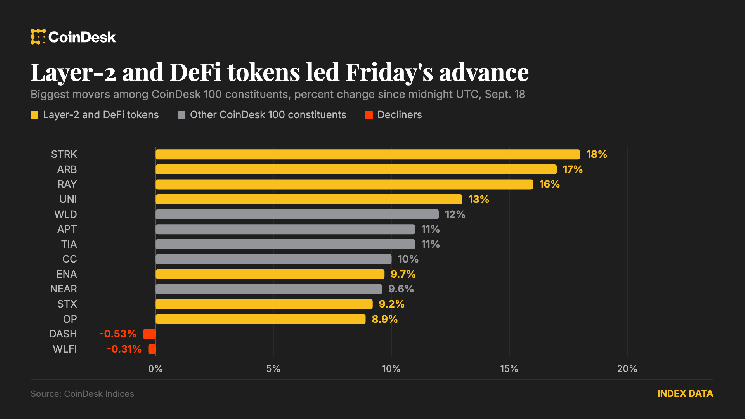
    • DeFi and Layer-2 tokens led a broad crypto market rally Friday, with the DeFi Select Index surging 16% in 24 hours as risk-on sentiment returned following the Fed rate decision.
    • Bitcoin reclaimed $78,000 while Uniswap (UNI) futures open interest neared a record high, signaling strong institutional conviction in major DeFi protocols.
    • Implied volatility dropped to May lows and options skew turned short-term bullish for BTC and ETH, suggesting traders expect near-term market calm after key macro events cleared.

    DeFi and Layer-2 Tokens Spearhead Post-Fed Risk-On Rotation

    Cryptocurrency markets extended their post-Federal Reserve rally into Friday, with a pronounced sector rotation shifting leadership from privacy and haven assets toward decentralized finance (DeFi) and Layer-2 scaling tokens. The DeFi Select Index (DFX) accelerated fastest among major benchmarks, surging 8.3% since midnight UTC and 16% over the trailing 24-hour period, reflecting a broad-based return to risk-on positioning across digital asset markets.

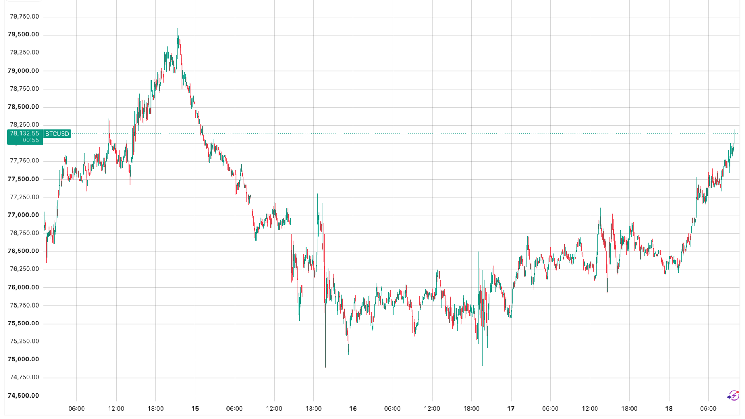
    Bitcoin $BTC rose above $78,000 during the European morning session, adding 2.1% since midnight UTC and 1.9% over the past 24 hours to trade at $78,192.86. Despite the advance, the largest cryptocurrency remains approximately 5% below its September 4 monthly high of $82,284 after two weeks of range-bound price action. The CoinDesk 100 index showed near-universal gains, with all but two constituents trading higher on the day.

    Macroeconomic Backdrop Fuels Risk Appetite

    The rally unfolded against a more conducive macroeconomic backdrop. The 10-year U.S. Treasury yield slipped back below the psychologically significant 5% threshold, while Brent crude eased under $103 per barrel after touching $109 earlier in the week. This combination relieved some of the inflation pressure that had followed the latest rate increase. Traditional risk assets mirrored the optimism, with S&P 500 and Nasdaq 100 futures rising 0.3% and 0.6% respectively, while gold and silver added 1.1% and 2.8%.

    Derivatives Data Reveals Structural Capital Inflows

    Futures Open Interest Expands as Volume Dips

    The crypto futures market is signaling a revival in positional trading rather than speculative churn. Cumulative open interest (OI) expanded nearly 5% to $141.2 billion, contrasting with a 3% decline in daily trading volume to $95 billion. The taker buy-sell volume remains balanced, suggesting capital is entering the market structurally rather than through aggressive momentum chasing.

    Bitcoin Positioning Builds Gradually

    Bitcoin futures open interest ticked up to 680,000 BTC from 670,000 BTC since midnight UTC, a modest increase accompanying the price advance. This combination typically represents a build-up of long, or bullish, positions. However, the increase remains slight, and the OI tally sits well below the peak of 800,000 BTC recorded early this year, indicating overall positioning remains light by historical standards.

    Binance Trader Ratios Show Institutional Conviction

    Binance’s top trader long-short accounts ratio pulled back to 1.52 from Wednesday’s high near 2.0, while the long-short positions ratio remains elevated at 2.36. This divergence means fewer individual large holders, or “whales,” are leaning long, but those who are have significantly increased their bet sizes, pointing to strong institutional conviction rather than retail-driven speculation.

    Uniswap Futures Open Interest Nears Record

    Among altcoins, open interest in futures tied to Uniswap’s $UNI surged to 86.61 million tokens, flirting with an all-time high and up from 76.89 million tokens yesterday. This expansion highlights substantial capital inflows moving in tandem with a 30% explosion in the token’s spot price. The renewed appetite for major DeFi altcoins stems from mounting market optimism surrounding friendly, coordinated crypto regulations from the SEC and CFTC.

    Volume Delta and Volatility Metrics Confirm Bullish Tilt

    The bullish mood is reflected in the 24-hour OI-adjusted cumulative volume delta, which is positive for most major tokens excluding GRAM, SHIB, HBAR, and BNB. A positive reading indicates bulls are being more aggressive by executing market orders rather than passive limit orders. With major events including the Clarity Act vote and the Federal Reserve and Bank of Japan interest-rate meetings now past, Bitcoin’s annualized 30-day implied volatility index (BVIV) dropped to 36%, a level that has acted as a floor since May, pointing to expectations for near-term market calm.

    Options Skew Turns Short-Term Bullish

    In options listed on Deribit, Bitcoin’s one-week put-call skew has turned positive, indicating relative richness of calls over puts. However, one- and two-month skews still show a slight put bias. Ethereum’s one-week skew also shows bullishness. The 24-hour volume rankings present a mixed picture, with both BTC calls and puts featuring among the most actively traded contracts.

    Token Spotlight: UNI Leads DeFi Surge, Layer-2 Tokens Match Strength

    The DeFi Select Index’s advance rested largely on Uniswap ($UNI), which gained 13% since midnight UTC and 25% over the past 24 hours. Ethena (ENA) added 9.6% and liquid-staking token Lido DAO ($LDO) rose 6.6%. Layer-2 tokens matched DeFi’s strength, led by Starknet ($STRK) at 18% on the day and 21% over 24 hours, with Arbitrum ($ARB) up 17% and 25%, Stacks ($STX) up 9.2%, and Optimism ($OP) up 8.9%. STRK reached its highest level since June 19, while ARB at 20.9 cents hasn’t traded this high since January.

    Solana ($SOL) added 4.5% to $106.14, though the sharper move occurred within its ecosystem where Solana-based DEX token Raydium ($RAY) rose 16% to $1.71 while liquid-staking token Jito ($JTO) lagged at 1.6%. This split points to DEX volume driving the bid rather than a blanket rally for the chain. Thursday’s leader, Zcash ($ZEC), traded at $1,490.10 for a gain of 1.6% on the day against 7.6% over 24 hours, meaning almost all of its advance occurred Thursday. Rival privacy token Dash ($DASH) was one of only two CoinDesk 100 constituents in the red, losing 0.53%, alongside World Liberty Financial ($WLFI), which fell 0.31%. CoinMarketCap’s “Altcoin Season” index rose to 44/100 from Tuesday’s low of 32/100, confirming speculation as the overarching theme Friday.

    Why This Matters

    The sector rotation from privacy coins to DeFi and Layer-2 tokens signals a meaningful shift in market narrative. For months, regulatory uncertainty had pressured DeFi protocols, but the prospect of coordinated SEC and CFTC frameworks has reignited institutional interest in governance tokens like UNI and scaling solutions like ARB, OP, and STRK. The derivatives data reinforces this: rising open interest alongside declining volume suggests conviction-driven positioning rather than speculative flipping. Meanwhile, implied volatility compressing to multi-month lows and short-term options skew turning bullish indicate the options market is pricing in a period of stability after a dense macro calendar. For traders, the Altcoin Season index climbing from 32 to 44 confirms broadening participation beyond Bitcoin, though it remains well below levels seen during full altcoin rotations. The next test will be whether this derivatives-led bid translates into sustained spot accumulation or fades as macro data dependencies return.

    Frequently Asked Questions

    Why are DeFi and Layer-2 tokens outperforming Bitcoin and privacy coins?

    Market optimism around potential coordinated crypto regulations from the SEC and CFTC has renewed institutional appetite for major DeFi protocols like Uniswap and scaling solutions like Arbitrum, Optimism, and Starknet. The DeFi Select Index surged 16% in 24 hours while privacy leaders like Zcash and Dash stalled or declined.

    What does the rise in futures open interest with falling volume indicate?

    The 5% expansion in cumulative open interest to $141.2 billion alongside a 3% drop in daily volume to $95 billion suggests structural capital inflows and positional trading rather than short-term momentum chasing. Balanced taker buy-sell volume further supports this interpretation.

    How should traders interpret the current options skew and volatility readings?

    Bitcoin’s 30-day implied volatility (BVIV) dropping to 36%—a floor since May—signals expectations for near-term calm after key macro events. One-week put-call skew turning positive for both BTC and ETH shows short-term bullish bias, though longer-dated skews retain a slight put bias, indicating hedging for medium-term downside risk remains.

  • Bitcoin Endures September Volatility Amid Rate Hikes and Clarity Act Setback Challenging Bulls

    Bitcoin Endures September Volatility Amid Rate Hikes and Clarity Act Setback Challenging Bulls

    Key Highlights

    • The Clarity Act failed to advance in the U.S. Senate on Tuesday, securing only 49 of the 60 votes required for cloture.
    • Bitcoin dipped briefly below $74,887 but stabilized rapidly, signaling traders had largely priced in the legislative risk.
    • Analyst Mitchell Askew of Blockware Intelligence interprets the muted price reaction as evidence of seller exhaustion, a potential indicator of a market bottoming process.

    Senate Rejects Clarity Act as Bitcoin Shrugs Off Legislative Setback

    The Clarity Act, a closely watched piece of digital asset legislation, failed to overcome a procedural hurdle in the U.S. Senate on Tuesday. The measure attracted just 49 supporters, falling 11 votes short of the 60-vote supermajority needed to advance. Despite the legislative defeat, the cryptocurrency market’s reaction was notably subdued. Bitcoin briefly slipped below the $74,887 level during the session but recovered quickly, stabilizing in a manner that suggested market participants had already discounted the probability of failure.

    Analyst Cites Seller Exhaustion as Bullish Signal

    Mitchell Askew, head of Blockware Intelligence at Blockware, characterized the price action as a significant technical development. In an email commentary, Askew stated: “What stands out to me is that Bitcoin has hardly budged at all in response to two objectively bad pieces of news. A 25-basis-point hike and the CLARITY Act failing to pass are both headlines that, in a different market environment, would have sent price meaningfully lower. Instead, we got basically nothing.”

    Askew explained that the absence of a sustained sell-off on adverse headlines points to a depletion of motivated sellers. “Anybody who was going to sell bitcoin based on events like these has already sold. They no longer have coins to sell. That is an incredibly positive sign for the medium to long term, and it is exactly what you tend to see in the later stages of a bottoming process,” she noted. The analysis frames the legislative loss as a non-event for price discovery, reinforcing a narrative of structural support accumulating at current levels.

    Energy Markets Compound Macro Pressure

    Adding to the complex macroeconomic backdrop, energy markets exerted additional pressure early in the week. West Texas Intermediate (WTI) crude futures climbed above $106 per barrel on Tuesday, marking a five-month high. The surge was driven by persistent geopolitical tensions in the Middle East, which continue to inject volatility into global risk assets. While Bitcoin demonstrated resilience against the specific legislative catalyst, the broader inflationary impulse from rising energy costs remains a variable for monetary policy expectations.

    Why This Matters

    The failure of the Clarity Act represents a continuation of legislative gridlock surrounding digital asset regulation in the United States. However, the market’s indifferent reaction may be more consequential than the vote itself. The concept of “seller fatigue” described by Blockware Intelligence suggests that the marginal supply of Bitcoin available for sale on negative news shocks is diminishing. Historically, such dynamics have preceded periods of price consolidation and eventual upward re-rating. Meanwhile, the simultaneous spike in crude oil prices underscores that crypto assets are not trading in isolation; they remain sensitive to the same liquidity and inflation crosscurrents driving traditional markets. The next focal point for traders will be whether the Federal Reserve’s response to energy-driven inflation reintroduces correlation between risk assets and rate expectations.

    Frequently Asked Questions

    What was the vote count for the Clarity Act in the Senate?

    The Clarity Act received 49 votes in favor, failing to reach the 60-vote threshold required to invoke cloture and advance the legislation.

    Why did Bitcoin’s price not crash after the bill failed?

    According to Blockware Intelligence analyst Mitchell Askew, the muted reaction indicates seller exhaustion. Market participants looking to exit on regulatory or macro headlines have likely already done so, leaving a holder base less reactive to negative catalysts.

    How do rising oil prices affect the cryptocurrency outlook?

    Higher energy costs contribute to inflationary pressures, potentially influencing Federal Reserve policy. While Bitcoin showed resilience to the specific legislative news, sustained oil price strength could tighten financial conditions broadly, creating headwinds for risk assets including crypto.

  • DSRV Joins XDC Network as Validator

    DSRV Joins XDC Network as Validator

    Key Highlights

    • South Korean blockchain infrastructure provider DSRV has officially joined the XDC Network as an institutional masternode validator after operating a mainnet node for approximately one month.
    • DSRV manages nearly KRW 4 trillion in digital assets and operates validator nodes across more than 70 blockchain networks, while holding registration as a Virtual Asset Service Provider with South Korea’s Financial Intelligence Unit.
    • The validator onboarding represents the first tangible outcome of a July partnership between DSRV and SBI XDC Network APAC to develop blockchain applications for trade finance, supply chain management, and asset tokenization in Japan and South Korea.

    DSRV Expands Institutional Validator Footprint to XDC Network

    South Korean blockchain infrastructure firm DSRV has been admitted to the XDC Network’s consensus layer as an institutional masternode validator, marking a significant expansion of its multi-chain validation operations. The company confirmed it has been running a node on the XDC mainnet for roughly one month prior to the formal announcement, positioning itself alongside an established validator cohort that includes HashKey, Deutsche Telekom, Clear Street, and CertiK. XDC Network, which specializes in trade finance and enterprise-grade blockchain solutions, operates a delegated proof-of-stake consensus mechanism where masternodes validate transactions and secure the network.

    Infrastructure Scale and Regulatory Standing

    DSRV brings substantial operational credentials to the validator set. The firm currently manages close to KRW 4 trillion (approximately USD 3 billion) in digital assets under custody and staking arrangements, while maintaining active validator infrastructure across more than 70 distinct blockchain networks. Domestically, DSRV holds registration as a Virtual Asset Service Provider (VASP) with South Korea’s Financial Intelligence Unit, the regulatory body overseeing anti-money laundering compliance for digital asset businesses. This regulatory clearance underscores the institutional-grade compliance framework underpinning its validation activities.

    Strategic Partnership with SBI XDC Network APAC Yields First Result

    The validator appointment constitutes the first concrete deliverable from a strategic alliance announced in July between DSRV and SBI XDC Network APAC, the Asia-Pacific arm of the SBI Holdings group focused on XDC ecosystem development. The partnership aims to jointly explore and deploy blockchain applications targeting businesses in Japan and South Korea, with an explicit focus on three verticals: trade finance, supply chain management, and asset tokenization. Both entities indicated that DSRV’s integration into the validator set establishes the infrastructure foundation necessary to advance these commercial use cases on the XDC Network.

    Validator Set Composition Reflects Enterprise Orientation

    The composition of XDC Network’s validator roster signals a deliberate strategy to attract established institutional operators rather than relying solely on native crypto validators. Alongside DSRV, the network counts Deutsche Telekom’s T-Systems subsidiary, digital asset custodian HashKey Group, broker-dealer Clear Street, and blockchain security auditor CertiK among its masternode operators. This institutional validator profile aligns with XDC’s positioning as a blockchain optimized for regulatory-compliant enterprise adoption, particularly in trade finance workflows requiring known, accountable validation participants.

    Why This Matters

    The onboarding of DSRV as an XDC Network masternode validator illustrates the accelerating convergence of regulated Asian digital asset infrastructure providers with enterprise-focused blockchain protocols. For XDC Network, securing a validator with DSRV’s multi-chain operational scale—spanning 70+ networks and billions in managed assets—enhances network resilience and credibility among institutional users evaluating the protocol for trade finance and tokenization deployments. For DSRV, the addition extends its validator revenue streams while deepening its strategic alignment with SBI Holdings, a major Japanese financial conglomerate actively bridging traditional finance and blockchain ecosystems. The explicit focus on Japan-South Korea cross-border use cases in trade finance and supply chain management addresses a high-value corridor where blockchain-based document verification, letter of credit automation, and real-time shipment tracking can deliver measurable efficiency gains over legacy paper-based processes. The next phase will likely involve joint technical integrations and pilot programs with corporate clients in both markets, leveraging DSRV’s validation infrastructure as the trusted execution layer.

    Frequently Asked Questions

    What is a masternode validator on XDC Network?

    A masternode validator on XDC Network participates in the network’s delegated proof-of-stake consensus mechanism by validating transactions, producing blocks, and securing the blockchain. Validators are selected based on stake delegation and reputation, and they earn rewards for maintaining network integrity. XDC’s validator set is curated to include institutional operators with established compliance and infrastructure capabilities.

    What is the significance of DSRV’s VASP registration in South Korea?

    Registration as a Virtual Asset Service Provider with South Korea’s Financial Intelligence Unit means DSRV operates under the country’s strict anti-money laundering and counter-terrorism financing regulations. This regulatory status enables DSRV to provide custodial and staking services to institutional clients legally within South Korea and signals compliance credibility to international partners.

    What blockchain applications are DSRV and SBI XDC Network APAC targeting in Japan and South Korea?

    The partnership focuses on three primary verticals: trade finance (including letter of credit automation and documentary trade digitization), supply chain management (track-and-trace, provenance verification, and logistics optimization), and asset tokenization (fractional ownership of real-world assets, securities tokenization, and digital asset issuance). These use cases leverage XDC Network’s enterprise-oriented architecture and EVM compatibility.

  • Celo Adds Local Currency Payments for AI Agents

    Celo Adds Local Currency Payments for AI Agents

    Key Highlights

    • Celo Core Co. launched a native x402 facilitator on July 16, enabling AI agents to transact using Ripio’s wARS, wBRL, and wCOP tokens denominated in Argentine pesos, Brazilian reais, and Colombian pesos.
    • The update eliminates the need for AI agents to convert local currencies into dollar-based stablecoins, reducing foreign exchange exposure for users who delegate transaction authority to autonomous agents.
    • Celo plans to extend support to additional Latin American currencies including Mexican pesos (wMXN), Chilean pesos (wCLP), and Peruvian sol (wPEN), building on a network that has processed over 1.4 billion transactions since its 2020 mainnet launch.

    Celo Integrates Local Currency Payments for Autonomous AI Agents

    Celo Core Co., the core development team behind the Celo blockchain, has deployed a native x402 payment facilitator that allows artificial intelligence agents operating on the network to settle transactions in local Latin American currencies. Announced on July 16, the integration leverages Ripio’s wrapped fiat tokens—wARS for the Argentine peso, wBRL for the Brazilian real, and wCOP for the Colombian peso—enabling AI agents to make payments, purchase data, and access APIs without converting to dollar-pegged stablecoins.

    Eliminating Foreign Exchange Friction for Agentic Commerce

    The architectural shift addresses a structural limitation in current agentic payment flows. Previously, AI agents acting on behalf of users in Latin America were forced to route payments through USD-denominated stablecoins, introducing foreign exchange spreads, conversion latency, and custody risk. By supporting Ripio’s wFIAT suite directly, Celo allows agents to operate in the same monetary unit as their human principals. This parity simplifies accounting, preserves purchasing power, and reduces the operational overhead for developers building agent-driven commerce, remittance, and service applications across the region.

    Ripio’s Regulated Token Infrastructure Underpins the Expansion

    Ripio, a licensed digital asset platform operating across Latin America, issues the wFIAT token family used in the integration. Each token is fully backed by reserves held in the corresponding sovereign currency, including the Argentine peso, Brazilian real, Mexican peso, Colombian peso, Chilean peso, and Peruvian sol. The company’s regulatory compliance and local banking relationships provide the off-ramp credibility necessary for mainstream adoption. With the x402 facilitator now live, businesses and developers on Celo can price services, data feeds, and API calls in local currency terms, aligning revenue models with end-user economics.

    Why This Matters

    The convergence of AI agent frameworks and blockchain payment rails is accelerating, but currency localization remains an underdeveloped layer. Most agentic payment prototypes assume a dollarized world, which mismatches the reality of emerging markets where local currency volatility and banking access shape user behavior. Celo’s x402 implementation, combined with Ripio’s regulated fiat tokens, creates a template for regionally native agent economies. The roadmap to add wMXN, wCLP, and wPEN signals intent to cover the major Spanish-speaking and Portuguese-speaking markets in Latin America. With over 1.4 billion transactions processed since 2020—spanning payments, remittances, commerce, and DeFi—Celo’s transaction throughput provides a proven base for scaling agent-driven activity without the congestion risks seen on higher-fee networks.

    Frequently Asked Questions

    What is the x402 facilitator and how does it work with AI agents?

    The x402 facilitator is a native payment protocol on Celo that enables HTTP 402 “Payment Required” responses to be settled programmatically. AI agents can automatically fulfill payment challenges for API access, data, or services using supported tokens—in this case, Ripio’s wARS, wBRL, and wCOP—without human intervention or currency conversion.

    Which currencies are currently supported and what is coming next?

    As of the July 16 launch, the x402 facilitator supports Argentine peso (wARS), Brazilian real (wBRL), and Colombian peso (wCOP) via Ripio’s wrapped tokens. Celo has announced plans to add Mexican peso (wMXN), Chilean peso (wCLP), and Peruvian sol (wPEN) in future updates.

    Why does local currency support matter for AI agents in Latin America?

    It removes the need for agents to convert local funds into dollar stablecoins before transacting, eliminating foreign exchange fees, slippage, and settlement delay. Users can delegate spending authority to agents in their native currency, while merchants and developers can price goods and services in the same unit of account their customers use daily.

  • US Bitcoin ETFs See $159.5M Net Inflows as Ethereum ETF Outflows Continue

    US Bitcoin ETFs See $159.5M Net Inflows as Ethereum ETF Outflows Continue

    Key Highlights

    • U.S. spot Bitcoin ETFs attracted a net inflow of $159.45 million on September 17, rebounding after a single day of outflows, led by BlackRock’s IBIT with $183.66 million.
    • Spot Ethereum ETFs saw a third consecutive day of net outflows totaling $39.24 million, with BlackRock’s ETHA recording the largest single-fund withdrawal of $42.86 million.
    • The divergent flows signal a clear split in institutional sentiment, with investors favoring Bitcoin exposure while reducing positions in Ethereum products on the same trading session.

    Bitcoin ETFs Rebound with Strong Inflows Led by BlackRock’s IBIT

    U.S. spot Bitcoin exchange-traded funds returned to positive territory on September 17, recording a combined net inflow of approximately $159.45 million, according to data aggregated by SoSoValue. The rebound follows a one-day pause in inflows and underscores sustained institutional appetite for regulated Bitcoin exposure. BlackRock’s iShares Bitcoin Trust (IBIT) dominated the session, single-handedly attracting $183.66 million in net new capital, a figure that exceeded the entire sector’s net total and highlighted the fund’s continued status as the primary vehicle for institutional Bitcoin allocation.

    Fidelity and VanEck See Modest Outflows Amid Sector Strength

    While the overall Bitcoin ETF complex posted healthy inflows, not every fund participated in the rally. Fidelity’s Wise Origin Bitcoin Fund (FBTC) registered a net outflow of $16.64 million, and VanEck’s Bitcoin Trust (HODL) saw $7.57 million exit the fund. These outflows were more than offset by IBIT’s massive intake, along with smaller inflows into other issuers’ products, resulting in the sector’s positive net result. The mixed performance among individual funds suggests active portfolio rebalancing rather than a broad-based retreat from the asset class.

    Ethereum ETFs Extend Losing Streak to Three Days

    In stark contrast to Bitcoin’s resilience, U.S. spot Ethereum ETFs suffered their third consecutive trading day of net outflows. Data from Farside Investors and SoSoValue show a combined withdrawal of approximately $39.24 million on September 17. BlackRock’s iShares Ethereum Trust (ETHA) led the exodus with a substantial $42.86 million net outflow, dwarfing the modest inflows seen elsewhere in the Ethereum complex. The persistent selling pressure on ETHA, the largest Ethereum ETF by assets, indicates a concentrated institutional repositioning away from Ether exposure, at least in the near term.

    Fidelity and VanEck Ethereum Funds Buck the Outflow Trend

    Despite the sector-wide retreat, two Ethereum funds managed to attract fresh capital. Fidelity’s Ethereum Fund (FETH) recorded a net inflow of $1.83 million, while VanEck’s Ethereum ETF (ETHV) added $1.79 million. These inflows, though modest relative to ETHA’s outflow, demonstrate that investor sentiment toward Ethereum is not uniformly negative. The divergence between ETHA and its peers may reflect fund-specific factors such as fee structures, liquidity profiles, or the composition of each fund’s shareholder base.

    Why This Matters: Diverging Institutional Sentiment on Crypto’s Two Largest Assets

    The opposing flow dynamics on September 17 reveal a nuanced institutional landscape where Bitcoin and Ethereum are being treated as distinct asset classes with separate risk-return profiles and narrative drivers. Bitcoin ETFs continue to benefit from the “digital gold” narrative and expectations around macroeconomic tailwinds, including potential Federal Reserve rate cuts. Ethereum, meanwhile, faces headwinds from competitive Layer 1 blockchains, uncertainty around staking yields in a falling rate environment, and a less defined institutional narrative post-Merge. ETF flow data has become a critical real-time barometer for gauging professional investor conviction, and the current divergence suggests capital is rotating toward Bitcoin as the preferred crypto beta play. Market participants will closely monitor whether Ethereum’s outflow streak extends further or if the asset can reclaim inflows alongside improving on-chain fundamentals or regulatory clarity.

    Frequently Asked Questions

    Which Bitcoin ETF saw the largest inflow on September 17?
    BlackRock’s iShares Bitcoin Trust (IBIT) recorded the largest single-day net inflow of $183.66 million.
    How many consecutive days have Ethereum ETFs seen net outflows?
    September 17 marked the third consecutive trading day of net outflows for U.S. spot Ethereum ETFs.
    What was the net flow difference between Bitcoin and Ethereum ETFs on September 17?
    Bitcoin ETFs saw a net inflow of $159.45 million, while Ethereum ETFs saw a net outflow of $39.24 million, a swing of nearly $199 million between the two asset classes.
  • SBI Group backs payments firm dtcpay in $25 million funding round

    SBI Group backs payments firm dtcpay in $25 million funding round

    Key Highlights

    • Stablecoin payments infrastructure firm dtcpay has formally closed a $25 million Series A round with strategic participation from Japan’s SBI Group.
    • The round was initially anchored by Vertex Ventures Southeast Asia & India, with SBI entering via SBI Ventures Asset and the SBI-NTU-Kyobo Digital Innovation Fund.
    • Dtcpay holds a Major Payment Institution license from the Monetary Authority of Singapore and regulatory approvals across Europe, Hong Kong, Australia, and North America.

    dtcpay Secures $25 Million Series A to Bridge Japanese Capital and Southeast Asian Markets

    Stablecoin payments firm dtcpay announced today the formal completion of its $25 million Series A funding round, marking a significant strategic milestone with the entry of Japan’s financial conglomerate, the SBI Group. The capital raise, which was initially anchored earlier this year by Vertex Ventures Southeast Asia & India, concluded with SBI participating through its investment vehicles SBI Ventures Asset and the SBI-NTU-Kyobo Digital Innovation Fund. Existing investors Genedant Capital and Kwee Liong Tek also maintained their positions in the company, signaling continued confidence in dtcpay’s regulatory-first approach to crypto infrastructure.

    Regulated Infrastructure for Cross-Border Stablecoin Payments

    Dtcpay operates as a licensed payment institution providing essential crypto infrastructure, including asset conversion, custody solutions, and a Visa-linked card that enables holders to spend stablecoins like ordinary cash. The firm holds a Major Payment Institution license from the Monetary Authority of Singapore (MAS), alongside regulatory footprints in Europe, Hong Kong, Australia, and North America. This multi-jurisdictional licensing framework positions dtcpay as a compliant bridge for institutional and commercial stablecoin flows, addressing a critical gap in the current financial plumbing where traditional correspondent banking remains slow and costly.

    Strategic Alignment with SBI Group’s Regional Ambitions

    SBI’s involvement is widely viewed as a strategic move to secure fully regulated pipelines connecting Japanese capital with Southeast Asian commercial channels. As one of Japan’s most prominent financial services groups, SBI has been actively expanding its digital asset and blockchain footprint. By backing dtcpay, SBI gains exposure to a regulated stablecoin payment network that can facilitate high-speed, low-cost cross-border transactions—offering a viable alternative to legacy SWIFT-based correspondent banking relationships, provided the intermediary meets rigorous regulatory standards across multiple jurisdictions.

    Why This Matters

    The closure of this Series A round underscores a growing convergence between traditional financial giants in Northeast Asia and regulated crypto-native infrastructure providers in Southeast Asia. Stablecoins are increasingly recognized not merely as trading instruments but as settlement rails for real-world commerce and treasury management. Dtcpay’s multi-license strategy—anchored by the MAS Major Payment Institution license—provides the regulatory credibility that institutions like SBI require to engage meaningfully with public blockchain networks. The partnership also highlights Singapore’s continued role as a regulatory hub for digital asset innovation in the Asia-Pacific region. Looking ahead, the fresh capital is expected to accelerate dtcpay’s product expansion, licensing efforts in new jurisdictions, and the scaling of its Visa card program to enterprise clients.

    Frequently Asked Questions

    Who led dtcpay’s $25 million Series A round?

    The round was initially anchored by Vertex Ventures Southeast Asia & India, with strategic participation from Japan’s SBI Group through SBI Ventures Asset and the SBI-NTU-Kyobo Digital Innovation Fund. Existing backers Genedant Capital and Kwee Liong Tek also participated.

    What licenses does dtcpay hold?

    Dtcpay holds a Major Payment Institution license from the Monetary Authority of Singapore, along with regulatory approvals in Europe, Hong Kong, Australia, and North America.

    What is the strategic significance of SBI Group’s investment?

    SBI’s investment signals a move to establish regulated, high-speed stablecoin payment corridors linking Japanese capital markets with Southeast Asian commercial channels, offering an alternative to traditional correspondent banking.

  • Ethereum Developers Warn of Potential Attack on Sepolia Testnet

    Ethereum Developers Warn of Potential Attack on Sepolia Testnet

    Key Highlights

    • Ethereum developers have flagged a potential attack vector on the Sepolia testnet that could disrupt block production during Glamsterdam upgrade testing, though mainnet user funds remain unaffected.
    • The exploit scenario involves attackers leveraging free Sepolia testnet ETH and one-time builder IDs to win block bids while withholding transaction data, undermining test reliability.
    • Public testing on Sepolia begins October 6, followed by Hoodi testnet trials on October 27; mainnet deployment timing for Glamsterdam will depend on the stability outcomes from these test phases.

    Ethereum Developers Flag Sepolia Testnet Attack Risk Ahead of Glamsterdam Upgrade Testing

    Ethereum core developers have issued a warning regarding a potential attack on the Sepolia testnet that could interfere with block production during the upcoming testing window for the Glamsterdam upgrade. The vulnerability centers on the unique economics of testnet environments, where Sepolia Ether is distributed freely, creating an incentive structure that could be exploited to degrade the quality of pre-mainnet validation. While the attack would not compromise actual user assets on the Ethereum mainnet, it poses a direct threat to the integrity of the testing process itself, which is critical for verifying the stability of infrastructure components tied to the Glamsterdam release.

    Attack Mechanics Exploit Free Testnet ETH and Builder IDs

    The outlined attack scenario describes a method by which a malicious actor could leverage freely available Sepolia testnet ETH to gain an outsized advantage in block bidding. By deploying a one-time builder identifier, the attacker could win block proposals on the testnet and subsequently refuse to transmit the associated transaction data. This behavior would effectively stall block production, introducing delays or failures that distort test results. Developers emphasize that the primary danger lies not in financial loss but in the erosion of test reliability—specifically, the ability to evaluate whether Glamsterdam-related infrastructure functions securely and stably under realistic conditions.

    Glamsterdam Upgrade Represents Critical Development Milestone

    Glamsterdam is regarded as a pivotal stage in Ethereum’s ongoing protocol evolution. The upgrade encompasses a suite of infrastructure changes that require rigorous validation across multiple test environments before any mainnet consideration. Public testing on Sepolia is scheduled to commence on October 6, with a subsequent testing phase on the Hoodi testnet expected to begin on October 27. These sequential test windows are designed to surface implementation issues, performance bottlenecks, and security edge cases in a controlled but realistic setting. The timeline for mainnet deployment remains undetermined and will be contingent on the outcomes and stability assessments derived from these testnet phases.

    Why This Matters: Testnet Integrity as a Prerequisite for Mainnet Confidence

    The highlighted attack vector underscores a systemic challenge in blockchain protocol development: the fidelity of test networks directly governs the confidence developers can place in mainnet upgrades. Unlike mainnet, where economic stakes align participant incentives, testnets rely on artificial scarcity mechanisms that can be subverted. The Sepolia scenario illustrates how an attacker with minimal resource expenditure—free testnet ETH and ephemeral builder identities—can disproportionately disrupt a process that underpins the security of billions in mainnet value. As Ethereum advances toward increasingly complex upgrades involving proposer-builder separation, execution layer refinements, and consensus modifications, safeguarding testnet environments from manipulation becomes a prerequisite for responsible release engineering. The Glamsterdam testing cadence, spanning Sepolia and Hoodi, reflects a deliberate multi-network strategy to mitigate single-point-of-failure risks in validation.

    Frequently Asked Questions

    Does the potential Sepolia attack put mainnet user funds at risk?

    No. The attack targets the Sepolia testnet exclusively and cannot affect Ethereum mainnet assets. The risk is limited to the reliability of test results for the Glamsterdam upgrade.

    When does public testing for the Glamsterdam upgrade begin?

    Public testing on the Sepolia testnet is scheduled to start on October 6, with Hoodi testnet testing expected to begin on October 27.

    What determines the mainnet launch date for the Glamsterdam upgrade?

    The mainnet deployment timeline is not fixed. It will depend on the results and stability assessments from the Sepolia and Hoodi testnet phases, which developers will evaluate before proposing a mainnet activation.

  • Iran Ran Strait of Hormuz ‘Toll Booth’ Through Bitcoin Exchange, US Says

    Iran Ran Strait of Hormuz ‘Toll Booth’ Through Bitcoin Exchange, US Says

    Key Highlights

    • The U.S. Treasury’s Office of Foreign Assets Control (OFAC) has designated Iranian crypto exchange BitBank, freezing its U.S.-based assets and imposing secondary sanctions that threaten foreign firms processing its transactions.
    • Iran’s Economy Ministry developed HormuzSafe, a platform offering insurance, traffic control, and emergency response to vessels in the Strait of Hormuz for payment, which shipping lawyers argue violates transit rights under the UN Law of the Sea.
    • Wednesday’s designation did not include specific cryptocurrency wallet addresses, unlike previous OFAC actions such as the January Zedcex designation that listed seven Tron wallets for compliance screening.

    OFAC Targets Iranian Exchange BitBank With Secondary Sanctions

    The U.S. Department of the Treasury’s Office of Foreign Assets Control (OFAC) moved Wednesday to designate Iranian cryptocurrency exchange BitBank, invoking secondary sanctions that significantly expand the enforcement reach beyond U.S. borders. The designation freezes any property or interests in property belonging to BitBank that fall within U.S. jurisdiction and prohibits U.S. persons from engaging in transactions with the entity. However, the more consequential measure is the attachment of secondary sanctions, which expose non-U.S. financial institutions and cryptocurrency exchanges to the risk of losing access to the American financial system if they facilitate transactions for BitBank.

    Secondary Sanctions Extend Enforcement to Foreign Intermediaries

    Under the secondary sanctions framework, a cryptocurrency exchange operating in Dubai or a bank in Istanbul that processes funds flows connected to BitBank can be severed from the U.S. financial system, even if no American party is directly involved in the transaction. This extraterritorial leverage is designed to compel global compliance by making the cost of servicing designated Iranian entities the potential loss of dollar-denominated clearing and correspondent banking relationships. For offshore platforms that serve Iranian users, the primary threat is not prosecution in a U.S. court but the severance of critical dollar access.

    Iran’s HormuzSafe Platform Draws Legal Scrutiny

    Separately, local reports indicate that Iran’s Economy Ministry has developed a platform called HormuzSafe, which advertises insurance coverage, traffic control coordination, and emergency response services to commercial vessels transiting the Strait of Hormuz in exchange for payment. Shipping lawyers consulted on the arrangement have characterized it as a violation of transit passage rights guaranteed under the United Nations Convention on the Law of the Sea (UNCLOS). The convention stipulates that ships enjoy the right of unimpeded transit passage through straits used for international navigation, and coastal states may not hamper or condition that passage on the payment of fees for services not rendered.

    Absence of Wallet Addresses Complicates Compliance Operations

    Notably, Wednesday’s OFAC designation against BitBank did not publish any associated cryptocurrency wallet addresses. This omission contrasts with previous enforcement actions, such as the January designation of the exchange Zedcex, where OFAC listed seven specific Tron blockchain addresses. Compliance teams at exchanges and financial institutions typically ingest these on-chain identifiers into transaction screening software to automatically flag and block interactions with sanctioned entities. Without published addresses, firms must rely on name-based matching and counter-party due diligence, which are less precise and more resource-intensive.

    Why This Matters

    The dual developments underscore the intensifying intersection of maritime geopolitics and cryptocurrency regulation in the Persian Gulf. The HormuzSafe initiative signals Tehran’s intent to monetize its strategic control over the Strait of Hormuz—a chokepoint for roughly 20% of global oil consumption—by creating a paid-services layer that challenges established international maritime law. Simultaneously, OFAC’s use of secondary sanctions against BitBank reflects a broader U.S. strategy to degrade Iran’s capacity to circumvent financial restrictions through digital assets. The absence of blockchain addresses in the latest designation may indicate either an intelligence gap or a deliberate tactic to force exchanges into broader, risk-averse de-risking of Iranian-linked counterparties. Market participants should monitor whether OFAC supplements the designation with on-chain identifiers in subsequent updates and whether HormuzSafe gains traction among commercial shipping operators.

    Frequently Asked Questions

    What are secondary sanctions and how do they affect non-U.S. companies?

    Secondary sanctions authorize the U.S. government to penalize foreign persons and entities that engage in significant transactions with sanctioned targets, even if those transactions have no U.S. nexus. A foreign exchange or bank that processes payments for BitBank risks being cut off from the U.S. financial system, including losing its correspondent banking relationships and ability to clear dollar transactions.

    Why did OFAC not include cryptocurrency wallet addresses in the BitBank designation?

    The source does not specify the reason. However, OFAC has included wallet addresses in prior designations, such as the seven Tron addresses published with the Zedcex action in January. The absence may reflect incomplete blockchain intelligence or a strategic choice to pressure compliance teams into broader de-risking of Iranian-linked activity.

    What is HormuzSafe and why do shipping lawyers say it violates international law?

    HormuzSafe is a platform developed by Iran’s Economy Ministry offering insurance, traffic control, and emergency response to vessels in the Strait of Hormuz for a fee. Legal experts argue that conditioning transit passage on payment for such services contravenes the UN Convention on the Law of the Sea, which guarantees ships the right of unimpeded transit passage through international straits without tolls or mandatory service fees.

  • Blockchain Life Returns to Dubai on December 1–2, 2026

    Blockchain Life Returns to Dubai on December 1–2, 2026

    Key Highlights

    • Blockchain Life 2026 returns to Dubai on December 1–2, expecting 15,000+ attendees from 130+ countries alongside 200+ speakers and 200+ sponsors.
    • The forum launches a new AI Future Forum 2026 track dedicated to practical AI applications, robotics advances, and AI convergence with crypto and business.
    • Tickets are on sale now with a 10% discount using promo code CRYPTONEWSNET at blockchain-life.com.

    Global Crypto Convergence Returns to Dubai

    Blockchain Life 2026 is set to convene the international cryptocurrency and Web3 ecosystem for two intensive days on December 1–2 in Dubai. Now three months out, organizers confirm the forum will host more than 15,000 participants representing over 130 countries, cementing its position as one of the largest annual gatherings for digital asset professionals, founders, investors, and technology leaders.

    Three Stages, 200+ Speakers, and a New AI Track

    The program spans three stages featuring more than 200 high-profile speakers, including founders and top executives of major blockchain projects, influential investors, representatives of Tier 1 funds, global experts, and veteran traders. A significant addition for 2026 is the AI Future Forum 2026, a dedicated track examining practical applications of artificial intelligence, the latest advances in robotics, and the convergence of AI with crypto and business. This expansion reflects the accelerating overlap between decentralized technologies and machine learning across the industry.

    Expo, Trading Tournaments, and a Legendary Afterparty

    Beyond the speaking program, a major expo will showcase 200+ sponsors comprising leading projects, top-tier exchanges, mining companies, Web3 and AI teams, and promising startups. Competitive elements include trading tournaments designed to engage active market participants. The forum will conclude with its signature Afterparty at one of Dubai’s premier clubs, headlined by a world-class performer, continuing the event’s tradition of blending high-level business with flagship networking experiences.

    Why This Matters

    Blockchain Life has evolved into a bellwether for the Web3 and digital finance calendar, particularly as Dubai solidifies its regulatory framework and infrastructure as a global virtual asset hub. The 2026 edition’s scale—15,000+ attendees, 200+ speakers, and 200+ sponsors—signals sustained institutional and retail momentum despite market cycles. The introduction of the AI Future Forum track underscores a structural shift: capital and talent are increasingly flowing toward the intersection of decentralized networks and artificial intelligence, from decentralized compute and data markets to on-chain AI agents. For founders, investors, and enterprise decision-makers, the concentration of Tier 1 funds, exchange leadership, and protocol architects in a single venue creates an unusually efficient environment for deal origination, partnership formation, and talent acquisition. The event also kicks off one of the largest tech and business weeks of 2026 in the region, amplifying ancillary meetings and satellite events across the city.

    Frequently Asked Questions

    When and where is Blockchain Life 2026 taking place?
    The forum runs December 1–2, 2026 in Dubai, United Arab Emirates.
    How can I purchase tickets and is there a discount available?
    Tickets are on sale at blockchain-life.com. Use promo code CRYPTONEWSNET for a 10% discount.
    What is the AI Future Forum 2026 track?
    A new dedicated program track focused on practical AI applications, robotics advances, and the convergence of artificial intelligence with crypto and business, reflecting the growing overlap between Web3 and AI technologies.