Tag: Federal Reserve

  • Bitcoin Bounces as Markets Brace for the Fed’s Next Move

    Bitcoin Bounces as Markets Brace for the Fed’s Next Move

    Key Highlights

    • The Federal Reserve raised its benchmark interest rate by 25 basis points to 3.75%–4% on a unanimous 12–0 vote, marking the first hike since July 2023.
    • Bitcoin held near $76,300, largely unmoved by the decision, while the broader crypto market capitalization stabilized around $2.63 trillion.
    • Zcash (ZEC) surged up to 23% to a multi-year high near $1,425 after Paradigm co-founder Matt Huang disclosed his firm’s stake, calling it “a private complement to Bitcoin.”

    Fed Delivers Expected Hike; Crypto Markets Absorb Move With Composure

    Bitcoin traded sideways near $76,300 on Thursday, showing remarkable resilience a day after the Federal Reserve executed its first interest rate increase since July 2023. The Federal Open Market Committee lifted the federal funds rate by 25 basis points to a target range of 3.75% to 4%, a decision backed by all 12 voting members. Heading into the announcement, CME’s FedWatch tool indicated traders had priced in a 93% probability of the move, which helped mute immediate volatility across digital asset markets.

    While traditional markets reacted more sharply—the Dow Jones Industrial Average fell roughly 1.2% and the S&P 500 declined 0.4% to 0.5% on Wednesday—cryptocurrency prices steadied by Thursday morning. The 10-year Treasury yield, which had breached 5% earlier in the week for the first time since 2007, retreated slightly, and equity futures turned positive. Oil prices also pulled back from highs above $100 a barrel driven by the Israel–Iran conflict. These developments eased the dual headwind of a stronger dollar and higher risk-free yields that typically pressure non-yielding assets like Bitcoin and gold.

    Zcash Breaks Out on Paradigm Endorsement and Privacy Narrative

    While major tokens traded in tight ranges, Zcash (ZEC) erupted as much as 23% to trade near $1,425, hitting a multi-year high. The catalyst came after Paradigm co-founder Matt Huang disclosed on X that his venture firm holds a position in ZEC and has invested in the Zcash Open Development Lab. Huang called Zcash “a private complement to Bitcoin” and argued its inflation-funded developer fund deserves continued backing as AI-driven cyber threats and quantum computing advance.

    The rally extends a powerful run for the privacy-focused cryptocurrency. ZEC has gained approximately 160% over the past month, vastly outperforming Bitcoin’s 18.2% climb in the same period, and is up nearly 3,000% over the trailing 365 days. In May, Multicoin Capital’s Tushar Jain revealed a position built since February, describing the token as “the cleanest way” to express a privacy thesis rooted in wealth-seizure fears. Those disclosures have helped make Zcash the standout performer among the top 10 cryptocurrencies by market capitalization this week.

    Broader Market Context: Liquidations, Legislative Setback, and Sentiment Shift

    Elsewhere in the top 50, gains were more modest. BNB traded near $724 (up 2%), Solana held just above $100 for a 3.3% increase, and XRP lagged at $1.29—up 2% on the day but still down more than 6% for the week. XRP’s weekly decline followed the failure of the crypto Clarity Act to secure a Senate cloture vote days earlier. The legislation would have legalized most crypto activity in the United States and provided more meaningful regulatory clarity for altcoins such as Solana and XRP than for Bitcoin, which is widely recognized to occupy a distinct regulatory category.

    Leveraged positions felt the pressure as prices ground higher into the rate decision. Roughly $373 million in crypto liquidations hit the market over 24 hours, with short positions accounting for the larger share. Sentiment indicators reflect the cooling enthusiasm: the Crypto Fear and Greed Index read 50, exactly in “neutral” territory, a significant drop from the “extreme greed” readings recorded just three weeks ago.

    Why This Matters

    The Fed’s latest hike signals that the central bank remains vigilant on inflation despite growing risks to economic growth. The median “dot plot” projection places the federal funds rate at 4.1% by the end of 2026, leaving room for one more quarter-point move this cycle. The next FOMC meeting is scheduled for October 27–28, and markets will closely parse incoming labor and inflation data for clues on whether that final hike materializes.

    For crypto, the relatively muted reaction suggests the rate path was well-telegraphed and that the market is increasingly focused on idiosyncratic catalysts—such as the privacy narrative driving Zcash—rather than macro surprises. The failure of the Clarity Act underscores that regulatory uncertainty remains a persistent overhang for altcoins, even as Bitcoin continues to decouple from traditional risk assets in the eyes of some investors. With the Fear and Greed Index resetting to neutral, the stage is set for the next directional move to be driven by either a macro shock or a breakthrough in protocol-level adoption.

    Frequently Asked Questions

    How did Bitcoin react to the Fed’s rate hike?

    Bitcoin briefly touched $76,499 after the announcement before settling near $76,300, roughly flat on the day. The muted response reflects the fact that traders had priced in a 93% probability of the 25-basis-point increase, per CME’s FedWatch tool.

    Why did Zcash (ZEC) surge while other cryptocurrencies were flat?

    Zcash jumped as much as 23% after Paradigm co-founder Matt Huang disclosed his firm’s stake and investment in the Zcash Open Development Lab. Huang called ZEC “a private complement to Bitcoin”, and the token has benefited from a growing privacy narrative amid concerns over AI-driven cyber threats and quantum computing.

    What is the Fed’s projected rate path and next meeting date?

    The Fed’s median projection sees the federal funds rate at 4.1% by the end of 2026, implying one more potential quarter-point hike. The next FOMC meeting is scheduled for October 27–28.
  • U.S. Diesel Prices Hit Record High as Bitcoin and Gold Struggle

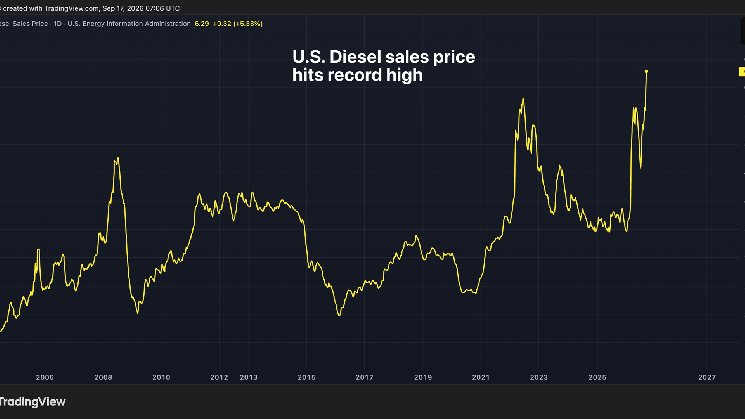
    U.S. Diesel Prices Hit Record High as Bitcoin and Gold Struggle

    Diesel prices are surging globally, driven primarily by escalating geopolitical tensions in the Middle East. The ongoing conflict involving the U.S., Israel, and Iran has disrupted crude oil flows and injected significant risk premiums into refined product markets. Compounding the supply-side pressure, tight refinery capacity and robust demand from both freight and industrial sectors have amplified the price move, transforming a regional supply shock into a worldwide spike at the pump.

    Federal Reserve Policy Under Scrutiny Amid Supply-Driven Inflation

    The Federal Reserve’s decision on Wednesday to raise its benchmark borrowing cost by 25 basis points to the 3.75%–4% range has drawn criticism from market observers. Critics argue the hike demonstrates a policy bias toward using interest rate increases to combat inflation rooted in oil-supply shocks—a strategy some view as a fundamental mistake. Higher borrowing costs historically act as a headwind for non-yielding assets, and the current environment is no exception.

    Record Diesel Prices Create Headwinds for Gold, Bitcoin, and Tech Stocks

    Record-high diesel prices are pressuring traditional safe-haven assets and growth equities alike. Both gold and bitcoin are widely viewed as stores of value and hedges against sovereign risk. However, historical precedent shows that rising interest rates weigh heavily on cryptocurrency valuations, a dynamic clearly illustrated during the Fed’s aggressive tightening cycle in 2022. Technology stocks, sensitive to discount rates and economic growth forecasts, face similar downward pressure.

    Global Central Banks Extend Tightening Cycle

    The shift toward restrictive monetary policy is not isolated to the United States. The European Central Bank has recently implemented its own rate increase, and the Bank of Japan (BOJ) is widely expected to follow suit with a hike on Friday. Major Wall Street institutions, including Goldman Sachs and Morgan Stanley, anticipate the Fed will deliver an additional 25 basis point increase at its October meeting, signaling that the global tightening cycle remains firmly in place.

  • Bitcoin Volatility Persists After Fed Rate Hike as Analysts Outline Key Support Levels

    Bitcoin Volatility Persists After Fed Rate Hike as Analysts Outline Key Support Levels

    Bitcoin Support Levels to Watch: Analyst Lark Davis Highlights $73K and $67K Zones Amid Regulatory Uncertainty

    Cryptocurrency investor and analyst Lark Davis has outlined key technical support levels for Bitcoin should the asset face further downside pressure. In an assessment shared via X, Davis identified the 200-day exponential moving average (EMA) near $73,000 as the first critical line of defense, with a deeper correction potentially targeting $67,000 if that level fails.

    200-Day EMA at $73,000 Serves as Immediate Pivot

    The 200-day EMA is a widely followed long-term trend indicator used by investors to gauge macro momentum. According to Davis, he is closely monitoring whether Bitcoin can hold above this threshold. A sustained break below the 200-day EMA would signal weakening long-term structure and could invite additional selling pressure.

    $67,000 Marked as Secondary Support in Deeper Correction Scenario

    Should Bitcoin lose the $73,000 zone, Davis points to approximately $67,000 as the next notable support area. This level aligns with prior consolidation zones and could act as a magnet for dip buyers if a more pronounced pullback materializes.

    Macro Headwinds Cited as Catalysts for Near-Term Weakness

    Davis attributes potential continued market softness to two primary drivers: evolving cryptocurrency regulatory developments in the United States — including progress around the Clarity Act — and the Federal Reserve’s interest rate policy. Both factors have historically correlated with risk-asset volatility and could keep Bitcoin range-bound or pressured in the short term.

    Analyst Sees Low Probability of New Cycle Low

    Despite the cautious technical outlook, Davis emphasized that he does not believe current conditions are severe enough to push Bitcoin to a new cycle low. While downward pressure may persist, the structural bull case remains intact unless key support levels are decisively broken on high volume.

    What Investors Should Monitor Next

    Market participants are advised to track three core variables in the coming weeks:

    • Federal Reserve policy signals — particularly around rate-hike trajectory and inflation data
    • Legislative progress on the Clarity Act and broader U.S. crypto regulatory framework
    • Bitcoin price action around the $73,000 and $67,000 technical zones

    This article is for informational purposes only and does not constitute investment advice.

  • Zcash Surges 23% as Bitcoin, Major Tokens Rally Despite Fed’s First Rate Hike Since 2023

    Zcash Surges 23% as Bitcoin, Major Tokens Rally Despite Fed’s First Rate Hike Since 2023

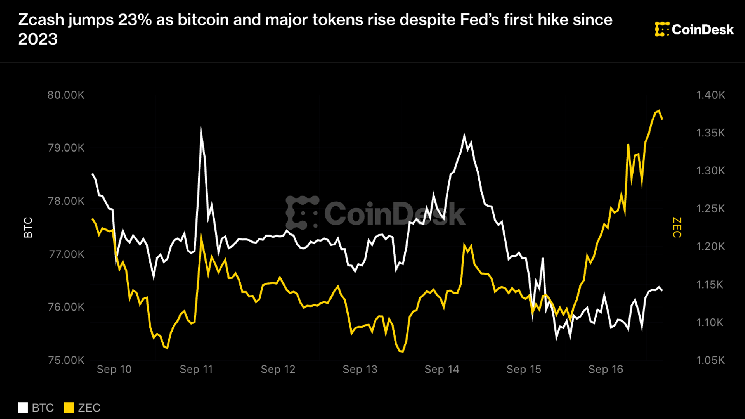
    Privacy-focused cryptocurrency Zcash (ZEC) surged 23% over the past 24 hours, leading gains across major digital assets as Bitcoin and the broader crypto market rallied overnight into Asian trading hours Thursday. The move coincided with a recovery in U.S. stock futures following the Federal Reserve’s first interest-rate increase since 2023.

    Market Snapshot: ZEC Leads, Bitcoin Holds Near $76K

    At the time of writing, ZEC traded near $1,369, significantly outperforming the market. Bitcoin edged up less than 1% to approximately $76,258, while Solana (SOL) gained nearly 3% to just below $100. BNB and HYPE, the native token of the crypto trading platform Hyperliquid, each added more than 2%. Ether (ETH), XRP, and Dogecoin (DOGE) posted gains between 1% and 2%.

    Paradigm Co-Founder Highlights Zcash as Bitcoin Privacy Complement

    The sharp rally in ZEC followed public comments from Matt Huang, co-founder of prominent crypto investment firm Paradigm. In a post on X, Huang discussed Zcash’s role as a privacy layer for Bitcoin and disclosed that his firm holds a position in the token.

    “a private complement to Bitcoin.”

    Huang, whose firm owns ZEC, described the protocol as “a private complement to Bitcoin.” He expressed support for continued funding of Zcash’s core developers while advocating that governance votes by coin holders should be combined with other decision-making mechanisms for network upgrades.

    Zcash Governance and Monetary Policy in Focus

    Zcash enables users to transact without publicly revealing sender, recipient, or transaction amounts. Its community recently backed proposals aimed at accelerating payment speeds while maintaining the protocol’s scheduled reductions in new coin issuance—a disinflationary feature shared with Bitcoin’s halving cycle.

    The convergence of positive macro tailwinds, high-profile institutional endorsement, and ongoing protocol improvements appears to be driving renewed investor interest in privacy-preserving digital assets.

  • Bitcoin Absorbs Fed Rate Hike as Officials Anticipate Further Tightening

    Bitcoin Absorbs Fed Rate Hike as Officials Anticipate Further Tightening

    Bitcoin maintained its position near pre-announcement levels around $76,000 on Wednesday, showing minimal immediate reaction to the U.S. Federal Reserve’s decision to raise its benchmark interest rate for the first time since 2023.

    Fed Raises Rates by 25 Basis Points

    The Federal Open Market Committee voted unanimously to increase rates by 25 basis points, setting a new target range of 3.75% to 4%. This move, typically associated with pressure on stocks and risk assets, came as the central bank continues to address persistently high inflation.

    At the time of writing, Bitcoin was trading at $76,663, representing a 1.35% gain over the previous 24 hours.

    Market Reaction Largely Anticipated

    Cooper Duschang, research analyst at Talos, noted in comments shared with Cointelegraph:

    “The initial reaction suggests the Fed’s decision was largely anticipated by crypto markets. Bitcoin has remained relatively resilient, holding broadly around pre-announcement levels even as equities moved lower.”

    Equities Decline While Bitcoin Holds

    U.S. stocks slipped on Wednesday following the rate decision. Crypto analysts caution that Bitcoin’s current resilience could face fresh tests if the Fed implements additional rate hikes before year-end.

    During the FOMC press conference, Fed Chair Kevin Warsh stated that inflation remains too high while the U.S. economy shows signs of strengthening. Updated economic projections indicate a majority of officials anticipate at least one more rate increase before the end of the year.

    16 out of 18 FOMC participants expected another rate increase this year. Source: US Federal Reserve

    Andrew Melville, head of research at Block Scholes, characterized a potential additional increase as a “more hawkish surprise than today’s 25bp hike.”

    Derivatives and Spot Markets Show Divergence

    While Bitcoin’s spot price remained stable, Duschang highlighted significant activity beneath the surface:

    “Perpetual futures have shifted towards net selling, led by approximately $82 million in Bitcoin and $68 million in Ether over the past hour. In contrast, Bitcoin recorded around $15.5 million of net spot buying, suggesting spot demand is absorbing some of the selling pressure coming through derivatives.”

    Duschang also pointed to notable exchange flows, with approximately 2,170 Bitcoin moving onto exchanges following the rate announcement, followed by a withdrawal of 1,260 Bitcoin.

    “Rather than a uniform risk-off response, investors appear to be actively repositioning as they digest the Fed’s message. The key question now is whether Bitcoin’s resilience and spot demand hold as attention shifts from today’s widely anticipated hike to the prospect of further tightening.”

    Analysts Warn of Repricing Risk

    Martin Lee, market insights lead at DWF Labs, warned that the Fed’s renewed “hawkish stance” of “higher for longer” rates would lead to risk-on assets “repricing this new reality.”

    Related: Bitcoin awaits Fed rate decision below $76K as analysis discounts ‘dovish surprise’ odds

    Magazine: HYPE price could suffer as Binance takes its revenue: Alice Liu

  • Goldman Pivots, Now Forecasts Fed Rate Hike in October

    Goldman Pivots, Now Forecasts Fed Rate Hike in October

    Goldman Sachs Revises Fed Rate Forecast, Now Expects October Hike

    Goldman Sachs has executed a significant reversal in its Federal Reserve policy outlook, now projecting that the central bank will raise its benchmark interest rate once more in October. This new forecast marks a 180-degree pivot from the firm’s previous expectation of a September hike followed by an extended pause.

    Fed Signals Further Tightening After September Increase

    The shift follows the Federal Reserve’s Wednesday decision to lift rates by 25 basis points, bringing the target federal funds rate to a range of 3.75%–4.00%. Perhaps more critically, the central bank’s updated Summary of Economic Projections revealed that a strong majority of policymakers anticipate at least one additional rate increase before the end of the year.

    Warsh Strikes Hawkish Tone at Press Conference

    At the post-meeting press conference, Fed Chair Kevin Warsh adopted a notably hawkish stance. He stated that inflation remains “too high” and characterized the latest hike as having merely removed a “dose of accommodation”. The implication is clear: the current policy stance is still not restrictive enough, and further rate hikes remain in the pipeline.

    Markets Price In Elevated Probability of October Move

    Financial markets have quickly adjusted to the revised guidance. As of this writing, traders are pricing in just over a 50% probability of another 25 basis point hike at the Fed’s October meeting, according to data from the CME Group’s FedWatch tool.

    Bitcoin Holds Steady Amid Macro Uncertainty

    Despite the shifting rate outlook, Bitcoin has shown resilience, continuing to trade near the $76,260 level. The cryptocurrency is up a marginal 0.5% over the past 24 hours, suggesting digital asset markets are currently digesting the hawkish pivot without significant volatility.

  • Fed Decision to Determine Gold’s Next Move: XAUUSD Risks $4,355 Rejection or Eyes $4,388 Breakout

    Fed Decision to Determine Gold’s Next Move: XAUUSD Risks $4,355 Rejection or Eyes $4,388 Breakout

    Fed Rate Decision Looms as Key Catalyst for Gold Price Direction

    The Federal Reserve’s September 16 interest rate decision stands as the pivotal event for gold markets this week, with traders closely monitoring XAUUSD for signs of a decisive breakout or rejection following the FOMC announcement. Gold has rebounded from the $4,300 level to trade between $4,335 and $4,345 as markets price in a widely anticipated 25-basis-point rate hike.

    The central question for gold traders centers on whether Fed guidance, U.S. dollar movements, and Treasury yield reactions will push prices below the $4,355 resistance or provide sufficient momentum for a sustained break above $4,388.

    FOMC Meeting Schedule and Market Expectations

    The Federal Reserve’s September 15–16, 2026 FOMC meeting concludes with a policy announcement at 2:00 PM ET on Wednesday, September 16. The release will be followed by the Summary of Economic Projections (SEP), the updated “dot plot,” and a press conference with Chair Kevin Warsh at 2:30 PM ET.

    Markets are assigning approximately a 92% probability to a 25-basis-point rate increase, suggesting the immediate rate decision itself is unlikely to drive significant XAUUSD volatility. Instead, the gold price trajectory after the Fed decision will depend heavily on how the U.S. dollar and Treasury yields respond to the central bank’s forward guidance on the future policy path.

    Why Fed Guidance Drives Gold Price Action

    Gold’s price sensitivity to real interest rates and the U.S. dollar remains the fundamental driver. As a non-yielding asset, gold’s opportunity cost rises when real yields surge and the dollar strengthens. A hawkish surprise from the Fed could push yields higher and firm the dollar, pressuring XAUUSD lower. Conversely, a restrained or “one-and-done” policy message could ease yield and dollar pressures, supporting a relief rally in gold.

    At press time, spot gold was trading at $4,341.50, with traders awaiting either a rejection of the $4,355–$4,388 resistance zone or a move higher. The initial market reaction may involve a liquidity sweep near Monday’s $4,355 peak before a clearer directional move emerges. Key support levels to monitor if gold reverses include $4,304, $4,292, and $4,253.

    Dot Plot and Chair Warsh’s Commentary in Focus

    The updated dot plot will be scrutinized for any indication of a higher median rate path through 2026–2027. If projections signal continued tightening, or if Chair Warsh emphasizes persistent inflation risks and a readiness to hike further, Treasury yields could climb and the dollar could strengthen, creating headwinds for gold. More restrained forecasts, however, could alleviate yield and dollar pressures, allowing XAUUSD to stabilize or recover.

    Resistance Zone Analysis: $4,355–$4,388

    A Fed-driven strengthening of the U.S. dollar or rise in Treasury yields following the announcement could trigger a rejection of XAUUSD from the $4,355–$4,388 resistance zone. A price move above $4,355 that fails to hold above that level would constitute a liquidity sweep rather than a genuine breakout.

    Should rejection occur below $4,355, the resistance zone remains intact and exposes the aforementioned support levels at $4,304, $4,292, and $4,253. However, a sustained break above $4,388 would invalidate the rejection scenario and shift market attention toward the $4,443 target.

    Identifying a Liquidity Sweep vs. True Breakout

    A move above $4,355 signals a liquidity sweep rather than a legitimate gold breakout if XAUUSD quickly falls back below the level. In the event of a Fed-triggered reversal, traders should monitor $4,304, $4,292, and $4,253 as critical XAUUSD support levels.

    Conversely, sustained acceptance above $4,388 would confirm stronger upside momentum and shift the gold price forecast higher, with $4,443 becoming the next technical target. The $4,355 and $4,388 levels therefore represent the critical inflection points for gold prices following the Fed decision.

    Source: TradingView

  • Clarity Law Fails, Bitcoin and Altcoins Drop; Analysts Say “Don’t Worry About It,” Outline Recovery Needs

    Clarity Law Fails, Bitcoin and Altcoins Drop; Analysts Say “Don’t Worry About It,” Outline Recovery Needs

    The Digital Asset Market Clarity Act failed to advance in the U.S. Senate on Tuesday, falling short of the 60-vote threshold required to proceed. The procedural vote tally stood at 49 in favor and 50 against, effectively stalling the comprehensive regulatory framework for digital assets.

    The outcome triggered immediate sell-offs across Bitcoin and altcoin markets. However, analysts speaking to The Block characterized the legislative setback as a delay rather than a structural shift for the crypto sector, emphasizing that macroeconomic forces—particularly Federal Reserve monetary policy—remain the primary driver of medium-to-long-term market direction.

    “The Failure of the Law to Pass is Not a Structural Problem”

    Arctic Digital Research President Justin d’Anethan told The Block that while the CLARITY Act’s failure was disappointing, it does not signal a fundamental market problem.

    d’Anethan pointed out that current Bitcoin price levels and previous all-time highs were achieved before the Clarity Act was in effect. He noted that institutional investors view the development not as a complete failure of the regulatory framework, but rather as a delay in the regulatory timeline. According to the analyst, interest rates and the overall monetary policy environment may be more decisive than regulatory clarity in determining the direction of the crypto market.

    Regulation Not a Key Determinant in Current Cycle

    BTC Markets crypto analyst Rachael Lucas offered a parallel assessment, stating that regulatory efforts are not a key determinant in the current crypto market cycle and that the market is more sensitive to interest rates.

    Lucas identified three critical areas for investors to monitor in the coming period:

    “1) Whether the Fed’s expected interest rate hikes will mark the beginning of a longer period of tightening, 2) Whether capital inflows into spot Bitcoin ETFs will accelerate again, 3) Whether an alternative regulatory path will emerge that can proceed without requiring 60 Senate votes.”

    Lucas added that capital is not exiting the market but concentrating in specific assets. While Congress is not strictly necessary for a fourth-quarter recovery, the analyst stressed that a prerequisite for such a rebound is for interest rates not to worsen further.

    “All Eyes Are on the FED Today!”

    Market attention has now pivoted squarely to the Federal Reserve. The U.S. central bank is expected to raise its benchmark interest rate for the first time since 2023 at today’s FOMC meeting, with a 25-basis-point increase widely anticipated. Futures markets are pricing in a higher than 90% probability of a hike at this session, with an additional increase projected before year-end.

    This is not investment advice.

  • FOMC Meeting Today: Fed Expected to Hike Rates 25 Bps – Will Bitcoin Drop Again?

    FOMC Meeting Today: Fed Expected to Hike Rates 25 Bps – Will Bitcoin Drop Again?

    Fed Expected to Raise Rates by 25 Basis Points

    Crypto markets are already under pressure ahead of today’s Federal Open Market Committee (FOMC) meeting, with Bitcoin trading below $75,000. The Fed is widely expected to raise rates by 25 basis points, a move that is largely priced in. Traders are now focused on Chair Kevin Warsh’s comments for clues on future rate hikes and whether another wave of selling could hit Bitcoin.

    The FOMC will announce its decision at 2:00 PM EDT, followed by Fed Chair Kevin Warsh’s press conference at 2:30 PM EDT. Markets are pricing in a 92.5% chance of a 25-basis-point hike, which would move the federal funds rate from 3.50%–3.75% to 3.75%–4.00%. This would be the Fed’s first rate hike in three years.

    🚨 REMINDER: 🇺🇸 FED INTEREST RATE DECISION TODAY AT 2:00 PM ET!
    Current: 3.50% – 3.75%
    Forecast: 3.75% – 4.00%
    HIKE → MARKETS DROP HARD
    HOLD → MARKETS RALLY
    CUT → MARKETS RALLY HARD
    PRESS CONFERENCE AT 2:30 PM ET!
    pic.twitter.com/Du0sWRoIBp
    — Crypto Rover (@cryptorover) September 16, 2026

    However, traders are already looking beyond today’s decision. They are watching Warsh’s comments for signals about future rate hikes. The markets have shifted from expecting two hikes to pricing in at least three by June 2027. Former Fed Vice Chair Richard Clarida warned that another hike could follow.

    “If we get a hike next week, certainly we’ll get additional ones. This is certainly not one and done.”

    CLARITY Act Failure Adds More Pressure

    The Fed’s decision comes as the crypto market deals with another setback. On September 15, the CLARITY Act failed to advance in the Senate, weakening a major regulatory catalyst for the market. Even after a last-minute substitute text included 126 bipartisan changes, lawmakers could not overcome major political and ideological differences. Prediction markets now put the bill’s 2026 passage odds at around 12%.

    Following the setback, the total crypto market fell more than 3%, while Bitcoin dropped below $75,000. The decline also triggered around $770 million in liquidations, adding more selling pressure from leveraged long positions.

    Bitcoin Could Face More Selling If Warsh Sounds Hawkish

    The biggest risk for crypto may not be the 25-basis-point increase itself, because traders have already priced it in. Instead, Bitcoin could face more selling if Warsh signals that more hikes are coming or the Fed’s updated projections point to tighter policy for longer. Such a signal could strengthen the dollar, lift bond yields, and push investors away from riskier assets. Bitcoin has already fallen below $76,000, now trading around $75,860.

  • Bitcoin Coinbase Premium Falls to One-Month Low: Key Drivers Behind the Drop

    Bitcoin Coinbase Premium Falls to One-Month Low: Key Drivers Behind the Drop

    Bitcoin Coinbase Premium Slumps to Four-Week Low as U.S. Demand Weakens

    Bitcoin’s Coinbase premium has dropped to its lowest level in four weeks, signaling fading U.S. buying pressure as traders digest a legislative setback for the crypto industry and brace for tighter monetary policy.

    Coinbase Premium Turns Negative

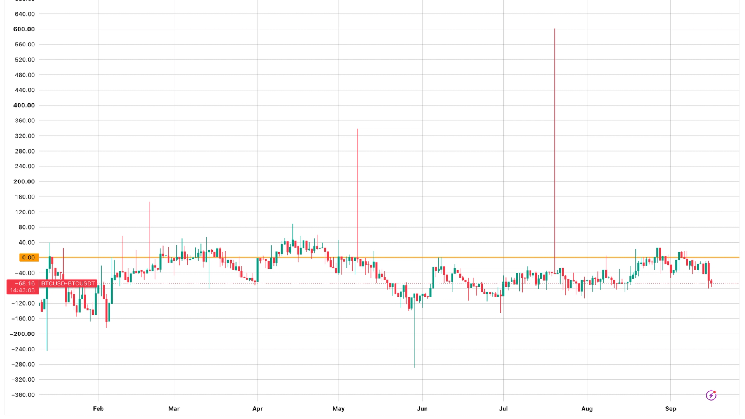
    The premium measures the price gap between Bitcoin’s dollar value on Coinbase and its USDT-denominated price on Binance. CryptoQuant’s Coinbase Premium Index tracks this spread as a percentage of price. Tuesday’s reading of approximately -0.07% translates to roughly $50 on a $75,900 Bitcoin — a narrow margin that nonetheless points to relatively weak demand on the U.S. exchange.

    The discount deepened from roughly -0.02% a day earlier after the Clarity Act failed to advance on Tuesday. The move marks a sharp reversal from late August and early September, when the premium flipped positive for the first time in months as Bitcoin rallied toward $80,000. Since then, Bitcoin has retreated to around $75,000.

    Legislative Setback Weighs on Sentiment

    The failure of the Clarity Act — a bill aimed at establishing clearer regulatory frameworks for digital assets — has removed a potential catalyst for institutional inflows. Market participants had viewed legislative progress as a key driver for sustained U.S. exchange premiums, which typically reflect stronger domestic appetite.

    Fed Policy Decision Looms

    Monetary policy presents an additional headwind. The Federal Reserve announces its rate decision later Wednesday, with markets widely pricing in a 25-basis-point increase that would lift the federal funds target range to 3.75%–4%. Higher rates tend to dampen risk appetite across speculative assets, including cryptocurrencies.

    Traders will closely monitor the accompanying policy statement and press conference for signals on the pace of future hikes, which could further influence Bitcoin’s near-term trajectory and exchange-specific pricing dynamics.