Tag: Federal Reserve

  • Bitcoin Recovers From Asian-Session Lows as Falling Oil Price Supports Risk Appetite

    Bitcoin Recovers From Asian-Session Lows as Falling Oil Price Supports Risk Appetite

    Key Highlights

    • Bitcoin surged above $86,000 after breaking the May high, driven by nearly $1 billion in single-day spot ETF inflows—the largest since October 2024.
    • WTI crude oil dropped below $90 a barrel on reports Iran may reopen the Strait of Hormuz, easing inflation fears and reducing pressure for further Federal Reserve rate hikes.
    • Broad risk appetite improved as the Nasdaq rallied, global stocks rose, U.S. bond yields fell, and optimism grew over U.S.–China trade negotiations.

    Bitcoin Extends Rally Past $86K on Record ETF Flows and Macro Tailwinds

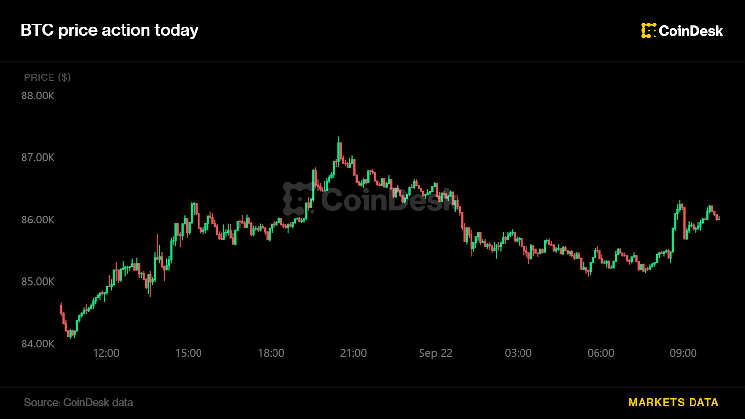
    Bitcoin (BTC) consolidated near $85,927 early Tuesday after a decisive break above its May high during Monday’s session, reinforcing a bullish technical structure that has been building for weeks. The largest cryptocurrency by market capitalization recovered from Asian-session lows around $85,000 and traded within striking distance of the $86,000 psychological level. The broader digital-asset benchmark, the CoinDesk 20 Index (CD20), advanced 2.2% over the past 24 hours, signaling broad-based participation across the crypto complex.

    Spot Bitcoin ETFs Post Largest Daily Inflow Since October

    A primary catalyst for Monday’s surge was extraordinary demand for U.S.-listed spot bitcoin exchange-traded funds. The cohort attracted nearly $1 billion in net inflows in a single trading day, marking the largest one-day haul since October 2024. The magnitude of the flow underscores renewed institutional conviction and suggests that the recent price consolidation was viewed as an accumulation opportunity rather than a distribution phase. Analysts note that sustained inflows of this scale could provide a structural bid underpinning further upside.

    Falling Oil Prices Ease Inflation Concerns and Fed Hawkishness

    Macroeconomic developments provided additional tailwinds. West Texas Intermediate (WTI) crude futures slid more than 2% to dip below $90 per barrel, extending a retreat from a recent peak near $106. The decline followed a Kyodo News report stating that Iran signaled willingness to reopen the Strait of Hormuz within seven days if the United States eased its blockade. A sustained drop in energy costs could alleviate inflationary pressures, weakening the argument for additional Federal Reserve interest-rate increases in the coming months—a scenario historically supportive of risk assets, including cryptocurrencies.

    Risk Appetite Revives on Equities Rally and Geopolitical Optimism

    The crypto advance coincided with a sharp rise in the Nasdaq Composite, rising global equity markets, and declining U.S. Treasury yields. Sentiment was further buoyed by optimism surrounding U.S.–China trade negotiations. Alex Kuptsikevich, chief market analyst at FxPro, summarized the confluence in an email: “The crypto market gained ground against the backdrop of a sharp rise in the Nasdaq index. Falling oil prices and US government bond yields, rising global stock markets and optimism regarding US-China negotiations supported risk appetite.”

    Why This Matters

    The simultaneous break of a key technical level, record-setting ETF inflows, and a favorable macroeconomic backdrop—lower oil, falling yields, and easing geopolitical tension—creates a rare alignment of fundamental and technical tailwinds for bitcoin. If ETF demand persists and the Federal Reserve maintains a dovish tilt amid disinflationary data, the path of least resistance for BTC could remain higher, with the next major resistance zone likely near the all-time high above $108,000. Market participants will closely monitor weekly ETF flow data, upcoming CPI/PCE prints, and any formal progress on the Strait of Hormuz situation for confirmation of the current narrative.

    Frequently Asked Questions

    What triggered Bitcoin’s break above the May high?
    A combination of nearly $1 billion in single-day spot bitcoin ETF inflows—the largest since October 2024—falling oil prices, declining U.S. bond yields, a rallying Nasdaq, and optimism over U.S.–China talks drove the breakout.
    How do lower oil prices affect Bitcoin?
    Lower oil prices reduce inflationary pressure, which lessens the likelihood of further Federal Reserve rate hikes. A more dovish Fed outlook typically supports risk assets, including cryptocurrencies.
    What is the significance of the Strait of Hormuz report?
    The Kyodo report that Iran may reopen the Strait of Hormuz if U.S. sanctions ease triggered a sharp drop in WTI crude below $90 a barrel, directly contributing to the disinflationary narrative benefiting Bitcoin.
  • Bitcoin Rally Driven by ‘Serious Institutional Money,’ Devere Says

    Bitcoin Rally Driven by ‘Serious Institutional Money,’ Devere Says

    Key Highlights

    • Devere Group CEO Nigel Green argues Bitcoin’s recovery is gaining durability from sustained institutional inflows into regulated U.S. spot ETFs, marking a shift from leveraged speculation to “patient capital.”
    • Despite a net inflow of approximately $6.1 million across five trading days through Sept. 18, the trend remains fragile after $746.3 million in withdrawals on Sept. 15–16 nearly offset recent gains.
    • The Federal Reserve’s Sept. 16 rate hike to 3.75%–4% raises the opportunity cost of holding non-yielding Bitcoin, while the CLARITY Act’s legislative stall delays regulatory clarity that Green says could unlock pension and wealth-manager allocations.

    Institutional Flows Signal Market Shift, Says Devere Group CEO

    Bitcoin’s recent price recovery is underpinned by a structural shift in market participation, according to Devere Group Chief Executive Officer Nigel Green. In comments issued Sept. 21, Green asserted that consistent purchasing through regulated investment products indicates buyers have regained control of the market. He characterized the current momentum as fundamentally different from previous rallies driven by leveraged speculation.

    “The market’s momentum has flipped, and this time there’s serious institutional money behind it,” Green said, adding:

    “Billions are flowing into regulated bitcoin products week after week. It’s patient capital that plans to stay, a very different animal from the leveraged speculation that fuelled past rallies.”

    ETF Data Shows Mixed Recovery After Volatile Week

    Flow data for U.S. spot bitcoin exchange-traded funds (ETFs) supports Green’s observation of renewed demand, though the net picture remains modest. Farside Investors’ rounded daily figures show the funds attracted $433 million in net inflows on Sept. 18, following $159.5 million the previous session and $159.9 million on Sept. 14. However, those purchases only narrowly offset withdrawals of $746.3 million recorded on Sept. 15 and 16, leaving approximately $6.1 million in net inflows across the five trading days.

    The recovery began Thursday, Sept. 18, when bitcoin ETFs returned to positive flows after two consecutive sessions of withdrawals. BlackRock’s IBIT led the rebound, while ether and XRP funds continued losing money. The divergence suggests renewed demand for bitcoin products has not yet translated into consistent buying across the broader crypto ETF market.

    Monetary Policy Creates Countervailing Pressure

    Green’s supply-side argument—that Bitcoin’s fixed cap of 21 million coins offers a hedge against currency debasement—runs against a tightening monetary backdrop. The Federal Reserve raised its benchmark target range to 3.75%–4% on Sept. 16, a unanimous quarter-point increase accompanied by language describing inflation as elevated. Higher interest rates increase returns on interest-bearing assets, raising the opportunity cost of holding Bitcoin, which pays no yield.

    A separate assessment from Grayscale characterized the latest increase as a limited adjustment within the current Fed cycle. The asset manager distinguished one or two potential increases in 2026 from the prolonged tightening cycle that began in 2022. That interpretation aligns with Green’s view that demand can remain resilient despite higher rates, though both assessments represent forward-looking market outlooks rather than established facts.

    Regulatory Uncertainty Tempers Optimism

    Green identified clearer U.S. crypto rules as a conditional catalyst that could encourage pension funds and wealth managers to increase exposure. His forecast depends on large allocators becoming more comfortable with the regulatory framework governing digital assets, which would extend demand beyond current ETF buyers into a wider pool of portfolio allocations.

    The legislative backdrop, however, delivered a setback on Sept. 15 when senators failed to advance the CLARITY Act toward floor debate. The procedural vote required 60 votes to move forward; its failure left the proposed market-structure framework unresolved. Green nevertheless expects a larger potential pool of buyers if regulation becomes clearer, while acknowledging that volatility and pullbacks will continue.

    “Once big allocators see rules they can work with, the next wave of demand could dwarf this one,”

    he described, elaborating:

    “The crypto winter looks to be ending. Every dip that gets bought strengthens the case that the floor has moved higher.”

    “Bitcoin is a permanent fixture in the global portfolio conversation, and the bulls know it,”

    the executive concluded.

    Why This Matters

    The interplay between institutional adoption, monetary policy, and regulatory progress defines Bitcoin’s current inflection point. Sustained ETF inflows—particularly from vehicles like BlackRock’s IBIT—signal growing acceptance among traditional financial intermediaries, yet the net flow figures remain marginal after sharp reversals. The Federal Reserve’s higher-for-longer rate posture introduces a persistent headwind for non-yielding assets, while the CLARITY Act’s stall underscores that U.S. regulatory certainty remains a work in progress. Market participants should monitor whether the “patient capital” Green describes withstands the dual test of rate sensitivity and legislative gridlock, or whether the recent rebound proves another bear-market rally.

    Frequently Asked Questions

    What were the net flows into U.S. spot Bitcoin ETFs for the week ending Sept. 18?

    According to Farside Investors data cited in the report, U.S. spot Bitcoin ETFs saw approximately $6.1 million in net inflows across the five trading days through Sept. 18. This followed $433 million in inflows on Sept. 18, $159.5 million on Sept. 17, and $159.9 million on Sept. 14, which were largely offset by $746.3 million in withdrawals on Sept. 15–16.

    How does the Federal Reserve’s September rate hike affect Bitcoin’s appeal?

    The Fed raised its benchmark rate to 3.75%–4% on Sept. 16, increasing the opportunity cost of holding Bitcoin because the cryptocurrency does not generate interest income. Higher yields on bonds and cash equivalents make non-yielding assets comparatively less attractive, though some analysts, including Grayscale, view the hike as a limited adjustment rather than a return to aggressive tightening.

    What is the CLARITY Act and why does its failure matter for Bitcoin?

    The CLARITY Act is a proposed U.S. market-structure framework for digital assets. Its failure to advance past a procedural vote on Sept. 15—falling short of the 60 votes needed—leaves regulatory rules unresolved. Devere Group CEO Nigel Green argues that clearer rules would unlock allocations from pension funds and wealth managers, potentially driving a larger wave of institutional demand than current ETF flows.

  • Markets Eye Federal Reserve: Goolsbee on Inflation, Bessent on Warsh

    Markets Eye Federal Reserve: Goolsbee on Inflation, Bessent on Warsh

    Key Highlights

    • Chicago Fed President Austan Goolsbee signaled openness to rate cuts if inflation meaningfully decelerates toward the 2% target, while emphasizing the need for decisive action against price pressures.
    • U.S. Treasury Secretary Scott Bessent expressed confidence in Fed Chairman Kevin Warsh and noted President Donald Trump shares that confidence, alongside an expansion of the Treasury’s bond repurchase program.
    • With U.S. PCE inflation at 3.7% as of July, Goolsbee stressed that reaching the 2% goal depends on easing supply constraints and distinguishing between supply-driven and demand-driven inflation components.

    Goolsbee Outlines Conditional Path for Rate Cuts Amid Inflation Fight

    Chicago Federal Reserve President Austan Goolsbee delivered a nuanced assessment of monetary policy during a meeting in London, stating that the central bank would not oppose interest rate reductions if inflation slows significantly toward its 2% target. His remarks come on the heels of the Fed’s 25 basis point rate increase last week—the first hike since 2023—with markets now pricing potential further increases in October or December. Goolsbee emphasized that the Federal Reserve must have the courage to respond forcefully to inflation when necessary, expressing optimism that the 2% goal remains achievable provided there are no signs of overheating demand.

    Disentangling Supply Shocks from Demand Pressures

    Central to Goolsbee’s analysis is the ongoing effort to parse how much of current inflation stems from supply disruptions versus demand strength. He pointed specifically to robust investment in artificial intelligence as a factor supporting demand, while noting that persistent supply shocks continue to exert upward pressure on prices. As of July, U.S. personal consumption expenditures (PCE) inflation stood at 3.7%, and Goolsbee underscored that returning to the 2% target hinges on the easing of supply-side constraints. Officials, he said, are still analyzing the relative contributions of supply and demand dynamics to the current inflation picture.

    Bessent Backs Warsh, Highlights Treasury Market Operations

    Following the Fed’s latest rate decision, U.S. Treasury Secretary Scott Bessent appeared on CNBC to convey a message of stability regarding Fed leadership. Bessent reiterated his confidence in Federal Reserve Chairman Kevin Warsh and added that President Donald Trump also maintains confidence in Warsh’s stewardship of monetary policy. The Treasury chief also addressed market liquidity conditions, disclosing that the department has increased the size of its bond repurchase program—a move aimed at supporting smooth functioning in the government securities market.

    Central Bank Independence Takes Center Stage

    Goolsbee waded into the institutional dimension of monetary policy, arguing that expectations for the Fed to lower federal government borrowing costs underscore the critical importance of central bank independence. He emphasized that the Federal Reserve must set monetary policy strictly in line with its inflation mandate, free from fiscal dominance considerations. The comments arrive at a moment when the interplay between U.S. monetary policy and Treasury market interventions is under intense scrutiny from investors and policymakers alike.

    Why This Matters

    The divergent but complementary signals from the Fed and Treasury reflect a delicate balancing act as policymakers navigate the final stretch of 2026. Goolsbee’s conditional dovishness—openness to cuts only if inflation data cooperates—signals that the Fed remains data-dependent despite the recent hike. Meanwhile, Bessent’s public backing of Chairman Warsh and the expansion of the Treasury’s buyback operation aim to anchor market confidence in both leadership continuity and plumbing liquidity. With PCE inflation still nearly double the target and AI-driven investment bolstering demand, the path to 2% remains contingent on supply-side normalization, making upcoming inflation prints and Fed communications pivotal for market pricing through year-end.

    Frequently Asked Questions

    What conditions would prompt the Fed to consider rate cuts according to Goolsbee?

    Goolsbee stated the Fed would not oppose rate cuts if inflation slows significantly toward the 2% target, provided there are no signs of overheating demand and supply pressures continue to ease.

    What is the current level of U.S. PCE inflation and the Fed’s target?

    As of July, U.S. PCE inflation was at 3.7%, while the Federal Reserve’s target remains 2%.

    What actions has the Treasury taken to support market liquidity?

    Treasury Secretary Scott Bessent announced an increase in the size of the Treasury’s bond repurchase program to address liquidity conditions in the government securities market.

  • Crypto Rallies on Bullish Bounce After Fed Rate Hike: Weekly Outlook

    Crypto Rallies on Bullish Bounce After Fed Rate Hike: Weekly Outlook

    Key Highlights

    • Bitcoin holds near $84,000, demonstrating resilience despite the Federal Reserve’s benchmark rate holding at 4.00% following last week’s hawkish stance.
    • The SEC’s conditional five-year exemption window for tokenized securities pilot trading opens September 22, allowing select institutional venues to trade tokenized stocks on public blockchains.
    • Major governance votes are underway across Lido DAO, Uniswap, and CoW DAO, addressing liquidity provisions, protocol fee extensions, and solver competition redesigns.

    Bitcoin Resilience Amid Macro Uncertainty

    Cryptocurrency markets opened the week on a firm footing, with bitcoin BTC trading at $83,915.85 and testing the psychologically significant $84,000 threshold. The digital asset’s stability comes as investors digest the Federal Reserve’s latest policy posture, which maintained the benchmark target rate at 4.00% after last week’s hawkish signaling. While traditional risk assets often react negatively to restrictive monetary policy, bitcoin’s current price action suggests a decoupling from immediate rate-sensitive impulses, at least in the near term.

    The macroeconomic calendar this week centers on a cluster of high-impact U.S. data releases that could recalibrate rate-cut expectations. Initial jobless claims for the period ending September 19 are estimated at 201,000, up from the previous 196,000, while new home sales for August are forecast to decline to 700,000 from 739,000. Durable goods orders are expected to contract 0.3% month-over-month in August after a 1.1% gain previously, and the final University of Michigan Consumer Sentiment Index for September is seen at 47.8, down sharply from 51.7. Canadian retail sales for August are also due, estimated at -0.8% versus a prior 0.6% gain. Cross-asset markets continue to process the divergent policy paths emerging from the Bank of Japan and the Bank of England, adding another layer of complexity to the global liquidity backdrop.

    SEC Tokenized Securities Pilot Framework Goes Live

    A pivotal regulatory milestone arrives on September 22, when the U.S. Securities and Exchange Commission’s conditional five-year exemption window officially opens. This framework permits select institutional venues to commence pilot trading of tokenized stocks directly on public blockchains. The initiative represents the most concrete step yet by U.S. regulators to bridge traditional securities infrastructure with distributed ledger technology, potentially unlocking new paradigms for settlement efficiency, fractional ownership, and market accessibility. Market participants will be closely monitoring which venues receive approval and the volume dynamics during the pilot’s early phase.

    Governance Activity Intensifies Across Major DAOs

    Decentralized autonomous organizations are driving a busy week of on-chain governance. Lido DAO is voting on a proposal to authorize a contingent LDO centralized-exchange liquidity market-making mandate, budgeting up to $1.5 million in recallable LDO and 480,000 USDC to maintain orderbook depth and mitigate potential exchange delisting risks. Voting concludes September 21. Uniswap Governance is conducting a temperature check on extending its protocol fee collection and UNI burn infrastructure to Arc, a Layer 1 network built by Circle, with voting ending September 23. Meanwhile, CoW DAO is voting on a redesign of its solver quote competition, allocating a dedicated quote reward budget equal to 10% of protocol revenue to enhance price routing and order conversion; this vote wraps up September 25.

    Token Unlock Schedule Presents Supply Dynamics

    Several notable token unlocks are scheduled this week, introducing incremental supply into circulating markets. Canton (CC) unlocks 0.38% of its circulating supply, valued at approximately $17.17 million, on September 21. Toncoin (TON) follows on September 22 with a 1.3% unlock worth $51.2 million. Humanity (H) releases 14.7% of its circulating supply, valued at $20.8 million, on September 23. No major token launches are confirmed for the period, and the conference calendar remains clear.

    Why This Matters

    The convergence of bitcoin’s price resilience, the SEC’s tokenized securities pilot launch, and heightened DAO governance activity signals a maturing market structure where regulatory engagement, institutional infrastructure, and decentralized coordination are advancing simultaneously. The SEC pilot, in particular, could establish precedent for how traditional assets are issued, traded, and settled on-chain, potentially attracting broader institutional participation. Meanwhile, the governance votes at Lido, Uniswap, and CoW reflect the growing operational sophistication of major protocols as they address liquidity sustainability, cross-chain fee architectures, and execution quality—issues critical to long-term protocol viability. Traders should monitor this week’s macro data for signals on the Fed’s next move, as any shift in rate expectations could rapidly reassert correlation between digital assets and traditional risk markets.

    Frequently Asked Questions

    What is the SEC’s tokenized securities pilot framework?

    The SEC’s conditional five-year exemption window, opening September 22, allows select institutional venues to conduct pilot trading of tokenized stocks directly on public blockchains. This regulatory sandbox aims to test distributed ledger technology for securities settlement and trading under supervised conditions.

    Why are the Lido, Uniswap, and CoW DAO votes significant?

    These governance proposals address critical operational priorities: Lido seeks to secure exchange liquidity for LDO to prevent delistings; Uniswap explores extending its fee and burn mechanism to Circle’s Arc network; CoW Protocol aims to improve solver competition and order routing through a dedicated reward budget. Outcomes will shape protocol economics and cross-chain strategies.

    Which macroeconomic data points should crypto traders watch this week?

    Key releases include U.S. initial jobless claims (Sept. 24, 8:30 a.m. ET), new home sales (Sept. 24, 10:00 a.m. ET), durable goods orders (Sept. 25, 8:30 a.m. ET), and the final Michigan Consumer Sentiment Index (Sept. 25, 10:00 a.m. ET). These indicators will influence Federal Reserve policy expectations and broader risk sentiment.

  • Crypto Traders Braced for Total Wipeout, But Bitcoin Defied Expectations

    Crypto Traders Braced for Total Wipeout, But Bitcoin Defied Expectations

    Key Highlights

    • Bitcoin demonstrated unexpected resilience, holding near $75,000 despite a Federal Reserve rate hike and the failure of the Clarity Act in the U.S. Senate.
    • Market analysts indicate Bitcoin remains insulated from legislative setbacks, with derivatives traders having largely priced in the Senate’s rejection of the crypto bill.
    • Bitfinex’s Jag Kooner notes the modest spot market reaction reflects a market that was not positioned for a legislative breakthrough.

    Market Defies Bearish Expectations Amid Macro and Legislative Headwinds

    Just one week ago, sentiment across the cryptocurrency sector bordered on panic. The prevailing consensus among market participants was that a dual catalyst—a Federal Reserve interest rate hike combined with the anticipated failure of the Clarity Act in the Senate—would trigger a sharp correction for Bitcoin and the broader digital asset complex. However, that predicted sell-off failed to materialize. Even as the Fed tightened monetary policy and the landmark crypto legislation stalled on Capitol Hill, Bitcoin not only stabilized but continued its ascent, brushing against the psychologically significant $75,000 level.

    Senate Vote Dynamics and Price Action

    The tension peaked on the night of September 14, as senators prepared to cast their ballots on the Clarity Act. In the hours leading up to the vote, Bitcoin experienced a dip driven by pre-vote jitters. Rumors of partisan gridlock—specifically concerning stablecoin yield provisions and ethics amendments attached to the bill—circulated rapidly through trading desks and social media, amplifying uncertainty. Despite this noise, the selling pressure proved shallow. By the time the Senate session commenced, Bitcoin had already recovered its footing, marching toward $75,000 and effectively shrugging off the legislative defeat once the final tally confirmed the bill’s failure.

    Derivatives Market Signals Resilience and Priced-In Outcomes

    The disconnect between the legislative outcome and the market’s muted reaction finds its clearest explanation in the derivatives arena. According to Jag Kooner, head of derivatives at Bitfinex, derivatives traders largely anticipated the Senate’s failure to approve the law. The modest spot reaction reflects a market that was already not positioned for a legislative breakthrough, he said. This insight suggests that sophisticated market participants had hedged or reduced exposure well in advance, neutralizing the potential for a cascading liquidation event. The data implies that the Clarity Act’s passage was viewed as a potential upside catalyst rather than a baseline expectation, meaning its failure represented a maintenance of the status quo rather than a negative surprise.

    Why This Matters

    The market’s ability to absorb simultaneous hawkish monetary policy and legislative disappointment signals a maturation of the Bitcoin market structure. It suggests that institutional participation and derivatives sophistication have created a buffer against binary political events that historically caused violent volatility. For investors, the key takeaway is that Bitcoin’s price discovery is increasingly decoupling from U.S. regulatory timelines, relying instead on global liquidity conditions and adoption metrics. The next critical inflection points will likely come from Federal Reserve policy signals regarding the terminal rate and incoming inflation data, rather than Congressional action on market structure bills.

    Frequently Asked Questions

    Why did Bitcoin not crash after the Clarity Act failed in the Senate?

    Derivatives traders had largely anticipated the bill’s failure and adjusted positioning accordingly. The market was not priced for a legislative breakthrough, so the negative outcome was already reflected in prices, resulting in only a modest spot market reaction.

    What role did the Federal Reserve rate hike play in Bitcoin’s price action?

    Despite the Fed hiking rates—a traditionally bearish signal for risk assets—Bitcoin continued its upward trajectory toward $75,000. This suggests that current market dynamics, including derivatives positioning and supply constraints, are overriding traditional macro correlations in the near term.

    What is the significance of the $75,000 level for Bitcoin?

    The $75,000 level represents a key psychological and technical resistance zone. Bitcoin’s ability to approach and hold near this level amid adverse legislative and macro news is being interpreted by analysts as a sign of underlying structural strength and buying conviction.

  • Bitcoin Bottom Signal vs. Fed Rate Expectations: Which Drives Market Direction? Two Analysts Weigh In

    Bitcoin Bottom Signal vs. Fed Rate Expectations: Which Drives Market Direction? Two Analysts Weigh In

    Key Highlights

    • On-chain analyst Willy Woo identifies a Fisher Transform golden cross on Bitcoin’s monthly chart, marking only the fourth such bottom signal in the asset’s history.
    • Crypto analyst Murphy contends that interest rate hikes by the Federal Reserve and Bank of Japan are not inherently bearish for Bitcoin, emphasizing pace of tightening and market structure over rate decisions alone.
    • Historical comparison shows Bitcoin rallied during the 2015–2017 and 2023 rate hike cycles, while the 2022 decline coincided with aggressive 75-basis-point increases; current conditions mirror early 2023 more than 2022.

    Willy Woo’s Fisher Transform Analysis Signals Potential Bitcoin Bottom

    As Bitcoin consolidates between $76,000 and $79,000, prominent on-chain analyst Willy Woo has turned attention to the asset’s monthly chart, where the Fisher Transform indicator has formed a golden cross. First published in 2002, the Fisher Transform is designed to identify turning points in price movements. According to Woo, this latest crossover represents only the fourth bottom signal in Bitcoin’s entire history. Crucially, the previous three occurrences did not result in false breakouts, lending historical weight to the current formation.

    Why the Golden Cross Isn’t an Immediate Buy Signal

    Despite the indicator’s track record, Woo cautions against interpreting the golden cross as a sudden trend reversal or a direct buy signal. He notes that Bitcoin’s price may continue moving sideways for a period before resuming its upward trajectory. Woo also points out that during bull markets, the Fisher Transform has occasionally crossed bearish only to turn bullish again without signaling the end of the primary trend. Therefore, while the current signal points to a possible bottom, it does not, by itself, definitively confirm a trend reversal.

    Murphy Challenges Rate Hike Bearish Narrative with Historical Evidence

    Separately, crypto analyst Murphy argued that interest rate hikes by the U.S. and Japanese central banks alone do not indicate Bitcoin will re-enter a bear market. Murphy asserts that the pace of monetary tightening, market structure, and investor positioning will be more decisive than the rate hike decisions themselves in determining Bitcoin’s direction.

    To support this view, Murphy compared three distinct tightening cycles. In 2022, the Federal Reserve implemented a cumulative 425 basis points of increases, including four consecutive 75-basis-point hikes from June to November. During that period, Bitcoin declined from approximately $41,000 to $15,800. In contrast, during 2023, the Fed raised rates four times by 25 basis points each, and Bitcoin rose from roughly $16,500 to $42,000. Murphy also highlighted the December 2015 to December 2017 cycle, when the Fed hiked five times by 25 basis points each, and Bitcoin surged from about $454 to $16,515.

    Market Structure Resembles Early 2023 More Than 2022 Peak

    Murphy further observed that the current structure of the Bitcoin market more closely resembles conditions at the beginning of 2023 than those during the initial 2022 rate hike period. At that time, inflation was falling, the size of each rate hike decreased from 75 to 25 basis points, and the market priced in the end of the tightening cycle. According to the analyst, if future rate hikes remain limited to around 25 basis points and the market does not anticipate a new, prolonged tightening cycle, interest rate policy alone may not be sufficient to trigger a fresh bear market in Bitcoin. The pace and scale of future Federal Reserve rate hikes will be critical for Bitcoin’s trajectory.

    Why This Matters

    The convergence of technical and macroeconomic analyses offers a nuanced view for market participants. Woo’s Fisher Transform signal provides a rare, historically validated technical marker suggesting a cyclical bottom may be in place, yet his emphasis on the indicator’s limitations—specifically its inability to time entries or guarantee immediate reversals—underscores the need for patience. Meanwhile, Murphy’s macroeconomic framework challenges the simplistic narrative that higher rates automatically depress risk assets like Bitcoin. By demonstrating that the asset has rallied during previous tightening cycles when hikes were measured and expected, the analysis shifts focus to the trajectory of policy rather than its mere existence. With inflation moderating and central banks signaling smaller incremental moves, the current environment bears stronger resemblance to the constructive 2023 backdrop than the disruptive 2022 shock. For investors, the key takeaway is that Bitcoin’s next major directional move will likely hinge on whether the Fed maintains a gradual, telegraphed path or surprises with accelerated tightening.

    Frequently Asked Questions

    What is the Fisher Transform golden cross, and why is Willy Woo highlighting it now?
    The Fisher Transform is a technical indicator published in 2002 designed to identify price turning points. A golden cross occurs when its faster line crosses above its slower line. Willy Woo highlights that this has happened only four times in Bitcoin’s history on the monthly chart, with the prior three instances marking valid bottoms without false breakouts.
    Does the Fisher Transform golden cross mean Bitcoin will rally immediately?
    No. Woo explicitly states the signal is not a sudden trend reversal or a direct buy signal. He notes Bitcoin may trade sideways for a while before continuing its uptrend, and that the indicator has previously flipped bearish then bullish again during bull markets without ending the primary trend.
    Are Federal Reserve interest rate hikes bearish for Bitcoin?
    Not necessarily. Analyst Murphy shows that Bitcoin fell during 2022’s aggressive 75-basis-point hikes but rose during the 2015–2017 and 2023 cycles when hikes were smaller (25 basis points) and well-telegraphed. The pace, scale, and market expectations around rate hikes matter more than the hikes themselves.
  • Layer-2 and DeFi Tokens Lead Broad Crypto Advance as Post-Fed Hike Nerves Fade

    Layer-2 and DeFi Tokens Lead Broad Crypto Advance as Post-Fed Hike Nerves Fade

    Key Highlights

    • DeFi and Layer-2 tokens led a broad crypto market rally Friday, with the DeFi Select Index surging 16% in 24 hours as risk-on sentiment returned following the Fed rate decision.
    • Bitcoin reclaimed $78,000 while Uniswap (UNI) futures open interest neared a record high, signaling strong institutional conviction in major DeFi protocols.
    • Implied volatility dropped to May lows and options skew turned short-term bullish for BTC and ETH, suggesting traders expect near-term market calm after key macro events cleared.

    DeFi and Layer-2 Tokens Spearhead Post-Fed Risk-On Rotation

    Cryptocurrency markets extended their post-Federal Reserve rally into Friday, with a pronounced sector rotation shifting leadership from privacy and haven assets toward decentralized finance (DeFi) and Layer-2 scaling tokens. The DeFi Select Index (DFX) accelerated fastest among major benchmarks, surging 8.3% since midnight UTC and 16% over the trailing 24-hour period, reflecting a broad-based return to risk-on positioning across digital asset markets.

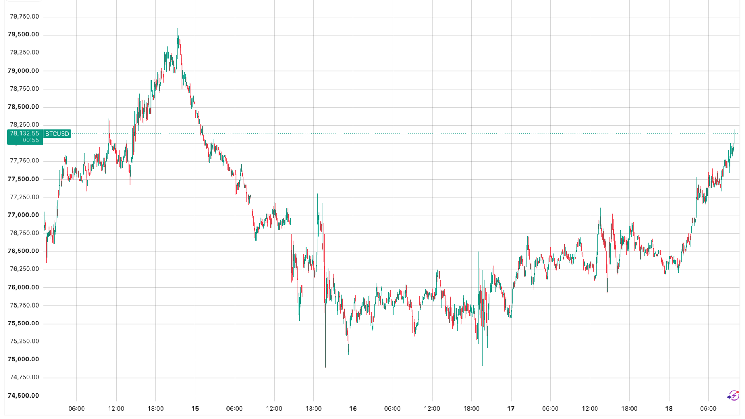
    Bitcoin $BTC rose above $78,000 during the European morning session, adding 2.1% since midnight UTC and 1.9% over the past 24 hours to trade at $78,192.86. Despite the advance, the largest cryptocurrency remains approximately 5% below its September 4 monthly high of $82,284 after two weeks of range-bound price action. The CoinDesk 100 index showed near-universal gains, with all but two constituents trading higher on the day.

    Macroeconomic Backdrop Fuels Risk Appetite

    The rally unfolded against a more conducive macroeconomic backdrop. The 10-year U.S. Treasury yield slipped back below the psychologically significant 5% threshold, while Brent crude eased under $103 per barrel after touching $109 earlier in the week. This combination relieved some of the inflation pressure that had followed the latest rate increase. Traditional risk assets mirrored the optimism, with S&P 500 and Nasdaq 100 futures rising 0.3% and 0.6% respectively, while gold and silver added 1.1% and 2.8%.

    Derivatives Data Reveals Structural Capital Inflows

    Futures Open Interest Expands as Volume Dips

    The crypto futures market is signaling a revival in positional trading rather than speculative churn. Cumulative open interest (OI) expanded nearly 5% to $141.2 billion, contrasting with a 3% decline in daily trading volume to $95 billion. The taker buy-sell volume remains balanced, suggesting capital is entering the market structurally rather than through aggressive momentum chasing.

    Bitcoin Positioning Builds Gradually

    Bitcoin futures open interest ticked up to 680,000 BTC from 670,000 BTC since midnight UTC, a modest increase accompanying the price advance. This combination typically represents a build-up of long, or bullish, positions. However, the increase remains slight, and the OI tally sits well below the peak of 800,000 BTC recorded early this year, indicating overall positioning remains light by historical standards.

    Binance Trader Ratios Show Institutional Conviction

    Binance’s top trader long-short accounts ratio pulled back to 1.52 from Wednesday’s high near 2.0, while the long-short positions ratio remains elevated at 2.36. This divergence means fewer individual large holders, or “whales,” are leaning long, but those who are have significantly increased their bet sizes, pointing to strong institutional conviction rather than retail-driven speculation.

    Uniswap Futures Open Interest Nears Record

    Among altcoins, open interest in futures tied to Uniswap’s $UNI surged to 86.61 million tokens, flirting with an all-time high and up from 76.89 million tokens yesterday. This expansion highlights substantial capital inflows moving in tandem with a 30% explosion in the token’s spot price. The renewed appetite for major DeFi altcoins stems from mounting market optimism surrounding friendly, coordinated crypto regulations from the SEC and CFTC.

    Volume Delta and Volatility Metrics Confirm Bullish Tilt

    The bullish mood is reflected in the 24-hour OI-adjusted cumulative volume delta, which is positive for most major tokens excluding GRAM, SHIB, HBAR, and BNB. A positive reading indicates bulls are being more aggressive by executing market orders rather than passive limit orders. With major events including the Clarity Act vote and the Federal Reserve and Bank of Japan interest-rate meetings now past, Bitcoin’s annualized 30-day implied volatility index (BVIV) dropped to 36%, a level that has acted as a floor since May, pointing to expectations for near-term market calm.

    Options Skew Turns Short-Term Bullish

    In options listed on Deribit, Bitcoin’s one-week put-call skew has turned positive, indicating relative richness of calls over puts. However, one- and two-month skews still show a slight put bias. Ethereum’s one-week skew also shows bullishness. The 24-hour volume rankings present a mixed picture, with both BTC calls and puts featuring among the most actively traded contracts.

    Token Spotlight: UNI Leads DeFi Surge, Layer-2 Tokens Match Strength

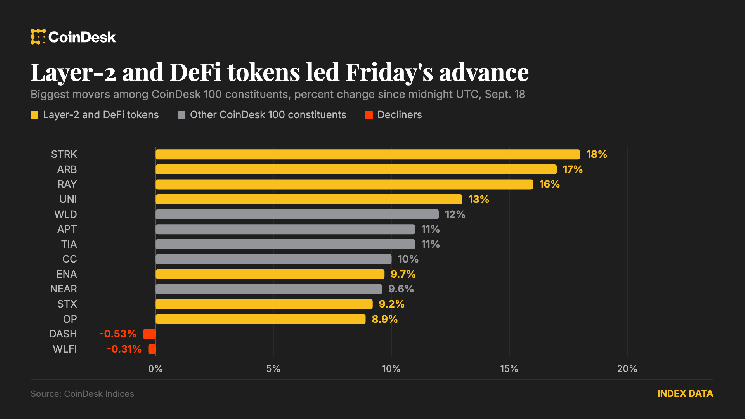
    The DeFi Select Index’s advance rested largely on Uniswap ($UNI), which gained 13% since midnight UTC and 25% over the past 24 hours. Ethena (ENA) added 9.6% and liquid-staking token Lido DAO ($LDO) rose 6.6%. Layer-2 tokens matched DeFi’s strength, led by Starknet ($STRK) at 18% on the day and 21% over 24 hours, with Arbitrum ($ARB) up 17% and 25%, Stacks ($STX) up 9.2%, and Optimism ($OP) up 8.9%. STRK reached its highest level since June 19, while ARB at 20.9 cents hasn’t traded this high since January.

    Solana ($SOL) added 4.5% to $106.14, though the sharper move occurred within its ecosystem where Solana-based DEX token Raydium ($RAY) rose 16% to $1.71 while liquid-staking token Jito ($JTO) lagged at 1.6%. This split points to DEX volume driving the bid rather than a blanket rally for the chain. Thursday’s leader, Zcash ($ZEC), traded at $1,490.10 for a gain of 1.6% on the day against 7.6% over 24 hours, meaning almost all of its advance occurred Thursday. Rival privacy token Dash ($DASH) was one of only two CoinDesk 100 constituents in the red, losing 0.53%, alongside World Liberty Financial ($WLFI), which fell 0.31%. CoinMarketCap’s “Altcoin Season” index rose to 44/100 from Tuesday’s low of 32/100, confirming speculation as the overarching theme Friday.

    Why This Matters

    The sector rotation from privacy coins to DeFi and Layer-2 tokens signals a meaningful shift in market narrative. For months, regulatory uncertainty had pressured DeFi protocols, but the prospect of coordinated SEC and CFTC frameworks has reignited institutional interest in governance tokens like UNI and scaling solutions like ARB, OP, and STRK. The derivatives data reinforces this: rising open interest alongside declining volume suggests conviction-driven positioning rather than speculative flipping. Meanwhile, implied volatility compressing to multi-month lows and short-term options skew turning bullish indicate the options market is pricing in a period of stability after a dense macro calendar. For traders, the Altcoin Season index climbing from 32 to 44 confirms broadening participation beyond Bitcoin, though it remains well below levels seen during full altcoin rotations. The next test will be whether this derivatives-led bid translates into sustained spot accumulation or fades as macro data dependencies return.

    Frequently Asked Questions

    Why are DeFi and Layer-2 tokens outperforming Bitcoin and privacy coins?

    Market optimism around potential coordinated crypto regulations from the SEC and CFTC has renewed institutional appetite for major DeFi protocols like Uniswap and scaling solutions like Arbitrum, Optimism, and Starknet. The DeFi Select Index surged 16% in 24 hours while privacy leaders like Zcash and Dash stalled or declined.

    What does the rise in futures open interest with falling volume indicate?

    The 5% expansion in cumulative open interest to $141.2 billion alongside a 3% drop in daily volume to $95 billion suggests structural capital inflows and positional trading rather than short-term momentum chasing. Balanced taker buy-sell volume further supports this interpretation.

    How should traders interpret the current options skew and volatility readings?

    Bitcoin’s 30-day implied volatility (BVIV) dropping to 36%—a floor since May—signals expectations for near-term calm after key macro events. One-week put-call skew turning positive for both BTC and ETH shows short-term bullish bias, though longer-dated skews retain a slight put bias, indicating hedging for medium-term downside risk remains.

  • Bitcoin Endures September Volatility Amid Rate Hikes and Clarity Act Setback Challenging Bulls

    Bitcoin Endures September Volatility Amid Rate Hikes and Clarity Act Setback Challenging Bulls

    Key Highlights

    • The Clarity Act failed to advance in the U.S. Senate on Tuesday, securing only 49 of the 60 votes required for cloture.
    • Bitcoin dipped briefly below $74,887 but stabilized rapidly, signaling traders had largely priced in the legislative risk.
    • Analyst Mitchell Askew of Blockware Intelligence interprets the muted price reaction as evidence of seller exhaustion, a potential indicator of a market bottoming process.

    Senate Rejects Clarity Act as Bitcoin Shrugs Off Legislative Setback

    The Clarity Act, a closely watched piece of digital asset legislation, failed to overcome a procedural hurdle in the U.S. Senate on Tuesday. The measure attracted just 49 supporters, falling 11 votes short of the 60-vote supermajority needed to advance. Despite the legislative defeat, the cryptocurrency market’s reaction was notably subdued. Bitcoin briefly slipped below the $74,887 level during the session but recovered quickly, stabilizing in a manner that suggested market participants had already discounted the probability of failure.

    Analyst Cites Seller Exhaustion as Bullish Signal

    Mitchell Askew, head of Blockware Intelligence at Blockware, characterized the price action as a significant technical development. In an email commentary, Askew stated: “What stands out to me is that Bitcoin has hardly budged at all in response to two objectively bad pieces of news. A 25-basis-point hike and the CLARITY Act failing to pass are both headlines that, in a different market environment, would have sent price meaningfully lower. Instead, we got basically nothing.”

    Askew explained that the absence of a sustained sell-off on adverse headlines points to a depletion of motivated sellers. “Anybody who was going to sell bitcoin based on events like these has already sold. They no longer have coins to sell. That is an incredibly positive sign for the medium to long term, and it is exactly what you tend to see in the later stages of a bottoming process,” she noted. The analysis frames the legislative loss as a non-event for price discovery, reinforcing a narrative of structural support accumulating at current levels.

    Energy Markets Compound Macro Pressure

    Adding to the complex macroeconomic backdrop, energy markets exerted additional pressure early in the week. West Texas Intermediate (WTI) crude futures climbed above $106 per barrel on Tuesday, marking a five-month high. The surge was driven by persistent geopolitical tensions in the Middle East, which continue to inject volatility into global risk assets. While Bitcoin demonstrated resilience against the specific legislative catalyst, the broader inflationary impulse from rising energy costs remains a variable for monetary policy expectations.

    Why This Matters

    The failure of the Clarity Act represents a continuation of legislative gridlock surrounding digital asset regulation in the United States. However, the market’s indifferent reaction may be more consequential than the vote itself. The concept of “seller fatigue” described by Blockware Intelligence suggests that the marginal supply of Bitcoin available for sale on negative news shocks is diminishing. Historically, such dynamics have preceded periods of price consolidation and eventual upward re-rating. Meanwhile, the simultaneous spike in crude oil prices underscores that crypto assets are not trading in isolation; they remain sensitive to the same liquidity and inflation crosscurrents driving traditional markets. The next focal point for traders will be whether the Federal Reserve’s response to energy-driven inflation reintroduces correlation between risk assets and rate expectations.

    Frequently Asked Questions

    What was the vote count for the Clarity Act in the Senate?

    The Clarity Act received 49 votes in favor, failing to reach the 60-vote threshold required to invoke cloture and advance the legislation.

    Why did Bitcoin’s price not crash after the bill failed?

    According to Blockware Intelligence analyst Mitchell Askew, the muted reaction indicates seller exhaustion. Market participants looking to exit on regulatory or macro headlines have likely already done so, leaving a holder base less reactive to negative catalysts.

    How do rising oil prices affect the cryptocurrency outlook?

    Higher energy costs contribute to inflationary pressures, potentially influencing Federal Reserve policy. While Bitcoin showed resilience to the specific legislative news, sustained oil price strength could tighten financial conditions broadly, creating headwinds for risk assets including crypto.

  • Wall Street Banks Revise Forecasts for Fed’s Next Rate Move

    Wall Street Banks Revise Forecasts for Fed’s Next Rate Move

    Key Highlights

    • Major Wall Street banks have shifted to more hawkish rate forecasts following the Federal Reserve’s September 25 basis point hike, with the median analyst prediction now pointing to one additional 25 basis point increase.
    • Forecasts are split on timing: NatWest, Swedbank, and Goldman Sachs see an October hike, while Standard Chartered and Commerzbank target December; Morgan Stanley projects two more hikes by Q1 2027.
    • A notable divide persists: ING, SEB, and Citi maintain the September move was the cycle peak, while JPMorgan, Barclays, UBS, and others expect only 25 basis points more, versus 50 basis points from Bank of America, Deutsche Bank, and others.

    Wall Street Recalibrates Fed Rate Path After September Meeting

    The Federal Reserve’s September policy meeting, which delivered a widely anticipated 25 basis point rate increase, has triggered a broad reassessment across Wall Street’s leading financial institutions. Analysts at Goldman Sachs, Morgan Stanley, NatWest, Rabobank, Swedbank, and Commerzbank have all shifted their forward guidance in a more hawkish direction, reflecting the central bank’s signaling that inflation remains sticky enough to warrant further tightening. While the consensus has coalesced around at least one more rate hike, the dispersion in timing and terminal rate expectations underscores deep uncertainty about the trajectory of monetary policy into 2024 and beyond.

    Divergent Timing: October Versus December for Next Move

    The most immediate point of contention among strategists is the calendar. NatWest and Swedbank have penciled in a 25 basis point increase for the Federal Open Market Committee’s October gathering, a view now shared by Goldman Sachs, which also pushed out its projected rate cuts to September and December 2027 and March 2028. Standard Chartered and Commerzbank, by contrast, have slotted their additional hike into the December meeting. Morgan Stanley stands out with a more aggressive call, forecasting a cumulative 50 basis points of further tightening—two quarter-point moves—by the first quarter of 2027. The median of analyst predictions compiled across the Street aligns with a single 25 basis point increase from current levels, but the range of projected meeting dates spans October through December.

    Terminal Rate Split: 25 Versus 50 Basis Points of Additional Tightening

    Beyond timing, firms are divided on the total magnitude of remaining hikes. A cohort including ANZ, Bank of America, RBC, TD Securities, BNP Paribas, Deutsche Bank, Morgan Stanley, and Société Générale anticipates a full 50 basis points of additional tightening. Another group—JPMorgan Chase, Barclays, UBS, Goldman Sachs, and Standard Chartered—sees the cycle ending after just 25 more basis points. On the dovish fringe, ING, SEB, and Citigroup argue the September increase marked the terminal rate, projecting no further hikes in the near term. This fragmentation has eroded the previously dominant “one-and-done” narrative, shifting market focus squarely onto whether the next move arrives in October or December.

    Why This Matters

    The recalibration of Wall Street’s rate forecasts carries direct implications for asset allocation, corporate financing costs, and global capital flows. A higher-for-longer rate environment pressures equity valuations, particularly in rate-sensitive sectors like real estate and utilities, while supporting the U.S. dollar and lifting yields across the Treasury curve. For businesses, the widened spread between the 25 and 50 basis point camps translates into material uncertainty around the cost of capital for 2024 investment planning. Policymakers at the Fed will closely monitor financial conditions indices as they weigh the lagged effects of 525 basis points of cumulative tightening since March 2022 against resilient labor markets and persistent core inflation. The next Critical Consumer Price Index and employment reports ahead of the November 1 FOMC meeting will likely determine whether the October hike scenario gains traction or the December camp prevails.

    Frequently Asked Questions

    What is the current median Wall Street forecast for additional Fed rate hikes?
    The median analyst prediction points to one more 25 basis point increase from current levels, though institutions are split between October and December for the timing.
    Which major banks believe the Fed has already finished hiking rates?
    ING, SEB, and Citigroup maintain that the September 25 basis point hike was the final move in the current tightening cycle and do not expect another increase in the near future.
    How have Goldman Sachs and Morgan Stanley updated their rate projections?
    Goldman Sachs now expects a 25 basis point hike in October and has delayed its forecast for rate cuts to late 2027 and early 2028. Morgan Stanley projects two additional 25 basis point hikes totaling 50 basis points by the first quarter of 2027.
  • Chinese Mining Company Founder Reveals Why He Repurchased All Sold Bitcoin

    Chinese Mining Company Founder Reveals Why He Repurchased All Sold Bitcoin

    Key Highlights

    • BTC.TOP founder Jiang Zhuoer has repurchased all Bitcoin positions he sold at $77,226, marking a swift strategic reversal.
    • The prominent Chinese miner cites persistent strong buying pressure and now projects Bitcoin will climb to the $80,000–$84,000 range.
    • The turnaround follows legislative headwinds for the U.S. CLARITY Act and a reassessment of macroeconomic risk factors.

    BTC.TOP Founder Reverses Course Amid Market Strength

    Jiang Zhuoer, the well-known Chinese cryptocurrency miner and founder of mining pool BTC.TOP, announced that he has fully repurchased the Bitcoin holdings he liquidated just days earlier. In a recent statement, Jiang explained that buying pressure in the spot market remains robust, leading him to adopt a renewed bullish outlook. He now anticipates that Bitcoin will surpass the $80,000 threshold and advance toward $84,000 in the near term.

    Previous Bearish Stance Driven by Macro Concerns

    The reversal is notable for its speed. Only recently, Jiang disclosed that he had sold 100% of his Bitcoin position at $77,226. At that time, he pointed to U.S. inflation data and the prospect of a Federal Reserve interest rate hike as primary catalysts for a potential market downturn. Jiang explicitly stated he was prepared for further declines and signaled a willingness to open short positions if conditions warranted.

    CLARITY Act Hurdles and Renewed Bullish Conviction

    Jiang’s latest commentary links the initial sell-off to obstacles encountered by the CLARITY Act, a piece of U.S. legislation aimed at providing regulatory clarity for digital assets. With those legislative headwinds persisting, Jiang appears to have concluded that structural demand for Bitcoin outweighs the macroeconomic risks he previously emphasized. His assessment that buyers remain dominant in the current market structure underpins the new price target of $80,000 to $84,000.

    Why This Matters

    Jiang Zhuoer is a closely watched figure in the crypto mining and trading community, and his public position changes often serve as a sentiment barometer for Chinese-market participants. His rapid flip from a full exit back to a long stance underscores the volatility of market narratives driven by U.S. policy developments—specifically the progress of the CLARITY Act—and shifting expectations around Federal Reserve monetary policy. For traders and institutional observers, the episode highlights how quickly on-chain and derivative positioning can realign when perceived regulatory risk intersects with visible spot-market demand.

    Frequently Asked Questions

    At what price did Jiang Zhuoer originally sell his Bitcoin?
    Jiang sold 100% of his Bitcoin position at $77,226.
    What is Jiang Zhuoer’s new price target for Bitcoin?
    He expects Bitcoin to rise to the $80,000–$84,000 range.
    What prompted Jiang’s initial decision to sell?
    He cited U.S. inflation data, the possibility of a Federal Reserve rate hike, and obstacles facing the CLARITY Act as reasons for his bearish stance.

    This is not investment advice.