Tag: Bitcoin

  • Crypto Trading Volume Surges as September Tests August Demand Strength

    Crypto Trading Volume Surges as September Tests August Demand Strength

    Crypto Trading Volume Faces Durability Test After August Surge

    Cryptocurrency trading volume returned sharply in August, but September is testing whether that heightened activity can hold without another broad price rally. Spot and perpetual markets expanded as Bitcoin and major tokens gained roughly 25% during the broader rebound tracked by CryptoQuant. The latest pullback now creates a cleaner test of underlying demand, allowing traders to watch whether exchange activity stays elevated without a fresh price surge.

    Macro Events Add Pressure

    Bitcoin trades near one-month lows ahead of two major policy events clustered close together. A Senate procedural vote on the CLARITY Act and the Federal Reserve’s two-day policy meeting both began on September 15. Both events can affect risk appetite and short-term positioning, giving crypto trading volume a new stress test just weeks after August’s comeback.

    August Spot Volume Hits Multi-Month High

    Spot crypto trading volume reached about $75 billion on August 21, which CryptoQuant described as the second-highest daily spot total since February. Binance handled $19.4 billion of that total, while Coinbase recorded $8 billion and Gate processed $5.1 billion.

    CryptoQuant chart showing daily spot trading volume
    Source: CryptoQuant

    The composition differed from several earlier 2026 volume spikes. Those periods often appeared during sell-offs and heavy risk reduction. August activity rose during a broad crypto rally, giving the increase a stronger buying component. That difference now raises a fresh question about persistence.

    Spot Demand Outpaces Derivatives Growth

    CoinMarketCap data also show spot activity growing faster than derivatives during August. Eleven tracked exchanges processed $4.23 trillion across spot and derivatives, up 12.3% from July. Spot volume increased 17.7% month over month, while derivatives rose 11.5%.

    That shift matters because derivatives still dominate total exchange activity, accounting for 86.2% of tracked August volume. Spot represented 13.8%, up from 13.2% in July. A continued rise in spot share would show more activity moving through direct asset purchases and reduce dependence on leveraged turnover as the main source of exchange activity.

    Binance Leads as Participation Broadens

    Binance kept the largest share of exchange activity during August. CoinMarketCap placed its total market share at 43.3% across the tracked venues. CryptoQuant also showed Binance leading the August 21 spot surge.

    However, the rebound extended beyond one platform. CryptoQuant data showed rapid 30-day spot volume growth across Gate, Coinbase, OKX, Binance, and smaller exchanges. Gate recorded the fastest increase, while Coinbase and OKX also posted strong gains.

    Perpetual futures volume reached about $336 billion on August 21, the highest daily level since March. Binance handled $124 billion, while OKX recorded $46 billion and MEXC processed $30 billion. Short covering and liquidations contributed to that futures burst.

    September Pullback Tests August Comeback

    Bitcoin dropped toward $76,000 on September 15 and approached a one-month low. The token touched an intraday low near $75,560 before recovering part of the decline. The move came before the Senate’s CLARITY Act procedural vote, with the Federal Reserve also starting its two-day policy meeting the same day.

    That backdrop gives crypto trading volume a new test. August showed that exchange activity could rise with prices rather than during forced selling. September can show whether that participation survives weaker prices and higher macro uncertainty.

    If spot turnover stays elevated during the pullback, the August rebound would look broader than one event-driven session. If activity fades quickly, the $75 billion spike would stand out as a temporary burst. Exchange volume now offers a useful measure of whether recent demand can keep engaging through volatility across major centralized venues.

    Related: Ripple Lands Multi-Year Louisville Deal to Put XRP Branding on Court

  • Clarity Law Fails, Bitcoin and Altcoins Drop; Analysts Say “Don’t Worry About It,” Outline Recovery Needs

    Clarity Law Fails, Bitcoin and Altcoins Drop; Analysts Say “Don’t Worry About It,” Outline Recovery Needs

    The Digital Asset Market Clarity Act failed to advance in the U.S. Senate on Tuesday, falling short of the 60-vote threshold required to proceed. The procedural vote tally stood at 49 in favor and 50 against, effectively stalling the comprehensive regulatory framework for digital assets.

    The outcome triggered immediate sell-offs across Bitcoin and altcoin markets. However, analysts speaking to The Block characterized the legislative setback as a delay rather than a structural shift for the crypto sector, emphasizing that macroeconomic forces—particularly Federal Reserve monetary policy—remain the primary driver of medium-to-long-term market direction.

    “The Failure of the Law to Pass is Not a Structural Problem”

    Arctic Digital Research President Justin d’Anethan told The Block that while the CLARITY Act’s failure was disappointing, it does not signal a fundamental market problem.

    d’Anethan pointed out that current Bitcoin price levels and previous all-time highs were achieved before the Clarity Act was in effect. He noted that institutional investors view the development not as a complete failure of the regulatory framework, but rather as a delay in the regulatory timeline. According to the analyst, interest rates and the overall monetary policy environment may be more decisive than regulatory clarity in determining the direction of the crypto market.

    Regulation Not a Key Determinant in Current Cycle

    BTC Markets crypto analyst Rachael Lucas offered a parallel assessment, stating that regulatory efforts are not a key determinant in the current crypto market cycle and that the market is more sensitive to interest rates.

    Lucas identified three critical areas for investors to monitor in the coming period:

    “1) Whether the Fed’s expected interest rate hikes will mark the beginning of a longer period of tightening, 2) Whether capital inflows into spot Bitcoin ETFs will accelerate again, 3) Whether an alternative regulatory path will emerge that can proceed without requiring 60 Senate votes.”

    Lucas added that capital is not exiting the market but concentrating in specific assets. While Congress is not strictly necessary for a fourth-quarter recovery, the analyst stressed that a prerequisite for such a rebound is for interest rates not to worsen further.

    “All Eyes Are on the FED Today!”

    Market attention has now pivoted squarely to the Federal Reserve. The U.S. central bank is expected to raise its benchmark interest rate for the first time since 2023 at today’s FOMC meeting, with a 25-basis-point increase widely anticipated. Futures markets are pricing in a higher than 90% probability of a hike at this session, with an additional increase projected before year-end.

    This is not investment advice.

  • Bitcoin Miner MARA Holdings Makes Millions in Bitcoin Purchases: Details Revealed

    Bitcoin Miner MARA Holdings Makes Millions in Bitcoin Purchases: Details Revealed

    MARA Holdings Adds 1,292 Bitcoin to Treasury in $98.6 Million FalconX Transaction

    Bitcoin mining firm MARA Holdings (NASDAQ: MARA) has expanded its corporate treasury with a significant Bitcoin acquisition, according to on-chain data tracked by analytics platform Lookonchain. The company purchased 1,292 BTC through institutional trading platform FalconX approximately nine hours before the data was published.

    Transaction Details and Market Context

    The acquisition carries an estimated value of $98.64 million, marking another substantial single institutional Bitcoin purchase by the publicly traded miner. MARA Holdings operates with a dual strategy: mining Bitcoin through its operations while simultaneously accumulating the asset on its balance sheet.

    Large-scale Bitcoin purchases by public companies are widely viewed as a key indicator of institutional investor confidence in the cryptocurrency market. The use of FalconX—a prime brokerage catering to institutional clients—underscores the professional execution behind the transaction.

    Strategic Implications for Miner Treasuries

    Rather than immediately selling mined Bitcoin to cover operational costs, MARA and peers have increasingly adopted a long-term asset accumulation strategy. This approach treats Bitcoin as a treasury reserve asset, aligning corporate holdings with the very commodity the business produces.

    Market observers are monitoring the transaction not only for its potential price impact but also for signals regarding MARA’s total digital asset position. The company’s continued buying reinforces a broader trend of publicly traded firms deepening their institutional presence in the crypto ecosystem.

    Data Gaps Remain

    While Lookonchain’s on-chain analysis confirms the transaction size and counterparty, the data does not disclose:

    • The average purchase price per Bitcoin
    • MARA’s total Bitcoin holdings following this acquisition

    These details would provide further clarity on the company’s dollar-cost averaging approach and overall treasury exposure.

    This article is for informational purposes only and does not constitute investment advice.

  • FOMC Meeting Today: Fed Expected to Hike Rates 25 Bps – Will Bitcoin Drop Again?

    FOMC Meeting Today: Fed Expected to Hike Rates 25 Bps – Will Bitcoin Drop Again?

    Fed Expected to Raise Rates by 25 Basis Points

    Crypto markets are already under pressure ahead of today’s Federal Open Market Committee (FOMC) meeting, with Bitcoin trading below $75,000. The Fed is widely expected to raise rates by 25 basis points, a move that is largely priced in. Traders are now focused on Chair Kevin Warsh’s comments for clues on future rate hikes and whether another wave of selling could hit Bitcoin.

    The FOMC will announce its decision at 2:00 PM EDT, followed by Fed Chair Kevin Warsh’s press conference at 2:30 PM EDT. Markets are pricing in a 92.5% chance of a 25-basis-point hike, which would move the federal funds rate from 3.50%–3.75% to 3.75%–4.00%. This would be the Fed’s first rate hike in three years.

    🚨 REMINDER: 🇺🇸 FED INTEREST RATE DECISION TODAY AT 2:00 PM ET!
    Current: 3.50% – 3.75%
    Forecast: 3.75% – 4.00%
    HIKE → MARKETS DROP HARD
    HOLD → MARKETS RALLY
    CUT → MARKETS RALLY HARD
    PRESS CONFERENCE AT 2:30 PM ET!
    pic.twitter.com/Du0sWRoIBp
    — Crypto Rover (@cryptorover) September 16, 2026

    However, traders are already looking beyond today’s decision. They are watching Warsh’s comments for signals about future rate hikes. The markets have shifted from expecting two hikes to pricing in at least three by June 2027. Former Fed Vice Chair Richard Clarida warned that another hike could follow.

    “If we get a hike next week, certainly we’ll get additional ones. This is certainly not one and done.”

    CLARITY Act Failure Adds More Pressure

    The Fed’s decision comes as the crypto market deals with another setback. On September 15, the CLARITY Act failed to advance in the Senate, weakening a major regulatory catalyst for the market. Even after a last-minute substitute text included 126 bipartisan changes, lawmakers could not overcome major political and ideological differences. Prediction markets now put the bill’s 2026 passage odds at around 12%.

    Following the setback, the total crypto market fell more than 3%, while Bitcoin dropped below $75,000. The decline also triggered around $770 million in liquidations, adding more selling pressure from leveraged long positions.

    Bitcoin Could Face More Selling If Warsh Sounds Hawkish

    The biggest risk for crypto may not be the 25-basis-point increase itself, because traders have already priced it in. Instead, Bitcoin could face more selling if Warsh signals that more hikes are coming or the Fed’s updated projections point to tighter policy for longer. Such a signal could strengthen the dollar, lift bond yields, and push investors away from riskier assets. Bitcoin has already fallen below $76,000, now trading around $75,860.

  • Bitcoin Coinbase Premium Falls to One-Month Low: Key Drivers Behind the Drop

    Bitcoin Coinbase Premium Falls to One-Month Low: Key Drivers Behind the Drop

    Bitcoin Coinbase Premium Slumps to Four-Week Low as U.S. Demand Weakens

    Bitcoin’s Coinbase premium has dropped to its lowest level in four weeks, signaling fading U.S. buying pressure as traders digest a legislative setback for the crypto industry and brace for tighter monetary policy.

    Coinbase Premium Turns Negative

    The premium measures the price gap between Bitcoin’s dollar value on Coinbase and its USDT-denominated price on Binance. CryptoQuant’s Coinbase Premium Index tracks this spread as a percentage of price. Tuesday’s reading of approximately -0.07% translates to roughly $50 on a $75,900 Bitcoin — a narrow margin that nonetheless points to relatively weak demand on the U.S. exchange.

    The discount deepened from roughly -0.02% a day earlier after the Clarity Act failed to advance on Tuesday. The move marks a sharp reversal from late August and early September, when the premium flipped positive for the first time in months as Bitcoin rallied toward $80,000. Since then, Bitcoin has retreated to around $75,000.

    Legislative Setback Weighs on Sentiment

    The failure of the Clarity Act — a bill aimed at establishing clearer regulatory frameworks for digital assets — has removed a potential catalyst for institutional inflows. Market participants had viewed legislative progress as a key driver for sustained U.S. exchange premiums, which typically reflect stronger domestic appetite.

    Fed Policy Decision Looms

    Monetary policy presents an additional headwind. The Federal Reserve announces its rate decision later Wednesday, with markets widely pricing in a 25-basis-point increase that would lift the federal funds target range to 3.75%–4%. Higher rates tend to dampen risk appetite across speculative assets, including cryptocurrencies.

    Traders will closely monitor the accompanying policy statement and press conference for signals on the pace of future hikes, which could further influence Bitcoin’s near-term trajectory and exchange-specific pricing dynamics.

  • Crypto Longs Worth $570 Million Wiped Out as Clarity Act Fails

    Crypto Longs Worth $570 Million Wiped Out as Clarity Act Fails

    Crypto traders holding long, or bullish, futures positions suffered significant losses over the past 24 hours following the failure of the Clarity Act in a Senate procedural vote.

    Liquidation Data Reveals Heavy Long-Side Damage

    Exchanges liquidated approximately $571 million in long positions during this period, marking the highest total since August 22, according to data from CoinGlass. In contrast, short, or bearish, positions accounted for only about $100 million of the total wipeout.

    Bitcoin and Ether Lead Liquidation Tally

    Bitcoin and ether longs absorbed the heaviest damage, with roughly $190 million liquidated in each asset. XRP longs lost about $30 million, while Solana longs saw approximately $22 million in liquidations.

    Market Positioning Reflected Legislative Optimism

    The liquidation data indicates markets were positioned for continued upside, largely driven by hopes that the Clarity Act would advance. Analysts had previously flagged ether and DeFi tokens as the assets most likely to outperform bitcoin if the Senate voted in favor of the legislation.

    Trump Concession Reports Fueled Recent Rally

    Optimism strengthened earlier this week after reports that President Donald Trump was willing to make concessions on the bill’s ethics provisions. The market responded positively: bitcoin, the largest cryptocurrency by market value, rose to nearly $80,000 from about $77,000 on Monday.

  • Crypto Sector Surges 213% Since Bitcoin’s 2025 Peak as One Coin Leads the Rally

    Crypto Sector Surges 213% Since Bitcoin’s 2025 Peak as One Coin Leads the Rally

    Privacy Coins Surge 213% Since Bitcoin’s October 2025 Peak, Led by Zcash Rally

    Privacy-focused cryptocurrencies have climbed 213% since Bitcoin’s October 2025 high, even as BTC remains significantly below that level, according to a market breakdown published today by analyst Wise Crypto. The sector’s combined market capitalization has grown from $7.1 billion a year ago to $33.6 billion currently, though the gains are heavily concentrated in a single asset.

    Zcash Dominates Privacy Sector Growth

    Zcash (ZEC) accounts for roughly 62% of the privacy category’s total market cap on its own, rising 25x over the past year. Its market-cap ranking surged from #82 to as high as #7 at one point, though CoinGecko data currently places it at #9. Glassnode data published last week corroborated the trend, finding that privacy was the only crypto sector trading above its October peak, with every other category still down by double digits.

    Grayscale’s Zcash ETF, trading under the ticker ZCSH, crossed $500 million in assets within two weeks of launch. Monero (XMR), the second-largest privacy asset, has approximately doubled over the same period despite facing delistings from several exchanges. Among the 25 largest crypto assets, Wise Crypto noted that only four — ZEC, HYPE, XMR, and WBT — are still trading above their October levels.

    Investors Highlight Diversification Beyond Major Chains

    Investor Dan Tapiero told The Wolf of All Streets on September 11 that the moves in ZEC and HYPE this cycle demonstrate crypto is no longer just a Bitcoin, Ethereum, and Solana story. “Zcash has been an enormous winner this year,” he said, pointing to broader activity building outside the three largest chains.

    A day later, Egor Sidelska of Infinex argued that privacy is one of the only parts of crypto that hasn’t already been built out and cloned across other chains, calling ZEC “the last 100x in crypto that isn’t a random meme coin.”

    Valuation Debate Continues Amid Rapid Appreciation

    Not all analysts are convinced the rally is fully justified. Analyst filbfilb recently pushed back on how far the Zcash advance can be trusted, sharing valuation models that compared ZEC’s transaction activity against Bitcoin’s at a similar stage of issuance. Those models implied a price around $944 — below current levels — though convergence scenarios place fair value much higher if Zcash continues closing the gap.

    At the time of writing, ZEC was changing hands at approximately $1,140, flat on the day but up 32% over the last two weeks and more than 2,100% over the past year. The token remains well off its 2016 all-time high near $3,190. Meanwhile, Bitcoin traded near $77,000, down just over 1% in 24 hours and about 34% over one year, leaving it roughly 39% below its own October 2025 all-time high.

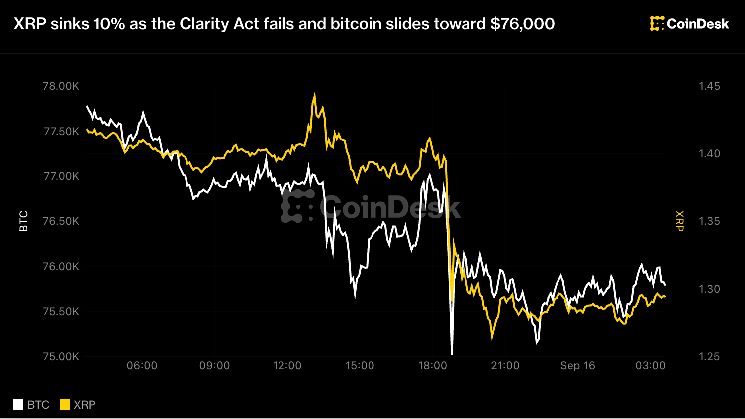
  • XRP Sinks 10% as Clarity Act Fails, Bitcoin Slides Toward $76,000

    XRP Sinks 10% as Clarity Act Fails, Bitcoin Slides Toward $76,000

    XRP led a broad cryptocurrency sell-off Wednesday morning, plunging nearly 10% to $1.30 during Asian trading hours after the U.S. Senate failed to advance the Clarity Act, according to CoinDesk data.

    Major Tokens Slide Across the Board

    Ether followed with a decline of nearly 5% to approximately $2,410. Solana dropped 5% to just above $97, while Dogecoin fell nearly 5%. Zcash and Hyperliquid’s HYPE each slipped close to 4%, and Bitcoin retreated nearly 3% to just above $76,000. BNB and Tron proved the most resilient, each down only about 1%.

    Clarity Act Fails on Cloture Vote

    The legislation fell short on a 49-50 cloture vote, the procedural threshold requiring 60 senators to move a bill to debate. Multiple Republicans joined Democrats in voting against the measure. Negotiators had produced more than 600 pages of compromise text, but the provision that ultimately derailed the bill centered on ethics language designed to prevent senior government officials from maintaining crypto business interests.

    Senator Slotkin Cites Ethics Concerns

    Senator Elissa Slotkin, a Michigan Democrat, explained her opposition by stating the “the ethics provisions in this bill are simply too thin,” pointing to President Donald Trump, his children and his Cabinet earning money in crypto.

    She also said the Commodity Futures Trading Commission lacks the staffing to implement the law, and that the bill left gaps on money laundering and terrorist financing.

    Today, I voted no on the Clarity Act, legislation meant to regulate cryptocurrency in America.The ethics provisions in this bill are simply too thin. President Trump, his children, and his Cabinet are making billions of dollars in the crypto space, in part from bilking everyday…

    — Sen. Elissa Slotkin (@SenatorSlotkin) September 15, 2026

    Crypto Equities Hit Harder Than Tokens

    Publicly traded crypto companies suffered steeper losses than the underlying assets. Coinbase shares fell nearly 9% to $174.42, while Circle dropped more than 9% to $88.26. Galaxy Digital declined 8% and Gemini slid 7%. Bullish and Riot Platforms each lost 5%, eToro fell 4%, and Robinhood, MARA Holdings, CleanSpark, IREN and Core Scientific all dropped between 3% and 4%.

    Regulatory Path Forward Shifts to SEC

    Attention now turns to the regulators the bill was intended to constrain. The Securities and Exchange Commission is already advancing its proposed Reg Crypto framework and rules for tokenized securities, which now represents the primary pathway to the regulatory certainty the industry sought from Congress.

    Political and Market Implications

    Industry political action committees, including Fairshake, must now decide how to approach senators who voted against the legislation ahead of the November 3 election. A new Congress will convene in January 2027.

    Meanwhile, the Federal Reserve is scheduled to announce its rate decision later Wednesday, with traders leaning toward a quarter-point hike. The decision lands on a market that has just watched its legislative push collapse and is already selling risk assets.

  • Bitcoin May Hit Record Levels This Year, Arthur Hayes Predicts

    Bitcoin May Hit Record Levels This Year, Arthur Hayes Predicts

    Bitcoin Faces Critical Resistance as Arthur Hayes Predicts Potential All-Time High

    Bitcoin is drawing heightened market scrutiny as prominent voices forecast a possible surge to new all-time highs before year-end. On September 8, BitMEX co-founder Arthur Hayes indicated in an interview with The Rollup that structural monetary easing could catalyze the next major rally. With U.S. political dynamics shaping policy implementation, traders are advised to monitor upcoming developments closely for strategic positioning.

    Price Action Tests Key $64,000–$65,000 Resistance Zone

    As Bitcoin approaches the pivotal resistance band between $64,000 and $65,000, market participants are observing a tense standoff between buyers attempting to reclaim control and sellers defending these levels. Recent analysis from DaanCrypto emphasizes the importance of Fibonacci retracement levels in gauging Bitcoin’s next directional move. With speculation mounting around potential monetary policy shifts, the market braces for heightened near-term volatility.

    Key Takeaways for Market Participants

    • Arthur Hayes projects Bitcoin could reach a new all-time high by year-end, driven by structural monetary easing.
    • U.S. political developments may influence the pace and nature of monetary policy implementation.
    • Traders should prioritize structural factors driving Bitcoin’s price movements over short-term noise.
    • Historical accuracy of Hayes’ past predictions remains mixed, warranting measured risk management.
    • Fibonacci retracement levels offer potential reference points for identifying trading opportunities.

    Market Structure Shows Mixed Signals Amid Low Volume

    The broader cryptocurrency market is delivering conflicting cues as Bitcoin tests critical resistance. Buyers are striving to breach the $65,000 barrier—a level pivotal for overall market sentiment—while sellers actively defend the zone, signaling a battle for directional control. Notably, the absence of substantial trading volume amplifies uncertainty, underscoring the need for vigilance and strategic flexibility.

    As the leading cryptocurrency operating on decentralized ledger technology, Bitcoin’s market activities remain under regulatory scrutiny to ensure compliance with financial laws. Traders must navigate an evolving landscape where ongoing U.S. monetary policy discussions could significantly impact price dynamics.

    Critical Levels to Watch for Breakout or Rejection

    A decisive breakthrough above $65,000 could signal the onset of a more substantial rally. However, the influence of U.S. political decisions on monetary policy introduces risk factors that may trigger increased volatility. Market participants are advised to track Fibonacci levels closely and adjust strategies accordingly, as any significant price movement could rapidly shift market sentiment.

    Disclaimer: The information provided is for educational purposes only and does not constitute financial advice.

  • Bitcoin, Ethereum, XRP Plunge After CLARITY Act Fails in Senate Vote

    Bitcoin, Ethereum, XRP Plunge After CLARITY Act Fails in Senate Vote

    Bitcoin, Ethereum, XRP Face Selling Pressure After Senate CLARITY Act Vote Fails

    Major cryptocurrencies including Bitcoin (BTC), Ethereum (ETH), and XRP came under fresh selling pressure Thursday after the U.S. Senate failed to advance the CLARITY Act, a key piece of digital-asset market structure legislation.

    Senate Procedural Vote Falls Short of 60-Vote Threshold

    A procedural vote on the bill did not secure the 60 votes needed to overcome a filibuster, effectively stalling the legislation. The defeat concludes months of negotiations between Republicans and Democrats over the regulatory framework for digital assets.

    Market Reaction Reflects Regulatory Uncertainty

    The immediate market reaction underscores how sensitive crypto prices remain to policy developments in Washington. Traders had been monitoring the CLARITY Act closely, viewing its passage as a potential catalyst for institutional adoption and clearer compliance guidelines.

    According to the latest market data, the three assets erased earlier gains following news of the vote’s failure, with selling pressure accelerating during the U.S. trading session.

    What the CLARITY Act Would Have Done

    The bipartisan bill aimed to establish clear jurisdictional boundaries between the Securities and Exchange Commission (SEC) and the Commodity Futures Trading Commission (CFTC) for digital asset oversight. It also sought to define when a token qualifies as a security versus a commodity — a distinction that has been central to enforcement actions and industry uncertainty.

    Outlook for Crypto Regulation in Congress

    With the legislative calendar tightening ahead of the November elections, the path forward for comprehensive crypto market structure legislation remains unclear. Market participants will now watch for potential attachment to must-pass spending bills or renewed bipartisan efforts in the next session.