Tag: Bitcoin

  • Coinbase and Wintermute Release Key Analyses: “The Balance is Shifting in the Bitcoin-Gold Equation! This Week’s Focus Will Be This Level!”

    Coinbase and Wintermute Release Key Analyses: “The Balance is Shifting in the Bitcoin-Gold Equation! This Week’s Focus Will Be This Level!”

    Key Highlights:

    • Bitcoin has risen over the past month while gold has declined, despite their 90-day correlation approaching a record high.
    • Coinbase Institutional said marginal investment demand is favoring Bitcoin even as interest rates remain elevated.
    • Wintermute identified $82,500 as Bitcoin’s critical level this week after the cryptocurrency closed above its 50-week moving average for the first time since November 2025.

    Bitcoin Outperforms Gold Despite Near-Record Correlation

    Bitcoin is diverging from gold in recent performance, according to an analysis by Coinbase Institutional. The 90-day correlation between Bitcoin ($BTC) and gold is nearing a record high, indicating that the two assets have recently tended to move in similar directions. However, the analysis emphasized that a stronger correlation does not necessarily produce similar returns.

    Bitcoin rose over the past month, while gold declined during the same period. The divergence highlights how closely correlated assets can still deliver significantly different price movements over shorter time frames.

    Coinbase Institutional also pointed to the effect of higher interest rates on investment demand. According to the firm, new marginal demand has shifted toward Bitcoin in an environment of rising rates, with Bitcoin favored despite the higher cost of capital.

    “Bitcoin > altın. $BTC’nin altınla korelasyonu rekor düzeye yakın. Ama benzer korelasyonlar benzer getiriler anlamına gelmez. Son bir ayda $BTC yükseldi, altın ise düştü.
    The lesson we learned: Marginal demand favors bitcoin despite higher interest rates.

    Wintermute Identifies $82,500 as Bitcoin’s First Major Test

    Wintermute, a cryptocurrency market maker, has also assessed Bitcoin’s latest move. In its most recent market analysis, the company said Bitcoin closed above its 50-week moving average last week for the first time since November 2025.

    Following that advance, market attention has shifted to the $82,500 level. Wintermute described the level as critical for Bitcoin this week because it marks the upper boundary of the cryptocurrency’s previous consolidation range.

    Wintermute said that holding above $82,500 would be important for sustaining Bitcoin’s recent rally. The price has struggled to break through this area for weeks, and sustained trading above it could suggest that the first weekly close above the 50-week moving average represents a more lasting price formation rather than a temporary move.

    However, Wintermute expects Bitcoin to test $82,500 several times in the short term. A weekly close below the level could raise questions about the validity of the upward breakout, according to the market maker.

    Risk Assets Stay Strong Despite Higher Treasury Yields

    Wintermute also noted that risk assets remained strong last week even as the U.S. 10-year Treasury yield climbed above 5%, reaching its highest level since 2007. The observation places Bitcoin’s latest technical test against a backdrop of elevated bond yields and continued strength across risk-oriented markets.

    Why This Matters

    The developments show that Bitcoin and gold can maintain a high correlation while producing sharply different short-term returns. For Bitcoin, the $82,500 level now represents an important technical marker: holding above it would support the sustainability of the recent rally, while a close below it could weaken confidence in the breakout.

    Bitcoin’s position above its 50-week moving average and the continued strength of risk assets are central to Wintermute’s assessment. At the same time, Coinbase Institutional’s analysis indicates that marginal demand is currently favoring Bitcoin despite higher interest rates.

    Frequently Asked Questions

    Did Bitcoin outperform gold over the past month?

    Yes. Bitcoin rose during the last month, while gold declined, even though their 90-day correlation is nearing a record high.

    Why is $82,500 important for Bitcoin?

    Wintermute identified $82,500 as the upper limit of Bitcoin’s previous consolidation range and said that holding above it is important for sustaining the recent rally.

    What could happen if Bitcoin closes below $82,500?

    According to Wintermute, a close below $82,500 could raise questions about whether Bitcoin’s upward breakout is valid.

    This is not investment advice.

  • Michael Saylor Issues Statement Following Recent Developments

    Michael Saylor Issues Statement Following Recent Developments

    Key Highlights

    • Strategy founder Michael Saylor unveiled a comprehensive policy framework advocating for Bitcoin’s integration into banking and insurance systems, including custody services and balance-sheet adoption.
    • Saylor proposes a “digital rights declaration” establishing five fundamental rights for digital asset creation, issuance, holding, transfer, and use, alongside simplified disclosure rules scaled to project size.
    • The framework calls for regulatory differentiation between client custody, Bitcoin-backed lending, and bank proprietary positions, while criticizing the Basel 1,250% risk weighting and the Clarity Act’s restrictive approach.

    Saylor Outlines Five-Pillar Digital Rights Framework

    Strategy founder and Executive Chairman Michael Saylor has published a sweeping policy framework for the digital economy, arguing that Bitcoin should be more broadly integrated into the banking and insurance systems. In his published article, Saylor stated that artificial intelligence will significantly increase the productivity of individuals and businesses, and that the digital asset era needs a “digital rights declaration.” According to Saylor, individuals and companies should have five fundamental rights regarding the creation, issuance, holding, transfer, and use of digital assets.

    Simplifying Issuance and Enabling Digital Dollar Competition

    Saylor, who advocates for simplifying the rules regarding digital asset issuance, said that applying different disclosure obligations based on project size could lower the cost of accessing finance for companies. Saylor suggested that this approach could help approximately 10 million new companies access capital. Saylor also stated that a clear regulatory path should be created to allow banks, fintech companies, and technology platforms to issue digital dollar products. He argued that organizations issuing digital dollars should also be able to compete on terms of yield.

    Bitcoin as “Digital Capital”: Banking and Insurance Integration

    Saylor, who described Bitcoin as “digital capital,” called for banks to be allowed to offer Bitcoin custody services and provide Bitcoin-backed loans. He also said that a viable regulatory framework should be created so that insurance companies can incorporate Bitcoin into their balance sheets and product designs. Saylor argued that the 1,250% risk weighting applied to some crypto asset risks under Basel regulations is too strict. He stated that regulations should differentiate between client-based custody services, Bitcoin-backed loans, and banks’ own Bitcoin positions, adding that bank adoption of Bitcoin could be a significant catalyst for the sector’s growth.

    Tokenized Securities, Privacy, and the Clarity Act Critique

    Saylor, also touching upon tokenized securities, said that simply moving existing securities onto the blockchain is not enough. He argued that investors should be able to store their assets directly, transfer them freely, and choose different custody or lending service providers. Regarding privacy, Saylor stated that ordinary and legitimate transactions under $10,000 should not be automatically reported to government agencies simply because they involve the transfer of money or digital assets. According to Saylor, the U.S. Securities and Exchange Commission (SEC), the Commodity Futures Trading Commission (CFTC), the U.S. Treasury Department, banking regulators, and the White House will play a key role in advancing reforms over the next two years. Saylor, who also criticized the Clarity Act, argued that the regulation placed too much emphasis on restrictions.

    Why This Matters

    Saylor’s framework arrives amid intensifying debate over U.S. digital asset legislation, including the Financial Innovation and Technology for the 21st Century Act (FIT21) and stablecoin bills advancing in Congress. His proposals directly address three structural friction points: the Basel Committee’s punitive 1,250% risk weight for Group 2 cryptoassets, which discourages bank balance-sheet engagement; the lack of a clear charter for insurers to hold Bitcoin as a reserve asset; and the absence of a scaled disclosure regime that would lower compliance costs for smaller token issuers. By explicitly naming the SEC, CFTC, Treasury, federal banking agencies, and the White House as the entities that must drive reform over the next two years, Saylor is mapping a lobbying and legislative roadmap that aligns with Strategy’s corporate strategy of accumulating Bitcoin while advocating for the institutional infrastructure to support it. The critique of the Clarity Act signals industry concern that current legislative drafts may over-index on enforcement tools at the expense of market-making clarity.

    Frequently Asked Questions

    What are the five fundamental digital rights Saylor proposes?

    Saylor outlines rights covering the creation, issuance, holding, transfer, and use of digital assets, framed as a “digital rights declaration” for individuals and companies.

    How does Saylor propose to change Basel capital rules for Bitcoin?

    He argues the current 1,250% risk weighting is excessive and urges regulators to differentiate between client custody services, Bitcoin-backed loans, and banks’ own proprietary Bitcoin positions.

    Which U.S. agencies does Saylor identify as critical for implementing reforms?

    Saylor names the SEC, CFTC, U.S. Treasury Department, federal banking regulators, and the White House as the key entities that will drive policy changes over the next two years.

  • Bitwise: 15 Institutions Signal More Crypto Buyers May Be Coming

    Bitwise: 15 Institutions Signal More Crypto Buyers May Be Coming

    Key Highlights

    • Major institutions held crypto allocations through a roughly 50% market decline between October 2025 and April 2026, with none of the 15 interviewed by Bitwise reducing exposure and several increasing positions.
    • Bitcoin serves as the universal first, largest, and longest-held crypto asset for every institutional holder surveyed, with allocations typically ranging from 1% to 2% of investable assets.
    • Bitwise projects a majority of institutional investors will hold crypto within five years, supported by separate data showing 60% of wealth managers plan allocations within a year and 75% of institutions intend to increase exposure in 2026.

    Institutions Weather Market Decline Without Selling

    Some of the world’s largest institutional investors maintained their cryptocurrency allocations through a severe market downturn, according to Bitwise Asset Management’s institutional crypto adoption report published September 23. The firm interviewed 15 institutions between late March and April 2026, covering a period when crypto markets declined approximately 50% from October 2025 through April 2026. Not a single interviewee reduced its allocation during that window, and several added to their positions.

    The resilience reflects a longer-term investment thesis. As one investment consultant described the perspective to Bitwise: “If the thesis is right, given the S-curve of adoption, selling now would be selling too early.” None of the institutions cited price depreciation as a reason they would sell. The group also included potential buyers: several participants without existing allocations were in advanced due diligence, while multiple sovereign wealth funds were actively examining sizable positions. One sovereign investor noted that building the necessary legal and regulatory infrastructure for an allocation could take more than a year, suggesting decisions may not appear in public holdings data immediately.

    Bitcoin Dominates Institutional Crypto Portfolios

    Among Bitwise’s interviewees, crypto allocations ranged from 0.5% to 13% of investable assets, with most clustering between 1% and 2%. Family offices reported the largest positions and could often act with approval from a single principal. Sovereign wealth funds tended to hold smaller allocations while navigating more layers of review. Bitwise found that allocation size tracked almost inversely with the number of people required to approve the investment.

    Every institution that owned cryptocurrency held bitcoin, universally as its first, largest, and longest-held crypto position. Some also held ether or solana in smaller amounts, attaching conditions to those positions such as whether growing network usage would produce value for their tokens. Public disclosures corroborate substantial existing positions: two Abu Dhabi investment vehicles held nearly $764 million in BlackRock bitcoin ETF shares at the end of June without reducing their combined net share count during the second quarter. Those holdings are separate from the anonymous institutions in Bitwise’s study.

    ETFs Become Primary Access Vehicle

    Access has become significantly easier for institutional allocators. Almost every institution Bitwise interviewed either used spot cryptocurrency exchange-traded funds or planned to use them, citing lower costs and simpler administration. A spot bitcoin ETF provides price exposure through brokerage-held shares while the fund handles custody of the underlying bitcoin. Bitwise also found that some institutions use vehicles outside Form 13F disclosure, making public filings an incomplete measure of total institutional ownership.

    Sovereign Wealth Funds and Family Offices Lead Adoption

    The interviews reveal distinct adoption patterns across institution types. Family offices, with streamlined decision-making, have moved fastest into larger positions. Sovereign wealth funds, while showing strong interest, face longer implementation timelines due to regulatory and governance requirements. This dynamic creates a staggered adoption curve where early movers establish positions while a larger wave of capital works through due diligence and approval processes.

    Growing Pipeline of New Institutional Capital

    Bitwise expects adoption to build as investors complete due diligence and more institutions disclose positions. The asset manager argues each credible public allocation lowers the reputational cost of investing for the next institution. Bitwise forecasts that a majority of institutional investors will hold crypto within five years—a projection, not a measured outcome from the 15 interviews.

    Separate data reinforces the trajectory. A Coinbase and EY-Parthenon survey of 351 institutional investors conducted in January 2026 found nearly three-quarters planned to increase crypto allocations in 2026. Nearly half also reported greater attention to risk management, liquidity, and position sizing amid volatility. In a separate poll of wealth managers discussed by Bitwise Head of Research Ryan Rasmussen on September 8, 60% of respondents planned a crypto allocation within a year, while 67% had none at the time.

    Why This Matters

    The Bitwise report signals a maturation of institutional crypto adoption from speculative positioning to strategic portfolio construction. The fact that no interviewed institution sold during a 50% drawdown—and several bought—suggests bitcoin is increasingly viewed as a long-term store of value akin to gold, which institutions often pair it with. The widespread embrace of spot ETFs as the preferred access vehicle removes custody and operational barriers that previously deterred traditional allocators. Meanwhile, the pipeline of sovereign wealth funds and wealth managers working through due diligence represents a potentially massive wave of future capital. Regulatory progress and peer adoption effects—where each public allocation reduces career risk for the next decision-maker—create a self-reinforcing adoption dynamic that could accelerate over the next several years.

    Frequently Asked Questions

    What percentage of their portfolios are institutions allocating to crypto?

    Among the 15 institutions Bitwise interviewed, crypto allocations ranged from 0.5% to 13% of investable assets, with most falling between 1% and 2%. Family offices tended to hold larger positions than sovereign wealth funds.

    Which cryptocurrencies do institutions hold?

    Every institutional holder in the Bitwise study owned bitcoin as their first, largest, and longest-held position. Some also held smaller allocations to ether or solana, typically with conditions tied to network adoption and token value accrual.

    How are institutions accessing crypto exposure?

    Almost every institution interviewed by Bitwise either used or planned to use spot cryptocurrency exchange-traded funds, citing lower costs and simpler administration. Some also use investment vehicles that fall outside Form 13F disclosure requirements, meaning public filings understate total institutional ownership.

  • Bitcoin Price Gains 44% for Second-Best Q3 as Ethereum Jumps 71%

    Bitcoin Price Gains 44% for Second-Best Q3 as Ethereum Jumps 71%

    Key Highlights

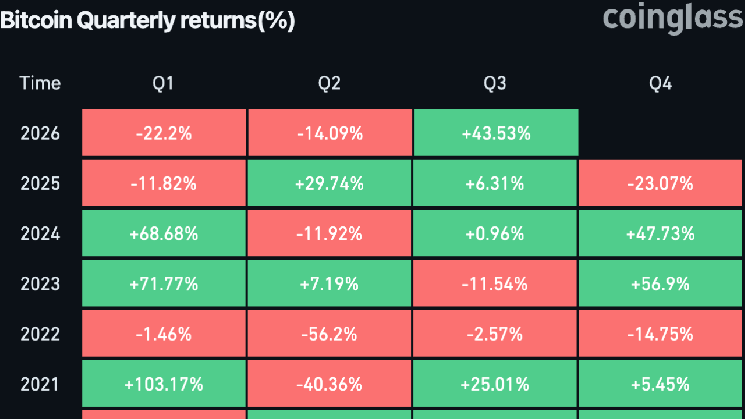
    • Bitcoin surged approximately 43.5% in Q3 2026, rising from roughly $58,500 to around $84,000, marking its second-best third quarter on record behind only the 80.4% gain in 2017.
    • Ethereum outperformed with a 71% quarterly advance, surpassing its previous Q3 record of 66.5% set in 2025 and establishing its strongest summer rally ever.
    • Both assets cleared key technical hurdles including the September 25 quarterly options expiry, with Bitcoin reclaiming critical investor cost-basis levels and showing strengthened ETF demand alongside restrained profit-taking.

    Bitcoin and Ethereum Break Historical Q3 Patterns

    Cryptocurrency markets have transformed what is typically one of the calendar’s quieter quarters into one of the strongest periods in digital asset history. Bitcoin’s price has gained roughly 43.5% during Q3 2026, climbing from about $58,500 at the quarter’s start to approximately $84,000 as of September 26. This performance puts the quarter on track to become Bitcoin’s second-best Q3 ever, trailing only the approximately 80.4% surge recorded in 2017.

    Ethereum has delivered an even more remarkable showing. According to Coinglass data, ETH has risen 71% this quarter, exceeding its previous Q3 record of about 66.5% set in 2025. The move marks Ethereum’s strongest summer rally on record, defying the historical pattern where July, August, and September often produce flat or modest returns compared with typically stronger fourth-quarter periods.

    Analysts Call Performance Extraordinary

    The combination of both major assets posting historic quarterly gains simultaneously has drawn significant attention from market observers. Crypto analyst Luciano described the developments as extraordinary, writing on X that this is the 2nd best quarter ever recorded for BTC and the best quarter $ETH has ever had. The significance extends beyond raw percentage gains, as both assets enter the final stretch of September with established momentum ahead of a quarter that has historically attracted greater speculative interest.

    Bitcoin Clears Technical Hurdles and Cost Bases

    The rally’s foundation appears to rest on more than derivatives speculation alone. Bitcoin has moved back above several investor cost-basis levels that previously capped recovery attempts. Exchange-traded fund demand has strengthened, spot trading volume has increased, and profit-taking remains relatively restrained compared with previous market peaks.

    Bitcoin’s price also held firm through the large September 25 quarterly options expiry, an event carrying substantial open interest that had the potential to generate significant short-term volatility. With that hurdle now behind the market, attention is shifting toward the next major onchain resistance level near the mean MVRV price around $96,700. A move toward that zone would again place Bitcoin within striking distance of the psychological $100,000 level.

    Why This Matters

    The historic Q3 performance fundamentally alters the setup for what has traditionally been cryptocurrency’s strongest seasonal quarter. Q4 has historically outperformed Q3 for digital assets, and the current momentum—combined with stronger ETF demand, improving spot market activity, and lighter profit-taking than at prior peaks—creates a potentially powerful launching pad. However, the immediate test centers on whether buyers can continue absorbing supply as Bitcoin trades in the mid-$80,000 range. If demand sustains, what is already a historic third quarter could become the foundation for an even more consequential fourth quarter, potentially accelerating institutional adoption narratives and broader market participation.

    Frequently Asked Questions

    How does Bitcoin’s Q3 2026 performance compare historically?

    Bitcoin’s approximately 43.5% gain in Q3 2026 represents its second-best third quarter on record, behind only the 80.4% surge in Q3 2017. It also marks Bitcoin’s best Q3 performance since 2013.

    What records did Ethereum set this quarter?

    Ethereum’s 71% quarterly advance surpassed its previous Q3 record of 66.5% set in 2025, establishing its strongest summer rally on record according to Coinglass data.

    What technical levels are traders watching next for Bitcoin?

    The next major onchain resistance sits near the mean MVRV price around $96,700. A move toward that level would bring Bitcoin back within striking distance of the psychologically significant $100,000 threshold.

  • Peter Brandt Labels XRP “Fool Coin” in Controversial Comments

    Peter Brandt Labels XRP “Fool Coin” in Controversial Comments

    Key Highlights

    • Veteran trader Peter Brandt reiterated his long-standing skepticism toward XRP, labeling it a “dumb coin” and questioning its tokenomics despite Ripple’s expanding bank partnerships.
    • Brandt draws a sharp fundamental distinction between Bitcoin as a “store of value” and XRP as a transaction-focused asset, arguing utility alone does not drive token price appreciation.
    • The trader expressed a more favorable view on Ethereum and Solana, calling Ethereum a “good asset” with upside potential, while maintaining Bitcoin as his preferred core portfolio holding.

    Brandt Doubles Down on XRP Skepticism Amid Ripple Progress

    Senior market trader Peter Brandt has reaffirmed his bearish stance on XRP, stating that recent developments within the Ripple ecosystem—including widespread collaborations with global banking institutions—have failed to alter his fundamental assessment of the asset. During a recent interview, Brandt was pressed on whether Ripple’s institutional momentum and technological advancements warranted a reassessment. He responded by maintaining his skepticism, emphasizing that structural questions surrounding the token’s supply dynamics and value accrual mechanism remain unresolved.

    A Fundamental Taxonomy: Store of Value vs. Transaction Utility

    Central to Brandt’s thesis is a categorical distinction between crypto assets based on their primary utility. He characterizes Bitcoin primarily as a “store of value,” acknowledging its current speculative trading nature while attributing to it monetary properties akin to digital gold. In contrast, he views XRP as an asset designed explicitly for transactional throughput and cross-border settlement. This classification leads him to a blunt appraisal: he directly referred to XRP as a “dumb coin,” arguing that its transactional efficiency does not inherently translate into investment merit.

    Utility Does Not Equal Value Accrual

    When challenged on XRP’s proven ability to facilitate cheap, rapid transactions, Brandt conceded the technical point but rejected the investment conclusion. He cited the U.S. dollar as a parallel: a fiat currency used globally for highly effective transactions that no holder expects to appreciate in value solely because of its velocity. “Just because something can be used in transactions doesn’t automatically mean it has to be more valuable,” Brandt stated. He posited that the critical unanswered question for XRP is at what inflection point transactional volume converts into genuine economic value for the token itself, rather than merely benefiting the Ripple network infrastructure.

    Diverging Views on Ethereum and Solana

    Brandt’s critique does not extend uniformly across the altcoin landscape. He spoke positively of Ethereum, describing it as a “good asset” and expressing confidence that both Ethereum and Solana possess the potential to reach higher valuation levels. He places these networks in a separate category from both Bitcoin and XRP—platforms upon which applications are built—suggesting they warrant a distinct valuation framework. Ultimately, Brandt disclosed a personal portfolio preference heavily weighted toward Bitcoin, reinforcing his conviction in the premier cryptocurrency’s monetary role over utility-focused alternatives.

    Why This Matters

    Peter Brandt’s commentary carries weight due to his decades-long track record in commodity and futures trading, offering a traditional market perspective on digital asset classification. His insistence on separating “store of value” narratives from “utility token” mechanics highlights a persistent debate in crypto valuation methodologies. As Ripple continues to secure regulatory clarity—most notably the July 2023 court ruling that XRP is not inherently a security—and expands its On-Demand Liquidity (ODL) corridors with financial institutions, the market is actively testing whether enterprise adoption creates token holder value. Brandt’s dollar analogy underscores a critical tokenomics question: velocity and utility are necessary but not sufficient conditions for price appreciation without a mechanism capturing that value (e.g., fee burns, staking yields, or supply constraints). Meanwhile, his endorsement of Ethereum and Solana reflects growing institutional comfort with smart contract platforms as programmable settlement layers, a narrative driving ETF filings and allocation shifts in 2024.

    Frequently Asked Questions

    What specific concerns did Peter Brandt raise about XRP’s tokenomics?
    Brandt highlighted “question marks regarding the total supply and whether it would expand in the future,” suggesting uncertainty over XRP’s emission schedule and escrow release mechanism undermines its credibility as a scarce store of value.
    How does Brandt differentiate Bitcoin from XRP and Ethereum?
    He categorizes Bitcoin as a “store of value” asset, XRP as a transaction-focused utility token, and Ethereum (alongside Solana) as an application platform layer—arguing each requires a distinct valuation framework rather than a one-size-fits-all approach.
    Does Peter Brandt hold any XRP or recommend it as an investment?
    No. Brandt explicitly maintained his skepticism, called XRP a “dumb coin,” and stated he prefers Bitcoin for the majority of his cryptocurrency portfolio. The source includes a disclaimer: “This is not investment advice.”
  • Circle Executive Warns Germany’s 50% Crypto Tax Rule Could Hit Retail Investors

    Circle Executive Warns Germany’s 50% Crypto Tax Rule Could Hit Retail Investors

    Key Highlights

    • Germany proposes a 50% default tax base for crypto assets acquired after December 31, 2026, combined with a flat 25% capital gains tax plus solidarity surcharge totaling 26.375%.
    • Circle’s Patrick Hansen warns the framework will disproportionately hit retail investors who cannot provide clean acquisition cost documentation, potentially taxing nonexistent gains.
    • The regime is projected to generate €160 million ($182.2 million) in 2028, rising to €350 million ($398.7 million) annually by 2031, with withholding mechanisms starting in 2028.

    Germany’s Proposed Crypto Tax Framework Sparks Industry Concern

    Germany’s proposed cryptocurrency taxation framework has placed local industry stakeholders on high alert due to its significant implications for retail investors. The draft legislation introduces a default 50% tax base for crypto assets where acquisition costs cannot be verified, alongside a flat 25% levy on capital gains plus a 5.5% solidarity surcharge—bringing the effective rate to 26.375%. This represents a fundamental shift from the current framework, under which retail investors generally owe no tax when cashing out Bitcoin or other cryptocurrencies after holding them for the required period.

    Circle’s Patrick Hansen Warns of Disproportionate Impact on Retail Investors

    Patrick Hansen, who leads policy and strategy at Circle—the largest issuer of stablecoins licensed under the EU’s Markets in Crypto-Assets (MiCA) framework—has emerged as a vocal critic of the proposal. In a post on X, Hansen detailed why the default 50% tax base is problematic for ordinary investors.

    “This will hit normal consumers/investors particularly hard. People who don’t even notice this regulatory change, who can’t technically provide their acquisition costs in a clean way, and who in recent years have sometimes bought with little profit or even at a loss,”

    Hansen wrote.

    Hansen emphasized that he wishes the tax draft would not come into effect. He explained that once the provisions take effect, failure to provide evidence of purchase costs will result in tax authorities treating assets purchased after 2026 as taxable, effectively taxing half of the income earned based on the state’s assumption that the asset’s value has doubled. Hansen argued this assumption appears overly optimistic given Bitcoin’s annual declines and the poor performance of many altcoins, noting the framework could force people to pay taxes on nonexistent gains.

    “In my view, the average Joe will end up paying far too much tax if this isn’t adjusted, especially if – as I fear for many – he can’t provide his acquisition costs in a clean and convincing way,”

    he further asserted.

    Legal Expert Highlights Documentation Requirements and Uncertainty

    Dr. David Hötzel, associate partner at the Poellath law firm, contended that the 50% figure is not yet finalized. However, he echoed Hansen’s concerns about the practical impact on traders.

    “The protection of existing holdings effectively depends on reliable documentation,”

    he said.

    Dr. Hötzel pointed out that a 50% baseline imposes a substantial upfront tax burden on trades that might have generated only minimal real profit, creating a significant compliance challenge for investors with incomplete records.

    Record-Keeping Becomes Critical for Compliance

    The documentation requirement could become one of the most consequential practical changes for German crypto investors. The Finance Ministry has ruled that taxpayers must maintain records of acquisition dates, quantities, purchase costs, transaction fees, and the platforms or wallets involved. Acceptable evidence includes tax returns, exchange transaction records, and structured personal spreadsheets.

    Under the reported draft, the new regime would apply to crypto assets acquired after December 31, 2026, while holdings acquired before January 1, 2027, would generally remain subject to current rules. The withholding mechanism would reportedly begin in 2028. This distinction means investors may need to separate older holdings from new purchases and maintain clearer records of every transaction. Reconstructing acquisition history for those who have traded across multiple exchanges and used self-custody wallets represents a substantial tax compliance undertaking.

    Flat Tax Structure and Exemptions Detailed

    Germany is proposing a flat 25% levy on crypto capital gains, plus the 5.5% solidarity surcharge for a total of 26.375%. Cryptocurrencies such as Bitcoin and Ethereum would be subject to this rate. However, certain digital assets—including NFTs, certain stablecoins, security tokens, and real-world asset (RWA) tokens—would continue to enjoy exemption from the proposed legislation. Day traders are likely to benefit from the change, as they currently pay the maximum personal income tax rate of 45%, which would be replaced by the flat rate.

    For long-term holders, the shift is dramatic. A taxpayer with €100,000 in long-term capital gains would face approximately €26,375 in combined flat tax and solidarity surcharges, eliminating the current tax exemption on capital gains for qualifying holding periods.

    Revenue Projections and Implementation Timeline

    Government estimates project the new tax regime will generate €160 million ($182.2 million) in revenue in 2028, rising to as much as €350 million ($398.7 million) annually by 2031. The withholding mechanism is slated to begin in 2028, giving exchanges and custodial service providers time to implement the necessary reporting infrastructure.

    Why This Matters

    Germany’s proposed framework signals a broader European trend toward harmonizing crypto taxation as the MiCA regulatory regime takes full effect. The 50% default tax base creates a de facto presumption of guilt for investors without perfect records, shifting the burden of proof onto taxpayers—a significant departure from traditional capital gains taxation principles. For the estimated millions of German retail crypto holders, the compliance burden could be substantial, particularly for early adopters who acquired assets across multiple platforms before standardized reporting existed. The exemption of certain stablecoins and tokenized assets suggests regulators are attempting to distinguish between speculative trading instruments and payment or utility tokens, though the boundaries remain contested. As the legislative process advances, industry lobbyists and tax advisors will likely push for higher documentation thresholds or grandfathering provisions to protect long-term holders who acted in good faith under previous rules.

    Frequently Asked Questions

    When would Germany’s new crypto tax rules take effect?

    The proposed framework would apply to crypto assets acquired after December 31, 2026. Existing holdings acquired before January 1, 2027, would generally remain under current tax rules. The withholding mechanism is scheduled to begin in 2028.

    Which crypto assets would be exempt from the proposed flat tax?

    According to the draft, NFTs, certain stablecoins, security tokens, and real-world asset (RWA) tokens would continue to enjoy exemption from the proposed 25% flat capital gains tax plus solidarity surcharge.

    How does the 50% default tax base work if I cannot prove my acquisition costs?

    If you cannot provide documentation of your purchase price for assets acquired after December 31, 2026, tax authorities would assume your asset value doubled and tax 50% of the proceeds at the flat 25% rate plus solidarity surcharge—effectively applying a 26.375% tax on half the sale value regardless of actual profit or loss.

  • 1,638 Bitcoin Transferred from Unknown Wallets, Raising Concerns

    1,638 Bitcoin Transferred from Unknown Wallets, Raising Concerns

    Key Highlights

    • 1,638 Bitcoin valued at approximately $137.4 million transferred between unknown wallets, flagged by blockchain tracker Whale Alert.
    • The transaction occurs amid low 24-hour Bitcoin trading volume, suggesting thin market liquidity that could amplify price impact.
    • Traders are monitoring for follow-on movements to gauge whether the transfer signals strategic repositioning by a major holder or broader sentiment shift.

    Massive Bitcoin Transfer Sparks Market Speculation

    A significant on-chain movement detected by the blockchain monitoring service Whale Alert has captured the attention of cryptocurrency traders and analysts. In a single transaction, 1,638 Bitcoin (BTC) — valued at roughly $137.4 million at current market prices — moved between two unidentified wallets. The transfer, executed on the Bitcoin blockchain, remains unattributed to any known exchange, institution, or custodial service, adding a layer of opacity that typically fuels conjecture about the sender’s intent.

    Context: Thin Liquidity Amplifies Whale Impact

    The transfer arrives at a moment when Bitcoin’s 24-hour trading volume remains relatively subdued, indicating thin order-book depth across major spot and derivatives venues. In such an environment, a single entity moving nearly 1,700 BTC can materially influence short-term price discovery, especially if the coins are deposited onto an exchange for potential sale or withdrawn into cold storage for long-term holding. Market participants are now parsing on-chain data for clues — such as whether the receiving address has a history of exchange deposits or belongs to a known institutional custodian — to assess the probability of imminent sell pressure.

    Why Traders Monitor Whale Wallets Closely

    Large holders, colloquially termed “whales,” have historically preceded notable volatility events. A transfer of this magnitude often serves as a leading indicator for repositioning ahead of macroeconomic catalysts, regulatory announcements, or technical breakouts. While the pseudonymous nature of Bitcoin addresses prevents definitive attribution, analysts typically cross-reference cluster analysis, exchange deposit patterns, and timing relative to market structure to infer motive. The current episode underscores how blockchain transparency — a core feature of the protocol — simultaneously enables real-time surveillance and speculative narrative-building.

    What the Data Shows

    On-chain analytics indicate the transaction was confirmed with standard network fees and did not involve coin-join or mixing services, suggesting a straightforward peer-to-peer or entity-to-entity transfer. The sending wallet had accumulated the balance over multiple prior inputs, consistent with a consolidated treasury or long-term holder. No subsequent outflows from the receiving address have been observed as of the latest block height, leaving the market in a wait-and-see posture.

    Why This Matters

    Bitcoin’s role as the flagship digital asset means that outsized movements by anonymous entities function as de facto sentiment barometers. With institutional adoption expanding through spot ETFs and corporate treasuries, the line between retail whale activity and institutional rebalancing is blurring. This transfer, while routine from a protocol perspective, highlights the persistent information asymmetry in crypto markets: participants know that a large transfer occurred, but not who initiated it or why. Until the coins resurface — on an exchange, in a staking contract, or in another cold wallet — the event will remain a focal point for short-term traders navigating a low-volatility, low-volume regime.

    Frequently Asked Questions

    Who reported the 1,638 BTC transfer?
    The transaction was flagged by Whale Alert (@whale_alert), a widely followed blockchain tracking service that monitors large movements across major cryptocurrency networks.
    Why does a transfer between unknown wallets matter?
    Even without identified parties, a movement of ~$137 million in Bitcoin can signal impending sell pressure if the coins reach an exchange, or conviction if they move to cold storage. In low-liquidity conditions, such flows disproportionately influence price action and trader psychology.
    What should traders watch for next?
    Market participants are monitoring the receiving address for outflows — particularly to known exchange deposit addresses — as well as any correlated movements from clustered wallets. Subsequent large transactions could confirm a broader repositioning trend.
  • Bitcoin Faces New Inflation Test as Diesel Hits Nominal $6.53 Record

    Bitcoin Faces New Inflation Test as Diesel Hits Nominal $6.53 Record

    Key Highlights

    • US on-highway diesel reached $6.529 per gallon on September 21, marking a new nominal record high and a 24.4-cent weekly increase, according to the Energy Information Administration.
    • Distillate fuel inventories fell to 107.431 million barrels in the week ended September 18, signaling constrained supply amid tight global distillate and crude markets.
    • The price surge raises freight-cost inflation risks that could influence Federal Reserve interest-rate policy, with upcoming CPI and PCE data releases in October serving as critical tests for Bitcoin and risk-asset investors.

    Diesel Hits Fresh Nominal Record as Inventories Tighten

    The Energy Information Administration reported Monday that the US average on-highway diesel price climbed to $6.529 per gallon on September 21, up 24.4 cents from the prior week. Because the EIA had already designated the September 14 reading as a nominal dollar record, the latest figure establishes another all-time high at the pump without inflation adjustment. The increase coincides with a drawdown in distillate fuel stocks, which fell to 107.431 million barrels in the week ended September 18 from 107.859 million barrels a week earlier, according to EIA data published September 23. The inventory decline reinforces evidence of constrained supply in the distillate complex.

    Global Supply Dynamics Drive Price Surge

    The EIA attributes the recent diesel surge to tight global distillate supply and elevated crude oil prices. Diesel fuels the majority of US freight movement by road and rail, and the agency notes that sustained high prices can translate into higher shipping costs across the logistics chain. Whether carriers pass those costs to shippers and ultimately to consumers depends on contract structures, competitive dynamics, and the duration of the fuel-price squeeze. A prolonged rise across multiple freight billing cycles would pose a more significant inflation risk than a single expensive week at the pump.

    Upstream Price Pressure Evident in Producer Data

    Earlier data from the Bureau of Labor Statistics illustrate why the diesel-to-freight channel warrants close monitoring. The producer price index for diesel fuel jumped 24.1% in August from July, while the truck freight transportation price index rose 2.0% over the same period. Both increases occurred before the latest retail diesel record, signaling upstream price pressure building in August. The data leave the precise cause of the freight index increase and any downstream consumer-price effect unsettled, but the sequence suggests a transmission mechanism from fuel costs to transportation services is active.

    Inflation and Rate Expectations Link Diesel to Bitcoin

    The potential Bitcoin effect operates through inflation and interest-rate expectations. If sustained fuel and freight costs keep broader inflation firm, investors may anticipate the Federal Reserve holding rates higher for longer, weighing on assets sensitive to financing conditions. The Federal Open Market Committee raised its target federal funds range to 3.75%–4% on September 16, citing elevated inflation broadly. That decision preceded the September 21 diesel reading. Bitcoin’s specific response to this diesel move remains to be seen, but the macroeconomic pathway is clear: diesel → freight costs → services inflation → Fed policy expectations → risk-asset valuation.

    Why This Matters

    The diesel price spike sits at the intersection of physical commodity markets and monetary policy. Distillate inventories remain near seasonal lows, and global refining constraints—particularly in Europe and Asia—limit quick supply responses. The Federal Reserve’s next policy meetings will incorporate the September CPI release scheduled for October 14, the September producer price index on October 15, and the September Personal Consumption Expenditures price index on October 29. If diesel prices moderate or freight and consumer prices show limited pass-through, the case for a lasting inflation impulse from this episode weakens. For Bitcoin investors, the sequence of data releases over the next month will clarify whether the latest diesel record represents a transient supply shock or a durable cost-push factor that could keep interest rates elevated deeper into 2025.

    Frequently Asked Questions

    What is the current US on-highway diesel price and how does it compare to recent history?

    The national average on-highway diesel price reached $6.529 per gallon on September 21, 2024, up 24.4 cents from the prior week. The EIA had already labeled the September 14 price a nominal record, making this the second consecutive weekly record high in nominal dollar terms.

    How could higher diesel prices affect Federal Reserve interest-rate decisions?

    Diesel powers most US freight transport. Sustained increases can raise shipping costs, which may feed into broader services inflation. If upcoming CPI and PCE data show persistent inflation partly driven by freight costs, the Fed may maintain its current 3.75%–4% target range longer than markets currently expect, creating headwinds for rate-sensitive assets like Bitcoin.

    What upcoming economic releases will clarify the inflation impact?

    Key releases include the September Consumer Price Index on October 14, the September Producer Price Index on October 15, and the September Personal Income and Outlays report (including PCE price data) on October 29. These will reveal whether August’s upstream diesel and freight price pressures have passed through to consumer-level inflation.

  • Bitcoin Enters Critical Period as BTC Braces for Historically Bullish Month, Data Shows

    Bitcoin Enters Critical Period as BTC Braces for Historically Bullish Month, Data Shows

    Key Highlights

    • Bitcoin is on track to close September in positive territory, completing a rare three-month uninterrupted uptrend stretching back to July.
    • Historical data since 2013 shows October — often dubbed “Uptober” — has delivered monthly gains in the vast majority of years, with only three negative Octobers recorded.
    • Options market activity signals bullish sentiment, highlighted by a notable trade targeting a $95,000 price level by October 30, though analysts caution that a single trade does not guarantee the outcome.

    Bitcoin’s Three-Month Winning Streak Nears Completion

    The leading cryptocurrency, Bitcoin, has sustained an upward trajectory since July, posting positive monthly closes for both July and August. As September draws to a close, BTC is poised to secure a third consecutive monthly gain, a feat that would mark a rare three-month uninterrupted uptrend for the July-through-September period. Historically, such a streak has occurred only a limited number of times, underscoring the significance of the current momentum as the market transitions into the final quarter of the year.

    Historical Patterns Favor October Gains

    Seasonal analysis of Bitcoin’s monthly returns reveals a distinct pattern: March, August, and September have frequently been declining months, while February, July, October, and November have tended to produce gains. October in particular stands out as a key period in Bitcoin’s historical performance. Since 2013, the asset has mostly ended October with positive returns, with only three Octobers registering a monthly decline. This track record has earned the month the moniker “Uptober” among market participants, raising expectations as the calendar flips.

    Market Focus Shifts to “Uptober” Narrative

    If Bitcoin finalizes its three-month winning streak in September, investor attention will pivot sharply to October’s performance. The combination of consecutive price increases and October’s historical reputation for strength has elevated bullish sentiment. Some market cycle models suggest a new bull run could commence in October or November, though analysts emphasize that past cycles alone do not constitute a definitive bullish signal. The narrative is further fueled by the question: “Does Bitcoin like October? How has it performed in previous Octobers?” — a query that encapsulates the data-driven optimism surrounding the month.

    Options Market Bets on $95,000 Target

    Adding to the bullish chorus, a notable options trade recently surfaced in which a trader positioned for Bitcoin to trade around $95,000 by October 30. The transaction stands out as one of the more aggressive bets in the options market, reflecting heightened confidence among certain participants. However, market observers stress that a single investor’s options activity does not necessarily translate into a guaranteed price trajectory. The trade serves as a sentiment indicator rather than a predictive guarantee.

    Why This Matters

    The convergence of a rare three-month winning streak, strong historical seasonality, and elevated options market positioning creates a unique technical and psychological setup for Bitcoin entering Q4. For institutional and retail investors alike, October’s track record since 2013 provides a statistical backdrop that often influences allocation decisions and risk appetite. Meanwhile, the $95,000 options strike highlights the growing sophistication of derivatives markets in expressing directional views. As the cryptocurrency approaches key psychological and technical resistance levels, the interplay between historical precedent and real-time derivatives positioning will likely dictate near-term price action. Traders should monitor whether September’s close confirms the three-month uptrend, as a confirmed streak could amplify the “Uptober” narrative and attract fresh capital inflows.

    Frequently Asked Questions

    How many times has Bitcoin posted a negative return in October since 2013?
    According to historical data, Bitcoin has experienced a monthly decline in October only three times since 2013, with the majority of years showing positive returns.
    Does the $95,000 options trade guarantee Bitcoin will reach that price by October 30?
    No. The trade reflects a single investor’s bullish bet and indicates sentiment in the options market, but it does not guarantee the price will reach $95,000. Options positions can be speculative and are not predictive certainties.
    What is the significance of a three-month winning streak from July to September?
    A three-month uninterrupted uptrend during the July-through-September period is historically rare for Bitcoin. Completing such a streak would signal sustained momentum heading into Q4, a period often associated with stronger seasonal performance.
  • Ripple CEO Brad Garlinghouse Unveils 5-Year Crypto Strategy Featuring Bitcoin, XRP, Three Altcoins

    Ripple CEO Brad Garlinghouse Unveils 5-Year Crypto Strategy Featuring Bitcoin, XRP, Three Altcoins

    Key Highlights

    • Ripple CEO Brad Garlinghouse proposes a simple five-year “buy and hold” strategy focusing on the top five cryptocurrencies by market capitalization: Bitcoin, Ethereum, Tether, BNB, and XRP.
    • Garlinghouse emphasizes he is not an “XRP maximalist,” reveals he personally holds a small amount of Solana, and argues different blockchain projects can succeed simultaneously without being direct competitors.
    • The executive cites “trust, utility, speed, and liquidity” as the fundamental drivers of XRP’s long-term value, asserting that the most liquid assets tend to become the most valuable over time.

    Garlinghouse Unveils Long-Term ‘Top Five’ Crypto Portfolio Strategy

    Speaking at a recent industry event, Ripple CEO Brad Garlinghouse outlined a straightforward investment thesis for long-term cryptocurrency holders, suggesting that a diversified basket of the five largest digital assets by market capitalization could yield “great results” over a five-year horizon. The strategy moves away from concentrated bets on single tokens, instead advocating for exposure to the established market leaders: Bitcoin (BTC), Ethereum (ETH), Tether (USDT), BNB, and XRP.

    XRP Inclusion Notable Amid ‘Non-Maximalist’ Stance

    The inclusion of XRP in Garlinghouse’s proposed top-five basket draws particular attention given his previous public stance. The Ripple chief has explicitly stated in the past that he does not define himself as an “$XRP maximalist,” signaling a broader market perspective rather than singular allegiance to the token native to the Ripple ecosystem. This approach underscores a philosophy of market-cap-weighted diversification rather than thematic or ecosystem-specific concentration.

    Solana Acknowledged as Valid, Non-Competitive Peer

    Addressing the inevitable comparisons between XRP and other high-throughput blockchains, specifically Solana (SOL), Garlinghouse declined to frame the relationship as a zero-sum competition. When asked why an investor should prefer XRP over Solana, he stated he was not trying to convince anyone to choose one over the other. He revealed he personally owns a small amount of Solana and maintains a positive view of various cryptocurrencies for different reasons. “He stated that he does not see Solana as a direct competitor to $XRP and that different crypto projects can be successful simultaneously,” reinforcing a multi-chain future thesis.

    Liquidity, Trust, and Utility Cited as XRP Value Drivers

    Concluding his remarks, Garlinghouse expressed strong optimism regarding XRP’s specific fundamentals. He argued that the determinants of a currency’s enduring value are “trust, utility, speed, and liquidity“—effectively, how liquid the asset is. He posited a direct correlation between liquidity and value, asserting that the most liquid currencies tend to be the most valuable because liquidity is the primary reason investors seek to hold an asset. This framework positions XRP’s design for institutional cross-border payments as its core competitive advantage.

    Why This Matters

    Garlinghouse’s comments arrive as institutional adoption of digital assets accelerates, with major financial firms increasingly treating cryptocurrency as a distinct asset class requiring diversified allocation strategies rather than speculative single-token bets. His “top five” framework mirrors traditional finance index-investing principles applied to the crypto market cap leaderboard. Furthermore, his explicit refusal to engage in tribalistic “maximalist” rhetoric—and his acknowledgment of holding Solana—signals a maturing industry leadership mindset focused on interoperability and collective ecosystem growth. For market participants, the remarks reinforce the narrative that regulatory clarity (particularly surrounding XRP’s status in the U.S.) and deepening liquidity pools are critical milestones for the next phase of crypto market development.

    Frequently Asked Questions

    What are the five cryptocurrencies Brad Garlinghouse includes in his proposed long-term strategy?
    The basket consists of Bitcoin (BTC), Ethereum (ETH), Tether (USDT), BNB, and XRP, ranked by current market capitalization.
    Does Brad Garlinghouse consider himself an XRP maximalist?
    No. Garlinghouse has previously stated he does not define himself as an “$XRP maximalist,” and he confirmed he personally holds a small amount of Solana (SOL).
    What fundamental factors does Garlinghouse believe drive XRP’s value?
    He cites “trust, utility, speed, and liquidity” as the primary drivers, arguing that the most liquid assets tend to become the most valuable over time.