Tag: Bitcoin

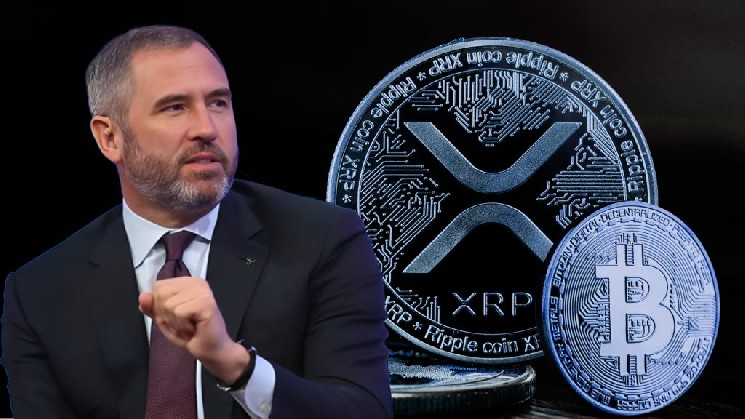
  • Ripple CEO Brad Garlinghouse Unveils 5-Year Crypto Strategy Featuring Bitcoin, XRP, Three Altcoins

    Ripple CEO Brad Garlinghouse Unveils 5-Year Crypto Strategy Featuring Bitcoin, XRP, Three Altcoins

    Key Highlights

    • Ripple CEO Brad Garlinghouse proposes a simple five-year “buy and hold” strategy focusing on the top five cryptocurrencies by market capitalization: Bitcoin, Ethereum, Tether, BNB, and XRP.
    • Garlinghouse emphasizes he is not an “XRP maximalist,” reveals he personally holds a small amount of Solana, and argues different blockchain projects can succeed simultaneously without being direct competitors.
    • The executive cites “trust, utility, speed, and liquidity” as the fundamental drivers of XRP’s long-term value, asserting that the most liquid assets tend to become the most valuable over time.

    Garlinghouse Unveils Long-Term ‘Top Five’ Crypto Portfolio Strategy

    Speaking at a recent industry event, Ripple CEO Brad Garlinghouse outlined a straightforward investment thesis for long-term cryptocurrency holders, suggesting that a diversified basket of the five largest digital assets by market capitalization could yield “great results” over a five-year horizon. The strategy moves away from concentrated bets on single tokens, instead advocating for exposure to the established market leaders: Bitcoin (BTC), Ethereum (ETH), Tether (USDT), BNB, and XRP.

    XRP Inclusion Notable Amid ‘Non-Maximalist’ Stance

    The inclusion of XRP in Garlinghouse’s proposed top-five basket draws particular attention given his previous public stance. The Ripple chief has explicitly stated in the past that he does not define himself as an “$XRP maximalist,” signaling a broader market perspective rather than singular allegiance to the token native to the Ripple ecosystem. This approach underscores a philosophy of market-cap-weighted diversification rather than thematic or ecosystem-specific concentration.

    Solana Acknowledged as Valid, Non-Competitive Peer

    Addressing the inevitable comparisons between XRP and other high-throughput blockchains, specifically Solana (SOL), Garlinghouse declined to frame the relationship as a zero-sum competition. When asked why an investor should prefer XRP over Solana, he stated he was not trying to convince anyone to choose one over the other. He revealed he personally owns a small amount of Solana and maintains a positive view of various cryptocurrencies for different reasons. “He stated that he does not see Solana as a direct competitor to $XRP and that different crypto projects can be successful simultaneously,” reinforcing a multi-chain future thesis.

    Liquidity, Trust, and Utility Cited as XRP Value Drivers

    Concluding his remarks, Garlinghouse expressed strong optimism regarding XRP’s specific fundamentals. He argued that the determinants of a currency’s enduring value are “trust, utility, speed, and liquidity“—effectively, how liquid the asset is. He posited a direct correlation between liquidity and value, asserting that the most liquid currencies tend to be the most valuable because liquidity is the primary reason investors seek to hold an asset. This framework positions XRP’s design for institutional cross-border payments as its core competitive advantage.

    Why This Matters

    Garlinghouse’s comments arrive as institutional adoption of digital assets accelerates, with major financial firms increasingly treating cryptocurrency as a distinct asset class requiring diversified allocation strategies rather than speculative single-token bets. His “top five” framework mirrors traditional finance index-investing principles applied to the crypto market cap leaderboard. Furthermore, his explicit refusal to engage in tribalistic “maximalist” rhetoric—and his acknowledgment of holding Solana—signals a maturing industry leadership mindset focused on interoperability and collective ecosystem growth. For market participants, the remarks reinforce the narrative that regulatory clarity (particularly surrounding XRP’s status in the U.S.) and deepening liquidity pools are critical milestones for the next phase of crypto market development.

    Frequently Asked Questions

    What are the five cryptocurrencies Brad Garlinghouse includes in his proposed long-term strategy?
    The basket consists of Bitcoin (BTC), Ethereum (ETH), Tether (USDT), BNB, and XRP, ranked by current market capitalization.
    Does Brad Garlinghouse consider himself an XRP maximalist?
    No. Garlinghouse has previously stated he does not define himself as an “$XRP maximalist,” and he confirmed he personally holds a small amount of Solana (SOL).
    What fundamental factors does Garlinghouse believe drive XRP’s value?
    He cites “trust, utility, speed, and liquidity” as the primary drivers, arguing that the most liquid assets tend to become the most valuable over time.
  • MOVE Index Surges Past 130, Fueling Bailout Speculation

    MOVE Index Surges Past 130, Fueling Bailout Speculation

    Key Highlights

    • The $MOVE Index has surged above 130, signaling heightened implied volatility in bond markets and growing liquidity concerns.
    • Traders and analysts, including prominent voice @CryptoHayes, are flagging the move as a potential precursor to policy intervention or regulatory action.
    • Historical patterns show similar index spikes have preceded central bank support measures, making current levels a critical watchpoint for market participants.

    $MOVE Index Breaches 130 Threshold, Triggering Policy Speculation

    The $MOVE Index — a widely tracked gauge of implied volatility in U.S. Treasury markets managed by ICE (Intercontinental Exchange) — has climbed above the 130 level, a threshold that market veterans associate with acute stress in fixed-income liquidity. The move was amplified across financial social media after a post by @CryptoHayes, the pseudonymous founder of BitMEX and a closely followed macro commentator, drew attention to the index’s rapid ascent. His tweet catalyzed a wave of discussion among rates traders, hedge fund managers, and crypto-market participants who monitor the $MOVE as a leading indicator of systemic funding pressure.

    Unlike the VIX, which reflects equity volatility, the $MOVE Index captures expected swings in Treasury yields across the 2-, 5-, 10-, and 30-year maturities. A reading above 130 has historically coincided with episodes such as the March 2020 pandemic liquidity crunch, the September 2022 U.K. gilt crisis, and the regional banking turbulence of early 2023. In each case, the Federal Reserve or other major central banks responded with emergency lending facilities, quantitative easing restarts, or explicit backstops — actions that subsequently stabilized markets but also reshaped asset-price trajectories across equities, credit, and digital assets.

    Mixed Crypto Signals Complicate the Picture

    The broader cryptocurrency market is sending conflicting signals as the $MOVE rises. Bitcoin (BTC) has shown resilience near recent range highs, while Ethereum (ETH) and major altcoins exhibit divergent momentum, reflecting uncertainty over whether tighter financial conditions or imminent policy relief will dominate. Liquidity in on-chain markets remains thinner than in 2021, and the correlation between crypto risk assets and rates volatility has strengthened since the 2022 bear market. Traders are parsing whether a sustained $MOVE elevation will force the Federal Reserve to signal a pause or pivot — a development that could inject fresh risk appetite into digital assets — or whether the index simply reflects transient positioning ahead of key economic data.

    Market structure analysts note that the $MOVE’s jurisdiction falls under the purview of the SEC, CFTC, and the Federal Reserve Bank of New York, all of which monitor fixed-income volatility as a barometer of dealer balance-sheet capacity. With primary dealers already managing elevated Treasury supply, a further $MOVE spike could strain market-making ability, widening bid-ask spreads and increasing the odds of an official-sector response.

    Why This Matters

    The $MOVE Index’s breach of 130 is not merely a technical milestone — it is a signal that the world’s deepest, most liquid bond market is pricing in exceptional uncertainty around interest-rate paths. For institutional allocators, this raises the specter of forced deleveraging in strategies reliant on stable funding, from basis trades to mortgage-backed securities hedging. For crypto-native funds, it underscores the growing integration of digital-asset pricing with traditional macro liquidity cycles. Policymakers at the Fed and Treasury will likely reference the $MOVE in upcoming FOMC discussions and Financial Stability Oversight Council (FSOC) meetings as they assess whether current market functioning warrants intervention. The next two weeks — featuring CPI, PPI, and retail sales data — will be decisive in determining whether the index retraces or consolidates at elevated levels, setting the stage for either a policy calm or a repeat of 2020-2023 crisis playbooks.

    Frequently Asked Questions

    What is the $MOVE Index and why does 130 matter?
    The $MOVE Index (Merrill Lynch Option Volatility Estimate) measures implied volatility across key U.S. Treasury maturities. A level above 130 has historically signaled severe fixed-income stress, often preceding central bank liquidity interventions.
    Who is @CryptoHayes and why did his post move markets?
    @CryptoHayes is Arthur Hayes, co-founder of BitMEX and chief investment officer of Maelstrom. His macro commentary commands a large following among crypto and rates traders, and his highlight of the $MOVE surge amplified institutional attention to the signal.
    How could a policy response affect cryptocurrency markets?
    If the Fed or Treasury acts to ease funding pressure — via swap lines, standing repo facilities, or balance-sheet expansion — risk assets including Bitcoin and Ethereum typically benefit from improved dollar liquidity. Conversely, inaction could prolong volatility and correlation-driven selloffs.
  • ‘Bull Market Confirmed’: Analyst Identifies Bitcoin’s Fifth Historic Signal

    ‘Bull Market Confirmed’: Analyst Identifies Bitcoin’s Fifth Historic Signal

    Key Highlights

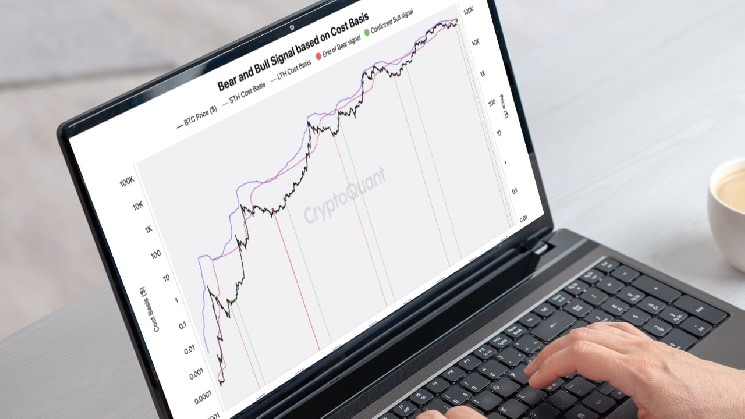
    • Cryptoquant contributor Darkfost identifies a fifth historical bull market signal for Bitcoin on September 24, marking the first such crossover since 2023 and joining prior signals in 2012, 2015, 2019, and 2023.
    • The signal triggers when the short-term holder cost basis rises above the active long-term holder cost basis, using a seven-year activity filter that excludes over 3.5 million dormant BTC untouched for a decade or more.
    • U.S. spot Bitcoin ETFs recorded $2.06 billion in net inflows over three consecutive days (Sept. 21–23), led by a record $999 million single-day inflow on Sept. 21, coinciding with the signal’s confirmation.

    Fifth Cost-Basis Crossover Confirms Bull Market Structure

    A new on-chain metric flashed a bullish confirmation for Bitcoin on September 24, marking the fifth time in the asset’s history that the average acquisition cost of short-term holders has surpassed that of active long-term holders. The analysis, published by Cryptoquant contributor Darkfost, identifies the crossover as a recurring structural signal that has preceded sustained upward moves in each of the four prior cycles.

    In a post on X, the analyst stated: “Bull Market Confirmed … This is the 5th occurrence, which gives a bit more credibility to the dynamic bitcoin is putting in place, though there’s always a margin for error, and I prefer to point that out.” The comment underscores both the statistical weight of the pattern and the inherent uncertainty in any single indicator.

    The metric compares two distinct cost bases: the average price paid by short-term holders versus the average price paid by active long-term holders. Crucially, the long-term cohort is filtered to include only coins that have moved at least once in the past seven years. This design excludes deeply dormant supply—estimated at more than 3.5 million BTC older than ten years—which the analyst argues would otherwise distort the measure of genuine holder conviction.

    Defining Active Long-Term Holders: The Seven-Year Filter

    The seven-year activity threshold serves a different analytical purpose than the standard 155-day holding period used by firms such as Glassnode to separate short-term from long-term supply. While Glassnode’s definition classifies any coin held longer than roughly five months as long-term, Darkfost’s additional filter asks whether that long-term coin has shown any on-chain life in the last seven years. Coins that have not are treated as effectively lost or permanently dormant and removed from the active cost-basis calculation.

    The analyst acknowledges the cutoff is arbitrary but notes its practical relevance. The dormant pile grows by an estimated 8,000 to 30,000 BTC each month, and its monthly change has turned negative only once since 2019—when an early miner moved approximately 100,000 BTC. Notably, coins inactive for five to 15 years resumed movement in 2026, demonstrating that even decade-old supply can re-enter circulation and validating the decision to track active versus dormant segments separately.

    ETF Inflows Provide Liquidity Backdrop for the Signal

    The cost-basis crossover arrived alongside a surge of institutional demand via U.S. spot Bitcoin exchange-traded funds. According to daily flow data from Farside, the funds attracted $2.06 billion in net inflows across the three sessions from September 21 through September 23. Every session printed positive flows, though the pace decelerated sharply after the opening day.

    September 21 saw the largest single-day inflow of 2026 at $999 million. The following day added $714.7 million, and September 23 contributed $346.9 million. The three-day sequence coincides with the period in which the on-chain signal confirmed, lending circumstantial support to the argument that fresh ETF liquidity is reinforcing the shift in holder economics. The analyst cautions, however, that the flow data establishes correlation during the signal window, not causation of the crossover itself.

    Spot Bitcoin ETFs allow investors to gain exposure through brokerage-traded shares backed by actual BTC held by the fund, lowering the operational barrier for institutional allocators and wealth managers who cannot or prefer not to custody digital assets directly.

    Cycle Outlook: Tempered Volatility, Multi-Fold Returns

    The bullish signal and ETF momentum are being framed within a broader cycle thesis. In a separate assessment published September 22, Cryptoquant founder and CEO Ki Young Ju argued that the market’s expanding size and deepening institutional ownership could dampen the extreme boom-bust amplitude characteristic of earlier cycles. His base-case forecast projects threefold to fivefold returns for Bitcoin this cycle, followed by a milder bear market drawdown than historical norms.

    Why This Matters

    The fifth cost-basis crossover matters because it represents a rare confluence of on-chain holder behavior and institutional capital flows. Prior occurrences in 2012, 2015, 2019, and 2023 each preceded significant bull-market legs, suggesting the metric captures a fundamental shift in the marginal buyer—from long-term accumulators to newer participants willing to pay higher average prices. The seven-year activity filter refines this insight by focusing on economically active long-term holders, filtering out supply that behaves more like lost coins than invested capital. Meanwhile, the $2.06 billion in ETF inflows over three days—anchored by a record $999 million session—signals that traditional financial infrastructure is now a primary vector for Bitcoin demand. If Ki Young Ju’s cycle thesis holds, the combination of structural on-chain signals and sustained institutional flows could produce a cycle defined by steadier appreciation and shallower corrections, reshaping risk expectations for both retail and institutional participants.

    Frequently Asked Questions

    What exactly is the “fifth bull market signal” identified by Cryptoquant?

    It is the fifth historical occurrence where the short-term holder realized price (average acquisition cost of coins held less than ~155 days) crosses above the active long-term holder realized price (average cost of coins held longer than 155 days that have also moved at least once in the past seven years). Previous crossovers appeared in 2012, 2015, 2019, and 2023.

    Why does the analysis exclude Bitcoin that hasn’t moved in over seven years?

    The analyst treats coins untouched for seven-plus years as dormant or effectively lost supply. Including them in the long-term holder cost basis would dilute the measure of active holder conviction. Over 3.5 million BTC fall into this category, growing by 8,000–30,000 BTC monthly, with only one monthly decline since 2019.

    Did the ETF inflows cause the bullish crossover?

    The data shows the $2.06 billion in net ETF inflows (Sept. 21–23) coincided with the signal’s confirmation, but the analyst explicitly states the flows “do not establish that ETF buying caused the crossover.” The inflows provide liquidity context, not proof of causation.

  • US Banks Shift From Bitcoin to Altcoins as Three Tokens Gain Attention

    US Banks Shift From Bitcoin to Altcoins as Three Tokens Gain Attention

    Key Highlights

    • Bitcoin’s share of US banks’ cryptocurrency exposure dropped sharply from 75.8% to 44.2%, according to new Basel Committee on Banking Supervision data cited by Ledger Insights.
    • Ethereum’s allocation surged to 38.5%, while Solana (7.8%) and XRP (5.6%) entered bank portfolios as notable holdings.
    • Client-driven crypto transaction volumes at American banks jumped 93% to €6.4 billion, contrasting with a 25% decline in Europe to €1.9 billion.

    US Banks Drastically Reduce Bitcoin Exposure in Favor of Ethereum, Solana, and XRP

    New regulatory data published by the Basel Committee on Banking Supervision (BCBS) reveals a profound rotation in how financial institutions across the Americas are allocating capital across digital assets. According to analysis by Ledger Insights, Bitcoin’s ($BTC) dominance within bank cryptocurrency risk portfolios has nearly halved, falling from 75.8% to 44.2% — a shift that signals growing institutional comfort with alternative Layer 1 networks and a diversification away from the original cryptocurrency as a sole reserve asset.

    Ethereum Emerges as Primary Beneficiary of Portfolio Rebalancing

    The decline in Bitcoin’s weighting has coincided with a substantial rise in Ethereum ($ETH) exposure, which now accounts for 38.5% of banks’ crypto risk portfolios in the Americas. This near-parity with Bitcoin marks a watershed moment for institutional adoption of the second-largest blockchain by market capitalization. Additionally, Solana ($SOL) and XRP have established measurable footholds, registering 7.8% and 5.6% allocations respectively. The presence of these assets in regulated bank portfolios suggests evolving risk frameworks that now accommodate a broader spectrum of crypto assets beyond Bitcoin.

    Total Crypto Risk Exposure Remains Stable Amid Allocation Shift

    Notably, the BCBS data indicates no material change in the aggregate cryptocurrency risk held by banks during the reporting period. This stability implies that the observed rebalancing reflects strategic asset rotation rather than a net reduction in digital asset engagement. Banks appear to be actively managing concentration risk by redistributing exposure across multiple protocols, a development consistent with maturing institutional custody and risk management practices.

    Client-Driven Trading Activity Surges in Americas, Contracts in Europe

    Beyond proprietary holdings, the data captures a sharp divergence in client-facing crypto activity. Transaction volumes executed by banks on behalf of customers in the Americas surged 93% period-over-period, reaching €6.4 billion. In contrast, European banks saw a 25% decline in similar client flows, falling to €1.9 billion. The asymmetry underscores differing regulatory climates and market appetites across jurisdictions, with U.S. institutions capturing a growing share of institutional and high-net-worth crypto order flow.

    Why This Matters

    The BCBS portfolio data offers the most transparent window yet into how globally systemically important banks are treating digital assets under the evolving Basel III prudential framework. The rotation from Bitcoin toward Ethereum, Solana, and XRP suggests that regulatory capital rules — which assign higher risk weights to less liquid or more volatile assets — may be influencing allocation decisions as much as market conviction. Meanwhile, the explosion in Americas-based client volumes signals that U.S. banks are increasingly acting as on-ramps for institutional capital, even as Europe’s Markets in Crypto-Assets (MiCA) regime continues to take shape. Future BCBS disclosures will be critical for tracking whether this diversification trend accelerates or stabilizes.

    Frequently Asked Questions

    What does the BCBS data measure exactly?
    The data tracks the composition of cryptocurrency risk exposures held by banks in the Americas, expressed as percentage allocations across specific assets, as reported under Basel Committee supervisory standards.
    Did banks sell Bitcoin to buy Ethereum, Solana, and XRP?
    The data shows a shift in portfolio weightings but does not confirm net buying or selling of any specific asset, as total crypto risk exposure remained stable. The rebalancing could reflect valuation changes, new allocations, or a combination of both.
    Why did client transaction volumes rise in the Americas but fall in Europe?
    The divergence likely reflects differences in regulatory clarity, institutional adoption curves, and market structure. The U.S. has seen growing custodial and prime brokerage services for crypto, while Europe’s MiCA framework is still being implemented.
  • Bitcoin Bear Markets Growing Milder, Signaling Potential Bull Market Ahead

    Bitcoin Bear Markets Growing Milder, Signaling Potential Bull Market Ahead

    Key Highlights

    • Bitcoin ETFs have shifted ownership toward financial advisers and professional investors who typically allocate around 2% of portfolios to the asset, compared to 20–30% or more for crypto-native retail investors.
    • Institutional rebalancing behavior—buying after declines and selling after surges to maintain target weights—is expected to soften sell-offs but also cap the magnitude of rallies.
    • Risk Dimensions CIO Mark Connors predicts smaller drawdowns than the 70–80% crashes of prior cycles, but warns that reduced volatility comes with moderated returns and “smaller blow-off tops.”

    ETFs Reshape Bitcoin Ownership From Retail to Professional Hands

    Before the launch of spot bitcoin exchange-traded funds, ownership of the largest cryptocurrency was concentrated among retail investors, crypto-native funds, and traders making tactical bets. According to Rasmussen, the introduction of ETFs provided financial advisers and other professional investors with a familiar, regulated vehicle to add bitcoin to traditional portfolios. This structural shift has fundamentally altered the composition of the investor base, bringing in participants who approach the asset through the lens of portfolio construction rather than speculative conviction.

    Allocation Discipline Creates Divergent Risk Profiles

    The difference in allocation size creates starkly different risk experiences. Rasmussen noted that a professional investor might allocate roughly 2% of a portfolio to bitcoin, whereas crypto-focused retail investors often commit 20%, 30%, or more of their capital to the asset. Consequently, a 50% price decline impacts these groups in vastly different ways. “If it goes down 50%, my portfolio is only down 1%,” Rasmussen said in an interview, describing how an investor with a 2% allocation might view the decline. For a retail holder with a 30% allocation, the same drop would erase 15% of total portfolio value.

    Rebalancing Mechanics May Dampen Volatility Cycles

    Beyond allocation size, the discipline of periodic rebalancing introduces a mechanical counter-cyclical force. An adviser targeting a 2% bitcoin weight may buy after a steep decline to restore the target allocation, providing a floor of demand during sell-offs. Conversely, if bitcoin surges and grows to 5% of the portfolio, that same investor may sell a portion at the next rebalancing date, creating natural supply at higher prices. This dynamic could soften the depth of corrections while simultaneously limiting the explosive upside that characterized earlier market cycles.

    Institutionalization Brings Trade-Offs: Smaller Drawdowns, Moderated Returns

    Mark Connors, chief investment officer at Risk Dimensions, expects growing institutional participation to contribute to smaller drawdowns than the 70–80% declines observed in previous bitcoin cycles. However, he cautioned that investors should not expect to get something for nothing. Connors said bitcoin’s volatility has fallen over time, but its returns have moderated as well. More institutional investors could mean “smaller blow-off tops due to rebalancing,” he said, highlighting the trade-off between reduced downside risk and capped upside potential as the asset matures within traditional financial infrastructure.

    Why This Matters

    The transition from a retail-dominated market to one with significant professional participation marks a structural maturation for bitcoin as an asset class. The introduction of spot ETFs in the United States has accelerated this shift by lowering operational and custody barriers for registered investment advisors, family offices, and institutional allocators. As these investors apply modern portfolio theory—fixed allocations, systematic rebalancing, and risk-budgeting frameworks—the statistical properties of bitcoin’s price action are likely to evolve. Historically, bitcoin’s boom-bust cycles were amplified by homogeneous, high-conviction holders prone to panic selling and euphoric buying. A more diverse holder base with differentiated time horizons and mandate constraints could produce a return profile that resembles other alternative assets: lower volatility, reduced tail risk, but also diminished alpha relative to the asset’s early years. For allocators, this raises strategic questions about bitcoin’s role in a portfolio—whether it remains a high-beta growth sleeve or transitions toward a diversifier with equity-like risk and modestly enhanced returns.

    Frequently Asked Questions

    How does a typical professional investor’s bitcoin allocation differ from a retail crypto investor’s?

    Professional investors such as financial advisers typically allocate around 2% of a portfolio to bitcoin, while crypto-focused retail investors often hold 20%, 30%, or more of their total capital in the asset.

    What effect does portfolio rebalancing have on bitcoin’s price cycles?

    Systematic rebalancing creates counter-cyclical flows: advisers buy bitcoin after price declines to restore target weights, supporting prices during corrections, and sell after sharp rallies to trim overweight positions, capping upside momentum.

    Will institutional adoption eliminate bitcoin’s volatility entirely?

    No. Mark Connors of Risk Dimensions notes that while institutional participation may reduce the severity of drawdowns compared to historical 70–80% crashes, volatility will persist and returns are likely to moderate, resulting in “smaller blow-off tops due to rebalancing.”

  • Data Proves Bitcoin Unfazed by Rising Bond Yields Long-Term

    Data Proves Bitcoin Unfazed by Rising Bond Yields Long-Term

    Key Highlights

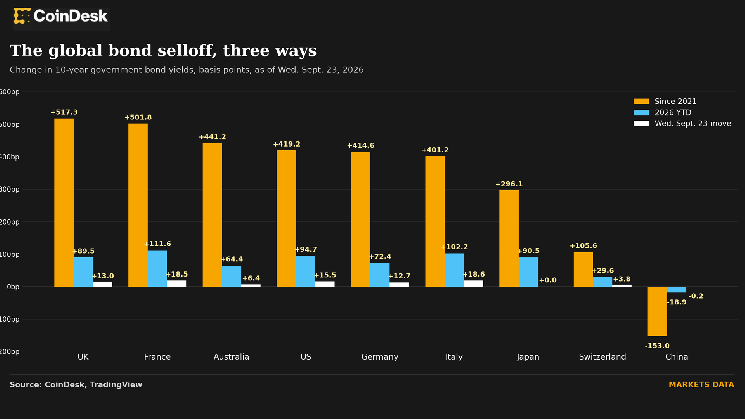
    • U.S. 10-year Treasury yield surged 15 basis points to 5.13%, the highest level since 2007, triggering global yield increases.
    • Bitcoin’s 90-day correlation with U.S. 10-year yield daily moves stands at just −0.18, with 180-day and 1-year correlations even closer to zero at −0.06 and −0.03 respectively.
    • Historical data analyzed by CoinDesk shows Bitcoin has demonstrated little to no consistent correlation with bond yields across multiple timeframes and international markets.

    Rising Yields Reignite Debate Over Bitcoin’s Macro Sensitivity

    The U.S. 10-year Treasury yield jumped 15 basis points on Wednesday to breach 5.13%, marking its highest level since the pre-financial crisis era of 2007. The move rippled across global fixed-income markets, pulling sovereign yields higher worldwide and reviving a familiar market narrative: that rising bond yields create a structural headwind for non-yielding assets like Bitcoin (BTC) and gold. The conventional logic posits that as risk-free returns become more attractive, the opportunity cost of holding zero-coupon assets increases, theoretically drawing capital away from crypto and toward government debt.

    Correlation Data Contradicts Conventional Wisdom

    While the theoretical framework appears sound on paper, empirical evidence fails to support a consistent inverse relationship. According to data analyzed by CoinDesk, the 90-day rolling correlation between Bitcoin’s daily returns and daily moves in the U.S. 10-year yield sits at just −0.18—a figure statistically indistinguishable from zero correlation. Extending the observation window does not strengthen the link; the 180-day correlation narrows further to −0.06, while the one-year correlation stands at a negligible −0.03. Across every measured timeframe, Bitcoin’s price action has exhibited virtually no linear dependence on the trajectory of U.S. benchmark yields.

    Global Yield Regimes Show Similar Disconnect

    The absence of correlation is not confined to the United States. Bitcoin has demonstrated an equally weak statistical relationship with the sovereign yields of other major economies. This global pattern suggests that Bitcoin’s valuation drivers operate independently of the interest rate channels that dominate traditional asset pricing models. Rather than functioning as a simple “risk-off” or “risk-on” proxy sensitive to the cost of capital, the asset’s historical behavior aligns more closely with a distinct, idiosyncratic return stream shaped by network adoption cycles, liquidity conditions specific to crypto markets, and evolving regulatory narratives.

    Why This Matters

    The persistent disconnect between Bitcoin and bond yields carries significant implications for portfolio construction and macro strategy. Investors and analysts who position Bitcoin strictly as a rate-sensitive speculative asset may be relying on a flawed mental model that has not held up over the asset’s history. As central banks navigate a potential “higher for longer” rate environment, understanding Bitcoin’s true correlation profile—effectively zero with respect to sovereign yields—becomes critical for accurate risk budgeting. The data suggests Bitcoin should be evaluated on its own fundamental merits and crypto-specific catalysts rather than through the lens of traditional duration risk.

    Frequently Asked Questions

    What is the current correlation between Bitcoin and the U.S. 10-year Treasury yield?

    As of the latest analysis by CoinDesk, the 90-day correlation is −0.18, the 180-day correlation is −0.06, and the one-year correlation is −0.03—all statistically near zero.

    Does Bitcoin correlate with bond yields in other countries?

    No. The data shows Bitcoin is equally uncorrelated with the sovereign yields of other nations, indicating this is a global phenomenon rather than a U.S.-specific anomaly.

    Why does the market still believe rising yields hurt Bitcoin?

    The narrative relies on theoretical opportunity cost logic: higher risk-free rates should make non-yielding assets less attractive. However, historical price data does not bear out this relationship, suggesting other factors dominate Bitcoin’s valuation.

  • AI Coding Slashes Quantum-Safe Bitcoin Transaction Cost Estimate from $320 to $66 in One Week

    AI Coding Slashes Quantum-Safe Bitcoin Transaction Cost Estimate from $320 to $66 in One Week

    Key Highlights

    • StarkWare has demonstrated a quantum-resistant Bitcoin transaction method that operates within current protocol rules, requiring no soft fork or network upgrade.
    • The approach uses hash-based cryptography to protect against quantum computers deriving private keys from exposed public keys, but costs approximately $320 in computing per transaction under current implementation.
    • Significant limitations remain: transactions must be submitted directly to miners, and the method cannot protect coins whose public keys are already exposed — the primary target for any quantum attacker.

    StarkWare Unveils Quantum-Resistant Bitcoin Transaction Method Without Protocol Changes

    Israeli blockchain scaling firm StarkWare has published research demonstrating a method to execute quantum-resistant transactions on Bitcoin without requiring a soft fork or any modification to the network’s consensus rules. The technique leverages hash-based cryptographic commitments — specifically leveraging the collision resistance of SHA-256 — to shield coins from a future scenario in which a sufficiently powerful quantum computer could derive a private key from an exposed public key using Shor’s algorithm.

    Because the construction fits entirely within Bitcoin’s existing script and transaction validity rules, it can be deployed immediately as an emergency mitigation if the quantum threat materializes before the broader ecosystem adopts a more comprehensive, protocol-level upgrade such as BIP-360 or similar proposals for post-quantum signature schemes. However, the current implementation carries a steep computational price tag: approximately $320 of computing resources per transaction, according to the cost breakdown published by StarkWare.

    Cost Claims and Independent Verification

    A third-party contest site associated with the research cites a lower figure of $66 per transaction, but this number remains an estimate drawn from a test computation and has not been validated by a subsequent transaction actually mined on the Bitcoin mainnet. The improved code referenced by the contest site has not been shown preparing another transaction that was successfully included in a block. Applying the speedups displayed on the contest site to StarkWare’s original $320 cost breakdown yields an estimated $83 per transaction, according to calculations performed by CoinDesk. The contest site states that later record-setting runs surpass those measurements, though it does not disclose which specific results underpin the $66 estimate.

    Operational Constraints Limit Practical Deployment

    Beyond cost, the method imposes structural constraints that reduce its utility as a general-purpose solution. Transactions constructed using this approach must be sent directly to a miner because they do not propagate through the Bitcoin peer-to-peer network in the standard manner. More critically, the protection only applies to coins whose public keys have not yet been exposed on-chain — such as those locked in pay-to-taproot (P2TR) or pay-to-witness-script-hash (P2WSH) outputs where the public key remains hidden until spending. Coins in pay-to-pubkey-hash (P2PKH) or reused pay-to-taproot addresses with revealed public keys — the very cohort a quantum adversary would target first — cannot be secured retroactively by this method.

    Why This Matters

    The research addresses a long-standing theoretical vulnerability in Bitcoin’s elliptic curve cryptography (secp256k1), which secures the vast majority of coins in circulation. While large-scale, fault-tolerant quantum computers capable of breaking ECDSA do not yet exist, advances in quantum error correction and qubit coherence have accelerated expert timelines. The National Institute of Standards and Technology (NIST) has already standardized post-quantum algorithms such as CRYSTALS-Dilithium and SPHINCS+, but integrating them into Bitcoin would require a contentious, multi-year soft fork process with broad miner, developer, and user consensus.

    StarkWare’s hash-based fallback offers a permissionless, immediate escape hatch — but only for a subset of unspent transaction outputs (UTXOs) and at a cost that currently limits use to high-value holdings. The requirement for direct miner submission also introduces trust and censorship considerations. As the ecosystem debates long-term quantum resistance — including proposals for quantum-resistant address formats and commit-reveal schemes — this work establishes a proven, if imperfect, bridge capability.

    Frequently Asked Questions

    Does this method require a Bitcoin soft fork or protocol upgrade?
    No. The construction operates entirely within Bitcoin’s existing consensus and script rules, meaning it can be used today without any network-level changes.
    Can this protect all Bitcoin holdings from a quantum attack?
    No. It only secures coins whose public keys have not yet been revealed on-chain — primarily Taproot and certain Script-based outputs. Coins in legacy P2PKH addresses or reused Taproot addresses with exposed public keys remain vulnerable.
    What is the real-world cost to use this quantum-resistant transaction method?
    StarkWare’s published breakdown estimates ~$320 in compute per transaction. Independent analysis by CoinDesk applying claimed optimizations suggests ~$83, while a contest site cites an unverified $66 figure. No subsequent mainnet transaction has confirmed the lower costs.
  • Coinbase Launches Fixed-Rate USDC Loans Backed by Bitcoin

    Coinbase Launches Fixed-Rate USDC Loans Backed by Bitcoin

    Key Highlights

    • Coinbase launches fixed-rate USDC loans backed by Bitcoin, offering borrowers certainty on interest costs and repayment dates.
    • The new product runs on Morpho Midnight, a decentralized fixed-rate lending protocol that settles on Coinbase’s Base layer-2 network.
    • Fixed-rate loans sit alongside Coinbase’s existing variable-rate Morpho Blue offering, which currently holds over $1.4 billion in active loans.

    Coinbase Expands Crypto Lending With Fixed-Rate Bitcoin-Backed USDC Loans

    Nasdaq-listed cryptocurrency exchange Coinbase (COIN) has introduced a fixed-rate borrowing option that allows users to mint dollar-pegged stablecoin USDC against their Bitcoin (BTC) holdings. Announced on Tuesday, the new product sets both the interest rate and the repayment date at the moment of borrowing, providing a predictable alternative to the exchange’s existing variable-rate loans. The move signals a significant evolution in how centralized platforms are integrating decentralized finance primitives to offer more sophisticated credit products.

    Morpho Midnight Powers the Fixed-Rate Infrastructure

    The fixed-rate offering operates on Morpho Midnight, a decentralized, non-custodial lending protocol designed specifically for fixed-rate and fixed-term crypto loans. Launched in July of this year, Morpho Midnight enables borrowers to lock in borrowing costs for a defined period, shielding them from the rate volatility inherent in utilization-based models. All transactions settle on Base, Coinbase’s Ethereum layer-2 network, combining the efficiency of a rollup with the composability of onchain lending markets.

    Contrast With the Existing Variable-Rate Model

    Until now, Coinbase’s lending functionality has relied exclusively on the Morpho Blue protocol, where interest rates fluctuate algorithmically based on real-time supply and demand dynamics. During periods of heightened borrowing demand, those variable rates can climb sharply, introducing uncertainty for users managing leveraged positions or liquidity needs. “The move takes onchain borrowing beyond the predominantly variable-rate model, giving users greater certainty over the cost and duration of their borrowing,” according to an announcement on Tuesday. The floating-rate market remains substantial, with more than $1.4 billion in active loans backed by nearly $3 billion of collateral, and will continue to operate alongside the new fixed-term option.

    Why This Matters

    The introduction of fixed-rate, Bitcoin-backed loans on a regulated exchange venue represents a meaningful bridge between traditional finance expectations and decentralized finance architecture. For retail and institutional users alike, the ability to borrow against BTC without selling—and with a known cost of capital—mirrors the term-loan structures common in traditional credit markets. By leveraging Morpho Midnight’s immutable smart contracts and settling on Base, Coinbase reduces counterparty risk while maintaining a compliant, user-friendly interface. This development also underscores the growing role of purpose-built lending protocols like Morpho in powering the next generation of onchain credit, moving the ecosystem beyond the purely variable-rate paradigm that has dominated DeFi lending since its inception.

    Frequently Asked Questions

    What is the difference between Coinbase’s new fixed-rate loans and its existing variable-rate loans?

    Fixed-rate loans lock in the interest rate and repayment date at the time of borrowing, providing cost certainty. Variable-rate loans on Morpho Blue have interest rates that change based on supply and demand and can increase when borrowing demand spikes.

    Which protocol and network power the new fixed-rate USDC loans?

    The fixed-rate loans run on Morpho Midnight, a decentralized fixed-rate lending protocol launched in July, and settle on Base, Coinbase’s Ethereum layer-2 network.

    How large is Coinbase’s existing variable-rate lending market?

    The floating-rate loans on Morpho Blue currently have more than $1.4 billion in active loans backed by nearly $3 billion of collateral.

  • CryptoQuant CEO Ki Young Ju Predicts Bitcoin Could Surge 3-5x This Cycle

    CryptoQuant CEO Ki Young Ju Predicts Bitcoin Could Surge 3-5x This Cycle

    Key Highlights

    • CryptoQuant CEO Ki Young Ju forecasts Bitcoin appreciation of 3–5x in the current bull cycle, significantly below the 10x+ gains seen in prior cycles.
    • Growing institutional participation and market maturation are reducing both upside volatility and downside crash risk, potentially making future bear markets milder.
    • Ki argues this structural shift positions Bitcoin as a long-term capital preservation asset rather than a short-term speculative vehicle, with transformative implications for the global financial system if adoption as a functional currency accelerates.

    CryptoQuant CEO Projects Tempered Bitcoin Returns Amid Market Maturation

    CryptoQuant founder and chief executive Ki Young Ju has revised expectations for Bitcoin’s current bull cycle, suggesting the asset may climb only three to five times its present value rather than repeating the tenfold or greater surges characteristic of earlier market phases. In a post published on X, Ki attributed the moderated outlook to the cryptocurrency’s expanding market capitalization and the rising dominance of institutional investors, factors he says are fundamentally altering Bitcoin’s volatility profile.

    Institutional Growth Dampens Speculative Extremes

    Ki explained that during Bitcoin’s earlier stages, a comparatively small market cap and heavy reliance on retail participants left prices acutely sensitive to short-term speculative flows. That structure, he noted, routinely produced parabolic rallies followed by drawdowns as deep as 80 percent. As institutional capital assumes a larger share of ownership, the analyst argues, the market’s depth increases, compressing volatility in both directions and lowering the probability of both explosive melt-ups and catastrophic crashes.

    Shift Toward Long-Term Store of Value

    The CryptoQuant chief framed this evolution as a positive development for the asset class, contending that reduced cyclicality makes Bitcoin better suited for long-term capital allocation rather than short-term trading. He further speculated that should Bitcoin eventually achieve sufficient stability and gain widespread adoption as a functional medium of exchange, the resulting transformation of the global financial architecture could extend well beyond anything currently anticipated by market observers.

    Why This Matters

    Ki Young Ju’s assessment reflects a growing consensus among on-chain analysts that Bitcoin’s risk-return profile is normalizing as the asset graduates from a niche speculative instrument to an institutional-grade treasury reserve. The increasing presence of spot Bitcoin ETFs, corporate treasuries, and sovereign wealth fund allocations deepens liquidity and lengthens holder time horizons, structurally suppressing the boom-bust cycles that defined the 2013, 2017, and 2021 peaks. For investors, this implies a recalibration of expectations: lower maximum upside per cycle in exchange for shallower drawdowns and a higher probability of multi-year compounding. At a macro level, a Bitcoin that behaves more like a low-volatility monetary asset than a high-beta tech stock could accelerate its integration into global payment rails, central bank reserves, and cross-border settlement layers—a transition that would indeed reshape financial infrastructure in ways current models struggle to capture.

    Frequently Asked Questions

    What specific price multiple does Ki Young Ju expect for Bitcoin in this bull cycle?

    Ki Young Ju projects a 3–5x appreciation from current levels, contrasting with the 10x+ multiples observed in previous bull markets.

    Why does Ki believe future bear markets will be less severe?

    He cites the growing share of institutional investors and a larger market capitalization, which together deepen liquidity and reduce the influence of short-term speculative capital that historically amplified both rallies and crashes.

    Does Ki Young Ju’s analysis constitute investment advice?

    No. The original post explicitly includes a disclaimer stating “This is not investment advice.”

  • Crypto Bull Market Returns? Three Signals Indicate a Possible Comeback

    Crypto Bull Market Returns? Three Signals Indicate a Possible Comeback

    Key Highlights

    • Total cryptocurrency market capitalization surged nearly $1 trillion in six weeks, climbing from $2.06 trillion to over $2.91 trillion as Bitcoin led a broad-based recovery.
    • Spot Bitcoin ETFs recorded $999 million in net inflows—the largest single-day haul since October 2023—while combined Bitcoin and Ethereum ETF inflows reached $1.27 billion.
    • Bitcoin reclaimed all major long-term moving averages after 300 days below them, trading above both the True Market Mean ($76,746) and short-term holder cost basis ($71,763), signaling potential bull-market onset.

    Market Sentiment Shifts From Fear to Greed as Bitcoin Breaks $85,000

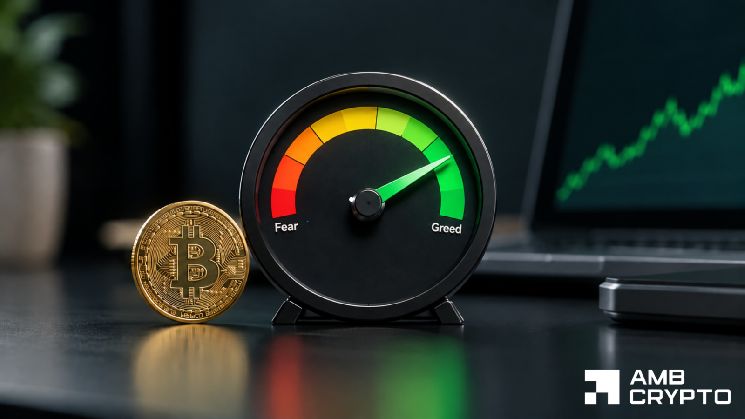
    The cryptocurrency market has entered a pronounced bullish phase since early August, with Bitcoin spearheading a recovery that has erased much of the bear-market damage accumulated since October 2023. In just six weeks, the aggregate crypto market capitalization has swollen from $2.06 trillion to more than $2.91 trillion, according to CoinGecko data, adding nearly $1 trillion in fresh value. The Fear & Greed Index—a widely watched sentiment gauge—has surged to 59, squarely in “greed” territory, up sharply from a “fear” reading of 45 only a week earlier. The inflection point coincided with Bitcoin’s decisive push above the $85,000 psychological threshold, a level that had acted as stiff resistance during the prolonged consolidation.

    Record ETF Inflows Signal Deepening Institutional Conviction

    Underpinning the price action is a torrent of institutional capital flowing into U.S.-listed spot exchange-traded funds. On the most recent trading day, Spot Bitcoin ETFs collectively attracted $999 million in net inflows, marking the largest single-session intake since the products drew $1.21 billion on October 6, 2023, per SoSoValue figures. BlackRock’s iShares Bitcoin Trust led the charge with $381.37 million, followed by the Ark 21Shares Bitcoin ETF at $289.12 million and Fidelity’s Wise Origin Bitcoin Fund at $238.84 million. The momentum was not confined to Bitcoin: Ethereum ETFs simultaneously pulled in $269.98 million, lifting the combined daily net inflow across both asset classes to $1.27 billion. Analysts note that the breadth of participation—spanning both the flagship cryptocurrency and its largest smart-contract rival—suggests the rally is evolving into a genuine altcoin expansion rather than a Bitcoin-only phenomenon.

    On-Chain and Technical Metrics Align With Bull-Market Thesis

    Beyond fund flows, on-chain and technical indicators are flashing constructive signals. Glassnode data shows Bitcoin has now recaptured all of its long-term moving averages after spending roughly 300 days trading beneath them—a duration that historically precedes sustained up-trends. The asset’s spot price sits comfortably above two critical cost-basis benchmarks: the True Market Mean at $76,746 and the short-term holder realized price at $71,763. Holding above these levels implies that the majority of recent acquirers are in profit, a condition that typically reinforces holder conviction and reduces sell-side pressure. Meanwhile, the rally’s breadth has flipped the Bitcoin-cycle signal in favor of altcoins, indicating capital is rotating beyond the dominant store-of-value narrative into the broader ecosystem.

    Why This Matters

    The confluence of improving sentiment, record-breaking ETF flows, and technical breakouts arrives at a pivotal juncture for digital assets. After a grueling 18-month bear market that tested institutional commitment, the simultaneous breach of $85,000 Bitcoin, the reclamation of long-term moving averages, and the rotation into altcoins mirrors the early innings of previous bull cycles in 2017 and 2020-21. However, market veterans caution that the Fear & Greed Index’s rapid ascent toward “extreme greed” (above 70) often coincides with short-term tops or sharp pullbacks. The next few sessions will test whether the current inflow momentum can absorb profit-taking from early-cycle participants without triggering a deeper correction. Regulatory clarity around stablecoins and market structure legislation in the U.S. Congress, coupled with the Federal Reserve’s evolving rate-cut trajectory, remain the key macro variables that could either extend or truncate the advance.

    Frequently Asked Questions

    What triggered the latest surge in crypto market capitalization?
    A combination of Bitcoin breaking above $85,000, record single-day inflows into Spot Bitcoin ETFs ($999M), and concurrent Ethereum ETF inflows ($269.98M) drove the total market cap from $2.06T to over $2.91T in six weeks.
    Which ETF issuers led the Bitcoin inflows?
    BlackRock’s iShares Bitcoin Trust ($381.37M), Ark 21Shares Bitcoin ETF ($289.12M), and Fidelity’s Wise Origin Bitcoin Fund ($238.84M) were the top three recipients of the $999M net inflow.
    Are technical indicators confirming a new bull market?
    Yes. Bitcoin has reclaimed all long-term moving averages after 300 days below them and trades above both the True Market Mean ($76,746) and short-term holder cost basis ($71,763)—conditions historically associated with bull-market starts. However, the Fear & Greed Index at 59 nearing “extreme greed” warrants caution for near-term volatility.