Tag: Bitcoin

  • Bitcoin Could Test $90,000 After Short Squeeze, but Traders Warn Leverage Is Building

    Bitcoin Could Test $90,000 After Short Squeeze, but Traders Warn Leverage Is Building

    Key Highlights

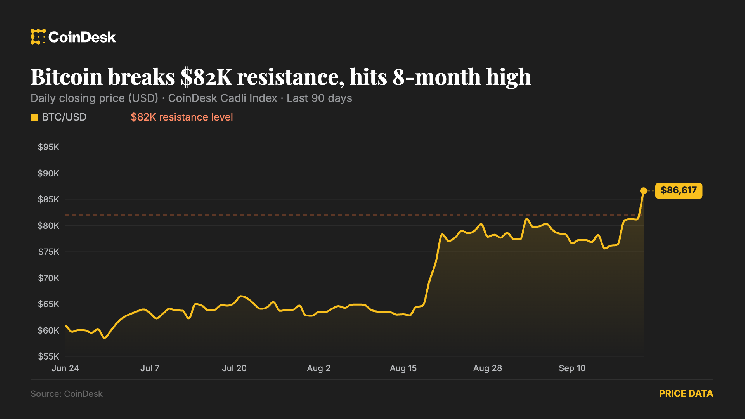
    • Bitcoin surged to an eight-month high of $86,000 on Monday, clearing the $82,000 resistance level that had capped prices since August and triggering roughly $750 million in bearish derivative liquidations.
    • Futures open interest rose faster than price, with approximately $2 billion in new leveraged exposure added since the breakout, signaling aggressive fresh positioning even as short sellers were wiped out.
    • While renewed spot ETF demand and short covering drove the rally, crypto-native investor positioning has been slower to flip from bearish to bullish, according to Nansen analytics.

    Bitcoin Breaks Key Resistance at $82,000

    Bitcoin pushed to a fresh eight-month high of $86,000 on Monday, extending a rally that forced bearish traders out of their short positions and drew fresh leverage bets back into the market. The move cleared the $82,000 level that had acted as a ceiling for prices since August, unleashing a cascade of liquidations across crypto derivative markets.

    Short Liquidations Fuel Momentum

    Roughly $750 million in bearish crypto derivative positions were liquidated as bitcoin cleared $82,000, according to CoinGlass data. When short positions are liquidated, exchanges execute buy orders to close them, adding fuel to an already upward market. “Bitcoin up 5% this morning due to short perpetual futures contracts being liquidated,” Schwab’s head of crypto research Jim Ferraioli told CoinDesk.

    Leveraged Bets Return Aggressively

    Meanwhile, futures open interest — the value of outstanding derivatives bets — rose even faster than bitcoin’s price. Since the breakout, about $2 billion in new leveraged exposure has been added, according to Coinalyze data, suggesting traders are placing fresh bets even as shorts got wiped out. The rapid rebuild in open interest indicates strong conviction among market participants that the breakout has legs.

    ETF Demand vs. Crypto-Native Caution

    While the rally has been fueled by a mix of renewed ETF demand and short covering, crypto-native positioning has been slower to shift from bearish to bullish, according to crypto analytics firm Nansen’s senior research analyst, Nicolai Sondergaard. This divergence suggests that while institutional flows via exchange-traded products are driving near-term price action, the core crypto trading community remains cautious about the sustainability of the move.

    Why This Matters

    The $82,000 level had served as a critical technical barrier since August, and its decisive breach marks the first time bitcoin has traded above this threshold in eight months. The combination of massive short liquidations and a rapid $2 billion rebuild in open interest creates a feedback loop that can sustain upward momentum in the near term. However, the reluctance of crypto-native traders to fully embrace the rally introduces a potential vulnerability: if ETF flows slow or macro conditions shift, the market may lack the deep conviction needed to hold gains. Market participants will be watching whether open interest continues to expand alongside price — a sign of healthy trend development — or if the current leverage buildup sets the stage for a volatile unwind.

    Frequently Asked Questions

    What triggered Bitcoin’s surge to $86,000?

    The rally was driven by a combination of renewed spot Bitcoin ETF demand and a massive short squeeze. As Bitcoin cleared the $82,000 resistance level — a ceiling since August — roughly $750 million in bearish derivative positions were liquidated, forcing exchanges to execute buy orders that accelerated the move higher.

    How much new leverage has entered the market since the breakout?

    According to Coinalyze data, approximately $2 billion in new leveraged exposure has been added to futures open interest since Bitcoin broke above $82,000, with open interest rising faster than price itself.

    Are crypto-native traders bullish on this move?

    Not yet. Nansen senior research analyst Nicolai Sondergaard notes that crypto-native positioning has been slower to shift from bearish to bullish, suggesting the core trading community remains cautious despite the price breakout and ETF-driven inflows.

  • Crypto Giants Resume Buying Bitcoin, Ethereum, and Solana, On-Chain Data Shows

    Crypto Giants Resume Buying Bitcoin, Ethereum, and Solana, On-Chain Data Shows

    Key Highlights

    • Strategy (formerly MicroStrategy) added 950 BTC to its treasury, raising total holdings to 846,000 BTC, while also repurchasing $174 million in STRC preferred shares.
    • Bitmine, the largest corporate Ethereum holder, acquired 27,562 ETH to reach 5.98 million ETH (4.9% of circulating supply), valuing its total crypto-asset portfolio at $17.1 billion.
    • Nasdaq-listed DeFi Development Corp. increased its Solana position by 101,381 SOL, bringing total holdings to 2.49 million SOL for staking and validator operations.

    Corporate Treasury Accumulation Accelerates Across Major Crypto Assets

    Bitcoin, Ethereum, and Solana have all registered significant price appreciation in recent sessions, coinciding with a renewed wave of institutional buying from publicly listed treasury companies. The coordinated accumulation signals growing conviction among corporate allocators that the digital asset bull cycle is entering a mature expansion phase, particularly as macroeconomic headwinds ease and tokenization narratives gain traction.

    Strategy Extends Bitcoin Lead With Fresh 950 BTC Purchase

    Strategy, the world’s largest publicly traded Bitcoin holder, resumed its acquisition program after a multi-week pause. According to a statement by Strategy founder Michael Saylor, the company purchased an additional 950 Bitcoin, lifting its aggregate treasury to 846,000 BTC. In parallel, Strategy repurchased STRC preferred shares valued at $174 million. Saylor noted that Strategy holds assets worth $6.09 billion, adding that the company’s dollar-denominated assets could cover current preferred stock dividends and interest payments for approximately 3.8 years.

    Bitmine Deepens Ethereum Dominance With 27,562 ETH Acquisition

    Bitmine, recognized as the world’s largest corporate holder of Ethereum, disclosed last week that it purchased an additional 27,562 ETH, bringing its total holdings to 5,983,940 ETH. According to the announcement, this represents 4.9% of the total circulating ETH supply. The official statement also noted that Bitmine’s total assets, including cryptocurrency, cash, marketable securities, and strategic investment assets, have reached $17.1 billion. This figure includes 5.98 million ETH, 212 Bitcoin, $714 million in cash and marketable securities, $180 million worth of Beast Industries shares, and $105 million worth of Aitco Holdings shares. Assuming an ETH price of $2,688, Bitmine’s ETH holdings are estimated to be worth approximately $16.1 billion.

    Bitmine Chairman Tom Lee Outlines Bull Market Thesis

    Bitmine Chairman Tom Lee stated, “We believe a crypto bull market is continuing, driven by several factors, including the shift from AI to crypto that began in late June, the strengthening of crypto fundamentals around both tokenization and AI, and finally, the end of the 4-year cycle. In our view, $ETH’s tremendous performance in Q3 2026 is seen as a harbinger of potentially even stronger growth in Q4 2026. Given that institutions kept their crypto investments low in early 2026, partly due to the superior performance of AI stocks in early 2026, we expect institutions to significantly increase their crypto investments in the final three months of 2026.”

    DeFi Development Corp. Expands Solana Infrastructure Bet

    Last week, Nasdaq-listed company DeFi Development Corp. announced it had purchased an additional 101,381 Solana tokens, bringing its total SOL holdings to 2.49 million. The company also added that it plans to use its SOL holdings for staking, validator operations, and on-chain financial infrastructure, depending on market conditions and risk management standards.

    Why This Matters

    The simultaneous accumulation across Bitcoin, Ethereum, and Solana by three distinct public companies illustrates a broadening institutional adoption curve that extends beyond single-asset exposure. Strategy’s continued Bitcoin stacking reinforces its role as a de facto Bitcoin proxy for equity investors, while Bitmine’s outsized Ethereum position — now approaching 5% of circulating supply — underscores growing confidence in ETH’s staking yield and tokenization utility. DeFi Development Corp.’s validator-focused Solana strategy highlights a shift toward active network participation rather than passive holding. Collectively, these moves suggest corporate treasurers are diversifying across the layer-one spectrum, positioning for a cycle where yield-bearing staking assets and programmable infrastructure tokens command premium valuations alongside Bitcoin’s store-of-value narrative.

    Frequently Asked Questions

    How much Bitcoin does Strategy now hold after its latest purchase?

    Strategy holds 846,000 BTC following the acquisition of an additional 950 Bitcoin.

    What percentage of Ethereum’s circulating supply does Bitmine control?

    Bitmine’s 5,983,940 ETH represents 4.9% of the total circulating ETH supply.

    What is DeFi Development Corp.’s stated purpose for its Solana holdings?

    The company plans to use its 2.49 million SOL for staking, validator operations, and on-chain financial infrastructure, subject to market conditions and risk management standards.

  • What’s Driving Bitcoin’s Rise? Glassnode and CryptoQuant CEOs Explain

    What’s Driving Bitcoin’s Rise? Glassnode and CryptoQuant CEOs Explain

    Key Highlights

    • Bitcoin surged past $85,000 as short-position liquidations between $82,000 and $86,000 accelerated upward momentum, according to Glassnode on-chain data.
    • CryptoQuant CEO Ki Young Ju confirmed Bitcoin has reclaimed the critical 365-day moving average at approximately $83,000, a level widely watched to signal the end of the bear market.
    • Analysts suggest sustained trading above the 365-day MA could trigger increased buying pressure from trend-following and institutional investors driven by FOMO.

    Short-Position Liquidations Fuel Bitcoin’s Break Above $85,000

    Bitcoin opened the week with a decisive move above the $85,000 threshold, marking its highest level in months. On-chain analytics firm Glassnode attributes the acceleration to a cascade of short-position liquidations clustered between $82,000 and $86,000. According to Glassnode data, a significant volume of short liquidity had accumulated in this range over recent months. When Bitcoin failed to produce the sharp pullbacks many traders anticipated, those holding short positions were forced to buy back $BTC to cover, creating a feedback loop that propelled prices higher.

    Glassnode analysts described the dynamic in their latest assessment: “As expected, Bitcoin quickly broke through the short liquidation wall.” They elaborated that the rejection at this level proved insufficient to halt the advance: “Short positions accumulated between $82,000 and $86,000 over the months, but the rejection at that level was insufficient. Now these short positions have become fuel, because these traders need to buy back $BTC.” This short-covering rally has effectively turned prior bearish positioning into buying pressure.

    365-Day Moving Average Reclaimed: A Critical Bull-Market Signal

    Adding weight to the bullish narrative, CryptoQuant CEO Ki Young Ju posted on X that Bitcoin has reclaimed its 365-day moving average, currently situated near $83,000, with price action holding above $84,000. Ju emphasized that this long-term trend indicator is a primary reference point for market participants assessing whether the bear market has concluded. CryptoQuant has historically treated a sustained breakout above the 365-day MA as a confirmation signal for a new bull market cycle.

    Ju’s commentary underscored the psychological and structural importance of the level: “Bitcoin reclaimed the 365MA at the $83,000 level and is currently sitting above $84,000.” He further noted the potential for momentum-driven inflows: “This is the line everyone is watching for the end of the bear market. If it holds, momentum will start to drive traders and institutions crazy with FOMO. This is where things get fun.”

    Why This Matters

    The confluence of short-covering dynamics and a key long-term technical reclamation presents a noteworthy inflection point for Bitcoin. The $82,000–$86,000 zone had acted as a liquidity magnet for bearish bets; its clearance removes a structural overhang and may reduce near-term selling pressure from forced liquidations. Simultaneously, the 365-day moving average reclaim is widely regarded by quantitative analysts and institutional desks as a regime-change filter. A daily close above this level, if sustained, could unlock algorithmic trend-following strategies and encourage capital allocation from funds that mandate bull-market confirmation before deploying size. Market participants will now monitor whether Bitcoin can establish support above the 365-day MA and the $84,000–$85,000 band, which would strengthen the case for a durable uptrend.

    Frequently Asked Questions

    What caused Bitcoin’s rapid move above $85,000?

    The surge was driven by a cascade of short-position liquidations. Glassnode data shows a large concentration of short bets between $82,000 and $86,000. When price failed to reverse sharply in that zone, short sellers bought back $BTC to cover, creating a self-reinforcing upward spiral.

    Why is the 365-day moving average so important?

    The 365-day moving average (currently ~$83,000) is a widely watched long-term trend indicator. CryptoQuant and many institutional analysts treat a sustained break above this level as a primary signal that the bear market has ended and a new bull market may be underway.

    What needs to happen for the bullish case to strengthen?

    Analysts will look for Bitcoin to hold above the 365-day MA and the $84,000–$85,000 range on daily closes. Sustained support could trigger additional buying from trend-following algorithms and institutional investors, amplifying momentum.

  • Bitcoin Surges 44% in Q3, Signaling Potential Full-Blown Crypto Bull Run

    Bitcoin Surges 44% in Q3, Signaling Potential Full-Blown Crypto Bull Run

    Key Highlights

    • Bitcoin surged 44% in Q3 2025, marking its strongest quarterly performance since Q4 2024, significantly outpacing gold (+8.7%), the S&P 500 (+2%), and the Nasdaq (+2%).
    • Despite the rally, Bitcoin remains 48% below its all-time high of $126,000 set in October 2024, while major altcoins including ETH, XRP, SOL, UNI, and NEAR posted gains between 40% and 150%.
    • The initial recovery was fueled by oversold conditions and a short squeeze, but a emerging regulatory tailwind has recently provided additional momentum for the cryptocurrency complex.

    Bitcoin Leads Asset Class Performance in Third Quarter

    As the third quarter draws to a close, Bitcoin has emerged as the standout performer across major asset classes, climbing approximately 44% to trade near $84,753. Data from TradingView confirms the cryptocurrency’s dominance over traditional benchmarks: gold advanced 8.7%, while the S&P 500 and the tech-heavy Nasdaq Composite each managed only a 2% gain. The reversal is striking given the market dynamics at the start of the year, when equities—propelled by artificial intelligence enthusiasm—outpaced digital assets by a wide margin.

    Outpacing Mega-Cap Tech Including Nvidia

    The scale of Bitcoin’s outperformance extends to individual equity giants. Nvidia (NVDA), one of the world’s largest companies by market capitalization and a primary beneficiary of the AI investment wave, has risen roughly 11% over the same period. Bitcoin’s nearly fourfold advantage over the semiconductor leader underscores a pronounced shift in risk appetite and capital rotation toward digital assets during the quarter.

    Valuation Context: Still Well Below Record Highs

    Despite the robust quarterly advance, Bitcoin does not appear extended on a historical basis. The cryptocurrency remains approximately 48% below its all-time high of $126,000 reached in October 2024. This gap suggests substantial room for further recovery before previous peaks are retested, a factor likely supporting the narrative that the current rally represents a normalization rather than a speculative excess.

    Broad-Based Altcoin Strength Signals Risk-On Rotation

    The gains are not confined to Bitcoin. Major alternative tokens have recorded even larger percentage advances. Ether (ETH), XRP, Solana (SOL), Uniswap (UNI), and Near Protocol (NEAR) have each posted quarterly returns ranging from 40% to 150%. The breadth of the move indicates a broad-based risk-on rotation within the digital asset ecosystem rather than a Bitcoin-specific flight to safety.

    From Technical Overshoot to Regulatory Tailwind

    Market analysts attribute the initial phase of the recovery to deeply oversold technical conditions that attracted bargain hunters, amplified by a short squeeze that accelerated price appreciation. More recently, however, a regulatory tailwind has emerged as a fundamental catalyst. While the source does not specify particular policy developments, the shift suggests that evolving regulatory clarity—or the perception thereof—is beginning to underpin the technical recovery with a more durable structural bid.

    Why This Matters

    The third quarter performance marks a critical inflection point for digital assets. After a prolonged period where equity markets—particularly AI-exposed mega-caps—dominated returns, capital appears to be rotating back toward crypto as a distinct, high-beta asset class. The fact that Bitcoin outperformed both traditional safe havens (gold) and growth benchmarks (S&P 500, Nasdaq, Nvidia) simultaneously suggests a repricing of crypto’s role in diversified portfolios. With prices still significantly below the October 2024 peak, the setup favors continued recovery if the regulatory environment remains constructive. Upcoming quarterly earnings from crypto-exposed public companies and any further policy signals from major jurisdictions will be key drivers for Q4 momentum.

    Frequently Asked Questions

    How much has Bitcoin risen in Q3 2025?
    Bitcoin has gained approximately 44% in the third quarter, trading near $84,753 as the quarter ends.
    Is Bitcoin at a new all-time high?
    No. Despite the quarterly rally, Bitcoin remains about 48% below its record high of $126,000 set in October 2024.
    What drove the initial phase of the rally?
    The initial recovery was primarily driven by oversold technical conditions that attracted bargain hunters and a short squeeze that pushed prices higher.
  • Bitcoin Hits $85,000 as Short Squeeze Liquidates $648 Million in Bearish Bets

    Bitcoin Hits $85,000 as Short Squeeze Liquidates $648 Million in Bearish Bets

    Key Highlights

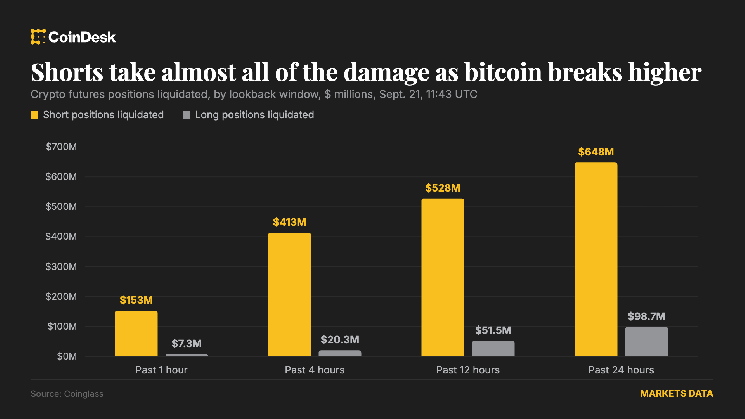
    • Bitcoin surged 5.4% to $84,984, breaking decisively above the September range high of $82,284 set on Sept. 4.
    • The rally was fueled primarily by a massive short squeeze, with $746 million in positions liquidated over 24 hours—$647.9 million of them shorts.
    • Open interest rose 7.59% to $156 billion and volume jumped 39% to $224 billion, indicating traders are re-establishing positions rather than exiting the market.

    Bitcoin Breaks September Resistance on Heavy Short Liquidations

    Bitcoin BTC extended its breakout above the top of its September trading range on Monday, changing hands at $84,984 during the late European morning session. The move represents a 5.4% gain over the prior 24 hours and leaves the asset well clear of the $82,284 high recorded on Sept. 4, which had previously capped upside attempts throughout the month.

    Forced Buying Drives Momentum Rather Than Fresh Conviction

    According to market analysts and data from Coinglass, the rally is being propelled predominantly by forced buying stemming from a cascading short squeeze rather than an influx of new long-side conviction. Over the past 24 hours, $746 million in total positions were liquidated, of which $647.9 million were short positions. In the most recent hour alone, an additional $159.9 million in positions were wiped out, with 95% of those liquidations on the short side.

    Bitcoin shorts accounted for $277.5 million of the 24-hour liquidation total, while Ether (ETH) shorts contributed $122.8 million. The disproportionate short-side washout underscores a market that was heavily positioned for downside or range-bound price action, leaving bears vulnerable to a sharp upside repricing.

    Open Interest and Volume Signal Position Replenishment

    Despite the massive short covering, open interest across the market has risen 7.59% to $156 billion, and 24-hour trading volume has surged 39% to $224 billion. This combination—rising open interest alongside heavy liquidations—suggests that traders are actively replacing the positions being closed out rather than stepping back from the market. The data points to a structural repositioning, with new participants or existing players re-entering on the long side as the breakout confirms.

    Why This Matters

    The break above the September range high marks a technically significant development for Bitcoin, which had been consolidating in a relatively tight band for weeks. The fact that the move was catalyzed by a short squeeze rather than organic spot buying introduces a degree of fragility: if the forced buying exhausts itself without follow-through from spot accumulators, a pullback toward the former resistance—now potential support—around $82,000 could materialize. However, the concurrent expansion in open interest and volume suggests the market is not merely covering shorts but rebuilding directional exposure. Traders will be watching closely for sustained spot bid interest, funding rate normalization, and whether the $85,000 level can flip to support in the coming sessions. The next key technical hurdle lies near the late-July highs around $87,500–$88,000.

    Frequently Asked Questions

    What triggered Bitcoin’s break above the September range?

    The breakout was driven primarily by a massive short squeeze, with $746 million in positions liquidated over 24 hours—$647.9 million of them shorts—forcing bearish traders to buy back positions and accelerating upside momentum.

    Does rising open interest during a short squeeze signal bullish continuation?

    Yes. The 7.59% increase in open interest to $156 billion, combined with a 39% volume surge to $224 billion, indicates traders are replacing liquidated shorts with new long positions rather than exiting the market, suggesting conviction behind the move.

    What are the key levels to watch after this breakout?

    Immediate support now sits at the former September high of $82,284. Upside targets include the late-July highs near $87,500–$88,000. Sustained spot buying and funding rate normalization will be critical for follow-through.

  • Bitcoin and Altcoin Rally Extends: BTC Hits Eight-Month High Amid Liquidations Update

    Bitcoin and Altcoin Rally Extends: BTC Hits Eight-Month High Amid Liquidations Update

    Key Highlights

    • Bitcoin surged 2.5% in one hour to breach $85,000 for the first time since January 30, posting a 9.1% weekly gain and nearing a 30% monthly increase.
    • Ethereum rallied 6% to surpass $2,730, while top altcoin gainers included Sui (22.3%), Venice Token (22%), and Sei (20%) over the last 24 hours.
    • A short-squeeze liquidated approximately $400 million in leveraged positions within hours, contributing to a 24-hour total of $750 million across 136,931 traders.

    Bitcoin Breaks $85,000 as Broad Crypto Rally Accelerates

    Bitcoin extended its recovery on Tuesday, climbing above the psychologically significant $85,000 threshold for the first time since January 30. The flagship cryptocurrency added 2.5% in a single hour, lifting its seven-day advance to 9.1% and its 30-day gain to nearly 30%. The move comes despite lingering macroeconomic headwinds, including last week’s negative developments surrounding the Clarity Act and Federal Reserve policy signals, suggesting that internal market dynamics are currently outweighing external regulatory and monetary concerns.

    Oil Decline Correlates with Risk-On Sentiment

    Market analysts noted that the cryptocurrency rally coincides with a four-day slide in international oil prices. The drop in energy costs has historically eased inflation expectations, fostering a more favorable environment for risk-on assets such as equities and digital currencies. This correlation appears to be fueling renewed buying pressure across the board, with Bitcoin acting as the primary catalyst for broader market participation.

    Altcoins Outperform as Ethereum Reclaims $2,700

    Ethereum led the major altcoin charge, surging 6% over the past 24 hours to trade above $2,730—its first visit above the $2,700 level since the end of January. Other layer-one protocols posted strong gains, with XRP advancing 6.6%, Solana climbing 7%, and HyperLiquid (HYPE) rising approximately 4%. The breadth of the rally indicates improving sentiment across multiple blockchain ecosystems rather than a Bitcoin-only phenomenon.

    Mid-Cap Tokens Lead Percentage Gainers

    According to CoinMarketCap data, the most explosive moves occurred in the mid-cap segment. The platform reported the following 24-hour leaders: “Sui (SUI – 22.3%), Venice Token (VVV – 22%), Sei (SEI – 20%), Near Protocol (NEAR – 19.9%), Render (RENDER – 17.9%) and Avalanche (AVAX – 13.9%)”. These outsized returns highlight speculative appetite returning to higher-beta assets, often a hallmark of early-stage bull market rotations.

    Short Liquidations Fuel Price Discovery

    The rapid ascent triggered a massive unwinding of bearish leverage. Approximately $400 million worth of leveraged trades were liquidated in the space of a few hours, with the vast majority representing short positions. Over the full 24-hour window, total liquidations reached $750 million, affecting 136,931 individual accounts. The single largest liquidation occurred on Binance’s BTC/USDT perpetual contract, valued at $11.29 million, underscoring the intensity of the short squeeze on the dominant trading venue.

    Why This Matters

    The simultaneous breakout in Bitcoin and Ethereum, combined with aggressive short covering and broad altcoin participation, suggests a potential regime shift from consolidation to trend expansion. The $85,000 level for Bitcoin has acted as stiff resistance since January; a sustained close above it could invite fresh institutional and retail inflows. Meanwhile, the scale of short liquidations—$750 million in 24 hours—indicates that a significant portion of the market was positioned for further downside, creating structural fuel for continued upside if momentum persists. Traders will now watch for follow-through volume and whether the Clarity Act and Fed narratives reassert influence in the coming sessions.

    Frequently Asked Questions

    What triggered the latest Bitcoin surge above $85,000?
    The rally appears driven by a combination of falling oil prices improving risk sentiment, a sharp short squeeze liquidating $400 million in bearish bets within hours, and broad-based buying across major and mid-cap altcoins.
    Which altcoins posted the largest 24-hour gains?
    Per CoinMarketCap, the top performers were Sui (SUI) at 22.3%, Venice Token (VVV) at 22%, Sei (SEI) at 20%, Near Protocol (NEAR) at 19.9%, Render (RENDER) at 17.9%, and Avalanche (AVAX) at 13.9%.
    How significant were the liquidations?
    Total liquidations reached $750 million over 24 hours, impacting 136,931 traders. The largest single liquidation was an $11.29 million BTC/USDT position on Binance, highlighting the force of the short-covering rally.

    *This is not investment advice.

  • Crypto Rallies on Bullish Bounce After Fed Rate Hike: Weekly Outlook

    Crypto Rallies on Bullish Bounce After Fed Rate Hike: Weekly Outlook

    Key Highlights

    • Bitcoin holds near $84,000, demonstrating resilience despite the Federal Reserve’s benchmark rate holding at 4.00% following last week’s hawkish stance.
    • The SEC’s conditional five-year exemption window for tokenized securities pilot trading opens September 22, allowing select institutional venues to trade tokenized stocks on public blockchains.
    • Major governance votes are underway across Lido DAO, Uniswap, and CoW DAO, addressing liquidity provisions, protocol fee extensions, and solver competition redesigns.

    Bitcoin Resilience Amid Macro Uncertainty

    Cryptocurrency markets opened the week on a firm footing, with bitcoin BTC trading at $83,915.85 and testing the psychologically significant $84,000 threshold. The digital asset’s stability comes as investors digest the Federal Reserve’s latest policy posture, which maintained the benchmark target rate at 4.00% after last week’s hawkish signaling. While traditional risk assets often react negatively to restrictive monetary policy, bitcoin’s current price action suggests a decoupling from immediate rate-sensitive impulses, at least in the near term.

    The macroeconomic calendar this week centers on a cluster of high-impact U.S. data releases that could recalibrate rate-cut expectations. Initial jobless claims for the period ending September 19 are estimated at 201,000, up from the previous 196,000, while new home sales for August are forecast to decline to 700,000 from 739,000. Durable goods orders are expected to contract 0.3% month-over-month in August after a 1.1% gain previously, and the final University of Michigan Consumer Sentiment Index for September is seen at 47.8, down sharply from 51.7. Canadian retail sales for August are also due, estimated at -0.8% versus a prior 0.6% gain. Cross-asset markets continue to process the divergent policy paths emerging from the Bank of Japan and the Bank of England, adding another layer of complexity to the global liquidity backdrop.

    SEC Tokenized Securities Pilot Framework Goes Live

    A pivotal regulatory milestone arrives on September 22, when the U.S. Securities and Exchange Commission’s conditional five-year exemption window officially opens. This framework permits select institutional venues to commence pilot trading of tokenized stocks directly on public blockchains. The initiative represents the most concrete step yet by U.S. regulators to bridge traditional securities infrastructure with distributed ledger technology, potentially unlocking new paradigms for settlement efficiency, fractional ownership, and market accessibility. Market participants will be closely monitoring which venues receive approval and the volume dynamics during the pilot’s early phase.

    Governance Activity Intensifies Across Major DAOs

    Decentralized autonomous organizations are driving a busy week of on-chain governance. Lido DAO is voting on a proposal to authorize a contingent LDO centralized-exchange liquidity market-making mandate, budgeting up to $1.5 million in recallable LDO and 480,000 USDC to maintain orderbook depth and mitigate potential exchange delisting risks. Voting concludes September 21. Uniswap Governance is conducting a temperature check on extending its protocol fee collection and UNI burn infrastructure to Arc, a Layer 1 network built by Circle, with voting ending September 23. Meanwhile, CoW DAO is voting on a redesign of its solver quote competition, allocating a dedicated quote reward budget equal to 10% of protocol revenue to enhance price routing and order conversion; this vote wraps up September 25.

    Token Unlock Schedule Presents Supply Dynamics

    Several notable token unlocks are scheduled this week, introducing incremental supply into circulating markets. Canton (CC) unlocks 0.38% of its circulating supply, valued at approximately $17.17 million, on September 21. Toncoin (TON) follows on September 22 with a 1.3% unlock worth $51.2 million. Humanity (H) releases 14.7% of its circulating supply, valued at $20.8 million, on September 23. No major token launches are confirmed for the period, and the conference calendar remains clear.

    Why This Matters

    The convergence of bitcoin’s price resilience, the SEC’s tokenized securities pilot launch, and heightened DAO governance activity signals a maturing market structure where regulatory engagement, institutional infrastructure, and decentralized coordination are advancing simultaneously. The SEC pilot, in particular, could establish precedent for how traditional assets are issued, traded, and settled on-chain, potentially attracting broader institutional participation. Meanwhile, the governance votes at Lido, Uniswap, and CoW reflect the growing operational sophistication of major protocols as they address liquidity sustainability, cross-chain fee architectures, and execution quality—issues critical to long-term protocol viability. Traders should monitor this week’s macro data for signals on the Fed’s next move, as any shift in rate expectations could rapidly reassert correlation between digital assets and traditional risk markets.

    Frequently Asked Questions

    What is the SEC’s tokenized securities pilot framework?

    The SEC’s conditional five-year exemption window, opening September 22, allows select institutional venues to conduct pilot trading of tokenized stocks directly on public blockchains. This regulatory sandbox aims to test distributed ledger technology for securities settlement and trading under supervised conditions.

    Why are the Lido, Uniswap, and CoW DAO votes significant?

    These governance proposals address critical operational priorities: Lido seeks to secure exchange liquidity for LDO to prevent delistings; Uniswap explores extending its fee and burn mechanism to Circle’s Arc network; CoW Protocol aims to improve solver competition and order routing through a dedicated reward budget. Outcomes will shape protocol economics and cross-chain strategies.

    Which macroeconomic data points should crypto traders watch this week?

    Key releases include U.S. initial jobless claims (Sept. 24, 8:30 a.m. ET), new home sales (Sept. 24, 10:00 a.m. ET), durable goods orders (Sept. 25, 8:30 a.m. ET), and the final Michigan Consumer Sentiment Index (Sept. 25, 10:00 a.m. ET). These indicators will influence Federal Reserve policy expectations and broader risk sentiment.

  • Bitcoin Surges Past $81,000 as NEAR Jumps 23% on Zcash Swap Traffic

    Bitcoin Surges Past $81,000 as NEAR Jumps 23% on Zcash Swap Traffic

    Key Highlights:

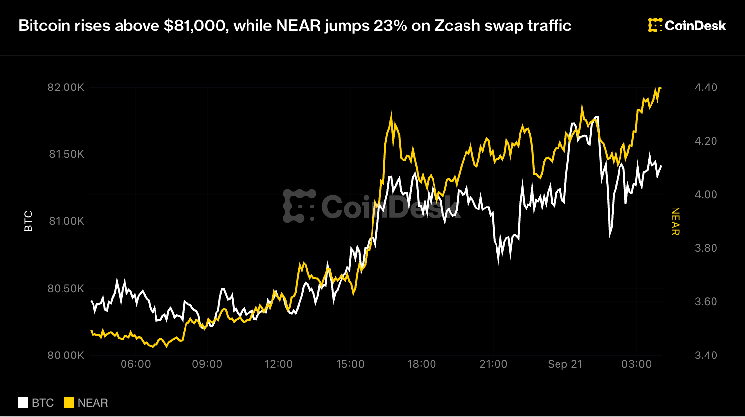
    • Bitcoin holds above $81,000 in Monday Asian trading, extending gains after the SEC greenlit onchain trading of tokenized U.S. equities.
    • NEAR token surges roughly 23% to above $4 as its cross-chain swap service, NEAR Intents, becomes a primary routing layer for Zcash (ZEC) volume.
    • Major consumer wallets ZODL and Vizor have integrated NEAR Intents, driving a sixfold jump in daily ZEC volume routed through the protocol in the past week.

    Bitcoin Consolidates Above $81K as SEC Tokenized Stock Ruling Lifts Sentiment

    Bitcoin traded just above $81,000 during Monday morning hours in Asia, marking a gain of less than 1% over the preceding 24 hours according to CoinDesk data. The cryptocurrency has been adding to its recovery since Thursday, when the U.S. Securities and Exchange Commission cleared a regulatory path for the onchain trading of tokenized U.S. stocks. The move is widely seen as a landmark step toward bridging traditional equity markets with blockchain-based settlement, providing a fresh catalyst for digital-asset risk appetite.

    NEAR Token Leads Major-Cap Gains on Cross-Chain Routing Demand

    The standout performer among major tokens was NEAR, which climbed approximately 23% to trade just above $4. The rally traces directly to NEAR Intents, a swap service built on the NEAR blockchain that enables a wallet to exchange one token for another across different chains without requiring the user to move funds between networks first. The abstraction of cross-chain complexity has turned NEAR into a de facto routing layer for one of the most heavily traded assets in the market.

    Wallet Integrations Drive Sixfold Volume Spike for ZEC

    Major consumer wallets, including ZODL and Vizor, have plugged NEAR Intents into their interfaces to offer Zcash (ZEC) swaps. Since those integrations went live, daily ZEC volume routed through the service has jumped sixfold in a single week. The surge in order flow has created a positive feedback loop for the NEAR token itself, which has followed the traffic as the underlying settlement and gas asset for the routing activity.

    Broader Market Moves Remain Measured

    Outside of NEAR’s outsized move, the rest of the major-cap complex posted modest advances. ZEC itself gained 3% to just above $1,500, while BNB rose 2% to nearly $777. Ether and HYPE each added roughly 2%. The remaining large-cap cohort — XRP, DOGE, SOL, and TRX — all rose 1% or less, indicating a market digesting the SEC news selectively rather than chasing a broad risk-on impulse.

    Why This Matters

    The SEC’s decision to allow onchain trading of tokenized U.S. equities represents a structural shift: it legitimizes the use of public blockchains as settlement rails for regulated securities. For protocols like NEAR that have invested in chain-abstraction infrastructure, the ruling arrives as tailwinds build for cross-chain liquidity aggregation. The sixfold volume increase on NEAR Intents demonstrates real user demand for seamless interoperability — a prerequisite if tokenized stocks are to trade natively onchain at scale. Watch for further wallet integrations and whether other Layer 1s deploy similar intent-based routing to capture order flow.

    Frequently Asked Questions

    What is NEAR Intents and why is it driving NEAR’s price higher?

    NEAR Intents is a cross-chain swap service on the NEAR blockchain that lets users trade tokens across different networks without manually bridging funds. Wallets ZODL and Vizor have integrated it for ZEC swaps, causing a sixfold volume spike that increases demand for NEAR as the routing layer’s native gas and settlement token.

    How did the SEC’s tokenized stock decision affect Bitcoin?

    Bitcoin has extended gains since Thursday’s SEC ruling, trading above $81,000 on Monday. The decision is viewed as a bullish regulatory signal for the broader digital-asset ecosystem, though Bitcoin’s own move has been modest — up less than 1% in 24 hours — suggesting the market is still calibrating the long-term implications.

    Which other major tokens moved on Monday?

    ZEC gained 3% to above $1,500; BNB rose 2% to near $777; Ether and HYPE each added about 2%; while XRP, DOGE, SOL, and TRX all rose 1% or less.

  • Bitcoin Clears Key Hurdle That Historically Preceded Major Bull Runs

    Bitcoin Clears Key Hurdle That Historically Preceded Major Bull Runs

    Key Highlights

    • Bitcoin closed the week ended September 20 above its 50-week moving average for the first time in 45 weeks, signaling a potential trend reversal.
    • The cryptocurrency gained nearly 6% during the week, trading around $81,000 and extending its rebound to 29% over the past 35 days.
    • Galaxy Research Head Alex Thorn described the weekly close above the key moving average as “a potentially important confirmation that the market’s bear phase may have run its course and a new uptrend is upon us.”

    Bitcoin Breaks 45-Week Barrier Above Critical 50-Week Moving Average

    Bitcoin (BTC) has cleared a major technical hurdle that had resisted bullish attempts for nearly a year. For the first time since late 2023, the world’s largest cryptocurrency posted a weekly close above its 50-week moving average, a development market analysts are interpreting as a potential confirmation that the prolonged bearish phase has concluded.

    The weekly candlestick close—recorded at 23:59 UTC on Sunday, September 20—shows Bitcoin settling around $81,000 after a weekly gain of nearly 6%. This advance extends the asset’s recovery to approximately 29% over the preceding 35-day period. Unlike previous instances where price action briefly pierced the moving average only to retreat, this week’s candle closed decisively above the indicator, a distinction technical analysts consider significant for trend validation.

    Why the Weekly Close Carries More Weight Than Intraday Tests

    Bitcoin trades continuously across global exchanges, but technical analysis frameworks rely on defined session closes—daily at 00:00 UTC and weekly at 23:59 UTC on Sundays—to construct candlestick charts. A weekly close above a major moving average carries substantially more analytical weight than an intraday or intraweek breach that fails to hold into the close.

    The 50-week moving average represents the arithmetic mean of weekly closing prices over roughly the past year. In Bitcoin market analysis, this metric serves as a widely watched proxy for the asset’s long-term trend direction. When price action sustains above this level on a weekly basis, it historically correlates with the early stages of sustained uptrends; conversely, extended periods below the average typically coincide with bearish or consolidation phases.

    Analyst Perspective: Galaxy Research Signals Trend Shift

    Commenting on the technical development, Galaxy Research Head of Research Alex Thorn characterized the weekly close as “a potentially important confirmation that the market’s bear phase may have run its course and a new uptrend is upon us.” Thorn’s assessment underscores the significance market participants attach to the 50-week average as a regime-change indicator rather than merely a short-term support or resistance level.

    Galaxy Digital, the financial services and investment management firm founded by Mike Novogratz, operates Galaxy Research as its dedicated market analysis division. The firm’s commentary often influences institutional sentiment given its focus on digital asset markets and its position as a bridge between traditional finance and the cryptocurrency ecosystem.

    Why This Matters

    The 50-week moving average breach represents more than a standalone technical signal; it occurs against a backdrop of evolving macroeconomic conditions, including anticipated shifts in global monetary policy and growing institutional adoption through spot exchange-traded products in major markets. A sustained weekly close above this threshold could attract trend-following capital allocation strategies that use the 50-week average as a systematic entry filter. However, market structure analysts caution that the true test lies in whether Bitcoin can convert the former resistance into support during subsequent weekly candles, particularly if macroeconomic volatility prompts risk-off sentiment across broader financial markets.

    Frequently Asked Questions

    What is the 50-week moving average and why is it significant for Bitcoin?

    The 50-week moving average calculates the average weekly closing price of Bitcoin over approximately the past year. Technical analysts use it as a long-term trend indicator; sustained trading above it typically signals a bullish regime, while extended periods below suggest bearish or consolidation conditions.

    How does a weekly candle close differ from an intraday price move?

    A weekly candle closes at 23:59 UTC every Sunday, capturing the full week’s price action. Analysts consider a weekly close above a key level more reliable than an intraday breach because it reflects sustained conviction across all global trading sessions rather than a temporary liquidity-driven spike.

    What was Bitcoin’s price performance during the week of this breakout?

    Bitcoin rose nearly 6% during the week ended September 20, closing around $81,000. This weekly gain contributed to a broader 29% rebound over the preceding 35-day period.

  • Strategy Founder Michael Saylor Argues Clarity Act Collapse Is a Win

    Strategy Founder Michael Saylor Argues Clarity Act Collapse Is a Win

    Key Highlights

    • Strategy founder Michael Saylor contends the Senate’s failure to advance the Clarity Act benefits the digital asset industry by avoiding restrictive legislative provisions.
    • Despite the legislative setback, the SEC and CFTC are independently advancing rulemaking, including conditional relief for onchain trading of tokenized securities.
    • The Clarity Act fell one vote short of cloture on Tuesday (49-50), stalling a framework the industry had sought to resolve jurisdictional uncertainty between regulators.

    Saylor Reframes Legislative Defeat as Strategic Opportunity

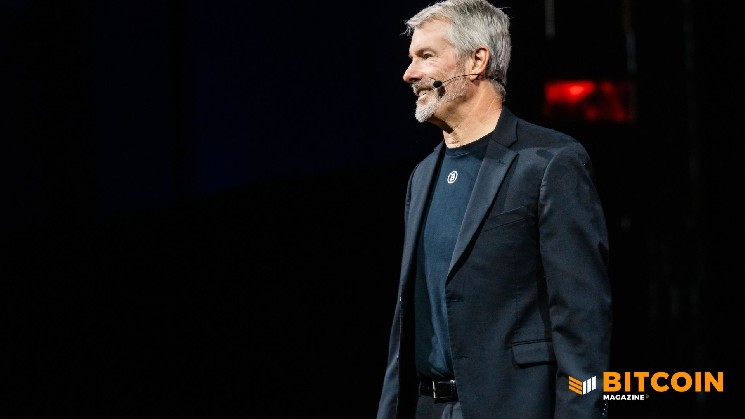
    Strategy founder and Executive Chairman Michael Saylor argued Saturday that the Senate’s blockade of the long-awaited Clarity Act represents a net positive for the digital asset ecosystem. Writing on X, the Bitcoin treasury pioneer asserted that legislation carries the risk of cementing restrictions as easily as it enshrines rights, suggesting the industry may be better served by regulatory evolution driven by market innovation rather than statutory compromise.

    Regulators Advance Rulemaking Independently of Congress

    The Clarity Act, which aimed to formally delineate oversight between the Securities and Exchange Commission (SEC) and the Commodity Futures Trading Commission (CFTC), failed a procedural vote on Tuesday by a margin of 49 to 50. Despite the legislative impasse, both agencies are moving forward with independent rulemaking initiatives. The SEC has issued conditional relief for the onchain trading of certain tokenized stocks, while the CFTC Chair has signaled a willingness to act without the bill’s authority. Saylor contended these developments would deliver the regulatory clarity crypto companies require without the constraints embedded in the proposed legislation.

    Critique of Specific Bill Provisions

    Saylor specifically criticized provisions within the Clarity Act that would limit the ability to pay customers for holding payment stablecoins, arguing such restrictions would not benefit the crypto space. “We have an administration willing to modernize financial markets. We should use the next two years to put better financial products into people’s hands,” Saylor wrote. He continued: “Let the Digital Assets industry innovate rapidly in a free market and create the greatest possible value for the U.S. and global economy.”

    Political Context and Industry Background

    The bill’s collapse comes after President Donald Trump urged lawmakers to pass the measure last month, a call that helped spur a Bitcoin rally. Republicans had warned for months that Democrats were deliberately stalling the legislation. The digital asset industry has long advocated for a clear regulatory framework following an enforcement-heavy approach during the Biden administration, when regulators penalized numerous crypto companies with fines for allegedly selling unregistered securities. Strategy, formerly known as MicroStrategy, began accumulating Bitcoin in 2020 and has since become the largest corporate holder of the asset.

    Why This Matters

    The failure of the Clarity Act leaves a significant regulatory vacuum at the federal level, but Saylor’s perspective highlights a growing sentiment among some industry leaders that agency-led rulemaking may offer more flexibility than a legislative compromise negotiated in a polarized Congress. With the SEC and CFTC actively pursuing their own frameworks, the practical regulatory landscape for tokenized assets, stablecoins, and market structure will likely be shaped by administrative action and litigation in the near term. The episode underscores the ongoing tension between the industry’s desire for legislative certainty and its aversion to provisions perceived as limiting innovation or competitive dynamics.

    Frequently Asked Questions

    What was the Clarity Act intended to do?

    The Clarity Act aimed to formally divide regulatory oversight of digital assets between the SEC and CFTC by establishing clear definitions for which assets qualify as securities, commodities, or stablecoins, resolving long-standing jurisdictional ambiguity.

    Why does Michael Saylor view the bill’s failure as positive?

    Saylor argues that legislation can permanently entrench restrictions alongside protections. He believes agency-led rulemaking—such as the SEC’s conditional relief for onchain tokenized stock trading and the CFTC’s independent action—can provide necessary clarity without codifying provisions he views as harmful, like limits on stablecoin yield incentives.

    What happens next for crypto regulation in the U.S.?

    With the Clarity Act stalled, the SEC and CFTC are expected to continue advancing their own rulemaking agendas. Market participants should monitor agency proposals, enforcement actions, and court rulings as the primary drivers of regulatory development in the absence of comprehensive legislation.