Tag: Bitcoin

  • Clarity Act Replaced: What the Bill Contained and What Comes Next

    Clarity Act Replaced: What the Bill Contained and What Comes Next

    Key Highlights

    • The Clarity Act would have granted the Commodity Futures Trading Commission (CFTC) full supervisory authority over crypto commodity spot markets, including Bitcoin and Ethereum trading.
    • The legislation aimed to define regulatory buckets for blockchain-native assets, curb illicit finance, and provide limited legal protections for decentralized finance (DeFi) software developers.
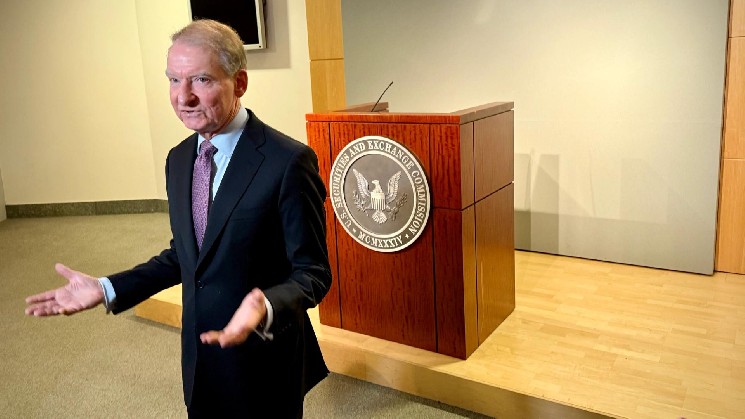
    • With the bill stalled, the Securities and Exchange Commission (SEC) is moving to fill the regulatory vacuum, signaling continued enforcement-focused oversight of the digital asset sector.

    The Clarity Act’s Regulatory Blueprint

    The Clarity Act represented a comprehensive attempt to resolve the United States’ fragmented approach to digital asset regulation by formally designating the Commodity Futures Trading Commission as the primary supervisor of crypto commodity spot markets. Since Bitcoin (BTC) at $81,656.52 and Ethereum’s ether (ETH) at $2,643.82 were classified as commodities, the bulk of cryptocurrency trading activity occurs in spot markets that have operated without a dedicated, hands-on federal regulator—except in cases involving market manipulation. The bill would have elevated the CFTC, the SEC’s sister agency overseeing derivatives, to direct supervisory authority over these markets, addressing a structural gap unique to the American regulatory framework where securities and derivatives oversight remain separated across independent agencies.

    Defining Asset Categories and Developer Protections

    Beyond market structure, the legislation sought to establish clear taxonomic buckets for blockchain-native assets, assigning each to the appropriate regulatory regime. The bill also incorporated provisions targeting illicit finance risks and, in a notably contentious measure, proposed limited legal shields for software developers building decentralized finance protocols. These protections aimed to prevent developers from facing prosecution based solely on how third parties utilize their open-source code—a provision that sparked significant debate across industry and policy circles.

    Legislative Failure and the Enforcement Vacuum

    The Clarity Act ultimately stalled due to provisions unrelated to its core regulatory mission, leaving a policy void that the SEC has moved quickly to occupy. Rather than waiting for congressional action, the securities regulator has intensified its enforcement posture, leveraging existing securities laws to assert jurisdiction over a broad swath of digital asset activity. This development effectively replaces a potential legislative framework—designed with industry input and clear statutory boundaries—with a case-by-case enforcement approach that many market participants argue creates greater uncertainty for compliant actors.

    Why This Matters

    The collapse of the Clarity Act underscores the persistent inability of Congress to pass bespoke digital asset legislation, leaving regulatory authority contested between the SEC and CFTC. The U.S. remains an outlier among major economies in maintaining separate securities and derivatives regulators, a structure that complicates the classification of hybrid assets like cryptocurrencies. In the absence of statutory clarity, the SEC’s enforcement-first strategy is likely to continue shaping market behavior, potentially driving activity offshore or into less transparent venues while courts adjudicate the boundaries of the agency’s jurisdiction on a case-by-case basis.

    Frequently Asked Questions

    What would the Clarity Act have changed for crypto regulation?
    The bill would have granted the CFTC full supervisory powers over crypto commodity spot markets—where Bitcoin and Ethereum primarily trade—while creating defined regulatory categories for blockchain assets, adding anti-illicit finance measures, and offering limited liability protections for DeFi software developers.
    Why did the legislation fail?
    The bill was derailed by unrelated provisions that had little to do with its primary regulatory objectives, though the source does not specify which particular sections caused the breakdown.
    How is the SEC responding to the legislative vacuum?
    The SEC is actively using its existing enforcement authority to police the digital asset sector, effectively filling the regulatory gap left by the Clarity Act’s failure through litigation and regulatory actions rather than new rulemaking.

  • ‘The orange tie stays’: Michael Saylor responds to venture capitalist’s bitcoin obituary

    ‘The orange tie stays’: Michael Saylor responds to venture capitalist’s bitcoin obituary

    Key Highlights

    • Jason Calacanis declares Bitcoin “boring” as it returns to $80,000, criticizing its transaction utility, user experience, and cultural relevance.
    • Michael Saylor counters that Bitcoin has become a $1.6 trillion “Digital Capital” asset focused on generational wealth preservation.
    • The exchange highlights a fundamental divide between critics seeking utility and adoption metrics versus proponents viewing Bitcoin as a long-term store of value.

    Calacanis Declares Bitcoin’s Cultural Moment Has Passed

    As bitcoin reclaimed the $80,000 level on Friday, veteran investor Jason Calacanis took to social media to deliver a scathing assessment of the cryptocurrency’s current trajectory. “The dead cat continues to bounce,” wrote Calacanis, invoking a market term for a temporary recovery in a declining asset. He proceeded to dismantle the case for bitcoin across multiple dimensions, questioning its fundamental utility seventeen years after its inception.

    Utility, Experience, and the “Dinner Party” Test

    Calacanis argued that bitcoin fails as both a transactional medium and a platform for smart contracts, while presenting an “intimidating user experience” that alienates mainstream users. He contended the asset no longer captures the public imagination, applying a cultural litmus test: “If it comes up at the dinner party, it’s followed by a hearty ‘remember that!’” The investor suggested the narrative has shifted from wealth creation to stability expectations. “Folks expect bitcoin to be stable and that it’s no longer a way to get rich quick,” he continued. “It’s boring … Advocates went from pirates to suits in orange ties, awkwardly sharing cringe memes — just like the cool kids do!” His conclusion was definitive: “If Bitcoin were going to reach mass adoption and an important use case, it does better than anyone else, it would have by now.”

    Saylor Reframing: Digital Capital and Generational Wealth

    Michael Saylor, founder of MicroStrategy and bitcoin’s most prominent corporate advocate, issued a point-by-point rebuttal framing the asset in civilizational rather than consumer terms. “You’ve watched Bitcoin grow since 2011,” Saylor responded. “It’s now a $1.6 trillion success and the world’s most valuable digital asset.” He rejected the premise that transactional velocity or dinner-party relevance defines success. “Digital Capital is the killer app,” Saylor continued. “Preserving wealth across generations is a bigger ambition than entertaining a dinner party.” He closed with a symbolic declaration of continuity: “The orange tie stays.”

    Why This Matters

    The Calacanis-Saylor exchange crystallizes the central debate surrounding bitcoin in 2025: whether its value proposition lies in medium-of-exchange utility and mass consumer adoption — the original cypherpunk vision — or in settlement-layer “Digital Capital” serving as a sovereign-grade store of value. Calacanis represents the skeptic’s benchmark: seventeen years without Venmo-level usability or mainstream cultural currency suggests product-market fit failure. Saylor represents the institutional thesis: a $1.6 trillion market cap, nation-state accumulation strategies, and corporate treasury adoption prove the “digital gold” use case has already won. The “orange tie” motif — originally a bitcoin community signal — now functions as a Rorschach test: to critics, a symbol of cringe corporate co-option; to believers, a marker of institutional maturation. With bitcoin oscillating around $80,000, the next inflection point may depend less on technical upgrades and more on whether sovereign and corporate balance-sheet allocation continues to outpace retail onboarding.

    Frequently Asked Questions

    What triggered the Calacanis-Saylor exchange?

    Bitcoin’s return to the $80,000 price level on Friday prompted Jason Calacanis to post a critical thread questioning bitcoin’s utility, user experience, and cultural relevance after 17 years. Michael Saylor responded directly, reframing bitcoin as “Digital Capital” for generational wealth preservation.

    What is Michael Saylor’s “Digital Capital” thesis?

    Saylor argues bitcoin’s primary value proposition is not payments or smart contracts but serving as a sovereign-grade, digitally native store of value — “Digital Capital” — capable of preserving wealth across generations, a purpose he considers more significant than consumer adoption or dinner-party relevance.

    What does “the orange tie stays” signify?

    The orange tie has been a symbol worn by bitcoin advocates, including Saylor, representing conviction in the asset. Calacanis mocked it as “suits in orange ties, awkwardly sharing cringe memes.” Saylor’s closing line — “The orange tie stays” — signals institutional conviction remains unchanged despite criticism.

  • Analyst With 30 Years Experience Weighs In on Bitcoin, Altcoins Future

    Analyst With 30 Years Experience Weighs In on Bitcoin, Altcoins Future

    Key Highlights

    • Macro investor Jordi Visser shifts from cautious to bullish on crypto, citing the convergence of AI and blockchain infrastructure as the primary catalyst for a new growth era.
    • Visser argues Bitcoin’s role is evolving into a long-term store of value and collateral asset, distinct from stablecoins and networks like Ethereum and Solana that will power high-speed AI agent transactions.
    • The investor predicts Bitcoin is the only crypto technology certain to exist in 20 years, providing “collateral” and “stability” amid technological disruption, while noting its investor base is shifting from ideological decentralization to portfolio diversification.

    Visser Signals Major Pivot: From Crypto Skeptic to Strategic Bull

    Renowned macro investor Jordi Visser has articulated a significant reversal in his stance on Bitcoin and the broader cryptocurrency market, moving from a historically cautious posture to a constructive long-term outlook. In a recent program appearance, Visser was characterized as an investor who has “always gone from bear to bull,” a trajectory he attributes to a fundamental maturation of the sector. The pivot hinges on a singular observation: cryptocurrency is transitioning from a vehicle for price speculation to an infrastructure layer supporting real-world economic utility. Visser emphasized that his optimism is not rooted in cyclical liquidity tailwinds or monetary expansion, but in the structural integration of innovation—specifically artificial intelligence—into the crypto stack.

    AI Agents and the New Payment Rails: Why Stablecoins and Smart Contract Platforms Lead

    Central to Visser’s thesis is the impending rise of autonomous AI agents. He argues that a future economy populated by high-speed, machine-to-machine commerce will require a payment infrastructure fundamentally different from the traditional financial system. In this architecture, stablecoins and high-throughput blockchain networks such as Ethereum and Solana are positioned to play a dominant role. Visser suggested that once AI agents begin transacting natively on-chain, adoption could grow “parabolically,” ushering in a period where consumer-facing AI agents become ubiquitous. This framework explicitly delineates function: programmable, high-speed settlement layers handle the velocity of agent commerce, while Bitcoin serves a separate, foundational purpose.

    Bitcoin as Digital Collateral: Survival Over Speculation

    Visser draws a sharp distinction between Bitcoin and the smart contract ecosystems designed for transactional throughput. He contends that Bitcoin’s primary utility is not as a medium of exchange, but as a long-term store of value and a pristine collateral asset. Noting that hundreds of millions of individuals have already selected Bitcoin as a digital savings vehicle, he points to its survival through multiple severe bear markets as the ultimate proof of resilience. In a landscape where artificial intelligence threatens to rapidly obsolete companies, business models, and traditional equity investments, Visser views Bitcoin as one of the few assets likely to remain completely unaffected by technological transformation. Its value proposition, he argues, lies in a high probability of survival over decades, offering portfolio protection that is uncorrelated to the disruption cycle.

    Shifting Capital Flows and an Evolving Identity

    Addressing Bitcoin’s recent relative underperformance versus AI-equity darlings, Visser acknowledged that capital has rotated toward higher-return opportunities in the technology sector, dampening near-term demand for the digital asset. However, he identifies a powerful structural counter-trend: the strengthening bridge between traditional finance and crypto infrastructure. The advent of tokenization and the maturation of Ethereum, Solana, and related blockchain rails are poised to attract significant institutional capital into the ecosystem, a tailwind that will ultimately benefit Bitcoin as the reserve asset of the sector. Furthermore, Visser observed that Bitcoin’s identity is undergoing a profound shift. The asset has migrated from an early investor base motivated by ideological separation from state systems toward a broader, mainstream constituency focused on portfolio diversification. He interprets this not as a betrayal of origins, but as the natural consequence of parallel financial systems merging over time.

    The Twenty-Year Conviction: Bitcoin as the System’s Bedrock

    Capping his analysis with a striking long-term forecast, Visser stated that Bitcoin is the only technology he is confident will still exist within both the crypto ecosystem and the current fiat system two decades from now. While acknowledging that AI will rapidly transform or destroy countless other assets and corporations, he maintains that Bitcoin will endure as the system’s “collateral” and “stability.” This conviction underscores a view of Bitcoin not as a speculative bet on price appreciation, but as a monetary constant engineered to withstand the entropy of technological revolution.

    Why This Matters

    Visser’s commentary reflects a growing consensus among macro strategists that the crypto narrative is decoupling from simple “risk-on/risk-off” liquidity trades. The convergence of AI agents and blockchain settlement layers represents a tangible total addressable market (TAM) expansion—programmable money for a machine economy. For investors, the critical takeaway is the functional unbundling of crypto assets: high-velocity chains (Solana, Ethereum L2s) capture the transactional layer, stablecoins capture the unit-of-account layer, and Bitcoin captures the trust-minimized collateral layer. This framework suggests that portfolio construction should reflect these distinct roles rather than treating the sector as a monolithic beta trade. Additionally, the noted shift in Bitcoin’s holder base—from cypherpunks to institutions—signals a reduction in systemic “holder risk” (the probability of mass ideological abandonment), potentially lowering the asset’s long-term volatility profile as it becomes a standard diversifier in multi-asset portfolios.

    Frequently Asked Questions

    Why does Jordi Visser believe Bitcoin will not be used for AI agent payments?

    Visser argues that Bitcoin’s design prioritizes security and decentralization over transaction throughput and programmability. High-speed commerce between AI agents requires low-latency, high-capacity settlement layers—roles better suited for stablecoins and smart contract platforms like Ethereum and Solana. He views Bitcoin’s optimal function as a static store of value and collateral asset rather than a dynamic medium of exchange.

    What does Visser mean by Bitcoin providing “collateral” and “stability” in 20 years?

    He posits that as AI disrupts corporate earnings, business models, and equity valuations, Bitcoin’s immutable monetary policy and proven resistance to censorship make it the most reliable asset to pledge as collateral or hold as a stability anchor. Unlike companies that can be rendered obsolete, the Bitcoin protocol has no management team to disrupt and no cash flows to impair, making it a unique “survivor” asset in a period of accelerated technological creative destruction.

    How does the changing investor base affect Bitcoin’s risk profile?

    Visser notes the transition from holders motivated by anti-state ideology to those seeking portfolio diversification. This broadens the demand base, reduces concentration risk among ideologically rigid holders, and integrates Bitcoin into standard financial planning. The result is a more resilient holder base less likely to capitulate during drawdowns, which may dampen volatility and support long-term price stability.

  • Multicoin Founder: “Bitcoin and Ethereum Will Lag Behind in This Cycle,” Shares Altcoin Outlook

    Multicoin Founder: “Bitcoin and Ethereum Will Lag Behind in This Cycle,” Shares Altcoin Outlook

    Key Highlights

    • Multicoin Capital co-founder Tushar Jain warns that “bear market trauma” causes investors to underestimate bull market potential, citing historical examples like Ethereum’s 100x rise in 2017 and Solana’s surge from $2 to $250 in 2021.
    • Jain predicts Bitcoin and Ethereum will significantly underperform high-quality altcoins in the current cycle, suggesting capital rotation could drive sharper altcoin gains without requiring the previous cycle’s market cap expansion.
    • Based on CoinGecko data showing crypto market cap nearly quadrupled from $770 billion to $3 trillion in the last cycle, Jain argues a mere twofold increase from the current $2.1 trillion to $4.2 trillion could fuel substantial altcoin appreciation.

    Multicoin Capital’s Jain Identifies “Bear Market Trauma” as Key Investor Pitfall

    Tushar Jain, co-founder of cryptocurrency investment firm Multicoin Capital, has warned that prolonged market downturns inflict psychological damage that blinds investors to the explosive potential of subsequent bull runs. In a detailed analysis of current market dynamics, Jain articulated how extended periods of decline erode conviction in the magnitude of bull market movements, leading to what he terms a pervasive cognitive bias among market participants.

    Central to Jain’s thesis is the concept of “bear market trauma” — a phrase he uses to describe the tendency of investors to forget how powerful price movements can be in a bull market after enduring a long and painful period of decline. This psychological anchoring to recent price action, he argues, causes systematic underestimation of upside potential precisely when opportunity is greatest.

    Historical Precedents Underscore Altcoin Outperformance Potential

    To illustrate the magnitude of gains possible during bullish expansions, Jain cited two landmark historical examples. He pointed to Ethereum’s ascent from $10 to $1,000 during the 2017 cycle — a 100x appreciation — and Solana’s (SOL) remarkable climb from $2 to $250 in the 2021 cycle. These cases, he contends, demonstrate that high-quality alternative assets can deliver returns that dwarf major large-cap cryptocurrencies during periods of broad market expansion.

    Jain stated that he believes $BTC and $ETH will underperform significantly compared to other high-quality crypto assets in the current market cycle. This conviction underpins his argument that capital rotation from the two dominant cryptocurrencies into a broader set of quality altcoins could produce much sharper gains in those assets, even without a proportionate increase in total market capitalization.

    Market Capitalization Math Suggests Lower Threshold for Altcoin Gains

    Supporting his outlook with quantitative analysis, Jain referenced CoinGecko data showing that total cryptocurrency market capitalization nearly quadrupled in the previous cycle, growing from approximately $770 billion in 2021 to $3 trillion at its peak. He contrasted this with the current cycle’s starting point, noting that if the market were to grow only twofold this time around — a more modest expansion — the total value could reach $4.2 trillion from the current $2.1 trillion.

    This mathematical framing suggests that altcoins may not require a repeat of the last cycle’s explosive total market growth to achieve significant price appreciation. Instead, a redistribution of capital within a moderately expanding total addressable market could be sufficient to drive outsized returns in selected high-quality assets, according to Jain’s analysis.

    Why This Matters

    Jain’s perspective carries weight given Multicoin Capital’s track record as an early institutional backer of Solana and other layer-one ecosystems that subsequently achieved massive valuations. His framework challenges the prevailing narrative that Bitcoin and Ethereum must lead any sustainable bull market, instead positing a scenario where capital efficiency favors rotating into assets with higher beta to market expansion. For market participants, the analysis underscores the importance of distinguishing between psychological anchoring to past trauma and objective assessment of current risk-reward dynamics. The next critical test will be whether Bitcoin dominance continues to decline amid rising total market cap — a pattern that would validate the capital rotation thesis — or whether the major assets reassert leadership, undermining the altcoin outperformance scenario.

    Frequently Asked Questions

    What is “bear market trauma” according to Tushar Jain?

    Jain defines “bear market trauma” as the common investor mistake of forgetting how powerful price movements can be in a bull market after a long and painful period of decline, leading to systematic underestimation of upside potential.

    Why does Jain believe Bitcoin and Ethereum will underperform altcoins this cycle?

    Jain argues that capital will shift from BTC and ETH toward high-quality altcoins as they lag behind broader market momentum, producing sharper gains in those assets without requiring the same magnitude of total market cap expansion seen in prior cycles.

    What market cap levels does Jain cite from CoinGecko data?

    Jain notes total crypto market cap nearly quadrupled from approximately $770 billion in 2021 to $3 trillion in the last cycle, and projects that a twofold increase from the current $2.1 trillion could bring total valuation to $4.2 trillion.

    This is not investment advice.

  • CFTC Submits Secret Two-Part Crypto Rules Package to White House

    CFTC Submits Secret Two-Part Crypto Rules Package to White House

    Key Highlights

    • The CFTC has submitted a two-part crypto regulation proposal (RIN 3038-AF80) to the White House OIRA, outlining frameworks for “Regulation Crypto Asset Transactions” and “Regulation Crypto Asset Markets.”
    • The proposal introduces a new “crypto asset markets” exchange category for spot trading digital commodities like Bitcoin and XRP under CFTC oversight, though final rules are unlikely before late 2027.
    • Bitcoin surged to $80,000 and total crypto market capitalization rose 5.11% to $2.76 trillion, defying bearish macroeconomic signals including Fed rate hikes and oil above $100.

    CFTC Advances Dual-Track Crypto Framework Through White House Review

    The U.S. Commodity Futures Trading Commission has formally submitted a comprehensive two-part regulatory proposal to the White House Office of Information and Regulatory Affairs, marking a significant step toward federal oversight of digital asset markets. Filed under identifier RIN 3038-AF80, the submission is divided into “Regulation Crypto Asset Transactions” and “Regulation Crypto Asset Markets,” signaling the agency’s intent to establish a dedicated regulatory architecture for digital commodities.

    New Exchange Category for Digital Commodity Spot Trading

    While the proposal’s specific details remain confidential during the initial White House review, the structural outline strongly suggests the creation of a novel “crypto asset markets” designation. This new category would authorize both existing and prospective exchanges to conduct spot trading of digital commodities—specifically citing Bitcoin (BTC) and XRP—under direct CFTC supervision. The move addresses a long-standing regulatory gap where spot markets for assets deemed commodities have operated without a dedicated federal framework.

    Extended Rulemaking Timeline Projects 2027 Implementation

    The administrative process facing the proposal is extensive. OIRA has up to 99 days to complete its review before the measure returns to the Commission for a formal vote. Subsequent publication in the Federal Register would trigger two separate 60-day public comment periods. Given this procedural sequence, market participants and legal observers anticipate that a final, binding rule is unlikely to take effect until late 2027, underscoring the deliberate pace of U.S. financial regulation.

    Regulatory Momentum Builds Despite Legislative Setback

    This submission represents the latest in a coordinated series of administrative actions by the CFTC and the Securities and Exchange Commission following the rejection of the Clarity Act. Just yesterday, the CFTC announced an exception for crypto and prediction market software providers from broker classification under specified conditions. Concurrently, the SEC introduced a five-year “Innovation Exemption” rule permitting on-chain trading of certain tokenized stocks. Together, these measures demonstrate a regulatory strategy advancing through rulemaking channels rather than waiting for congressional action.

    pic.twitter.com/N87oIV8mXC — Mike Selig (@ChairmanSelig) September 16, 2026

    Why This Matters

    The CFTC’s proposal arrives at a critical juncture for U.S. crypto policy. With comprehensive legislation stalled, the agency is leveraging its existing authority under the Commodity Exchange Act to claim jurisdiction over spot markets for digital commodities. The proposed “crypto asset markets” category would provide a regulated venue for Bitcoin and XRP trading—assets the CFTC has consistently classified as commodities—potentially resolving the jurisdictional ambiguity that has hindered institutional adoption. The extended timeline reflects the complexity of designing a framework that accommodates decentralized technology within traditional exchange regulation, while the simultaneous SEC and CFTC actions suggest a de facto inter-agency coordination emerging in the absence of statutory clarity.

    Frequently Asked Questions

    What digital assets would fall under the proposed “crypto asset markets” framework?

    The proposal outline specifically identifies Bitcoin (BTC) and XRP as examples of digital commodities that would be eligible for spot trading on CFTC-regulated “crypto asset markets” exchanges.

    When could these regulations actually become enforceable?

    Given the 99-day OIRA review, Commission vote, Federal Register publication, and two mandatory 60-day public comment periods, a final binding rule is not expected to take effect until late 2027.

    How does this relate to the SEC’s recent “Innovation Exemption” for tokenized stocks?

    Both actions reflect parallel regulatory tracks: the CFTC is building a framework for digital commodities like Bitcoin, while the SEC is creating a controlled environment for tokenized securities. Together, they represent a bifurcated administrative approach to crypto regulation in the absence of new legislation.

  • Bitcoin Bullish Phase Forms, but Overbought Conditions Signal Caution

    Bitcoin Bullish Phase Forms, but Overbought Conditions Signal Caution

    Key Highlights

    • CryptoQuant analysis indicates Bitcoin has exited extreme bubble-or-crash conditions and is gradually approaching a full-fledged bullish rally after a period of correction and consolidation.
    • JPMorgan reports institutional investors are more defensively positioned toward Bitcoin than gold, with heavy put-option activity around ETFs such as BlackRock’s IBIT creating potential for $1 trillion in hedge unwinding and short-covering pressure if prices rise.
    • Technical indicators flash mixed signals: Bitcoin trades near $78,241 with RSI in overbought territory and widening Bollinger Bands signaling elevated volatility, while macro headwinds including a Fed rate hike and stronger dollar cloud the Q4 outlook.

    Bitcoin Exits “Weakness Zone” as Cycle Structure Shifts

    The digital asset market is undergoing a notable sentiment shift in the second half of 2027. After failing to breach a long-standing resistance level during the first half of the year, Bitcoin ($BTC) appears to be transitioning toward a bullish phase, according to a recent analysis by on-chain analytics firm CryptoQuant. The firm’s bubble-versus-crash market structure indicator shows that the extreme conditions historically associated with either a speculative bubble or a severe crash have dissipated.

    Bitcoin has already navigated a period of correction and consolidation, yet it has not experienced the kind of extreme speculative mania that typically marks major cycle tops. This suggests the asset may still have room to enter a stronger upward trend. As CryptoQuant stated directly in its report:

    The full-fledged bullish rally has not yet begun. Currently, it is in the process of gradually approaching that stage.

    Institutional Positioning: Bitcoin vs. Gold Dynamics

    Adding weight to the constructive outlook, JPMorgan has highlighted a striking divergence in institutional positioning. The bank notes that investors are currently more defensively positioned toward Bitcoin than toward gold. This defensive stance manifests in elevated short interest and significant put-option activity around Bitcoin exchange-traded funds, most notably BlackRock’s IBIT.

    While gold ETFs have recovered more of their 2026 outflows, Bitcoin carries relatively heavier bearish hedging. However, JPMorgan emphasizes that this hedging does not necessarily reflect outright bearish conviction. Instead, it creates a coiled spring effect: if Bitcoin rallies, these protective hedges could be unwound rapidly, generating additional buying pressure. The potential market impact of such hedge unwinding and short covering is estimated to be worth approximately $1 trillion.

    Technical Crosscurrents: Overbought RSI Meets Expanding Volatility

    At press time, Bitcoin was changing hands at $78,240.79, representing a 2.5% gain over the preceding 24 hours. Despite the upward momentum, technical indicators are flashing caution. The Relative Strength Index (RSI) has entered overbought territory, a classic warning sign that bears may attempt to pull back the recent advance. Simultaneously, widening Bollinger Bands indicate that volatility is expanding significantly, suggesting the current price action may be unstable.

    These conflicting signals—bullish structure on-chain versus overbought momentum and rising volatility on the chart—create a tug-of-war that traders will need to navigate carefully in the near term.

    Macro Headwinds Complicate Q4 Outlook

    Further complicating the picture, a recent report from AMBCrypto projects a cautious outlook for the fourth quarter. The Federal Reserve’s 25 basis-point rate hike, rising Treasury yields, and a strengthening U.S. dollar are converging to threaten global liquidity and risk-asset appetite. These macroeconomic forces could act as a ceiling on Bitcoin’s upside, even as on-chain fundamentals and institutional positioning improve.

    Why This Matters

    The convergence of improving on-chain market structure, massive institutional hedge positions, and tightening macro liquidity creates a high-stakes inflection point for Bitcoin. The CryptoQuant indicator suggests the worst of the bearish structural damage is in the rearview mirror, while the JPMorgan data reveals a Wall Street positioning that is defensive but not defeatist—potentially setting the stage for a violent short-covering rally if momentum sustains. However, the overbought RSI, expanding Bollinger Bands, and the Fed’s hawkish trajectory represent genuine headwinds that could trigger a pullback before any “full-fledged” rally materializes. Market participants should monitor the interplay between ETF flow data, put/call ratios, and the dollar index for clues on which force prevails in Q4 2027.

    Frequently Asked Questions

    Has the Bitcoin bull market officially started according to CryptoQuant?

    No. CryptoQuant explicitly states that “the full-fledged bullish rally has not yet begun” and that the market “is in the process of gradually approaching that stage.” The firm’s bubble-versus-crash indicator shows extreme conditions have faded, but the decisive upward phase has not yet arrived.

    Why does JPMorgan say institutions are more defensive on Bitcoin than gold?

    JPMorgan observes heavier bearish hedging—specifically elevated short interest and put-option activity—around Bitcoin ETFs like BlackRock’s IBIT compared to gold ETFs. Gold ETFs have recovered more of their 2026 outflows, indicating greater comfort, while Bitcoin’s defensive positioning reflects uncertainty but also creates potential fuel for a rally through hedge unwinding.

    What are the main risks to Bitcoin’s price in Q4 2027?

    The primary risks are technical and macroeconomic. Technically, the RSI is in overbought territory and Bollinger Bands are widening, signaling potential for a pullback and high volatility. Macroeconomically, the Federal Reserve’s 25 bps rate hike, rising Treasury yields, and a stronger U.S. dollar threaten liquidity and risk-asset demand, according to AMBCrypto’s analysis.

  • Bitcoin Faces Eight-Year Rate Test as BOE Unwinds £368 Billion

    Bitcoin Faces Eight-Year Rate Test as BOE Unwinds £368 Billion

    Key Highlights

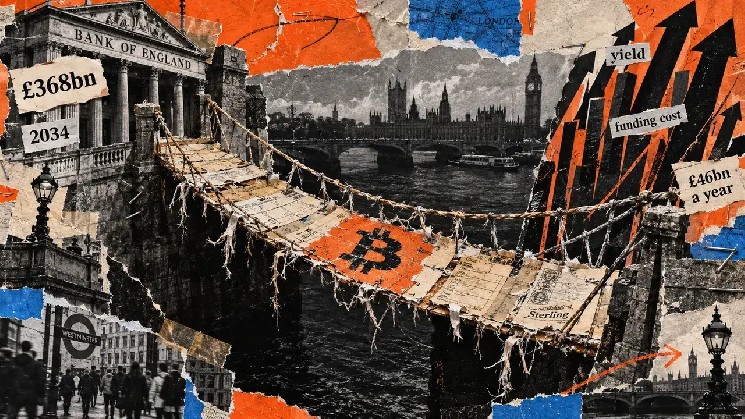
    • The Bank of England will reduce its monetary-policy gilt portfolio by £368 billion by September 2034, combining £46 billion annually from maturities and £20 billion from active sales.
    • The Monetary Policy Committee voted unanimously for the unwind but split 6–3 on Bank Rate, with Megan Greene, Catherine Mann, and Huw Pill favoring a hike to 4% while six members held at 3.75%.
    • Initial market reaction was muted: 10-year and 30-year gilt yields fell 7–10 basis points, and Bitcoin hovered near $78,000 with no isolated reaction to the announcement.

    Bank of England Sets Nine-Year Gilt Unwind Path

    The Bank of England has formalized a multi-year quantitative tightening (QT) program that will remove £368 billion of gilts held for monetary-policy purposes by September 2034. The figure represents the portfolio remaining after the Bank separated £120 billion of longer-dated gilts to back banknote issuance. Under the plan approved by the Monetary Policy Committee (MPC), the residual stock will contract by an average of £46 billion per year through a combination of bond maturities and £20 billion of annual active sales.

    Split Vote on Rates, Unanimous Backing for Balance-Sheet Reduction

    The rate decision and the balance-sheet decision were taken as separate votes. Six MPC members voted to maintain Bank Rate at 3.75%, while three members—Megan Greene, Catherine Mann, and Huw Pill—preferred an increase to 4%. Despite the divergence on the policy rate, all nine members backed the multi-year gilt unwind, signaling broad consensus on the need to normalize the central bank’s balance sheet even as opinions differ on the appropriate level of short-term interest rates.

    Implementation Details and Market Mechanics

    Auction Pause and Treasury Coordination

    Implementation will begin with a temporary reduction in active market sales. The Bank’s market notice confirmed that Asset Purchase Facility (APF) auctions will pause while officials review a possible arrangement involving HM Treasury and the Debt Management Office (DMO). Operational details for any sales-to-government model are due by April 2027, and the framework remains subject to a final decision. In the interim, gilts will continue to run off through maturities.

    Runoff Pace Comparable to Recent Practice

    The planned annual active sales pace of £20 billion aligns closely with recent experience. Over the preceding 12 months, the Bank sold £21 billion of gilts. However, average total runoff—including maturities—will slow to £46 billion per year from the previous year’s £70 billion reduction, reflecting the changing maturity profile of the portfolio.

    Market Reaction: Yields Ease, Bitcoin Steady

    Early market response pointed toward easier conditions in long-dated UK debt. Reuters reported that the 10-year gilt yield fell more than 7 basis points and the 30-year yield declined nearly 10 basis points by early Thursday afternoon. The Bank’s own yield-curve data provide the broader rates backdrop, though a single trading session cannot isolate how much each policy detail contributed to the move.

    BoE Sees Modest Cumulative QT Impact

    The Bank’s July assessment estimated that quantitative tightening accounted for only 20 to 30 basis points of an approximately 200-basis-point rise in long-term gilt term premia since 2022. The majority of the increase was attributed to global uncertainty, heavy sovereign issuance, and structural changes in UK demand. This suggests the incremental effect of the newly announced pace may be limited relative to the broader forces shaping long-term yields.

    Why This Matters

    The Bank of England’s QT framework represents a significant commitment to balance-sheet normalization that will test the capacity of private investors to absorb steady gilt supply over the next decade. By separating the rate decision from the unwind plan—and securing unanimous support for the latter—the MPC has signaled that balance-sheet policy will proceed on a predetermined schedule regardless of short-term rate moves. The auction pause and Treasury coordination review introduce an operational nuance that could reshape how central bank gilt sales interact with government debt management. For risk assets, the episode underscores the indirect transmission channel: predictable central-bank withdrawal may gradually tighten global financial conditions and dampen risk appetite, but the immediate market reaction was comparatively mild, with long-dated yields falling and Bitcoin showing no discernible isolated response. The coming years will reveal whether the cumulative pressure from steady QT, combined with heavy sovereign issuance globally, exerts a more pronounced influence on term premia and cross-asset correlations.

    Frequently Asked Questions

    What is the total amount of gilts the Bank of England plans to remove by 2034?
    £368 billion, covering the monetary-policy portfolio after £120 billion of longer-dated gilts were separated to back banknotes.
    How did the MPC vote on Bank Rate versus the QT plan?
    The MPC split 6–3 on Bank Rate, with six members holding at 3.75% and three (Megan Greene, Catherine Mann, Huw Pill) favoring a hike to 4%. All nine members voted unanimously for the multi-year gilt unwind.
    Did Bitcoin react to the Bank of England’s announcement?
    Bitcoin traded near $78,000 on Friday per CryptoSlate and Coinbase snapshots, but both were rolling levels that cannot isolate a reaction to Thursday’s announcement. No discernible isolated move was identified.
  • Bitcoin Rallies After BOJ’s 1.25% Rate Hike, but Real Yen-Carry Test Looms Next Week

    Bitcoin Rallies After BOJ’s 1.25% Rate Hike, but Real Yen-Carry Test Looms Next Week

    Key Highlights

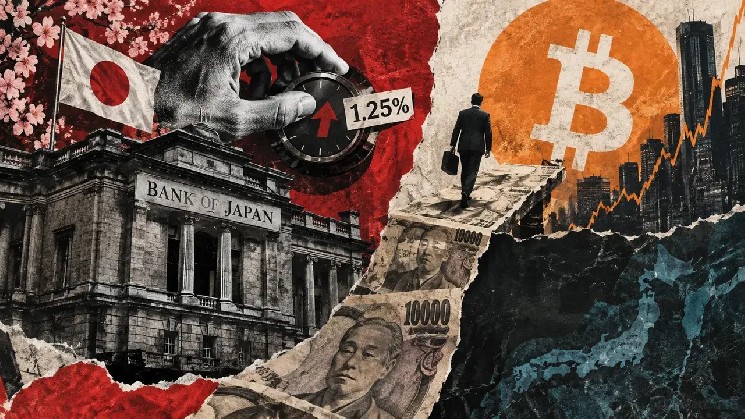
    • The Bank of Japan raised its policy rate by 25 basis points to approximately 1.25% on September 18, with the new target taking effect September 24.
    • Bitcoin traded orderly following the announcement, rising from $76,961 to over $81,000 intraday, while the yen weakened 1.2% against the dollar—contrary to a classic carry-unwind pattern.
    • The BOJ signaled financial conditions will remain accommodative and tied further hikes to economic and inflation outlook rather than a fixed timetable, leaving longer-term risk open.

    BOJ Delivers Rate Hike as Markets Monitor Yen-Carry Dynamics

    The Bank of Japan voted 7-2 on September 18 to lift its target for the uncollateralized overnight call rate from about 1% to about 1.25%, marking a continuation of its gradual normalization cycle. The new target and related facility rates take effect September 24, meaning the policy path shifted before the official operating rates changed. This separation allows market positions to adjust ahead of implementation, and the BOJ’s next policy signal may prove as consequential as the September 24 effective date because the central bank explicitly tied further increases to its economic and inflation outlook rather than a predetermined schedule.

    Bitcoin Reaction Remains Orderly Amid Yen Weakness

    At the BOJ’s 02:54 UTC release time, Coinbase one-minute data recorded Bitcoin’s closing price at $76,961. By 03:30 UTC, the one-minute close stood at $77,383, with the cryptocurrency continuing to climb throughout the session to an intraday high of $81,000. The currency move simultaneously ran counter to the simplest carry-unwind pattern. Reuters reported that during BOJ Governor Kazuo Ueda’s press conference, the dollar climbed to a two-week high of 157.84 yen, leaving the Japanese currency 1.2% weaker on the day. A visible synchronized unwind would more typically pair rapid yen appreciation with falling risk assets.

    Yen Funding One Channel Among Several for Crypto

    The available evidence leaves the amount of Bitcoin exposure financed in yen unquantified. Coinbase Institutional’s review of the 2024 carry episode identified several simultaneous catalysts, including weak U.S. economic data and pressure on technology stocks. Yen funding represents one transmission channel among several that can shape crypto market moves. The initial reaction points to limited immediate unwind pressure in observed markets, though longer-term risk remains open as the new rate takes effect and the BOJ considers its next steps.

    Why This Matters

    The BOJ’s decision arrives at a critical juncture for global liquidity and risk-asset positioning. Yen-funded carry trades have historically amplified volatility across asset classes when Japanese rates rise or the yen appreciates sharply. The central bank’s explicit conditioning of future hikes on realized economic and inflation outcomes—rather than a mechanical calendar—introduces a layer of policy uncertainty that markets must price incrementally. For cryptocurrency markets, the orderly Bitcoin response suggests current positioning is less vulnerable to an immediate, disorderly unwind than some analysts feared. However, the diagnostic warning signs remain clear: sharp yen appreciation concurrent with declining crypto and equity prices, or a fresh BOJ signal indicating tighter policy sooner than consensus expects, could rapidly alter the risk calculus. The September 24 implementation date serves as the next tangible milestone, but the evolving outlook guidance from Governor Ueda and the BOJ board will likely drive the narrative in the weeks ahead.

    Frequently Asked Questions

    Did the BOJ rate hike trigger a Bitcoin sell-off?

    No. Bitcoin rose from $76,961 at the time of the announcement to an intraday high of $81,000, indicating an orderly market response rather than a forced unwind of yen-funded positions.

    Why did the yen weaken instead of strengthen after the rate increase?

    The dollar climbed to a two-week high of 157.84 yen during Governor Ueda’s press conference, leaving the yen 1.2% weaker on the day. This suggests markets interpreted the BOJ’s forward guidance as sufficiently dovish—emphasizing accommodative conditions and data-dependent future hikes—to offset the immediate rate increase.

    What are the key signals to watch for potential carry-unwind risk ahead?

    Analysts highlight two primary warning signs: a sharp appreciation of the yen accompanied by simultaneous declines in crypto and equity markets, or a new BOJ communication indicating that policy tightening will resume sooner than markets currently anticipate.

  • Bitcoin Briefly Tops $81,000 as Bad News Stops Working

    Bitcoin Briefly Tops $81,000 as Bad News Stops Working

    Key Highlights

    • Bitcoin surged approximately 6% on Friday to briefly trade above $81,000, absorbing five major macroeconomic and regulatory headwinds—including a failed Senate vote on the CLARITY Act, a Federal Reserve rate hike, and a Bank of Japan rate increase—without a sustained selloff.
    • The rally was driven predominantly by short covering: $470 million in short positions were liquidated versus only $60 million in longs, while aggregate open interest fell 1.4%, signaling position compression rather than fresh leveraged buying.
    • Technical momentum is improving (14-day RSI at 63.56, above its moving average), but the daily MACD remains below its signal line, leaving the move unconfirmed by slower momentum indicators.

    Bitcoin Defies Concentrated Macro Headwinds

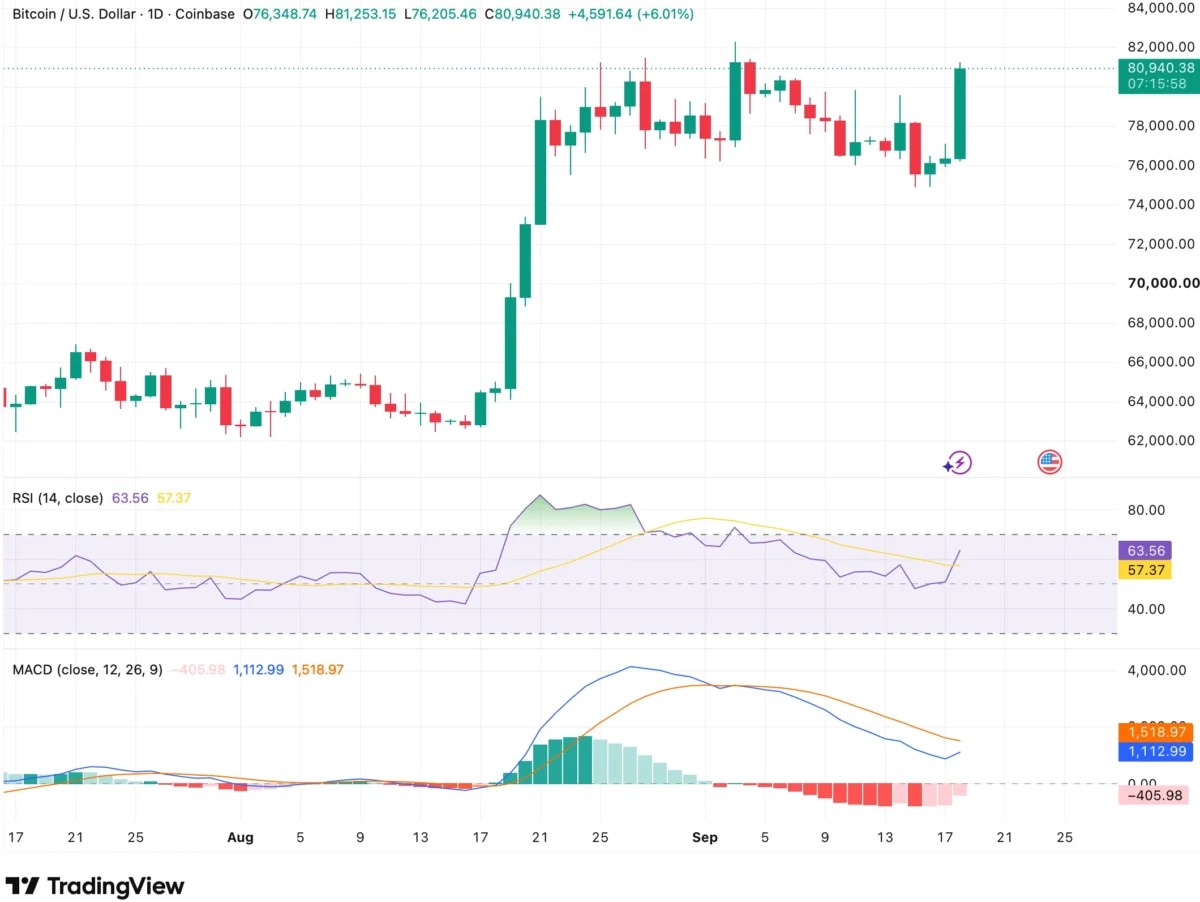
    Bitcoin staged a sharp intraday reversal on Friday, climbing roughly 6% to a session high of $81,253 on the Coinbase daily chart before settling near $80,940 at the time of writing. The advance is notable not for its magnitude but for the backdrop against which it occurred: within a single week, the market digested a procedural failure on the CLARITY Act in the U.S. Senate (49–50, short of the 60 votes needed for cloture), the Federal Reserve’s first rate increase since 2023 (lifting the target range to 3.75%–4.00%), the Bank of Japan’s policy rate hike to 1.25% (a 31‑year high), a U.S. Dollar Index reclaiming the 100 level, and Brent crude holding above $100 per barrel. Each of these developments typically pressures risk assets—higher rates boost the appeal of yield‑bearing alternatives, a stronger dollar tightens global financial conditions, and elevated oil sustains inflationary impulses—yet Bitcoin not only refused to extend its earlier decline toward $76,000 but accelerated higher.

    Derivatives Data Reveal Short‑Covering Dynamics

    Friday’s derivatives metrics provide a clearer mechanical explanation than any single bullish catalyst. According to Coinglass data, roughly $530 million in leveraged crypto positions were liquidated over 24 hours, with short positions accounting for approximately $470 million of that total versus only $60 million in long liquidations. Simultaneously, aggregate open interest declined 1.4% to $453.43 billion while 24‑hour derivatives volume rose 2.2% to nearly $936 billion. This combination—rising price, falling open interest, and disproportionately large short liquidations—is consistent with position compression: traders positioned for further downside were forced to buy back as Bitcoin rallied, amplifying the move. The breadth of the advance underscores the systemic nature of the squeeze; Ethereum gained 5.3%, XRP 6.2%, Solana 10.4%, and HYPE more than 11%, lifting total crypto market capitalization about 5% to $2.76 trillion.

    Short Squeezes Are Self‑Limiting

    While the liquidation cascade explains the velocity of Friday’s rally, it does not guarantee durability. Forced covering creates mechanical demand that evaporates once bearish positions are exhausted. The critical question is whether underlying spot demand—evidenced by sustained exchange trading activity, continued ETF inflows, or stable open interest rebuilding—persists after the liquidation impulse fades. Absent that, the rally remains a positioning unwind rather than a new demand regime.

    Technical Momentum Improves But Lags Price Action

    Bitcoin’s daily chart offers a second lens on sustainability. The 14‑day Relative Strength Index has climbed to 63.56, comfortably above its moving average at 57.37 and well clear of the conventionally overbought 70 threshold, indicating strengthening momentum without exhaustion. The Moving Average Convergence Divergence, however, tells a more cautious story: the MACD line has turned upward to 1,112.99 but remains below the signal line at 1,518.97, leaving the histogram negative at –405.98. The histogram bars have been contracting and the MACD line curling higher, suggesting the direction is improving, but a bullish crossover has not yet occurred. This divergence—price accelerating while the slower daily momentum indicator has not fully confirmed—creates a clear watchpoint: a MACD crossover would signal that momentum broadening is underway rather than remaining concentrated in a single explosive session.

    Historical Parallel: 2023 Regime Shift Echoes

    The current dynamic bears a striking resemblance to Bitcoin’s behavior throughout 2023. During that period, the asset absorbed aggressive Federal Reserve tightening (the target range ultimately reaching 5.25%–5.50%) alongside an intensive U.S. regulatory campaign that saw the SEC sue Coinbase and Binance and designate several major tokens as securities. Despite repeated negative headlines, each successive shock generated diminishing incremental selling pressure, and Bitcoin gradually ceased revisiting the lows established after the 2022 collapse. The lesson from 2023 is not that restrictive policy or enforcement actions became bullish, but that the market’s capacity to produce new sellers in response to them was waning. Markets can begin shifting before the news flow turns favorable, and Friday’s price action—absorbing five simultaneous headwinds without a net decline—suggests a similar recalibration may be in progress.

    Why This Matters

    The week’s events highlight a potential inflection point in Bitcoin’s market structure. For years, macro tightening and regulatory uncertainty acted as reliable catalysts for drawdowns. The failure of that playbook in the face of a concentrated barrage of negative catalysts—failed legislation, dual central‑bank hikes, dollar strength, and elevated energy prices—signals that the marginal seller may be exhausted. If spot demand proves resilient, leverage remains contained, and momentum indicators like the MACD confirm the RSI’s strength, the market could be transitioning to a regime where bad news is increasingly “priced in” and produces diminishing downside volatility. This has direct implications for portfolio allocation, risk management, and the narrative around Bitcoin’s maturation as a macro asset. Institutional participation metrics (ETF flows, custody data) and derivatives market structure (open interest trends, funding rates) will be the primary arbiters of whether this is a durable shift or a temporary positioning anomaly.

    Frequently Asked Questions

    What specifically drove Bitcoin’s 6% rally on Friday?

    The primary driver was a massive short‑covering event: approximately $470 million in short positions were liquidated in 24 hours, forcing bearish traders to buy back Bitcoin and accelerating the price rise. Aggregate open interest fell, confirming that the rally stemmed from position unwinding rather than new leveraged long entries.

    Is this rally sustainable or just a short squeeze?

    Sustainability hinges on whether genuine spot demand persists after the forced buying ends. Key signals to watch include continued ETF inflows, stable or gradually rebuilding open interest (rather than a surge in aggressive longs), and a bullish MACD crossover on the daily chart confirming broadening momentum.

    How does this week compare to previous macro stress periods for Bitcoin?

    The closest analogue is 2023, when Bitcoin absorbed simultaneous Fed tightening and SEC enforcement actions with progressively smaller drawdowns. In both episodes, the market’s reaction function to negative news appeared to change—selling pressure diminished even as the fundamental headwinds persisted—suggesting a structural shift in participant positioning and risk appetite.

  • Altcoin Rally Sustainability Questioned: Analysts Debate if Bull Market Has Begun

    Altcoin Rally Sustainability Questioned: Analysts Debate if Bull Market Has Begun

    Key Highlights

    • Bitcoin demonstrated unexpected resilience following the Clarity Act’s Senate failure and the Federal Reserve’s rate hike, outperforming the S&P 500 despite initial fear-driven sell-offs.
    • Santiment on-chain data reveals large wallets (10–10,000 BTC) have distributed approximately 57,600 BTC since August 5, while small investors increased holdings—a pattern historically associated with heightened pullback risk.
    • Capital rotation is accelerating into altcoins, with Zcash, Uniswap, and Hyperliquid significantly outperforming Bitcoin and Ethereum, while AI and big data tokens like NEAR see surging volume and price action.

    Bitcoin Resilience Amid Macro Headwinds

    Bitcoin’s price action has defied bearish macroeconomic catalysts in recent sessions, holding relatively flat while traditional equity markets stumbled. According to Santiment analyst Brian, the failure of the Clarity Act to advance in the U.S. Senate combined with the Federal Reserve’s latest interest rate decision initially amplified investor fear. However, the cryptocurrency market’s reaction proved more resilient than anticipated. Brian noted that despite these developments being widely viewed as extremely negative for digital assets, Bitcoin’s swift recovery after a limited pullback suggests the market has largely absorbed the negative news flow. He highlighted a striking divergence: while the S&P 500 dropped to its lowest level in a month following the Fed’s decision, Bitcoin avoided a similarly severe sell-off, signaling underlying strength relative to traditional risk assets.

    On-Chain Data Flags Whale Distribution

    Beneath the surface stability, Santiment’s on-chain metrics are flashing a significant risk signal for Bitcoin. Data shared by Brian shows that large investor wallets holding between 10 and 10,000 BTC—often categorized as whales and “sharks”—have sold a cumulative total of approximately 57,600 BTC since August 5. Concurrently, smaller investors have been accumulating during the same period. This dynamic indicates that sophisticated entities are distributing into strength while retail participants chase price appreciation, a pattern that historically precedes corrections. Brian emphasized that this outlook warrants caution in the short to medium term, adding that renewed accumulation by these large wallets would be required to restore a more bullish structural signal. Santiment concludes that the continued reduction in whale holdings alongside rising retail exposure elevates the probability of a pullback above normal levels.

    Capital Rotation Fuels Altcoin Outperformance

    In stark contrast to Bitcoin’s distribution profile, the altcoin sector is exhibiting clear signs of capital rotation. Santiment data highlights that several mid- and low-capitalization assets—including Zcash, Uniswap, and Hyperliquid—have significantly outperformed both Bitcoin and Ethereum over the past week. Brian stated that the strong gains across a broad swath of alternative cryptocurrencies, juxtaposed with limited downside in the two largest assets, serve as a significant signal that capital is actively shifting toward altcoins. This rotation extends beyond isolated names; trading volumes for AI and big data-focused cryptocurrencies have surged recently. Brian specifically noted strengthening volume and price action in NEAR Protocol and other AI-themed projects, advising that if the altcoin rally persists through the second half of September, the AI and big data sector warrants close monitoring.

    AI and Memecoin Dynamics Signal Shifting Sentiment

    Sentiment analysis further complicates the outlook. Santiment tracks memecoin activity as an inverse market indicator, observing that peaks in memecoin trading volume and speculative fervor have historically coincided with short-term market tops, while sharp declines in memecoin interest have occasionally appeared near market bottoms. Meanwhile, overall market sentiment has deteriorated from strong optimism at the start of September to neutral levels. Brian explained that sentiment was buoyed by high expectations for the Clarity Act’s passage but eroded progressively following the Senate setback and the Fed’s rate decision. Regarding Bitcoin’s near-term trajectory, Brian acknowledged a path toward $80,000 and potentially $85,000 remains possible, though he stressed that fresh positive catalysts would likely be necessary to sustain such a move.

    Why This Matters

    The divergence between whale distribution and retail accumulation in Bitcoin underscores a classic late-cycle dynamic where smart money exits into liquidity provided by late entrants. Simultaneously, the pronounced capital rotation into altcoins—particularly AI-linked tokens—suggests investors are seeking higher beta exposure amid a perceived lull in Bitcoin’s momentum. The Clarity Act’s legislative stall removes a near-term regulatory clarity catalyst for the U.S. market, while the Fed’s rate posture keeps macro liquidity tight. These factors combined create an environment where selective altcoin strength may persist, but systemic risk remains elevated should Bitcoin’s whale distribution accelerate. Market participants should monitor on-chain accumulation trends among large wallets and the sustainability of altcoin volume as leading indicators for the next directional move.

    Frequently Asked Questions

    What does the 57,600 BTC sale by large wallets since August 5 indicate?
    It signals that entities holding 10–10,000 BTC are distributing positions during price strength, while smaller buyers absorb supply—a pattern Santiment associates with increased short-to-medium-term pullback risk.
    Which altcoins are leading the current capital rotation?
    Zcash, Uniswap, and Hyperliquid have significantly outperformed Bitcoin and Ethereum over the past week, alongside rising volume in AI and big data tokens such as NEAR Protocol.
    What catalysts could push Bitcoin above $80,000 again?
    According to Santiment’s Brian, Bitcoin could retest $80,000–$85,000, but the market would likely require new positive catalysts—such as regulatory clarity or improved macro liquidity—to sustain such a rally.