Category: Coins

Digital assets, cryptocurrencies, blockchain, and currency news.

  • Mid-Tier Bitcoin Treasury Bets Entire BTC Reserve on a Single 30-Day Reset Price

    Mid-Tier Bitcoin Treasury Bets Entire BTC Reserve on a Single 30-Day Reset Price

    PowerCompute, a Bitcoin treasury and mining company, has added $3.765 million to its debt following an early Bitcoin collar reset involving 307 $BTC. The executed reset schedule records the unwind cost as additional principal rather than as a cash or $USDC payment.

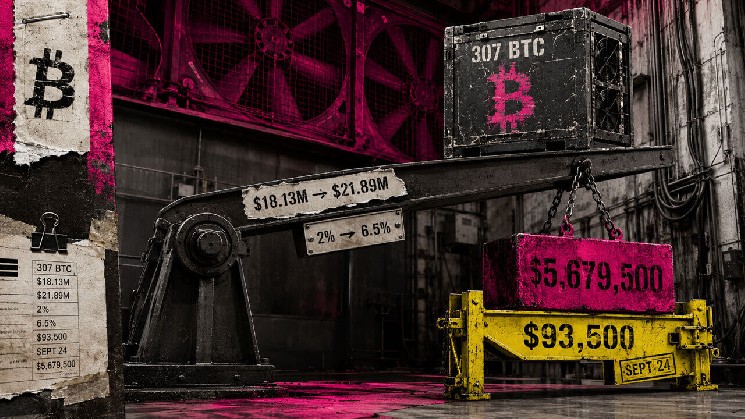
    In a filing dated Aug. 28, the company disclosed a replacement 30-day collar balance of $21,892,131.88 with Arch Lending, up from $18,127,131.88. The facility remains secured by 307 $BTC, while its annual interest rate has increased from 2% to 6.5%.

    How PowerCompute’s Bitcoin collar reset increased principal

    PowerCompute’s borrowing subsidiary, US Digital Mining and Hosting Co., elected to add the unwind cost to the loan balance. The annex states that the cost was agreed in place of a separate excess-appreciation settlement for the terminated period.

    The previous collar began on Aug. 3 and was scheduled to reset on Sept. 2. PowerCompute terminated it on Aug. 25, 22 days into the period, when the reference price was $78,500. That price was above the company’s always-on $66,370 ceiling, according to the previous reset confirmation. The original loan filing reported an $18.13 million balance and a 2% interest rate.

    Under the contract’s 30/360 calculation, the replacement loan’s full interest charge for the period from Aug. 25 to Sept. 24 is $118,582.38. The annex sets out the collar’s 30-day mechanics, while the reset schedule provides the commercial figures despite the longer-form provisions in the master agreement.

    New Bitcoin collar terms run through Sept. 24

    The new collar moves the next decision date to Sept. 24. It establishes a $71,112 floor, a $75,000 ceiling and a $93,500 knock-in barrier. Arch will test the reference price once, at 8:00 a.m. EST.

    If the reference price remains below $93,500, the ceiling has no effect. PowerCompute retains all Bitcoin appreciation, including any appreciation above $75,000. If the reference price reaches or exceeds $93,500, however, the ceiling applies to the entire period.

    Excess appreciation arises only if the Sept. 24 reference price reaches at least $93,500. At the barrier exactly, the settlement formula is:

    307 × ($93,500 − $75,000) = $5,679,500

    This is conditional settlement arithmetic before interest, not an amount that PowerCompute already owes. The company can settle the amount using retained $BTC or USD/$USDC. If it rolls the loan forward, it can instead add the amount to principal or incorporate it into the next ceiling and rate quote.

    The $93,500 barrier is not an intraday liquidation threshold. The annex bars ordinary margin calls and liquidations during the rolling period, limits ordinary recourse to the pledged Bitcoin subject to stated carve-outs, and tests the collar only at reset. A voluntary exit before the end of the period would bring the test forward.

    Bitcoin price context after the reset

    At 2:23 a.m. UTC on Aug. 29, CryptoSlate’s live Bitcoin page displayed a price of $77,808.23, placing the barrier approximately 20.2% above that snapshot. The comparison provides context and is not a forecast for Bitcoin’s price on Sept. 24.

    CryptoSlate previously covered PowerCompute’s initial collar after tracking the company’s earlier bridge-loan chain. The Aug. 28 filing turns the first structure’s modeled trade-off into a realized financing cost and begins a new 30-day test.

  • New Clues Emerge in Satoshi’s Bitcoin Genesis Block Puzzle, but Mystery Remains

    New Clues Emerge in Satoshi’s Bitcoin Genesis Block Puzzle, but Mystery Remains

    A Bitcoin puzzle built from information in the Genesis Block has attracted attention from blockchain analysts and the wider Bitcoin community, but it remains unsolved.

    Bitcoin puzzle uses data from the Genesis Block

    The puzzle was created on August 23, 2026, using information contained in the Genesis Block created by Bitcoin creator Satoshi Nakamoto.

    According to the Galaxy Research X account, the puzzle was hidden in human-readable text in Bitcoin Block 963,629. Its creator used the information to generate a wallet with extremely low entropy, which he said required no backup.

    Galaxy Research said the puzzle creator answered two questions intended to help others solve the challenge. The first asked whether the witness script was a hash lock, a multisig or something else. The creator indicated that it was a multisig.

    The second question asked how many keys were involved, what threshold applied and how the keys were derived from the Genesis Block. The puzzle creator answered that there were two keys, adding: “both required. The rest is for you to derive.”

    In a follow-up post on August 25, Galaxy Research said the puzzle jackpot had reached 125,779 sats and shared additional clues from the creator:

    “The witness script is a multisig. Two keys, both required. The rest is for you to derive. Both keys use the same Genesis field, and there is no hash. Both keys are derived independently from Genesis.”

    Puzzle jackpot reaches 142,779 sats

    Galaxy Head of Research Alex Thorn recently highlighted his efforts to solve the Bitcoin puzzle, saying he had been working on it.

    i’ve been working on this puzzle a bitthe jackpot is currently 142,779 sats (~$111)i haven’t myself sent in any requests for hints, but others have. based on the hints, we assume:- a 2-of-2 multisig- both keys from the same Genesis field with no hash applied- derived… https://t.co/afCkDj1Kxe pic.twitter.com/gFo5tFNZcK
    — Alex Thorn (@intangiblecoins) August 29, 2026

    In the X post, Thorn said the puzzle jackpot stood at 142,779 sats, or nearly $111. He added that he had not personally requested any hints, although other participants had.

    Based on the available clues, Thorn listed the following assumptions:

    “a 2-of-2 multisig, both keys from the same Genesis field with no hash applied, derived independently, along the BIP48 path root > multisig > mainnet > genesis_data > script_type, the field is one The Times newspaper printed.”

    Using these clues, Thorn said he had searched through more than 19.3 billion candidate scripts but eliminated them from consideration.

    Bitcoin’s Genesis Block remains central to the challenge

    The Genesis Block, also known as Block 0, is the first block ever mined on the Bitcoin blockchain. Satoshi Nakamoto mined it on January 3, 2009, and embedded the hidden message, “The Times 03/Jan/2009 Chancellor on brink of second bailout for banks,” a headline published by The Times on the same date.

    The message remains one of Bitcoin’s most recognizable historical artifacts, and its connection to the puzzle is central to the ongoing challenge.

    The Bitcoin puzzle remains unsolved, but Thorn invited others working on it to collaborate in an effort to claim the jackpot.

  • Solana Whales Buy $41.5M in SOL as Price Eyes $110 Reclaim

    Solana Whales Buy $41.5M in SOL as Price Eyes $110 Reclaim

    Solana ($SOL) pulled back from $110 to a low of $102 as the broader cryptocurrency market slowed. Since then, the token has consolidated and traded sideways.

    At press time, Solana was trading at $105, up 1.4% on the daily chart and extending its weekly gain to 13%. However, altcoin trading volume fell 64% to $1.8 billion, pointing to weaker market activity.

    Solana also showed signs of reduced speculative interest. Over the previous 12 hours, $471.85 million flowed out of the futures market, while only $456 million flowed in.

    Solana whale returns with an $8 million purchase

    Demand for Solana among high-net-worth investors, including individuals and institutions, has risen significantly over the past week.

    AMBCrypto previously reported that Solana spot ETFs recorded $138 million in net inflows. In addition to institutional demand, whales have been aggressively accumulating $SOL since the token crossed the $100 mark.

    With Solana holding firmly above $100, high-net-worth investors appear increasingly optimistic and are positioning for further gains. The recent market cooldown may also have created an opportunity for whales to continue buying.

    Source: Arkham

    Lookonchain reported that a whale returned after eight months of dormancy and purchased 76,856 $SOL worth $8 million from Hyperliquid.

    Whale accumulation has become a notable trend. One day earlier, Lookonchain reported that two whales had purchased $33.5 million worth of $SOL. Continued accumulation during a period of stable upward movement suggests strong confidence in the market.

    Exchange flows also support the accumulation trend. After turning positive, Solana’s spot netflow fell again.

    Source: Coinglass

    At the time of writing, netflow stood at approximately -$4.5 million, indicating that outflows were exceeding inflows. Strong demand, particularly from high-net-worth investors, has often preceded gains in Solana’s price.

    What to expect next for Solana’s price

    Although the market has shown some weakness, Solana’s market structure remains bullish. The ADX with SMA indicator also points to sustained trend strength.

    At press time, the +DI was above the -DI, while the ADX and SMA remained above it. The Bull-Bear Ratio was also positive, suggesting that buyers remained in control of the market.

    Source: TradingView

    Together, these indicators point to strong upward pressure and suggest that the current trend could hold. If investors, particularly whales, continue buying and the futures market begins to attract new positions, Solana’s upward movement could resume.

    Under that scenario, $SOL could close above $105 and attempt to reclaim $110, the level where its previous advance stalled. However, if sellers continue to dominate the derivatives market, sideways trading could continue.

    Key takeaways

    A Solana whale returned after eight months of inactivity and purchased 76,856 $SOL worth $8 million from Hyperliquid.

    Solana has traded within a narrow range between $104 and $105 during the broader market slowdown, but its market structure continues to lean bullish.

  • Solana (SOL) Shoveled Onto Hyperliquid: Why It’s Better

    Solana (SOL) Shoveled Onto Hyperliquid: Why It’s Better

    Solana has a significant technical advantage over Hyperliquid after one of its biggest comebacks of 2026. The key difference is that $SOL has already broken through the long-term resistance that often separates a short-term rally from a broader trend reversal.

    Solana price returns to growth

    After rising from approximately $75 in the second half of August, Solana is currently trading near $104.65. The cryptocurrency gained about 45% from its consolidation range to its latest peak, briefly moving above $110.

    The location of that rally is particularly important. Before testing the more significant resistance zone near $90, $SOL moved above its 50-day and 100-day moving averages at approximately $80.78 and $82.46, respectively.

    $SOL/USDT Chart by TradingView

    Solana’s 20-day exponential moving average and 200-day moving average are currently near $90.06 and $90.18. Rather than being rejected immediately, $SOL moved decisively through the 200-day moving average on rising volume. The current price is more than 15% above that indicator.

    From a relative technical perspective, this gives Solana a stronger foundation than assets such as Hyperliquid, which remain below their long-term trend resistance. Solana no longer needs to break through its 200-day moving average; it now needs to defend it. However, the rally faces a clear short-term challenge.

    Solana faces overbought conditions

    During the breakout, $SOL entered severely overbought territory. The daily relative strength index climbed above 80 before falling to approximately 73.4. Momentum remains strong, but buying the asset between $105 and $110 carries considerably more risk than buying it in the $80-$90 range.

    Trading volume is also beginning to return to normal after the initial breakout surge, making a period of consolidation more likely.

    The recent high between $110 and $111 remains the first immediate resistance zone. A break above that level could open the way for Solana to test the $115-$120 range. If the price fails to continue higher, $SOL could retrace toward $100 and then the critical $90 area.

    The $90 zone is currently the key technical level. A successful retest would strengthen the argument that Solana has entered a genuine trend reversal and confirm that its former long-term resistance has become support.

    Solana’s current advantage is therefore structural: the difficult breakout has already occurred. The next question is whether buyers can hold the gains.

    Source: cryptonews.net

  • Bitwise CEO Offers Crucial XRP Reality Check as Solana Fund Surpasses $1 Billion Threshold

    Bitwise CEO Offers Crucial XRP Reality Check as Solana Fund Surpasses $1 Billion Threshold

    The $XRP ETF market is expanding steadily, but no individual fund has yet joined the billion-dollar tier of crypto ETFs. The debate over the sector’s size intensified after Bitwise’s Solana Staking ETF (BSOL) reached $1 billion in assets under management (AUM) 10 months after launching.

    BSOL’s growth has been driven in part by its built-in annual yield of approximately 5.8%, generated through staking within the regulated ETF structure.

    Commenting on the milestone on X, Bitwise CEO Hunter Horsley said that only Bitcoin, Ethereum and Solana ETFs had crossed the $1 billion mark. After one commenter suggested the statistic was biased against $XRP, Horsley replied: “I’m not! There’s no $1B $XRP ETF yet!”

    SolanaEthereumBitcoin The only 3 crypto assets in the world with ETFs that have grown to $1B+ so far. https://t.co/wwslT0Ixie

    — Hunter Horsley (@HHorsley) August 30, 2026

    Why Solana ETFs have grown faster than $XRP ETFs

    Horsley’s comment highlights a key technological difference between Solana and the $XRP Ledger. Unlike Solana, the $XRP Ledger does not have native staking. All $XRP tokens were issued upfront, and the blockchain cannot create new tokens to distribute as staking rewards.

    A possible future alternative for funds is the native XRPL Lending Protocol, which is currently undergoing a validator vote. Until then, $XRP ETFs must rely entirely on demand for spot exposure.

    Monthly net inflows and asset growth for the Bitwise $XRP ETF through August 2026. Source: SoSoValue

    Investor demand remains strong. According to SoSoValue, U.S. spot $XRP ETFs have accumulated $1.44 billion in net assets, while cumulative inflows have reached $1.66 billion. By total capital, the $XRP ETF sector is already operating at a level comparable to leading crypto ETF markets.

    However, the lack of yield means that no individual $XRP fund has reached $1 billion in assets.

    Bitwise’s $XRP ETF currently leads the segment, controlling 44% of the market with $632.03 million in assets. Franklin Templeton’s XRPZ follows with $411.39 million, while Canary’s WAXRP holds $234.36 million. The remaining market share is divided between products from 21Shares and Grayscale.

    Recent Form 13F filings have confirmed growing participation by U.S. institutional investors in crypto ETFs. Based on its current assets, Bitwise’s standalone $XRP fund needs approximately $368 million in additional net assets to reach the $1 billion threshold.

    Solana’s performance suggests that pure spot exposure may grow more slowly than products supported by staking income. Whether an $XRP ETF can cross the billion-dollar mark will therefore depend entirely on sustained demand from long-term investors.

  • XRP Prediction Author Spots the “Cleanest Chart in Crypto Right Now”

    XRP Prediction Author Spots the “Cleanest Chart in Crypto Right Now”

    Ethereum (ETH) price action could become the leading indicator for the broader cryptocurrency market in the coming weeks, according to trader DonAlt, who gained recognition after predicting XRP’s more than 700% rally in 2024–2025.

    DonAlt said Ethereum’s daily chart currently offers one of the clearest technical setups in the crypto market. The second-largest cryptocurrency by market capitalization has entered a consolidation phase after breaking decisively above a key resistance level.

    Ethereum price chart with technical analysis levels. Source: DonAlt / TradingView

    “Cleanest chart in crypto right now. How $ETH trades is probably gonna be indicative of the rest of the market. So far it’s a clean consolidation after a breakout, exactly what you’d like to see,” DonAlt stressed.

    Ethereum gains 30% in two weeks as price consolidates

    DonAlt began publicly building his Ethereum position on Aug. 13, when he said he was buying $ETH at $1,878 and had “waited long enough.” Since then, Ethereum has risen by more than 30%, adding roughly $600 before entering its current consolidation phase.

    Earlier this month, DonAlt outlined long-term Ethereum price targets near $4,000. However, he also said that taking profit at $3,000 would be acceptable to him.

    His current Ethereum chart identifies two key price zones that shape the market structure. The $2,400 level has become the primary support area. After moving above that level, ETH consolidated inside the green accumulation range between $2,454 and $2,492.

    For buyers, the main medium-term target remains resistance at $2,815.68, marked by the red line on the chart.

    Declining volatility and Ethereum’s ability to hold above $2,400 suggest that buyers remain in control. The asset also appears to be accumulating volume ahead of its next significant directional move.

    According to DonAlt, whichever direction Ethereum takes after the current period of consolidation, the broader altcoin market is likely to follow.

  • Peter Schiff Says Bitcoin Is Not a Real Asset

    Peter Schiff Says Bitcoin Is Not a Real Asset

    Gold investor and longtime Bitcoin critic Peter Schiff has renewed his criticism of the cryptocurrency, arguing that Bitcoin should not be compared with established assets such as gold, equities or real estate.

    Schiff was responding to a post by crypto analyst Quinten Francois, who highlighted the relative size of major asset classes. “Gold is roughly 20 times larger than Bitcoin,” Francois wrote. “Global equities are roughly 100 times larger. Global real estate is more than 250 times larger.”

    Schiff rejected the comparison. “Bitcoin is not a real asset so its value has no relationship to gold, equities or real estate,” Schiff wrote. “Why can’t your brain understand that?”

    Peter Schiff rejects Bitcoin as an inflation hedge

    Schiff has repeatedly challenged Bitcoin’s reputation as a potential hedge against inflation. On Aug. 21, he disputed the argument that investors should buy Bitcoin to protect their portfolios from rising prices.

    “I don’t think Bitcoin is an inflation hedge.”

    Although Schiff acknowledged that some investors view Bitcoin in that way, he dismissed the idea. “I noted that other people think it is. They are wrong,” Schiff wrote. He argued that investors seeking inflation protection should choose traditional precious metals instead.

    “Those choosing inflation instead of gold or silver are making the wrong choice,” he said.

    Bitcoin’s market performance has not persuaded Schiff to change his position. On Aug. 23, he responded to criticism that he had missed out on Bitcoin’s substantial appreciation.

    “Yes, I could have made a lot of money with Bitcoin,” he wrote. “But that’s old news.”

    Schiff instead claimed that he had benefited from avoiding Bitcoin over a longer period.

    “Over the last five years or so I’ve been better off not owning Bitcoin,” he said. “It’s the Bitcoin HODLers who have left a lot of money on the table by not selling!”

    Schiff says AI could threaten Bitcoin

    As reported by U.Today, Schiff has also rejected efforts to link Bitcoin to the artificial intelligence boom.

    “Bitcoin pumpers are trying to hitch Bitcoin to the AI wagon, hoping investors will see it as part of the AI trade,” Schiff wrote.

    He argued that the relationship between Bitcoin and artificial intelligence could work in the opposite direction.

    “They have it backwards,” he said. “AI isn’t bullish for Bitcoin; it’s a threat to it.”

  • Veteran Bitcoin Developer Luke Dashjr Leaves OCEAN Pool: Will Hash Power Follow Him to a New Pool?

    Veteran Bitcoin Developer Luke Dashjr Leaves OCEAN Pool: Will Hash Power Follow Him to a New Pool?

    OCEAN Mining Completes Buyout of Co-Founder Luke Dashjr

    OCEAN Mining has completed the buyout of co-founder and 16-year Bitcoin Core developer Luke Dashjr, ending his ownership of the company and three leadership roles at the Bitcoin mining pool.

    Dashjr resigned as chairman, chief technology officer and director, while OCEAN repurchased all of his equity, according to an Aug. 29 joint statement. His positions placed him at the center of OCEAN’s corporate governance and mining-policy decisions.

    The privately held company did not disclose the repurchase price, its remaining ownership structure or the identities of any successors. OCEAN said it will continue operating its transparent, non-custodial mining pool, while Dashjr plans to pursue a new mining venture called CONVOY.

    At the reporting cutoff, publicly available information was insufficient to verify that CONVOY was operating a mining pool. Neither its public profile nor the announcement disclosed an endpoint, codebase, participating miners, infrastructure, fees or block-template policy. The materials also did not disclose any transfer of miners, staff other than Dashjr or infrastructure from OCEAN.

    OCEAN retains a measurable share of Bitcoin mining

    A Mempool.space snapshot taken at 07:07 UTC on Aug. 30 attributed four of the previous 163 Bitcoin blocks to OCEAN, representing 2.45%. Applying that percentage to the endpoint’s network-hashrate estimate produced a block-share-derived estimate of approximately 24.57 exahashes per second.

    The longer-term figures were similar. Mempool.space attributed 29 of the 1,007 blocks mined during the previous week to OCEAN, or 2.88%. Its latest weekly hashrate figure placed the pool at 25.33 EH/s, equivalent to 2.86% of the network.

    Across both measurement periods, OCEAN remained within a broad 2.5% to 3% range. That makes potential miner departures measurable without treating the discovery of a single block as evidence of a broader trend.

    These figures represent hashpower directed to OCEAN, not mining machines owned by the company. The trailing 24-hour measurement can also change quickly as blocks enter and leave the sample, making it a snapshot rather than a durable measure of market share.

    Protocol disagreements preceded the separation

    The joint statement said the separation reflected different visions following recent protocol developments. However, it did not identify BIP-110, Bitcoin Knots, a proof-of-work change or any other specific proposal as the cause.

    OCEAN added dedicated BIP-110 and no-signal endpoints in July. On Aug. 9, it returned its default endpoint to the non-BIP-110 chain while keeping both options available. OCEAN said its DATUM system allowed participating miners to control block construction.

    CryptoSlate’s earlier coverage described the surrounding fork and proof-of-work dispute, but the separation statement did not link the buyout to any particular development.

    A functioning CONVOY pool, published mining instructions or a sustained change in OCEAN’s share would offer the first measurable evidence that miners or block-template policy are shifting. The corporate split alone does not establish such a change.

  • Kalshi Ruling Puts CFTC Prediction-Market Rules at Risk

    Kalshi Ruling Puts CFTC Prediction-Market Rules at Risk

    A federal appeals court ruled on Aug. 28 that Kalshi had not shown Nevada’s regulation of its sports-event contracts was likely preempted by federal commodities law.

    The unanimous Ninth Circuit decision allows Nevada gaming authorities to enforce state requirements while the litigation continues. The court also raised concerns under the major-questions doctrine, but it did not invalidate the Commodity Futures Trading Commission’s proposed event-contract rules or determine whether a future final rule would survive a lawsuit under the Administrative Procedure Act.

    Ninth Circuit ruling preserves Nevada sports-betting authority

    Kalshi argued that its sports-event contracts qualified as swaps under the Commodity Exchange Act. Because the company operates a CFTC-regulated designated contract market, it claimed that federal jurisdiction displaced Nevada’s gaming laws.

    The Ninth Circuit rejected that argument at the preliminary-injunction stage. The court found that the contracts likely fell outside the applicable meaning of “swap” because they functioned as sports bets. The panel therefore rejected Kalshi’s express, conflict and field-preemption arguments.

    Circuit Judge Ryan Nelson wrote that “the CFTC is not a national gambling regulator.” The court said Kalshi’s broader interpretation lacked a limiting principle and did not fit the surrounding statutory framework.

    As crypto.news reported, the 3-0 ruling affirmed the dissolution of an earlier injunction that had protected Kalshi from Nevada enforcement. The panel sent Nevada’s separate election-contract claims back to the district court for further review.

    Major-questions language does not end CFTC rulemaking

    Gaming attorney Daniel Wallach argued that the CFTC’s rulemaking was “DOA” because of the court’s major-questions analysis. In an Aug. 29 post, he predicted that the proposal would face litigation under the Administrative Procedure Act in a California federal court.

    That prediction goes beyond the court’s direct holding. The opinion said Kalshi’s broad interpretation of “swap” “would raise concerns under the major-questions doctrine.” It did not rule that the doctrine categorically prevents the CFTC from regulating prediction markets.

    Ripple CTO emeritus David Schwartz disputed Wallach’s interpretation. “This seems to be incorrect to me,” Schwartz wrote. He argued that Congress could create a federal framework for exchange-traded contracts without displacing conventional state-regulated sportsbooks.

    Schwartz’s comments reflected his own interpretation, not a Ripple corporate position or a judicial finding. The Ninth Circuit’s ruling addressed whether Kalshi had demonstrated a likelihood of success on its preemption claim.

    CFTC event-contract proposal remains pending

    The CFTC’s June proposal would amend Rule 40.11, which governs event contracts involving gaming, terrorism, assassination, war and activities unlawful under federal or state law.

    The proposal would establish a 90-day review process and define how the agency interprets “gaming” and when a contract “involves” an enumerated activity. The CFTC would assess covered contracts individually using specified public-interest factors.

    The Federal Register notice closed for public comments on July 27. After reviewing the submissions, the agency can revise, finalize or withdraw the proposal.

    A final rule could face an Administrative Procedure Act challenge involving statutory authority, agency procedure or the rationale supporting the rule. Wallach predicted such a lawsuit, but no matching complaint had been verified when the debate emerged.

    Circuit split increases Supreme Court stakes

    The Ninth Circuit’s decision conflicts with a Third Circuit ruling that favored Kalshi in its dispute with New Jersey. The disagreement makes Supreme Court review more plausible, although review is not guaranteed.

    New Jersey faced a Sept. 3 deadline to seek further review of the Third Circuit decision, according to Reuters. Kalshi could also seek a rehearing before the Ninth Circuit or petition the Supreme Court, but neither action had been immediately confirmed.

    The jurisdictional dispute extends beyond Nevada. Several states classify sports contracts as gambling products that require local licenses. Kalshi maintains that federal derivatives regulation preempts those requirements.

    For now, Nevada can enforce its gaming laws against Kalshi’s sports contracts. The CFTC proposal remains active, but the Ninth Circuit opinion gives potential challengers another argument against any final rule that claims broad authority over sports-event markets.

  • Bitcoin Tops $80K as Crypto Market Flips to Greed—but Is the Rally Misleading?

    Bitcoin Tops $80K as Crypto Market Flips to Greed—but Is the Rally Misleading?

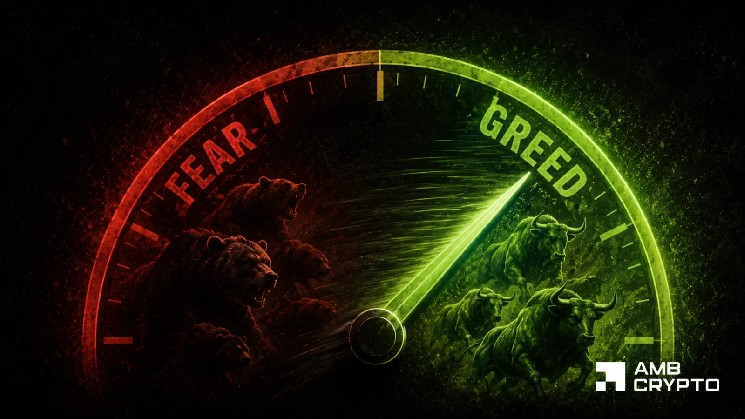
    Crypto market sentiment has shifted sharply in just a few days. After spending months between “Fear” and “Extreme Fear,” the market has now moved into “Greed.”

    At press time, the Crypto Fear and Greed Index stood at 68, placing it in the “Greed” zone. CoinShares’ recent report, ‘From despair to greed in a week: a rally is not a verdict’, highlighted a more favorable environment for Bitcoin’s rally.

    However, the shift does not indicate a fundamental improvement across the entire cryptocurrency industry.

    Source: Alternative

    Why did crypto sentiment change so quickly?

    Jean-Marie Mognetti, CEO of CoinShares, believes conditions surrounding digital assets have become more favorable, particularly for Bitcoin [$BTC]. However, most individual crypto projects have not suddenly become stronger businesses simply because their prices have increased.

    Mognetti put it best when he said:

    This is where the rally becomes more dangerous to interpret.

    Just one month earlier, more than 100 crypto projects had reportedly shut down, entered bankruptcy, or disappeared in 2026. Major industry names were also announcing closures or filing for bankruptcy, creating the impression that the crypto sector was entering another major downturn.

    The situation then changed rapidly. Bitcoin climbed back above $80,000, other digital assets followed, and options traders began placing large bets that Bitcoin could rise above $82,000.

    What is driving the Bitcoin rally?

    Several factors have contributed to the latest crypto market rally. The most prominent was last week’s White House meeting, during which President Trump urged Congress to pass a “fair version” of the CLARITY Act.

    Treasury buybacks, a hawkish tone from the Federal Reserve, and US federal debt surpassing US$40 trillion were additional factors supporting the market’s momentum.

    Despite these developments, the rally has not resolved the fundamental problems that caused more than 100 crypto projects to disappear in 2026. Many failed after running out of funds or experiencing security issues, while cryptocurrency exploits caused more than $1 billion in losses during the first half of 2026.

    These developments suggest that the rally has genuine support from a stronger macroeconomic backdrop. However, rising prices do not automatically validate every asset participating in the rally.

    Mognetti added:

    What deserves scepticism is the assumption that a rising market validates everything rising with it.

    The warning is significant because a similar level of market greed preceded Bitcoin’s correction of more than 30% in October 2025.

    This time, the total crypto market capitalization has risen by more than 22% in a week. However, the weekly relative strength index is extremely overbought, so caution remains warranted. Longer-term data, meanwhile, continues to indicate that the rally may have further room to run.

    Crypto sentiment has not reached peak greed

    Institutional demand remains a key difference in the current market cycle. Spot Bitcoin ETFs recorded more than $1 billion in inflows last week alongside a 21% $BTC rally. October’s inflows, however, exceeded $3 billion, suggesting there may still be scope for stronger institutional demand.

    The Coinbase Premium Index previously reached 0.18, reflecting strong accumulation by US investors. That signal is currently absent. As a result, despite short-term overbought conditions, sentiment around 75 may not yet represent peak greed or guarantee an imminent correction.

    These changes followed Bitcoin’s move back above $80,000. Nevertheless, some concerning market data suggest that the rally could continue while also highlighting the risks of interpreting rising prices as evidence of broad-based strength across the crypto industry.