Category: Coins

Digital assets, cryptocurrencies, blockchain, and currency news.

  • BNB Chain Captures 50% of Tokenized Equities: What’s Driving the Surge?

    BNB Chain Captures 50% of Tokenized Equities: What’s Driving the Surge?

    BNB Chain has emerged as the leading blockchain for tokenized equities after the launch of bStocks, overtaking Ethereum in total tokenized-equity supply. Before bStocks launched, Ethereum held the largest supply, while BNB Chain remained below $500 million despite months of gradual growth.

    Growth accelerated after June. By the end of August, BNB Chain’s tokenized-equity supply had surpassed $1.3 billion, compared with approximately $800 million on Ethereum. Solana also increased its tokenized-equity supply to around $550 million, while Avalanche remained near $170 million and smaller networks attracted only minimal amounts.

    According to BlockWorks data, BNB Chain now accounts for nearly 50% of the sector’s total supply, which stands at approximately $2.9 billion. In addition to providing greater liquidity, bStocks offers two advantages that traditional shares do not: 24/7 settlement and composability.

    bStocks drives BNB Chain’s tokenized-equity growth

    BNB Chain’s broader lead is largely concentrated in bStocks rather than being evenly distributed across the network’s tokenized-equity ecosystem.

    bStocks has accumulated more than $500 million in assets under management (AUM) since June and now supports more than 67 active assets, according to data from BNBChain.org.

    Trading volume has already exceeded $19 billion, indicating that the assets are actively circulating rather than simply remaining issued on-chain. On a narrower measure of tokenized equities and assets, bStocks typically represents more than half of the available tokenized-equity supply.

    Continued use of bStocks for new issuances and trading could further strengthen BNB Chain’s position as the leading decentralized exchange platform. However, a slowdown in bStocks activity would highlight the network’s reliance on the bStocks product family.

    BNB Chain’s broader RWA market share still trails Ethereum

    BNB Chain’s tokenized-equity lead becomes less dominant when viewed across the wider real-world asset (RWA) market. BNB Chain represents $5.7 billion of the $38.4 billion total distributed RWA market, giving it approximately 15% of the sector.

    Ethereum remains the largest RWA network, with $17.27 billion and an estimated 45% market share. Solana follows BNB Chain with $4.06 billion. As a result, BNB Chain’s leadership in tokenized equities has not yet translated into comparable dominance across the broader RWA market, according to RWA.xyz.

    BNB Chain continues to expand in tokenized equities, while Ethereum attracts capital across multiple asset classes. That broader diversification increases Ethereum’s overall liquidity and reduces its reliance on a single RWA segment.

    Expansion into Treasuries and funds could help BNB Chain diversify demand and retain more capital. Without that growth, a slowdown in tokenized-equity activity could limit BNB Chain’s ability to close Ethereum’s overall RWA lead.

    Key takeaway

    BNB Chain now leads the tokenized-equity market, largely because of bStocks’ rapid growth. Ethereum, however, continues to dominate the broader RWA market with an approximately 45% share.

  • Bitcoin Shorts Squeezed for $6.55 Billion in August as Weak Demand Raises September Doubts

    Bitcoin Shorts Squeezed for $6.55 Billion in August as Weak Demand Raises September Doubts

    After a bullish August rally, Bitcoin is entering September with momentum—and growing uncertainty over whether its gains can continue.

    According to CoinGlass data, Bitcoin is set to close August with a return of more than 24%, its strongest monthly performance since the 2017 cycle. The rally also triggered a major short squeeze across the derivatives market, forcing bearish traders to liquidate their positions.

    More than $9.71 billion has been liquidated from the cryptocurrency market over the past two weeks, including $6.55 billion in short positions and $3.16 billion in long positions. Shorts represented roughly two-thirds of total liquidations, showing that bearish traders were heavily squeezed as Bitcoin moved higher.

    Source: X

    Bitcoin funding rates rise as traders assess the next move

    The key question now is where Bitcoin ($BTC) is headed next.

    Data from CryptoQuant suggests that market participants remain bullish. Bitcoin’s funding rates on Binance increased by more than 42% in less than a week, even as $BTC consolidated below the $80,000 level.

    With many leveraged positions liquidated, the market has undergone a reset that could leave room for another move higher. However, on-chain data may be pointing to a different explanation for Bitcoin’s latest advance.

    The rally may have resulted from the unwinding of excessive leverage rather than fresh spot demand. If that is the case, the move could prove to be a short-term relief rally and set the stage for a more bearish September.

    Bitcoin faces $9 billion in liquidations and weakening demand

    A sustained breakout above resistance requires strong investor conviction. Yet that conviction appears to be fading as the market approaches September.

    According to SoSoValue, Bitcoin exchange-traded funds recorded more than $201 million in net outflows on August 28, ending a nine-day streak of inflows.

    Another trend in the current market cycle could also affect Bitcoin’s momentum. As the chart below shows, smaller holders accumulated Bitcoin as its price fell below $67,000. Wallets holding fewer than 100 $BTC recorded heavy gross inflows.

    However, short-term holders are often among the first market participants to take profits when sentiment turns risk-off or Bitcoin fails to break through key resistance. That behavior could increase selling pressure around the $80,000 level.

    Source: Glassnode

    Ethereum-Bitcoin ratio adds to September uncertainty

    Technical factors are adding to the risks facing Bitcoin. The $ETH/$BTC ratio is currently at a key breakout level, with analysts anticipating a major move.

    At the same time, weakening Bitcoin spot demand, rising short-term holder supply and increasingly bearish sentiment have made the asset’s setup less convincing. If $ETH/$BTC breaks higher while Bitcoin struggles, it could indicate that capital is rotating away from Bitcoin and place additional pressure on the September outlook.

    Against this backdrop, Bitcoin’s late-August rally may fail to deliver on its bullish promise. The more than $9 billion in crypto liquidations are central to that concern: because most of the liquidations came from short positions, the recent advance may have been driven primarily by a short squeeze rather than strong underlying buying.

    If that interpretation is correct, Bitcoin’s latest rally could lose momentum and leave the cryptocurrency market facing a bearish September.

  • Solana Sets September 9 Date for Transaction V1

    Solana Sets September 9 Date for Transaction V1

    Solana is preparing several major network upgrades, including a larger transaction format, lower account rent, faster slot times and the proposed Alpenglow consensus redesign. Solana Foundation Vice President of Technology Jacob Creech outlined the expected timeline on Aug. 30, while stressing that the changes will use separate activation processes.

    There are a lot of major changes happening soon– Next week: First step down in rent reduction– Sept 9: Transaction V1 goes live– Dropping slot time even further– October: AlpenglowThen we all meetup at Scale or Die in NovemberSolana development will never be the same

    — Jacob Creech (@jacobvcreech) August 29, 2026

    Transaction V1 raises Solana’s transaction limit to 4,096 bytes

    Transaction V1 is scheduled to go live on Sept. 9. The upgrade will increase Solana’s maximum serialized transaction size from 1,232 bytes to 4,096 bytes, or roughly 3.3 times the current limit, according to Solana’s official upgrade roadmap.

    The larger transaction format could support zero-knowledge proofs, complex multisignature instructions, BLS signatures and cross-chain operations. The SIMD-0296 proposal identifies these as potential use cases.

    Developers will need to opt into the V1 format. Existing legacy and version-zero transactions will remain valid, but Transaction V1 will not support address lookup tables. Applications will therefore need to select the format that best fits each transaction.

    The upgrade also requires wallets, application programming interfaces and other infrastructure to support larger data payloads. The proposal acknowledges potential bandwidth and network-fragmentation risks, making coordinated testing important before broader adoption.

    Solana rent reduction begins with one of five stages

    Solana’s first rent-reduction stage will not deliver the full planned 90% cut immediately. The network has outlined five stages that would eventually reduce the rent calculation from 6,960 lamports per byte to 696 lamports per byte.

    Solana uses rent-exempt balances to limit uncontrolled growth in onchain state. Applications lock $SOL when creating accounts that store data. The funds are generally recoverable when an account closes, making rent more like a refundable deposit than a recurring network fee.

    Lower rent requirements would reduce the amount of $SOL developers must lock when creating token accounts, program accounts and other onchain data. That could lower entry costs for applications managing large numbers of user accounts.

    Agave 4.2 included the required code, but Solana placed the changes behind independent feature gates. Validators can activate the rent, transaction-size and slot-time upgrades separately after testing.

    Faster Solana slot times have a separate schedule

    Solana has already reduced its target slot time to 350 milliseconds from 400 milliseconds. The network plans additional stages at 300, 250 and eventually 200 milliseconds.

    Creech did not provide dates for the remaining reductions. Each change requires a separate feature activation, allowing network developers to monitor validator performance before moving to the next target.

    Shorter slots could improve transaction confirmation speeds and increase how often validators produce blocks. They also create greater timing and networking demands for validators. Solana plans to adjust resource limits proportionally during the rollout.

    Transaction V1 and reduced slot times form part of Solana’s broader performance roadmap, but they remain technically distinct. Describing Sept. 9 as the activation date for both upgrades would overstate Creech’s announcement.

    Alpenglow remains targeted for October

    Alpenglow is Solana’s proposed consensus redesign. Solana says the upgrade aims to reduce transaction finality to approximately 150 milliseconds compared with the longer confirmation process under the current consensus system.

    The official roadmap lists Alpenglow as “in development,” while Agave 4.3 is expected in October. Creech’s post supports October as the current target, but neither statement confirms a guaranteed mainnet activation date.

    Before then, Solana is expected to begin the first rent-reduction stage and activate Transaction V1 on Sept. 9. Further slot-time reductions will depend on separate validator activations, while Alpenglow must complete testing and secure the required network support.

    No verified market movement was directly attributed to Creech’s announcement at publication time.

  • Shiba Inu Burn Rate Surges 1,020%, Destroying 20.82 Million SHIB Tokens

    Shiba Inu Burn Rate Surges 1,020%, Destroying 20.82 Million SHIB Tokens

    Shiba Inu’s daily burn rate surged by more than 1,020% after 20.95 million $SHIB tokens were sent to inaccessible dead wallets over the past 24 hours, according to the Shibburn website.

    The sharp increase followed several days of subdued burn activity. Daily Shiba Inu burns declined from more than 40 million $SHIB on August 23 to approximately 5 million tokens, then dropped further to 2,551,224 $SHIB on August 29 before rebounding sharply.

    Over the past seven days, a total of 85.48 million $SHIB was burned. Despite the latest surge, the weekly burn rate remained down 46.20%. Over the last 30 days, 607.34 million $SHIB was removed from circulation.

    Since the Shiba Inu token’s launch, 410,844,015,547,496 $SHIB has been burned from its initial supply of 1 quadrillion tokens across 21,690 transactions.

    At the time of writing, $SHIB was up 0.81% over the previous 24 hours after a broader weekend market decline. The downturn followed Federal Reserve Chairman Kevin Warsh’s expressed concern about current inflation trends.

    Warsh’s closely watched remarks at the Fed’s annual symposium in Jackson Hole, Wyoming, avoided committing to forward guidance. Traders subsequently increased the probability of a rate hike at the September policy meeting.

    $SHIB price awaits its next move

    $SHIB declined after reaching a high of $0.00000623 on August 22. Although bulls attempted to restore upward momentum, resistance pushed the Shiba Inu price below the daily 200-day moving average at $0.00000538.

    Shiba Inu remains below that level, with resistance at $0.00000538, represented by the daily MA 200, as well as $0.00000553, $0.00000575 and $0.00000623. Meanwhile, the token continues to test support around the $0.000005 level.

    If the decline continues, Shiba Inu could attempt to turn the daily 50-day moving average at $0.0000047 into support.

    The possibility of consolidation or range-bound trading remains as the daily relative strength index flattens at 54. Shiba Inu may continue moving between its 50-day and 200-day moving averages before making its next major move.

    Shiba Inu is down 6.85% over the past week but remains up 9.77% so far in August, putting it on track for its second positive month since June.

  • Watch Out: Major Token Unlocks Scheduled for 12 Altcoins This Week—Day-by-Day, Hour-by-Hour Schedule

    Watch Out: Major Token Unlocks Scheduled for 12 Altcoins This Week—Day-by-Day, Hour-by-Hour Schedule

    The cryptocurrency market partially recovered last week after declining following comments by FED Chairman Kevin Warsh. Bitcoin is currently trading at around $80,000.

    Despite the recovery, several altcoins are scheduled to undergo significant token unlocks during the coming week. The following token unlock calendar has been prepared by Bitcoinsistemi.com. All times are listed in UTC+3 Turkish time.

    Altcoin Token Unlock Schedule

    Token Market Value Tokens Unlocked Unlock Date
    Kite (KITE) $309.21 million $13.73 million (4.46% of market value) September 1, 2026, 03:00
    Audiera (BEAT) $45.08 million $1.51 million (3.35% of market value) September 1, 2026, 03:00
    EigenCloud (EIGEN) $182.17 million $7.35 million (4.01% of market value) September 1, 2026, 11:00 AM
    Quack AI (Q) $99.83 million $5.55 million (5.56% of market value) September 2, 2026, 03:00
    Opinion (OPN) $10.00 million $1.84 million (18.49% of market value) September 2, 2026, 03:00
    Bitway (BTW) $1.08 billion $40.57 million (3.76% of market value) September 2, 2026, 09:00
    Ethereum (ENA) $1.60 billion $15.48 million (0.96% of market value) September 2, 2026, 11:00 AM
    Impossible Cloud Network (ICNT) $27.00 million $1.63 million (6.03% of market value) September 3, 2026, 03:00
    Lagrange (LA) $11.27 million $1.70 million (15.04% of market value) September 4, 2026, 03:00
    Succinct (PROVE) $34.48 million $3.44 million (9.97% of market value) September 5, 2026, 03:00
    Power Protocol (POWER) $16.87 million $1.51 million (8.93% of market value) September 5, 2026, 03:00
    GoldFinger (GF) $168.98 million $32.05 million (18.97% of market value) September 6, 2026, 03:00

    *This is not investment advice.

    Source: cryptonews.net

  • 105% Imbalance: Rising XRP Prices Drive AI Wallets Deeper Into RLUSD

    105% Imbalance: Rising XRP Prices Drive AI Wallets Deeper Into RLUSD

    The economic gap between the native $XRP token and Ripple USD ($RLUSD) in artificial intelligence wallets continues to widen, reaching 105% at the time of writing.

    Recent data indicates that autonomous algorithms are increasingly favoring fiat-denominated settlements. Bots have continued to increase their transaction turnover in $RLUSD while largely avoiding $XRP amid the token’s current price range.

    According to the XRPL AI Hub dashboard, AI scripts spent just 209 $XRP while processing 554,007 transactions over the past seven days. During the same period, transaction volume in the dollar-pegged stablecoin reached 602.27 $RLUSD.

    With $XRP trading at $1.4027, the difference becomes more pronounced in fiat terms: the bots spent approximately $293.16 in $XRP compared with $602.27 in $RLUSD. This places the stablecoin’s spending volume 105% above that of the native token.

    AI agent settlement metrics on the $XRP Ledger show a seven-day volume shift between $XRP and $RLUSD. Source: XRPL AI Hub

    Why AI agents are avoiding expensive $XRP

    The sustained shift toward $RLUSD is linked to $XRP’s price behavior. After rallying above $1.70 in the second half of August, $XRP became range-bound between $1.38 and $1.50.

    That price level can create challenges for autonomous software processing millions of micropayments. The average transaction size for APIs and server capacity is $0.0035, making dollar-denominated program limits vulnerable to rapid depletion at the current exchange rate.

    To protect operating budgets from market fluctuations, automated systems continue to route their transaction flows through $RLUSD. The dollar-pegged stablecoin provides more predictable settlement costs than a volatile native token.

    The number of machine-generated transactions on the XRPL has already exceeded 2.3 million this week. Although total turnover remains in the hundreds of dollars, the persistent imbalance highlights a broader trend: AI agents appear increasingly resistant to volatility.

    The $XRP Ledger is developing into a settlement hub where the native token gives way to a predictable digital dollar when market volatility rises.

  • Ripple Executive: Clarity Act Could Create More Jobs in the U.S.

    Ripple Executive: Clarity Act Could Create More Jobs in the U.S.

    Ripple Chief Legal Officer Stuart Alderoty has linked the passage of the CLARITY Act to potential job creation and broader economic growth in the United States.

    “A vote for Clarity is a vote for jobs and economic growth,” Alderoty wrote on X.

    His comments follow the release of new research from the National Cryptocurrency Association (NCA) examining the cryptocurrency industry’s contribution to the U.S. labor market. Produced in partnership with Pragmatic Policy Group, the report estimates that the crypto sector will support 232,000 jobs across the country in 2026.

    Approximately 34,000 of those positions are direct jobs at cryptocurrency companies such as Ripple and Coinbase. Suppliers and contractors serving the industry support another 75,000 jobs, including roles at law firms, cloud-computing providers and accounting businesses.

    According to the NCA, the cryptocurrency industry contributes more than $55 billion to the U.S. economy and generates about $31 billion in worker income.

    California leads the country with approximately 57,600 crypto-supported jobs, followed by New York with 53,800 and Texas with 26,500. Washington, North Carolina and Colorado account for 15,100, 9,500 and 5,800 jobs, respectively.

    The study also found that crypto-linked employment offers relatively high wages. Average pay across the jobs included in the report is approximately $133,000, compared with a national median wage of $64,000.

    CLARITY Act remains stalled in the Senate

    The CLARITY Act remains unfinished despite making substantial progress in Congress. The bill passed the House of Representatives by a 294-134 vote in July 2025 before advancing to the Senate.

    The Senate Banking Committee moved the legislation forward in a bipartisan 15-9 vote in May. Senate lawmakers released updated bill language in July.

    Senate Majority Leader John Thune later pushed the planned vote beyond the August recess. A cloture vote is now scheduled for Sept. 15.

    White House officials continue to argue that the CLARITY Act can advance in September. For now, however, the outlook remains unfavorable for crypto bulls.

  • Bitcoin, Ethereum and XRP Prices Brace for Jobs Report Week as Fed Decision Looms

    Bitcoin, Ethereum and XRP Prices Brace for Jobs Report Week as Fed Decision Looms

    Bitcoin is trading at $78,796.58, while Ethereum stands at $2,478.28 and $XRP at $1.40 as traders prepare for a week packed with U.S. labor-market data. The figures could influence the Federal Reserve’s next policy decision and, in turn, determine the near-term direction of the cryptocurrency market.

    Current Cryptocurrency Market Snapshot

    • Bitcoin: $78,796.58, up 1.7% over seven days, with a market capitalization of $1.58 trillion
    • Ethereum: $2,478.28, up 0.7% over seven days, with a market capitalization of $299 billion
    • $XRP: $1.40, up 7.7% over seven days, with a market capitalization of $87.78 billion
    • Solana: $106.44, up 12.0% over seven days
    • BNB: $698.37, roughly unchanged over seven days

    Economic Data Traders Are Watching

    According to The Kobeissi Letter, six major economic releases are scheduled this week, with employment data expected to be the main focus for financial markets:

    • Monday: August Chicago PMI data
    • Tuesday: August ISM Manufacturing PMI and Prices data, along with July JOLTS Job Openings data
    • Wednesday: August ADP Nonfarm Employment data
    • Thursday: August ISM Non-Manufacturing PMI and Prices data
    • Friday: July Jobs Report

    Why the Labor Market Matters for Crypto

    Employment data carries particular importance for cryptocurrency markets because it can directly affect expectations for the Federal Reserve’s interest-rate decision at the next FOMC meeting.

    Unexpected strength in the labor market could support the hawkish tone Fed Chair Kevin Warsh struck at Jackson Hole. That scenario could keep expectations for rate cuts subdued and place additional pressure on risk assets such as Bitcoin, Ethereum and $XRP.

    Bitcoin Price Technical Outlook

    Bitcoin remains range-bound, with support around $73,000 to $75,000 and resistance between $80,000 and $82,000. Technical analysts generally view a move above approximately $82,500 as necessary to confirm a broader bullish trend shift on higher timeframes.

    A significant pocket of liquidation liquidity is located between $76,400 and $76,700. Analysts have identified that zone as a potential near-term target if short-term weakness continues.

    Ethereum and $XRP Price Levels

    Ethereum is holding above $2,400, preserving its bullish breakout structure. The next major resistance area is positioned between $2,750 and $2,800.

    $XRP is testing support in the $1.30 to $1.40 range after being rejected near $1.60 to $1.70. The retreat followed an extended overbought signal that triggered the recent pullback.

    The current cooldown does not necessarily indicate a trend reversal. Instead, it may represent a reset before the broader trend potentially resumes.

    What the Data Could Mean for Bitcoin and Crypto

    With five separate labor and manufacturing data points scheduled from Monday through Friday, volatility in Bitcoin, Ethereum and $XRP could increase ahead of Friday’s Jobs Report. The report is widely regarded as the most important release of the week.

    Whether the data comes in above or below market expectations could determine whether the recent cryptocurrency consolidation breaks higher or develops into a longer cooling-off period.

  • Mid-Tier Bitcoin Treasury Bets Entire BTC Reserve on a Single 30-Day Reset Price

    Mid-Tier Bitcoin Treasury Bets Entire BTC Reserve on a Single 30-Day Reset Price

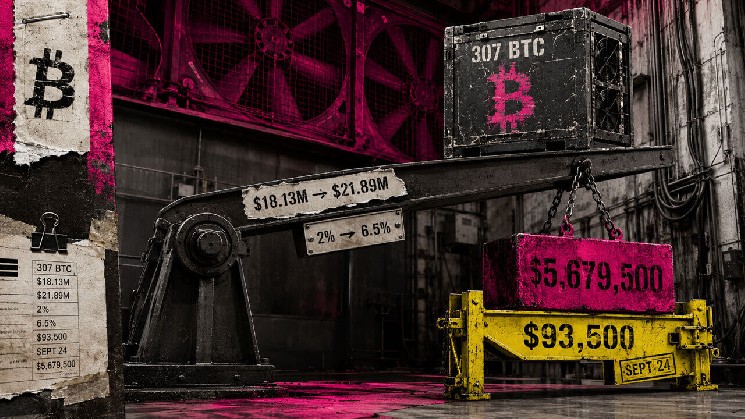
    PowerCompute, a Bitcoin treasury and mining company, has added $3.765 million to its debt following an early Bitcoin collar reset involving 307 $BTC. The executed reset schedule records the unwind cost as additional principal rather than as a cash or $USDC payment.

    In a filing dated Aug. 28, the company disclosed a replacement 30-day collar balance of $21,892,131.88 with Arch Lending, up from $18,127,131.88. The facility remains secured by 307 $BTC, while its annual interest rate has increased from 2% to 6.5%.

    How PowerCompute’s Bitcoin collar reset increased principal

    PowerCompute’s borrowing subsidiary, US Digital Mining and Hosting Co., elected to add the unwind cost to the loan balance. The annex states that the cost was agreed in place of a separate excess-appreciation settlement for the terminated period.

    The previous collar began on Aug. 3 and was scheduled to reset on Sept. 2. PowerCompute terminated it on Aug. 25, 22 days into the period, when the reference price was $78,500. That price was above the company’s always-on $66,370 ceiling, according to the previous reset confirmation. The original loan filing reported an $18.13 million balance and a 2% interest rate.

    Under the contract’s 30/360 calculation, the replacement loan’s full interest charge for the period from Aug. 25 to Sept. 24 is $118,582.38. The annex sets out the collar’s 30-day mechanics, while the reset schedule provides the commercial figures despite the longer-form provisions in the master agreement.

    New Bitcoin collar terms run through Sept. 24

    The new collar moves the next decision date to Sept. 24. It establishes a $71,112 floor, a $75,000 ceiling and a $93,500 knock-in barrier. Arch will test the reference price once, at 8:00 a.m. EST.

    If the reference price remains below $93,500, the ceiling has no effect. PowerCompute retains all Bitcoin appreciation, including any appreciation above $75,000. If the reference price reaches or exceeds $93,500, however, the ceiling applies to the entire period.

    Excess appreciation arises only if the Sept. 24 reference price reaches at least $93,500. At the barrier exactly, the settlement formula is:

    307 × ($93,500 − $75,000) = $5,679,500

    This is conditional settlement arithmetic before interest, not an amount that PowerCompute already owes. The company can settle the amount using retained $BTC or USD/$USDC. If it rolls the loan forward, it can instead add the amount to principal or incorporate it into the next ceiling and rate quote.

    The $93,500 barrier is not an intraday liquidation threshold. The annex bars ordinary margin calls and liquidations during the rolling period, limits ordinary recourse to the pledged Bitcoin subject to stated carve-outs, and tests the collar only at reset. A voluntary exit before the end of the period would bring the test forward.

    Bitcoin price context after the reset

    At 2:23 a.m. UTC on Aug. 29, CryptoSlate’s live Bitcoin page displayed a price of $77,808.23, placing the barrier approximately 20.2% above that snapshot. The comparison provides context and is not a forecast for Bitcoin’s price on Sept. 24.

    CryptoSlate previously covered PowerCompute’s initial collar after tracking the company’s earlier bridge-loan chain. The Aug. 28 filing turns the first structure’s modeled trade-off into a realized financing cost and begins a new 30-day test.

  • New Clues Emerge in Satoshi’s Bitcoin Genesis Block Puzzle, but Mystery Remains

    New Clues Emerge in Satoshi’s Bitcoin Genesis Block Puzzle, but Mystery Remains

    A Bitcoin puzzle built from information in the Genesis Block has attracted attention from blockchain analysts and the wider Bitcoin community, but it remains unsolved.

    Bitcoin puzzle uses data from the Genesis Block

    The puzzle was created on August 23, 2026, using information contained in the Genesis Block created by Bitcoin creator Satoshi Nakamoto.

    According to the Galaxy Research X account, the puzzle was hidden in human-readable text in Bitcoin Block 963,629. Its creator used the information to generate a wallet with extremely low entropy, which he said required no backup.

    Galaxy Research said the puzzle creator answered two questions intended to help others solve the challenge. The first asked whether the witness script was a hash lock, a multisig or something else. The creator indicated that it was a multisig.

    The second question asked how many keys were involved, what threshold applied and how the keys were derived from the Genesis Block. The puzzle creator answered that there were two keys, adding: “both required. The rest is for you to derive.”

    In a follow-up post on August 25, Galaxy Research said the puzzle jackpot had reached 125,779 sats and shared additional clues from the creator:

    “The witness script is a multisig. Two keys, both required. The rest is for you to derive. Both keys use the same Genesis field, and there is no hash. Both keys are derived independently from Genesis.”

    Puzzle jackpot reaches 142,779 sats

    Galaxy Head of Research Alex Thorn recently highlighted his efforts to solve the Bitcoin puzzle, saying he had been working on it.

    i’ve been working on this puzzle a bitthe jackpot is currently 142,779 sats (~$111)i haven’t myself sent in any requests for hints, but others have. based on the hints, we assume:- a 2-of-2 multisig- both keys from the same Genesis field with no hash applied- derived… https://t.co/afCkDj1Kxe pic.twitter.com/gFo5tFNZcK
    — Alex Thorn (@intangiblecoins) August 29, 2026

    In the X post, Thorn said the puzzle jackpot stood at 142,779 sats, or nearly $111. He added that he had not personally requested any hints, although other participants had.

    Based on the available clues, Thorn listed the following assumptions:

    “a 2-of-2 multisig, both keys from the same Genesis field with no hash applied, derived independently, along the BIP48 path root > multisig > mainnet > genesis_data > script_type, the field is one The Times newspaper printed.”

    Using these clues, Thorn said he had searched through more than 19.3 billion candidate scripts but eliminated them from consideration.

    Bitcoin’s Genesis Block remains central to the challenge

    The Genesis Block, also known as Block 0, is the first block ever mined on the Bitcoin blockchain. Satoshi Nakamoto mined it on January 3, 2009, and embedded the hidden message, “The Times 03/Jan/2009 Chancellor on brink of second bailout for banks,” a headline published by The Times on the same date.

    The message remains one of Bitcoin’s most recognizable historical artifacts, and its connection to the puzzle is central to the ongoing challenge.

    The Bitcoin puzzle remains unsolved, but Thorn invited others working on it to collaborate in an effort to claim the jackpot.