Category: Coins

Digital assets, cryptocurrencies, blockchain, and currency news.

  • Why a Famous Burger Chain Now Calls Itself a ‘Bitcoin Company’

    Why a Famous Burger Chain Now Calls Itself a ‘Bitcoin Company’

    Steak ‘n Shake Rebrands Itself as a Bitcoin Company

    Steak ‘n Shake, the burger chain founded in 1934, is positioning itself around bitcoin after beginning to accept cryptocurrency payments at its restaurants more than 15 months ago. The company made the declaration on Aug. 30 on X, following an Aug. 7 filing from parent company Biglari Holdings that detailed the chain’s sales growth.

    “From the moment we started accepting bitcoin payments, Steak n Shake has produced the best same-store sales in the fast food industry,”

    the company summarized.

    “Bitcoiners continue to help our business. We have never seen an allegiance as strong as Bitcoin holders. The increased business and savings have helped us reinvest in food quality.”

    The restaurant chain added:

    “Steak n Shake is a Bitcoin company.”

    Biglari Holdings Inc. (NYSE: BH), which owns Steak ‘n Shake, reported a 13.8% increase in same-store sales during the second quarter of 2026 at its domestic company-operated and franchise-partner-operated restaurants.

    How Steak ‘n Shake Moved From Bitcoin Payments to a Strategic Reserve

    Steak ‘n Shake began accepting bitcoin in May 2025 through the Bitcoin Lightning Network, a second-layer system designed to settle smaller transactions more quickly and at lower cost than the base blockchain.

    The company says those lower transaction costs contribute to operating savings. Instead of converting customer payments into traditional currency, Steak ‘n Shake directs the bitcoin it receives into a Strategic Bitcoin Reserve, making cryptocurrency part of its financial strategy rather than simply a checkout option.

    The chain increased its bitcoin exposure twice in January, first by $10 million and later by another $5 million in notional value. Steak ‘n Shake also partnered with Fold on a bitcoin bonus program for employees.

    Bitcoin Bonuses for Employees and Promotions for Customers

    Hourly employees at company-operated restaurants have received a bitcoin bonus in addition to their wages since March 1. The bonus is set at 21 cents for every hour worked and becomes payable after a two-year vesting period.

    Customers received a bitcoin promotion of their own on Oct. 31, 2025, when Fold Holdings, Inc. (Nasdaq: FLD) and Steak ‘n Shake introduced a limited-time $5 bitcoin offer at approximately 400 U.S. locations. Customers who purchased a Bitcoin Steakburger or Bitcoin Meal could upload their receipt and receive a code redeemable through the Fold app.

    Biglari Holdings reported pretax operating earnings of $6.3 million for the second quarter, up from $3.7 million a year earlier. The figure covers the company’s insurance and reinsurance, licensing and media, restaurant, and oil and gas operations.

    For the first six months of 2026, pretax operating earnings totaled $2.1 million, down from $13.7 million during the same period in 2025.

    Source: cryptonews.net

  • Why Ethereum’s Exit Queue Hitting Zero May Not Be a Good Sign Yet

    Why Ethereum’s Exit Queue Hitting Zero May Not Be a Good Sign Yet

    Ethereum’s recent rally has pushed ETH sharply higher. The largest altcoin, which was trading near $1,900, climbed close to $2,500. At press time, ETH was trading at $2,459.03 after gaining more than 30% over the past 30 days.

    However, the price increase does not guarantee that Ethereum will continue rising. Data from the network’s staking ecosystem shows behavior that differs from what might typically be expected during a major rally.

    Rather than a rush to unlock and sell ETH, Ethereum is seeing continued commitment to staking.

    Ethereum staking shows limited exit pressure

    According to Ethereum’s Validator Queue, the ETH ‘exit queue’ has reached zero. The network currently has approximately 902,506 active validators, while around 42.4 million ETH is staked, representing 34.8% of the total supply.

    Source: Validator Queue

    This development comes even after Ethereum recorded a 70% price increase. Based on the current staking data, the ETH rally may still have room to continue.

    If validators expect ETH to appreciate further, exiting staking simply to sell after a 70% rally may not make sense. Stakers can also continue earning rewards for helping secure and operate Ethereum’s network while maintaining exposure to the asset.

    Ethereum validator activity in August

    In August 2026, the validator entry wait time fell from approximately 43–44 days to roughly 36 days, indicating that Ethereum’s large staking backlog is gradually clearing.

    Source: Validator Queue

    Meanwhile, the number of active validators began recovering after falling to approximately 880,000–881,000 in mid-July. During August, the count increased sharply from roughly 887,000 at the start of the month to more than 900,000 by late August, reaching approximately 902,000–903,000.

    Source: Validator Queue

    The recovery suggests that Ethereum’s validator base is expanding again, signaling strong staking participation and limited pressure to exit staking positions.

    Institutional Ethereum staking expands

    Ethereum’s largest DAT, Bitmine Immersion Technologies, has staked 5,067,309 ETH so far, with a value of approximately $12.4 billion. Shaprlink has staked more than 26,193 ETH in total.

    Fidelity has also announced plans for Ethereum staking and quarterly cash distributions, potentially adding another source of income to its spot ETF.

    Although Ethereum staking is attracting increased attention, Solana has a significantly higher staking participation rate, with approximately 68.3% of its supply staked. Around 421.8 million SOL is staked, generating yields of approximately 5.75%–6.5%.

    Despite Solana’s higher staking participation rate, the total dollar value of assets staked on the network remains considerably lower than Ethereum’s.

    Key Ethereum staking figures

    • Approximately 902,506 active Ethereum validators
    • Around 42.4 million ETH staked
    • Staked ETH represents 34.8% of Ethereum’s total supply
    • The validator entry wait time has fallen to roughly 36 days

    The continued growth in active validators and the absence of an exit queue indicate that many Ethereum stakers remain committed despite the asset’s recent 70% rally.

  • PROM Surges Over 300% as Rally Accelerates, but Investors Should Remain Cautious

    PROM Surges Over 300% as Rally Accelerates, but Investors Should Remain Cautious

    Prom ($PROM) remains one of the cryptocurrency market’s strongest-performing assets, gaining 48% in the past 24 hours.

    The latest surge extends a broader bullish trend that has developed over several weeks. According to the CoinGlass performance chart, $PROM has risen 176% over the past seven days and 326% over the last 30 days.

    Capital inflows support the $PROM rally

    $PROM’s current market outlook remains bullish, with capital flowing into both spot and perpetual markets. However, funding data indicates that market positioning could influence the asset’s direction in the near term.

    At the time of writing, the market had recorded approximately $5.47 million in net inflows, supporting buying activity. The sustained flow into the buy side of the perpetual market suggests that upward momentum could continue.

    Netflow data shows that traders recorded approximately $16.8 million in netflow over the past five days. Total buying reached about $463.89 million, compared with roughly $480.72 million in selling.

    Capital also moved through the spot market, although the flow was smaller over the shorter measurement period. During the last 12 hours, the spot market recorded approximately $239,940 in netflow and around $7.13 million in buying volume.

    Negative funding rate raises sell-off risk

    Despite the strong gains and continued inflows, the broader market data contains a warning sign: $PROM’s funding rate has turned negative.

    The funding rate indicates which side of the derivatives market is dominant by measuring whether long or short positions are leading. According to the CoinGlass chart, short positions currently have the upper hand, with the funding rate at -0.0009%.

    The sudden shift suggests that some traders are positioning for $PROM’s price to decline from its current level. Similar instances of negative funding have occurred before, with previous episodes coinciding with price corrections before the asset resumed its rally.

    If the funding rate falls further and remains negative for several days, $PROM could face a significant drop from its current levels.

    Bottom line: $PROM has gained more than 300% in 30 days as strong momentum and capital inflows drive its rally. However, negative funding points to increasing short positioning and raises the risk of a price correction if bearish pressure persists.

  • AI Agents Are Getting Wallets as Compliance Infrastructure Catches Up

    AI Agents Are Getting Wallets as Compliance Infrastructure Catches Up

    AI agents are beginning to hold digital wallets and make payments, but the financial system lacks a standard way to identify one machine counterparty from another. Solowin Holdings signed a memorandum with SC Ventures, Standard Chartered’s venture arm, in April to incubate an AI payments project called AGENPAY. The Hong Kong company, listed on Nasdaq under AXG, is developing Know-Your-Agent, a compliance engine designed to give machine counterparties verifiable identities.

    Can AI agents open bank accounts?

    “Is an agent gonna be able to open a bank account? Is JP Morgan gonna open an account for an agent?” Yat Siu, executive chairman of Animoca Brands, said on the On The Margin podcast. “Probably not gonna happen, right? So how do they do that? They have a wallet. We actually think you know agents with wallets essentially become autonomous economic actors who then basically do not just trade but buy and do stuff. They can use a stablecoin, right? We already have agents that are trading on hyperliquid. I have two hundred and eighty agents now doing all sorts of stuff.”

    Siu estimates that the eventual number of AI agents could reach “anywhere from 50 to 100 billion agents minimum.” He expects financial activity to expand alongside that population.

    “The total advertising, online advertising revenues is around $900 billion a year,” he said. “That’s all gonna shift into a kind of transactional invocation economy powered by agents.”

    “The next step, which is already starting, is that the AI agents start transacting on your behalf. So they pay for things, they sign up for services, they probably handle your financial transactions now,” Varun Kabra, chief growth officer at Concordium, said on On The Margin. “The counterparty on the other side, the airline in this case, or the ticketing platform, whatever it is, they have no way to verify whether a real accountable human is behind the transaction. And that could open a door to fraud, bots acting as humans, agents operating with no accountability.”

    “You’re quickly gonna realize because our entire financial ecosystem was primarily human-centric,” Chandler Fung, co-founder of t54 Labs, said in an interview. “The entire society is a trust business.”

    Most banks still prevent AI agents from accessing customer funds, creating an opening that Solowin spent 2026 targeting.

    “AI doesn’t have a transaction layer right now,” Atul Khekade, co-founder of XDC Network, said in an interview. “AI platforms don’t have a monetization compliance layer that they can use for, like, real transactions to execute actions. insurance companies, banks, fintech providers, airline companies, a lot of them are coming to us now.”

    Thomas Zhu, a Solowin director and co-founder of its AlloyX subsidiary, was an executive director in Goldman Sachs’ securities division from 2015 to 2020. He later led digital assets at China Asset Management (Hong Kong), which listed some of Asia’s first spot bitcoin and ether ETFs in 2024.

    “Without compliant governance, AI-stablecoin integration will remain experimental,” Zhu said in written answers to questions.

    The financial rails behind AI agents

    Solowin’s Bahrain subsidiary received a license from the country’s central bank in June to issue stablecoins, becoming the first company granted approval under that framework. The stablecoin itself has not yet launched.

    “Agents are like fundamentally about outsourcing a purchase and anyone who has ever outsourced a purchase knows that this comes with trade-offs,” Nitya Subramanian, chief executive of wallet infrastructure firm Para, said on On The Margin. “Wallets are ultimately the authorization and control flow layer of anything that’s happening on chain. Every chain, every DeFi primitive, every action that you can take on chain needs to go through a wallet. And I feel like people still don’t fully get that.”

    “I could create a stable coin backed card and give it $200 a week and just have it buy Chipotle,” Subramanian said, describing the spending limits she would impose. “So it’s only allowed to buy my Chipotle bowl every day.”

    “I think in the past 12 months, there’s been over 300 million unique users of stablecoins, which is an absurdly high number,” Patrick Kim, a researcher at crypto data firm Artemis, said on On The Margin, referring to the settlement asset that banks spent 2026 pursuing. “If you told this to someone five years ago, they would look you dead in the eyes and say, you’re bullshitting me, like you’re bluffing.”

    Stablecoin supply stood at $308 billion on Aug. 13, according to Reap’s 2026 stablecoin data. Every major bank is now expected to launch a stablecoin.

    What AI agents could trade

    “Reality is the world that we’ve been living in for crypto for the past few years has been a lot of these, you know, quote unquote unsexy use cases, right? Like bringing private credit on chain, bringing equities on chain,” Kim said.

    Zhu expects AI agents to trade those types of assets, beginning with government bonds and money-market funds before expanding into real estate and private credit. He sees the products being offered to banks as a service rather than developed entirely in-house.

    Solowin operates a tokenization platform called Ferion and backed a funding round for Libeara in April. Libeara is a Singapore-based platform also supported by SC Ventures.

    “You own the token and the token is the asset, you own the asset. It’s different. It’s what we call title tokenization,” Chris Turner, co-founder of impact investment platform Kula, said in an interview, describing the distinction at the center of the $80 billion tokenization market. Most of the market offers a weaker structure, he said: “it’s giving a contractual exposure to the economic upside of that particular asset. But you don’t own the asset.”

    Zhu identified the main challenges as “cross-jurisdictional legal affirmation, custody and regulatory compliance.”

    Solowin’s AI payments business

    Solowin reported revenue of $28.05 million for the year ended March 31, an 895% increase, according to its 6-K filing. AI infrastructure fees accounted for $22.2 million of that total.

    The company’s operating expenses reached $40.14 million, resulting in a net loss of $13.29 million. Solowin also acquired AlloyX for $350 million in stock as it expanded its reach into the UAE, ASEAN and Africa.

    “The last time we had a new financial rail was probably credit cards in the 70s,” Subramanian said. “And so it’s probably the most exciting time in many of our, if not most of our careers to be building in either FinTech or crypto.”

    “if you refuse to access it, if you say I don’t want anything to do with it, that’s no different than saying I don’t want to be on the internet,” Siu said.

  • Options Bets Turn Defensive Ahead of Bitcoin Price Showdown

    Options Bets Turn Defensive Ahead of Bitcoin Price Showdown

    Bitcoin futures open interest across major derivatives venues stood at 695,020 BTC, equivalent to $54.82 billion, according to weekend data from Coinglass. Aggregate open interest declined 0.26% over one hour and 0.38% over four hours, but remained 1.15% higher over the past 24 hours. The mixed readings suggest traders are trimming exposure at the margins rather than making a broad exit from the market.

    Binance Leads as $54.82 Billion Remains at Stake

    Binance, the largest cryptocurrency exchange by trading volume, held the biggest share of tracked futures open interest, with 142,500 BTC valued at $11.24 billion. That represented 20.5% of the total. CME followed with 116,040 BTC worth $9.15 billion on Sunday, giving it a 16.69% share. CME’s position is particularly significant because it offers a useful measure of institutional positioning.

    MEXC accounted for another $5.01 billion, followed by Bybit with $4.58 billion and Gate with $4.57 billion. OKX held $2.79 billion, while Bitget and KuCoin accounted for $2.16 billion and $1.62 billion, respectively.

    Most major venues recorded lower open interest over the previous four hours on Sunday. BingX, however, posted a 34.50% increase, while Bitunix rose approximately 1.29%.

    The broader futures market has recovered substantially from its June lows. Historical data shows Bitcoin futures open interest falling toward the mid-$40 billion range in June before recovering above $54 billion in late August, as Bitcoin rebounded past $81,000. The key concern is that leverage has returned alongside the price, leaving more capital exposed if volatility suddenly increases.

    One popular crypto X account this weekend wrote:

    “Leverage is piling up over the weekend. This won’t end well.”

    Calls Dominate Open Interest as New Flows Seek Protection

    Bitcoin options are showing a similarly leveraged setup. Total options open interest approached approximately $44 billion over the weekend, recovering sharply from around $25 billion in early August.

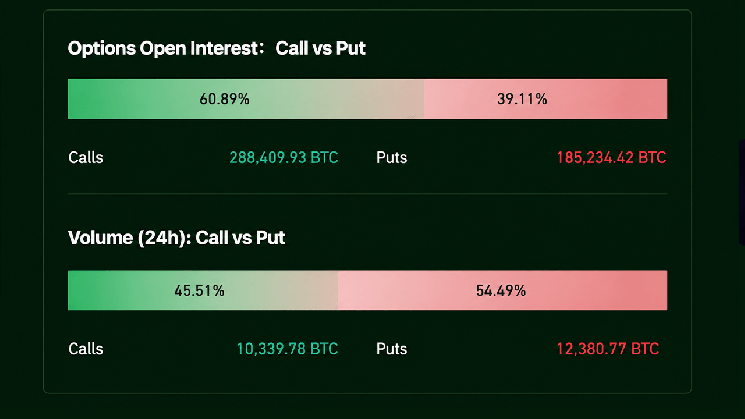
    The latest call-and-put breakdown showed 288,409.93 BTC in calls versus 185,234.42 BTC in puts. Calls therefore represented 60.89% of outstanding options open interest, compared with 39.11% for puts.

    Bitcoin options data via Coinglass.com.

    Trading volume presents a more defensive picture. Over the latest 24-hour period, puts represented 54.49% of options volume, with 12,380.77 BTC traded, compared with 10,339.78 BTC in calls. While the existing options book remains tilted toward upside exposure, newer trading flows are leaning toward downside protection.

    At Deribit, the largest individual open-interest contract is the Sept. 25 $70,000 call, with 11,018.2 BTC. It is followed by the Dec. 25 $80,000 call at 8,590 BTC, the Sept. 25 $85,000 call at 8,373.9 BTC and the Sept. 25 $100,000 call at 7,323.4 BTC. The Sept. 25 $70,000 put holds 7,227.3 BTC, indicating substantial positioning on both sides of the market.

    CME adds another institutional dimension. Expiration-stacked data shows CME options open interest rebuilding into late August, with contracts expiring within one to two months forming the largest visible block. Position-stacked data also shows calls expanding sharply during the final August sessions, while puts remain active but account for a smaller share of the newest bars.

    Max Pain Creates a Volatile September Setup for Bitcoin

    Max pain refers to the strike price at which option holders would theoretically face the greatest aggregate losses at expiration. Data from the largest Bitcoin options exchanges, including Coinbase and Deribit, shows near-term max-pain levels ranging from $70,000 to $80,000.

    Deribit’s levels include approximately $78,500 for Aug. 31 and Sept. 1, $75,000 for Sept. 4 and $70,000 for Sept. 25. Longer-dated Deribit expirations generally cluster near $70,000, with the exception of Nov. 27, which is positioned around $80,000.

    Binance and OKX show a similarly uneven distribution. Binance’s max pain is near $78,500 for Aug. 31, $75,000 for Sept. 4, $80,000 for Sept. 11 and Sept. 18, and approximately $73,000 for Sept. 25. On OKX, Aug. 31 is near $78,500, Sept. 4 is around $75,000, Sept. 11 is near $80,000 and Sept. 25 is around $70,000.

    With Bitcoin trading at $78,425, derivatives traders are not positioned for a quiet September. Futures exposure remains elevated, calls control most outstanding options open interest, puts lead the latest volume figures, and several max-pain levels sit below the current spot price. The positioning indicates that traders continue to seek upside, while significant capital is also buying downside protection.

    Feature/Hero image via Coinglass.com

  • Goldman Sachs Shock: Coinbase Traders Braced for $196

    Goldman Sachs Shock: Coinbase Traders Braced for $196

    “The problem is mostly the analyst just moves targets with their price,” Charan Dangeti, a finance content creator, said in an interview. Dangeti pointed to analyst price targets as an example, suggesting “when stock goes down, like Citi, they lower their Micron target when it went down 10%. And then they increase it when it goes up.”

    “That’s the problem with all these targets. Right? It’s kind of, I think, there’s some bias involved when they make their targets and I mean, I don’t think they’re the most honest way to do it,” said Dangeti, a paid creator partner of paper trading app GameStock.

    Goldman Sachs raised its Coinbase price target to $196 from $173 on Tuesday, after the cryptocurrency exchange’s stock had already gained 28% in five sessions.

    Crypto increasingly enters mainstream finance

    “This is going to be embedded in the large finance institutions”

    “Version two of the narrative around crypto is to take it seriously,” Andy Duenas, director of financial services at Cap V, said on the On The Margin podcast.

    Goldman analyst James Yaro maintained his Buy rating on Robinhood and set a $124 price target, citing growth in newer business lines, including derivatives and prediction markets.

    “This is going to be the future of finance. This is going to be embedded in the large finance institutions,”. Duenas made the comments as Goldman Sachs continued building its own cryptocurrency business. Coinbase closed Tuesday at $187.16, up 4.3%.

    “One of our clients did a partnership with Coinbase to be able to offer the first crypto-backed mortgages,” Duenas said. “Because you’re seeing that more younger folks have their assets tied up in crypto. So how can they leverage that in order to purchase their first home?”

    “And at the heart of it, when it comes to anyone’s money, it’s building that trust. So our big job is building trust around crypto and it being a viable product,” Duenas said.

    Coinbase traded at $182.43 by midday Wednesday, about 7.4% below Goldman’s $196 target. Robinhood was trading at $109.92, 12.8% below the $124 target.

    Institutional crypto demand remains uncertain

    “Big money still doesn’t look fully convinced”

    “Coinbase’s Bitcoin premium briefly flipped green. But it didn’t last long. It’s already back in the red, which suggests U.S. institutional buying is still weak. $BTC is moving, but big money still doesn’t look fully convinced,” Niels, co-founder of STABL Agency, wrote on X on Tuesday morning, hours after bitcoin peaked at $80,698 on CoinGecko’s index.

    Six hours later, the same indicator was being interpreted differently. “Coinbase bitcoin premium just flipped positive after being negative for 3+ months straight,” posted trader Crypto Jargon. “When coinbase premium goes negative for months, US demand is dead, and every rally is foreign-led and fragile. When it flips positive, the real bid is back.”

    “Coinbase is showing a $BTC net selling state. However, Binance and OKX are maintaining a net buy state,” CryptoQuant contributor CW wrote on August 20, as the exchange’s role in the infrastructure supporting exchange-traded funds drew renewed attention.

    Tuesday marked bitcoin’s first move above $80,000 since mid-May. The cryptocurrency traded near $77,900 on Wednesday, remaining up 19.9% on the week.

    “Why would you trust one custodian versus three? It’s pretty straightforward. We’re just so early. That’s why people don’t do it yet,” Michael Tanguma, co-founder and chief executive of bitcoin custody firm Onramp, said in an interview about the concentration risk running through the same infrastructure. “There’s a single point of failure whether it’s Coinbase or yourself.”

    Analysts continue to diverge on Coinbase

    “The last step of every bear market”

    “Newbie capitulation is the last step of every bear market,” wrote Ki Young Ju, founder of CryptoQuant.

    Mizuho cut its Coinbase price target to $155 from $200 in early August, leaving its target below the stock’s current market price.

    “Coinbase dominance surged while the premium stayed negative. Paper hands at ETFs and institutions sold the bottom,” Ki Young Ju wrote.

    Bernstein has the highest Wall Street target at $330. BTIG trimmed its target because of weak trading volumes, while Benchmark cut its target after Coinbase’s second-quarter miss. The quarter came as market-wide crypto spot trading volumes fell 25% from the previous three months.

    “Raymond James said $800 SpaceX,” Dangeti said, citing his own example of a price target he does not trust.

    Coinbase remains about 54% below its 52-week high of $402.16.

  • Former White House Teleprompter Operator Fined for Prediction Market Insider Trading

    Former White House Teleprompter Operator Fined for Prediction Market Insider Trading

    A former White House teleprompter operator has agreed to pay $172,000 to settle allegations that he used advance knowledge of presidential speeches to trade prediction-market contracts linked to words President Donald Trump would say.

    The Commodity Futures Trading Commission said Gabriel Perez misappropriated confidential government information to trade “presidential mention market” contracts. These event contracts pay out based on whether a president uses specific words or phrases during a speech.

    Because his role gave him access to presidential speeches before they were delivered, Perez allegedly placed trades on outcomes he already knew, according to the CFTC. Between December 2025 and February 2026, he generated more than $107,500 in profits, the agency said.

    Under the settlement, Perez must disgorge $107,539.02 in gains, pay a $65,000 civil penalty, accept a three-year trading ban and cease further violations of the Commodity Exchange Act.

    The CFTC said the penalty was substantially reduced under a new cooperation policy because of what it described as Perez’s “exemplary assistance” with the investigation. The regulator also credited exchange operator Kalshi with helping advance the case.

    Prediction markets face growing insider-trading scrutiny

    The enforcement action is one of the clearest examples yet of the insider-trading risks facing prediction markets as they grow in popularity. These platforms allow users to wager real money on real-world outcomes, including elections, sports and increasingly specific details of political speeches.

    The risks are not hypothetical. Earlier this year, a U.S. soldier was charged over alleged Polymarket trading that produced more than $400,000 in illicit gains tied to the military operation that ousted Venezuelan leader Nicolas Maduro. Separately, a MrBeast video editor was fired in March amid a Kalshi insider-trading investigation.

    Kalshi has also been working through a backlog of suspicious-activity reviews and has introduced additional safeguards amid increasing scrutiny over whether insiders are manipulating its markets.

    The case comes as prediction markets move further into the mainstream, generating billions of dollars in trading volume and attracting greater regulatory attention. It also signals that the CFTC considers event contracts to fall squarely within its authority as swaps subject to insider-trading rules.

  • UK Reveals 240 Crypto Millionaires in First Official Tax Report

    UK Reveals 240 Crypto Millionaires in First Official Tax Report

    The UK government’s first official report on taxable crypto asset gains has identified 240 crypto millionaires who each declared more than £1 million in capital gains during the 2024-25 tax year.

    HM Revenue and Customs (HMRC) published the figures on Aug. 27. The 240 taxpayers reported £717 million in capital gains collectively.

    The figures appear in HMRC’s annual Capital Gains Tax statistics, which now include a dedicated table covering crypto asset taxpayers, disposal proceeds and taxable gains. HMRC stated:

    “It is the first time HMRC has published this specific data, following the introduction of a dedicated part of the Self Assessment return for cryptoasset capital gains.”

    Across all taxpayers, 17,600 individuals reported £13.8 billion in crypto asset disposal proceeds and £1.38 billion in taxable gains, an average of approximately £78,000 per person. About 87% of those declaring taxable crypto gains were male, while approximately 13% were female.

    Crypto sales, swaps and spending can trigger tax

    Crypto asset disposals can include selling tokens, exchanging one cryptocurrency for another, using digital assets to purchase goods or services, and giving crypto to another person outside specified exemptions. Crypto received through employment, self-employment, mining, staking or lending may also be taxable as income under wider cryptocurrency tax rules.

    HMRC has increased direct outreach to investors whose tax returns may not reflect their cryptocurrency activity. Accountancy group UHY Hacker Young said on Aug. 20 that the agency had sent 81,000 crypto tax letters during the previous 12 months. That represented a 25% increase from approximately 65,000 letters and was nearly three times the 27,714 letters sent during the 2023-24 tax year.

    Financial Secretary to the Treasury and Paymaster General James Murray said the statistics support efforts to improve compliance and raise awareness among people who profit from crypto asset transactions:

    “Taxes are due on cryptoasset gains just like any other gains, and we want to make sure people making gains from crypto know about what taxes they owe.”

    He added:

    “This important work is supporting the Government’s efforts to close the tax gap, so that everyone pays their fair share towards our vital public services.”

    Separate reforms will change the tax treatment of certain decentralized finance (DeFi) transactions from April 6, 2027. Under HMRC’s planned rules for crypto lending and liquidity pools, capital gains tax will generally be deferred until an economic disposal occurs. The government estimates that approximately 700,000 individuals could be affected by the changes.

    International reporting will expand HMRC’s crypto data

    The United Kingdom began implementing the Organisation for Economic Co-operation and Development’s Cryptoasset Reporting Framework in January. Under HMRC’s crypto asset user and transaction reporting requirements, service providers must submit their first reports between Jan. 1 and May 31, 2027. The reports will cover qualifying customer information and transactions from the 2026 calendar year.

    Crypto service providers must collect information on all users but report transaction summaries only for users who are tax residents in participating jurisdictions. Inaccurate, incomplete, unverified, late or missing submissions may result in penalties of up to £300 per user. International information exchanges will also give HMRC greater visibility into crypto activity conducted through providers outside the United Kingdom.

    Taxpayers with undeclared crypto income or gains can use HMRC’s Crypto Disclosure Service. Amounts above the tax-free allowance for the 2025-26 tax year must be declared on a Self Assessment return by Jan. 31, 2027, with any tax due paid by that date.

    HMRC estimated that its crypto compliance and education efforts generated an additional £168 million in capital gains tax during 2024-25.

    “We want to make it as easy as possible for people to understand and meet their tax obligations when it comes to cryptoassets,” HMRC Permanent Secretary and Chief Executive John-Paul Marks said.

    Highlighting the importance of reviewing crypto asset tax obligations as international reporting expands, the permanent secretary concluded:

    “As new international reporting rules come into force, it’s more important than ever for people to check they are paying any tax owed.”

  • Polygon Quietly Patched Security Flaws in Two Hard Forks Before Disclosing Them

    Polygon Quietly Patched Security Flaws in Two Hard Forks Before Disclosing Them

    Polygon Labs has disclosed that it patched multiple security vulnerabilities in its proof-of-stake network through two hard forks: Austin on the Bor client and Kyoto on the Heimdall client.

    The upgrades were deployed privately and validated on Polygon’s Amoy testnet before being activated on mainnet. Polygon said the approach followed its standard procedure for consensus-affecting security fixes: implement the changes quietly, confirm network stability, and disclose the vulnerabilities after the network was protected.

    Polygon hard forks address denial-of-service vulnerabilities

    The Austin hard fork fixed two denial-of-service vulnerabilities in block processing. One flaw could have allowed a malicious block producer to crash peer nodes by filling a block with an oversized data field.

    The Kyoto hard fork addressed a broader group of consensus-hardening issues. The most serious vulnerability could have allowed an attacker to trigger costly, coordinated processing across the entire validator set with a single crafted transaction that was inexpensive to create but expensive for the network to process.

    Polygon said it found no evidence that any of the vulnerabilities had been exploited on mainnet and that the issues were resolved proactively. Both upgrades are now mandatory for node operators and are active across the network. The hard forks do not require a state migration or node resynchronization.

    POL price remains under pressure

    The security disclosures come during a pivotal period for Polygon, which has completed the migration from its legacy MATIC token to POL as part of a broader overhaul of its network architecture.

    The news did little to support the price of POL. The token was trading at approximately $0.09983 on Sunday, down 2.3% over 24 hours and 6.8% over the past week, according to CoinGecko.

    POL has fallen about 60.8% over the past year. Its market capitalization stood near $1.07 billion despite gains over the past month.

  • Crypto Market’s Weekly Winners and Losers: VET, RAIN, STABLE, and ARB

    Crypto Market’s Weekly Winners and Losers: VET, RAIN, STABLE, and ARB

    Crypto markets remained largely range-bound during the week following Bitcoin’s strong rebound in the final week of August. Bitcoin failed to break above $80,000, while mixed performance across the wider market reflected profit-taking among traders.

    At the same time, capital continued rotating into selected altcoins, helping support the total cryptocurrency market value.

    Weekly Crypto Market Winners

    VeChain [$VET] Still Has Room to Rise

    VeChain [$VET] was the clear winner of the week, surging 25% and climbing above $0.07 for the first time since mid-May. Given the renewed fear of missing out (FOMO), the rally could have further room to extend.

    Technical indicators also support the recent strength. VeChain continued this week’s advance after posting a 30% rally last week, taking its total gain above 50% in less than 14 days. This sharp move raises the possibility of significant profit-taking, particularly as short-term holders (STHs) are now sitting in profit.

    However, the Relative Strength Index (RSI) remains below the overbought zone. This suggests that despite VET’s strong performance, the cryptocurrency has not yet reached an excessively extended level that would typically signal a major correction.

    Source: TradingView ($VET/$USDT)

    With strong FOMO, profitable short-term holders and a relatively compressed RSI, VET could potentially break through the $0.08 threshold. If that happens, the token could continue higher on its current bullish momentum before profit-taking pressure from short-term holders intensifies.

    Rain [$RAIN] Has Reached an Overextended Level

    Rain [$RAIN] ranked second among the week’s biggest gainers after rising 22%. Unlike VET’s more bullish market structure, RAIN’s setup appears more volatile, with the altcoin now recording four consecutive weeks of gains.

    The move has pushed the weekly RSI into overextended territory, a pattern that previously preceded a sharp correction during the mid-June cycle. With the broader market still consolidating, capital could continue flowing into RAIN.

    If the trend continues, a move toward $0.02 could become possible. However, the rally is unlikely to move in a straight line. RAIN could experience short-term relief before attempting another breakout, making HOLD the more suitable approach for now.

    Solana [$SOL] Shows Bullish Continuation

    Solana [$SOL] was the third-biggest weekly winner, gaining 10% after rising 28% during the previous week’s trading. Notably, SOL continues to outperform other large-cap cryptocurrencies.

    This divergence suggests that SOL’s rally may be driven by more than broad altcoin rotation and could instead reflect “Solana-specific” bullish momentum. That makes the divergence an important factor to monitor. The RSI has also not yet entered overextended territory.

    Against this backdrop, a move toward $110 appears increasingly likely in the near term, placing SOL among the large-cap cryptocurrencies to watch during the remainder of the third-quarter cycle.

    Other Notable Weekly Winners

    Outside the major cryptocurrencies, several tokens posted substantial gains. Pons [PONS] led the market with a 543% surge, followed by Bitlayer [BTR], which gained 540%, and The Index [INDEX], which climbed 327%.

    Weekly Crypto Market Losers

    Stable [$STABLE] Could Face a Deeper Correction

    Stable [$STABLE] led the week’s declining altcoins, falling 13%. The sell-off pushed the token below $0.03 and erased all of the gains recorded after the April market cycle.

    STABLE is now approaching the critical $0.02 support level that triggered a 50% rebound in April, followed by five consecutive weeks of gains. With profit-taking increasing, a similar recovery remains possible.

    However, the RSI remains well above oversold territory, indicating that STABLE still has room to decline before buyers return. For now, $0.02 is the key level to watch for a potential reversal.

    Source: TradingView ($STABLE/$USDT)

    If bulls defend the $0.02 support, STABLE could establish another rebound and potentially revisit $0.03. If the RSI remains away from oversold conditions, however, the altcoin could extend its decline until it reaches a more attractive reversal area.

    Arbitrum [$ARB] Approaches a Critical Inflection Point

    Arbitrum [$ARB] was the second-biggest weekly loser, declining 11%. Its price structure is similar to STABLE’s, with the correction following a 37% rally last week as a broader risk-off mood returned to the market.

    Bears have pushed ARB well below the key $0.105 resistance level, pointing to further downside risks in the near term. The RSI also remains far from oversold conditions, suggesting that additional short-term declines are possible.

    With the $0.07 support level now under pressure, further failures to hold above it could trigger another wave of selling and lead to additional weakness. Conversely, if bulls defend this support, ARB sellers may retreat, allowing for a short-term price rebound.

    Bitway [$BTW] Could Be in a Textbook Accumulation Zone

    Bitway [$BTW] recorded the third-largest weekly decline, slipping 3%. Although the move appears bearish on the surface, the shallow correction could offer a more constructive interpretation. BTW pulled back after posting six consecutive weeks of gains.

    The extended rally pushed the RSI to an overbought reading of 90. However, the token gave back only 3% over the past week. This suggests that investors may not be as bearish as expected and that FOMO remains present in the market.

    Under these conditions, BTW could develop an accumulation zone around its current price. If bulls maintain the token’s current value, it could quickly move toward the $0.5 level.

    Other Notable Weekly Losers

    The downside of the market also produced several steep declines. Velvet [VELVET] led losses with an 84% drop, followed by Tutorial [TUT], which fell 45%, and The Interfold [FOLD], which declined 40% as bullish momentum rapidly faded.

    Crypto Market Outlook

    It was a volatile week for the cryptocurrency market, with major pumps and dumps across both large-cap and smaller altcoins. Traders should remain cautious, conduct their own research and manage their trades carefully.

    Final Summary

    • VeChain [$VET], Rain [$RAIN], and Uniswap [UNI] led the week in gains.
    • Stable [$STABLE], Bitway [$BTW], and Arbitrum [$ARB] recorded significant declines.