Category: Coins

Digital assets, cryptocurrencies, blockchain, and currency news.

  • Wall Street Altcoin Picks: Charles Schwab Backs Ethereum, Solana, XRP, and Hyperliquid

    Wall Street Altcoin Picks: Charles Schwab Backs Ethereum, Solana, XRP, and Hyperliquid

    Schwab Identifies Five Distinct Crypto Portfolio Roles

    Charles Schwab director of global equity research Adam Lynch recently outlined the firm’s approach to crypto allocation, separating five digital assets that it believes serve fundamentally different portfolio purposes: Bitcoin, Ethereum, Solana, $XRP and Hyperliquid.

    Schwab Says Crypto Assets Are Not the Same Trade

    Lynch described Bitcoin as the “classic” hedge against currency debasement, making it the asset investors may turn to when concerned about fiat currency devaluation. He said Ethereum offers greater functional utility than Bitcoin while still fitting within the broader debasement narrative.

    Lynch classified Solana, $XRP and Hyperliquid as higher-volatility, higher-risk allocations. He suggested pairing them with core positions in larger digital assets rather than using them as replacements.

    Goldman Sachs’ Solana ETF Exposure Draws Attention

    Goldman Sachs has become the largest disclosed holder of spot Solana ETFs, with $88 million in exposure, according to disclosure filings referenced in the discussion. Since not all institutional holders must disclose their positions, Wall Street’s actual Solana exposure could be significantly greater than the amount currently visible in public filings.

    Separately, Schwab confirmed that it is adding Solana, Avalanche and Chainlink to its crypto trading platform. The move expands the platform’s offering beyond the Bitcoin and Ethereum access it already provided.

    Grayscale Research has identified Bitcoin, Ethereum and Zcash as the assets most likely to benefit from what it calls the “debasement trade,” a trend linked to U.S. national debt exceeding $40 trillion and ongoing fiscal deficits.

    Solana’s Planned Token Supply Falls After Validator Vote

    In a separate development, Solana validators approved a proposal to double the network’s disinflation rate to 30%. Yes votes surpassed the 66.6% threshold during the final hour of voting.

    The change is expected to reduce planned SOL issuance by nearly 20 million tokens over the next six years, representing an estimated $1.4 billion in value. A reduction in newly issued tokens entering circulation is widely viewed as a structurally bullish development for Solana’s long-term valuation.

    Bitcoin Falls Below $77,000 as Fed Chair Warsh Signals Hawkish Stance

    The bullish crypto outlook met broader macroeconomic pressure on Friday, when Bitcoin dropped below $77,000 after Fed Chair Kevin Warsh signaled that a rate hike could be possible during his Jackson Hole keynote. Warsh has maintained a hawkish tone in each of his public appearances since taking the role.

    U.S. inflation has remained above the Federal Reserve’s 2% target for 65 consecutive months, according to the discussion. That persistent inflation continues to complicate the outlook for interest-rate cuts.

    What the Developments Mean for Crypto Investors

    Schwab’s differentiated crypto allocation strategy, Goldman Sachs’ growing Solana exposure, Solana’s reduced planned token issuance and a bipartisan regulatory bill receiving support from banks all point to expanding institutional infrastructure around digital assets.

    That infrastructure is developing even as short-term crypto prices respond to Federal Reserve commentary. Whether the structural momentum leads to sustained price strength could depend less on any single Fed speech and more on how quickly the CLARITY Act advances through Congress.

  • Neobank Token Plunges 49% After $1.1 Million Crypto Card Hack

    Neobank Token Plunges 49% After $1.1 Million Crypto Card Hack

    A $1.1 million cryptocurrency card hack caused the AVICI token linked to a neobank to plunge 49% from its all-time high within 24 hours, marking a record low before the token recovered slightly.

    AVICI Token Falls After Crypto Card Hack

    The security breach triggered a sharp sell-off among investors and sent shockwaves through the cryptocurrency market associated with the neobank. The sudden decline raised concerns about the AVICI token’s stability and reliability, while highlighting the risks facing digital banking platforms and cryptocurrencies.

    Partial Recovery Follows Record Low

    Efforts to stabilize the situation and restore investor confidence helped the token recover part of its losses. However, the limited rebound also underscores the difficulty financial technology companies face in maintaining strong security controls and protecting digital assets.

    The incident highlights the importance of advanced cybersecurity measures for safeguarding investors’ funds in an increasingly digital financial system. Consumers and financial institutions alike must prioritize comprehensive security strategies to reduce the risk of similar breaches.

    Source: cryptonews.net

  • Official Trump Surges 10% as Liquidations Top $13.57M: Can the Memecoin Revisit $2.2?

    Official Trump Surges 10% as Liquidations Top $13.57M: Can the Memecoin Revisit $2.2?

    Official Trump ([$TRUMP]) experienced extreme volatility over the past 24 hours. The memecoin surged 10.2%, broke above the $3 resistance level and reached a high of $3.06 before reversing lower.

    The rally failed to hold, with $TRUMP falling to $2.6 before recovering to around $2.7 at press time. The initial surge came as investors mistakenly believed that the recently launched GOLD token was a second version of $TRUMP. Sentiment reversed after the team behind GOLD was accused of a rug pull.

    Lookonchain reported that 15 wallets that bought GOLD sold their holdings and exited the market, securing more than $312,000 in profit.

    $TRUMP investors exit as liquidation risk rises

    The sharp price swings triggered a wave of liquidations across both long and short positions. Traders betting on continued upside suffered more than $8.4 million in liquidations, while short positions worth over $5.1 million were also liquidated.

    Source: CoinGlass

    Overall, the memecoin recorded more than $13.57 million in liquidations, highlighting the heightened market volatility. As liquidations increased, many traders on both sides of the market rushed to close their positions.

    According to CoinGlass data, Official Trump [$TRUMP] recorded $1.44 billion in futures outflows compared with $1.38 billion in inflows. As a result, futures netflow fell 5,614% to negative $68 million.

    Source: CoinGlass

    Negative netflow suggests that traders were primarily closing their positions. The decline in open interest supports this interpretation.

    $TRUMP’s open interest fell 6.4% to $279 million, while derivatives volume increased 23% to $3.3 billion. Falling open interest alongside rising trading volume suggests that many traders exited their positions rather than opened new ones.

    Profit-taking returns to the spot market

    After $TRUMP crossed above $3, spot-market holders also moved to take profits as the GOLD token launch weakened market sentiment.

    Before this shift, the spot market had been accumulating $TRUMP aggressively, with netflow remaining negative for five consecutive days. On 29th August, that trend changed for the first time, as netflow moved into positive territory.

    Source: CoinGlass

    At press time, netflow stood at approximately $4.5 million. This indicates that more $TRUMP was moving onto exchanges, a clear sign of increasing selling pressure.

    What is next for the Official Trump memecoin?

    With sellers active in both the spot and futures markets, $TRUMP may struggle to maintain its uptrend. Historically, intense selling pressure has often preceded further price declines.

    For now, however, the memecoin’s momentum remains bullish. The Relative Strength Index (RSI) is still elevated at 73.

    Source: TradingView

    At this level, the RSI indicates that the uptrend remains intact and that buyers still control the market. $TRUMP is also trading above both its short-term and long-term moving averages, further supporting the bullish outlook.

    Under these conditions, the bullish structure remains intact. If buyers absorb the emerging selling pressure, $TRUMP could reclaim $3 and target the $3.6 resistance level.

    However, continued selling could push the memecoin below $2.7, with $2.2 serving as the next major support level.

    Key takeaways

    • Official Trump [$TRUMP] surged 10.2% to $3.06 before retracing to approximately $2.7.
    • Total liquidations exceeded $13.57 million as market volatility intensified.
    • Positive spot-market netflow suggests that more $TRUMP is entering exchanges, increasing selling pressure.
    • A move above $3 could expose the $3.6 resistance level, while a breakdown below $2.7 could send the price toward $2.2.
  • Bullish Makes $100 Million AI Credit Bet Using GPUs as Collateral

    Bullish Makes $100 Million AI Credit Bet Using GPUs as Collateral

    Two major financial trends are converging in the artificial intelligence sector: private credit for AI infrastructure spending and the tokenization of real-world assets (RWAs).

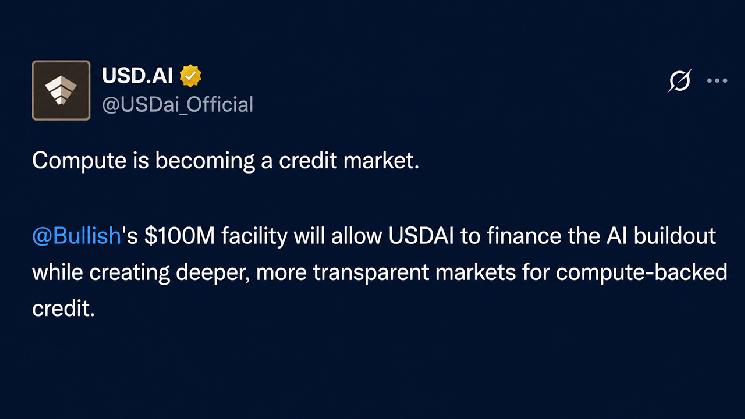
    Bullish, a New York Stock Exchange-listed institutional crypto platform and the parent company of the news publication Coindesk, announced this week that it is lending $100 million to USD.AI. The financing will support loans to businesses developing AI systems and related infrastructure.

    Under the model, AI companies use valuable graphics processing units (GPUs) as collateral. Bullish says the market for this emerging form of lending is substantial and larger than several established borrowing categories.

    “Bullish is targeting a capital-intensive sector that has rapidly emerged as one of the largest in private credit, with a scale that eclipses legacy debt markets such as auto loans and home equity lines of credit (HELOCs),” the company said.

    Bullish Expands Its Real-World Asset Strategy

    Block.one co-founder and CEO Brendan Blumer established Bullish in Hong Kong in 2020. Following Friday’s announcement, Bullish shares fell 2% on the NYSE. However, the stock was up 10.5% over five days and had gained more than 44% over the previous month.

    Thomas Cowan, Bullish’s head of tokenization, said the company believes physical assets should be connected to digital financial systems. He described the USD.AI transaction as an example of that strategy.

    “Our commitment to USD.AI reflects a conviction we’ve believed since our first investment in the protocol: that credible, well-structured real-world assets belong onchain,” Cowan remarked. “USD.AI’s onchain transparency gave us the visibility to underwrite this facility with the same institutional diligence we apply across our platform, and backing it is a meaningful step toward bringing tokenized assets to institutional scale.”

    GPU-Backed Loans Face a Major Risk Test

    GPU-backed lending also carries significant risks. Hardware prices can fall rapidly, while GPUs may become obsolete soon after more advanced models reach the market.

    As of Saturday, Aug. 29, 2026, GPU prices remained high, particularly for Nvidia consumer graphics cards with larger amounts of video memory. Valuations had also risen again during the summer rather than easing.

    The model’s most important test will come if a borrower is unable to repay its loan. In that scenario, lenders will need to determine how much value the pledged GPUs retain and how quickly they can be sold.

  • What Happens to Bitcoin, Ethereum, and XRP if the CLARITY Act Passes?

    What Happens to Bitcoin, Ethereum, and XRP if the CLARITY Act Passes?

    The CLARITY Act aims to resolve a question that has challenged U.S. regulators for more than a decade: when should a crypto token be treated as an investment, and when does it function more like a commodity such as gold?

    The answer would determine which regulator oversees a token, what its creators must disclose, and which rules crypto platforms must follow when listing the asset or holding it for customers.

    What Problem Is the CLARITY Act Designed to Solve?

    When a company or development team creates a token and sells it to finance a project, the transaction can resemble an investment. Early buyers may be betting on the team’s ability to build and promote the network.

    Years later, however, the same token could trade broadly across a decentralized network, with its value no longer primarily tied to the original team. At that stage, it may look more like a commodity than a security.

    U.S. law currently provides no clear rule for when a token crosses that line, leaving two federal regulators involved. The Securities and Exchange Commission oversees securities, while the Commodity Futures Trading Commission regulates futures markets and has more limited authority over direct commodity trading. Traditional assets generally fit clearly into one category. Crypto assets often do not.

    How the CLARITY Act Would Treat Bitcoin

    Bitcoin is already generally treated as a commodity, largely because it has no central issuer or company behind it. Under the current system, the CFTC’s authority over spot Bitcoin trading is mostly limited to policing fraud and market manipulation.

    The CLARITY Act would expand that authority, giving the CFTC broader power to directly regulate platforms where Bitcoin is bought and sold rather than intervening only after problems occur.

    How the Bill Would Treat Ethereum and $XRP

    Tokens such as Ethereum and $XRP occupy a more ambiguous position because of their fundraising histories and current decentralized use. The CLARITY Act attempts to draw the regulatory line based on a token’s function rather than solely on its origins.

    Fundraising activity would remain under SEC oversight, while later-stage trading in tokens deemed sufficiently decentralized could move to a new CFTC framework. The bill would not automatically classify every token as a commodity. Instead, it would create a path for tokens to move out of securities treatment when they no longer depend primarily on a central team.

    New Rules for Crypto Platforms and Projects

    Platforms operating under the proposed CFTC framework would have to register, keep customer assets separate from their own funds, and comply with requirements covering disclosures, recordkeeping and conflicts of interest.

    Projects raising money through token sales would need to disclose information about the people behind the project and explain how the underlying technology works. Insiders would also face new restrictions on how quickly they could sell their holdings.

    Why the CLARITY Act Has Been Difficult to Pass

    The central disagreement is not whether the crypto industry needs regulation, but what those rules should require and which agency should enforce them. Three disputes have shaped the bill’s progress.

    The first concerns rewards paid to stablecoin holders. Some platforms offer rewards for holding stablecoins, in a way that can resemble bank interest. Banks have argued that these programs could draw deposits away from the traditional banking system. Crypto companies have countered that restricting such rewards would protect banks from competition.

    After months of negotiations, lawmakers reached a compromise that would prohibit rewards paid solely for holding a stablecoin while allowing rewards connected to actually using one. Coinbase supported the revised agreement, and the Senate Banking Committee advanced the bill in May.

    The second dispute involves state regulatory authority. The CLARITY Act would replace certain state-level requirements with a single federal framework. Supporters say this would create consistency across the country, while critics warn that it could weaken states’ existing tools for investigating scams and holding crypto platforms accountable.

    The third issue concerns potential conflicts of interest among lawmakers and other federal officials. The latest draft would prohibit federal officials and their spouses from being paid to issue or sponsor digital assets while in office.

    Democrats are seeking stricter limits on lawmakers profiting from cryptocurrency. Republicans supporting the bill argue that the current draft already goes far enough. The legislation requires bipartisan support, and identical versions must pass both the House and Senate before it can reach the president’s desk.

    What Would Happen If CLARITY Passes?

    Crypto businesses would receive a clearer federal rulebook for registering and operating in the United States. Because the U.S. accounts for a significant share of global crypto capital and users, businesses and exchanges based outside the country could also adjust their practices to align with the new framework.

    That could extend the CLARITY Act’s influence beyond U.S. borders, particularly among companies serving American customers or seeking access to the U.S. market.

    What Happens If CLARITY Fails?

    Cryptocurrency would not become unregulated if the bill fails. Existing laws would continue to apply through regulators, courts and individual states.

    The main difference would be timing. Many of today’s legal boundaries are clarified only after a product launches, often after something has gone wrong. The CLARITY Act is designed to establish those boundaries in advance rather than after the fact.

    Source: cryptonews.net

  • How High Could Solana’s Price Rise in This Rally?

    How High Could Solana’s Price Rise in This Rally?

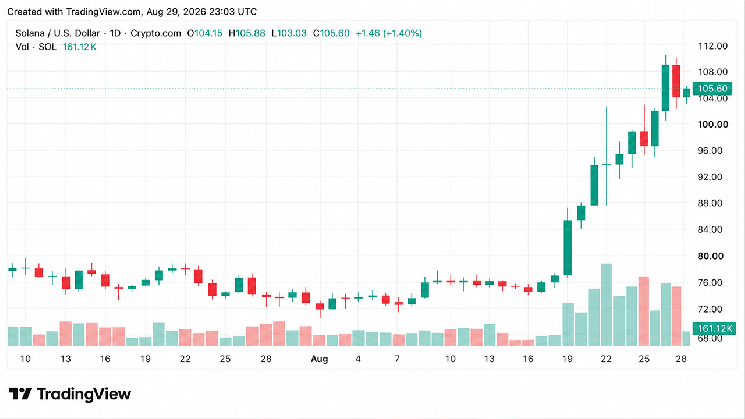
    Solana is trading at $105.23, marking a 12.3% gain over the past week after facing rejection at $110. Analysts had identified $110 as the cryptocurrency’s first major resistance level.

    According to analysts, Solana’s pullback from $110 began within the past day, later than a similar retracement already visible on Bitcoin’s chart. The move is currently viewed as an internal correction within a broader uptrend rather than a trend reversal, provided key support levels continue to hold.

    Solana Support Levels to Watch

    Two support zones are now in focus. The first is a weaker zone between $102.57 and $106.76, which is considered mainly relevant for intraday trading. The more significant support area lies between $90.46 and $94.83. Analysts calculated this range using Fibonacci retracement levels measured from Solana’s August 16 low to this week’s high.

    If the upper support zone breaks, selling pressure could push Solana toward the lower range. The price would need to stabilize near the August 26 swing low to preserve the current bullish market structure.

    A break below $90.46 would invalidate the bullish outlook, according to the analysts, and could open the door to broader short-term losses rather than a limited intraday decline.

    Solana Price Target: $133

    On the upside, the analysts’ Fibonacci resistance projection points to a potential Solana price target near $133. Reaching that level depends on the current support structure holding throughout the pullback.

    However, upward momentum has already started to weaken. Price action has become more volatile below $110, and a deeper pullback into the weekend appeared increasingly likely. At the time of recording, the immediate micro-support level had not yet broken.

    What the Solana Price Setup Means for Traders

    Solana’s next move may depend on the narrow support band between roughly $102 and $95. Holding above this area would keep the path toward $133 open. Losing the zone would shift attention toward the $90 support level, while a break below $90.46 would signal a more significant change in Solana’s short-term trend.

  • DeXe Jumps 36% as Trading Volume Hits $238 Million: 3 Factors That Could Drive Further Gains

    DeXe Jumps 36% as Trading Volume Hits $238 Million: 3 Factors That Could Drive Further Gains

    DeXe ($DEXE) has emerged as one of the strongest performers among the top 150 cryptocurrencies by market capitalization, with its price surging 36%.

    The rally has been supported by a sharp increase in trading activity and growing bullish sentiment across the market. According to CoinMarketCap, $DEXE’s trading volume rose 1,460% during the same period to reach $238 million.

    A simultaneous rise in price and trading volume is typically viewed as a sign that more buyers are entering the market and actively accumulating the asset.

    What is driving the DeXe price rally?

    The latest gains followed a significant increase in the number of $DEXE token holders. CoinMarketCap reported that the holder count rose by exactly 120, marking one of the largest single-day increases and contributing to the token’s price momentum.

    Source: CoinGlass

    However, the increase in holders was not the only notable development. Data indicates that whales—investors with substantial capital and liquidity—were also involved in the latest accumulation.

    The whale retail delta, which tracks activity between large investors and retail market participants, has climbed significantly over the past several weeks. A rising reading suggests that whales have been acquiring $DEXE, potentially setting the asset up for further gains.

    Source: CoinGlass

    Because whales typically hold positions for longer periods, their accumulation could help support the rally if broader market demand remains strong.

    Perpetual market activity supports bullish momentum

    Activity in the perpetual derivatives market has also played an important role, with a significant amount of capital flowing into $DEXE.

    According to the latest data, capital in the $DEXE perpetual market has reached approximately $29 million. The open-interest-weighted funding rate currently stands at 0.0054%.

    With market positioning tilted toward buyers, investors may be more likely to sustain the bullish momentum that has driven the recent advance.

    Source: CoinGlass

    Buying interest is also increasing across major exchanges. Binance and OKX are among the platforms showing elevated buying volume, while data from CoinGlass indicates that Binance’s top-trader volume ratio stood at 1.99. LBank’s ratio also exceeded 1.2.

    These readings suggest that traders are placing bids in anticipation that $DEXE could outperform in the near term.

    DeXe market sentiment remains positive

    Although capital is clearly flowing into $DEXE, market data also shows that investors continue to maintain a bullish outlook.

    The sentiment indicator measures the market’s overall expectations on a scale ranging from -10 to 10. Its latest reading stood at 5.7, indicating positive sentiment toward the asset.

    If this outlook persists, $DEXE could maintain its upward trajectory. Market sentiment often influences whether investors choose to buy, hold, or sell an asset.

    DeXe has gained 36% while trading volume jumped 1,460% to $238 million. Whale accumulation, bullish perpetual-market positioning, and positive sentiment could continue supporting the $DEXE rally if buying momentum holds.

  • Crypto Weekly: Solana Leads Altcoin Gains as XRP and DOGE Decline

    Crypto Weekly: Solana Leads Altcoin Gains as XRP and DOGE Decline

    Crypto markets ended the week virtually flat after a volatile stretch that saw bitcoin and major altcoins retreat from multi-week highs before recovering late in the session. The choppy trading followed a sharp rally the previous week, when digital assets added more than $500 billion in combined market value in seven days.

    Crypto market capitalization began the week near $2.74 trillion, fell below $2.7 trillion on Aug. 23, and then recovered to $2.79 trillion by Friday. By Saturday afternoon, however, total market capitalization had slipped to approximately $2.73 trillion, leaving the crypto economy nearly unchanged for the week.

    Bitcoin Recovers After Volatile Trading

    Momentum from the previous week’s U.S. Treasury bond buyback announcement carried into Tuesday, Aug. 25, briefly pushing bitcoin above $81,000 before the rally stalled. Bitcoin then consolidated between $77,000 and $79,000 for two days before surging again Thursday and reclaiming $81,000 for the second time in a week.

    Bitcoin fell below $77,000 in the period surrounding Federal Reserve Chair Kevin Warsh’s Jackson Hole address. The leading cryptocurrency later recovered some of its losses, returning above $78,000 by Saturday afternoon and recording a modest 1% weekly gain. The move kept bitcoin on track to end August more than 20% higher.

    Bitcoin and Gold Fuel Scarce-Asset Debate

    Bitcoin’s parallel movement with gold during the week renewed debate over whether institutional investors are shifting toward a broader debasement trade to hedge against the erosion of fiat currencies. Industry experts, however, described the trend as a structural evolution rather than a straightforward hedging strategy.

    Himanshu Sahay, co-founder and CTO of Arch Lending, said the simultaneous movement in bitcoin and gold was notable but should not automatically be viewed as evidence of an institutional flight from fiat debasement alone.

    “What I do think we’re seeing is a broader reassessment of scarce assets,” Sahay said. “Gold has traditionally played that role, while bitcoin increasingly occupies a similar position for investors who are comfortable with a higher-volatility asset. The fact that they’re moving together is important because it suggests bitcoin is increasingly being traded within a broader macro framework rather than purely on crypto-specific narratives. That’s a meaningful evolution for the asset.”

    Altcoin Performance Diverges

    Altcoin performance varied sharply, with several tokens recording double-digit gains or losses. Solana (SOL) led the advancing assets after Charles Schwab announced plans to add SOL, AVAX and LINK to its accounts in the near future.

    Privacy-focused cryptocurrency Monero (XMR) also posted strong gains, rising from $425 to close the week at $463 on Saturday. Among large-cap digital assets, RAIN recorded the strongest weekly performance, climbing 24%.

    On the losing side, XRP, one of the previous week’s top performers, declined nearly 7%. Dogecoin fell 7.2%, while ADA, XLM and BCH each dropped more than 10%.

    Despite the mixed performance across individual tokens, the combined altcoin market capitalization increased by just over 4%, rising from $1.13 trillion at the start of the week to $1.18 trillion on Aug. 29.

  • The Next Trillion-Dollar Currency May Not Be a Stablecoin

    The Next Trillion-Dollar Currency May Not Be a Stablecoin

    A new CoinDesk analysis examines why the next trillion-dollar currency could emerge outside the stablecoin model used today—and why it may not have a name yet.

    What the CoinDesk Analysis Says

    The development is significant because it could alter the outlook for the next trillion-dollar currency. However, the available reporting identifies a specific development without establishing that it represents a completed, industry-wide shift.

    The figures and descriptions remain limited to the scope and claims presented in the source. Further evidence is needed before drawing broader conclusions about the digital-asset market.

    Why It Matters for Digital Assets

    Crypto infrastructure is increasingly linking payments, financial markets and software systems. These connections may create new opportunities for adoption, while also raising questions about security, regulation, liquidity and operational reliability.

    Those factors will help determine whether the reported development advances beyond an initial test, study or proposal. They will also indicate whether the system can support broader participation from users and institutions.

    What Comes Next

    The key milestones will be additional disclosures, implementation details and evidence of adoption by users or institutions. Until those details emerge, the development should be viewed as a dated event rather than a prediction about market prices or a guarantee of future adoption.

    BlockchainReporter has previously covered related digital-asset infrastructure in earlier reporting.

    Source: cryptonews.net

  • Ethereum: $1.5B in ETF Inflows Meet Aggressive Selling—Can $2.3K Hold?

    Ethereum: $1.5B in ETF Inflows Meet Aggressive Selling—Can $2.3K Hold?

    Ethereum spot ETFs have recorded net inflows every trading day since August 12, with 12 consecutive sessions bringing in more than $1.5 billion. The substantial capital flow helps explain Ethereum’s rapid price gains and raises the question of whether strong ETF demand can push ETH above the $2,500 level.

    BlackRock’s Ethereum ETF attracts more than $1 billion

    Analytics platform Arkham reported that BlackRock clients have purchased more than $1 billion worth of Ethereum through the firm’s ETHA spot ETF, with no days of net selling. Over nine trading days, ETHA accumulated $1.02 billion in Ethereum.

    ETF inflows of this size point to strong institutional demand. However, derivatives market data suggests that Ethereum is also facing significant aggressive selling pressure.

    Ethereum sell pressure is absorbed above key support

    The Ethereum taker buy/sell ratio fell to 0.81 on Binance, marking one of the most extreme readings in its history. Crypto analyst Moreno observed that aggressive market-order selling volume was approximately 23% higher than taker buying volume.

    Despite the elevated selling pressure in the derivatives market, ETH was trading just below the $2,500 psychological level. A normalization in the taker buy/sell ratio while Ethereum remains near $2,500 would represent a strong bullish signal.

    Analysis of the realized prices for different ETH balance cohorts identified the $2,260-$2,350 range as the cost basis for the largest wallets. Ethereum’s market price remains above the aggregate cost basis of even these largest holders, meaning every tracked cohort is holding unrealized profits to varying degrees.

    A breakdown below key cost-basis levels would signal growing seller dominance. At the same time, rising Open Interest combined with aggressive selling would create a particularly bearish setup.

    As long as Ethereum defends the $2,300 area, buyers can remain confident that the market is absorbing the selling pressure.

    Ethereum’s short-term range raises distribution concerns

    Ethereum has established a trading range between $2,383 and $2,530. Consolidation following a period of explosive gains can be healthy, but the range’s position near the $2,466 swing high from June raises concerns that the market could be entering a distribution phase.

    Options data indicates that market participants are positioning for an Ethereum price rally in September. A breakout above the $2,530 local range high would provide the first important bullish signal for traders to monitor.

    Ethereum price outlook

    The continued streak of Ethereum spot ETF inflows points to firm demand, while derivatives data highlights strong aggressive selling at the same time.

    Short-term consolidation has interrupted Ethereum’s upward momentum. A decisive breakout above $2,530 is needed to confirm the next upward impulse move.

    Source: cryptonews.net