Author: Evan Mercer

  • Binance’s bStocks Adds 181K Asset Holders, Leading Adoption

    Binance’s bStocks Adds 181K Asset Holders, Leading Adoption

    Key Highlights

    • Binance’s bStocks added 181,000 new asset holders in seven days, outpacing Robinhood’s 148,700 additions.
    • The BNB Chain now commands a significant share of the tokenized stock market, signaling a shift in trader preferences.
    • Surge in tokenized stock adoption highlights growing demand for fractional ownership and digital asset alternatives.

    Binance bStocks Leads Tokenized Stock Surge with Record Holder Growth

    Binance’s tokenized stock product, bStocks, has established a commanding lead in the rapidly evolving digital asset sector, onboarding 181,000 new asset holders over the past week. According to data highlighted by Token Terminal, this growth trajectory significantly outpaces traditional fintech competitor Robinhood, which added 148,700 new holders during the same seven-day window. The milestone underscores a definitive migration of retail and institutional interest toward blockchain-based equity exposure, positioning the BNB Chain as a central infrastructure layer for tokenized traditional finance assets.

    Market Dynamics Shift as Tokenized Equities Gain Mainstream Traction

    The acceleration in bStocks adoption reflects a broader structural shift in how market participants access equity markets. Tokenized stocks offer distinct advantages over conventional share ownership, most notably fractional ownership capabilities that lower entry barriers for global investors. Binance has leveraged its regulatory positioning and the BNB Chain’s throughput capacity to capture this demand, effectively turning the chain into a primary settlement layer for tokenized equities. The platform’s ability to innovate within existing financial frameworks has allowed it to iterate faster than many Western-regulated counterparts, consolidating market share while competitors assess compliance roadmaps.

    Competitive Pressure Mounts on Traditional and Crypto-Native Platforms

    Robinhood’s substantial but secondary growth figures indicate that established fintech platforms are not ceding ground entirely, yet the velocity gap suggests a potential inflection point. As Binance deepens its bStocks catalog and liquidity pools, the competitive pressure on both traditional brokerages and other crypto exchanges to launch or expand tokenized equity offerings will intensify. Market observers note that the mixed signals in the broader cryptocurrency market—characterized by volatile token prices and shifting regulatory sentiment—create a complex backdrop where tokenized stocks emerge as a stable, yield-bearing use case for blockchain infrastructure.

    Why This Matters

    The rapid expansion of Binance bStocks signals that tokenized traditional assets are moving from experimental niche to scalable product-market fit. For the BNB Chain, capturing a dominant share of tokenized stock settlement validates its thesis as a high-performance financial infrastructure. For global regulators, the volume of non-U.S. retail participation via tokenized equities raises questions about investor protection, cross-border securities distribution, and the applicability of existing frameworks like MiCA or Reg S. For traders, the liquidity depth forming around these products may soon enable 24/7 equity exposure without reliance on legacy market hours or centralized clearinghouses. The next phase will likely involve expansion into tokenized ETFs, fixed income, and corporate actions processing on-chain.

    Frequently Asked Questions

    What are tokenized stocks and how do they differ from traditional shares?

    Tokenized stocks are blockchain-based digital representations of traditional equity shares. They enable fractional ownership, allowing investors to purchase portions of high-priced stocks, and typically trade on a 24/7 basis via crypto exchanges like Binance. Unlike traditional shares held in centralized brokerage accounts, tokenized stocks settle on-chain—on networks such as BNB Chain—providing transparent, near-instant finality.

    Why is Binance outperforming Robinhood in new tokenized stock holders?

    Binance’s bStocks benefits from the exchange’s global user base, the BNB Chain’s low transaction costs and high throughput, and a regulatory approach that has permitted faster product iteration in tokenized equities. Robinhood, while adding significant holders, operates under stricter U.S. securities regulations that limit the scope and speed of tokenized asset deployment.

    What role does the BNB Chain play in the tokenized stock ecosystem?

    The BNB Chain serves as the primary settlement and infrastructure layer for Binance’s bStocks products. Its significant market share in tokenized stock trading volume reflects the chain’s capacity to handle high-frequency, low-cost transactions required for equity token liquidity. This positions BNB Chain as critical financial infrastructure bridging traditional capital markets and decentralized technology.

  • BitMine Stock Stagnates: Why a Sharp Rally May Be Imminent

    BitMine Stock Stagnates: Why a Sharp Rally May Be Imminent

    Key Highlights

    • BitMine (BMNR) shares surged to $25.58, nearly doubling from 2025 lows as Ethereum reclaims the $2,500 level and the broader crypto market capitalization expands to $2.75 trillion.
    • The company holds 5.956 million ETH valued at over $15.4 billion and is nearing its accumulation target of 6 million tokens, after which it will pivot to generating free cash flow via its MAVAN staking validator network.
    • Technical indicators show both ETH and BMNR forming bullish flag and golden cross patterns, with analysts at Cantor Fitzgerald raising their BMNR price target to $60 and charts suggesting a potential move toward $40 resistance.

    BitMine Rides Ethereum Momentum Toward Strategic Inflection Point

    BitMine Corp. (BMNR) shares climbed to $25.58 in recent trading, marking a gain of nearly 100% from the stock’s lowest point this year. The rally mirrors a sharp recovery in Ethereum, which broke above the psychologically significant $2,500 resistance to trade at $2,595 — a substantial rebound from its year-to-date low of $1,517. The token’s ascent coincided with a broader cryptocurrency market expansion that lifted total market capitalization above $2.75 trillion, a 4% increase, while Bitcoin simultaneously reclaimed the $80,000 threshold.

    Ethereum Holdings Anchor BitMine’s Valuation Thesis

    BitMine’s position as a primary beneficiary of Ethereum’s price appreciation stems from its massive treasury holdings. The company currently holds 5.956 million ETH, a stash valued at over $15.4 billion at current prices. Technical analysis suggests further upside for the asset: ETH has formed a bullish flag pattern — characterized by a sharp vertical rally followed by a consolidating horizontal channel — and is approaching the pattern’s upper boundary. Compounding the bullish structure, a golden cross has emerged as the 50-day moving average crosses above the 200-day moving average, a classic signal of accelerating medium-term momentum. If these patterns resolve to the upside, a move toward $3,000 — roughly 16% above current levels — becomes a plausible scenario.

    From Accumulation to Cash Flow: The MAVAN Pivot

    BitMine’s stock advance also reflects a fundamental shift in corporate strategy. After 15 months dedicated to an aggressive Ethereum accumulation phase, the company — led by Tom Lee — is transitioning toward cash generation and strategic capital deployment. Lee’s stated objective is to accumulate 5% of all circulating ETH, an estimated 6 million tokens. With only approximately 43,000 tokens remaining to reach that target, the accumulation phase could conclude as early as this week or next. Once complete, BitMine, which operates with a lean team of about three employees, intends to cease share dilution and focus on free cash flow generation.

    Staking Yield to Fund Buybacks, Dividends, and Investments

    The mechanism for this cash flow is MAVAN, BitMine’s recently launched validator network. By staking its entire treasury through MAVAN at an estimated yield of 2.7%, the company projects annual returns of roughly 162,000 ETH. The dollar value of this yield will fluctuate with Ethereum’s market price, but the recurring token inflow provides a flexible capital base for share repurchases, dividend distributions, and strategic investments. This pivot from balance-sheet expansion to yield-driven capital return underpins Cantor Fitzgerald’s recent decision to raise its price target on BMNR to $60, implying significant further upside from current levels.

    Technical Setup Favors Continued Upside for BMNR

    BitMine’s own chart structure reinforces the fundamental narrative. The stock holds firmly above $23.67, a level that served as resistance in March, April, and May and has now flipped to support. BMNR has also carved out a bullish flag pattern, a continuation signal that typically precedes another leg higher. Additionally, the narrowing spread between the 50-day and 200-day moving averages suggests a golden cross formation is imminent for the equity itself, a development that would confirm strengthening trend momentum. Technicians see a path for the shares to test the key resistance zone near $40 in the coming weeks, representing a further advance of roughly 55% from current prices.

    Why This Matters

    BitMine’s trajectory illustrates a maturing playbook for corporate treasury management in the digital asset era. Unlike passive holders, BitMine has engineered a multi-phase strategy: aggressive accumulation during a bear market, followed by a structured transition to productive yield generation via native protocol infrastructure (MAVAN). The approach mirrors, in some respects, the Bitcoin treasury strategy popularized by MicroStrategy but applies it to Ethereum with a defined accumulation ceiling and a built-in staking yield engine. For investors, the next catalyst is the formal completion of the 6-million-ETH target and the first quarterly reporting of staking-derived cash flows. The market’s re-rating of the stock — evidenced by Cantor Fitzgerald’s $60 target — suggests confidence that the model can deliver sustainable, non-dilutive shareholder returns in a rising ETH environment.

    Frequently Asked Questions

    How many ETH does BitMine currently hold, and what is the target?

    BitMine holds 5.956 million ETH as of the latest data, valued at over $15.4 billion. The company’s stated accumulation target is 6 million ETH, representing approximately 5% of the circulating supply, leaving roughly 43,000 ETH remaining to acquire.

    What is MAVAN and how does it generate cash flow for BitMine?

    MAVAN is BitMine’s proprietary Ethereum validator network. By staking its treasury holdings through MAVAN at an estimated 2.7% annual yield, the company expects to earn approximately 162,000 ETH per year. These staking rewards can be sold or held to fund share buybacks, dividends, and strategic investments without diluting shareholders.

    What are the key technical levels to watch for BMNR stock?

    Immediate support sits at $23.67, the former multi-month resistance now acting as a floor. The stock has formed a bullish flag pattern and is approaching a golden cross (50-day MA crossing above 200-day MA). The next significant resistance level is $40, while Cantor Fitzgerald’s price target stands at $60.

  • Bitcoin Briefly Tops $81,000 as Bad News Stops Working

    Bitcoin Briefly Tops $81,000 as Bad News Stops Working

    Key Highlights

    • Bitcoin surged approximately 6% on Friday to briefly trade above $81,000, absorbing five major macroeconomic and regulatory headwinds—including a failed Senate vote on the CLARITY Act, a Federal Reserve rate hike, and a Bank of Japan rate increase—without a sustained selloff.
    • The rally was driven predominantly by short covering: $470 million in short positions were liquidated versus only $60 million in longs, while aggregate open interest fell 1.4%, signaling position compression rather than fresh leveraged buying.
    • Technical momentum is improving (14-day RSI at 63.56, above its moving average), but the daily MACD remains below its signal line, leaving the move unconfirmed by slower momentum indicators.

    Bitcoin Defies Concentrated Macro Headwinds

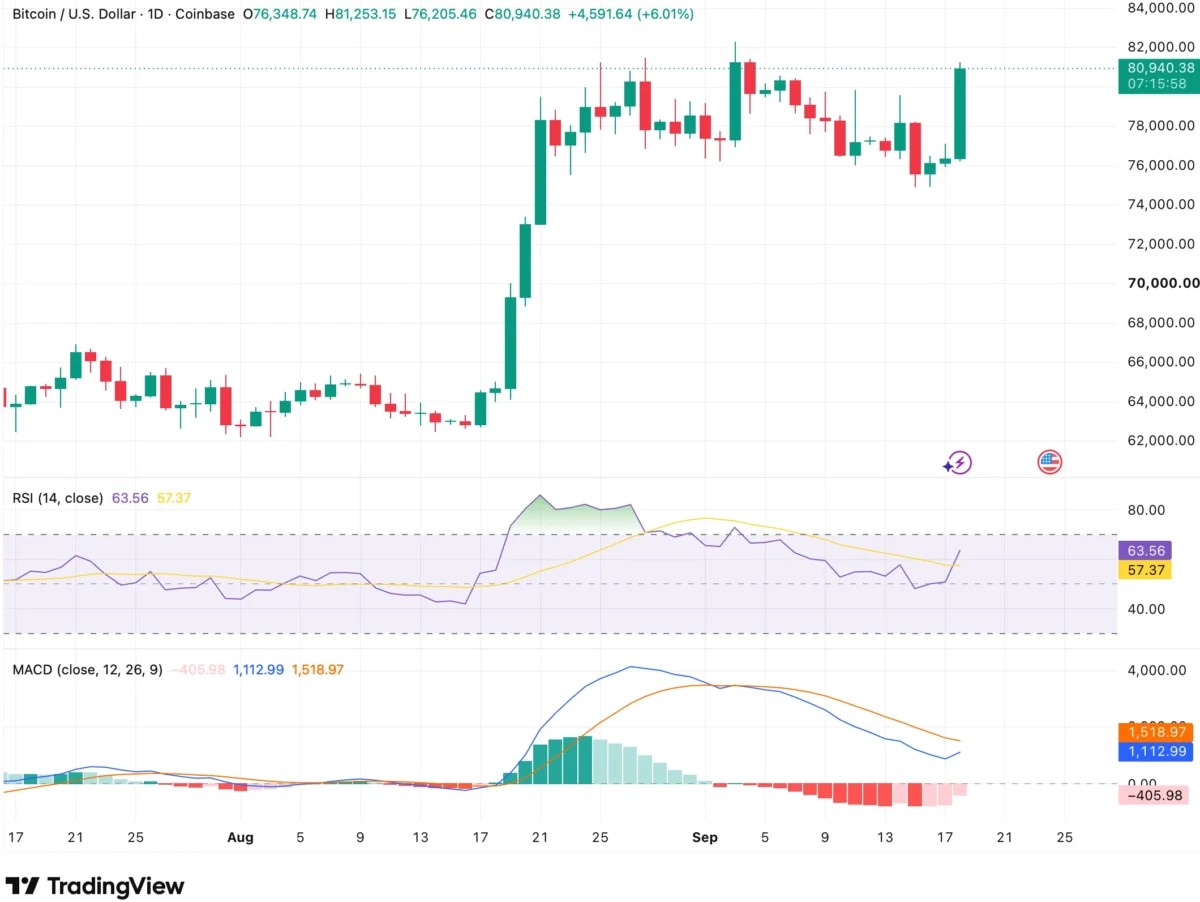
    Bitcoin staged a sharp intraday reversal on Friday, climbing roughly 6% to a session high of $81,253 on the Coinbase daily chart before settling near $80,940 at the time of writing. The advance is notable not for its magnitude but for the backdrop against which it occurred: within a single week, the market digested a procedural failure on the CLARITY Act in the U.S. Senate (49–50, short of the 60 votes needed for cloture), the Federal Reserve’s first rate increase since 2023 (lifting the target range to 3.75%–4.00%), the Bank of Japan’s policy rate hike to 1.25% (a 31‑year high), a U.S. Dollar Index reclaiming the 100 level, and Brent crude holding above $100 per barrel. Each of these developments typically pressures risk assets—higher rates boost the appeal of yield‑bearing alternatives, a stronger dollar tightens global financial conditions, and elevated oil sustains inflationary impulses—yet Bitcoin not only refused to extend its earlier decline toward $76,000 but accelerated higher.

    Derivatives Data Reveal Short‑Covering Dynamics

    Friday’s derivatives metrics provide a clearer mechanical explanation than any single bullish catalyst. According to Coinglass data, roughly $530 million in leveraged crypto positions were liquidated over 24 hours, with short positions accounting for approximately $470 million of that total versus only $60 million in long liquidations. Simultaneously, aggregate open interest declined 1.4% to $453.43 billion while 24‑hour derivatives volume rose 2.2% to nearly $936 billion. This combination—rising price, falling open interest, and disproportionately large short liquidations—is consistent with position compression: traders positioned for further downside were forced to buy back as Bitcoin rallied, amplifying the move. The breadth of the advance underscores the systemic nature of the squeeze; Ethereum gained 5.3%, XRP 6.2%, Solana 10.4%, and HYPE more than 11%, lifting total crypto market capitalization about 5% to $2.76 trillion.

    Short Squeezes Are Self‑Limiting

    While the liquidation cascade explains the velocity of Friday’s rally, it does not guarantee durability. Forced covering creates mechanical demand that evaporates once bearish positions are exhausted. The critical question is whether underlying spot demand—evidenced by sustained exchange trading activity, continued ETF inflows, or stable open interest rebuilding—persists after the liquidation impulse fades. Absent that, the rally remains a positioning unwind rather than a new demand regime.

    Technical Momentum Improves But Lags Price Action

    Bitcoin’s daily chart offers a second lens on sustainability. The 14‑day Relative Strength Index has climbed to 63.56, comfortably above its moving average at 57.37 and well clear of the conventionally overbought 70 threshold, indicating strengthening momentum without exhaustion. The Moving Average Convergence Divergence, however, tells a more cautious story: the MACD line has turned upward to 1,112.99 but remains below the signal line at 1,518.97, leaving the histogram negative at –405.98. The histogram bars have been contracting and the MACD line curling higher, suggesting the direction is improving, but a bullish crossover has not yet occurred. This divergence—price accelerating while the slower daily momentum indicator has not fully confirmed—creates a clear watchpoint: a MACD crossover would signal that momentum broadening is underway rather than remaining concentrated in a single explosive session.

    Historical Parallel: 2023 Regime Shift Echoes

    The current dynamic bears a striking resemblance to Bitcoin’s behavior throughout 2023. During that period, the asset absorbed aggressive Federal Reserve tightening (the target range ultimately reaching 5.25%–5.50%) alongside an intensive U.S. regulatory campaign that saw the SEC sue Coinbase and Binance and designate several major tokens as securities. Despite repeated negative headlines, each successive shock generated diminishing incremental selling pressure, and Bitcoin gradually ceased revisiting the lows established after the 2022 collapse. The lesson from 2023 is not that restrictive policy or enforcement actions became bullish, but that the market’s capacity to produce new sellers in response to them was waning. Markets can begin shifting before the news flow turns favorable, and Friday’s price action—absorbing five simultaneous headwinds without a net decline—suggests a similar recalibration may be in progress.

    Why This Matters

    The week’s events highlight a potential inflection point in Bitcoin’s market structure. For years, macro tightening and regulatory uncertainty acted as reliable catalysts for drawdowns. The failure of that playbook in the face of a concentrated barrage of negative catalysts—failed legislation, dual central‑bank hikes, dollar strength, and elevated energy prices—signals that the marginal seller may be exhausted. If spot demand proves resilient, leverage remains contained, and momentum indicators like the MACD confirm the RSI’s strength, the market could be transitioning to a regime where bad news is increasingly “priced in” and produces diminishing downside volatility. This has direct implications for portfolio allocation, risk management, and the narrative around Bitcoin’s maturation as a macro asset. Institutional participation metrics (ETF flows, custody data) and derivatives market structure (open interest trends, funding rates) will be the primary arbiters of whether this is a durable shift or a temporary positioning anomaly.

    Frequently Asked Questions

    What specifically drove Bitcoin’s 6% rally on Friday?

    The primary driver was a massive short‑covering event: approximately $470 million in short positions were liquidated in 24 hours, forcing bearish traders to buy back Bitcoin and accelerating the price rise. Aggregate open interest fell, confirming that the rally stemmed from position unwinding rather than new leveraged long entries.

    Is this rally sustainable or just a short squeeze?

    Sustainability hinges on whether genuine spot demand persists after the forced buying ends. Key signals to watch include continued ETF inflows, stable or gradually rebuilding open interest (rather than a surge in aggressive longs), and a bullish MACD crossover on the daily chart confirming broadening momentum.

    How does this week compare to previous macro stress periods for Bitcoin?

    The closest analogue is 2023, when Bitcoin absorbed simultaneous Fed tightening and SEC enforcement actions with progressively smaller drawdowns. In both episodes, the market’s reaction function to negative news appeared to change—selling pressure diminished even as the fundamental headwinds persisted—suggesting a structural shift in participant positioning and risk appetite.

  • BNB Chain Memecoin Launchpads Could Challenge Solana as MemeToro Adds AI Rules to Fair Launches

    BNB Chain Memecoin Launchpads Could Challenge Solana as MemeToro Adds AI Rules to Fair Launches

    Key Highlights:

    • MemeToro is building an AI-led memecoin launch platform on BNB Chain that enforces fair-launch rules through deterministic smart-contract validation, rejecting proposals with insider allocations or mismatched funding terms.
    • The project has raised over $137,000 in its Stage 7 presale with $MT priced at $0.00430, and has published 1,373 lines of Solidity across 17 files including a FairLaunchEscrow contract with no owner, admin role, or upgrade path.
    • Core platform components remain unfinished—including the live token executor, liquidity integration, and testnet deployment—with independent security reviews from Coinsult, BlockSAFU, and SOLIDProof still pending.

    MemeToro Positions BNB Chain as Foundation for Rules-Based Memecoin Launches

    Solana has long dominated memecoin trading volume thanks to its high throughput and minimal transaction costs, but BNB Chain is emerging as a credible alternative for launchpads prioritizing transparent funding mechanics over raw speed. MemeToro, a planned platform for researching, funding, and trading memecoins, has selected BNB Chain as its base layer to leverage lower gas fees, direct PancakeSwap liquidity routing, and smart-contract standards that are straightforward to audit. The project distinguishes itself by embedding an AI research layer, public launch manifests, and hard-coded validation rules designed to eliminate insider allocations before a funding round opens.

    Deterministic Validation Replaces Human Discretion

    MemeToro’s architecture centers on an AI agent that scans market, social, and news trends to produce a documented token proposal. Each proposal generates a public launch manifest disclosing the rationale, total supply, funding cap, fixed price, and supporting evidence. Before any round can proceed, the proposal passes through deterministic validation—programmed rules that check objective requirements rather than delegating final approval to an AI model. The validator is designed to reject proposals when source links were not collected by the system, token allocations do not equal 100%, an insider allocation is above zero, or funding terms do not match the launch manifest.

    Contract Design Eliminates Upgrade Paths and Admin Keys

    The project has published 1,373 lines of Solidity across 17 files, with the main FairLaunchEscrow.sol contract engineered to lock round settings at creation. The design includes no planned owner, admin role, or upgrade path, and routes funds exclusively to contributor refunds or the planned liquidity process. Allocation math requires contributors and liquidity to account for the full supply, with any rounding remainder directed to liquidity—making a hidden founder or insider allocation mathematically impossible. While this framework does not guarantee a memecoin will retain value, it provides users a verifiable rule set to inspect before committing capital.

    Why This Matters: Shifting the Launchpad Paradigm

    The memecoin launchpad landscape has traditionally optimized for frictionless token creation, often leaving buyers to conduct due diligence only after a token is live. MemeToro attempts to invert this dynamic by surfacing funding terms, allocation structures, and AI-generated research before capital is deployed. BNB Chain’s cost advantage supports this model by keeping the expense of multiple small transactions—funding, claiming, staking, trading—accessible to retail participants. However, the platform’s credibility hinges on completing several critical milestones: a live token executor, liquidity connection to PancakeSwap, manifest-to-contract integration, deployment scripts, a round factory, BNB Chain testnet deployment, ERC-8004 agent identity implementation, and finalized independent security audits. The project lists Coinsult, BlockSAFU, and SOLIDProof as review providers, though the scope of their final reports remains to be verified. If delivered, MemeToro could attract creators and buyers seeking stricter transparency standards; if not, it risks joining the ranks of ambitious but unfinished launchpad experiments.

    Frequently Asked Questions

    What is the current status of the MemeToro ($MT) presale?

    As of the latest update, MemeToro has raised more than $137,000 in Stage 7 of its presale, with $MT priced at $0.00430. The token is intended to support platform access, funding, staking, rewards, future memecoin trading, prediction markets, and a news portal.

    How does MemeToro prevent insider allocations?

    The FairLaunchEscrow smart contract enforces allocation math requiring contributors and liquidity to account for 100% of the token supply. The deterministic validator rejects any proposal where an insider allocation is above zero, and the contract design includes no owner, admin role, or upgrade path that could alter these rules post-deployment.

    What major components are still missing before mainnet launch?

    Key unfinished items include the live token executor, liquidity connection to PancakeSwap, manifest-to-contract integration, deployment scripts, a factory for creating new rounds, BNB Chain testnet deployment, ERC-8004 agent identity implementation, and completed independent security audits from the listed providers (Coinsult, BlockSAFU, SOLIDProof).

  • Top 3 BNB Memecoin Launchpads to Watch: Four.meme, Flap, MemeToro Amid Rising AI Launches

    Top 3 BNB Memecoin Launchpads to Watch: Four.meme, Flap, MemeToro Amid Rising AI Launches

    Key Highlights

    • BNB Chain has emerged as a hub for memecoin launchpads due to lower fees, with Four.meme, Flap, and MemeToro offering distinct approaches to token deployment.
    • MemeToro is developing an AI-led fair-launch model with public manifests, deterministic validation, and contract rules designed to eliminate insider allocations; its $MT token is in Stage 7 at $0.00430 with over $137,000 raised.
    • Four.meme leads with live infrastructure and fast, no-code token creation (~0.005 BNB fee), while Flap provides customizable bonding-curve structures for creators seeking flexible launch mechanics.

    BNB Chain Memecoin Launchpads Compete on Speed, Flexibility, and Fair-Launch Rules

    The BNB Chain ecosystem has become a focal point for memecoin launches, driven by low transaction fees and accessible decentralized liquidity pools. Three launchpad projects—Four.meme, Flap, and MemeToro—are attracting attention, though each addresses a different segment of the creator and contributor market. The choice between them effectively comes down to prioritizing deployment speed, bonding-curve flexibility, or rules-based launch governance.

    MemeToro Builds AI-Led Fair-Launch Infrastructure With Contract-Level Restrictions

    MemeToro is positioning itself as an AI-driven ecosystem for discovering, funding, and trading memecoins on BNB Chain. Its architecture centers on an AI agent designed to collect news, market, and social evidence before proposing a token concept through a public launch manifest. Contributors can review the reasoning, source links, supply parameters, funding caps, and fixed-rate terms before committing capital. The system enforces deterministic validation: it rejects proposals with uncollected source links, allocations that do not total 100%, any insider allocation above zero, and funding terms that deviate from the published manifest.

    The project has published its first contract layer—1,373 lines of Solidity across 17 files—including FairLaunchEscrow.sol. The escrow contract is designed without an owner, admin role, or upgrade path, locking round settings and routing funds exclusively to contributor refunds or planned liquidity. Token-allocation math requires contributors and liquidity to account for the full supply, with rounding leftovers directed to liquidity. MemeToro lists Coinsult, BlockSAFU, and SOLIDProof as named audit or review providers, offering contributors public verification material beyond a standard deployment flow.

    The $MT token is currently in Stage 7 at $0.00430, with more than $137,000 raised. The token is intended to support access, funding, staking, rewards, future memecoin trading, prediction markets, and the project’s news portal. At the displayed $0.05186 launch target, a $2,000 Stage 7 purchase (approximately 465,116 $MT before fees) would carry a theoretical paper value of roughly $24,121. At a $1 billion fully diluted valuation, the implied price would be approximately $0.8333, valuing the same allocation near $387,597. These are hypothetical scenarios, not guaranteed returns; real outcomes depend on delivery, liquidity, market demand, fees, slippage, taxes, and broader crypto-market conditions. MemeToro is not yet a fully live token factory; it still needs to complete the live executor, liquidity connection, factory, testnet deployment, and independent review.

    Four.meme Leads With Live Infrastructure and No-Code Token Creation

    Four.meme operates as an established BNB Chain token-launch platform built for quick, permissionless creation. It employs bonding curves and a reported deployment fee of about 0.005 BNB, minimizing the technical barrier for creators who want to launch without writing smart contracts or building dedicated launch websites. This approach has helped Four.meme cultivate a large BNB Chain meme-token ecosystem, with strengths in live infrastructure, easy access, and transaction volume. The trade-off is that a fast token factory does not inherently provide the research or validation layer of an AI-led proposal system; buyers must still conduct their own due diligence on creator wallets, token distribution, and liquidity conditions.

    Flap Offers Customizable Bonding-Curve Structures for Flexible Launches

    Flap functions as another permissionless BNB Chain deployment network, focusing on adjustable bonding-curve models. A bonding curve automatically adjusts token price based on buying and selling activity, streamlining early trading but introducing complexity for users unfamiliar with the mechanics. Flap appeals to creators who want more launch flexibility than a fixed template allows and to participants who experiment with different tokenomic structures. However, increased flexibility demands closer scrutiny of token terms by contributors. MemeToro takes a contrasting position: its planned fixed-rate rounds and validation rules aim to reduce moving parts before launch, potentially making verification easier for contributors even if it offers less creative latitude for issuers.

    Why This Matters

    The divergence among these three launchpads reflects a broader maturation in the memecoin launch sector. Early platforms prioritized speed and permissionless access, often leaving contributors exposed to opaque tokenomics, undisclosed insider allocations, and unaudited contracts. MemeToro’s approach—combining AI-curated launch rationale with immutable, ownerless escrow contracts and named audit partners—signals a shift toward verifiable, rules-based launches. For BNB Chain users, the choice now involves evaluating not just deployment cost and speed, but the depth of pre-launch transparency and the enforceability of fair-launch guarantees at the smart-contract level. As regulatory scrutiny on token offerings intensifies globally, launchpads that bake compliance-friendly features—public manifests, zero insider allocations, audited escrow logic—into their core architecture may gain a durable trust advantage. The next milestones to watch are MemeToro’s testnet deployment, independent audit completion, and live executor rollout, which will determine whether its proposed model functions as designed under real market conditions.

    Frequently Asked Questions

    Which BNB Chain launchpad is already live?

    Four.meme and Flap are operational launchpad models with live infrastructure. MemeToro is in development and has published its first fair-launch contract layer, but has not yet deployed a complete token factory.

    What makes MemeToro different from Four.meme?

    MemeToro is building an AI-led proposal and fair-launch system with public manifests and contract-level rules designed to block insider allocations. Four.meme focuses on fast, no-code token creation via a low-fee bonding-curve deployment flow without an integrated research or validation layer.

    Are launchpad tokens low risk?

    No. Launchpad and memecoin tokens remain highly volatile. Buyers should research the contract code, liquidity arrangements, token supply mechanics, and product development status before investing.

    More Information on MemeToro ($MT) Presale: Website | X | Telegram | YouTube

  • SEC’s ‘Innovation Exemption’ Boosts ONDO – Can the Altcoin Escape Its 4-Month Trap?

    SEC’s ‘Innovation Exemption’ Boosts ONDO – Can the Altcoin Escape Its 4-Month Trap?

    Key Highlights

    • Ondo Finance ($ONDO) surged over 12% in 24 hours as trading volume jumped 91% to exceed $267 million, driven by the SEC’s new five-year Innovation Exemption for tokenized securities venues.
    • The regulatory order allows qualified venues to trade tokenized stocks through permissioned liquidity pools without registering as traditional exchanges, potentially expanding the regulated market for Ondo’s tokenized products, which already exceed $3.5 billion in total market cap with over $900 million in tokenized stocks.
    • Technical analysis shows $ONDO testing a four-month descending triangle resistance near $0.38–$0.49, with MACD signaling a bullish crossover but bearish RSI divergence warning of rejection risk toward $0.30–$0.32 support.

    SEC Innovation Exemption Catalyzes Ondo Rally

    Ondo Finance’s native token $ONDO climbed more than 12% over the past 24 hours, outperforming the broader cryptocurrency market rally as daily trading volume surged 91% to surpass $267 million at press time. While the token benefited from general risk-on sentiment, the primary catalyst was a landmark regulatory development from the U.S. Securities and Exchange Commission that directly addresses the tokenized asset ecosystem Ondo operates within.

    Five-Year Regulatory Window for Tokenized Securities Venues

    On September 17, the SEC issued its “Innovation Exemption,” granting conditional relief to qualifying Tokenized Securities Venues for a five-year period. The order permits these venues to trade tokenized stocks through permissioned liquidity pools without requiring registration as traditional national securities exchanges. SEC Chairman Paul Atkins called the decision a significant step toward bringing U.S. capital markets on-chain. For Ondo Finance, which has positioned itself as a leading infrastructure provider for tokenized real-world assets, the exemption could substantially widen the regulated market accessible to its product suite.

    Ondo’s Tokenized Asset Footprint Expands

    According to data from Token Terminal, Ondo Finance’s total tokenized market capitalization has exceeded $3.50 billion. Tokenized stocks represent more than $900 million of that value, accounting for 25.5% of the composition. Funds hold the largest share at 71.2%, while stablecoins and commodities constitute 2.1% and 1.2% respectively. The regulatory clarity provided by the SEC’s temporary relief strengthens Ondo’s business case by reducing compliance uncertainty for institutional participants seeking exposure to on-chain representations of traditional securities.

    Technical Structure Tests Four-Month Triangle Resistance

    Despite the fundamental tailwind, $ONDO’s price action remains at a critical technical juncture. The token has been consolidating within a descending triangle pattern since early May, with resistance declining from $0.49 toward $0.38. Recent sessions saw price test this descending trendline as the MACD histogram turned positive after eight days of seller dominance, accompanied by a bullish signal line crossover. A confirmed breakout could target the pattern’s upper boundary near $0.50. However, bearish RSI divergence persists, indicating selling pressure may not be fully exhausted. Rejection at current levels risks a return to the $0.30–$0.32 support zone, with a break below $0.30 opening the path toward a deeper demand area around $0.26. Profit-taking from positions established near $0.30 could also interrupt the near-term advance.

    Why This Matters

    The SEC’s Innovation Exemption represents the most concrete federal regulatory acknowledgment to date that tokenized securities can operate within a tailored framework distinct from traditional exchange infrastructure. By creating a five-year sandbox for permissioned liquidity pools, the order addresses a core structural barrier that has limited institutional adoption of on-chain assets: the lack of a clear legal pathway for secondary trading. Ondo Finance, alongside peers such as Franklin Templeton and BlackRock in the tokenized fund space, stands to benefit directly as the universe of compliant counterparties and venues expands. The coming months will test whether regulatory relief translates into sustained capital inflows and deeper liquidity for tokenized equities, or whether the market remains constrained by custody, settlement, and interoperability frictions that the exemption does not resolve.

    Frequently Asked Questions

    What does the SEC’s Innovation Exemption allow for tokenized securities venues?
    The exemption grants conditional relief for five years, permitting qualified venues to trade tokenized stocks through permissioned liquidity pools without registering as traditional national securities exchanges.
    How large is Ondo Finance’s tokenized asset market currently?
    Ondo’s total tokenized market capitalization exceeds $3.50 billion, with tokenized stocks accounting for more than $900 million (25.5%) of that total, according to Token Terminal data.
    What are the key technical levels to watch for $ONDO?
    Immediate resistance sits at the descending triangle trendline near $0.38–$0.49, with a breakout target near $0.50. Key support lies at $0.30–$0.32; a break below $0.30 could see price test the $0.26 demand zone.
  • Ethereum Price Prediction: ETH Nears $2.5K as ETF Outflows Hit $407.3M

    Ethereum Price Prediction: ETH Nears $2.5K as ETF Outflows Hit $407.3M

    Key Highlights

    • Ethereum retreated 11.6% from a September 11 high of $2,667 to $2,356, and was trading near $2,495 while testing the $2,530 local resistance zone.
    • Spot Ethereum ETFs recorded $407.3 million in cumulative outflows over three trading days, according to Farside Investors data, signaling short-term bearish pressure.
    • On-chain analytics platform Santiment reported a significant drop in Ethereum transaction costs alongside price recovery in July and August, suggesting a friendlier environment for network projects.

    Price Action and Federal Reserve Policy Weigh on Bullish Conviction

    Ethereum’s recent price trajectory illustrates the tug-of-war between technical recovery and macroeconomic headwinds. After rallying to a local high of $2,667 on Friday, September 11, ETH surrendered those gains within four days, dropping 11.6% to $2,356. At the time of writing, the asset was changing hands near $2,495, once again knocking on the door of the $2,530 resistance level that has capped advances in recent sessions. The catalyst for the reassessment came from the Federal Reserve’s Wednesday rate-hike decision, which reintroduced the prospect of further monetary tightening to combat inflation. A sustained tightening cycle typically drains liquidity from risk-on assets, making cryptocurrencies vulnerable to deeper corrections.

    Spot ETF Outflows Highlight Waning Institutional Demand

    Adding to the cautious tone, spot Ethereum exchange-traded funds have seen a sharp reversal in flow dynamics. Data from Farside Investors shows that the past three trading days produced a cumulative net outflow of $407.3 million. This streak marks a notable shift from the steady inflows that accompanied the funds’ launch and early trading weeks. The outflows suggest that institutional allocators are either taking profits or reducing exposure amid uncertainty over the interest-rate outlook and Ethereum’s ability to sustain a breakout above key technical levels.

    On-Chain Fundamentals Improve as Transaction Costs Decline

    Despite the price volatility and flow data, underlying network metrics paint a more constructive picture. In a post on X, analytics firm Santiment observed that Ethereum transaction costs have dropped considerably over recent months. The firm attributed the decline to soft mainnet demand, which has reduced congestion and lowered fees, even as the token price recovered substantially during July and August. Santiment noted that cheaper utility combined with price recovery creates a friendlier environment for Ethereum-based projects, and that recovering participation alongside low execution costs could be a bullish signal for the network’s long-term health.

    Technical Structure Favors Range Resolution, But Breakout Skepticism Persists

    From a charting perspective, the daily and weekly timeframes remain bullishly aligned. The 1-day chart confirmed a breach of the April swing high at $2,466, a development technicians view as a sign of intent from buyers. Fibonacci retracement levels drawn from the weekly structure show that a recovery above the 78.6% level at $2,147 in August was an encouraging milestone. However, price action has since consolidated within a well-defined $2,380–$2,530 range (purple on charts). The range high is currently under test, but volume indicators urge caution: the Moving Average Convergence Divergence (MACD) has formed a bullish crossover below the zero line, indicating nascent momentum, while On-Balance Volume (OBV) remains well below last week’s peaks, reflecting subdued buying interest during the recent bounce.

    Traders’ Call to Action: Watch for a Range Resolution

    Given the history of failed breakouts, swing traders are advised to treat any move above $2,530 with skepticism until sustained volume confirms the advance. Conversely, a decisive close below the $2,380 range floor would open the door for a bearish extension, potentially triggering a sharp liquidity hunt. Risk management remains paramount in navigating this compression zone.

    Why This Matters

    Ethereum sits at a critical junction where macroeconomic policy, institutional fund flows, and on-chain fundamentals are sending mixed signals. The Federal Reserve’s hawkish stance threatens to keep a lid on risk appetite across all asset classes, while the abrupt reversal in spot ETF flows—once a primary driver of the 2024 rally—raises questions about the depth of institutional commitment. At the same time, declining transaction fees and a technically bullish weekly structure suggest the network’s foundational health is improving. How the $2,380–$2,530 range resolves will likely set the tone for Q4 price action and determine whether Ethereum can decouple from short-term macro volatility to resume its longer-term uptrend.

    Frequently Asked Questions

    What triggered Ethereum’s recent pullback from $2,667?

    The pullback coincided with the Federal Reserve’s rate-hike decision, which revived concerns about tighter liquidity conditions. Combined with profit-taking after the failed breakout, this macro catalyst led to an 11.6% retracement to $2,356 within four days.

    Do the spot Ethereum ETF outflows signal a long-term trend reversal?

    Not necessarily. The $407.3 million in outflows over three days reflects short-term repositioning amid macro uncertainty. However, sustained outflows over several weeks would be a more concerning signal for institutional conviction.

    What are the key technical levels to watch for Ethereum next?

    The immediate range is bounded by $2,380 (support) and $2,530 (resistance). A confirmed break above $2,530 on strong volume could target higher resistance zones, while a daily close below $2,380 would increase the probability of a deeper correction toward the $2,147 Fibonacci level.

  • Japan’s National Police Agency Exposes North Korean Hackers in Joint Operation with US, Australia, Germany

    Japan’s National Police Agency Exposes North Korean Hackers in Joint Operation with US, Australia, Germany

    Key Highlights

    • A seven-nation intelligence coalition publicly attributed a global cryptocurrency theft campaign to the North Korean group WaterPlum (alias “Contagious Interview”), linking the operation to the 313 General Bureau of the Munitions Industry Department under the Central Committee of the Workers’ Party of Korea.
    • Fake job recruitment schemes targeting software developers compromised over 30,000 devices across 100+ countries and breached approximately 7,000 cryptocurrency accounts, diverting an estimated 1.7 billion yen ($10.71 million) to North Korea between December 2025 and July 2026.
    • Japanese authorities dismantled a domestic “laptop farm” used to conceal the physical location of North Korean IT workers, marking the first such intervention in Japan and exposing a broader labor fraud network routing hundreds of millions of yen annually to Pyongyang.

    Seven-Agency Coalition Unmasks WaterPlum Operation

    In a coordinated announcement on Friday, September 18, 2026, seven national security agencies jointly exposed a North Korean cyber operation that has been masquerading as technology recruiters to steal cryptocurrency from information technology professionals worldwide. The advisory bears the seals of Japan’s National Police Agency (NPA) and National Cybersecurity Office, the United States Federal Bureau of Investigation (FBI) and Department of Defense Cyber Crime Center (DC3), Australia’s ASD Cyber Security Centre, and Germany’s Bundesnachrichtendienst (BND) and Bundesamt für Verfassungsschutz (BfV).

    The disclosure was made under a “public attribution” framework—a deliberate diplomatic and legal strategy designed to deter future attacks by formally naming the state sponsor and operational units behind malicious cyber activity. According to the joint assessment of the NPA and FBI, the hackers operating under the WaterPlum banner, alongside a contingent of North Korean IT workers, operate under the direct command of the 313 General Bureau of the Munitions Industry Department, a subunit of the Central Committee of the Workers’ Party of Korea. This chain of command confirms the operation as a state-directed revenue generation program for Pyongyang’s weapons development, a charge U.S. intelligence agencies have leveled repeatedly in previous North Korean cryptocurrency theft campaigns—allegations the North Korean regime has consistently denied.

    Fake Recruitment Lure: How the Malware Campaign Worked

    The threat actors posed as hiring managers at artificial intelligence firms, cryptocurrency ventures, and non-fungible token startups, extending attractive job offers to software developers. Candidates were guided through technical interviews or coding assignments, then instructed to download and execute files framed as assessment tasks. Those files were weaponized: they carried malware embedded in Node Package Manager (npm) packages, deploying a suite of custom payloads identified as BeaverTail, InvisibleFerret, OtterCookie, OtterCandy, and StoatWaffle.

    Once installed, the malware established persistent backdoors via remote-access trojans, enabling operators to harvest browser-stored passwords, keystroke logs, screenshots, and—critically—the private keys and seed phrases that control cryptocurrency wallets. Between December 2025 and July 2026, the campaign infected more than 30,000 devices in over 100 countries and compromised sensitive credentials for roughly 7,000 cryptocurrency accounts, yielding the 1.7 billion yen ($10.71 million) in diverted assets.

    Malware Arsenal and Technical Infrastructure

    The five identified malware families represent a modular toolkit designed for credential theft, system surveillance, and long-term access maintenance. Researchers note the use of legitimate software supply chains—specifically the npm registry—as a delivery vector, allowing the malicious packages to blend with routine development workflows. The stolen private keys and seed phrases provided direct, irreversible control over victims’ on-chain assets, facilitating rapid liquidation and laundering through North Korea’s established cryptocurrency mixing and exchange networks.

    Japan’s First Laptop Farm Takedown

    The advisory reveals a second, parallel operation: North Korean IT workers residing in North Korea, China, and Russia fraudulently secured remote programming and web-development contracts, funneling hundreds of millions of yen in wages back to the regime over several years. To obscure the true geographic origin of this labor, the network enlisted local facilitators to operate “laptop farms”—physical locations housing devices that made the remote workers appear to be logging in from within the hiring country.

    Japanese investigators identified, raided, and shut down one such laptop farm operated by a domestic enabler, marking the first known disruption of this infrastructure type in Japan. The takedown illustrates how North Korea’s revenue generation blends cyber intrusion with labor fraud, exploiting the global shift toward remote work to bypass sanctions and financial controls.

    Why This Matters

    The WaterPlum attribution arrives amid a sharp escalation in state-sponsored cryptocurrency theft. The advisory cites a 420% surge in malware targeting public blockchains, with North Korea and Iran identified as primary originators. In June 2026, G7 leaders formally classified North Korean cryptocurrency theft as a significant security threat, citing an estimated $6.75 billion stolen since 2016 by Pyongyang-linked actors. Independent research presented at Black Hat by Vangelis Stykas corroborates the scale: his analysis traced North Korean infiltration into 1,640 companies across 57 countries, frequently initiated through the same fake job offers that deliver malware, as reported by Cryptopolitan. The seven-agency public attribution signals a strategic shift toward collective deterrence, exposing not only the hackers but the institutional command structure that directs them.

    Frequently Asked Questions

    What is WaterPlum and who controls it?

    WaterPlum (also known by the alias “Contagious Interview”) is a North Korean cyber operation attributed by seven national intelligence agencies to the 313 General Bureau of the Munitions Industry Department, a unit under the Central Committee of the Workers’ Party of Korea. The group conducts cryptocurrency theft and labor fraud to fund North Korea’s weapons programs.

    How did the fake job scheme steal cryptocurrency?

    Attackers posed as recruiters at AI, crypto, and NFT companies. After interviews, victims were sent malware-laced npm packages (BeaverTail, InvisibleFerret, OtterCookie, OtterCandy, StoatWaffle) disguised as coding tests. The malware installed remote-access trojans, stealing browser passwords, keystrokes, screenshots, and—most critically—private keys and seed phrases for cryptocurrency wallets, enabling direct asset theft.

    What is a “laptop farm” and why is Japan’s takedown significant?

    A “laptop farm” is a physical facility where local enablers host devices that make North Korean remote workers appear to be logging in from within the hiring country (e.g., Japan). Japan’s disruption of such a farm is the first known case of its kind in the country, exposing a key infrastructure layer that allows North Korea to evade sanctions and labor laws while routing wages back to the regime.

  • MemeToro Surges to $137K as Open Source AI Development Advances

    MemeToro Surges to $137K as Open Source AI Development Advances

    Key Highlights

    • MemeToro surpasses $137,000 in Stage 7 presale funding with $MT priced at $0.00430 per token, targeting a launch price of $0.05186.
    • Project publishes 1,373 lines of open-source Solidity code across 17 files, including FairLaunchEscrow.sol with no owner, admin role, or upgrade path to prevent post-funding term changes.
    • AI agent validates launch proposals through deterministic rules that reject insider allocations, enforce 100% token distribution, and require collected source evidence before launch.

    MemeToro Advances AI-Led Memecoin Launch Platform with Transparent Presale and Open-Source Architecture

    MemeToro has crossed $137,000 in funds raised during its Stage 7 presale, where the native $MT token is priced at $0.00430. The milestone arrives as the project continues publishing open-source development work for its planned AI-led memecoin launch platform on BNB Chain. For market participants evaluating the best memecoin to buy right now, the central question extends beyond presale totals to whether the project is building infrastructure that retains relevance after token launch. MemeToro addresses this through public code repositories, an AI agent that documents token proposals, and smart-contract rules engineered to block insider allocations.

    Platform Architecture: AI Agent and Deterministic Validation

    MemeToro is building a BNB Chain platform for discovering, funding, and trading memecoins. Its planned system employs an AI agent to analyze market, news, and social trends before proposing a new token launch. The agent generates a public launch manifest detailing the token concept, source evidence, funding cap, supply structure, and funding-round conditions. This approach aims to provide participants more information than a typical meme-token announcement, which often presents only a name, logo, and countdown timer.

    The $MT token is designed to support platform access, funding, staking, rewards, memecoin trading, prediction markets, and a news-focused product layer. These features remain part of the planned ecosystem and depend on product delivery. The project’s displayed launch target is $0.05186, though long-term viability hinges on development execution, user demand, and market liquidity.

    Open-Source Contract Design Eliminates Admin Controls

    MemeToro has published 1,373 lines of Solidity code across 17 files in its first fair-launch contract release. The primary addition is FairLaunchEscrow.sol, designed to hold contributor funds for a single launch round. Because the code is open source, developers and community members can inspect the stated rules, creating a verifiable record beyond roadmap promises.

    The contract locks key settings when a round begins and includes no planned owner, admin role, or upgrade path. This design intends to prevent the team from altering terms after users commit funds. Additionally, the contract stores a fingerprint of the public launch manifest, allowing users to compare the on-chain round with the document they reviewed before payment. The project still needs to complete the token executor, liquidity connection, manifest integration, round factory, BNB Chain testnet deployment, and independent security review.

    AI Agent Enforces Structural Integrity Through Programmed Rules

    MemeToro’s AI agent is not designed to launch a token simply because a meme gains popularity. Its role is to collect evidence, prepare a proposal, and publish the reasoning behind the proposed launch. The proposal then passes through deterministic validation—standard programmed rules, not the AI model alone, check whether the launch meets stated requirements. The validator rejects a proposal when source links were never collected by the system, token allocations do not equal 100%, an insider allocation is above zero, or funding terms do not match the published proposal.

    This model separates research and documentation (handled by AI) from enforcement (handled by contract logic). MemeToro lists Coinsult, BlockSAFU, and SOLIDProof as audit or review providers. Buyers can examine these named firms alongside the public code and official project updates.

    Investment Scenarios Illustrate Presale-to-Launch Multiples

    Buying in with $750 at the current Stage 7 price yields approximately 174,419 $MT tokens before fees. At the project’s targeted launch figure of $0.05186, this position would translate into an estimated paper value of $9,045, reflecting a consistent 12.06x jump across the investment range. In a more optimistic scenario assuming MemeToro reaches a $1 billion fully diluted valuation with an implied token price of $0.8333, the same holding would theoretically scale to approximately $145,349. This upper figure should be viewed as an optimistic benchmark rather than a guaranteed return, since actual results remain heavily contingent on real market demand, exchange listings, and order-book liquidity at the moment of any eventual sale.

    Why This Matters

    The memecoin sector has long been criticized for opaque launch mechanics, undisclosed insider allocations, and post-launch rug pulls. MemeToro’s approach—combining AI-driven research with immutable, ownerless smart contracts—represents an attempt to introduce verifiable fairness into a category defined by speculation. By publishing the FairLaunchEscrow.sol contract with no upgrade path and requiring deterministic validation that rejects any insider allocation above zero, the project sets a technical precedent that could influence future launchpad designs on BNB Chain and beyond. The involvement of named audit firms Coinsult, BlockSAFU, and SOLIDProof adds a layer of third-party scrutiny, though the project acknowledges that open-source code does not eliminate risk. As the ecosystem awaits testnet deployment and security review completion, MemeToro’s progress will serve as a case study in whether transparent, rules-based memecoin launches can attract sustained liquidity and user trust.

    Frequently Asked Questions

    What is the current MemeToro presale price?

    $MT is priced at $0.00430 in Stage 7, according to the latest project information.

    Why has MemeToro raised more than $136,000?

    The project is attracting attention around its AI-led launchpad plan, public fair-launch code, and zero-insider contract design. Raised funds do not guarantee future token performance.

    How can users buy $MT?

    Users can visit the official MemeToro website, connect a compatible wallet on BNB Chain, choose a supported payment method, and confirm the transaction. Never share a wallet seed phrase.

  • Altcoin Hits All-Time High: Why It Surged and Analyst Predictions

    Altcoin Hits All-Time High: Why It Surged and Analyst Predictions

    Key Highlights

    • Hyperliquid Strategies accumulated 4.28 million HYPE tokens worth approximately $385 million over three weeks, representing 1.4% of circulating supply and outpacing Assistance Fund purchases by 7.5 times.
    • Despite aggressive institutional buying, HYPE price initially declined from $89 to $76, with analyst Shaunda Devens attributing weakness to insufficient marginal demand beyond PURR-driven flows and existing investors selling into the bid.
    • HYPE subsequently reversed to all-time highs as selling pressure abated; Devens notes improved financial positioning (cash assets of $245 million, market-cap-to-net-asset ratio of 1.24) but cautions that current valuation prices in significant optimism despite a 50% revenue decline since August 2024.

    Institutional Accumulation Drives HYPE to Record Highs

    Hyperliquid’s native token, HYPE, reached new all-time highs today following weeks of concentrated institutional buying by Hyperliquid Strategies. According to crypto analyst Shaunda Devens, the entity purchased 4.28 million HYPE tokens in just three weeks, deploying approximately $385 million. This accumulation represents roughly 1.4% of the token’s circulating supply and dwarfs the purchasing activity of the Assistance Fund, which bought only a fraction of that amount over the same period. Devens highlighted that Hyperliquid Strategies’ buying accounted for an estimated 15% of total Hyperliquid spot trading volume during the accumulation window, underscoring the outsized influence of a single institutional participant on market dynamics.

    Analyst Flags Demand Concerns Amid Aggressive Buying

    Despite the substantial bid from Hyperliquid Strategies, Devens observed that HYPE price action initially deteriorated, falling from $89 to $76 even as positive catalysts such as Kraken’s HIP-3 announcement failed to arrest the decline. The analyst interpreted this divergence as evidence of insufficient marginal demand beyond PURR-driven mechanisms, with existing holders using the institutional bid as liquidity to exit positions. Devens identified the $80 price region as a critical support zone, noting that approximately 33.4 million HYPE — about 11% of circulating supply — changed hands within this range. The analyst warned that a withdrawal of the primary buyer combined with a decisive break below $80 could trigger a cascading sell-off capable of ending the prevailing uptrend.

    Price Recovery and Improved Fundamentals Alter Near-Term Outlook

    Contrary to the bearish scenario outlined by Devens, the market moved in the opposite direction. HYPE surged to fresh all-time highs as selling pressure evaporated. The analyst acknowledged that Hyperliquid Strategies now sits in a materially stronger financial position compared to three weeks prior, with cash assets rising to $245 million and a market-capitalization-to-net-asset ratio of 1.24. Based on this improved balance sheet and the reduction in overhead supply, Devens expressed a very positive short-term outlook for the token, suggesting the path of least resistance remains higher.

    Valuation Shift Raises Caution on Priced-In Optimism

    However, Devens underscored a fundamental shift in HYPE’s investment narrative. The token, previously viewed as a fundamentally cheap asset largely overlooked by the broader sector, has transitioned into a widely accepted holding with elevated growth expectations now embedded in its price. Devens argued that current levels reflect a significant degree of optimism, pointing to a disconnect between token performance and protocol fundamentals: Hyperliquid’s revenues have declined by approximately 50% since August 2024, yet the HYPE price has nearly doubled over the same period. This divergence suggests that further upside may require evidence of revenue re-acceleration or new fundamental catalysts beyond the existing institutional accumulation story.

    Why This Matters

    Hyperliquid operates as a high-performance decentralized perpetual futures exchange, and its native token HYPE serves as both a governance and value-accrual mechanism within the ecosystem. The aggressive accumulation by Hyperliquid Strategies — effectively a protocol-aligned treasury vehicle — signals strong internal conviction and reduces circulating supply available to the market. However, the analyst’s observations reveal a market increasingly reliant on a single dominant buyer, creating structural fragility if that bid withdraws. The revenue decline since mid-2024 coincides with broader crypto market volatility and competitive pressures from both centralized exchanges and rival onchain venues. For investors, the key tension lies between the token’s improved technical setup and balance-sheet strength versus a valuation that may have decoupled from near-term fundamental trajectories. Upcoming protocol upgrades, fee-switch mechanisms, or expansion into new asset classes could serve as the next fundamental catalysts to justify current pricing.

    Frequently Asked Questions

    How much HYPE did Hyperliquid Strategies buy, and at what cost?

    Hyperliquid Strategies purchased 4.28 million HYPE tokens over a three-week period at an aggregate cost of approximately $385 million, according to analyst Shaunda Devens.

    Why did HYPE price fall initially despite heavy institutional buying?

    Devens attributes the price weakness to a lack of sufficient marginal demand beyond PURR-driven flows, with existing investors using the institutional bid as an opportunity to sell their holdings.

    What is the current financial position of Hyperliquid Strategies?

    As of the latest assessment, Hyperliquid Strategies holds $245 million in cash assets and trades at a market-capitalization-to-net-asset ratio of 1.24, indicating a stronger balance sheet than three weeks prior.