Tag: Bitcoin

  • Bitcoin Could See Dollar Drop Bulls Want This Week, But Miss Needed Liquidity Rally

    Bitcoin Could See Dollar Drop Bulls Want This Week, But Miss Needed Liquidity Rally

    Bitcoin’s Next Macro Catalyst: ECB Decision Could Weaken Dollar Without Easing Financing Conditions

    The European Central Bank’s September 10 policy decision may strengthen the euro and push the U.S. dollar index lower, offering potential relief to Bitcoin after its recent slide below $80,000. However, a currency-driven decline in the dollar index would provide limited evidence that the financing conditions restraining risk assets have actually improved.

    Data from CryptoSlate showed Bitcoin trading around $78,800, down roughly 1% over 24 hours, after stronger U.S. labor data revived expectations that interest rates could remain elevated. That leaves Thursday’s ECB decision as the next major macro event capable of shifting the currency backdrop before U.S. inflation data returns focus to the Federal Reserve.

    Euro’s Heavy Weight in Dollar Index Creates Potential False Positive for Bitcoin

    The distinction will hinge on what moves alongside the euro. A sustained Bitcoin recovery would carry more weight if it coincides with lower real yields, easier credit conditions, and gains in both BTC/USD and BTC/EUR pairs. A falling dollar index on its own could simply reflect Europe becoming relatively more attractive.

    The complication stems from how the dollar index is constructed. The euro carries a 57.6% weight in the Intercontinental Exchange’s dollar index, far larger than the Japanese yen at 13.6% or the British pound at 11.9%. A sufficiently strong move in EUR/USD can therefore drag the index lower even if U.S. borrowing costs remain high and the amount of capital available to investors barely changes.

    That creates a potential false positive for Bitcoin traders who use the dollar index as a shorthand for liquidity conditions. If the euro appreciates while Bitcoin’s dollar price remains unchanged, the cryptocurrency becomes cheaper for a euro-based buyer. If Bitcoin subsequently rises in dollars but makes little progress in euros, part of the apparent strength can be explained by currency translation rather than broader demand.

    Recent Bitcoin Price Action Shows Mixed Signals Across Currency Pairs

    Recent trading illustrates why the distinction can be useful. Between the September 1 and September 3 UTC closes, Bitcoin gained 4.99% against the dollar and 4.63% against the euro. That advance occurred alongside a modest decline in U.S. real yields, giving the move support beyond foreign exchange.

    The pattern reversed later. From September 6 to September 7, Bitcoin fell 1.55% against the dollar and 1.65% against the euro, showing that the weakness was visible to holders on both sides of the Atlantic rather than being driven primarily by a change in the dollar-euro exchange rate.

    Thursday could produce a less straightforward configuration if the ECB sends the euro higher while bond yields and credit conditions remain restrictive.

    Euro-Area Growth and Inflation Data Offer Competing Signals for ECB

    That risk has increased because the economic backdrop facing ECB officials gives markets reasons to pull the euro in either direction without a clear shift in monetary conditions. Eurostat this week revised second-quarter euro-area growth to 0.6% from the previous quarter, strengthening the headline picture entering the meeting. Yet the composition was heavily skewed toward trade.

    Net exports contributed 0.9 percentage points to quarterly growth, while inventory changes subtracted 0.5 points. Household consumption contributed 0.2 points and fixed investment made essentially no contribution. The figures suggest a stronger aggregate economy without the same acceleration in domestic demand that would typically point to a broad improvement in financing conditions.

    Inflation is sending a similarly divided signal. Headline euro-area inflation accelerated to 3.3% in August from 2.9% in July, largely as energy inflation jumped to 14.3%. Meanwhile, inflation excluding energy, food, alcohol and tobacco eased to 2.4% from 2.5%, while services inflation slowed to 3% from 3.3%.

    That combination leaves policymakers balancing a renewed headline inflation problem against signs that some underlying pressures are cooling.

    Credit Conditions Continue to Tighten Despite Potential Euro Strength

    The ECB’s July meeting account also showed that financing conditions were already moving in the opposite direction from the relief Bitcoin bulls would prefer. Credit standards for business loans tightened somewhat in the second quarter, while mortgage standards also became stricter as banks grew more concerned about economic risks.

    The ECB said financial conditions had tightened slightly since June, with higher longer-term yields beginning to feed into borrowing costs. Business lending rates stood at 3.6% in May and market-based debt financing costs at 4%. A stronger euro after Thursday’s decision could therefore coexist with expensive credit.

    US Inflation Data Will Quickly Reclaim Focus After ECB Decision

    For Bitcoin, the trade becomes clearer only if the ECB reaction spreads beyond currencies into the markets that determine the cost and availability of capital. A euro rally that pushes the dollar index lower while real yields stay elevated would leave leveraged investors facing much the same funding environment as before the decision. Bitcoin could still rise, but the move would carry less evidence that a broader liquidity shift was underway.

    The sequencing also gives traders little time to settle on the ECB interpretation. U.S. producer-price data are due Thursday, the same day as the ECB decision, followed by August consumer-price inflation on September 11. The CPI release will return attention directly to the Federal Reserve after July consumer inflation ran at 3.4% from a year earlier.

    That leaves any ECB-driven Bitcoin rally vulnerable to being repriced within 24 hours. If the euro rises, the dollar index falls, and Bitcoin climbs in both dollar and euro terms while real yields retreat, investors would have a broader set of signals supporting renewed exposure. If U.S. inflation instead drives yields higher on Friday, traders could find that Thursday’s apparent dollar relief lasted only until Washington reopened the argument over how expensive money will remain.

  • Missed Bitcoin Rally? Wintermute Outlines Scenarios to Catch Next Move

    Missed Bitcoin Rally? Wintermute Outlines Scenarios to Catch Next Move

    While most investors remain fixated on the U.S. Federal Reserve’s hawkish stance and count equity-market losses, institutional capital is quietly rotating into cryptocurrency. A new report from market maker Wintermute warns that traders waiting for a deeper pullback after Bitcoin’s recent breakout may miss the start of a fresh bull cycle entirely. The firm’s analysts characterize the current consolidation not as a terminus but as preparation for the next leg higher.

    Crypto Defies Macro Headwinds

    The past week delivered a stress test for risk assets. Unexpectedly strong U.S. labor data pushed the probability of another Federal Reserve rate hike to 60%, sending gold, government bonds, and technology stocks lower. Bitcoin initially followed suit, plunging from $82,400 to below $80,000, yet recovered all losses within minutes and closed the week up 3.45%. A weekly cross-asset performance ranking from Wintermute shows crypto outperforming both equities and gold during Week 36.

    Divergence From Equities Drives Resilience

    Wintermute attributes this decoupling to exhaustion in the stock market after the prolonged AI-driven rally. Investors are taking profits in equities and redeploying capital into Bitcoin and Ethereum. According to the market maker, crypto is rising for the first time in a long while not alongside stocks, but because of their decline.

    Why a 75% Crash Looks Unlikely This Cycle

    The primary bearish argument remains: We are too high. Let’s wait for a crash. Wintermute’s data, however, suggests this cycle is fundamentally different. Nearly 340 days have passed since the all-time high. In the 2018 and 2022 bear markets, Bitcoin had already shed more than 75% of its value by this stage and languished near the bottom for years. This time, the maximum drawdown has been only around 50%, and the floor of each new cycle is becoming progressively shallower.

    The catalyst is institutional participation. Major funds no longer wait for arbitrary price levels such as $20,000; they buy aggressively through spot ETFs much earlier. Nearly $1 billion has flowed into these vehicles over the past three weeks, with last Thursday recording the largest single-day inflows since January.

    Rotation Into Altcoins and AI Tokens

    The report indicates the market has entered a young cycle phase, where capital gradually migrates from the largest cryptocurrencies into riskier assets. Bitcoin and Ether provided the initial momentum, and attention is now shifting to altcoins. UNI and ARB surged nearly 40% over the week, while activity is picking up in the artificial intelligence sector—including TAO and RENDER—ahead of key December events.

    Two Critical Price Levels to Watch

    Wintermute distills the near-term outlook into two decisive zones:

    • $82,000 — A confident break above this level could trigger FOMO among cash-heavy funds, forcing them to chase the rally and propel prices higher.
    • $72,000 — This is the scenario-invalidation zone. A sustained move below it, accompanied by heavy spot ETF outflows, would put the bullish trend on hold, analysts warn.

    September CPI: The Month’s Main Test

    The next pivotal macro event arrives on September 11 with the release of the U.S. Consumer Price Index. Wintermute notes this inflation report will determine whether smart money continues rotating from equities into crypto or whether a broad-based sell-off takes hold.

  • $100 Oil Could Be Bitcoin’s Next Problem

    $100 Oil Could Be Bitcoin’s Next Problem

    Oil Surges Toward $100 as Iran Tensions Escalate

    Brent crude reached a seven-week high near $99 a barrel this week, while West Texas Intermediate climbed above $92. The rally follows Iran’s announcement that it plans to declare a maritime “exclusion zone” around the Strait of Hormuz, warning it will stop ships attempting to pass without permission. This escalation comes after U.S. strikes targeted three Iranian oil tankers over the weekend. Iran has promised a “more intense” response, and Brent prices have surged close to 20% over the past month.

    Why Rising Crude Creates an Inflation Problem

    Oil functions as more than transportation fuel. It feeds directly into shipping costs, plastics manufacturing, fertilizer production, and food supply chains. When crude prices spike this rapidly, the increases appear at gas pumps within days and in grocery bills within weeks. U.S. inflation was already running above the Federal Reserve’s 2% target before this latest geopolitical flare-up. Fed Chair Kevin Warsh has maintained a hawkish stance through the summer, and traders are now pricing in genuine odds of a rate hike rather than a cut, a scenario that appeared unthinkable a year ago.

    The Federal Reserve Faces a Policy Trap

    The Fed balances two sometimes conflicting mandates: controlling inflation and maintaining a healthy labor market. A cooling jobs picture typically argues for lower rates. However, if oil-driven inflation continues climbing, cutting rates risks exacerbating price pressures. Should oil remain near $100, the Fed may delay cuts it would otherwise implement, or hold rates higher for longer than markets currently anticipate. Some forecasters now place the probability of a September rate hike above 50%.

    How Higher Rates Pressure Bitcoin

    Bitcoin offers no yield comparable to bonds or savings accounts. When interest rates and Treasury yields rise, investors gain a superior risk-free alternative, prompting capital to flow out of assets like Bitcoin and into fixed income or cash. Higher rates also tighten overall financial system liquidity, the total pool of money available to chase risk assets. Reduced liquidity generally translates to weaker demand for Bitcoin. When U.S. strikes on Iranian tankers pushed oil higher this week, Bitcoin slipped toward $79,700. A similar pattern emerged on September 2, when renewed conflict drove Brent higher and Bitcoin fell roughly 1.5%.

    Bitcoin’s Safe-Haven Narrative Faces Reality Check

    A Middle East war might appear to be the type of event that drives investors toward Bitcoin as a hedge. In practice, that correlation has not materialized. Bitcoin has largely moved in tandem with equities during this conflict, declining when tensions escalate and stabilizing when they ease. Geopolitical fear alone does not drive capital into Bitcoin. Instead, Bitcoin responds to the direction of interest rates, yields, and overall market liquidity. Geopolitical events matter to Bitcoin only to the extent they alter those financial conditions.

    Potential Bullish Reversal Scenario

    One scenario could eventually benefit Bitcoin. If sustained $100+ oil chokes consumer spending and slows the economy severely enough, the Fed may ultimately be forced to cut rates aggressively to support growth, even with inflation remaining elevated. Should expensive energy damage growth sufficiently to compel aggressive monetary easing, the resulting easier financial conditions could become supportive for Bitcoin. However, a sharp economic slowdown could still pressure risk assets before that liquidity benefit emerges.

    The Critical $100 Oil Threshold

    The $100 per barrel mark represents a psychological and policy inflection point. Below that level, this episode likely remains a volatility event: Bitcoin dips on headlines and recovers as tensions ease. Above it, and sustained, the situation becomes a macroeconomic problem that reshapes Fed policy for months. In that environment, Bitcoin’s trajectory depends less on Iran and more on what Jerome Powell’s successor decides to do next.

  • Bitcoin Slips to $78,800 as BNB, DeFi Tokens Buck Selloff

    Bitcoin Slips to $78,800 as BNB, DeFi Tokens Buck Selloff

    Bitcoin Slips Below $79K as Macro Pressures Weigh; BNB Chain Tokens Lead Gainers

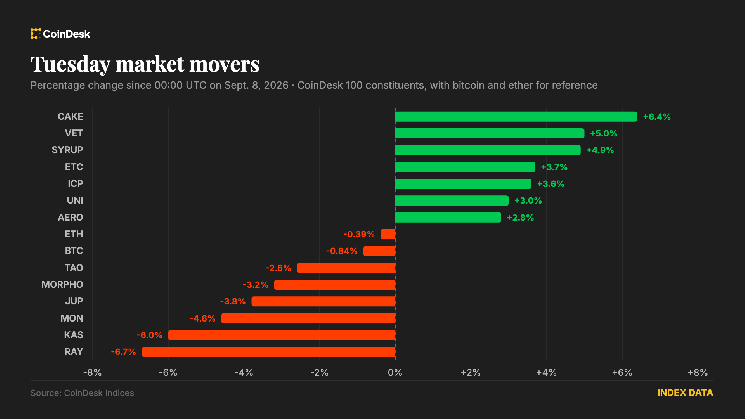
    Bitcoin (BTC) traded around $78,800 on Tuesday, down 0.42% since midnight UTC and 0.75% over the past 24 hours, according to CoinDesk data. The decline leaves the largest cryptocurrency 4.1% below the $82,320 resistance level it failed to breach last week. Ether (ETH) held relatively steady at $2,490, shedding just 0.02%, while Solana (SOL) dipped 0.06% to $103.77.

    Market Breadth Mixed as BNB Ecosystem Outperforms

    Among the 100 assets in the CoinDesk 100 Index, 42 traded in negative territory. BNB Chain tokens emerged as notable exceptions, with BNB rising 2% to $754 since midnight. Related assets CAKE (PancakeSwap) and SYRUP also advanced, benefiting from a rotation into the BNB Chain ecosystem.

    The CoinDesk 5 Index slipped 0.47%, while the broader CoinDesk 20 Index edged up 0.2%. The CoinDesk Memecoin Index outperformed with a 0.41% gain.

    Derivatives Signal Caution Amid Macro Headwinds

    Taker Flow Remains Bearish

    The buy-sell ratio of takers—traders who remove liquidity by executing at market prices—in crypto futures stayed bearish. Major tokens came under pressure from rising oil prices, speculation around Federal Reserve rate increases, and elevated bond yields.

    Open Interest Flat, Volume Rises 5%

    Twenty-four-hour open interest (OI) remained largely unchanged at $141 billion, but trading volume climbed 5% to $149.85 billion. The divergence suggests increased churn rather than fresh positional conviction, indicating traders are rotating capital without adding significant new leverage.

    Aerodrome’s AERO Leads Top-100 Gainers with 17% Surge

    Decentralized exchange Aerodrome Finance’s native token AERO surged 17% in 24 hours, topping the leaderboard among top-100 assets by market value. The rally coincided with a sharp rise in futures open interest to a record 129 million tokens, a combination that points to a buildup of long positions supporting the spot-price move.

    Positive CVD Confirms Aggressive Buying

    AERO’s bullish momentum is reinforced by a positive 24-hour open-interest-adjusted cumulative volume delta (CVD), signaling that buyers are executing market orders more aggressively than passive limit orders.

    Injective’s INJ Mirrors Bullish Futures Structure

    INJ, up 10%, displays a similar bullish futures setup, lending credibility to its spot-price breakout above $6—a level that has acted as a supply zone since mid-June, capping previous advances.

    Bitcoin Futures OI Rises Despite Price Drop

    Overall Bitcoin open interest remains below the 700,000 BTC mark, reflecting still-low appetite for leverage. However, open interest in major USDT- and USD-margined futures increased to 265,000 BTC from 257,000 BTC even as spot prices fell to $78,700 from $80,000. The uptick suggests some traders may have initiated short positions anticipating further downside.

    Bears Dominate Most Majors; AVAX, XLM, DOGE Show Strength

    Negative 24-hour cumulative volume deltas across most major tokens indicate bears are leading price action. Exceptions include Avalanche (AVAX), Stellar (XLM), and Dogecoin (DOGE), which posted positive CVDs.

    Volatility Indexes Calm; Deribit Options Lean Bullish Short-Term

    Bitcoin and ether volatility gauges remain near recent lows, signaling no scramble to buy options or hedge positions. On Deribit, weekly-expiry calls dominated 24-hour volume rankings for both BTC and ETH, reflecting short-term bullish expectations despite the broader bearish taker flow.

    Token Movers: CAKE, VET, SYRUP Lead; RAY, KAS, TAO Lag

    • PancakeSwap (CAKE): +4.9% since midnight UTC, +7.5% over 24 hours to $2.29, extending a rally driven by BNB Chain rotation and the exchange’s tokenized-stocks initiative.
    • VeChain (VET): +8% on the day, +9% over 24 hours to $0.00735.
    • SYRUP: +8% to $0.23, placing three DeFi and enterprise-chain names atop the gainers board while major assets sold off.
    • Raydium (RAY): -5.5% since midnight to $1.10, tracking Solana’s decline.
    • Kaspa (KAS): -4.7% to $0.034, unwinding most of a weekend surge that made it a top 24-hour gainer on Monday.
    • Bittensor (TAO): -1.5% on the day, -3.7% over 24 hours to $256, after leading the market on Sunday.
    • Aerodrome (AERO): +18% over 24 hours to $0.64, though momentum cooled to a 2.8% gain since midnight.
    • Jupiter (JUP): -3.8% to $0.24, a second consecutive heavy session following Monday’s 9% drop with no clear catalyst identified.
  • Tom Lee Outlines $6,000 Ethereum Scenario, Cites 4 Catalysts

    Tom Lee Outlines $6,000 Ethereum Scenario, Cites 4 Catalysts

    Bitcoin dipped below the $80,000 threshold as markets brace for upcoming U.S. inflation data and rising expectations of a Federal Reserve interest rate hike. While altcoins displayed mixed performance, Ethereum consolidated around the $2,480 level.

    BitMine President Tom Lee Identifies Four Catalysts for Ethereum Upside

    In a recent interview, BitMine President Tom Lee outlined a bullish case for Ethereum, suggesting the asset could climb to approximately $6,000. Lee cited four key catalysts that he believes could drive significant appreciation in the $ETH price.

    First Catalyst: The CLARITY Act

    Lee highlighted the CLARITY Act as the most critical development, describing it as the most important legislation expected to define the regulatory framework for cryptocurrencies in the United States. He projects that the bill’s passage in September could substantially increase Wall Street’s engagement with the crypto market. According to Lee, removing regulatory uncertainty would clear the path for major financial institutions to expand their operations in the digital asset space.

    Second Catalyst: Sidelined Capital Re-entering the Market

    The second catalyst involves the unwinding of idle capital and short positions that have remained on the sidelines. Lee noted that some investors exited the crypto market following the previous downturn. A sustained price recovery could compel these participants to re-enter. He specifically pointed to investors anticipating a potential cycle bottom in October based on the traditional four-year crypto cycle; if the market maintains strength, these investors may be forced to cover positions earlier than planned, adding upward pressure on prices.

    Third Catalyst: Asian Capital Rotation

    Lee identified a rotation of Asian capital toward crypto assets as the third driver. He observed that investors in markets such as South Korea, who had previously concentrated on local equities, are refocusing on cryptocurrencies. Lee believes this inflow could boost demand across the market, with Ethereum standing as a primary beneficiary.

    Fourth Catalyst: Institutional FOMO into Quarter-End

    The final catalyst centers on corporate FOMO (fear of missing out). Lee argued that if Ethereum sustains its momentum through the end of the third quarter in September, underperforming fund managers may pivot into $ETH and other digital assets to salvage fourth-quarter returns. This institutional chasing of performance could trigger a notable price rally.

    The $6,000 Price Target Scenario

    Lee’s $6,000 price target is derived from a valuation model based on the ETH/BTC trading pair. He calculates that if the ratio rises from current levels to 0.04 while Bitcoin reaches $150,000, Ethereum would trade near $6,000. Lee characterized this scenario as conservative, noting that the ETH/BTC ratio peaked near 0.08 during the 2021 bull market. He maintains that the four catalysts outlined above provide fundamental support for such a move.

    Disclaimer: This content is for informational purposes only and does not constitute investment advice.

  • Why Crypto Faces Its First September Test as U.S. Labor Data Looms

    Why Crypto Faces Its First September Test as U.S. Labor Data Looms

    September 15 is shaping up to be a potentially pivotal day for financial markets, with monetary policy, economic data and crypto regulation all converging.

    The Federal Open Market Committee (FOMC) is scheduled to meet on that date, while markets remain divided over the outlook for interest rates. With 12 voting members on the board, current pricing points to a 7-5 decision favoring a dovish rate policy. However, the meeting is still two weeks away, and this week’s key economic data could significantly influence the final vote.

    Jobs data could drive crypto market volatility

    The final month of the third quarter is expected to bring important labor-market data, placing employment conditions at the center of investor attention. Signs of a cooling labor market could reduce the likelihood of further rate hikes, while stronger-than-expected figures could weaken hopes for rate cuts. Either outcome could create volatility across the cryptocurrency market.

    Recent data points to a scenario consistent with the setup outlined above. According to FedWatch data, markets are already pricing in nearly a 60% chance of a rate hike, representing an increase of almost 46% in rate-hike expectations this week.

    The scheduled vote on the CLARITY Act is also set for September 15, adding another potential catalyst to the day of the FOMC statement. Given the significance of interest-rate policy and crypto regulation, the date could become a critical turning point for Bitcoin and digital assets.

    Macro headwinds test the crypto rally

    Despite a strong close to August, market sentiment appears to be turning bearish for September.

    Data from CryptoQuant shows that Bitcoin’s Coinbase Premium Index has turned negative again, while exchange-traded fund inflows also became negative in the latest recorded session. The shift has fueled bearish concerns that Bitcoin’s current technical structure could develop into a bull trap.

    At the same time, the timing of the macroeconomic releases coincides with the XAU/$BTC ratio approaching a critical weekly support level. The ratio bounced from this level in mid-May as capital moved out of Bitcoin and into gold.

    If the weekly support holds, another rotation into gold could place additional selling pressure on the broader cryptocurrency market.

    Under this scenario, Bitcoin’s recently regained $75k level could face renewed pressure as expectations of higher interest rates attract capital toward traditional safe-haven assets. The CLARITY Act vote adds another layer of uncertainty to an already event-heavy day.

    With monetary policy, capital rotation and crypto regulation converging on September 15, the date could set the tone for Bitcoin [$BTC] and the wider crypto market through the final stretch of the third quarter.

    Key factors to watch

    • Rate-hike expectations and labor-market data could increase crypto volatility.
    • Negative ETF flows, strength in gold against Bitcoin and the CLARITY Act vote could add further pressure to Bitcoin.
  • Tom Lee Makes a “Massive Bull” Bitcoin and Ethereum Prediction With One Condition

    Tom Lee Makes a “Massive Bull” Bitcoin and Ethereum Prediction With One Condition

    Tom Lee, Fundstrat’s head of research and chief investment officer, outlined his latest outlook for the Federal Reserve’s September policy decision, U.S. stocks and global markets in an interview with CNBC.

    Although September has historically been a weak month for financial markets and uncertainty remains over the path of interest rates, Lee said markets could deliver an upside surprise contrary to prevailing expectations.

    September Fed meeting seen as market turning point

    Lee described the Fed meeting on September 15th as a critical turning point. He said that if the central bank leaves interest rates unchanged, stock markets could trigger a very strong rally.

    According to Lee, a major market correction could be delayed until October. Alternatively, stocks could see only a limited pullback after the S&P 500 rises above the 8,000-point level.

    Crypto market recovery could accelerate

    Lee also said the periodic slowdown in the cryptocurrency market, often referred to as a “crypto winter,” had been relatively shallow and was approaching its end. He noted that crypto assets became the best-performing macro asset class during the third quarter of the year.

    With institutional investors increasingly turning to crypto stocks, Lee said investor interest could return quickly as the four-year crypto cycle reaches its conclusion in the coming days.

    The analyst identified potential regulatory changes as the sector’s biggest catalyst, stating:

    “If the CLARITY Bill passes Congress this year, Bitcoin and Ethereum will have an extremely strong and massive fourth quarter.”

    This is not investment advice.

  • Analyst Reveals Top Altcoins to Buy as Market Enters an Altcoin Supercycle

    Analyst Reveals Top Altcoins to Buy as Market Enters an Altcoin Supercycle

    Crypto Analyst Says Altcoin Super Cycle Has Begun, Names Four Coins He Holds

    Crypto analyst Ran Neuer says the market has entered a distinct altcoin super cycle, supported by a nine-year technical breakout that many traders have overlooked. He also identified the specific cryptocurrencies he is personally holding for the current phase of the market.

    According to Neuer, the cycle is being driven by renewed enthusiasm for altcoins rather than Bitcoin strength. He pointed to the ETH/BTC ratio as evidence, tracing its long-term pattern to Ethereum’s earliest use case: transferring digital value through smart contracts without human intervention.

    That use case helped trigger the 2017 initial coin offering boom before the ratio entered a prolonged downtrend as the technology struggled to deliver on its promises.

    “After a 9-year downtrend on the weekly, this is now breaking out,”

    Neuer said the breakout confirms a structural rotation into altcoins rather than a temporary market bounce.

    1. Solana

    Neuer named Solana as one of two winners of what he describes as the completed “L1 war.” He holds Solana directly and calls it “the second winner” in his broader investment thesis.

    He argues that Solana has effectively captured crypto-native onboarding, giving the network a strong position among users entering the cryptocurrency ecosystem through blockchain-native applications.

    2. Ethereum

    Alongside Solana, Neuer identified Ethereum as the other Layer 1 winner. He credited Ethereum’s integration with Base and Robinhood with helping it capture real-world asset onboarding, a channel that differs from Solana’s crypto-native user base.

    Neuer argues that the two networks have absorbed most of the long-term value in the Layer 1 sector, leaving him uninterested in other Layer 1 tokens.

    “I wouldn’t really invest in any other L1s because I just don’t think there’s any upside in the L1s,”

    Neuer said.

    3. Hyperliquid

    Neuer described Hyperliquid as the strongest active use case in crypto and said he holds the token directly. He cited its tokenomics and its role as an exchange as key reasons for his conviction.

    He also said he would buy Hyperliquid even at its current all-time high, arguing that the market is mispricing the token by focusing on fully diluted valuation, or FDV, without accounting for staking-driven scarcity.

    “Crypto is a function of scarcity times pressure,”

    Neuer said.

    “The buying pressure plus the staking pressure plus the actual buying pressure divided by the number of tokens in circulation creates insane pressure on the way up.”

    4. Zcash

    Neuer’s most aggressive individual call focuses on Zcash, the privacy-focused cryptocurrency that recently gained ETF backing. He argued that Zcash could develop into a dominant form of “private money” and outlined a specific scaling scenario linked to Bitcoin’s market capitalization.

    “I think the upside on Zcash from here is 10x, maybe 100x,”

    Neuer said.

    Neuer Still Holds Bitcoin

    Neuer’s confidence in altcoins does not come at Bitcoin’s expense. He remains bullish on Bitcoin because of continuing concerns about currency debasement, but views it as one component of a broader portfolio rather than the primary growth trade of the current cycle.

    What Comes Next for the Altcoin Market

    Beyond his four named holdings, Neuer believes investor attention is moving away from competition between blockchain infrastructure projects and toward application-layer projects that operate more like businesses.

    In his view, the strongest opportunities will involve assets with genuine user growth, sustainable revenue and a mechanism for distributing that revenue to token holders.

  • Crypto Weekly: Solana Leads Altcoin Gains as XRP and DOGE Decline

    Crypto Weekly: Solana Leads Altcoin Gains as XRP and DOGE Decline

    Crypto markets ended the week virtually flat after a volatile stretch that saw bitcoin and major altcoins retreat from multi-week highs before recovering late in the session. The choppy trading followed a sharp rally the previous week, when digital assets added more than $500 billion in combined market value in seven days.

    Crypto market capitalization began the week near $2.74 trillion, fell below $2.7 trillion on Aug. 23, and then recovered to $2.79 trillion by Friday. By Saturday afternoon, however, total market capitalization had slipped to approximately $2.73 trillion, leaving the crypto economy nearly unchanged for the week.

    Bitcoin Recovers After Volatile Trading

    Momentum from the previous week’s U.S. Treasury bond buyback announcement carried into Tuesday, Aug. 25, briefly pushing bitcoin above $81,000 before the rally stalled. Bitcoin then consolidated between $77,000 and $79,000 for two days before surging again Thursday and reclaiming $81,000 for the second time in a week.

    Bitcoin fell below $77,000 in the period surrounding Federal Reserve Chair Kevin Warsh’s Jackson Hole address. The leading cryptocurrency later recovered some of its losses, returning above $78,000 by Saturday afternoon and recording a modest 1% weekly gain. The move kept bitcoin on track to end August more than 20% higher.

    Bitcoin and Gold Fuel Scarce-Asset Debate

    Bitcoin’s parallel movement with gold during the week renewed debate over whether institutional investors are shifting toward a broader debasement trade to hedge against the erosion of fiat currencies. Industry experts, however, described the trend as a structural evolution rather than a straightforward hedging strategy.

    Himanshu Sahay, co-founder and CTO of Arch Lending, said the simultaneous movement in bitcoin and gold was notable but should not automatically be viewed as evidence of an institutional flight from fiat debasement alone.

    “What I do think we’re seeing is a broader reassessment of scarce assets,” Sahay said. “Gold has traditionally played that role, while bitcoin increasingly occupies a similar position for investors who are comfortable with a higher-volatility asset. The fact that they’re moving together is important because it suggests bitcoin is increasingly being traded within a broader macro framework rather than purely on crypto-specific narratives. That’s a meaningful evolution for the asset.”

    Altcoin Performance Diverges

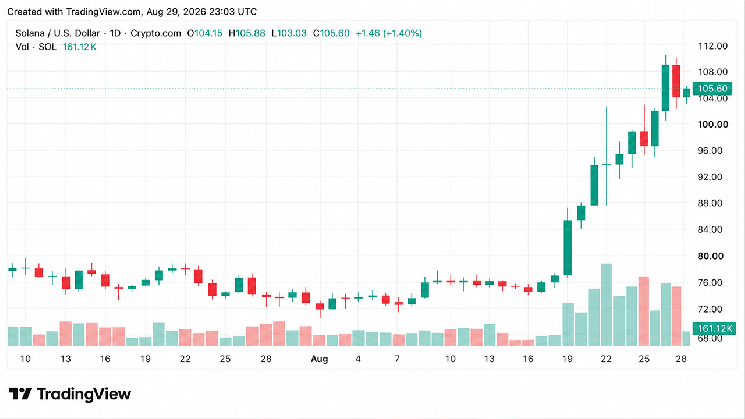
    Altcoin performance varied sharply, with several tokens recording double-digit gains or losses. Solana (SOL) led the advancing assets after Charles Schwab announced plans to add SOL, AVAX and LINK to its accounts in the near future.

    Privacy-focused cryptocurrency Monero (XMR) also posted strong gains, rising from $425 to close the week at $463 on Saturday. Among large-cap digital assets, RAIN recorded the strongest weekly performance, climbing 24%.

    On the losing side, XRP, one of the previous week’s top performers, declined nearly 7%. Dogecoin fell 7.2%, while ADA, XLM and BCH each dropped more than 10%.

    Despite the mixed performance across individual tokens, the combined altcoin market capitalization increased by just over 4%, rising from $1.13 trillion at the start of the week to $1.18 trillion on Aug. 29.

  • Metaplanet Sells Bitcoin in Latest $237 Million Transaction

    Metaplanet Sells Bitcoin in Latest $237 Million Transaction

    Metaplanet Transfers $237 Million in Bitcoin to Coinbase Prime, Raising Sell-Off Concerns

    Japan-based Bitcoin treasury firm Metaplanet has transferred approximately $237 million worth of Bitcoin to Coinbase Prime, prompting speculation that the company may be preparing to sell part of its holdings as the broader cryptocurrency market slows.

    Metaplanet Moves Bitcoin to Coinbase Prime

    According to the latest data shared today, Metaplanet sent the large Bitcoin deposit to Coinbase Prime, the leading U.S. cryptocurrency exchange’s institutional trading platform.

    The transaction has drawn attention from market participants because it comes as Bitcoin’s recent rally loses momentum. While Metaplanet is known for making regular Bitcoin purchases, the size and timing of this transfer have raised questions about whether the firm is becoming more cautious.

    Metaplanet has not specified the reason for the transfer. However, some market participants believe the move could represent an attempt to sell a portion of the company’s Bitcoin holdings.

    Transfers to cryptocurrency platforms such as Coinbase Prime do not necessarily indicate that Bitcoin has been sold. The assets could also be moved for custody, trading, or other operational purposes. Nevertheless, the scale of the transaction has fueled speculation about a potentially bearish move by Metaplanet.

    Is Metaplanet Taking Bitcoin Profits?

    The Bitcoin transfer comes as investors have started trading more cautiously, with some market participants selling assets to lock in gains from the recent price rally.

    Bitcoin has since pulled back from its upward trend and is trading in negative territory. The decline, combined with increased profit-taking activity, has led to speculation that Metaplanet may have moved the assets to secure profits.