Category: Coins

Digital assets, cryptocurrencies, blockchain, and currency news.

  • Mark Yusko Predicts Bitcoin Will Reach $250,000

    Mark Yusko Predicts Bitcoin Will Reach $250,000

    Key Highlights

    • Morgan Creek Capital Management CEO Mark Yusko signals Bitcoin has transitioned from a “distribution” phase to an “accumulation” phase, citing higher lows, higher highs, and a break above key moving averages.
    • Yusko’s valuation model pegs Bitcoin’s current fair value at approximately $105,000 based on Metcalfe’s Law and network valuation models, suggesting the asset remains undervalued at recent $85,000-$86,000 levels.
    • Global M2 money supply expansion, reduced leverage in crypto markets, and a shift toward institutional ownership are cited as structural tailwinds for a sustainable, albeit slower, long-term uptrend targeting $250,000.

    Yusko Identifies Structural Shift in Bitcoin Market Dynamics

    Mark Yusko, chief executive officer of Morgan Creek Capital Management, has outlined a bullish thesis for Bitcoin arguing that the cryptocurrency’s market structure is undergoing a fundamental shift back in favor of a sustained uptrend. In a recent interview, the veteran investor detailed a significant change in market character compared to just months prior, when he advised caution. Yusko now contends that Bitcoin has moved decisively from a “distribution” phase into an “accumulation” phase, a transition he believes marks the early stages of a new bull run with a long-term price target of $250,000.

    Technical Confirmation and Valuation Metrics Support Thesis

    The Morgan Creek CEO’s analysis rests on a confluence of technical and on-chain metrics. Yusko highlights that Bitcoin price action has begun printing higher lows and higher highs, a classic Dow Theory signal of an emerging uptrend. Critically, the asset has reclaimed both the 200-day moving average and the 50-week moving average, levels widely watched by institutional trend-followers. Bitcoin’s recent surge above $86,000, reaching its highest level since January, has been bolstered by sustained inflows into spot Bitcoin exchange-traded funds and renewed institutional purchasing.

    Despite the recovery from a local low near $58,000 to the current $85,000-$86,000 range, Yusko maintains that Bitcoin trades below its intrinsic “fair value.” Applying Metcalfe’s Law alongside Timothy Peterson’s network valuation model, Yusko calculates a fair value of approximately $105,000. In a separate recent statement, he characterized trading below this level as a compelling accumulation opportunity for long-term allocators.

    Macro Liquidity and Evolving Market Structure Favor Sustainability

    Beyond technicals, Yusko anchors his outlook in the macroeconomic backdrop. He points to a renewed expansion in global M2 money supply, noting that while the Federal Reserve maintains a restrictive posture, aggressive monetary expansion in major economies—particularly China—is driving global liquidity higher. This environment, he argues, historically favors scarce assets.

    Equally important is the changing composition of market participants. Yusko contrasts the current cycle with previous bull runs dominated by speculative retail leverage of 20x to 100x, which precipitated violent liquidation cascades. He observes that the growing dominance of spot ETFs, family offices, and high-net-worth long-term holders has structurally reduced systemic leverage. The sharp correction from a 2025 peak near $125,000-$126,000, in his view, effectively flushed excessive leveraged positions, leaving a healthier base.

    “The Rise in Bitcoin Won’t Come Suddenly”

    Yusko explicitly tempers expectations for explosive, vertical price action. “The Rise in Bitcoin Won’t Come Suddenly” he stated, emphasizing that Bitcoin’s maturation into a major asset class makes the tenfold rallies of prior cycles increasingly improbable. Instead, he envisions a protracted but more durable advance, potentially driving total market capitalization into the tens of trillions of dollars over the long term. This slower grind higher, he argues, is the trade-off for greater institutional participation and reduced volatility.

    Debt Monetization Narrative and Broader Digital Asset Exposure

    The thesis extends beyond Bitcoin-specific factors to a structural critique of the global financial system. Yusko argues that unsustainable sovereign debt loads will ultimately compel governments to devalue fiat currencies, positioning fixed-supply assets like gold and Bitcoin as primary stores of value. While his conviction is strongest on Bitcoin, Yusko also identifies significant roles for smart-contract platforms including Ethereum, Solana, and Avalanche in the evolving digital economy, highlighting tokenization of real-world assets, on-chain securities trading, and decentralized finance as key growth vectors.

    Why This Matters

    Yusko’s analysis reflects a growing consensus among institutional managers that Bitcoin’s market microstructure has fundamentally matured. The approval and success of spot Bitcoin ETFs in the United States have introduced a persistent, price-insensitive buyer base—registered investment advisors, pension funds, and endowments—that did not exist in prior cycles. This structural shift reduces the likelihood of the 80% drawdowns characteristic of Bitcoin’s early history, but also dampens the velocity of upside moves. For allocators, the implication is clear: Bitcoin is transitioning from a speculative vehicle to a strategic portfolio asset, demanding longer time horizons and conviction in the monetary debasement narrative. The $105,000 fair value estimate provides a tangible benchmark for dollar-cost averaging strategies, while the $250,000 long-term target underscores the asymmetric upside still perceived by early institutional adopters.

    Frequently Asked Questions

    What specific technical signals does Mark Yusko cite as confirmation of a new Bitcoin bull market?
    Yusko points to the formation of higher lows and higher highs, a decisive break above both the 200-day moving average and the 50-week moving average, and a second bottom formation with higher volume as primary technical confirmation of a trend change.
    How does Yusko arrive at a $105,000 fair value estimate for Bitcoin?
    The valuation derives from applying Metcalfe’s Law—which values a network proportionally to the square of its users—combined with Timothy Peterson’s network valuation model, which correlates Bitcoin’s price with its address activity and hash rate.
    Why does Yusko expect slower price appreciation in this cycle compared to previous ones?
    He attributes the slower grind to Bitcoin’s larger market capitalization and the dominant presence of institutional investors, ETFs, and family offices who employ little to no leverage and have longer investment horizons, reducing both volatility and the velocity of parabolic rallies.
  • Canada’s ‘Big Six’ Banks to Launch Interbank Tokenized Deposit Initiative

    Canada’s ‘Big Six’ Banks to Launch Interbank Tokenized Deposit Initiative

    Key Highlights

    • Canada’s six largest banks have joined forces to explore a shared tokenized deposit network, keeping customer funds within the regulated banking system while enabling 24/7 programmable payments.
    • The initiative builds on Project Samara, where the Bank of Canada, RBC, and TD successfully issued, traded, and settled a 100 million Canadian dollar bond on a distributed ledger using tokenized wholesale Canadian dollars.
    • Canada is simultaneously advancing a regulated digital Canadian dollar backed by Shopify and the National Bank of Canada, signaling a dual-track approach to blockchain-based money.

    Canada’s Big Six Banks Unite on Tokenized Deposit Framework

    Canada’s six largest lenders have launched a collaborative effort to design a shared infrastructure for tokenized deposits, marking the country’s most concerted push yet to bring commercial bank money onto blockchain rails. The project aims to create a common model where digital representations of existing bank deposits—not separately issued stablecoins—can move programmatically around the clock while remaining fully inside the regulated banking perimeter. Participants include Royal Bank of Canada, Toronto-Dominion Bank, Bank of Montreal, Scotiabank, Canadian Imperial Bank of Commerce, and National Bank of Canada, collectively representing the vast majority of the country’s banking assets.

    Distinguishing Tokenized Deposits from Stablecoins

    Unlike stablecoins issued by crypto-native firms, tokenized deposits are digital twins of money already held at a bank, carrying the same regulatory safeguards, deposit insurance eligibility, and central bank backing. A shared system would allow Canadian banks to test 24/7 programmable payments—such as instant settlement of securities trades or automated supply-chain finance—without fragmenting liquidity across proprietary platforms or ceding Canadian-dollar activity on blockchain networks to unregulated stablecoin issuers. The lenders have not yet committed to issuing a tokenized deposit, but the working group signals intent to shape the standards before the market does.

    Building on Project Samara’s Wholesale Success

    The retail-focused deposit initiative follows a successful wholesale experiment. In March, the Bank of Canada, RBC, and TD completed Project Samara, which issued, traded, and settled a 100 million Canadian dollar (roughly $71 million) bond on a distributed ledger using tokenized wholesale central bank money. That test proved that core capital markets functions—issuance, secondary trading, and delivery-versus-payment settlement—can operate on shared ledger infrastructure with atomic finality. The new six-bank effort extends that logic to commercial bank money, targeting the far larger universe of everyday corporate and consumer payments.

    Global Race Intensifies as Swift Enters Cross-Border Arena

    Canada’s move mirrors accelerating efforts abroad. In the United States, regional lenders are building a shared tokenized-deposit network while JPMorgan Chase, Citigroup, and Wells Fargo have each pursued institutional offerings such as JPM Coin and Citi Token Services. Meanwhile, Swift recently began testing tokenized deposits for 24/7 cross-border payments with banks across six continents, aiming to solve the time-zone mismatch that currently delays international settlements. A Canadian interoperable layer could eventually plug into similar global networks, positioning the loonie for frictionless programmable flows worldwide.

    Why This Matters

    The convergence of three parallel tracks—wholesale central bank money via Project Samara, retail tokenized deposits via the Big Six consortium, and a regulated digital Canadian dollar backed by Shopify and National Bank—suggests Canada is methodically constructing a full-stack blockchain monetary architecture. By keeping each layer inside the regulatory perimeter, policymakers aim to capture the efficiency gains of programmable money—atomic settlement, smart-contract automation, round-the-clock availability—while preserving financial stability, consumer protection, and monetary sovereignty. The outcome will likely influence how other mid-sized reserve-currency jurisdictions design their own digital money frameworks.

    Frequently Asked Questions

    What is the difference between a tokenized deposit and a stablecoin?

    A tokenized deposit is a digital representation of money already held in a regulated bank account, carrying the same legal status, deposit insurance, and central bank backing as the underlying funds. A stablecoin is typically issued by a non-bank entity and backed by reserve assets that may include commercial paper, treasury bills, or other instruments, with varying regulatory oversight.

    Which banks are participating in the Canadian tokenized deposit initiative?

    The six participants are Royal Bank of Canada, Toronto-Dominion Bank, Bank of Montreal, Scotiabank, Canadian Imperial Bank of Commerce, and National Bank of Canada—collectively known as Canada’s “Big Six” banks.

    Has any Canadian bank already launched a tokenized deposit for customers?

    No. The current project is an exploratory consortium to design a common model; the lenders have not committed to issuing a tokenized deposit product at this stage.

  • Narrowing Price Cushions Expose Bitcoin Loans to 4.7% Dips as Aave Eyes Higher Leverage

    Narrowing Price Cushions Expose Bitcoin Loans to 4.7% Dips as Aave Eyes Higher Leverage

    Key Highlights

    • Aave governance proposal from LlamaRisk would increase Bitcoin-backed borrowing limits on Aave V3 Ethereum Core from 73% to 81% loan-to-value (LTV) and raise the liquidation threshold from 78% to 85%.
    • The proposal has advanced to Snapshot with voting expected to begin within 24 hours of Sept. 21, though implementation remains unverified and an Aave Improvement Proposal (AIP) would follow only after a positive vote.
    • Analysis of one-year liquidation data across Ethereum Core, Arbitrum, and Base shows economically meaningful positions cleared within minutes, supporting capital efficiency, but the model cannot guarantee performance during extreme market moves combined with impaired pricing or liquidation infrastructure.

    Proposal Details: Higher Leverage, Tighter Liquidation Cushion

    Aave governance is considering a parameter update proposed by risk service provider LlamaRisk that would materially increase leverage for Bitcoin-backed borrowers on Aave V3 Ethereum Core. The proposal would raise the maximum loan-to-value (LTV) ratio for Wrapped Bitcoin (WBTC) and Coinbase Wrapped BTC (cbBTC) from 73% to 81%, allowing users to borrow up to $0.81 per $1 of collateral instead of $0.73. Simultaneously, the liquidation threshold—the point at which a position becomes eligible for liquidation—would increase from 78% to 85%.

    This change narrows the raw distance between the borrowing limit and the liquidation line from five percentage points to four. In practical terms, a maximally leveraged Bitcoin position would reach the proposed liquidation threshold after approximately a 4.7% collateral-price decline, compared with roughly 6.4% under current parameters. LlamaRisk announced on Sept. 21 that the proposal had advanced to Snapshot and voting would begin in less than 24 hours. The vote result and any subsequent implementation remained unverified at the reporting cutoff, meaning the higher limits are proposed parameters rather than live settings.

    Cross-Chain Parameter Adjustments Beyond Ethereum Core

    The proposal extends beyond Ethereum Core. On Arbitrum, WBTC’s ordinary LTV would rise by five percentage points. On Base, cbBTC’s LTV would increase by eight points, and a separate Base cbBTC stablecoin E-Mode would move to 82% LTV with an 85% liquidation threshold. Ethereum Core assets WETH, wstETH, and weETH would each receive a 0.5-point LTV increase. Selected liquidation thresholds would also rise, while Base cbBTC’s liquidation bonus would fall from 7.5% to 6%.

    These figures describe maximum capacity per dollar of eligible collateral and do not quantify how much additional debt users would actually take on. The proposal does not disclose a complete current dataset of collateral-enabled balances, debt attributed to each affected asset, or account health-factor distributions. Total reserve supply would overstate usable collateral because some supplied tokens may be ineligible, disabled as collateral, or unconnected to debt. Historical seized volume likewise does not reveal the live distribution of positions.

    Liquidation Speed Analysis Underpins Risk Model

    LlamaRisk studied liquidation behavior from August 2025 through August 2026 across Ethereum Core, Arbitrum, and Base. On Ethereum Core, the analysis counted 7,206 ETH liquidations that seized $618 million and 2,621 BTC liquidations that seized $358 million. For both collateral families, the value-weighted 99th-percentile time a liquidation call spent at or below its execution price was five minutes. This statistic measures a liquidation work-off window and differs from saying 99% of transactions executed within five minutes of an oracle update; large positions can require several calls because a single liquidation generally repays only part of the debt.

    The study separately measured processing after price-feed publications during the February and October 2025 stress windows. Its data reports that 100% of seized volume cleared within five minutes of the feed publication that made liquidation profitable in every listed market during those two events. February produced no recognized deficit. October produced $0.39 million of event-level bad debt against roughly $128 million, although LlamaRisk said none affected the ETH- or BTC-family collateral analyzed for this proposal. The result suggests liquidator response was not the binding constraint in those episodes, though it does not recreate those events under the proposed higher leverage.

    Model Limitations and Residual Risks

    The risk model combines a one-hour price excursion with each reserve’s liquidation bonus to derive a ceiling for the liquidation threshold. The 99.9th-percentile adverse one-hour move was 11.85% for ETH and about 5% for BTC. This percentile omits the most extreme 0.1% of one-hour observations in the two-year sample, which contained much larger moves: a worst one-hour ETH decline of 24.27% and a worst BTC decline of 10.72% (the proposal’s summary gives 11.15% for the BTC worst hour, an internal discrepancy). Either BTC figure is more than twice the roughly 5% percentile input.

    This gap defines the residual risk. LlamaRisk’s framework assumes regular oracle publications and responsive liquidators prevent a maximally leveraged position from sitting untouched for a full hour. A move beyond the percentile can become more damaging if price feeds stall, liquidation activity slows, or market depth deteriorates simultaneously. The percentile therefore calibrates a protocol bad-debt buffer rather than a borrower protection level. The proposal leaves BTC thresholds below the model ceiling to account for depth, caps, and concentration risks that price history does not capture. ETH receives less room: WETH is set at the model ceiling, while wstETH and weETH sit one point inside their ceilings.

    Governance Decision: Balancing Capital Efficiency and Protocol Safety

    Aave’s governance choice is whether observed liquidation performance under current parameters justifies allowing future positions to run closer to liquidation. For Bitcoin collateral on Ethereum Core, the exchange is clear at the borrower level: maximum LTV would rise eight percentage points while the simplified collateral-price cushion at maximum leverage would shrink from about 6.4% to 4.7%. Existing borrowers would not automatically add debt, but the new limits would permit new or adjusted positions to carry more.

    The protocol-level case appears more favorable than the borrower-level cushion alone suggests. In LlamaRisk’s sample, economically meaningful liquidations were processed quickly, and the two studied stress windows left no bad debt on the reviewed ETH- and BTC-family collateral. The model also incorporates the liquidation bonus and keeps recommended BTC thresholds below its calculated ceiling. However, historical execution does not measure an outage coinciding with an exceptional price move. The worst one-hour declines in the same dataset exceeded the percentile inputs by a wide margin, and the model cannot remove liquidity, concentration, or oracle risk. The aggregate credit effect also remains unknown; calculating it would require current collateral-enabled balances for every affected asset and market, the debt those positions already carry, their collateral settings, and their health-factor distribution. The published proposal supplies the parameter change, not that full position-level dataset.

    Why This Matters

    This proposal represents a significant test of decentralized finance (DeFi) risk management methodology. Aave, as one of the largest lending protocols, sets precedents for how on-chain lending markets balance capital efficiency against systemic risk. The LlamaRisk framework relies heavily on high-frequency liquidation performance data during stress events, arguing that rapid work-off of underwater positions justifies tighter liquidation cushions. However, the model explicitly acknowledges it cannot account for correlated failures—such as oracle delays, liquidator capital constraints, or market depth evaporation—during extreme volatility. The governance vote will signal the community’s risk appetite and could influence parameter-setting approaches across other lending protocols. If approved, the subsequent Aave Improvement Proposal (AIP) will codify the exact parameters for implementation, making the Snapshot vote a critical governance milestone.

    Frequently Asked Questions

    What are the exact parameter changes proposed for WBTC and cbBTC on Ethereum Core?

    The proposal would raise the maximum LTV from 73% to 81% and the liquidation threshold from 78% to 85% for both WBTC and cbBTC on Aave V3 Ethereum Core.

    When will the vote take place and what happens after?

    LlamaRisk stated on Sept. 21 that the proposal had advanced to Snapshot and voting would begin in less than 24 hours. An implementation AIP would follow only after a positive Snapshot result. Until a vote and AIP establish final values, the 81% Bitcoin LTV remains a governance proposal.

    Does the liquidation data guarantee the new parameters are safe?

    No. The analysis shows that under current parameters, economically meaningful liquidations cleared within minutes during observed stress windows. However, the model uses a 99.9th-percentile one-hour price move (roughly 5% for BTC) plus the liquidation bonus to set thresholds, while the same dataset contains worst-case one-hour declines exceeding 10% for BTC. The framework assumes continuous oracle updates and responsive liquidators; it cannot eliminate risks from simultaneous oracle failure, liquidator inaction, or severe market depth deterioration during extreme moves.

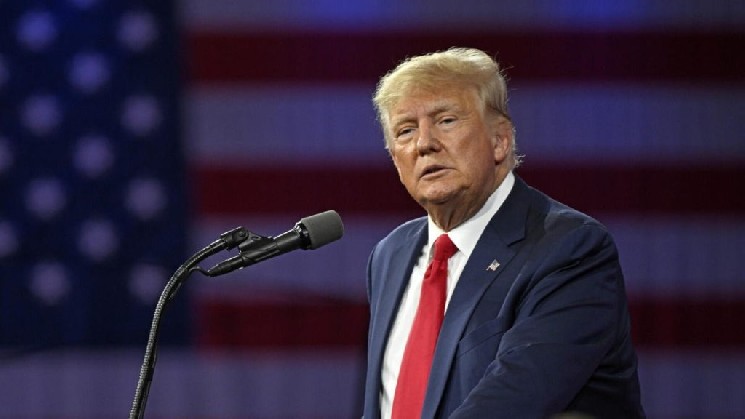
  • Donald Trump’s Single Word Sparks 300% Altcoin Surge

    Donald Trump’s Single Word Sparks 300% Altcoin Surge

    Key Highlights

    • Solana-based memecoin Super Inu surged over 300% following President Donald Trump’s United Nations General Assembly remarks endorsing “super intelligence” for artificial intelligence.
    • The token’s market capitalization reached approximately $7.23 million post-surge, with reports indicating it is paired with tokenized NVIDIA shares via the Stonk platform.
    • No official connection exists between Super Inu and the U.S. government, Donald Trump, or the Trump family, underscoring the speculative volatility of low-cap memecoins.

    Trump’s UN Address Sparks Memecoin Frenzy

    During his address to the United Nations General Assembly, President Donald Trump declared that his administration would not restrict artificial intelligence but instead encourage “super intelligence”. The President further announced that the term “Super Intelligence” would be officially adopted for artificial intelligence in U.S. government documents. While the remarks centered on national technology policy, cryptocurrency markets reacted almost immediately, demonstrating the outsized influence political rhetoric can exert on speculative digital assets.

    Super Inu Token Surges 300% on Solana

    Within a short window following the President’s speech, Super Inu, a memecoin built on the Solana blockchain, experienced a price surge exceeding 300%. Market data indicates the token’s total market capitalization climbed to roughly $7.23 million at the peak of the rally. According to on-chain analysis and platform disclosures, Super Inu is allegedly paired with tokenized NVIDIA shares and was issued through the Stonk platform, a detail that adds a layer of synthetic asset exposure to the token’s structure.

    No Official Ties to Government or Trump Entity

    Despite the dramatic price action, the President’s UN address made no mention of the Super Inu token, cryptocurrency, or blockchain technology. There is no confirmed official link between the asset and the United States government, Donald Trump, or any member of the Trump family. The rally appears driven entirely by speculative narrative trading, where traders associate keywords from high-profile political speeches with similarly named tokens, regardless of fundamental connections.

    Low-Cap Memecoin Mechanics Amplify Risk

    The Super Inu episode illustrates the inherent mechanics of low-market-capitalization memecoins. Because liquidity pools are shallow, even relatively small buy orders can trigger exponential price increases. Conversely, the same structural fragility means that selling pressure can precipitate equally rapid and severe price collapses, often wiping out late-entry retail investors. Market observers caution that such assets function more as sentiment-driven lottery tickets than as investments tied to underlying utility or adoption.

    Why This Matters

    The Super Inu rally highlights a recurring pattern in cryptocurrency markets where political figures’ public statements—particularly those involving technology buzzwords—act as catalysts for ephemeral speculative bubbles. As the 2024 U.S. election cycle intensifies and AI policy remains a dominant theme, traders and automated bots increasingly scan speeches for trigger terms. This dynamic raises concerns about market manipulation, investor protection, and the broader reputation of the digital asset sector. Regulators and exchange operators may face renewed pressure to monitor or restrict tokens that appear to exploit political branding without authorization.

    Frequently Asked Questions

    Did Donald Trump endorse the Super Inu token?
    No. President Trump’s UN General Assembly speech referenced “super intelligence” as a government policy term for artificial intelligence and did not mention Super Inu, cryptocurrency, or any digital asset.
    What is the Stonk platform’s role in Super Inu?
    According to the source data, Super Inu was issued via the Stonk platform and is allegedly paired with tokenized NVIDIA shares, suggesting a synthetic asset structure rather than a standard memecoin launch.
    Is Super Inu a safe investment?
    The source explicitly states this is not investment advice and warns that low-market-cap memecoins can rise and fall extremely quickly due to thin liquidity, making them highly speculative and risky.
  • Prometheum Outlines Ownership Rights for Tokenized US Stocks

    Prometheum Outlines Ownership Rights for Tokenized US Stocks

    Key Highlights

    • Prometheum, HashKey Digital Asset Group, and Velocity Capital have outlined a distribution framework for tokenized U.S. equities that relies on the existing DTC custody system and Article 8 of the Uniform Commercial Code, rather than creating new registered ownership.
    • Each token functions as a “digital twin” of a share already held at DTC, preserving SEC-registered broker-dealer protections, standard redemption processes, and corporate action flows through established market infrastructure.
    • International distribution would be conducted through HashKey’s licensed exchanges, subject to local regulations, with a pilot launch contingent on definitive agreements, regulatory approvals, and DTCC’s tokenization service slated for October 2026.

    Proposed Structure Leverages Existing Securities Law Framework

    Prometheum co-CEO Aaron Kaplan detailed how international investors would hold, redeem, and receive legal protection for tokenized U.S. stocks under a proposed arrangement involving HashKey and Velocity Capital. The structure would operate through the indirect holding system established under Article 8 of the Uniform Commercial Code, rather than making each tokenholder the registered shareholder on a company’s official books.

    Cede & Co., the nominee used by the Depository Trust Company (DTC), would remain the registered owner of the underlying shares. Kaplan emphasized that tokenization would not alter this arrangement, which is already used for nearly all publicly traded U.S. equities held through brokerage accounts. Within the planned structure, the participant connected to a registered blockchain wallet would hold the securities entitlement. Acting as a securities intermediary, the participant would then treat its customer as an entitlement holder under Article 8.

    “The Token itself does not create or define the customer’s ownership interest,” Kaplan said.

    According to Kaplan, the customer’s rights would instead derive from the participant’s duties under Article 8, the Securities and Exchange Commission’s Customer Protection Rule, and the Securities Investor Protection Act. Each protection would apply independently of the blockchain used to represent the position. This draws a distinction between appearing as the registered owner and holding a legally protected interest through an intermediary. Under the proposed system, an international customer’s name would not replace Cede & Co. on the issuer’s official shareholder record, but the customer would have an entitlement through the regulated custody chain.

    Distinction from Synthetic and SPV Products

    Kaplan contrasted the model with synthetic or special-purpose vehicle (SPV) structures, which place investors in a different legal position because an offshore entity may own the conventional shares while a customer holds only a contractual claim against that entity. In a synthetic product, the token can track the price of a listed stock without giving its holder rights in the underlying company. An SPV-backed product may hold real shares, but the tokenholder’s claim can run against the separate legal entity rather than through the established U.S. securities holding system.

    Prometheum, HashKey Digital Asset Group, and Velocity Capital intend to use shares custodied at DTC as the assets behind the proposed tokens. The companies described each token as a digital twin of a conventional security rather than a synthetic instrument or an offshore wrapper. Kaplan said the planned model would preserve the legal protections attached to securities held through SEC-registered broker-dealers. Prometheum Capital is registered with the SEC and belongs to the Financial Industry Regulatory Authority (FINRA), while Velocity is an SEC-registered, FINRA-member broker-dealer with traditional securities clearing and execution permissions.

    Regulatory Context and SEC Exemption

    The ownership question has entered current U.S. policy. Under a five-year SEC exemption announced on Sep. 17, qualifying tokenized National Market System stocks must provide the same rights as their conventional counterparts, including applicable voting, dividend, and liquidation rights. Synthetic products offering only price exposure do not qualify under the order. The SEC framework also allows an issuer to object when an unaffiliated party seeks to offer a tokenized version of its shares, and the regulator can modify the temporary exemption while it considers permanent rules for onchain securities trading.

    Prometheum’s arrangement concerns international distribution rather than an offer to U.S. investors. HashKey would provide access through eligible licensed exchanges in several jurisdictions, subject to local laws, licensing terms, and investor eligibility requirements.

    Redemption and Corporate Actions Through Standard DTC Processes

    For an investor seeking to exit the blockchain-based position, Kaplan said each token could be converted into a conventional share or sold for cash through the broker-dealer. Both routes would use DTC’s standard securities processes because the corresponding shares would already sit within its custody system.

    “Each token is a digital twin of a share already held at DTC, and investors can convert the token position back into a conventional share or sell it for cash through the broker-dealer, using DTC’s standard processes,” Kaplan said.

    Dividends, stock splits, and other corporate actions would also move through the same DTC channels used by the U.S. securities market, according to Kaplan. His comments did not set out separate procedures for voting or for processing corporate actions when a token trades outside regular U.S. exchange hours.

    Investor Protections in Failure Scenarios

    In the event of a broker-dealer failure, Kaplan said SEC Rule 15c3-3 would require customer securities to remain separate from the firm’s own property. Segregated shares could then be returned to customers rather than becoming part of the failed company’s estate. The Securities Investor Protection Act (SIPA) provides another layer of protection within the U.S. broker-dealer system, although the proposed international distribution chain would also involve HashKey exchanges operating under the rules of their respective jurisdictions. The binding memorandum does not itself establish the treatment of customer claims under every participating country’s insolvency law.

    Broader Market Infrastructure Developments

    Traditional market infrastructure has begun supporting other tokenized investment products. On Sep. 16, Ondo Finance subsidiary Oasis Pro Markets joined DTCC’s Fund/SERV, becoming the first tokenization platform admitted to a network that processes more than 85% of U.S. mutual fund transaction activity. Oasis Pro, like Prometheum Capital and Velocity, operates through U.S. securities registrations. Its Fund/SERV connection supports transaction processing and distribution, while the legal rights attached to each product still depend on its custody and ownership structure.

    HashKey’s Distribution Role and Product Scope

    Under the memorandum of understanding, HashKey would act as the international distributor through eligible exchanges within its licensed network. Prometheum Capital and Velocity would provide the custody, trade execution, and clearing services needed to connect the token positions with conventional securities held in the United States.

    “Through this collaboration, eligible clients in multiple jurisdictions will have the opportunity to access tokenized U.S. equities supported by SEC-registered clearing infrastructure, subject to applicable laws and regulatory requirements,” HashKey CEO Xiao Feng said.

    HashKey has already entered DTCC’s digital-assets work. Earlier in September, the company joined its industry group after DTC completed initial production transactions involving tokenized equities, exchange-traded funds, and Treasury products in July. Velocity CEO Roy Yan said the underlying shares would need to be executed, cleared, and held according to the same standards used in regulated U.S. equity markets. Velocity holds memberships with DTC, the National Securities Clearing Corporation, and the Options Clearing Corporation.

    The proposed product list could include companies in the Russell 1000, which covers the 1,000 largest publicly traded U.S. companies by market value. ETFs tracking major indexes and U.S. Treasury bills, notes, and bonds could also qualify. DTC has said its tokenized assets will carry the same ownership rights, investor protections, and entitlements as securities held in conventional form. DTCC scheduled the full launch of its Tokenization Service for October 2026 after conducting limited production transactions in July, and the organization said DTC held more than $114 trillion in assets when it announced the program’s timetable.

    Prometheum, HashKey, and Velocity are still selecting the securities and jurisdictions for the initial pilot, Kaplan said. A launch requires definitive agreements, regulatory approval, completed technical and operational integration, relevant licenses, and the availability of DTCC’s tokenization infrastructure.

    Why This Matters

    The proposed arrangement represents a significant step toward bridging traditional securities infrastructure with blockchain-based distribution for international investors. By anchoring tokenized equities in the existing DTC custody system and Article 8 entitlement framework, the model seeks to avoid the legal ambiguities associated with synthetic tokens or offshore SPV wrappers. This approach aligns with the SEC’s recent exemption requiring tokenized stocks to mirror conventional shareholder rights, and it leverages the regulatory standing of SEC-registered, FINRA-member broker-dealers. The involvement of HashKey—a licensed digital asset platform expanding into DTCC’s industry group—signals growing institutional convergence. However, the pilot’s success hinges on multiple contingencies: finalizing definitive agreements, securing regulatory clearances across jurisdictions, integrating with DTCC’s tokenization service (slated for full launch in October 2026), and resolving cross-border insolvency treatment for customers on HashKey exchanges. The initiative also underscores a broader trend where traditional market utilities like DTCC and Fund/SERV are actively onboarding tokenization platforms, suggesting that the plumbing for onchain securities may increasingly rely on established, regulated rails rather than parallel systems.

    Frequently Asked Questions

    What legal rights do holders of these tokenized U.S. stocks receive?

    Token holders receive a securities entitlement under Article 8 of the Uniform Commercial Code, with protections from the SEC’s Customer Protection Rule (Rule 15c3-3) and the Securities Investor Protection Act (SIPA). They do not become registered shareholders on the issuer’s books; Cede & Co. remains the registered owner via DTC. The token itself does not create ownership—the legal interest flows from the intermediary’s duties.

    How can an investor redeem or sell a tokenized share?

    Investors can convert the token back into a conventional share or sell it for cash through the broker-dealer, using DTC’s standard securities processes. Because the underlying shares are already held in DTC custody, redemption follows existing market infrastructure without requiring bespoke blockchain settlement.

    Is this offering available to U.S. investors?

    No. The arrangement described in the memorandum of understanding concerns international distribution only. HashKey would provide access through eligible licensed exchanges in multiple jurisdictions, subject to local laws, licensing terms, and investor eligibility requirements. U.S. investors are not the target audience for this specific distribution channel.

  • Mystery Whale Shifts $104 Million: Sells Bitcoin, Buys This Altcoin

    Mystery Whale Shifts $104 Million: Sells Bitcoin, Buys This Altcoin

    Key Highlights

    • A cryptocurrency whale has rotated approximately $104 million from Bitcoin into Ethereum over six days, with the latest swap converting 200.71 BTC ($17.2 million) into 6,247 ETH.
    • On-chain analytics platform Lookonchain reports the whale staked all 40,670 ETH acquired, signaling a long-term yield strategy rather than short-term speculation.
    • The move comes as Bitcoin has outperformed Ethereum in recent price action despite Ethereum’s larger market capitalization, though profitability of the rotation remains uncertain.

    Whale Executes Multi-Day Bitcoin-to-Ethereum Rotation Worth $104 Million

    Blockchain analytics firm Lookonchain has flagged a series of large-scale transactions by a single wallet address that has systematically exchanged Bitcoin for Ethereum over the past week. According to on-chain data shared by the platform, the entity—commonly referred to as a whale due to its substantial holdings—completed its most recent swap by converting 200.71 BTC, valued at roughly $17.2 million, into 6,247 ETH.

    This latest transaction is part of a broader pattern. Lookonchain’s analysis reveals that over a six-day window, the same address sold a cumulative 1,308 BTC and accumulated 40,670 ETH in return. At the time of execution, the total notional value of the assets involved was estimated at approximately $104 million. The consistent directionality of the flows suggests a deliberate portfolio rebalancing rather than opportunistic trading.

    Full Staking Deployment Indicates Long-Term Yield Focus

    A critical detail emerging from the on-chain data is the immediate deployment of all acquired Ethereum into staking. The whale staked the entire 40,670 ETH haul, a move that locks the assets into Ethereum’s proof-of-stake consensus mechanism to earn validator rewards. This behavior strongly implies a strategic horizon measured in months or years, as staked ETH typically faces withdrawal queues and is ill-suited for rapid liquidation.

    By committing the full position to staking, the whale is effectively betting on Ethereum’s long-term network security, adoption trajectory, and the sustainability of staking yields—currently hovering around 3% to 4% annually—rather than seeking short-term price arbitrage between the two largest cryptocurrencies by market capitalization.

    Why This Matters: Market Structure and Narrative Shifts

    The rotation arrives at a notable juncture in crypto market dynamics. Despite Ethereum’s larger market capitalization and its position as the primary settlement layer for decentralized finance and tokenized assets, Bitcoin has recently demonstrated stronger price momentum. The whale’s decision to rotate out of the outperforming asset into the laggard runs counter to simple trend-following logic and may reflect a fundamental reassessment of risk-adjusted returns, regulatory clarity around Ethereum’s status, or anticipation of upcoming protocol upgrades such as the Pectra hard fork.

    Large on-chain movements by identifiable entities are closely monitored by market participants because they can signal institutional-grade conviction shifts. While a single whale’s actions do not dictate market direction, the scale—$104 million in six days—and the staking commitment provide a data point suggesting that at least one sophisticated actor views Ethereum’s staking yield and roadmap as more compelling than Bitcoin’s current price trajectory over their investment horizon.

    Frequently Asked Questions

    Who is Lookonchain and why is their data significant?

    Lookonchain is a blockchain analytics platform that tracks and labels on-chain activity of notable addresses, including whales, institutions, and project treasuries. Their findings are widely cited in the crypto industry because they provide verified, real-time transaction data sourced directly from public blockchains.

    What does it mean that the whale staked all 40,670 ETH?

    Staking involves locking ETH to participate in Ethereum’s proof-of-stake consensus as a validator, earning protocol rewards in return. The decision to stake the entire acquired amount indicates the whale intends to hold the position long-term and generate yield, as staked ETH cannot be instantly sold and is subject to withdrawal queues.

    Does this transaction guarantee Ethereum will outperform Bitcoin going forward?

    No. The source explicitly notes that the whale’s purchase “doesn’t necessarily mean the transaction will be profitable.” Large investor moves reflect conviction at a point in time but are subject to market risk, regulatory changes, and protocol developments. Past performance and whale activity are not reliable predictors of future price action.

  • Ripple News: Europe’s Digital Euro Rail Prompts XRP Holders to Calculate $1,000 Potential

    Ripple News: Europe’s Digital Euro Rail Prompts XRP Holders to Calculate $1,000 Potential

    Key Highlights

    • The European Central Bank officially launched the Pontes system on September 21, enabling EU banks to settle transactions using a digital euro and blockchain technology, with a full digital euro pilot targeted for mid-2027.
    • Axology has deployed a private network built on open-source XRP Ledger code that connects to Pontes, allowing tokenized securities and bonds to settle against central bank euros in a single atomic transaction.
    • Crypto analyst Dom Kwok has reiterated his long-standing $1,000 XRP price target with a cryptic "slowly and then all at once" message, though neither Ripple nor the ECB has linked Pontes to any specific token valuation.

    ECB Launches Pontes: Digital Euro Settlement Infrastructure Goes Live

    European Central Bank President Christine Lagarde announced this week that the central bank officially launched Pontes on Monday, September 21, a system that lets banks across the European Union settle transactions with each other using a digital euro and blockchain technology. “It’s the beginning, not the finish,” Lagarde said, adding that a full digital euro pilot is planned to roll out around mid-2027. The launch marks the ECB’s first operational step toward integrating distributed ledger technology into the core of European wholesale payments.

    How Pontes Works: Tokenized Assets Meet Central Bank Money

    In simple terms, Pontes gives European banks a way to trade tokenized assets among themselves using digital euros issued by the central bank, settled through blockchain-style technology instead of older banking systems. It doesn’t replace how banks operate, but it gives them a faster, more direct way to move value between each other. The architecture is designed to support delivery-versus-payment settlement, meaning the asset and the payment move together instead of sequentially, reducing counterparty risk and settlement latency.

    XRP Ledger Technology Enters European Banking Through Axology Partnership

    Here’s the part getting attention in crypto circles. Pontes itself doesn’t run on XRP directly, but at least one platform connected to it does. A company called Axology has built a private network using open-source XRP Ledger code, and it’s being used to tokenize things like securities and bonds. Those tokenized assets can then be settled against real central bank euros through Pontes, a setup where the asset and the payment move together instead of separately. On top of that, existing Ripple banking partners like Société Générale and DZ Bank are also active in this space, giving XRP Ledger technology multiple points of contact with Europe’s new digital banking system, even if XRP the token isn’t the official settlement currency itself.

    Scale of European Payments Market Underscores Potential Impact

    To understand why this matters, look at the scale of money involved. Total non-cash payments across Europe, combining business and everyday transactions, are estimated at roughly 233.8 trillion euros every single year. Even capturing a tiny slice of that volume through XRP Ledger-based technology would represent a massive amount of real activity. The Pontes launch effectively creates a regulated on-ramp for tokenized asset settlement using central bank money, a capability that has been theorized for years but rarely implemented at this scale.

    Why This Matters

    The Pontes launch represents a significant milestone in the convergence of traditional financial infrastructure and distributed ledger technology. By providing a central bank-backed settlement layer for tokenized assets, the ECB is establishing a precedent that other major central banks are closely watching. The involvement of Axology’s XRP Ledger-derived network demonstrates how permissioned, enterprise-grade implementations of public blockchain code can interoperate with sovereign digital currency systems. For market participants, the key development is not token price speculation but the validation of blockchain-based settlement as a legitimate component of the European financial plumbing. The mid-2027 timeline for a full digital euro pilot suggests a deliberate, phased approach that prioritizes stability and regulatory compliance over speed.

    Frequently Asked Questions

    Does the ECB’s Pontes system use XRP as a settlement currency?
    No. Pontes settles transactions in digital euros issued by the European Central Bank. XRP is not the settlement asset. However, Axology’s private network—built on open-source XRP Ledger code—connects to Pontes to tokenize assets that then settle against those central bank euros.
    What is the significance of Société Générale and DZ Bank’s involvement?
    Both banks are existing Ripple partners and are active in the European tokenized asset space. Their participation signals that major European financial institutions are exploring how XRP Ledger technology can integrate with the new ECB digital euro infrastructure, even without using the XRP token itself.
    Is Dom Kwok’s $1,000 XRP price target connected to the Pontes launch?
    Kwok’s $1,000 figure is his own personal prediction, not a confirmed outcome. Neither Ripple nor the ECB has connected Pontes directly to any specific XRP price target. Kwok has held this position publicly since at least late 2025 and recently posted a cryptic follow-up message reading “slowly and then all at once.”
  • CME Group to Launch Bitcoin Cash, Uniswap Futures Next Month

    CME Group to Launch Bitcoin Cash, Uniswap Futures Next Month

    Key Highlights

    • CME Group will launch Bitcoin Cash and Uniswap futures contracts on Oct. 19, pending regulatory approval.
    • Both products will be offered in standard and Micro contract sizes, covering 250 BCH and 25 BCH for Bitcoin Cash, and 10,000 UNI and 1,000 UNI for Uniswap.
    • The expansion follows CME’s earlier 2026 rollout of futures for Cardano, Chainlink, Stellar, Avalanche, and Sui, reflecting growing institutional demand for crypto risk-management tools.

    CME Group Expands Crypto Derivatives Lineup with Bitcoin Cash and Uniswap Futures

    CME Group announced Tuesday that it plans to add Bitcoin Cash (BCH) and Uniswap (UNI) futures contracts to its cryptocurrency derivatives suite, with a targeted launch date of Oct. 19, subject to regulatory approval. The move marks a continued deepening of the exchange’s commitment to providing institutional-grade access to a broader spectrum of digital assets.

    Contract Specifications and Micro Options

    The new futures will be available in both standard and Micro contract sizes, catering to a range of market participants from large institutions to smaller traders. Standard Bitcoin Cash futures will represent 250 BCH, while Micro Bitcoin Cash futures will represent 25 BCH. For Uniswap, standard futures will cover 10,000 UNI and Micro futures will cover 1,000 UNI. This tiered structure mirrors the approach CME has taken with its existing Bitcoin and Ether futures and options, allowing for more precise position sizing and capital efficiency.

    Responding to Institutional Demand Amid Market Maturation

    The company said the new contracts respond to client demand for institutional-grade risk-management tools as crypto markets develop. CME’s crypto futures and options recorded average daily volume of 279,800 contracts in the first half of 2026, with average open interest of 264,600 contracts. These figures underscore the sustained engagement of professional market participants in regulated crypto derivatives, even amid broader market volatility.

    Building on a Year of Altcoin Futures Expansion

    The launch comes after CME rolled out futures tied to Cardano, Chainlink, Stellar, Avalanche, and Sui this year. That series of listings signaled a strategic pivot beyond the dominant Bitcoin and Ether complex, acknowledging the growing relevance of layer-one platforms and decentralized finance protocols in institutional portfolios. By adding Bitcoin Cash—a payments-focused fork of Bitcoin—and Uniswap—the leading decentralized exchange protocol—CME is further diversifying its crypto index to capture distinct use-case narratives.

    Why This Matters

    The introduction of Bitcoin Cash and Uniswap futures on a regulated exchange like CME Group represents a significant milestone for the institutional adoption of alternative crypto assets. It provides traditional financial institutions, hedge funds, and asset managers with a familiar, centrally cleared venue to hedge exposure or express directional views on these specific tokens without needing to hold the underlying assets directly. This development also reflects the evolving regulatory comfort with a wider array of digital assets, as evidenced by the pending approval process. For the broader market, the availability of Micro contracts lowers the barrier to entry, potentially increasing liquidity and price discovery for BCH and UNI. As CME continues to expand its crypto derivatives catalog, it reinforces the trend of traditional financial infrastructure integrating digital assets, which could accelerate capital inflows and further legitimize the asset class.

    Frequently Asked Questions

    When will the Bitcoin Cash and Uniswap futures launch?

    The targeted launch date is Oct. 19, pending regulatory approval.

    What contract sizes will be available?

    Both standard and Micro contract sizes will be offered. Standard Bitcoin Cash futures represent 250 BCH; Micro Bitcoin Cash futures represent 25 BCH. Standard Uniswap futures cover 10,000 UNI; Micro Uniswap futures cover 1,000 UNI.

    How does this fit into CME’s existing crypto derivatives lineup?

    CME already offers futures and options on Bitcoin and Ether, and earlier in 2026 launched futures for Cardano, Chainlink, Stellar, Avalanche, and Sui. The addition of Bitcoin Cash and Uniswap continues the expansion into a diversified set of crypto assets driven by institutional client demand.

  • CME Group Announces Futures Trading for Two New Altcoins, Prices Surge

    CME Group Announces Futures Trading for Two New Altcoins, Prices Surge

    Key Highlights

    • CME Group will launch Bitcoin Cash (BCH) and Uniswap (UNI) futures on October 19, 2025, following regulatory review.
    • Both standard and micro contract sizes will be available, offering institutional-grade risk management tools for highly liquid altcoin markets.
    • The addition expands CME Group’s single-asset cryptocurrency futures portfolio to include Bitcoin, Ethereum, XRP, Solana, Cardano, Chainlink, Stellar, Avalanche, Sui, and now BCH and UNI.

    CME Group Announces New Altcoin Futures Launch

    Chicago Mercantile Exchange Group (CME Group), the world’s largest derivatives exchange, announced today that it will launch Bitcoin Cash and Uniswap futures on October 19, 2025, following regulatory review. This latest expansion of CME Group’s cryptocurrency product portfolio comes in direct response to strong customer demand for institutional-level risk management tools in highly liquid altcoin markets. According to the official announcement, market participants will have the option to trade both large-scale and micro-scale contracts, providing flexibility for a wide range of trading strategies and capital requirements.

    Contract Specifications and Trading Details

    The new product suite comprises four distinct contracts designed for greater versatility and capital efficiency. Bitcoin Cash futures will be offered at a standard contract size of 250 BCH, alongside Micro Bitcoin Cash futures at 25 BCH. For Uniswap, standard contracts will represent 10,000 UNI, with Micro Uniswap futures sized at 1,000 UNI. All contracts will trade on CME Globex, the exchange’s 24/7 electronic trading platform, within a regulated marketplace framework that provides central counterparty clearing and risk mitigation.

    Institutional Demand Drives Product Expansion

    Giovanni Vicioso, Global Head of Cryptocurrency Products at CME Group, stated: “As cryptocurrency markets continue to mature, participants need broader, regulated tools to manage evolving digital asset price risk. Designed for greater versatility and capital efficiency, these new $BCH and $UNI contracts enable clients to manage price risk and gain access to key crypto networks in our 24/7 open, regulated marketplace.” The launch reflects CME Group’s strategy to deepen its cryptocurrency derivatives lineup as institutional adoption accelerates. At this point, CME is further expanding its comprehensive portfolio of single-asset cryptocurrency products, which includes Bitcoin, Ethereum, XRP, Solana, Cardano, Chainlink, Stellar, Avalanche, and Sui futures, along with the newly added BCH and UNI contracts.

    Market Reaction and Price Impact

    Following the news, both BCH and UNI prices increased, signaling positive market reception to the expanded availability of regulated derivatives. The introduction of futures contracts on a major regulated exchange like CME Group typically enhances price discovery, improves liquidity, and provides hedging mechanisms that can reduce volatility for underlying spot markets. Analysts note that the availability of micro contracts lowers the barrier to entry for smaller institutional participants and sophisticated retail traders, potentially broadening the investor base for these assets.

    Why This Matters

    The launch of Bitcoin Cash and Uniswap futures on CME Group represents a significant milestone in the mainstreaming of cryptocurrency derivatives. As the world’s largest derivatives marketplace, CME Group’s product decisions often serve as a bellwether for institutional acceptance of digital assets. The inclusion of BCH and UNI—both representing distinct blockchain ecosystems (a Bitcoin fork focused on payments and a leading decentralized exchange protocol, respectively)—signals growing institutional interest beyond the largest two cryptocurrencies by market capitalization. This expansion also occurs amid evolving regulatory clarity in major jurisdictions, which has encouraged traditional financial infrastructure providers to deepen their crypto offerings. The availability of regulated, centrally cleared futures contracts addresses a critical infrastructure gap for asset managers, hedge funds, and corporate treasuries seeking exposure to or hedges against altcoin price movements without direct custody of the underlying tokens.

    Frequently Asked Questions

    When do the new Bitcoin Cash and Uniswap futures begin trading?
    The contracts launch on October 19, 2025, following regulatory review.
    What contract sizes are available for BCH and UNI futures?
    Standard Bitcoin Cash futures are 250 BCH per contract; Micro Bitcoin Cash futures are 25 BCH. Standard Uniswap futures are 10,000 UNI; Micro Uniswap futures are 1,000 UNI.
    Where will these futures trade?
    All contracts will trade on CME Globex, CME Group’s 24/7 electronic trading platform, with central counterparty clearing.
  • XRP Drains From Exchanges as Data Points to Potential Rally

    XRP Drains From Exchanges as Data Points to Potential Rally

    Key Highlights

    • Binance XRP reserves recorded a net negative flow of approximately 102,912 tokens as outflows dropped 25.96% versus a 20.37% decline in inflows, signaling holders are moving supply off-exchange during the price rally.
    • Whale inflows to Binance surged to 1.6 billion XRP over the prior 30 days—the highest since March—yet exchange reserves rose only 0.22% above the quarterly baseline, indicating high turnover and repositioning rather than distribution.
    • XRP’s fully diluted market cap remains elevated near $139 billion despite the pullback from $150 billion peak, while circulating-supply market cap holds around $94 billion, suggesting no fresh wave of exchange selling has materialized.

    Binance Exchange Reserves Signal Accumulation Over Distribution

    XRP traded at $1.5176 on September 22, consolidating within a daily range of $1.5062 to $1.5398 after retracing from a session high of $1.57. While the pullback may appear to signal fading momentum, on-chain exchange data from CryptoQuant paints a more constructive picture. Binance, the largest centralized venue for XRP, has seen its token reserves contract. Inflows to the exchange declined 20.37%, but outflows fell more sharply at 25.96%, producing a net outflow of roughly 102,912 XRP. Because tokens held on exchanges are immediately available for sale, this net reduction in exchange-held supply suggests a cohort of holders is withdrawing tokens to private wallets rather than liquidating into the recent recovery.

    Whale Activity Shows High Turnover, Not Selling Pressure

    Adding nuance to the reserve data, CryptoQuant contributor Arab Chain reported that large-wallet inflows to Binance reached approximately 1.6 billion XRP over the previous 30 days, marking the highest cumulative reading since March after a lull in May through July. Yet Binance’s total XRP reserve ended the week at 2,630,628,140 XRP—only 0.22% above its quarterly baseline and 0.34% higher week-over-week. The disconnect between massive whale inflows and minimal reserve growth points to elevated turnover: whales are actively moving large volumes, but the tokens are not accumulating on the exchange order books. This pattern aligns with repositioning or custodial rotation rather than a coordinated distribution campaign.

    Market Cap Resilience Supports Bullish Structure

    Broader capitalization metrics reinforce the absence of heavy selling pressure. XRP’s fully diluted market cap, which accounts for all tokens in existence, expanded from roughly $103 billion early in the rally to over $150 billion at the peak before settling near $138.97 billion. The circulating-supply market cap currently sits closer to $94 billion. Despite the price correction from the rally high, both measures remain elevated while net exchange flows stay negative. This combination indicates the pullback has not yet triggered a significant increase in exchange-available supply, preserving the underlying bullish structure.

    September Seasonality Presents Historical Headwind

    One countervailing risk factor is XRP’s September seasonal track record. In seven of the past eight years, September performance moved opposite to August’s direction. In the two instances where August closed positive—2020 and 2021—September delivered declines of 14% and 19.6%, respectively. This pattern is especially relevant in 2024 because XRP posted a 30% gain in August, its strongest August since 2021. While seasonal tendencies are not deterministic, the historical precedent adds a potential headwind as the month enters its final stretch.

    Why This Matters

    The divergence between surging whale inflows and flat exchange reserves highlights a critical analytical distinction for crypto market participants: large on-exchange movements do not automatically equate to selling intent. When reserves fail to grow despite heavy inflows, it often signals that sophisticated actors are rotating custody, rebalancing across venues, or positioning for future catalysts rather than exiting positions. For XRP specifically, the negative net flow during a price advance suggests conviction among holders who anticipate higher levels. However, the strong August performance combined with a historically bearish September seasonal profile creates a tactical tension. Traders and investors should monitor the $1.55 resistance for a breakout toward $1.68 and the $1.4860 support zone for structure validation, while weighing seasonal probability against the current on-chain evidence of accumulation.

    Frequently Asked Questions

    What does a net negative exchange flow mean for XRP price action?
    A net negative flow indicates more XRP is leaving Binance than entering, reducing the immediately sellable supply on the exchange. This typically reflects holder conviction and can support prices during rallies by limiting available liquidity for selling.
    Why are whale inflows rising while Binance reserves stay flat?
    The 1.6 billion XRP in whale inflows over 30 days has not translated into higher reserves because outflows are matching or exceeding inflows. This suggests whales are actively trading or moving tokens between custodial solutions rather than depositing to sell.
    How reliable is XRP’s September seasonal pattern as a trading signal?
    Seasonal patterns are statistical tendencies, not deterministic rules. While seven of the last eight Septembers moved opposite to August, and the two post-positive-August years saw double-digit declines, market structure, macro conditions, and token-specific catalysts can override historical seasonality.