Category: Coins

Digital assets, cryptocurrencies, blockchain, and currency news.

  • Spot Bitcoin ETFs Attract Nearly $1 Billion Monday, Marking 9th Largest Inflow Ever

    Spot Bitcoin ETFs Attract Nearly $1 Billion Monday, Marking 9th Largest Inflow Ever

    Key Highlights

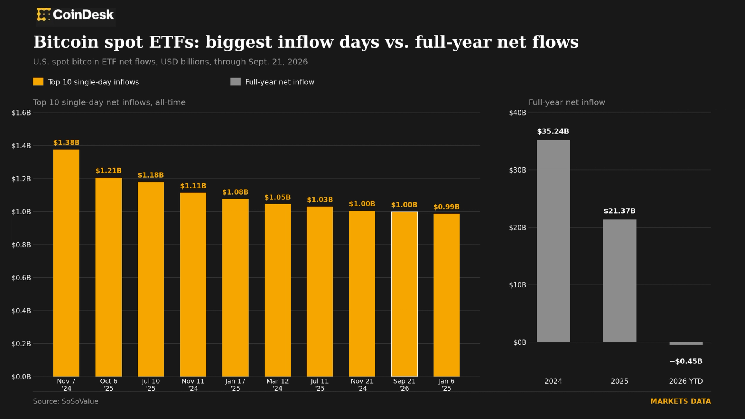
    • U.S. spot Bitcoin ETFs recorded a $998.95 million net inflow on Monday, the largest single-day haul since October 6, 2025, when Bitcoin traded near its all-time high of $126,200.
    • BlackRock’s IBIT led the surge with $381.37 million, followed by Ark’s ARKB ($289.12 million) and Fidelity’s FBTC ($238.84 million), marking the ninth-largest inflow day since the funds launched in January 2024.
    • The three-day winning streak lifts month-to-date inflows to $1.31 billion, extending August’s $3.52 billion pace and signaling sustained institutional conviction despite macroeconomic headwinds.

    Record-Breaking Inflow Signals Institutional Conviction

    U.S.-listed spot Bitcoin exchange-traded funds posted a staggering $998.95 million in net inflows on Monday, according to data from SoSoValue, marking the most significant single-day capital allocation since October 6, 2025. That date coincides with Bitcoin’s previous all-time high of approximately $126,200, a level the asset has yet to reclaim. Monday’s haul also ranks as the ninth-largest daily inflow since the ETF suite debuted on January 11, 2024, underscoring the magnitude of institutional appetite returning to the digital asset space.

    BlackRock, Ark, and Fidelity Lead the Charge

    The inflow was broad-based but heavily concentrated among the market’s dominant issuers. BlackRock’s iShares Bitcoin Trust (IBIT) captured $381.37 million, maintaining its position as the primary vehicle for institutional exposure. Ark Invest’s ARKB attracted $289.12 million, while Fidelity’s Wise Origin Bitcoin Fund (FBTC) drew $238.84 million. The combined strength across these three funds alone accounted for more than $900 million of the day’s total, reflecting a flight to liquidity and brand recognition among large allocators.

    Three-Day Streak Defies Legislative and Monetary Headwinds

    Monday’s print extends a three-day streak of positive flows—the first such run in two weeks—and arrives at a pivotal juncture. The cryptocurrency market recently absorbed a dual shock: a failed Senate cloture vote on the Clarity Act, which would have established a regulatory framework for digital assets, and a Federal Reserve interest-rate increase that typically pressures risk assets. Despite these headwinds, the persistent buying pressure suggests institutions are looking past near-term policy uncertainty and focusing on Bitcoin’s long-term portfolio role as a non-sovereign store of value.

    Monthly Momentum Builds on August’s Historic Pace

    The latest surge pushes month-to-date net inflows to $1.31 billion, building directly on August’s record-setting $3.52 billion tally. That two-month cumulative figure exceeds $4.8 billion, a pace that rivals the initial launch frenzy earlier this year. Analysts interpret the sustained flow data as evidence that allocators—ranging from registered investment advisors to hedge funds and corporate treasuries—are treating Bitcoin exposure as a strategic allocation rather than a tactical trade, even as fiscal debt concerns mount across advanced economies.

    Why This Matters

    The resilience of ETF flows amid legislative gridlock and restrictive monetary policy marks a maturation of the Bitcoin investment thesis. With the Clarity Act stalled, regulatory clarity remains elusive, yet capital continues to flow into the regulated ETF wrapper—a sign that institutions are comfortable navigating the current framework. The Fed’s rate hike cycle, while a traditional negative for non-yielding assets, has not deterred buyers, suggesting Bitcoin’s narrative as an inflation hedge and diversification tool is gaining traction in portfolio construction models. Upcoming catalysts include the next Federal Open Market Committee meeting, potential lame-duck session movement on crypto legislation, and the fourth-quarter rebalancing window that could amplify institutional positioning.

    Frequently Asked Questions

    Which Bitcoin ETFs saw the largest inflows on Monday?

    BlackRock’s IBIT led with $381.37 million, followed by Ark’s ARKB at $289.12 million and Fidelity’s FBTC at $238.84 million. These three funds accounted for the vast majority of the $998.95 million total net inflow.

    How does Monday’s inflow compare to historical levels?

    It was the largest single-day net inflow since October 6, 2025—the day Bitcoin hit its all-time high near $126,200—and ranks as the ninth-largest inflow day since the ETFs launched on January 11, 2024.

    What does the current flow trend suggest about institutional sentiment?

    The three-day winning streak and month-to-date total of $1.31 billion—following August’s $3.52 billion—indicate that institutions are maintaining conviction in Bitcoin despite the failed Clarity Act vote, a Fed rate hike, and broader fiscal debt concerns.

  • South Korea Prepares Blockchain-Based Digital Currency for Government Spending

    South Korea Prepares Blockchain-Based Digital Currency for Government Spending

    Key Highlights

    • South Korea’s Ministry of Science and ICT approved nine regulatory sandbox exemptions, including blockchain-based digital currency for public institution operating expenses.
    • Public institutions can now pay promotional and official duty expenditures via QR code smartphone payments, with reconciliation completed simultaneously at transaction time.
    • The measure expands real-world testing of blockchain technology in public spending, though specific digital currencies and rollout scale remain undisclosed.

    Regulatory Sandbox Clears Path for Blockchain Payments in Public Sector

    South Korea has taken a significant step toward modernizing public sector finance after the Ministry of Science and ICT approved nine regulatory sandbox exemptions for emerging technologies. The decision, finalized following a written review by the 45th ICT Regulatory Sandbox Committee on September 21st, explicitly allows public institutions to utilize blockchain-based digital currency for designated operating expenses. This marks a notable expansion of the country’s ongoing efforts to integrate distributed ledger technology into government operations.

    QR Code Payments and Real-Time Reconciliation

    Under the new framework, public institutions gain the ability to settle certain operating costs—including promotional expenditures and similar outlays incurred by employees during official duties—using blockchain-based digital currency. Payments can be executed via QR codes on smartphones, moving beyond traditional physical card transactions. A key technical advantage cited by the ministry is that reconciliation processes will be completed simultaneously with the payment itself, eliminating the separate settlement stages typical of conventional payment workflows and enabling faster transaction processing.

    Part of Broader Blockchain Testing Strategy

    The exemptions form part of South Korea’s wider strategy of leveraging regulatory sandbox mechanisms to trial blockchain technology and digital assets across various sectors. By authorizing real-world use cases in public spending, the government aims to evaluate the practical viability, efficiency gains, and oversight requirements of blockchain-based payment systems in a controlled environment. The ministry indicated that the implementation phase will include monitoring how digital currency payments are used and supervised within public institutions.

    Why This Matters

    South Korea’s move reflects a growing trend among advanced economies to explore central bank digital currency (CBDC) and blockchain applications for government operations. The simultaneous reconciliation feature addresses a persistent pain point in public finance—delayed settlement and reconciliation cycles—potentially reducing administrative overhead and improving transparency. However, the absence of disclosed details regarding which specific digital currencies will be deployed, the initial scale of adoption, and the identity of participating institutions suggests a cautious, phased approach. The monitoring component will be critical for shaping future policy, as regulators assess compliance, auditability, and public trust in blockchain-based public expenditure systems.

    Frequently Asked Questions

    Which public institutions are covered by the new regulation?
    The Ministry of Science and ICT did not specify which public institutions will participate in the initial implementation phase. Further details on the scope and participating entities are expected as the rollout progresses.
    What types of blockchain-based digital currency will be used?
    The current statement does not disclose which specific digital currencies or blockchain platforms will be utilized. The regulatory sandbox framework allows for testing of various solutions under supervision.
    When will the new payment system go live?
    No official launch date was announced. The ministry stated that implementation will include monitoring of how digital currency payments are used and supervised in public spending, indicating a phased approach.
  • Whitehats Transfer 52 Bitcoin from Coldcard Hack to Recovery Trust

    Whitehats Transfer 52 Bitcoin from Coldcard Hack to Recovery Trust

    Key Highlights

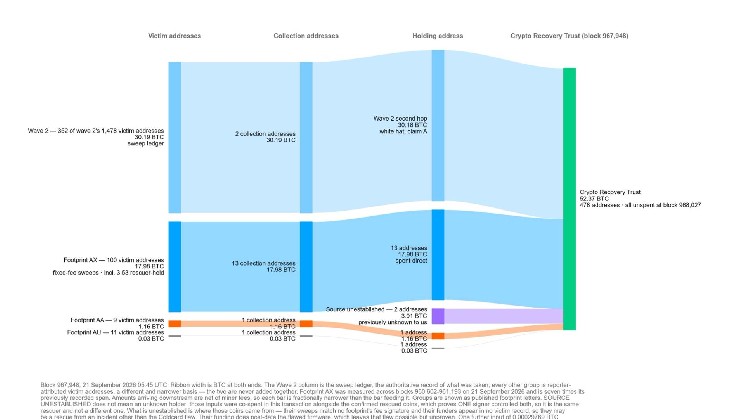
    • Ethical hackers transferred 52.37 BTC to a newly formed recovery trust address as part of remediation efforts from the July Coldcard hardware wallet exploit.
    • The multi-wave attack, beginning July 30, exploited a firmware vulnerability that forced wallets to use a weaker software-based random number generator, exposing over $100 million in bitcoin.
    • Coinkite has patched the firmware, but funds derived from compromised seeds remain at risk regardless of the update.

    Whitehat Operators Secure 52.37 BTC in Coldcard Recovery Effort

    “Whitehat operators” have moved 52.37 BTC to an address linked to a newly formed recovery trust, according to Galaxy Digital’s Head of Research Alex Thorn. The transfer represents a significant development in the ongoing fallout from July’s Coldcard hardware wallet exploit, which began on July 30 and unfolded across multiple attack waves—designated as waves 1, 2, and 3—in subsequent days. Estimated losses from the incident have surpassed $100 million in bitcoin.

    Firmware Vulnerability Enabled Seed Reconstruction

    The attack exploited a critical weakness in the Coldcard’s firmware implementation. Attackers manipulated affected devices into generating wallet seeds using a weaker software-based random number source instead of the wallet’s dedicated hardware random number generator. This deviation made a subset of seeds vulnerable to reconstruction by malicious actors, effectively compromising the cryptographic foundation of the affected wallets. Coinkite, the manufacturer of Coldcard, has since released a firmware patch to address the vulnerability.

    Patched Firmware Does Not Secure Previously Exposed Funds

    Despite the availability of a firmware update, Coinkite has clarified that funds already exposed under the old, compromised seeds remain at risk regardless of the patch. The cryptographic weakness pertains to the seed generation process itself; once a seed has been generated using the flawed entropy source, updating the device firmware cannot retroactively secure the private keys derived from that seed. This distinction leaves a significant volume of bitcoin vulnerable to potential theft unless proactive measures are taken.

    Ethical Hackers Intervene to Protect At-Risk Assets

    According to Thorn, not all funds moved from victim wallets were taken by malicious actors. A portion was swept by “good guys”—ethical cybersecurity professionals who use hacking skills to identify and remediate security weaknesses. These whitehat operators intervened specifically to remove the at-risk bitcoin from vulnerable addresses and place them into secure custody within the recovery trust, preserving the assets until they can be safely returned to their rightful owners.

    Why This Matters

    The Coldcard exploit underscores a persistent risk in the hardware wallet sector: implementation flaws in entropy generation can undermine the air-gapped security model that cold storage devices promise. While Coinkite’s patch prevents future seed generations from being compromised, the incident highlights the irreversible nature of seed exposure—once a mnemonic phrase is generated with insufficient entropy, the resulting private keys are permanently weakened. The formation of a recovery trust and the active participation of whitehat operators represent an emerging cooperative defense model in the bitcoin ecosystem, where ethical researchers race against malicious actors to secure funds derived from known cryptographic weaknesses. The situation remains fluid, with the total scope of affected addresses and the ultimate recoverability of swept funds still unfolding.

    Frequently Asked Questions

    How many bitcoin were moved to the recovery trust by whitehat operators?
    52.37 BTC were transferred to an address linked to a newly formed recovery trust as part of the remediation effort.
    Does updating Coldcard firmware protect funds from seeds generated before the patch?
    No. Coinkite has stated that funds exposed under the old, compromised seeds remain at risk regardless of the firmware update, because the vulnerability lies in the seed generation process itself, not in the device’s ongoing operation.
    What caused the Coldcard wallet seeds to be vulnerable?
    The exploit forced affected wallets to generate seeds using a weaker software-based random number source instead of the dedicated hardware random number generator, making those seeds susceptible to reconstruction by attackers.
  • Trueo Ethereum Plan Draws Praise from Vitalik Buterin

    Trueo Ethereum Plan Draws Praise from Vitalik Buterin

    Key Highlights

    • Trueo is migrating its prediction market protocol from Base to Ethereum mainnet, advising users to avoid creating new Base markets expiring after January 31, 2027.
    • Ethereum co-founder Vitalik Buterin publicly endorsed Trueo’s approach, praising its focus on decentralization and ethical design while calling it “not corposlop.”
    • The protocol will maintain Base operations during transition, with TRUE token migration proceeding without a deadline and a next-generation oracle system planned for Ethereum deployment.

    Trueo Announces Migration from Base to Ethereum Mainnet

    Prediction market protocol Trueo has announced plans to move its deployment from Coinbase’s Base Layer 2 network to Ethereum mainnet, marking a significant strategic shift for the platform launched in March 2025. In its migration announcement, Trueo instructed users to avoid creating new markets on Base with expiration dates beyond January 31, 2027, while confirming that the Base application will remain operational during the Ethereum deployment preparation period.

    The protocol, which operates binary YES-or-NO prediction markets onchain using a custom Uniswap v4 hook for non-custodial trading, will continue supporting trading, market resolution, and redemptions on Base. Existing markets will remain accessible through their natural expiries, and TYD collateral will continue earning yield throughout the transition. According to Trueo, markets expiring during 2026 can still be created on Base, while new market ideas requiring later expiration dates should wait for the Ethereum instance.

    Token Migration and Infrastructure Considerations

    TRUE, the protocol’s governance and oracle token, will migrate to Ethereum through an open-ended process without an announced deadline for token holders. Future staking and liquidity incentive programs are scheduled to operate on Ethereum once the new deployment becomes available. Current public data indicates the migration has not yet been completed—Trueo’s official deployment documentation continues to list its TruthMarketManager, OracleCouncil, OracleBonds, OrderManager, and market master contracts on Base mainnet, with no Ethereum mainnet deployment addresses published.

    DefiLlama’s September 22 snapshot attributes all $796,126.31 of tracked Trueo total value locked (TVL) to Base, with $9,727.92 in decentralized exchange volume recorded over the previous 30 days. Base accounts for 100% of the protocol’s tracked TVL, underscoring the early stage of the Ethereum transition.

    Ethereum’s Network Effects Drive Strategic Decision

    Trueo cited Ethereum’s network effects, available liquidity, integration options, and long-term infrastructure as primary drivers for the move. The team stated that lower execution costs on Ethereum have made mainnet more practical for its product, while the network’s roadmap offers what Trueo described as a “neutral and predictable base for development.” The project framed Base as useful during its earlier experimental period rather than criticizing the Coinbase-linked Layer 2, explaining that Ethereum better fits its intended model of a “widely integrated, permissionless and highly immutable prediction market.”

    The protocol also highlighted Ethereum’s existing decentralized finance environment as a factor, noting that direct access to Ethereum applications and liquidity could provide more integration paths. Trueo described the Ethereum L1 prediction-market field as less crowded than several competing blockchain environments, presenting that assessment as part of its migration rationale.

    Vitalik Buterin Endorses Trueo’s Approach

    Ethereum co-founder Vitalik Buterin responded publicly on September 21, welcoming what he described as a new prediction-market contender on Ethereum L1. In a post on X, Buterin wrote:

    Glad to see that Ethereum L1 will have a new strong prediction market contender that is dedicated to decentralization, and being ethical and not corposlop, and to actually trying to do interesting and meaningful things with this class of economic primitive.…

    Buterin praised Trueo’s stated focus on decentralization and ethical design, calling it “not corposlop” and saying prediction markets could be used for “interesting and meaningful things.” His response follows months of public criticism of some prediction-market products. As reported by crypto.news in February, Buterin warned that the sector was becoming heavily focused on short-duration cryptocurrency price wagers and sports betting, describing the direction as an “unhealthy product market fit” and discussing hedging and real-world risk management as alternative uses. In related coverage, Buterin proposed prediction-market-style mechanisms as one layer of future onchain governance, paired with a separate preference-setting system intended to resist capture. His latest Trueo comments did not announce an Ethereum Foundation partnership, grant, investment, or other formal arrangement with the project.

    Next-Generation Oracle System Planned for Ethereum Deployment

    Trueo said work surrounding the Ethereum deployment will include a next-generation oracle system for disputed prediction-market outcomes. The migration announcement did not provide a launch date or publish Ethereum contract addresses, leaving the Base contracts as the only deployment currently listed in Trueo’s public documentation.

    The current protocol uses an optimistic resolution process. According to Trueo’s resolution documentation, any participant can propose an outcome once a market meets its resolution criteria, beginning a 12-hour challenge period. If no valid dispute is raised, the proposed result becomes final at the end of the window. When a participant challenges an outcome, the dispute path can move through several levels: the Oracle Council handles early arbitration, followed by escalation to TRUE holders when further challenges meet required conditions. At the final level, the protocol randomly selects 11 attesters to determine the market outcome and applicable slashing conditions.

    Market definitions are committed onchain when users create them, with the market question, approved resolution sources, and supporting resolution information recorded as immutable strings. Trueo’s published integrity standards prohibit markets that directly create incentives for targeted violence, terrorism, self-harm, or other dangerous conduct. Markets lacking clear, publicly verifiable resolution criteria must be canceled under the protocol’s stated rules.

    Why This Matters

    Trueo’s migration from Base to Ethereum mainnet reflects a broader trend of protocols evaluating Layer 1 versus Layer 2 trade-offs as Ethereum’s execution costs decrease and its roadmap matures. The move positions Trueo to leverage Ethereum’s deeper liquidity pools, established DeFi integrations, and stronger immutability guarantees—critical factors for a prediction market protocol where trust minimization and oracle integrity are paramount. Vitalik Buterin’s public endorsement signals alignment with Ethereum’s core values around decentralization and ethical application design, potentially attracting developer and user attention in a prediction market landscape Buterin has criticized for prioritizing speculative gambling over meaningful risk management tools. The protocol’s commitment to maintaining Base operations during transition demonstrates a user-first approach, while the planned next-generation oracle system could advance onchain dispute resolution mechanisms. With no fixed timeline for Ethereum deployment or TRUE token migration completion, market participants should monitor Trueo’s official channels for contract addresses and launch announcements.

    Frequently Asked Questions

    Will Trueo shut down its Base deployment immediately?
    No. Trueo confirmed the Base application will remain available during Ethereum deployment preparation. Trading, market resolution, and redemptions will continue on Base, existing markets will remain accessible through their expiries, and TYD collateral will keep earning yield during the transition.
    What is the deadline for migrating TRUE tokens to Ethereum?
    Trueo has not announced a deadline for the TRUE token migration. The process is described as open-ended, with future staking and liquidity incentives scheduled to operate on Ethereum once the new deployment goes live.
    When will Trueo’s Ethereum mainnet deployment launch?
    Trueo has not published a launch date for its Ethereum deployment or released Ethereum contract addresses. The project’s public documentation currently lists only Base mainnet contracts for TruthMarketManager, OracleCouncil, OracleBonds, OrderManager, and market master contracts.
  • Kakao Pay, KakaoBank Partner with Fireblocks on Stablecoin Memorandum of Understanding

    Kakao Pay, KakaoBank Partner with Fireblocks on Stablecoin Memorandum of Understanding

    Key Highlights

    • Kakao Pay and KakaoBank signed a memorandum of understanding with Fireblocks on September 21, 2026, to explore stablecoin infrastructure and digital asset distribution frameworks tailored to South Korean regulatory requirements.
    • The agreement launches proof-of-concept testing but does not announce a stablecoin launch, investment amount, commercial product, deployment date, or selected blockchain technology.
    • The partnership adds Fireblocks as a second infrastructure provider alongside Kakao Group’s existing July agreement with Circle, while South Korea’s Financial Services Commission and Bank of Korea continue developing the legal framework for won-denominated stablecoins.

    Kakao Group Expands Stablecoin Research With Fireblocks Partnership

    Kakao Pay and KakaoBank have formalized a memorandum of understanding with institutional digital asset infrastructure provider Fireblocks to evaluate stablecoin distribution frameworks and other digital asset services for the South Korean market. Announced by Fireblocks on September 21, 2026, the three-party agreement initiates a proof-of-concept phase designed around Korea’s specific regulatory, security, and service requirements. The companies emphasized that the MoU does not constitute a stablecoin issuance announcement, commit investment capital, authorize a commercial product, or set a deployment timeline.

    Kakao Leadership Directs Joint Stablecoin Task Force

    Fireblocks identified Kakao Pay CEO Shin Won-keun and KakaoBank CEO Yun Ho-young as co-heads of Kakao Group’s Stablecoin Task Force, signaling coordinated executive oversight across the conglomerate’s payments and banking arms. Kakao Pay contributes its consumer payments expertise, while KakaoBank provides the licensed banking component necessary for financial infrastructure integration. Under the MoU, the parties will assess distribution frameworks compatible with domestic rules before advancing to practical PoC testing. No single technical design, blockchain protocol, token standard, reserve structure, custody model, or consumer rollout plan has been publicly selected.

    Executives Outline Strategic Direction Without Committing to Launch

    KakaoBank CEO Yun Ho-young stated the parties expect to combine their technology and expertise to “develop secure and accessible digital asset services.” His statement describes an intended direction and does not confirm a product launch. Kakao Pay CEO Shin Won-keun added that Korea’s developing digital asset market “depends on the reliable flow of digital asset distribution.” Neither Kakao entity disclosed whether a future stablecoin would be issued directly by a bank, another Kakao Group entity, or an outside issuer.

    Fireblocks Brings Institutional-Grade Infrastructure to PoC Phase

    Fireblocks contributes a platform deployed by more than 2,500 institutions, including over 100 banks, supporting custody, settlement, stablecoin payments, tokenization, trading, and compliance operations across more than 200 blockchains. According to the company’s own platform statistics, its network processes more than $200 billion in monthly stablecoin volume through more than 300 payment service providers, fintech companies, and banks—figures presented as Fireblocks network metrics, not Kakao transaction volumes. Fireblocks CEO Michael Shaulov said infrastructure for Korean banks and payment platforms needs to be “engineered to meet institutional requirements from day one.” The agreement does not state whether Kakao Pay or KakaoBank has committed to using Fireblocks in a production environment; PoC testing precedes any potential commercial deployment.

    Fireblocks Agreement Supplements, Does Not Replace, Circle Partnership

    The Fireblocks pact follows Kakao Group’s July agreement with Circle, which covered stablecoin payments, blockchain settlement, and digital asset infrastructure. Under that arrangement, Kakao, Kakao Pay, and KakaoBank planned to study KRW-based digital assets, cross-border payments, and tokenized financial services alongside Circle’s blockchain technology. Crypto.news reported at the time that no won-denominated stablecoin was launched, no launch date was set, and no particular issuance model was confirmed, while Circle CEO Jeremy Allaire had previously said Circle did not plan to issue its own KRW stablecoin. The Fireblocks announcement introduces another infrastructure provider into Kakao Group’s research without replacing or ending the Circle arrangement, though it does not describe Circle’s role in the new PoCs or state whether the two relationships will share technology.

    South Korea’s Regulatory Landscape Remains in Development

    Kakao Group’s dual-infrastructure approach unfolds as South Korea continues shaping its legal framework for digital assets. The Financial Services Commission has indicated its planned framework law will address stablecoins, while regulators prepare rules covering blockchain-based financial infrastructure. In August, the FSC said discussions over the government’s second-stage digital asset legislation were still underway and specifically rejected claims that a proposed ownership cap for major crypto-exchange shareholders had been finalized. The Bank of Korea, in a payment systems report published September 17, disclosed the creation of a Digital Asset Research Section following the Virtual Asset User Protection Act’s enactment, noting the unit has participated in legislative discussions concerning KRW-denominated stablecoins.

    Domestic Peers Advance Parallel Stablecoin Trials

    Kakao is not alone in testing stablecoin systems ahead of final regulations. KB Financial Group completed a proof of concept in May covering won-denominated stablecoin issuance, offline QR payments, merchant settlement, and a Vietnam remittance trial. Toss followed in July with a three-month technology program partnering with Optimism and Sunnyside Labs to examine payment settlement, compliance, and privacy requirements for won-linked stablecoins. These parallel efforts reflect broader industry preparation for a regulatory environment that remains unfinished.

    Why This Matters

    South Korea’s largest internet platform conglomerate is now running dual stablecoin infrastructure evaluations with two of the world’s most prominent institutional crypto infrastructure providers—Fireblocks and Circle—while the country’s financial regulators and central bank actively draft the legal framework that will govern won-denominated digital assets. The absence of a launch commitment, selected blockchain, or issuance model underscores that Kakao Group is prioritizing regulatory alignment and technical validation over speed to market. For the broader digital asset ecosystem, the Kakao-Fireblocks MoU signals how major Asian financial-technology incumbents are approaching stablecoin adoption: through methodical, regulatorily conscious PoC phases with institutional-grade partners, rather than immediate commercial deployment. The outcome of these tests, and the eventual shape of the FSC’s framework law and BOK’s policy stance, will likely influence how other major Korean financial groups—including KB Financial Group and Toss—structure their own stablecoin strategies.

    Frequently Asked Questions

    Has Kakao Group launched a won-denominated stablecoin?

    No. Neither the September Fireblocks MoU nor the July Circle agreement has resulted in a stablecoin launch. Both agreements are explicitly limited to proof-of-concept testing and infrastructure evaluation, with no product, deployment date, or issuance model confirmed.

    Does the Fireblocks partnership replace Kakao’s earlier agreement with Circle?

    No. Fireblocks’ announcement states the new MoU introduces another infrastructure provider into Kakao Group’s stablecoin research without replacing or ending the Circle arrangement. The relationship between the two partnerships—including whether they will share technology—has not been publicly described.

    What regulatory milestones remain before a Korean won stablecoin could launch?

    The Financial Services Commission is still developing its second-stage digital asset legislation, which will include stablecoin provisions, and the Bank of Korea’s new Digital Asset Research Section is participating in legislative discussions. The FSC has cautioned that reported provisions, including ownership caps for major exchange shareholders, have not been finalized.

  • Ethereum Treasury Firm Bitmine Withdraws Large ETH Sum from Kraken Amid Recent Rally

    Ethereum Treasury Firm Bitmine Withdraws Large ETH Sum from Kraken Amid Recent Rally

    Key Highlights

    • Bitmine, chaired by Tom Lee, withdrew 12,500 ETH worth approximately $34.55 million from Kraken exchange, per on-chain data from Lookonchain.
    • The transfer implies an Ethereum price of roughly $2,764 at the time of the transaction and aligns with Bitmine’s stated Ethereum-focused treasury strategy.
    • Analysts caution that exchange withdrawals do not conclusively confirm new purchases, as assets may be moved for custody, security, or other operational reasons.

    Bitmine Executes Large Ethereum Withdrawal from Kraken Exchange

    Blockchain analytics firm Lookonchain has flagged a significant on-chain movement involving Bitmine, the digital asset investment firm chaired by veteran market strategist Tom Lee. According to the on-chain data, Bitmine withdrew 12,500 Ether (ETH) from the Kraken cryptocurrency exchange in a single transaction. Based on the reported total value of approximately $34.55 million, the implied price of Ethereum at the time of the transfer was roughly $2,764. The transaction marks the latest in a series of accumulation moves by the firm, which has positioned Ethereum as a cornerstone of its corporate treasury strategy.

    Institutional Accumulation Strategy Comes Into Focus

    Bitmine has distinguished itself among publicly listed and institutional crypto holders through its explicit Ethereum-centric allocation approach. Under the leadership of Chairman Tom Lee, the company has consistently increased its ETH holdings, treating the asset as a long-term treasury reserve rather than a speculative position. The latest withdrawal from Kraken follows a pattern observed by on-chain analysts where entities reduce exchange counterparty risk by moving substantial holdings into self-custody or cold storage solutions. Such movements are frequently interpreted by market participants as a signal of long-term conviction, though the on-chain data alone cannot verify the specific intent behind each transfer.

    Exchange Outflows Versus Purchase Confirmation

    While the scale of the withdrawal—12,500 ETH—is material, analysts emphasize that a transfer off an exchange does not definitively equate to a fresh capital deployment or new purchase. Assets held on exchanges can be relocated for various operational reasons, including internal wallet restructuring, custodial migrations, preparation for staking activities, or risk management protocols. Lookonchain’s data tracks the movement of tokens between addresses but does not provide visibility into the off-chain commercial agreements or internal accounting that motivate such transfers. Therefore, attributing the outflow solely to aggressive buying would be an overinterpretation of the available evidence.

    Why This Matters

    The Bitmine withdrawal underscores a broader trend of institutional participants deepening their exposure to Ethereum amid evolving regulatory clarity and the maturation of staking infrastructure. As the second-largest cryptocurrency by market capitalization, Ethereum’s transition to proof-of-stake has introduced yield-bearing dynamics that appeal to corporate treasurers seeking both appreciation potential and native returns. Large exchange outflows reduce the immediately liquid supply available for trading, which can exert upward pressure on prices if demand remains constant. However, without confirmatory disclosures from Bitmine—such as a Form 8-K filing, press release, or verified wallet labeling—the market must rely on on-chain heuristics rather than audited financial data. The coming weeks will reveal whether this transfer precedes further accumulation or represents a one-off custodial adjustment.

    Frequently Asked Questions

    Did Bitmine buy 12,500 ETH in this transaction?

    Not necessarily. The on-chain data shows a withdrawal of 12,500 ETH from Kraken to an address associated with Bitmine. While this increases the firm’s self-custodied holdings, the transfer itself does not prove the assets were purchased at that moment; they may have been acquired earlier and held on the exchange.

    Who is Tom Lee and what is his role at Bitmine?

    Tom Lee is the Chairman of Bitmine. He is a well-known market strategist and co-founder of Fundstrat Global Advisors. At Bitmine, he oversees the company’s digital asset strategy, which has prominently featured Ethereum accumulation as a core treasury initiative.

    How does this withdrawal affect Ethereum’s market dynamics?

    Large exchange outflows reduce the circulating supply available for immediate sale, which can be bullish if buying pressure persists. However, a single transaction of this size—while notable—is unlikely to move the market materially on its own. Sustained institutional withdrawal trends are more impactful than isolated events.

  • SEI Surges 25% as Canary’s 90% Staking Plan Tightens Supply

    SEI Surges 25% as Canary’s 90% Staking Plan Tightens Supply

    Key Highlights

    • Sei ($SEI) surged 25.93% to $0.06285 after decisively breaking the $0.052 resistance level, accompanied by a 289% spike in daily trading volume to $203.44 million.
    • Canary Capital’s amended S-1 filing proposes staking approximately 90% of the ETF’s $SEI holdings, a structure that could significantly reduce circulating supply given that 42% of tokens are already staked.
    • Technical indicators show extreme overbought conditions with RSI at 87.64, while derivatives data reveals open interest near $95 million, suggesting leveraged positioning rather than spot-driven demand.

    Sei Breaks Key Resistance with Explosive Volume

    After weeks of failed attempts near the $0.052 level, Sei ($SEI) has finally executed a decisive breakout, surging 25.93% in 24 hours to reach $0.06285. The move marks a clear transition from a prolonged consolidation phase into upward momentum, according to TradingView chart analysis. Daily trading volume exploded to $203.44 million, representing a 289% increase per CoinMarketCap data, signaling broad-based market participation rather than isolated speculative activity. The volume surge suggests the breakout has attracted significant new capital, validating the technical breach of a resistance level that had repeatedly rejected price advances over recent weeks.

    Technical Indicators Signal Overbought Conditions

    Despite the bullish structure of the breakout, technical metrics warn of immediate downside risk. The Relative Strength Index (RSI) sits at 87.64, well into extreme overbought territory, indicating that buying momentum has reached unsustainable levels. Because the breakout price has moved well beyond the prior trading range, there is very little support established above the former $0.052 resistance. This structural vacuum means any profit-taking or shift in sentiment could trigger a rapid retracement. A successful retest and hold at $0.052 would validate the emerging trendline construction, but failure to defend that level could expose the token to significant selling pressure as recent buyers exit positions.

    Canary Capital ETF Proposal Introduces Supply Dynamics

    A fundamental catalyst underpinning the rally is Canary Capital’s amended S-1 registration statement for a spot $SEI exchange-traded fund. The filing proposes staking roughly 90% of the ETF’s $SEI holdings, a mechanism that would remove the majority of tokens acquired through fund purchases from open circulation. With approximately 4.2 billion of the 10 billion total tokens — 42% of circulating supply — already staked, the ETF structure would further constrain the tradable float rather than expand liquidity access. All future staking rewards would flow directly into the fund, compounding the yield-bearing allocation. BitGo has been designated as the sole custodian, streamlining operational execution while concentrating custody exposure. Larger inflows under this model could tighten liquidity further and amplify $SEI’s price sensitivity to demand shifts.

    Derivatives Market Drives Current Momentum

    While ETF headlines have fueled positive sentiment, derivatives markets remain the primary engine of current trading activity. Open interest sits near $95 million with funding rates moderately positive around 0.01%, according to CoinGlass data, indicating that leveraged traders are positioning for continued upside. However, this derivatives-heavy structure creates fragility: the recent price premium relies on expectations for the proposed ETF rather than actual creation and redemption activity, as regulatory approval and listing remain pending. Without a stronger shift toward spot-market buying, fading ETF optimism could prompt leveraged participants to unwind positions rapidly, placing recent gains under significant pressure.

    Why This Matters

    The convergence of a technical breakout, a novel ETF staking mechanism, and derivatives-driven speculation creates a unique inflection point for Sei. The Canary Capital proposal represents one of the first ETF structures to explicitly integrate native staking at scale, potentially setting a precedent for how crypto asset managers handle proof-of-stake tokens. If approved, the 90% staking ratio could effectively lock up a substantial portion of new institutional demand, creating a structural supply squeeze. However, the current rally’s dependence on futures positioning rather than spot accumulation highlights the speculative nature of the move. Market participants should monitor whether spot volume sustains above the 24-hour surge and whether the $0.052 level transitions from resistance to support — the key technical validation for a durable trend change.

    Frequently Asked Questions

    What caused Sei’s 25% price surge in 24 hours?

    The surge was triggered by a decisive break above the $0.052 resistance level that had contained price action for weeks, accompanied by a 289% volume increase to $203.44 million. Positive sentiment around Canary Capital’s proposed spot ETF with a 90% staking mechanism provided a fundamental narrative catalyst.

    How would Canary Capital’s ETF staking plan affect $SEI supply?

    The proposal to stake 90% of the ETF’s holdings would remove newly acquired tokens from circulation, further reducing the tradable float. With 42% of the 10 billion total supply already staked, this structure could intensify supply constraints and amplify price responses to demand.

    Is the current rally sustainable given technical indicators?

    Technical warning signs are significant: RSI at 87.64 indicates extreme overbought conditions, and minimal support exists above the breakout level. The rally is currently derivatives-led (open interest near $95M) rather than spot-driven, making it vulnerable to leveraged unwinding if ETF approval timelines extend or sentiment shifts.

  • Elon Musk’s X Brings Bitcoin, Stock Trading Closer to Timeline

    Elon Musk’s X Brings Bitcoin, Stock Trading Closer to Timeline

    Key Highlights

    • X (formerly Twitter) launches direct trading feature for U.S. users, enabling trades via cashtags like $BTC and $TSLA without leaving the app.
    • Trading executes through five partner platforms—Interactive Brokers, Moomoo, Gemini, Kraken, and Coinbase—with X acting as a gateway, not a broker.
    • The feature builds on cashtag enhancements from earlier this year, advancing Elon Musk’s vision of transforming X into a comprehensive finance destination.

    X Introduces In-App Trading Gateway for U.S. Users

    Elon Musk’s social media platform X has rolled out a new trading feature that allows its United States-based users to move directly from financial discussions on their timeline to executing trades on partner exchanges. The functionality, which went live recently, transforms cashtags—such as $BTC for Bitcoin or $TSLA for Tesla—into actionable entry points. When a user taps a cashtag, they now see real-time price charts and related posts alongside a prominent “Trade” button. Selecting this button redirects the user to one of X’s five integrated partner platforms: Interactive Brokers, Moomoo, Gemini, Kraken, or Coinbase. There, the user can log in to an existing account or create a new one to complete the transaction.

    Platform Acts as Conduit, Not Counterparty

    X emphasizes that it does not function as a broker-dealer in this arrangement. The company provides the discovery layer—surfacing market chatter and data—while the actual order execution, custody, and regulatory compliance remain entirely with the partnered exchanges and brokerages. This distinction is critical for regulatory positioning, as it allows X to monetize financial engagement without assuming the licensing burdens and fiduciary responsibilities of a registered broker. The partner roster covers both traditional brokerage services (Interactive Brokers, Moomoo) and cryptocurrency-native exchanges (Gemini, Kraken, Coinbase), offering users a choice of venue based on asset class preference and existing account relationships.

    Evolution of Cashtags From Discovery to Execution

    Cashtags have existed on the platform for years as a convention for tracking financial conversation, similar to hashtags but prefixed with a dollar sign and a ticker symbol. Earlier in 2024, X upgraded the feature to display live pricing data and interactive charts directly within the timeline, turning passive symbols into dynamic market snapshots. The addition of a direct trade button represents the logical next step in that product trajectory, collapsing the friction between seeing a market-moving post and acting on it. Product engineering lead Mridul Singhai framed the update as a completion of that loop: “Cashtags close the gap between a ticker on the timeline and the market itself.”

    Strategic Push Toward an “Everything App” Finance Hub

    The launch aligns with Musk’s stated ambition to evolve X into an “everything app” encompassing payments, banking, and securities trading. By embedding a trading gateway natively, X captures value from the high-volume financial discourse that already defines a significant slice of its user base—often referred to as “FinTwit.” The move also creates a new revenue surface, likely through referral agreements or revenue-sharing with partners, while increasing user dwell time and session depth. For the partner firms, the integration offers a high-intent acquisition channel directly from the social layer where investment theses are debated in real time.

    Why This Matters

    This development signals a broader convergence of social media and capital markets infrastructure. Retail trading behavior is increasingly driven by social sentiment, meme-stock dynamics, and influencer analysis, all of which originate on platforms like X. By formalizing the pipe from conversation to execution, X reduces the latency that previously required users to copy a ticker, switch apps, search the symbol, and place an order. Regulators will likely scrutinize whether the seamless UX encourages impulsive trading or adequately surfaces risk disclosures, especially for volatile assets like cryptocurrencies. Meanwhile, competitors such as Reddit (with its community-driven due diligence) and Discord (with private trading servers) may face pressure to offer similar native execution pathways. The partnership model also highlights a growing trend: fintechs and tradfi firms distributing their services through non-financial super-apps rather than relying solely on their own branded channels.

    Frequently Asked Questions

    Which partner platforms can X users trade through?

    U.S. users are routed to one of five partners: Interactive Brokers, Moomoo, Gemini, Kraken, or Coinbase. The choice of venue depends on the asset class and the user’s existing account relationships.

    Does X act as a broker or hold user funds?

    No. X explicitly states it is not a broker. The platform provides the cashtag discovery interface and the “Trade” button redirect; all order execution, custody, KYC/AML compliance, and regulatory obligations remain with the partner exchange or brokerage.

    Is this feature available globally?

    According to the announcement, the direct trading feature is currently live for U.S.-based users only. No timeline for international expansion has been disclosed.

  • Circle Launches Bitcoin-Backed USDC Borrowing Service

    Circle Launches Bitcoin-Backed USDC Borrowing Service

    Key Highlights

    • Circle has launched Digital Asset-Backed Borrowing for eligible Circle Mint institutions, enabling them to deposit Bitcoin, mint cirBTC, and borrow USDC through third-party DeFi lending markets on Arc and Ethereum.
    • Morpho is the first supported protocol, with an 86% liquidation loan-to-value threshold on Arc; Circle indicates Aave and other platforms will follow, though no timetable has been announced.
    • The service keeps native Bitcoin in regulated custody via Circle National Trust while cirBTC circulates as collateral through user-controlled Smart Wallets, separating DeFi credit risk from Circle Mint balances.

    Circle Unveils Institutional Bitcoin-Backed USDC Borrowing via DeFi Protocols

    Circle announced on September 21, 2026, the launch of Digital Asset-Backed Borrowing for eligible Circle Mint LLC customers, introducing a streamlined workflow that allows institutions to deposit native Bitcoin ($BTC), mint Circle Wrapped Bitcoin (cirBTC), and borrow $USDC through third-party lending markets on the Arc and Ethereum networks. The product combines what were previously separate steps—custody, wrapping, and DeFi borrowing—into a single coordinated interface, with Morpho serving as the inaugural supported lending protocol.

    Digital Asset-Backed Borrowing is now available in Circle Mint for eligible Circle Mint LLC customers.Deposit $BTC. Mint cirBTC. Borrow $USDC.Through one coordinated workflow, customers can use $BTC-backed cirBTC as collateral through supported third-party lending markets on Arc… the company posted on its official X account on September 21.

    How the Borrowing Workflow Operates

    Under the new workflow, an eligible institution deposits Bitcoin into Circle Mint and mints cirBTC, a 1:1 Bitcoin-backed token. The customer then transfers cirBTC into a user-controlled Smart Wallet, posts the token as collateral with a supported protocol such as Morpho, and borrows USDC. Borrowed funds move automatically from the Smart Wallet into the customer’s Circle Mint balance. Repayment follows the same path: USDC sent from Circle Mint into the Smart Wallet repays part or all of the outstanding debt, freeing collateral subject to the lending protocol’s rules.

    Circle emphasizes that it does not provide the underlying credit. Its legal terms state that Circle Technology Services supplies the interface and Smart Wallet technology, while lending, collateral management, and liquidations occur entirely through third-party DeFi protocols and their smart contracts. Assets moved into the Smart Wallet are no longer held within the regulated Circle Mint environment. Circle Mint remains an institutional service; individual retail users cannot open standard Mint accounts, and Digital Asset-Backed Borrowing carries additional jurisdiction and eligibility requirements. Circle confirmed that New York customers are excluded from the borrowing product.

    Morpho Leads on Arc with Live cirBTC-USDC Markets

    Morpho provides the first lending infrastructure integrated with the Circle Mint borrowing workflow. On Arc, the protocol operates a USDC market using cirBTC as collateral with an 86% liquidation loan-to-value threshold. Live Morpho data viewed on September 22 showed $18.86 million in outstanding borrowing against $157.85 million of available liquidity. The market held $176.71 million in total size with utilization at 10.67%, and no realized or unrealized bad debt was displayed at the time of verification. These figures fluctuate as users supply liquidity, borrow, repay, or withdraw funds.

    Circle’s terms make clear that displayed rates and protocol parameters come from third parties and can change without Circle’s control. Automatic liquidation can occur if collateral values, oracle readings, interest charges, or protocol settings push a position beyond the applicable limit. Morpho had moved onto Arc when Circle’s Layer 1 went public on September 16. As previously reported, the Arc mainnet launched with USDC as its native gas asset, while Morpho and Aave supplied lending infrastructure alongside applications for trading and tokenized assets. Morpho had indicated before the Digital Asset-Backed Borrowing release that institutional Circle Mint customers would gain access to its Arc credit markets directly through Circle’s interface, and the protocol has separately proposed a $50,000 monthly incentive budget for Arc borrowing activity under its governance process.

    cirBTC Reserves Verified Above Outstanding Supply

    cirBTC serves as the collateral bridge connecting native Bitcoin with the Ethereum and Arc smart-contract environments. Circle first introduced the asset on Ethereum in June before bringing it to Arc on September 21. The launch on Ethereum introduced 1:1 Bitcoin backing alongside Chainlink Proof of Reserve, allowing market participants to inspect reserve information while native Bitcoin remains held separately from circulating wrapped tokens.

    Current Circle data showed 948.7508 cirBTC outstanding against 951.2586 BTC in reserves at the time of verification. Arc accounted for 396.9919 cirBTC, while Ethereum carried 551.7590 cirBTC. The displayed reserve value stood at roughly $77.19 million. Circle states the underlying Bitcoin is held through its Bermuda affiliate and safeguarded by Circle National Trust in segregated accounts for cirBTC holders. Circle National Trust received final approval from the Office of the Comptroller of the Currency (OCC) in July to operate as a federally chartered national trust bank. The OCC charter permits the trust bank to provide regulated digital asset custody services; it does not accept deposits or make loans, and digital assets held there are not FDIC insured.

    Circle affirms that cirBTC reserves are not lent, pledged, or rehypothecated. Chainlink Proof of Reserve publishes reserve information onchain, while Circle lists Bitcoin reserve addresses so counterparties can compare native BTC holdings with circulating cirBTC supply.

    Regulatory Perimeter and Risk Disclosures

    Circle’s legal documentation draws a clear line between the Circle Mint account and the DeFi borrowing position. Once collateral leaves Circle Mint for the Smart Wallet, Circle Internet Financial no longer holds those assets under the controls applying to balances kept inside Mint. Customers control the Smart Wallet through a two-of-two multiparty computation key-management system. Circle says it cannot independently initiate, reverse, or cancel blockchain transactions from the wallet. Borrowers remain responsible for monitoring their positions, maintaining collateral, and reviewing protocol risks.

    Liquidations are controlled entirely by the selected lending protocol. Circle warns that falling collateral values, changing rates, oracle movements, or revised market parameters can trigger an automatic liquidation without prior notice, potentially resulting in penalties or collateral losses.

    Why This Matters

    The launch represents a significant step in bridging regulated institutional custody with decentralized finance credit markets. By enabling institutions to unlock dollar liquidity from Bitcoin holdings without selling the underlying asset, Circle addresses a core treasury management need for crypto-native firms and traditional financial institutions entering digital assets. The architecture—keeping native Bitcoin in an OCC-chartered trust while cirBTC circulates through audited smart contracts—offers a compliance-forward model that separates custodial risk from DeFi protocol risk.

    Morpho’s immediate integration on Arc, just five days after the network’s public mainnet launch, demonstrates the velocity at which lending infrastructure can deploy on new chains when native gas assets (USDC) and wrapped collateral (cirBTC) are natively available. The forthcoming addition of Aave and other protocols would deepen liquidity and provide institutions with protocol choice, a key requirement for treasury diversification. Meanwhile, Circle’s expanding institutional USDC network—evidenced by BNY’s June launch of USDC minting, redemption, and custody and Standard Chartered’s July introduction of bank-led USDC access—signals a broader strategy to embed USDC into regulated financial plumbing while using DeFi as a complementary, opt-in yield and credit layer.

    Frequently Asked Questions

    Who is eligible to use Circle’s Digital Asset-Backed Borrowing?

    Only eligible Circle Mint LLC customers—institutional entities that meet jurisdiction and compliance requirements—can access the product. Individual retail users cannot open standard Circle Mint accounts, and New York customers are explicitly excluded from the borrowing service.

    What happens to the Bitcoin deposited as collateral?

    Native Bitcoin is held through Circle’s Bermuda affiliate and safeguarded by Circle National Trust, an OCC-chartered national trust bank, in segregated accounts. The Bitcoin is not lent, pledged, or rehypothecated. cirBTC is minted 1:1 against these reserves, and Chainlink Proof of Reserve provides onchain verification of the backing.

    Does Circle control the lending terms or liquidation process?

    No. Circle provides the interface and Smart Wallet technology through Circle Technology Services. Lending, collateral management, interest rates, liquidation thresholds, and liquidation execution are controlled entirely by the third-party DeFi protocol (currently Morpho) and its smart contracts. Circle cannot initiate, reverse, or cancel transactions from the user-controlled Smart Wallet.

  • Spaces Launches Trust Anchor to Verify Bitcoin Identities Without a Central Resolver

    Spaces Launches Trust Anchor to Verify Bitcoin Identities Without a Central Resolver

    Key Highlights

    • Spaces launches Trust Anchor, enabling Bitcoin-native verification of human-readable identities like alice@bitcoin without central resolvers.
    • Version 0.4.2 activates off-chain issuance on mainnet with @bitcoin as first operator; handles cost a flat $25 and are irrevocable once issued.
    • Protocol differs from BIP-353, NIP-05, and ENS by anchoring name and key directly to Bitcoin, allowing holder-controlled certificates verifiable by anyone.

    Spaces Unveils Trust Anchor to Solve Bitcoin Identity Verification Without Central Authorities

    Spaces has released Trust Anchor, a new tool designed to let applications confirm human-readable identities—such as alice@bitcoin—directly through the Bitcoin network instead of relying on a central resolver. The launch, also reported by Bitcoin News, addresses a decades-old challenge in the cryptocurrency industry: how to simplify address usage without requiring users to trust a company server to determine who truly owns an address. By associating both payments and identity with Bitcoin, Trust Anchor aims to remove the intermediary trust assumptions that have plagued previous naming systems.

    How Trust Anchor and the Trust ID Work

    According to Spaces documentation, a single number called the Trust ID represents the Trust Anchor. When users scan or paste the Trust ID, compatible software can validate the state of the Spaces protocol using data obtained directly from the Bitcoin network. The generated anchor set is then transformed into the Trust ID. Spaces notes that a Trust ID remains valid for 14 days; users typically need to rescan only when adding new contacts or when a contact rotates a key.

    To obtain a Trust ID, running a full Bitcoin node is not required. Spaces recommends Veritas, a macOS menu-bar application that acts as a local certificate authority anchored to Bitcoin. Veritas can sync via a checkpoint, validate Bitcoin’s header chain, and generate the Trust ID locally. For users of the Spaces client with Bitcoin Core, the space-cli trust command provides an alternative method to produce the Trust ID as a QR code along with the linked Bitcoin block. Veritas currently supports only macOS, while Windows and Linux users are directed to the Spaces client.

    Mainnet Launch Activates Off-Chain Issuance with @bitcoin as First Operator

    Irrevocable Handles at a Flat $25 Fee

    On September 16, Spaces shipped version 0.4.2, bringing its off-chain issuance system to mainnet with @bitcoin serving as the first production operator. According to the mainnet announcement, handles can be acquired via Nacho on iOS, Android, or the web. Each handle links a readable name to the script pubkey of a Binary Merkle Trie. The operator periodically commits the trie root to Bitcoin via a 32-byte hash, after which the holder receives an off-chain certificate proving both inclusion and prior non-existence.

    Spaces emphasizes that there are no possibilities of later revoking, rerouting, or recovering a handle after it has been issued. The cost for @bitcoin handles is a flat $25 under a first-come, first-served distribution model. Technical details of the process are available in the project’s protocol paper.

    Contrasting Trust Roots: Spaces vs. BIP-353, NIP-05, and ENS

    The architecture differs fundamentally from existing approaches. BIP-353, authored by Matt Corallo and Bastien Teinturier, publishes Bitcoin payment details via DNS TXT records and relies on DNSSEC for verification. NIP-05 similarly uses internet domains, extracting identity information from the domain’s /.well-known/nostr.json file. Spaces, by contrast, links both the name and the private key directly to Bitcoin, enabling the holder to obtain a certificate verifiable by anyone without referencing the original certificate issuers.

    $ENS employs yet another model: its registry is built on Ethereum smart contracts. A March 2026 post by $ENS stated there are approximately 1.6 million registered domains and 30 million subnames across over one hundred different chains. Even if names become inactive due to non-renewal, active .eth registrations cannot simply be cancelled.

    Why This Matters: Adoption Hurdles and Market Context

    The significance of the Trust Anchor release extends beyond Bitcoin price movements—it targets the infrastructure layer that could make crypto applications more usable. Earlier this year, Cryptopolitan reported that Tether’s self-custodial wallet introduced human-readable identifiers for transactions, reducing reliance on copying lengthy addresses. However, history offers a cautionary tale: a Princeton study of Namecoin found that only 28 out of nearly 120,000 registered names had not been squatted and contained unique content, with little evidence of a viable secondary market for names.

    This underscores the challenge Spaces faces: a well-designed protocol alone does not guarantee adoption. Readable identities become useful only when wallets, applications, and users embrace them. Market conditions add another layer of uncertainty. TRM Labs estimated that global retail crypto trading volume in the first quarter of 2026 was $979 billion, an 11% decline year-over-year. Meanwhile, Coinbase Research suggests that open payment standards and agentic commerce could create more stable demand for on-chain transactions. The existence of verifiable, readable identities supports that premise, but the success of Spaces will depend less on the cleverness of its naming scheme than on the breadth of wallet and application integration.

    Frequently Asked Questions

    What is a Trust ID and how long is it valid?

    A Trust ID is a single number representing the Trust Anchor. It can be scanned or pasted into compatible software to validate the Spaces protocol state using Bitcoin network data. According to Spaces, a Trust ID is valid for 14 days and typically needs rescanning only when adding new contacts or when a contact rotates a key.

    How does Spaces differ from BIP-353, NIP-05, and ENS?

    Spaces anchors both the human-readable name and the private key directly to Bitcoin, allowing holders to obtain certificates verifiable by anyone without referencing the original issuer. BIP-353 uses DNS TXT records with DNSSEC validation. NIP-05 relies on domain-based /.well-known/nostr.json files. ENS operates via Ethereum smart contracts across 100+ chains with a renewal-based model.

    What are the costs and permanence guarantees for @bitcoin handles?

    @bitcoin handles cost a flat $25 on a first-come, first-served basis. Once issued, handles cannot be revoked, rerouted, or recovered—ownership is permanent and irrevocable according to Spaces.