Category: Coins

Digital assets, cryptocurrencies, blockchain, and currency news.

  • Japan’s crypto revolution: What it means for the DACH region

    Japan’s crypto revolution: What it means for the DACH region


    • Japan’s current overhaul of its crypto regulation is a revolution. The government is moving it completely into the legislation of the traditional financial system.
    • Taxes are falling dramatically and non-compliant providers are consistently excluded from the market.

    This creates a new situation for the DACH region, which creates both regulatory pressure and opens up new opportunities for institutional providers. The development in Tokyo is changing the international market structure and has a direct impact on the EU.

    Japan is integrating crypto into the classic tax system

    With the decision to place cryptocurrencies under the Financial Instruments and Exchange Act in the future, Japan is finally saying goodbye to the idea of ​​a parallel crypto regime. Bitcoin, Ethereum and other 103 crypto assets are classified as financial products, subject to strict disclosure requirements, insider trading legislation and consistent market standards.

    In parallel, the government is introducing a flat rate tax of 20% on profits from qualifying crypto assets and allowing losses to be carried forward for three years. These measures create regulatory clarity that is unparalleled anywhere in the world.

    While the MiCAR establishes a horizontal framework in the EU, Japan relies on vertical integration into existing capital market structures. For international investors, this creates an environment that is more predictable in terms of both tax and regulatory aspects than in many Western markets.

    New opportunities for DACH companies

    The DACH region is watching all this closely: the Japanese decision to give banks direct access to digital assets could signal to European regulators that they also need to bring about greater integration in order to remain globally competitive. At the same time, a strategic opportunity arises for companies from Germany, Austria and Switzerland:

    As Japan aligns its own rules with MiCAR and CARF, regulatory barriers to entry are decreasing. BaFin, FMA and FINMA-regulated providers can register more easily and benefit from the fact that Japan consistently excludes unregulated offshore exchanges. While Bybit and other platforms have to leave the market, regulated DACH companies gain credibility and potentially market share.

    Global capital flows and ETF dynamics will change

    The expected shift in global capital flows is particularly relevant for the DACH region. Japanese institutions are among the largest holders of international securities. If even a fraction of this liquidity flows into crypto ETFs, it will influence price developments on European trading venues and increase demand for products from issuers such as 21Shares and the ETC Group.
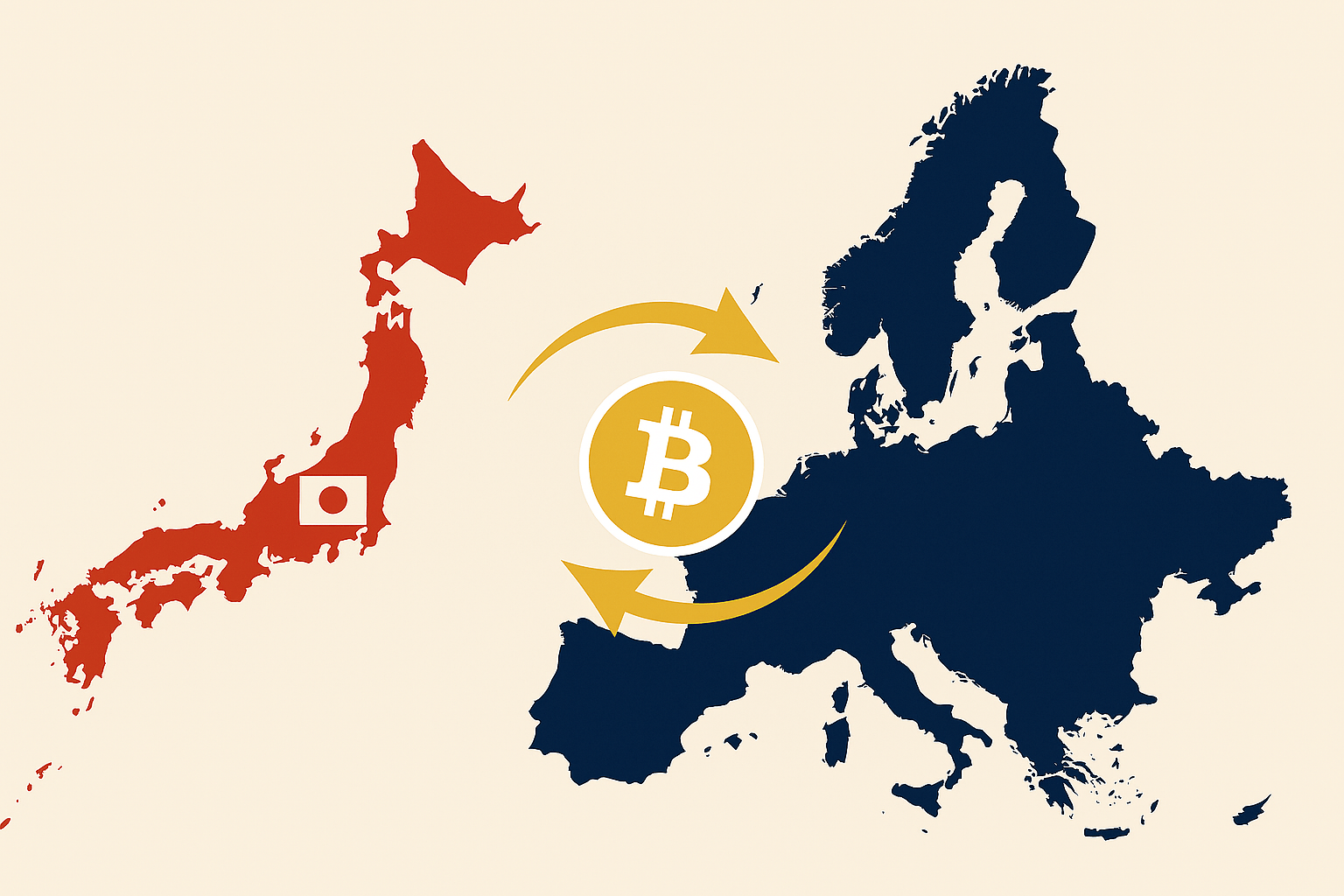
    At the same time, Japanese stablecoin models that rely heavily on banks could accelerate the European debate about a MiCA-compliant Euro stablecoin. The combination of effective regulation, tax attractiveness and institutional openness makes Japan a global driving force whose decisions have an impact far beyond its own national borders.

  • XRP price rises by 24% in 4 days: These are the reasons

    XRP price rises by 24% in 4 days: These are the reasons


    • The XRP price is up 24% in 4 days; Volume and liquidations indicate a short squeeze.
    • The price increase is driven by $46.1 million in ETF inflows, risk-on sentiment and a bullish signal in the XRP/BTC chart.

    XRP has gained around 24% in the past four days, making one of the most noticeable moves in the large-cap segment. The token rose more than 11% to around $2.40 in the last 24 hours alone, pushing its market cap to over $144.3 billion.

    Tailwind from US spot XRP ETFs

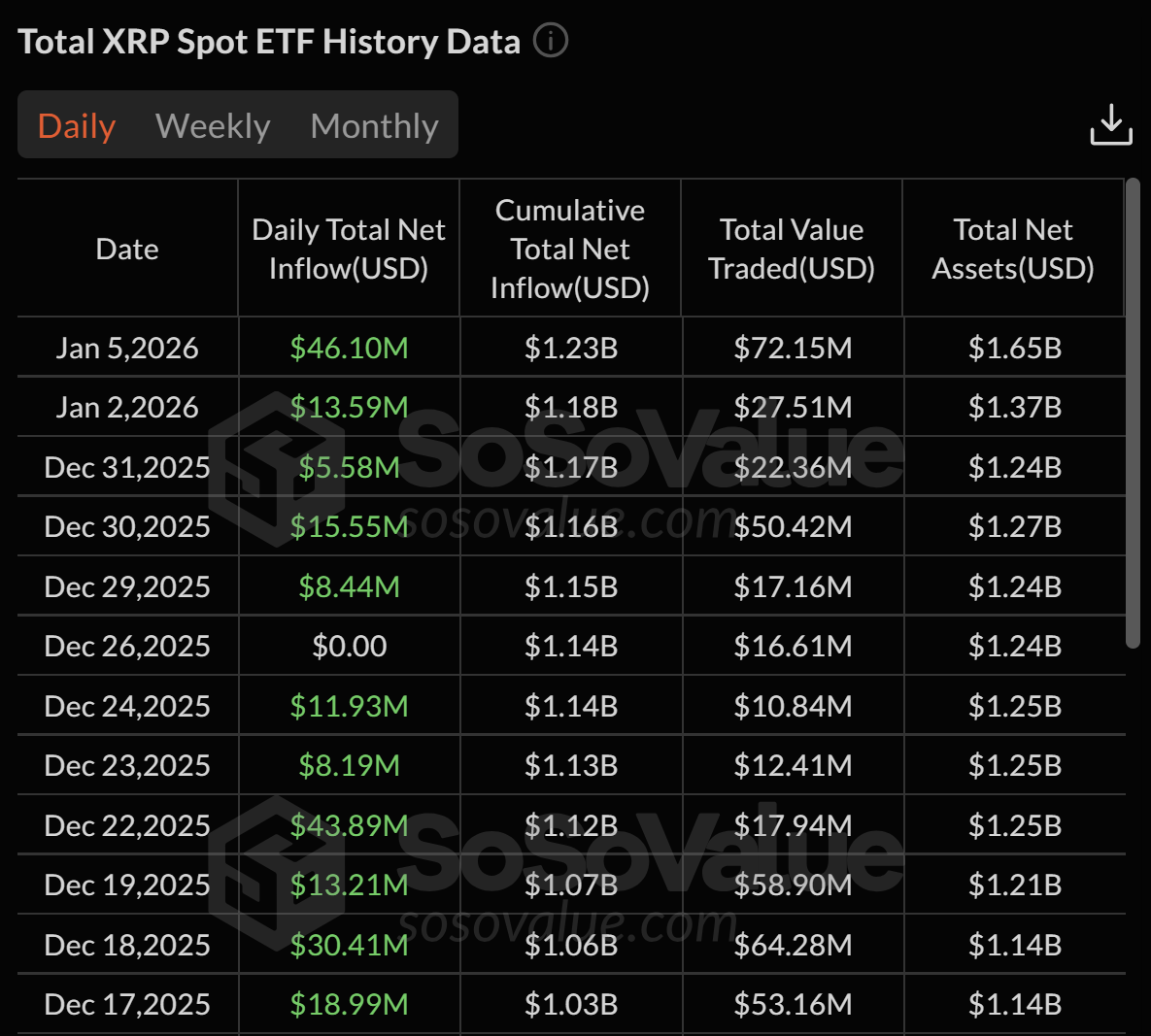
    Apparently a central driver for the price rally was the increasing demand in the US spot XRP ETFs. According to SoSoValue, the ETF complex recorded net inflows of $46.1 million on January 5. This is the strongest day since December 3rd ($50.27 million) and the seventh largest day of inflows since the products launched on November 13th, 2025.

    US spot XRP ETF data
    US spot XRP ETF data, source: SoSoValue

    Cumulatively, net inflows rose to $1.23 billion and total net assets to $1.65 billion. Bitwise led with $16.61 million on January 5, followed by Franklin Templeton (XRPZ) with 12.59 million, Grayscale (GXRP) with 9.89 million, and 21Shares (TOXR) with $7.01 million.

    Bitcoin is pulling the market along

    At the same time, the mood in the entire crypto market changed over the weekend, with Bitcoin serving as the driving force. The reason for the sudden change in sentiment was the news that the US military had successfully completed an operation to arrest Venezuelan President Nicolás Maduro.

    The following theory about US President Donald Trump’s strategy then became established in the financial markets: a freer supply from Venezuela’s oil reserves could cause oil prices to fall and thus depress inflation and interest rates. This is ultimately positive for risk assets like Bitcoin and altcoins. In this environment, XRP benefited disproportionately. Traders often see XRP as the leading token in altcoin rallies once BTC builds momentum.

    Speculation returns

    The data also suggests that risk appetite is noticeably returning. Spot trading volume jumped to $7.32 billion, up 144% in 24 hours, according to CoinMarketCap.

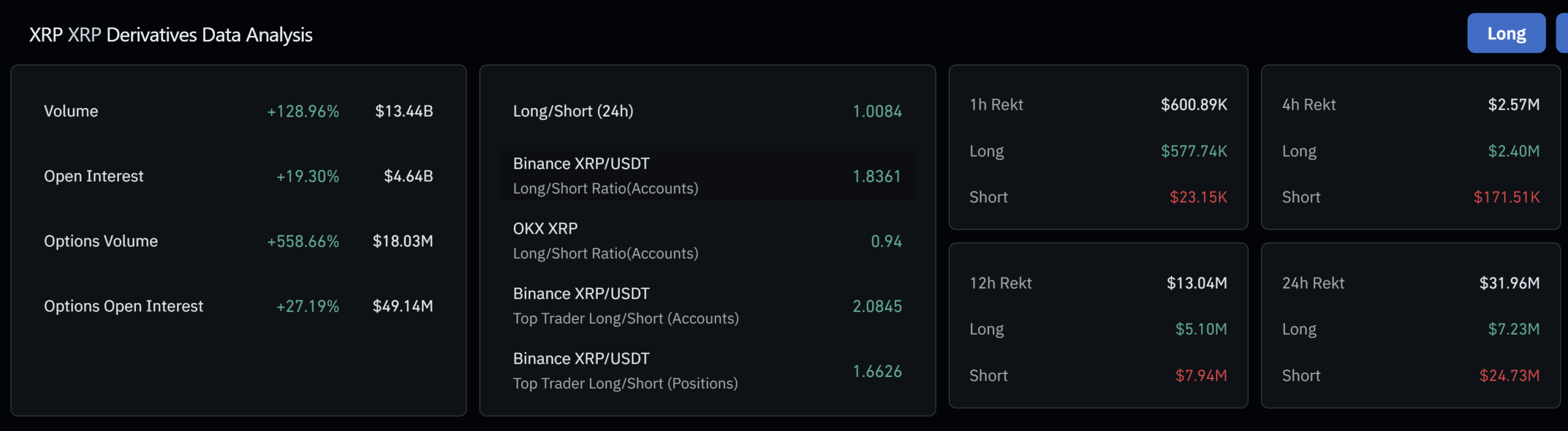
    According to Coinglass data, there was also an extreme increase in the derivatives market: volume increased by 128.96% to $13.44 billion, open interest increased by 19.30% to $4.64 billion. The options market is particularly noticeable, with an increase of 558.66% in options volume (US$18.03 million) and 27.19% in options open interest (US$49.14 million).

    At the same time, there were $31.96 million in liquidations, including 7.23 million from longs and 24.73 million from shorts. The imbalance suggests that a short squeeze not only accompanied the upward move but also reinforced it.

    XRP derivatives data from Coinglass
    XRP derivatives data from Coinglass

    Bullisches Setup im XRP/BTC-Chart

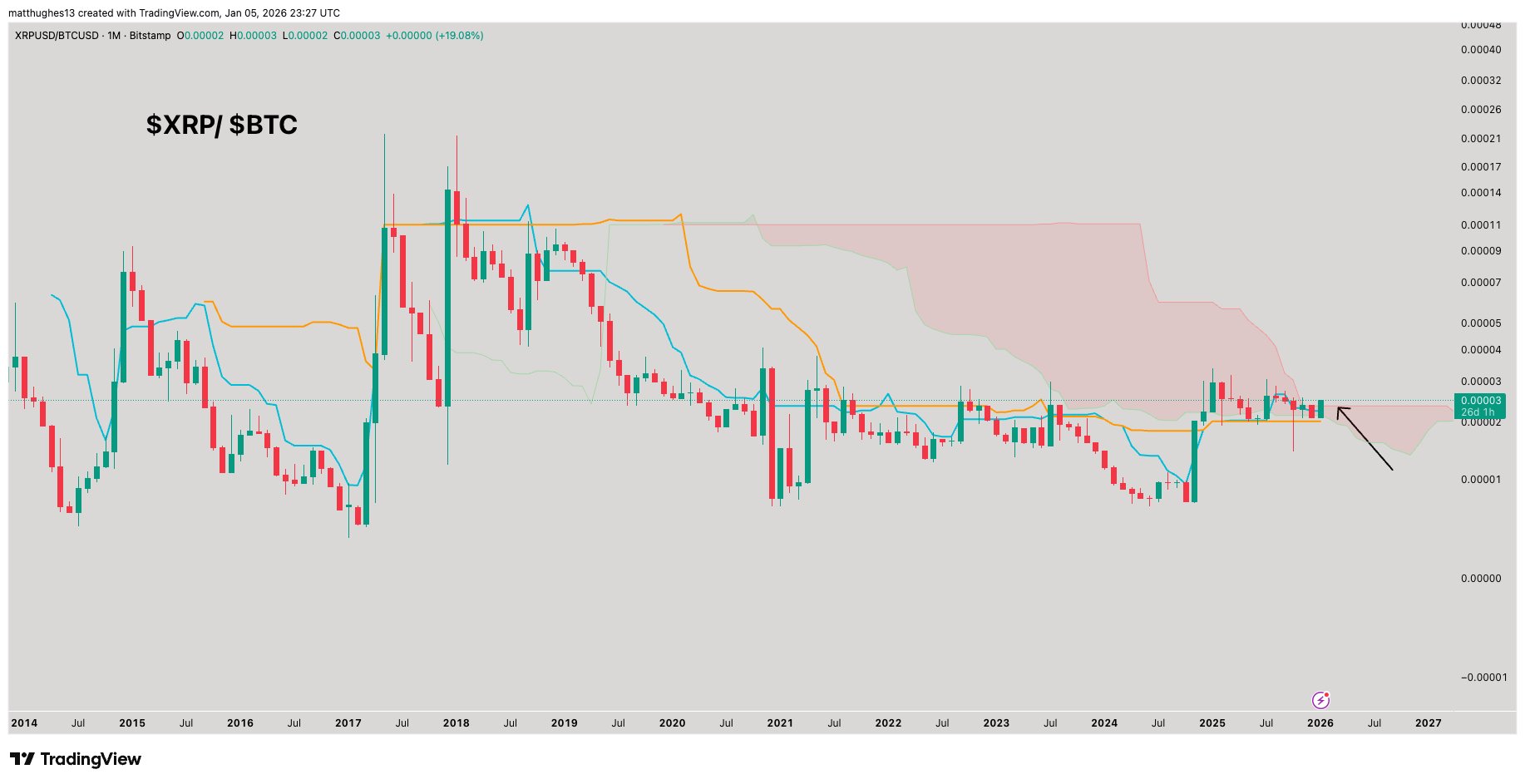
    Additionally, XRP continues to be one of the most talked about cryptocurrencies on X, with bullish predictions abound. Well-known crypto analyst Matt Hughes (“The Great Mattsby”) wrote yesterday on the XRP/BTC pair:

    “Something incredibly bullish is developing on the XRP/BTC chart that hasn’t been seen in a very long time. It’s about to break out above the monthly Ichimoku cloud for the first time since 2018. That would mean that XRP will massively outperform BTC.”

    XRP/BTC Analyse
    XRP/BTC Analysis, Source: @matthughes13 on X

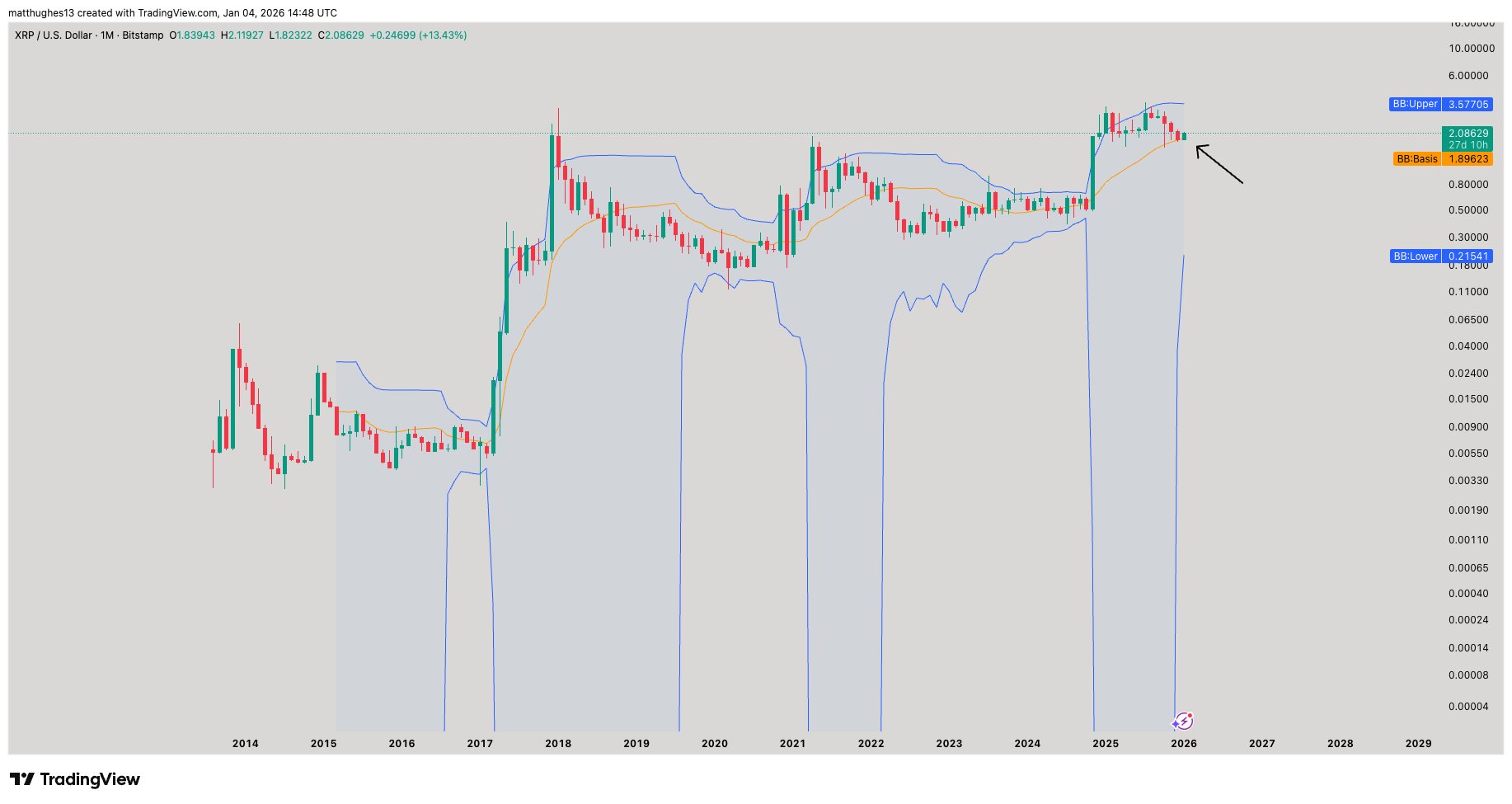
    Hughes had already predicted a bullish move on X on January 4th:

    “XRP has had a perfect bounce at the 20-month moving average as the upper and lower bands continue to tighten – setting up the next explosive push higher. Crazy how many people are bearish on a key high-time frame support of all places.”

    XRP finds support at 20-month MA
    XRP finds support at 20-month MA, Source: @matthughes13 on X
  • IOTA brings LayerZero/Stargate into the mainnet, Schiener is targeting adoption in 2026

    IOTA brings LayerZero/Stargate into the mainnet, Schiener is targeting adoption in 2026


    • IOTA integrates LayerZero and Stargate into the mainnet and expands the cross-chain connection to 150+ networks.
    • Schiener looks back on a difficult 2025 and sees IOTA “in the best position” for the next steps at the start of 2026.

    IOTA has integrated the Omnichain protocols LayerZero and Stargate into its mainnet, expanding cross-chain connectivity to more than 150 networks, including Ethereum, Solana, Base and BNB Smart Chain. According to a January 3 blog post from the IOTA Foundation, the move is significant because it will improve interoperability and data communication while enabling stablecoin and real-world asset (RWA) tokenization on the mainnet.

    What the collaboration brings to IOTA

    In dem Blogpost The IOTA Foundation describes LayerZero as a messaging protocol that forms the technical basis for Stargate. Stargate is classified as an “immutable, permissionless and censorship-resistant liquidity protocol” between networks and uses LayerZero as its backbone. Central to this is the Omnichain Fungible Token Standard (OFT), which enables transfers across multiple chains.

    According to the blog post, the LayerZero protocol also brings connectivity to more than 150 networks and boasts an annual asset transfer volume of “over $120 billion.” According to the IOTA Foundation, this creates the prerequisites for embedding IOTA-based assets and data flows into other established ecosystems.

    Dominik Schiener, Co-Founder and Chair of the IOTA Foundation, calls the integration a major milestone:

    “LayerZero’s integration into the IOTA mainnet represents a transformative milestone for the IOTA ecosystem, laying a strong foundation that accelerates mainstream adoption and advances key industries. By enabling seamless digital asset flows and the tokenization of real-world assets, LayerZero positions IOTA as a critical backbone to facilitate global trade and revolutionize supply chain finance worldwide.”

    The blog post explicitly mentions Europe, Africa and other emerging markets where IOTA wants to strengthen its infrastructure. LayerZero Labs CEO Brian Pellegrino also praises the collaboration:

    “The goal is to provide the world with global permissionless markets – starting with connecting every blockchain. LayerZero unifies the IOTA mainnet with the rest of crypto, allowing engineers to focus on building seamless, secure multichain applications that shape the evolution of Web3 adoption.”

    Technically, IOTA follows on from earlier integration steps. The blog post points out that LayerZero and Stargate already provided support for the IOTA EVM in September 2024. The new mainnet integration expands this framework: it is intended to enable asset transfers, messaging and cross-chain connectivity between Ethereum, Solana, IOTA EVM and “numerous additional networks”.

    IOTA describes this as crucial to connecting decentralized digital economies with the real economy, particularly in the trading and supply chain industries.

    Of central importance is the OFT standard: This maintains a “single, consistent token supply” across all connected networks. In addition, OFT assets should be transferable between LayerZero-supported networks via the Stargate WebApp.

    With a view to activity on the mainnet, the IOTA Foundation announces that “several new assets” will become available on-chain following the integration. First, the blog post mentions CYB, the native utility token of the Cyberperp Perpetual Exchange, which operates on IOTA EVM and the IOTA L1 mainnet. At the same time, IOTA promises “seamless bridging” of several IOTA-specific assets and emphasizes that the partnership also supports the interoperability of “numerous large blue-chip assets”.

    Particularly interesting is the statement that a “leading stablecoin” is currently undergoing a formal verification check and should “natively” join the IOTA mainnet ecosystem shortly. However, the IOTA Foundation has not yet revealed which stablecoin it is.

    In the coming weeks, additional assets will become “interchangeable” via LayerZero as developers implement additional integrations.

    Schiener looks ahead

    At the start of 2026, Schiener supplemented the technical step with a look back at 2025. Via X writes he on January 4th:

    “As I look back over the last twelve months, there is a lot to be really proud of. We have taken IOTA to new levels and transformed it by leaving our past behind us. We have brought many new partners on board and brought real adoption to the mainnet.”

    Schiener also gave hope for better times with a view to the IOTA token and its price:

    “There is no doubt that 2025 has been incredibly challenging, especially when you look at the markets over the last few months. While I can’t predict the price, all I know right now and what matters to me is that we made the right decisions, have the right team and the right strategy – and that we are in the best position we have ever been to deliver on our mission.”

  • Bitcoin and Ethereum are becoming a top priority: the new power of institutions in the crypto market

    Bitcoin and Ethereum are becoming a top priority: the new power of institutions in the crypto market


    • 2025 was a turning point for the crypto industry – especially because of the structural reorganization that is not only taking place in Europe.
    • The global crypto market has changed permanently. Bitcoin and Ethereum finally became a top priority for the institutions.

    With a market capitalization of over two trillion dollars, Bitcoin finally became a global economic factor, and Ethereum ensured that RWA tokenization was able to establish itself in almost all industries worldwide.

    However, the price development was less important than the type of capital that flowed into the market: pension funds, insurers, sovereign wealth funds and global asset managers appeared as buyers on a large scale for the first time.

    This helped to professionalize market structures through regulated ETFs, stricter custody standards and, last but not least, by distinguishing between regulated and unregulated market segments.

    Stablecoins and tokenization as growth engines

    2025 was also the year in which stablecoins left their role as pure trading currencies behind. With new regulatory frameworks in the US and EU, they have become practical tools for payments, cash management and international transactions.

    Net inflows reached record levels as banks and FinTechs began developing their own stablecoins. At the same time, RWA tokenization accelerated. Institutional investors discovered tokenized money market funds, loans and infrastructure projects as efficient, programmable forms of investment.

    Demand for onchain financial products grew so much that several major asset managers are now offering their own tokenization services. This shifted the focus from speculation-heavy adventures to real cash flows, serious collateral and regulatory compliance.

    What investors can expect in 2026

    Clear trends for 2026 can be derived from the movements of 2025:

    First, institutional dominance will continue to increase. This means less extreme volatility, but also less room for irrational exaggerations. Bitcoin and Ethereum are increasingly being treated like strategic allocations, not short-term trades.

    Second, the number of ETFs will continue to grow. Investors who want to invest in it have to be more concerned with product structures, replication methods and regulatory differences, as these factors sometimes have a greater impact on performance than the choice of coin itself.

    Third, stablecoins and tokenized assets are becoming key growth engines.

    Projects that provide infrastructure for onchain payments, compliance and institutional tokenization will be among the winners. At the same time, the importance of regulation is increasing: the consequences for anyone who believes they do not have to comply with it are becoming harsher.

    2026 will be a year in which regulated assets and “gray area crypto” finally diverge. For investors, this means that due diligence, issuer quality and legal certainty are becoming more important than ever before.

  • DACH region starts the new crypto transparency

    DACH region starts the new crypto transparency


    • At the turn of the year, the stream of new political announcements ended. The Volksbanks in the DACH region are now activating their new crypto functions.
    • The first customers are gaining access to Bitcoin trading and savings plans, while the institutions are “arming” their reporting processes to the Federal Central Tax Office.

    The industry is talking about a “soft rollout” that will last several weeks. Technical bottlenecks and increased support loads are already visible, but were expected.

    Data transmission begins

    The operational implementation of the Crypto Transparency Act begins in Germany: banks, brokers and custodians are transmitting structured inventory and transaction data to the Federal Central Tax Office in Bonn for the first time.

    Austria and Switzerland have also initiated the transition into practice. The first DAC8 information letters are being sent to investors, and CARF-compatible data structures are being tested in Switzerland. For the first time, crypto derivatives are also included in the new exchange formats.

    While retail processes are getting underway, international players are providing strong impetus: Tether confirms a further increase in its Bitcoin reserves, which is being followed closely in the institutional environment in the DACH region.

    At the same time, security analyzes warn of persistently high risks in the Web3 sector. For companies with crosschain activities, the pressure to tighten audits and monitoring is increasing.

    The combination of new regulation and institutional dynamics marks the beginning of a year that will be more than ever characterized by transparency, compliance and structured on-chain processes.

    Additional tax revenue in Germany

    According to KPMG, the new transparency results in significant new tax potential. It is assumed that private crypto profits were partly not declared at all and partly declared incorrectly. Staking and lending income was often not treated as taxable.

    In addition, stablecoin transactions are systematically recorded for the first time through MiCAR and DAC8. Conservative estimates from the industry assume a mid-three-digit million amount per year, which will also flow into the coffers of the tax offices – €300 to €600 million per year.

  • Venezuela’s Bitcoin reserve – what’s behind the rumor?

    Venezuela’s Bitcoin reserve – what’s behind the rumor?


    • A number of crypto media outlets are now spreading the claim that Venezuela has built up a crypto reserve of up to 660,000 Bitcoin under the Maduro regime.
    • That would correspond to up to 67 billion dollars. The reports cite analysts who supposedly have access to intelligence information.

    What is striking, however, is that no renowned business editorial team – neither Reuters nor Bloomberg, not the Financial Times and not the Wall Street Journal – pick up on or even confirm this figure. International institutions such as the IMF and the World Bank do not report any corresponding data. The report is therefore pure speculation.

    How the alleged mega-reserve was supposed to have come about

    The reports consistently describe the scenario that Venezuela has been systematically converting traditional assets into cryptocurrencies that are difficult to sanction since 2018.

    There are said to have been gold sales worth around two billion dollars between 2018 and 2020, and Bitcoins were then bought at the comparatively low prices at the time.
    In addition, there have been oil exports since 2023 for which the state oil company PDVSA has accepted payments in Bitcoin.

    And finally, the Maduro regime is said to have expropriated entire mining farms and collected their Bitcoin holdings and subsequent profits.

    All of this is possible and could have led to the rumored total of more than 600,000 Bitcoin. But as is the case with rumors: Everything is possible, nothing has been proven and in this case certainly not by publicly verifiable onchain data.

    Unproven claims

    The reports emerged after Maduro’s arrest by the US military. In fact, a Bitcoin reserve of this size would make Venezuela one of the largest Bitcoin investors in the world, in the league of Strategy.

    This speaks for:

    Venezuela has been subject to massive US sanctions for years due to corruption and drug trafficking, particularly affecting the financial system and individuals in Maduro’s power circle. It is plausible that Bitcoin has been used as a tool to evade sanctions.
    There is also evidence that Venezuela had close economic ties with China and Russia. In this environment, non-transparent payment channels to avoid US sanctions are not unreasonable.

    Against this speaks:

    Neither the IMF, the World Bank and the Financial Times, the Wall Street Journal nor Bloomberg and Reuters report anything about alleged Venezuelan Bitcoins.

    What is certain, however, is that Venezuela has around $60 billion in foreign debt and has been on the verge of national bankruptcy several times. A nice Bitcoin reserve of the same amount would come in handy. But that doesn’t make it any more plausible.

  • Bitcoin Reclaims $92,000: Is the $100,000 Attack Now Coming?

    Bitcoin Reclaims $92,000: Is the $100,000 Attack Now Coming?


    • Bitcoin reclaimed $92,000 and rose to $93,388.
    • The main reason for the price rally is short liquidations and the geopolitical escalation in Venezuela.

    Bitcoin reclaimed the $92,000 mark again over the weekend. After BTC hit a low of $88,379 on Friday, the price rose to an intraday high of $93,388 on Monday.

    The trigger for the price rally of around $5,000 (+5.7%) appears to be the geopolitical escalation surrounding Venezuela, which has indirectly boosted the Bitcoin price through energy prices and inflation narratives.

    Why has the Bitcoin price risen?

    In addition, The Kobeissi Letter (@KobeissiLetter) the movement explicitly with short liquidations:

    “Bitcoin shoots toward $93,000 after liquidating $75 million worth of leveraged shorts in 60 minutes. Bitcoin is now nearly $5,000 above its Friday night low after the US began attacks on Venezuela.”

    However, the impact on energy prices plays the most important role. The Kobeissi Letter reported that natural gas futures fell 6% at one point shortly after reopening on Sunday evening and oil was back below $57 a barrel, near its lowest levels since 2021.

    This is atypical in that energy prices “typically” move upwards during escalations with oil-producing countries. The difference this time, according to Kobeissi, is that greater US control of Venezuela could in the future bring “more oil and gas supply” onto the market; Accordingly, the market is not pricing in scarcity, but rather potentially additional supply.

    “The market knows that this weekend’s events will ultimately lead to the opposite of a supply disruption,” Kobeissi wrote, adding: “The market is never wrong.”

    This could have a positive impact on the inflation debate in the USA: more expected supply could depress energy prices, ease the inflation picture and thus provide tailwind for risk assets.

    Order flow: Futures led, spot bought with them

    Mechanically, the move was described in the material as a combination of fresh Bitcoin longs, short flush and moderate spot buying. YouTuber Furkan Yildirim wrote that the futures CVD slope was “clearly upward” and “accelerated significantly toward the breakout,” with derivatives leading the push. At the same time, the spot CVD is also pointing upwards, “slightly flatter than futures”: there is “real buying from the spot market,” but not as a dominant driver.

    Seine assessment reads:

    “The rise is driven by both sides (spot + derivatives), with futures leading. This speaks for short-term strength, but is vulnerable if OI continues to run higher and funding gets hot again. It will be more sustainable if spot CVD continues to rise and OI stabilizes after the jump instead of continuing to increase aggressively.”

    What are the next price targets?

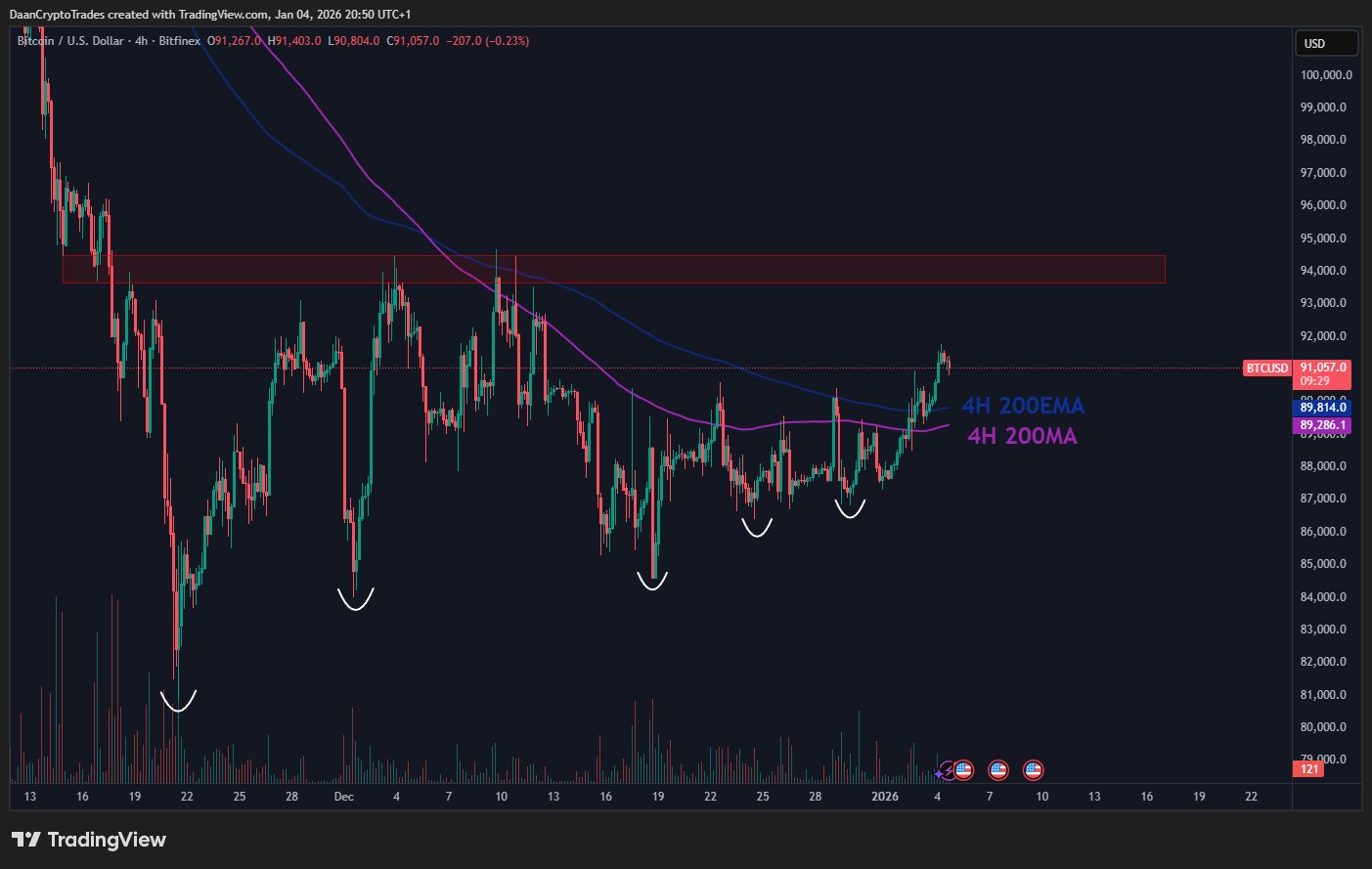
    In the 4-hour chart, Daan Crypto Trades (@DaanCrypto) points out that Bitcoin is back above the 200 moving averages. “BTC has broken above its 4H 200MA/EMA. This usually gives a good indication of short- to medium-term momentum,” he wrote, but cautioned that the start of the year and month tends to be “a bit rough.”

    Bitcoin 4-hour chart analysis
    Those: @DaanCrypto on X

    For him, the central level remains “the horizontal area around $94,000” as a range high. In the screenshot, the 4H-200EMA is at $89,814 and the 4H-200MA is at $89,286. The break above shows the current momentum in the market, but does not replace the break of the central resistance at $94,000.

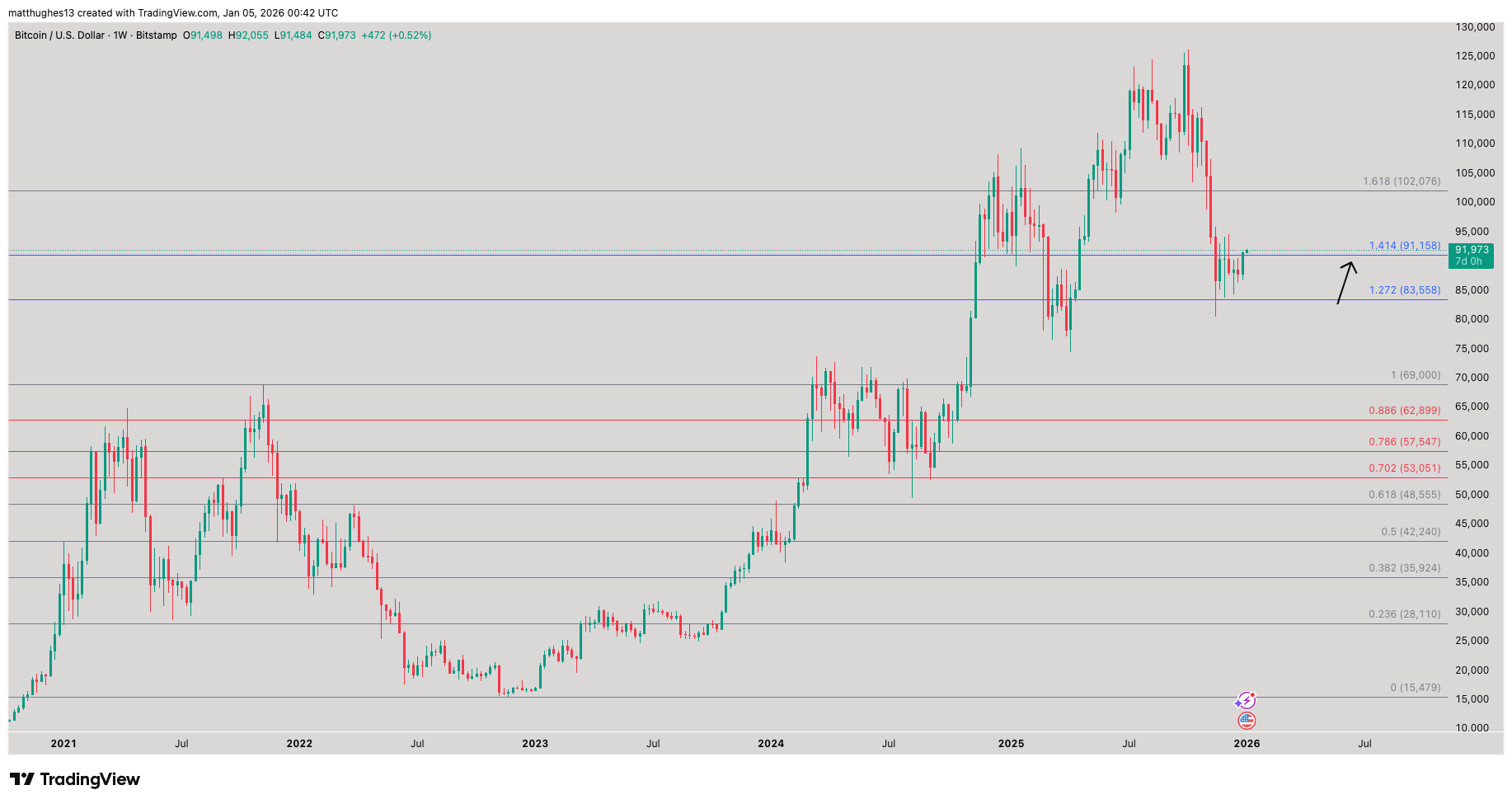
    On the weekly chart, Matt Hughes aka “The Great Mattsby” sets a specific weekly close as a goal. “Does this weekly candle close above 91,158 make bears nervous? It’s the first weekly close above this 1.414 fib since it broke below in November,” he wrote. The next designated level on its chart is at the 1.618 Fib at $102,076.

    Bitcoin weekly chart
    Bitcoin weekly chart | Source: @matthughes13 on X

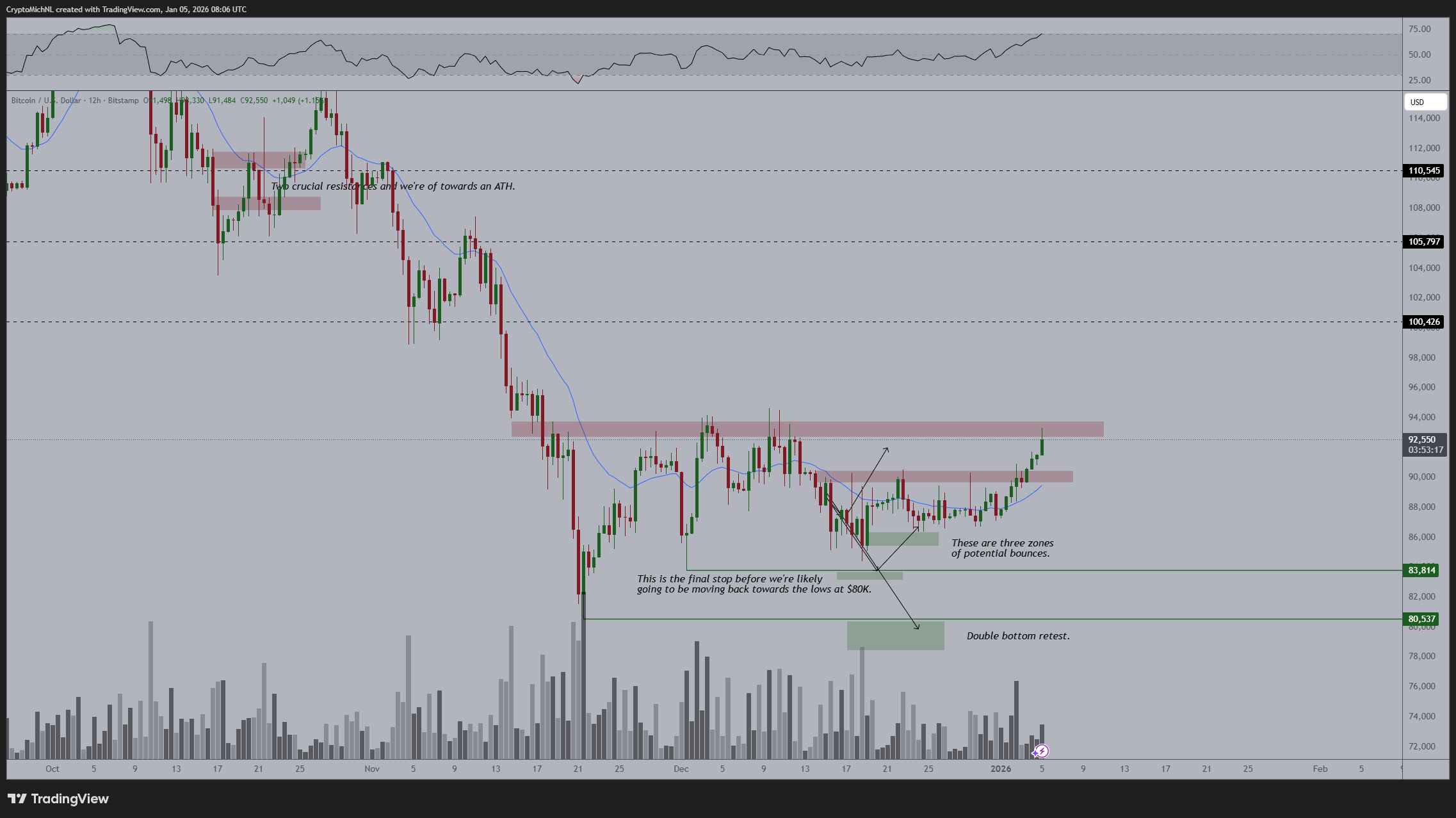
    Dutch crypto trader Michaël van de Poppe describes the 12-hour chart as follows: “Here we are! Last hurdle before $100,000: This is where Bitcoin currently stands. I wouldn’t expect a clear, immediate breakout; but I expect it to happen in the coming week. The year started off bullish.”

    Bitcoin 12-hour chart analysis
    Bitcoin 12-hour chart analysis | Source: @CryptoMichNL on X

    Its chart also marks the zone between $93,000 and $94,000 as crucial resistance. If BTC can overcome this hurdle, $100,426 would be the next logical step, according to van de Poppe. Furthermore, it marks $105,797 and $110,545 as follow-on targets.

  • Project TimberChain: Tokenized timber as an answer to decade-long growth cycles

    Project TimberChain: Tokenized timber as an answer to decade-long growth cycles


    • Wood production in the DACH region has a structural financing problem. It lies in the peculiarity of the production of this raw material.
    • Trees grow for years before value is created and income flows. Traditional banks are reluctant to finance such long cycles.

    Wood production is a long-term business. Tree growth takes years. The trees then have to be felled, processed in sawmills and dried for at least a few months before they can be processed into final products and sold.

    That’s why many producers have a chronic need for liquidity. At the same time, customer demand for sustainably produced wood is increasing, particularly in the construction, energy and packaging sectors.

    The MiCA regulation is now decisive for the DACH region. But there is another factor: the regulations on deforestation-free supply chains in the form of EU Regulation 2023/1115. It regulates the requirements for proof of origin. Companies must fully document that their wood does not come from recently deforested areas. This is exactly where the TimberChain project comes in.

    Tokenization of wood as a raw material

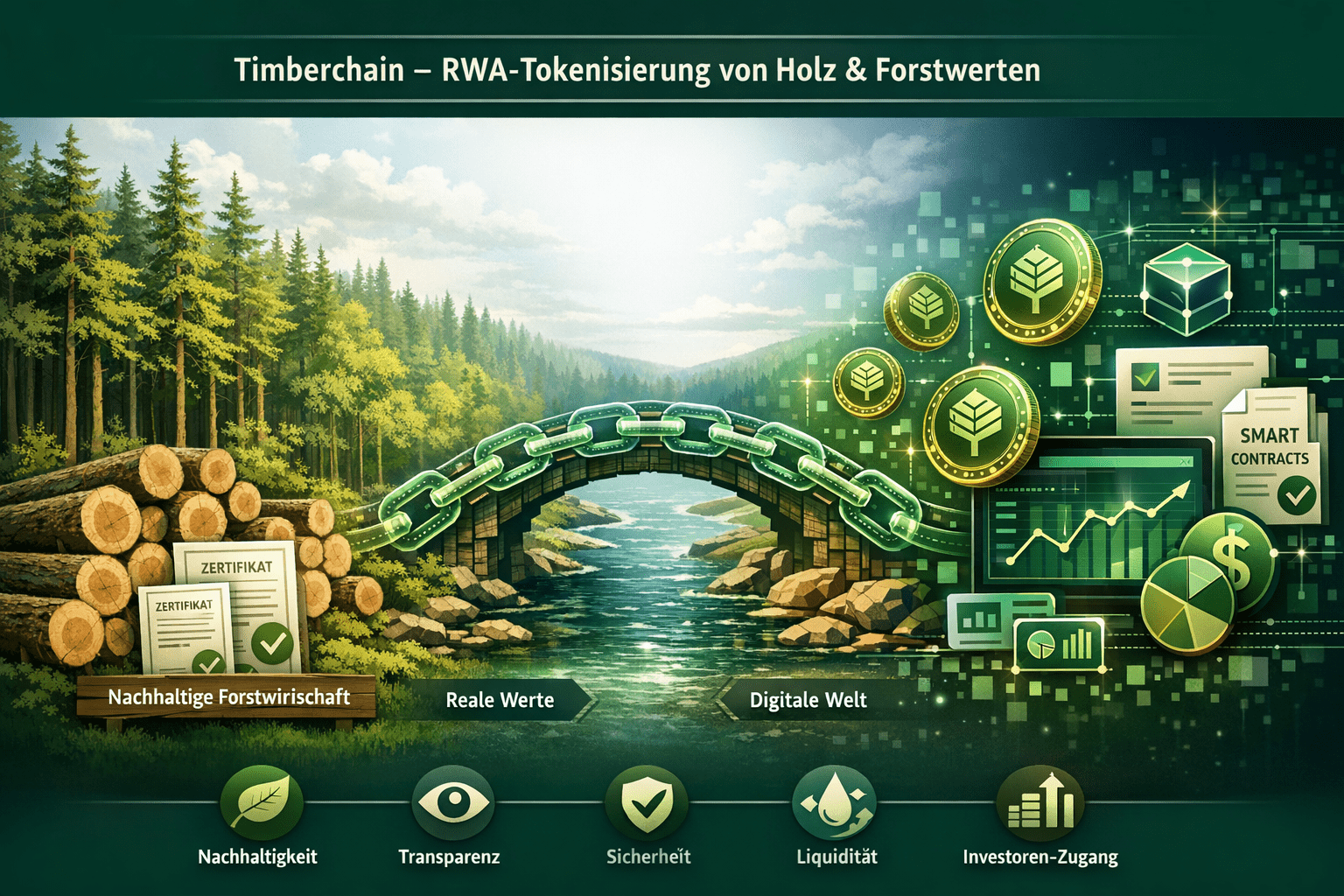
    TimberChain digitizes timber inventories, production stages and supply chain events through RWA tokenization. Tokens represent clearly defined rights, quantities and quality levels.

    The structure is based on the now mandatory MiCA rules. Institutional investors thus benefit from the new legal certainty, the corresponding liability rules and the transparent custody models.

    A central element is the linking of liquidity to the particularly long production cycles of the wood industry. Investors provide capital through staking, which is deployed according to the stage of growth and processing phases.

    Producers thus receive predictable financing, while investors gain access to an asset backed by the real economy.

    Benefits of TimberChain

    For three reasons, the TimberChain RWA tokenization creates a win-win situation for institutional investors and the capital-hungry companies in the timber industry.

    First, producers receive capital without becoming dependent on bank loans. Second: Tokenized supply chains automatically produce their complete documentation – a decisive advantage for companies that need EU-compliant proof of origin.

    Third: A new RWA segment is emerging, clearly regulated and with continuous demand. TimberChain thus positions itself as a bridge between sustainable forestry, digital infrastructure and institutional capital allocation.

  • Important changes for Bitcoin investors from Germany, Switzerland and Austria

    Important changes for Bitcoin investors from Germany, Switzerland and Austria


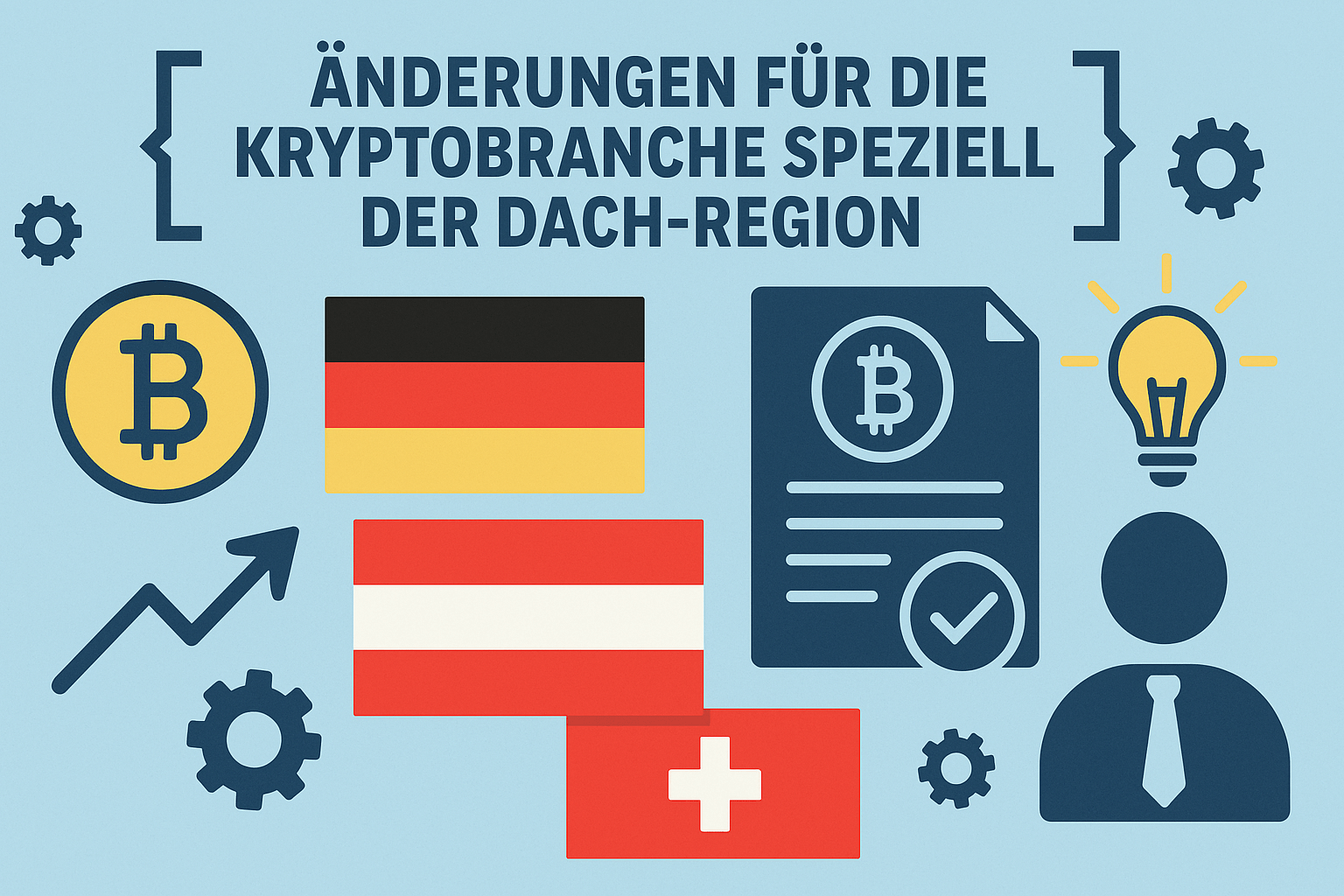
    • With DAC8 in the EU, the Tax Transparency Act in Germany and the Swiss CARF, the tax monitoring network in the DACH region is becoming tighter.
    • Crypto transactions are recorded systematically and across borders in all three countries. This ends the limited tax visibility for both providers and customers.

    The beginning of 2026 marks a turning point for the DACH region. Crypto assets will be fully integrated into the financial architecture from a regulatory and tax perspective. Anonymity and the parallel economy are over.

    Now comes institutional fit, transparency and technical resilience. For providers, an environment is emerging in which compliance becomes a key competitive factor, and for customers, tax visibility becomes the norm.

    Deutschland

    The new Crypto Transparency Act has been in effect since January 1st, requiring crypto service providers to report all transaction and customer data to the Federal Central Tax Office.

    For the first time, the authorities have a complete insight into stocks, profits and transfers. The basic tax logic remains unchanged, but enforcement will be much more consistent.

    Market observers speak of a paradigm shift that is particularly putting pressure on providers with weak compliance infrastructure.

    Austria

    Austria also follows the EU regime, but remains with its own tax model. The flat-rate taxation of crypto earnings remains, while DAC8 primarily strengthens the database on which the tax administration can act.

    For investors, this means that the probability of undiscovered returns also decreases significantly in Austria.

    Switzerland

    Although Switzerland is outside the EU, it is closed beyond it Crypto‑Asset Reporting Framework CARF and the expanded automatic exchange of information to the global transparency network. Swiss stock exchanges and brokers will also have to prepare transaction data for international exchange in the future.

    This means that Switzerland is finally losing its reputation as a tax haven for crypto assets. To put it more clearly: In Switzerland too, the long-term party for notorious tax evaders is over.

    In future, FINMA will treat CARF compliance as an integral part of its supervisory practice.

    But in parallel with the partial special routes of the three DACH countries, they are becoming more stringent DORA and NIS2 the requirements for the operational resilience of crypto service providers in the EU.

    Across the EU, providers must demonstrably control their IT security, risk management and dependencies on third parties. Germany and Austria are increasing the pressure on governance, cybersecurity and crisis management processes.

  • XRP jumps above $2 and overtakes BNB in ​​the top 10 again

    XRP jumps above $2 and overtakes BNB in ​​the top 10 again


    • XRP gained around 10% in 24 hours, once again moving ahead of Binance Coin into fourth place among the largest cryptocurrencies.
    • The market cap increased to $124 billion compared to BNB’s $121 billion. The price jump brought XRP above the psychologically important $2 mark.

    The XRP price increase attracted more market attention than one would normally expect due to the price now being above two dollars. It went from $1.86 to over $2.05 and has so far confidently maintained the new level.

    Market experts attribute the development primarily to strong capital inflows into the XRP ETFs. These have already absorbed more than a percent of the amount of XRP in circulation, which noticeably reduces the available supply on the exchanges. If the trend continues, up to 4% of all XRP could be tied up in ETFs by mid-May.

    At the same time, the technical situation also remains positive. XRP has cleared key resistance as it breaks above $1.90. The short ratio is low, which further stabilizes the upward movement. Analysts are already talking about a new phase in which the XRP price could reach a new ATH.

    XRP optimism is back

    There is palpable optimism in the community. Analyst “CW” describes the current increase as the beginning of phase 4, the goal of which is to exceed the ATH of $3.65. Some experts even predict that XRP will no longer fall below $2. Whether this assessment is correct depends primarily on whether ETF inflows continue and whether XRP will maintain the price level above two dollars permanently.

    XRP delivers a strong signal at the start of the year and once again pushes BNB from 4th place in the top 10. The combination of ETF inflows, technical strength and positive market sentiment is creating a positive environment unlike anything XRP has seen in years.

    If the momentum continues, XRP could soon be one of the strongest performers among altcoins.