Category: Coins

Digital assets, cryptocurrencies, blockchain, and currency news.

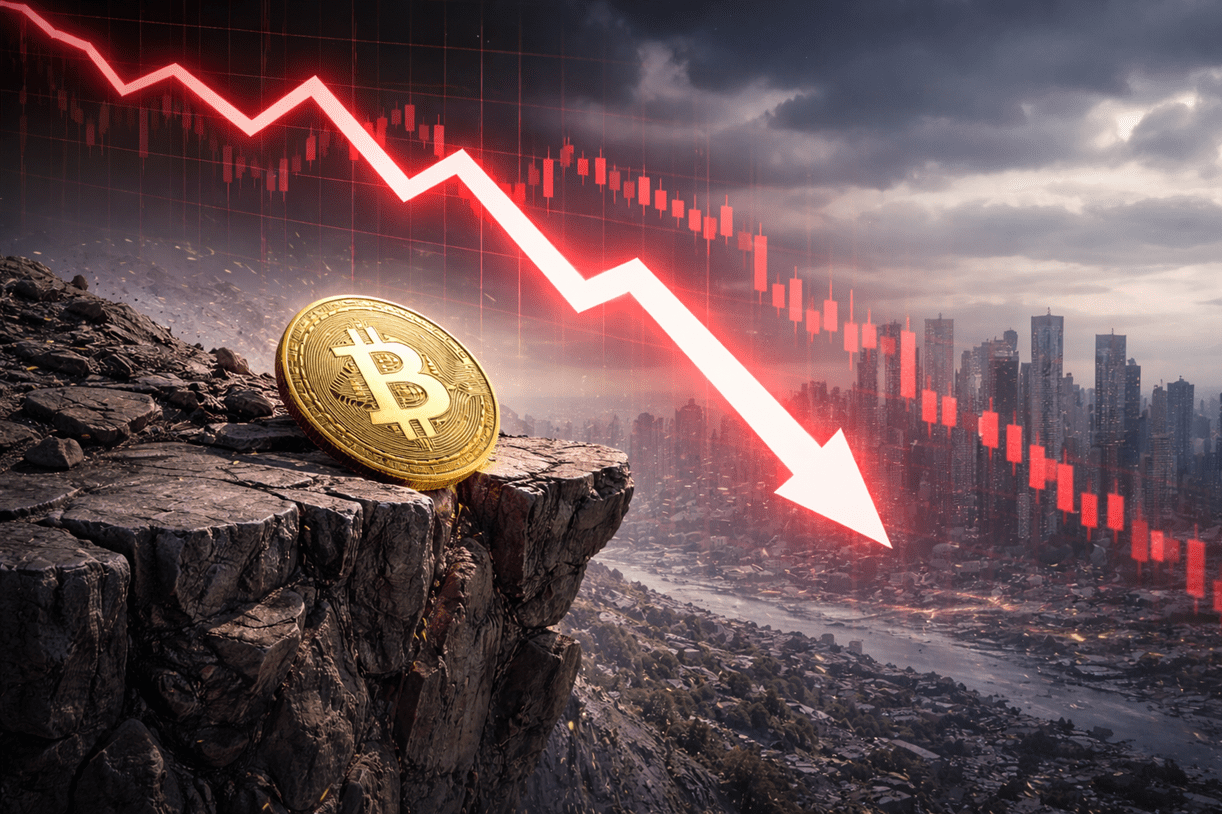
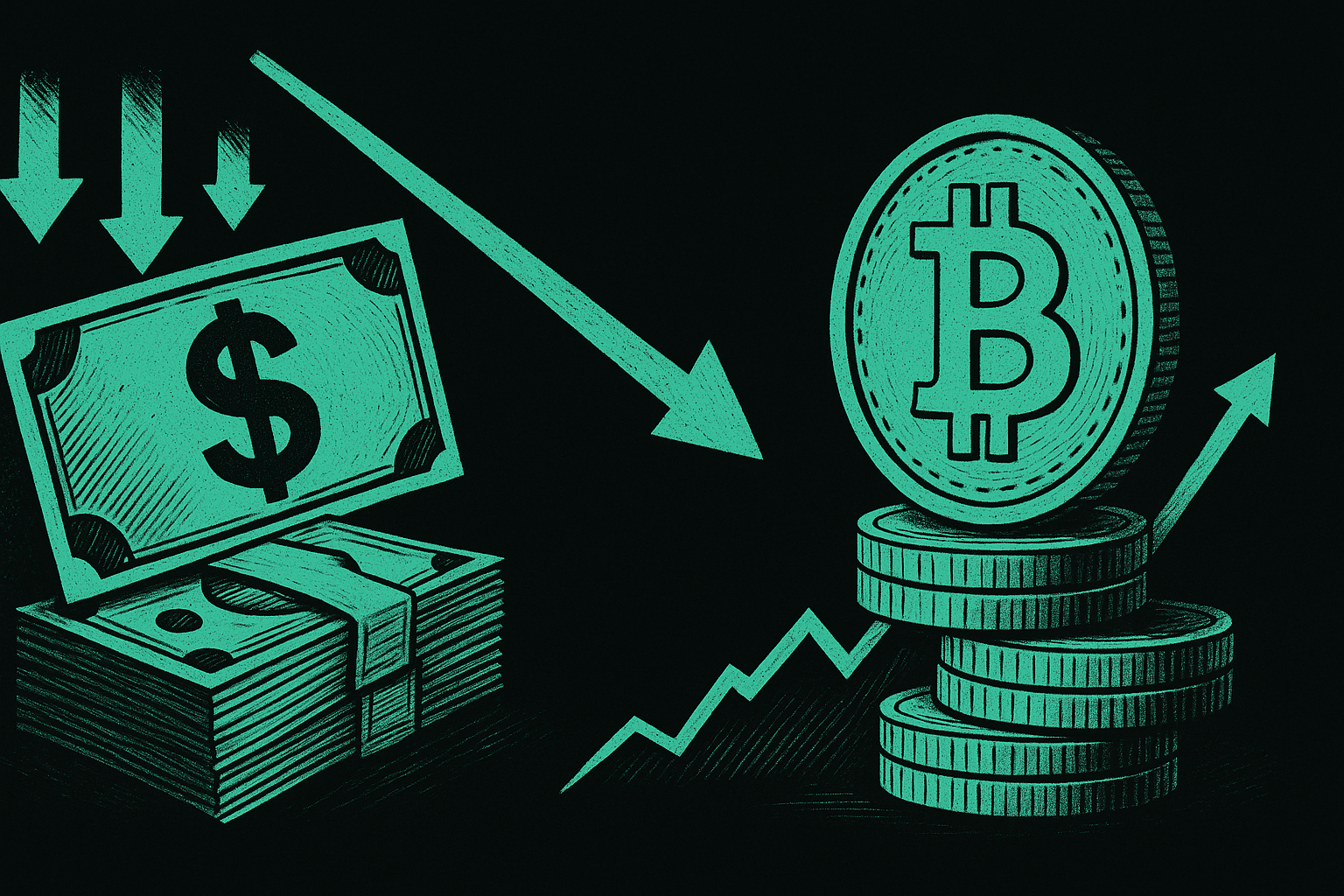
  • Dollar shorts at record levels – Bitcoin correlation broken

    Dollar shorts at record levels – Bitcoin correlation broken


    • A routine Bank of America survey shows stronger-than-usual bearish positioning against the dollar. Institutional investors’ net exposure is as low as it was in 2012.
    • The reasons are increasing concerns about a slowdown in the US labor market and fears that the central bank could cut interest rates sooner or more than expected – or both.

    Under normal market conditions, such a pronounced dollar weakness would be a strong tailwind for Bitcoin. Historically, BTC has predominantly developed in the opposite direction to the dollar index: if the dollar falls, risk assets such as Bitcoin rise; if the dollar rises, the Bitcoin price falls. This inversely proportional relationship has been a reliable pattern so far.

    But since the beginning of 2025 you can no longer rely on it. The dollar index fell more than nine percent in 2024 and recorded further losses in 2025. At the same time, Bitcoin has lost around 21 percent. The 90-day correlation between BTC and DXY has increased to 0.6 – the highest value since April 2025.

    This means that both markets are currently moving in sync – the old correlation has been broken. If the new one holds, a further decline in the dollar index would not be a bullish signal for Bitcoin, but rather a burden. Conversely, a dollar rebound triggered by a short squeeze could pull Bitcoin higher.

    The extremely one-sided positioning significantly increases the likelihood of such a scenario. As soon as the dollar unexpectedly rises, short positions come under pressure and have to be covered, reinforcing the upward movement.

    Washington Dollar
    Image created with ChatGPT-AI (DALL-E)

    Eamonn Sheridan, currency analyst at InvestingLive, warns of an increased risk of abrupt moves in key dollar currency pairs. While weak U.S. economic data could extend the dollar’s downward move, crowded short positioning also increases the potential for sharp countermoves.

    At the time of going to press, the dollar index was trading at 97.13 points, up 0.25 percent. Bitcoin traded at $68,150, down around one percent.

  • Bundesbank President Nagel: Digital euro and euro stablecoin mean dollar independence

    Bundesbank President Nagel: Digital euro and euro stablecoin mean dollar independence


    • Bundesbank President Joachim Nagel made it clear at the American Chamber of Commerce’s New Year’s reception in Frankfurt that Europe should become more independent of the dollar when it comes to payment systems and payment applications.
    • He made it clear that this also includes the digital euro, both in the retail version for private individuals and retailers, as well as in the programmable wholesale version for companies, in order to make international payments more cost-effective.

    From the EU perspective, the USA has inadequate regulatory instruments for digital money. But they have plenty of digital money in the form of dollar stablecoins.

    In the EU it is the other way around: it has a fabulous regulatory system with MiCAR. It took years to complete, but in the end all 27 member states agreed on the regulation of digital money. There is only one thing that was forgotten in the rush: digital money. There simply isn’t one, at least not on a euro basis.

    The few existing EURO stablecoins have a hopeless maximum share of 0.3% of the global stablecoin market. Dollar stablecoins have over 99% market share, and the tiny remainder goes to exotics like the Hong Kong stablecoin and a few others.

    But isn’t there the Digital Euro? Yes, but it won’t come until 2029 at the earliest.

    Euro stablecoins and digital euro

    Bundesbank President Nagel explainedregulated Euro stablecoins are a sensible addition to the planned digital euro. They would have significant advantages, particularly in international payment transactions, as they enable fast, cost-effective transactions.

    This would create new opportunities for businesses and consumers to process international payments without the delays and fees that are common today.

    However, the prerequisite is that the Euro stablecoins are fully backed and issued under national or EU central bank supervision. This is the only way to create trust and build stable demand.

    Europe acts now or will be left behind

    While the US and parts of Asia are already actively expanding their digital payment infrastructures, Europe is falling behind. The Bundesbank President therefore sees an urgent need for action to advance the modernization of the European payment system.

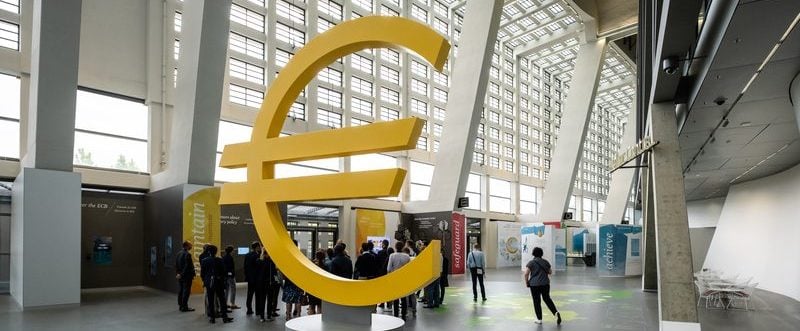
    Euro symbol in the entrance hall of the ECB
    Source: European Central Bank

    With the digital euro and its clear regulatory framework for euro stablecoins, the EU could strengthen its position in the global financial system, maintain its economic position and act on an equal footing with the USA and China.

    But the time window is not open for much longer.

  • Standard Chartered adjusts XRP price target 2026 downwards by 65%

    Standard Chartered adjusts XRP price target 2026 downwards by 65%


    • Standard Chartered Bank has lowered its cryptocurrency price forecasts for 2026, most significantly for XRP. The token is now only expected to be worth $2.8 instead of $8 at the end of the year.
    • Analysts at the major British bank are also warning of continued pressure on the entire market and are talking about one of the most difficult months in years.

    The revaluation was triggered by the exceptionally strong sell-off in the crypto sector. February is valid in the Standard Chartered Analyse as the weakest month in almost four years. Bitcoin temporarily fell to around $60,000, losing almost 30 percent month-on-month.

    XRP slipped to $1.08, its lowest price in 15 months. The bank points to a “challenging market environment” characterized by declining liquidity, low risk appetite and weak capital flows. These factors would have required a reassessment of the medium-term price targets.

    ETF outflows put additional strain on XRP

    The significant decline in capital inflows into the XRP ETFs is particularly difficult for Standard Chartered. While they had a TVL of around $1.6 billion at the beginning of January, it shrank to around one billion by mid-February.

    That’s a decrease of around 40 percent. The analysts see this as a clear signal that institutional investors are currently in “wait and see” mode. This development weakens the fundamental basis for XRP and justifies the significantly reduced price expectations.

    Reassessing the crypto industry

    The downgrade doesn’t just affect XRP. Standard Chartered also lowered forecasts for Bitcoin, Ethereum and Solana.

    The bank now expects only 100,000 instead of 150,000 for Bitcoin, 4,000 instead of 7,000 for Ethereum and 135 instead of 250 dollars for Solana, based on the end of the year.

    The bank justifies its drastic corrections with a structurally weaker market environment, which could encourage further declines in the short term.

    Clarity Act could help — if it finally came along

    In particular, the Clarity Act being discussed in the USA could support XRP in the long term, as the law would finally create clear crypto regulation.

    Crypto vs. banks: dispute over the Clarity Act
    Image created with ChatGPT-AI (DALL E)

    Ripple chief lawyer Stuart Alderoty recently described discussions in the White House as “productive”.

  • IOTA in Korea: Schiener points to Blue House tailwind

    IOTA in Korea: Schiener points to Blue House tailwind


    • After his trip to Korea, Schiener spoke of support from the “Blue House” and interest from large companies and financial institutions, but did not mention any specific commitments.
    • The IOTA Foundation refers to meetings around the World Crypto Forum, discussions about TWIN and a KRW stablecoin use case.

    After his trip to Korea, Dominik Schiener, co-founder of IOTA, reported on In a February 16 post on X wrote Rail:

    “I had a fantastic and productive trip in Korea. There was a very positive energy there – with strong support from the Blue House as well as large companies and financial institutions committed to building on crypto. IOTA’s pitch, with our clear focus on building a global trading infrastructure with TWIN, is a key difference from all other projects.”

    He does not mention any specific partnerships or commitments. However, the tone of the post suggests that Schiener is expecting updates from Korea in the next few weeks and months. With the “Blue House” Schiener alludes to Cheong Wa Dae, the symbol of the South Korean presidency in Seoul. Whether this involves formal contacts or more like discussion groups close to the president remains to be seen.

    Schiener had previously described Korea as a key market. In the further statement he wrote:

    “We are helping cryptocurrencies overcome the speculative bubble and establish themselves in the real world. We are deeply committed to Korea and will advance the country’s connectivity in the blockchain space to spark a new wave of crypto adoption. You can expect much more news in the coming months. I am very much looking forward to returning to Korea soon.”

    The reference to the Blue House was quickly picked up in the community. One IOTA ambassador called it “basically Korea’s White House” and argued the next wave would come from politics, trade routes and institutions rather than retail hype. IOTA is positioned accordingly.

    IOTA in Korea

    Schiener also linked a post from the IOTA Foundation that highlighted its Korea activities. As CNF reported yesterday, the IOTA Foundation was at the “World Crypto Forum” from October 10th to 11th. I was there in February and spoke to Korean institutions about TWIN: “We networked with leading Korean institutions and showed how TWIN can unlock real adoption on IOTA,” says the X post.

    According to the foundation, a panel also addressed the question of how a KRW stablecoin could be “made usable via the IOTA network”. In addition, a private lunch was organized off stage with “Tier 1” Korean financial institutions, without naming names, in Yeouido, the financial district of Seoul and a central hub for investment and banking.

  • Bundesbank boss Nagel:


    Germany’s Bundesbank boss sees stablecoins and CBDCs as an opportunity for Europe’s digital sovereignty

    Nagel warns of the growing dominance of the US dollar in digital payment transactions

    The President of the German Bundesbank, Joachim Nagel, took an unusually clear position in favor of digital currencies at the New Year’s reception of the American Chamber of Commerce in Frankfurt. In his speech, he emphasized that both euro-denominated stablecoins and a digital euro are crucial building blocks for securing Europe’s monetary sovereignty in the digital age. The background to his statements is the rapidly growing dominance of US dollar stablecoins, which now clearly dominate the global market and thus also increase geopolitical dependencies.

    Nagel pointed out that the US has already created a structured framework for stablecoins with new regulatory initiatives such as the GENIUS Act. Europe, on the other hand, is still in the implementation phase of MiCA. Without its own digital alternatives, the EU is threatened with “digital dollarization,” which could also impair its ability to manage monetary policy in the long term.

    Wholesale CBDC as infrastructure for the financial sector

    Nagel was particularly clear on the topic of wholesale CBDC, i.e. a digital central bank currency for financial institutions. He sees this as a technological advance that can make the processing of securities transactions more efficient, safer and more cost-effective. Programmable payments, immediate settlement and lower operational risks are key advantages that Europe urgently needs in international competition. The Bundesbank is already testing various prototypes that could be integrated into the European market infrastructure in the future.

    Euro stablecoins as a supplement to the digital euro

    Nagel made it clear that privately issued, strictly regulated euro-denominated stablecoins should not be seen as competition, but rather as a complement to the digital euro. They could bring significant efficiency gains, particularly in cross-border payment transactions. This opens up new opportunities for companies and consumers to process international transactions faster and cheaper. What is crucial, however, is that these stablecoins are fully backed by secure reserves and are under European supervision.

    Europe is under pressure to act

    The Bundesbank President’s speech is a signal that the tone in the European debate is noticeably tightening. While the US and parts of Asia are already pushing ahead with their digital currency projects, Europe is at risk of falling behind. Nagel’s appeal can therefore be understood as a request not to postpone the modernization of European payment transactions any longer. With MiCA, the digital euro and a clear regulatory framework for euro-based stablecoins, the EU could strengthen its position in the global financial system while securing its economic independence.

  • Is South Korea the XRP crash trigger? These numbers make you sit up and take notice

    Is South Korea the XRP crash trigger? These numbers make you sit up and take notice


    • Upbit XRP/KRW has shown strong, partly automated net selling pressure for months and is often only weakly correlated to Binance.
    • Intermittent “Reverse Kimchi Discount” indicates sellers’ KRW-driven liquidity needs. On “crash days” sales intensity increases sharply.

    An analysis of order book and trade data from the South Korean exchange Upbit indicates ongoing, automated selling pressure in the XRP/KRW pair. Pseudonymous analyst “Dom” (X: @traderview2) argues that KRW-driven order flow can at times shape pricing more than many traders expect.

    The influence of South Korea on the XRP price

    Dom writeshe evaluated 82 million trades on Upbit (XRP/KRW) and, for comparison, 444 million trades on Binance. The trigger was a short-term movement the day before:

    “It started with yesterday’s price action. -57 million XRP in CVD over 17 hours. That looked completely crazy. So I examined the trades in detail – including bot patterns, possible iceberg orders and signs of wash trading. The selling pressure was real. Algorithmic.”

    According to Dom, the timing was particularly striking: 61% of the trades were triggered within 10 milliseconds. “A single bot traded continuously for 17 hours – with only one interruption of 33 seconds,” says Dom.

    Dom describes the pattern as recurring. Upbit XRP/KRW is “net negative in every single month over 10 months”. Example months: April -165 million, July -197 million, October -382 million, January -370 million XRP (net). Overall, Dom puts net selling pressure at “3.3 billion XRP net. Around $5 billion.”

    Over the period, only one week out of 46 was net positive. The comparison with Binance should also show that it is not just a global dynamic.

    Dom writes, “Binance His core statement: “The hourly correlation between the two exchanges is only 0.37. The order flow on Upbit often behaves independently.”

    Der „Reverse Kimchi Discount“

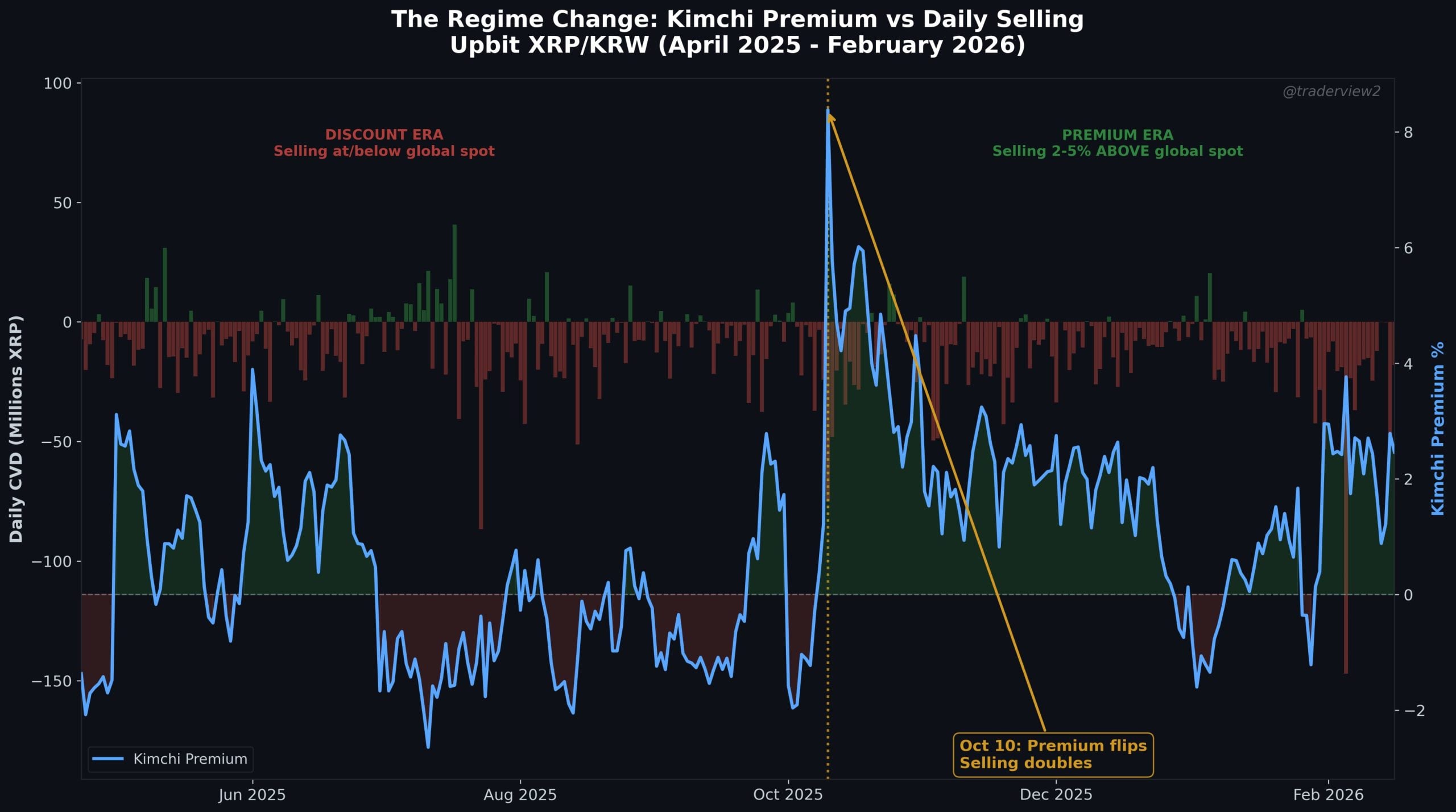
    What is also noticeable is a phase in which XRP on Upbit was temporarily traded below the global price level: “From April to September, Upbit-XRP was traded 3 to 6% below Binance. A reverse kimchi discount.” Dom sees the discounts accepted over months as an indication that the sellers were primarily looking for KRW liquidity, not the best possible price. Dom writes:

    “They don’t care about price. They need KRW, are obligated to use Upbit, and/or are Korean holders taking profits.”

    On the day of the October 10th crash, the price structure shifted abruptly: “Korean private investors completely freaked out. The premium turned from -0.07% to +2.4% in a single day. Trades increased fivefold to 832,000.” At the same time, the sellers became more active: “And the sellers? They doubled their daily rate. From -6.3 million/day to -11.2 million/day.”

    XRP order book data
    XRP order book data | Source: X @traderview2

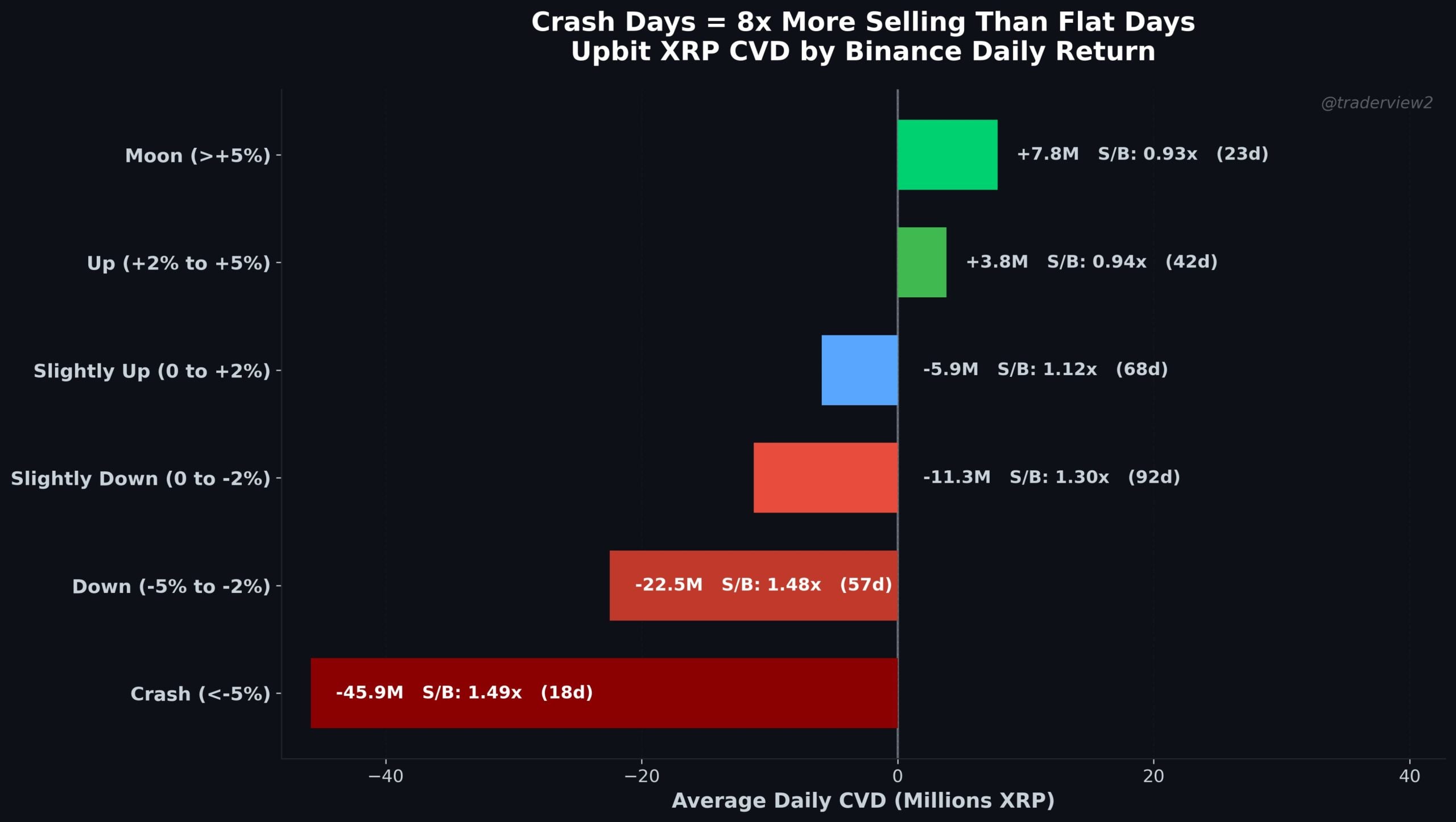
    Dom also organizes Upbit flow data by global XRP days on Binance. On “crash days (< -5%)” he sees “-46M average CVD” and a ratio of “1.49x sell/buy”. On “Moon days (> 5%)”, however, “+8 million average CVD” at “0.93x sale/purchase”. For Dom, this suggests pro-cyclical behavior:

    “Read that again. On moon days, Korean retail investors become net buyers. They accumulate. On crash days, selling intensity is eight times higher.”

    XRP order book data analysis
    XRP Order Book Data Analysis | Source: X @traderview2

    The trade sizes are also asymmetrical: “28% of buy trades are tiny fractional sizes […] that matches KRW-denominated orders,” while the sell side “round numbers […] 10, 100, 1000 XRP” show.

    “One side looks like retail. The other looks like a machine.”

    What does this mean for XRP?

    Dom puts the magnitude into perspective: “3.3 billion XRP represents 5.4% of the total circulating supply of XRP” – net over “a single trading pair on a single exchange in 10 months.”

    Dom leaves it open whether Korean retail owners are primarily behind the behavior or a specific institution linked to KRW. However, its data suggests that Upbit’s XRP/KRW flow can at times have a significant impact on short-term price movements. Monitoring Korean stock market data may therefore be more relevant for traders than is often assumed.

  • XRP price collapse shakes the altcoin market

    XRP price collapse shakes the altcoin market


    • The XRP price lost around 50% in a few days. From a level of almost two euros it fell to a low of 1.08 euros.
    • The plunge triggered a wave of panic selling that quickly reached the entire altcoin sector.

    Market observers speak of a classic capitulation phase in which retail investors in particular reflexively withdraw liquidity from the market, while more nervous professionals assess the situation more soberly.

    Parallel to the price decline, the overarching Fear & Greed Index fell to the rare value of nine points. Such extreme anxiety levels only occur in exceptionally stressful phases and are historically considered more of a contrarian indicator than a harbinger of a long-term downward trend.

    The XRP-specific sentiment index also reached an annual low. The discrepancy between fundamental data and market sentiment is particularly pronounced in this phase.

    Presumably unnoticed whale accumulation

    While retail investors sell in panic, onchain data does not show a bad picture. Large XRP holdings are increasingly being withdrawn from centralized exchanges.

    Such movements are seen as an indication that long-term investors are building up positions and available supply is decreasing. This divergence between price reaction and capital flows is a recurring pattern in early reversal phases and is closely watched by analysts.

    Fundamental disputes and capital flight are not helpful

    A heated debate between Ripple representatives and Bitcoiners is causing additional tension. Ripple supervisory board member and ex-CTO David Schwartz recently called Bitcoin a “technological dead end” and described XRP as the more efficient infrastructure for an increasingly AI-powered financial world.

    Ex-Ripple-CTO Schwartz
    Image created with AI using ChatGPT (DALL·E)

    At the same time, the global capital flight from overvalued tech stocks is exacerbating the situation. Investors are looking for infrastructure applications that can be used in the real economy as uncertainty in the crypto market increases.

    This mix of technological rivalry and overreaction forms the Core of the current XRP price crisis and the uncertainty of the altcoin market.

  • Is Bitcoin as undervalued as it was three years ago?

    Is Bitcoin as undervalued as it was three years ago?


    • According to current onchain data, the Bitcoin price is showing an undervaluation that was last observed in March 2023, when Bitcoin was trading at around $20,000.
    • The MVRV indicator – Market Value to Realized Value – measures the relationship between market value and realizable value. It is currently at 1.13, which means there is a chance of bottoming out.

    The MVRV value is a central indicator for evaluating the Bitcoin network. Values ​​close to one indicate that the market price is close to the average purchase price of all coins. In the past, such phases often marked turning points for holding stocks at a loss. The current decline to 1.13 is the lowest level since March 2023 and signals a significant slowdown in the market after the sharp rises of recent months.

    Different cycle progression

    However, analysts note that the current cycle is structurally different from previous bull markets. While Bitcoin reached MVRV values ​​of over 4 in previous peak phases, the highest value in the most recent cycle was only 2.28.

    This suggests that the market has not become extremely overvalued despite new all-time highs. This peculiarity complicates classic pattern recognition and makes historical comparisons less reliable.

    Onchain data points to trend reversal

    In addition to the MVRV indicator, the MVRV Z score also shows a significant cooling. This indicator measures how much the current valuation deviates from the long-term average. According to current analyses, the Z‑Score is at a level that is even lower than in the bottom phases of 2015, -18, -20 and -22. In the past, such extreme values ​​have often been associated with accumulation phases and subsequent trend changes.

    Parallel to March 23 with a significantly higher price

    The comparison with March 2023 results from the similar on-chain structure, not from the absolute price value. At that time, Bitcoin was trading at around $20,000 after the market had just digested the FTX crash.

    Today the price is significantly higher, but the valuations are similar. This suggests that, despite high nominal prices, the market is moving into a phase in which long-term investors are investing more and speculators are giving up.

    Ancient Bitcoin Whale Sells Another 500 BTC, Total Profits Hit $260M
    Image created with AI using ChatGPT (DALL·E)

    It could be the classic dip.

  • Fed under pressure: The 2027 trade could boost Bitcoin

    Fed under pressure: The 2027 trade could boost Bitcoin


    • In the next twelve months, around $9.6 trillion in US government debt will need to be refinanced, with direct relevance to Bitcoin.
    • Yield curve control could be back on the agenda by 2027 at the latest, which could price Bitcoin in early as a “liquidity seismograph”.

    A refinancing problem is growing in the US markets and this could put the Fed under pressure faster than many would like. For Bitcoin and crypto, this is more than background noise from the macro.

    Furkan Yildirim calculates: In the next twelve months, around $9.6 trillion in US national debt will have to be refinanced – around a third of the total debt. This is relevant for Bitcoin because it becomes a liquidity question: Who will absorb these emissions – and under what conditions?

    Yildirim writes on X:

    “Nearly $10 trillion in U.S. government debt needs to be refinanced over the next 12 months. That’s not a typo. That’s a third of all outstanding U.S. government debt.”

    He shows a chart: According to him, the “green line”, i.e. the debt due within a year, rises to $9.6 trillion. Short runners therefore make up 33%. This means that changes at the short end have an immediate impact on the state budget.

    What this means for Bitcoin

    The sticking point is today’s interest rate levels – and an interest burden that is already high. Yildirim writes that interest payments are “over a trillion dollars per year.” And even an increase of 0.25 percentage points means “an additional 95 billion” – year after year.

    From Yildirim’s point of view, what makes matters worse is that Treasury Secretary Bessent himself admitted that the window for cheap long-term financing in 2021/2022 had been missed. Instead, the financing is repeatedly rolled out via short-term T-bills. This means that the state is much more dependent on interest rates – and every fluctuation hurts more quickly.

    The big question is how Kevin Warsh – Trump’s nominee for Fed Chair – would handle this. Warsh was a Fed governor and comes from a Wall Street background. He is considered a hawk who threw down quantitative easing (QE) in protest in 2011 and criticized the Fed’s excessive balance sheet for years.

    At the same time, Warsh has argued for interest rate cuts since the end of 2025 – citing AI-related productivity gains that could enable growth without inflation. The problem is that Warsh also emphasizes that the balance sheet must shrink, not grow.

    Yildirim derives a trilemma from this – none of the options is particularly comfortable.

    Option 1: Lower your balance sheet further – and accept higher long-term interest rates. If the Fed does not replace maturing securities, the private market will have to absorb the duration. This could push up long-term interest rates – bad for real estate, stock valuations and ultimately also for government refinancing.

    Option 2: Maintain the balance sheet and effectively cap long-term interest rates. That would be exactly the “monetary dominance” that Warsh criticizes: the Fed as a permanent buyer of government bonds.

    Option 3: Push mature long-distance runners more into short-distance runners. A time-buying strategy that turns the balance sheet “effectively into a variable-rate liability.”

    Yildirim’s most likely view is a mixed strategy: cutting interest rates at the short end while the balance sheet continues to shrink. Citadel Securities is cited as the origin of an idea that is described as a “financial conditions-neutral” approach: What tightening the balance sheet brings should be offset by the interest rate cut.

    Why does this become a “2027 trade”? Yildirim explains:

    “If 9 to 10 trillion dollars have to be refinanced every year. If at the same time the deficits are over 6% of GDP. If foreign buyers, especially China, withdraw and the demand for US government bonds declines structurally.”

    Then at some point only one solution remains: “The Fed will have to buy again. On a large scale.” Not immediately, not in 2026 – but “by 2027 or 2028 at the latest” yield curve control will be back on the table, i.e. directly capping long-term interest rates through large bond purchases.

    As a harbinger, Yildirim cites “reserve management purchases” since December 2025: officially no QE, but in fact balance sheet expansion through purchases of short-term treasuries. His findings: The balance sheet is growing again, slowly and under a different label.

    Yildirim calls Bitcoin a “liquidity seismograph”; In his view, the correlation between the Fed’s balance sheet and price is “empirically well documented.” He refers to episodes such as 2019 (QT stopped, balance sheet up again), 2020/2021 (balance sheet from 4 to almost 9 trillion, Bitcoin up to 69,000) and 2022 (QT, Bitcoin up to 15,000). His key question is therefore timing, not direction: “The central question is not whether there will be more liquidity. The question is when. And how much.”

    The next few months will show whether the USA will roll through this in an orderly manner – or whether more monetary policy will have to intervene again in the end. If that happens, Bitcoin will likely be the first to price it in.
  • Social media giant X soon to launch in-app crypto trading

    Social media giant X soon to launch in-app crypto trading


    • The X-Corporation is continuing to transform its social media service of the same name into an all-in-one app.
    • In the future, customers will be able to trade stocks and cryptocurrencies directly from the app.

    The new function is based on so-called Smart Cashtags and will be introduced gradually over the coming weeks.

    X-Product Manager Nikita Bier clarifiedthat the company will not act as a broker itself. You just want to initiate the trade, while its practical execution will continue to take place via external partners.

    Smart cash tags as an introduction

    The new function expands the already known cash tags $BTC and $TSLA with interactive elements. In the future, customers will see real-time charts, price data and financial information directly in the feed. Tapping or clicking on “Buy” or “Sell” takes you directly to a connected broker or crypto exchange.

    X Corp
    Source: X, @elonmusk

    X itself does not process any orders or hold any trading licenses, but rather acts as an interface between social media and financial service providers.

    The goal is the all-in-one financial app

    The trading initiation is another building block in Elon Musk’s long-term strategy to expand X into an “all-in-one app”. At the same time, the company is working on X Money, a peer-to-peer payment system that is already being tested in the USA.

    X cooperates with VISA and develops its own wallet infrastructure. The integration of financial data, payments and trading functions is intended to turn the service into a communications, media and financial service provider.

    Spam and manipulation warning

    Despite the ambitious plans, Nikita Bier publicly expressed concerns about possible side effects. He warned of an increase in crypto spam, aggressive advertising accounts and coordinated pump-and-dump attempts that could harm customers.

    X already has to defend itself against botnets and questionable financial influencers who exploit certain trends to manipulate inexperienced investors. Product manager Bier emphasized that the implementation must be carried out carefully in order to prevent misuse and not to endanger the quality of the social media service.

    After the new in-app trading function was announced, there were immediate rumors that the X-Corporation would become a broker itself and set up its own crypto exchange.

    Bier immediately contradicted this and made it clear that the company itself would not execute any trades and that it would not manage customer funds. X remains an intermediary who promotes the trade but does not carry it out himself.

    This means that X-Corporation bears no risk when it comes to regulation, while at the same time they open up and earn new revenue models through partner programs and traffic redirects.