Category: Coins

Digital assets, cryptocurrencies, blockchain, and currency news.

  • Aviva Investors wants to offer tokenized fund products on XRPL

    Aviva Investors wants to offer tokenized fund products on XRPL


    • The asset manager Aviva Investors, part of the British insurance group Aviva plc, has announced its strategic collaboration with Ripple.
    • The aim of the cooperation is to tokenize selected fund products on the XRP ledger XRPL and thus complete Aviva’s entry into digital assets.

    This is a remarkable step for the industry: Aviva Investors manages more than 240 billion British pounds and is one of the most influential financial managers in Europe. The DecisionChoosing the XRP Ledger as the technological basis is a sign of the newfound confidence in Ripple after the company’s positive outcome in the trial against the US Securities and Exchange Commission.

    Tokenization as an efficiency booster for the fund market

    The new cooperation is intended to convert traditional fund structures into digital, tokenized units. This should make processes such as issuing, trading, processing and reporting significantly more efficient.

    Aviva Investors emphasizes that tokenization will reduce both costs and operational complexity in the long term. At the same time, they open up new opportunities for tailor-made products that can be structured more quickly and marketed globally. The first tokenized products are expected to be ready for the market as early as 2026, with Aviva initially wanting to offer them to selected institutional customers.

    Why on XRPL?

    The XRP Ledger has been considered one of the most stable public blockchains for years. It offers fast transaction confirmations, low fees, and an energy-efficient consensus mechanism without mining.

    Ripple also highlights the built-in compliance, asset issuance and programmable rules capabilities that are critical for regulated financial products.

    With over four billion transactions processed and more than 120 independent validators, Ripple sees XRPL as the ideal infrastructure for the next generation of tokenized real-world assets.

    The partnership with Aviva Investors is intended to underpin this claim and attract other institutional players.

    Ripple-Aviva cooperation
    Image created with ChatGPT-AI (DALL E)

    Signaling effect for the European financial industry

    Aviva Investors’ decision has potentially far-reaching implications for the European fund market. While tokenization is already part of normal industry business in the USA and Asia, many European asset managers have so far acted cautiously.

    The fact that a heavyweight like Aviva is now taking this step could be the starting signal for other European institutions. Ripple, in turn, is strengthening its position in Europe and expanding its strategy to establish real-world assets on XRPL.

    For the European crypto industry, it could be the beginning of a wave of RWA tokenization.

  • Digital EU product passport comes with infrastructure from Vechain and Rekord

    Digital EU product passport comes with infrastructure from Vechain and Rekord


    • The European Union is preparing a comprehensive new industry policy regulation with the Ecodesign for Sustainable Products Regulation (ESPR) – Vechain and Rekord have the solution.
    • At its center is the Digital Product Passport (DPP), which will become mandatory for the first product groups from 2026.

    While most companies still have to deal with unclear specifications and sometimes complex, sometimes contradictory data requirements, VeChain and Rekord are proving to be competent partners for solving the problem.

    Both processed more than 100,000 DPP-relevant data transactions in a month-long live operation, thereby demonstrating that the infrastructure for the new EU transparency obligation already exists.

    Regulatory pressure is building – but the industry is not prepared

    In the future, the Digital Product Passport will map the entire value chain of a product: origin, materials, supply chain, repairs, sustainability metrics and recyclability. The EU is pursuing the goal of anchoring transparency and circular economy throughout the entire manufacturing industry.

    But according to current industry surveys, less than half of companies know what data they will have to collect and store in the future. At the same time, time pressure is increasing because the first mandatory DPP categories are due to be introduced in 2026. You therefore quickly need applications that can be integrated without extensive system modifications and that reflect the requirements of the new regulation at an early stage.

    Rekord and VeChain: Security through industrial data integration

    The cooperation between Rekord and VeChain is intended to provide these applications. Rekord provides an “API‑first trust layer” that captures company data in a tamper-proof manner and integrates it into existing systems without having to change production or ERP structures.

    With the VeChainThor blockchain, VeChain delivers an energy-efficient, scalable and cost-effective infrastructure that has proven itself in industrial supply chains for years. Together, the two partners enable the capture, validation and tamper-proof storage of DPP data throughout the entire product life cycle.

    VeChain Already Live in 300+ Cases Ahead of EU Digital Product Passport Mandate
    Image created with ChatGPT-AI (DALL E)

    The approximately 100,000 on-chain transactions that have already been processed show that the method is not just a concept, but works as a procedure in real corporate environments.

    Early implementation as a competitive advantage

    While many companies are still waiting for final technical specifications from the EU, the VeChain record initiative shows that production-ready DPP systems can already be implemented today.

    Companies that rely on interoperable and tamper-proof data architectures at an early stage can reduce regulatory risks and at the same time open up new business models – for example through digital guarantees, automated take-back systems or transparent sustainability reports.

    For VeChain, the development means a further strengthening of its own position in the area of ​​real industrial applications, while Rekord establishes itself as a central integration partner for DPP projects in Europe. The message of the message is clear – the Digital Product Passport can come:
    We already have the technical infrastructure for this.

  • Ripple is betting everything on XRP: Garlinghouse is aiming for the “trillion” league

    Ripple is betting everything on XRP: Garlinghouse is aiming for the “trillion” league


    • Ripple emphasizes that XRP and XRPL are at the center of its future strategy.
    • According to CEO Garlinghouse, Ripple has a chance to become the first “trillion-dollar” crypto company.

    Ripple conveyed a clear message at the XRP Community Day: XRP and the XRP Ledger are not just “part” of the product strategy, but the linchpin on which the company is aligned. During the nearly 9-hour event, Ripple executives, especially CEO Brad Garlinghouse and President Monica Long, made some interesting statements that should make the XRP community bullish.

    So explained Garlinghouse during Community Day, for example, stated that he firmly believes that there will be at least one trillion-dollar crypto company by no later than this, and of course that could be Ripple. Garlinghouse said:

    “There will be a trillion dollar crypto company, I don’t doubt that for a second. I believe Ripple has a chance to be that company – and maybe there will be more than one.”

    With regard to regulatory decisions in the USA, Garlinghouse was confident that there will be an agreement on the Clarity Act within the next two months: He sees a “75 percent” probability that the Clarity Act will be “very close” to being signed by the end of April.

    XRP as the “North Star” of the strategy

    Garlinghouse also positioned Ripple not as a “one-chain” bet, but as a provider in a “multi-chain environment”. At the same time, he emphasized that XRP is a top priority internally:

    “XRP is the North Star for Ripple. It is our purpose. When we think about what we do at Ripple Payments, Ripple Prime, Ripple Treasury, Custody and RLUSD – everything is designed to build utility, trust and liquidity around XRPL.”

    As evidence of institutional interest, Garlinghouse pointed to capital flows, even during a weak market environment:

    “Even last week, when there was massive market devastation, there were positive XRP ETF inflows of $30 million to $40 million. Public markets want to invest in crypto. Customers want that.”

    Garlinghouse was particularly offensive in formulating Ripple’s self-image as a regulation-oriented infrastructure: “We want to be the most regulated, the most compliant, because we are focused on institutional flows – that is the priority,” he said.

    Garlinghouse referred, among other things, to the approval received in December 2025 from the Office of the Comptroller of the Currency (OCC) to act as a national trust bank. This OCC approval allows Ripple to offer custody and settlement services as a regulated financial institution.

    When asked about a possible Fed master account, Garlinghouse made a promising suggestion:

    “There has been a lot of speculation about what we might do in the future. There have been comments about a Fed master account, which we find quite exciting. And there are things we might do in the future that I won’t go into today.”

    What is crucial, however, is the distance from before: If you had told him ten years ago that Ripple had “even conditional approval” or even such a level of “involvement” from the OCC, that would be “massive progress” compared to the start of the journey.

    President Monica Long also calls XRP “the North Star for Ripple” and makes it clear: “XRP and the Ledger are our reason for being.” Ripple understands its purpose to be “building use cases,” applying technology to real-world problems; XRP is the north star that guides product strategy and decisions.

    For the current year, Long particularly highlighted the decentralized exchange (DEX) on the XRP Ledger. Ripple wants to bring payment flows that customers already use for stablecoin-based cross-border payments to the Decentralized Exchange.

    Long also proposed “Payments Credit” as a second focus, and short-term credit lines are common in payment transactions in order to temporarily finance liquidity. The idea is to link the financing needs of payment service providers with XRP holders “who want to use their XRP” and “earn more returns” via a lending protocol. She pointed out that the lending protocol is still “up for vote,” but that Ripple is “crossing its fingers” that it will be implemented as an amendment.

    Thirdly, long custody moved into a larger institutional context: banks not only wanted to store digital assets, but also wanted to actively push into tokenization – from tokenized deposits to funds, stocks, bonds. Ripple’s custody product should enable exactly that.

  • Starfish launches on IOTA: Now live on the testnet

    Starfish launches on IOTA: Now live on the testnet


    • IOTA has activated the Starfish consensus upgrade on the testnet.
    • The core idea is that the network should no longer wait for slower validators: the rest continue to work, while laggards catch up in parallel.

    IOTA has made Starfish live on the testnet. The consensus upgrade should depend less on “laboratory conditions” — and should prove itself more where it counts: in real operation. Via X wrote the IOTA Foundation on Wednesday:

    “Starfish is now available on the IOTA testnet. It is a comprehensive consensus upgrade designed for the real world, where trust depends on reliable data exchange between distributed systems at a global scale.”

    Why IOTA Starfish is crucial

    The team is thus targeting an old core problem. In previous processes, progress depended heavily on all validators staying in sync. IOTA puts it like this:

    “What changes with Starfish at the consensus level? Previously, network progress depended on perfect coordination when some validators fell behind. With Starfish, the network continues to run while these validators recover in parallel.”

    And why this focus? Because IOTA does not see “reliability under imperfect conditions” as a bonus, but as a minimum standard. Literally:

    “Reliability under imperfect conditions should be a basic requirement – not a nice-to-have. This behavior is crucial for real-world systems such as global trade.”

    Technically, the main thing is to ensure that the system doesn’t stop just because individual validators can’t keep up. The practical effect is: the network waits less. It continues to work. Lagging validators are catching up without slowing down the rest.

    One lever here is the separation according to “urgency”: What needs to be distributed quickly and reliably gets priority. Anything that is large and eats up bandwidth is handled differently. The goal is not just “more TPS”, but more predictable processes for companies, institutions and other partners if the network is not perfect.

    This fits with IOTA’s new direction. As CNF reported, co-founder Dominik Schiener released the “Manifesto” earlier this year, which focuses on adaptation in the real world beyond the cryptosphere.

    What’s important is that Starfish is now on the testnet. This is the place where it becomes clear whether the promised robustness holds up in practice, even under stress, even if parts of the validator set “run poorly”. If the concept works, the bottom line is: less downtime due to latecomers, less coordination stress – and a more reliable process.

    The next step would be implementation on IOTA’s mainnet. There is no exact release date for this yet.

  • Franklin Templeton and Binance are creating new types of security for institutions

    Franklin Templeton and Binance are creating new types of security for institutions


    • Franklin Templeton and Binance deepen their collaboration with a non-exchange collateral initiative aimed specifically at institutional clients.
    • The focus is on the use of tokenized money market fund shares, which are issued via Franklin Templeton’s Benji Technology Platform.

    Such shares can now be used as collateral for trading on Binance without the assets themselves having to be on the exchange. The tokens remain entirely in third-party custody while their value is projected into the Binance trading environment via Ceffu’s custody infrastructure.

    This creates a model that makes capital more efficient to use and at the same time reduces counterparty risk.

    Bridge between TradFi and DeFi

    The initiative follows on from the one announced in 2025 Partnership between Franklin Templeton and Binance and shows how quickly traditional financial instruments can be integrated into digital market structures.

    Institutional investors have the opportunity to simultaneously use regulated, return-producing money market funds as collateral and continue to earn their income.

    Roger Bayston, Head of Digital Assets at Franklin Templeton, emphasizes that Benji was developed for exactly this use case:

    Keep assets securely in third-party custody and still use them productively. Binance sees this as the logical step to integrate real-world assets more closely into digital trading and to modernize institutional processes.

    Gaining efficiency through tokenization

    Tokenized money market funds combine stability in a regulated system with the flexibility of digital markets. Institutional participants benefit from an infrastructure that enables 24/7 transactions while fitting into existing governance and risk environments.

    Ceffu CEO Ian Loh emphasizes that institutions increasingly need trading models that simultaneously optimize risk management and capital utilization. The ability to represent traditional fund shares onchain without physically moving them creates exactly this opportunity.

    Importance for the market infrastructure

    With the new collateral program, Franklin Templeton and Binance are sending a clear signal for the future of institutional market structures. Tokenized real world assets are becoming a central tool that combines liquidity, security and efficiency.

    Binance in der Wall Street
    Image created with ChatGPT-AI (DALL E)

    For Binance, the offer is a further step towards meeting the increasing demand for stable, yield-bearing securities.

    The cooperation makes it clear how traditional financial products can be integrated into the digital financial economy and shows an example of the role tokenization can play in institutional trading in the future.

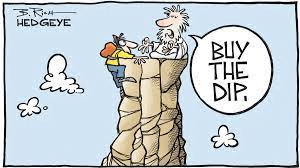
  • “Buy the dip” is good advice – but what is it, the dip?

    “Buy the dip” is good advice – but what is it, the dip?


    • The crypto market is once again in crisis mode, with investors torn between worry and hope.
    • The experts at Santiment have published a study from the “Hope Department” that clarifies the question of when a price decline is a real buying opportunity, i.e. a “dip”.

    Santiment combed through social media data, onchain indicators, and historical patterns to identify distinctive signals identifiedwhich occur particularly frequently in uncertain markets. The analysis is becoming increasingly important as the industry’s market capitalization has fallen significantly since the beginning of the year and many customers are looking for helpful guidance.

    Extremely negative sentiment as a leading indicator

    The first and perhaps strongest signal, according to Santiment, is a period of exceptionally negative sentiment on social media. When discussions are dominated by pessimism, doomsayers and FUD, it indicates that the market is oversold.

    Santiment points to historical examples where assets posted double-digit percentage recoveries immediately after such sentiment lows. The analysis shows that extreme fear is often not at the beginning, but at the end of a sell-off.

    Investors who recognize this pattern can identify potential turning points early on.

    Usage changes from “dip” to “crash”

    Another strong signal comes from the community’s choice of words. While terms like “dip” and “setback” tend to indicate a controlled correction, the transition to more drastic terms like “crash” or “goes to 0” often marks a phase of capitulation.

    Santiment emphasizes that such linguistic escalation is a recurring pattern that has often occurred shortly before a trend reversal in the past. When investors no longer talk about buying opportunities but rather about existential risks, market sentiment reaches its lowest point.

    Negative keywords strengthen the image

    The analysis also shows that an accumulation of negative key terms is another element of the overall picture. When terms like “sell,” “down,” and “panic” dominate social media, it reflects a broad loss of trust.

    Santiment points out that this collective uncertainty typically occurs when many market participants have already realized losses or are about to do so. Combined with other signals, this increases the likelihood that a bottom has been reached.

    Buy the dip
    Image created with ChatGPT-AI (DALL E)

    MVRV as objective onchain confirmation

    In addition to sentiment analysis, Santiment highlights the 30-day MVRV indicator, which measures whether short-term wallets are in profit or loss. If an asset is in the “severely undervalued” zone, it indicates that many investors are in the red – a condition that has historically often led to recoveries.

    Santiment emphasizes that particularly strong signals arise when negative sentiment and MVRV undervaluation occur simultaneously. In such phases, the likelihood of a sustained rebound increases significantly.

  • Ripple brings Aviva Investors onto XRPL: fund tokenization starts

    Ripple brings Aviva Investors onto XRPL: fund tokenization starts


    • Ripple and Aviva Investors want to tokenize traditional fund structures on the XRP Ledger.
    • Both companies justify the step with efficiency and infrastructure arguments.

    While the White House continues to struggle over regulatory guidelines for crypto, Ripple can show new progress in Europe. Aviva Investors, the asset manager of the British insurer Aviva plc, wants to tokenize traditional fund structures on the XRP Ledger (XRPL).

    tokenize and Aviva Investors shared in a statement on February 11, 2026 designated that they want to examine together how “traditional fund structures” can be brought to the XRPL. According to Ripple, this is the company’s first partnership with a European-based investment manager.

    Aviva Investors calls the project a novelty: It is “the first initiative of its kind” with which tokenized components are intended to be incorporated into the existing product range. Both sides speak of long-term cooperation and want to jointly implement tokenized funds on the XRPL “through 2026 and beyond.”

    Why Ripple and the XRP Ledger?

    In the communication, both focus primarily on the infrastructure: fast, secure and cheap transactions as well as energy efficiency. Ripple also refers to “compliance” functions that are specifically aimed at institutions in regulated markets.

    Ripple refers to the size of the network to classify it: Since 2012, over 4 billion transactions have taken place via the XRPL; The company also lists more than 7 million active wallets and 120 independent validators.

    On X, Markus Infanger, Senior Vice President at RippleX, wrote:

    “A truly significant moment for XRPL: Traditional financial services are now being implemented on the blockchain! Aviva Investors, the global asset management arm of leading British insurer Aviva plc, has announced a partnership with Ripple to tokenize traditional fund structures on the XRPL platform.”

    Jill Barber, Chief Distribution Officer at Aviva Investors, highlights the benefits for investors:
    “We are very pleased to announce our collaboration with Ripple and we look forward to working closely with the team to explore tokenized solutions,” said Barber. She added:

    “We believe tokenization can bring many benefits to investors – including improvements in time and cost efficiency. As the investment arm of the UK’s leading insurer, we have a long history of innovation. We are committed to adopting technological advances that we believe can bring positive change to our business – and we believe tokenized funds can be hugely beneficial for our clients.”

    Ripple describes the step as the next leap towards practical use. Nigel Khakoo, VP Trading and Markets at Ripple, said:

    “Tokenization is now moving from experimentation to large-scale production. Institutions like Aviva Investors are now focusing on how regulated financial assets can be deployed at scale.”

    According to Ripple, tokenized funds could bring noticeable efficiency gains to the investment process – and only really pay off over years. Khakoo cites “built-in compliance tools,” “near-instant settlement,” and “native liquidity” of XRPL as the infrastructure for “the next generation of institutional assets.”

    Reece Merrick, senior managing director for the Middle East and Africa at Ripple, designated the cooperation on

    As CNF reported, the news comes just days after Ripple received its final license as an Electronic Money Institution (EMI) from the Commission de Surveillance du Secteur Financier (CSSF) in Luxembourg.

  • Goldman Sachs reports $2.3 billion in crypto assets to SEC – XRP included for the first time

    Goldman Sachs reports $2.3 billion in crypto assets to SEC – XRP included for the first time


    • Goldman Sachs’ routine monthly report to the US Securities and Exchange Commission (SEC) is making the industry sit up and take notice. The bank reports crypto investments of $2.36 billion – a record value. But what is really remarkable is the new composition of the portfolio.
    • While Bitcoin and Ethereum continue to form the core, XRP and Solana positions of a significant size are also appearing for the first time. The bank relies exclusively on regulated spot ETFs and does not make any direct investments.

    At over a billion dollars, Bitcoin remains the most important crypto asset in the portfolio. Ethereum is almost on par, accounting for just under a billion. The almost identical weighting of the two assets is interpreted by market observers as a strong signal of trust in Ethereum.

    What is particularly interesting, however, is the inclusion of XRP ETFs worth over $150 million. Goldman Sachs is thus positioning itself in a segment that was long considered a hot potato due to the unclear Ripple regulation.

    XRP ETFs have only been trading for a few weeks and are seeing notable inflows. For many analysts, this is an indication that institutional investors are increasingly diversifying beyond Bitcoin and Ethereum and are giving more consideration to payment assets with clear use cases.

    Institutional demand is increasing – Goldman Sachs is sending a clear signal

    Die Routine reporting to the SEC shows that Goldman Sachs is continuing to expand its crypto exposure, although individual positions have been tactically reduced. The trend is clear: digital assets are no longer viewed as a speculative fringe topic, but are part of modern portfolio strategies.

    The bank only uses ETFs because they are operationally easy to handle with minimal risk. The inclusion of XRP and Solana in the portfolio shows that the bank is ready to focus on high-growth opportunities.

    Goldman Sachs holds XRP ETF
    Image created with ChatGPT-AI (DALL E)

    With the $2.3 billion in crypto ETFs, Goldman Sachs underlines that institutional players are no longer on the sidelines, but are actively channeling capital into the crypto market. Bitcoin and Ethereum are getting reaffirmation of their role as institutional underlyings.

    For XRP, on the other hand, it is an important step towards widespread acceptance after years of being an outsider due to the ultimately unsuccessful SEC lawsuit against Ripple.

  • Bank of England is testing cooperation with Chainlink

    Bank of England is testing cooperation with Chainlink


    • Chainlink takes part among other organizations in testing the second version of the Real-Time Gross-Settlement-Systems RTGS der Bank of England part. This is about the synchronous settlement of transactions involving central bank money and on-chain securities.
    • In the six-month innovation program, the British Central Bank is systematically investigating for the first time how modern interoperability applications can be embedded in the RTGS system version RT2.

    In a so-called Synchronisation Lab The British Real-Time Gross Settlement System RTGS is to be comprehensively modernized. It has been the basis of payment transactions in the United Kingdom for decades. With version RT2, the Bank of England wants to establish a modified system that can not only process classic payment flows, but also handle tokenized assets, programmable payments and future, new forms of digital money.

    The Synchronization Lab builds on the results of the earlier Meridian project. It had already shown that the completely synchronous processing of transactions between securities and central bank money “step by step” is technically feasible. Specific design options should now be tested, which could later be incorporated into the “live” infrastructure.

    Competence in the area of ​​interoperability

    Chainlink brings its expertise in the area of ​​decentralized oracles and in particular the Cross-Chain Interoperability Protocol CCIP to the program. The aim is to prove that different DLT systems, tokenized assets and simulated RTGS accounts can interact securely with one another.

    Chainlink collaborations
    Image created with ChatGPT-AI (DALL E)

    The Bank of England provides a test environment in which participants map end-to-end processes, evaluate synchronization models and simulate the behavior of different market participants. Chainlink is intended to show how settlement instructions can be reliably transferred between onchain systems and central bank components – a critical building block for the future, new financial market infrastructure.

    Importance for tokenization

    The Bank of England Synchronization Lab has significant strategic weight. Its results flow directly into the regulatory and technical design of the British financial system.

    The project shows the crypto industry that it is not just the EU central banks that are working to embed tokenized securities, digital central bank money and the programmable processing of transactions into existing classic financial structures.

    By participating in the project, Chainlink consolidates its position as a neutral infrastructure provider, usable both in Web3 projects and by traditional financial players. Interoperability is not an optional “nice to have” feature, but rather a basic requirement for the functioning of the next generation of financial markets.

  • Crypto vs. banks: Dispute over stablecoin rewards comes to a head in the White House

    Crypto vs. banks: Dispute over stablecoin rewards comes to a head in the White House


    • In the White House, the crypto industry and major banks continued to wrestle over the rules for stablecoin rewards in the Clarity Act, but the second meeting also ended without agreement.
    • Banks and associations are pushing for a far-reaching ban on returns and interest rates for stablecoins with a paper.

    Yesterday, Tuesday, representatives of the crypto industry and large US banks met again in the White House to debate the biggest point of contention in the Clarity Act: stablecoin “rewards” and the question of which activities should be considered permitted in the future. Participants described the round as more constructive than the first time, but in the end no one went home with an agreement.

    Crypto industry vs. banking industry

    Journalist Eleanor Terrett, citing those involved, wrote that this time there were fewer people at the table and that concrete deal details were discussed more quickly. Both sides called the conversation “productive” – “but this time too there was no compromise until the end,” said Terrett.

    In terms of content, the content became much more specific: The dispute was primarily about what would still be allowed in the future, i.e. what kind of rewards crypto companies would be allowed to offer if users held stablecoins.

    According to Terrett, the crypto site wants to define the term “rewards” broadly, while banks and associations want to make it as narrow as possible. The next step is to continue “in the coming days,” although it remains unclear whether there will be another meeting before the end of the month. The White House called on both sides to find a solution by March 1st.

    What made things even more explosive was a paper that banks and banking associations brought to yesterday’s meeting: “Yield and Interest Prohibition Principles”. It states that stablecoins are designed as payment instruments in the GENIUS Act and that market structure laws should therefore enshrine a strict ban on returns and interest rates in order to prevent outflows of deposits from the traditional banking system.

    Essentially, the paper calls for a very far-reaching ban on “tying any form of financial or non-financial consideration” to stablecoin holders – in connection with the “purchase, use, ownership, possession, custody, holding or retention” of a payment stablecoin.

    And then comes the sentence that seems like a red line from the crypto industry’s perspective: Proposed exceptions must therefore remain “extremely limited”. After all, the word exception is being used for the first time.

    On top of that, the paper also includes enforcement powers for the supervisors, including civil fines, anti-avoidance rules, strict requirements for marketing and risk presentations as well as a mandatory study two years after entry into force, including possible follow-up regulation for “significant risks”.

    Compromise in the air?

    Ripple-Chefjurist Stuart Alderoty pointed after the meeting for movement:

    “Today was a productive meeting at the White House – compromise is in the air. The clear, bipartisan momentum behind sensible crypto market structure legislation continues. We should act now – while the window is still open – and deliver a real win for consumers and America.”

    Dan coiler, director of industry affairs at the Blockchain Association, showed felt less positive:

    “After the first meeting at the White House last week, today’s follow-up shifted from broad discussion to serious problem-solving. This was a smaller, more focused session. Stablecoin rewards were the focus – but banks came not to negotiate on the text of the law, but with broad prohibitive principles, and that remains a key point of disagreement.”

    CEO Summer Mersinger explained:

    “The second White House meeting shows that the political drive behind bipartisan market structure legislation for digital assets remains. We are encouraged by the progress as stakeholders work constructively to resolve outstanding issues. We remain fully committed to translating this progress into legislation that positions the U.S. as a global innovation leader.”