Category: Coins

Digital assets, cryptocurrencies, blockchain, and currency news.

  • XRP at a turning point? Selling pressure meets bullish on-chain signal

    XRP at a turning point? Selling pressure meets bullish on-chain signal


    • XRP is under short-term selling pressure as more than 31 million XRP were transferred to Binance.
    • Santiment sees the biggest loss spike since 2022 as a possible capitulation signal near a bottom, but not a sure rally signal.

    For XRP, the latest on-chain data shows a possible turning point: selling pressure remains high. At the same time, a historic spike in realized losses could indicate that this pressure is slowly being exhausted.

    31 million XRP flows on Binance

    Crypto-Analyst Darkfost (@Darkfost_Coc) describes the market is currently directionless. Bitcoin continues to move sideways, and it is precisely this lack of momentum that is weighing on altcoins.

    In an X post early on February 23, Darkfost writes: “Bitcoin continues to range-bound, providing limited near-term directional clarity. This lack of momentum is weighing on the broader market, with altcoins continuing to underperform in the absence of a clear trend.”

    The crucial point for XRP is the transfer to Binance. According to Darkfost, “more than 31 million XRP” were moved onto the exchange in a single day. Binance continues to be the preferred platform for large transactions due to its low liquidity. This is relevant because deposits on exchanges often indicate intentions to sell – even if an inflow alone does not prove a sale.

    The inflows were mainly borne by the largest holder cohorts and were distributed as follows: small holders (under 1,000) with 6,543, small holders (1,000-10,000) with 73,630, medium holders (10,000-100,000) with 2,938,809, large holders (100,000-1 million). 14,236,825 and whales (over 1 million) with 14,494,865 XRP.
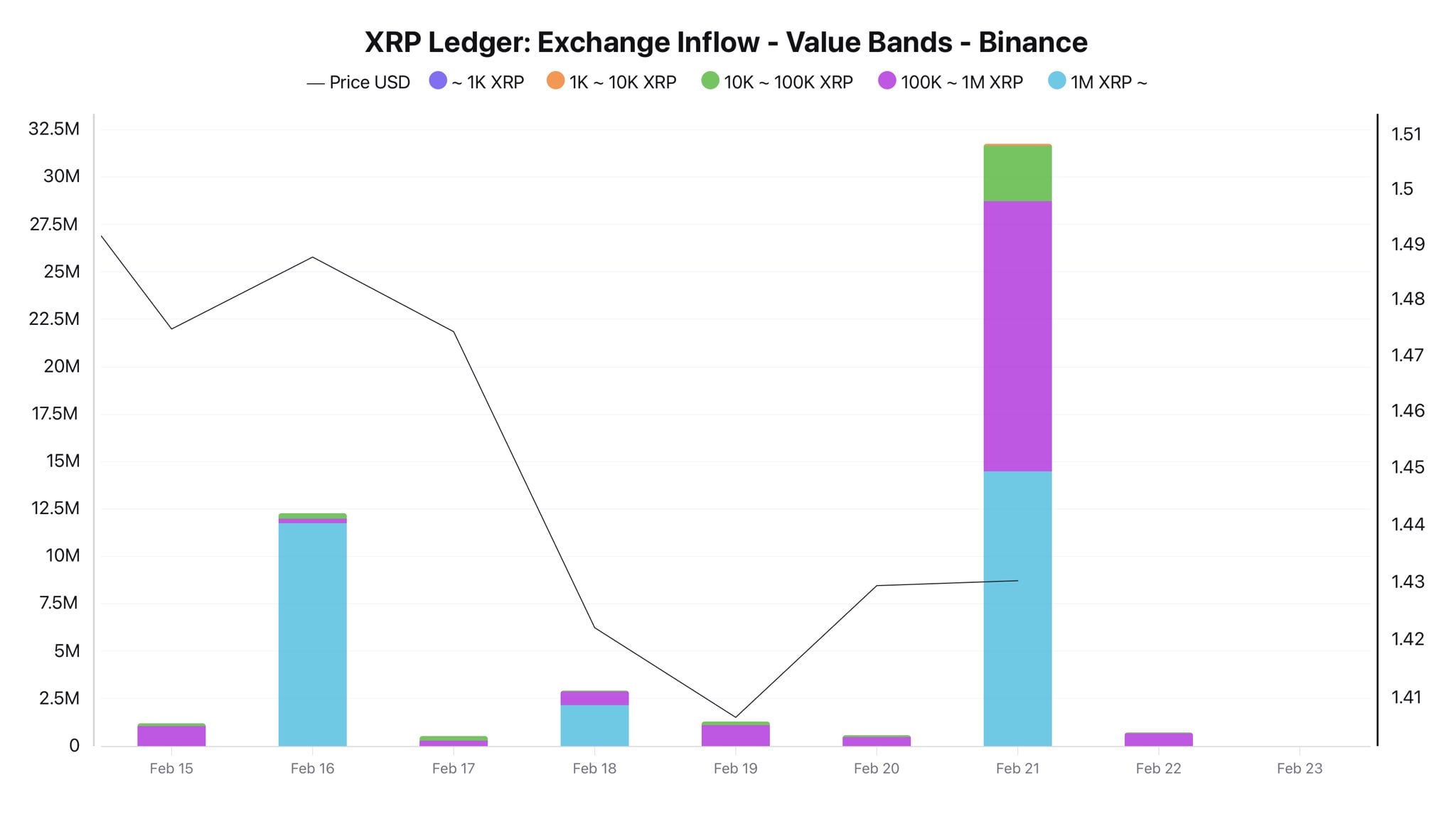
    XRP inflows on Binance
    XRP inflows on Binance, Source: @Darkfost_Coc on X

    Darkfost puts the potential selling pressure at around $45 million: “In total, this represents nearly $45 million in sudden potential selling pressure that should be closely monitored. Should this selling pressure continue, XRP may struggle to recover from its ongoing correction in the short term.”

    What is crucial is whether further inflows follow and the tokens are actually sold.

    Santiment: Biggest loss spike since 2022

    At the same time, on-chain data provider Santiment sees another extreme in the data. The on-chain data provider wrote on February 21: “XRP saw its largest spike in on-chain realized losses since 2022. When the previous weekly value of -1.93 billion in realized losses was reached 39 months ago, XRP gained 114% over the following eight months.”
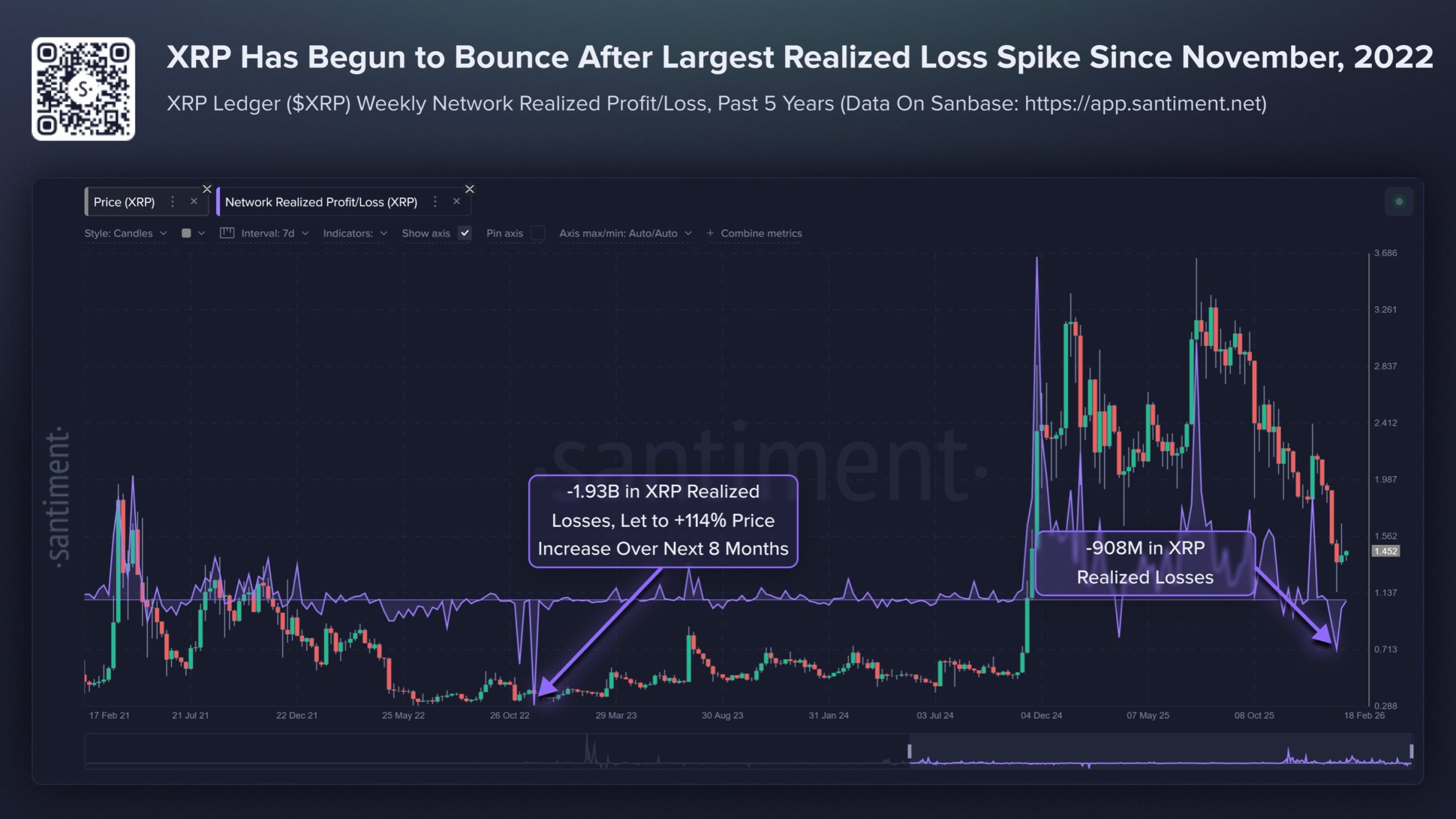
    XRP records largest increase in realized losses since 2022
    XRP Posts Biggest Increase in Realized Losses Since 2022, Source: @santimentfeed on X

    Santiment justifies this with classic market psychology. “Significant realized losses occur when many investors sell their coins at a lower price than they originally paid. This usually coincides with a period when fear dominates the market. When traders capitulate in panic, they realize their losses instead of waiting for a recovery.”

    However, this does not automatically mean an immediate recovery or bottoming out. Santiment itself makes this clear: Historically, such swings often occur near market bottoms, but do not guarantee an immediate rally. From Santiment’s perspective, this suggests that some of the selling pressure has already been released. A slightly bullish sign.

  • VeChain creates a recording system for environmentally friendly personal mobility

    VeChain creates a recording system for environmentally friendly personal mobility


    • Millions of people use public transport, ride-sharing services, e-bikes and e-scooters every day and reduce their environmental impact. VeChain’s blockchain tool ReCircleRewards now creates the technical basis for such behavior to be rewarded in the future.
    • VeChain has long been promoting personal environmental protection in everyday life. The new ReCircleRewards application measures and verifies environmental impact Everyday mobility based on submitted receipts, the data of which is scanned and processed via blockchain.

    Vechain’s new ReCircleRewards system consists, among other things, of a multi-stage verification process that checks submitted transport documents. Participants can upload screenshots, PDFs and email tickets etc., regardless of how different layouts, languages ​​and regional standards may be. An OCR scan, followed by a standardization process, brings diversity into a uniform format.

    Verification through plausibility checks

    An integrated duplicate check prevents the same trip from being submitted multiple times. In addition, cross-field validation checks whether information such as date, route, price and provider fit together logically.

    This technical framework is intended to ensure that the mobility data generated is trustworthy and can later be used for partner programs, for example in the area of ​​sustainability or corporate mobility concepts.

    Onchain transparency without technical hurdles

    Verified trips and the resulting potential rewards are stored on the VeChainThor blockchain. This means they remain transparent, tamper-proof and permanently available. VeChain emphasizes that the participants themselves do not need any knowledge of blockchain, as all technical processes take place in the background.

    The application presents itself as a classic app with the blockchain in the background. ReCircleRewards fits into a number of projects in which VeChain digitally secures sensitive processes. VeChain ToolChain was recently integrated into Decent’s service to document security and compliance data in the work environment in a forgery-proof manner.

    More providers and more precise classification

    The developers have announced that they will significantly increase the number of supported mobility providers so that the number of participants can grow worldwide. At the same time, the classification accuracy should improve so that even complex, very unstructured documents can be processed reliably.

    VeChain worldwideImage created with AI by ChatGPT (DALL-E)

    With ReCircleRewards, VeChain once again shows itself as an actor that combines environmentally friendly behavior with digital incentive mechanisms. Mobility, sustainability and Web3 technology are brought together in a practical, mass-market product, and blockchain technology creates the practical benefits.

    What the project doesn’t show – at least not so far – is probably not entirely unimportant for potential participants in the ReCircleRewards system: What are the rewards for the laborious collection and uploading of whatever receipts?

    VeChain is silent about this.

  • Netherlands bans Polymarket

    Netherlands bans Polymarket


    • The Dutch gaming authority banned Polymarket, which claims to be the largest prediction market in the world, from operating on the grounds of violating gaming law.
    • Polymarket, in fact, does not have a gambling license anywhere in the world, but it happily offered bets on real events, including election betting, which is generally banned in the Netherlands – even with a license.

    An agency official was able to easily place an election bet on politician Rob Jetten. After this factual evidence, the authorities intervened and ordered this Operating ban for Polymarketcombined with a penalty of 420,000 euros per week, but a maximum of 840,000 euros.

    The authority said it had previously contacted Polymarket, but there was no response. The measure now imposed is intended to ensure that Polymarket packs its bags immediately. One or two suitcases of money might also be there.

    Head of the authority becomes clear

    Ella Seijsener, director of licensing and supervision at the NL Gambling Authority, left no room for interpretation in her statement:

    “Prediction markets are on the rise, including in the Netherlands. Such companies offer bets that are fundamentally not allowed on our market – not even for license holders. In addition to the social risks of such predictions, such as the possible influence on elections, we note that this is illegal gambling. Anyone who does not have a license has no place in our market. This also applies to these new gambling platforms.”

    The authority also pointed to a lack of consumer protection, a lack of transparency and unclear dispute resolution mechanisms. These factors would increase the risk for consumers and are incompatible with the Dutch regulatory framework.

    EU states are tightening their course towards forecast markets

    The Netherlands is not the first EU country to take action against Polymarket. In recent months, Portugal, Italy, Belgium, Romania, France and Hungary have already taken measures against Polymarket, ranging from functional restrictions to a complete ban on operations.

    A clear picture emerges: the EU states view prediction markets as games of chance that are subject to regulation – and also tax – and react accordingly in a restrictive manner.

    For Polymarket this de facto means the loss of the EU market. The company received a fine from the US Securities and Exchange Commission (CFTC) in the USA as early as 2022. Now it is once again the focus of national supervisory authorities, who also don’t understand fun.

    Prediction markets will show their colors or disappear

    The Dutch approach is likely to consolidate the legal classification of forecast markets in the EU. While proponents emphasize their “informational value”, regulators see above all the danger of manipulative incentives and the potential influence on democratic processes.

    The question for Polymarket now arises as to whether the company will adapt its business model and call a spade a spade, or whether it will have to withdraw from further European markets.

    In any case, the development shows that EU states will not allow themselves to be fooled by companies that want to transform pure gambling into something more serious by simply calling it a “prediction market”.

    Just a few days ago, Ethereum inventor Vitalik Buterin warned about exactly this.

    Ethereum prediction markets as a casino
    Image created with AI by ChatGPT (DALL-E)
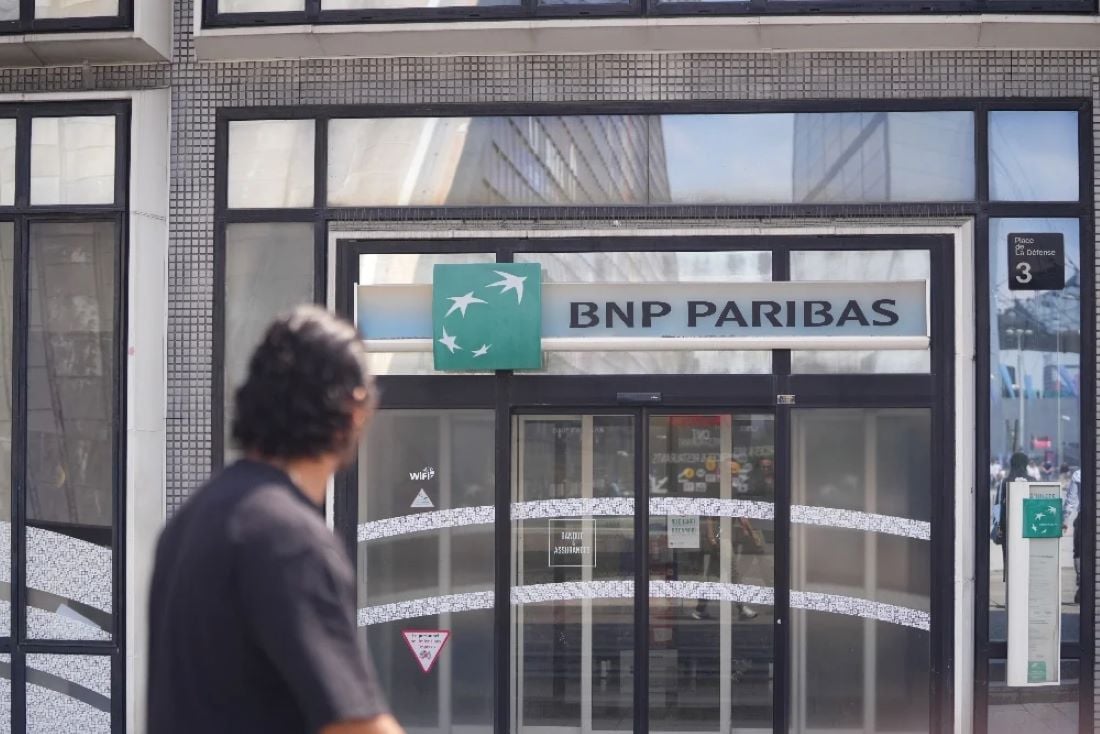
  • BNP Paribas reviews Ethereum blockchain for suitability for money market fund tokenization

    BNP Paribas reviews Ethereum blockchain for suitability for money market fund tokenization


    • In a pilot project, the French bank BNP Paribas has shares in one for the first time Money market funds issued on the Ethereum blockchain.
    • It is seen in the industry as a signal that banks will also view public blockchains as a basis for regulated financial products in the future.

    BNP Paribas, created in 2000 from the Banque Nationale de Paris and the Banque de Paris et des Pays-Bas, is a global universal bank for private customers, companies, institutional investors and government organizations.

    As part of their blockchain pilot project Shares of a money market fund as digital tokens on Ethereum pictured. Although the blockchain is public, access is restrictive. It is only available to specially authorized investors.

    The technical implementation is carried out via the in-house AssetFoundry system. BNP Paribas Securities Services takes on the role of transfer agent, including wallet setup and storage of private keys, while BNP Paribas Corporate & Institutional Banking is responsible for tokenization and connection to the blockchain.

    The aim is to digitally map the entire life cycle of a fund share, from the issue through register management to the final settlement.

    Banking on public blockchains

    The decision to use Ethereum as infrastructure is something fundamentally new for major banks. While they have so far relied almost exclusively on private networks based on the distributed ledger technology DLT, BNP Paribas is now showing that public blockchains are also suitable for displaying sensitive financial instruments.

    The project follows an earlier successful tokenization of a Luxembourg money market fund on a private blockchain and represents the bank’s new multi-chain strategy.

    More efficient with new market structures

    Money market funds are considered an ideal use case for tokenization because they are highly liquid, standardized, and are at the heart of institutional cash management.

    By mapping them on a blockchain, transactions can be processed in near real time, compliance checks can be automated and transparency can be increased for all authorized parties.

    With its project, BNP Paribas joins other global players such as BlackRock, Franklin Templeton and JPMorgan, who have been evaluating tokenized funds on public chains for some time.

    Expanded opportunities

    The pilot project fits the bank’s strategy, which is also open to experiments with wholesale CBDCs. A combination of tokenized fund shares and digital central bank money could lead to completely digitalized financial processes in the future.

    Image created with AI by ChatGPT (DALL-E)

    For European fund issuers, BNP Paribas’ move is a clear indication that the tokenization of classic financial products will become increasingly important in the traditional banking sector in the future.

  • IOTA Foundation uses expert advice to promote its TWIN project

    IOTA Foundation uses expert advice to promote its TWIN project


    • The IOTA Foundation has established an expert council as a new permanent institution. He is tasked with driving forward TWIN, the project’s international trade initiative.
    • He should act as an active mediator between technology, regulation and industrial implementation and accelerate the introduction of IOTA trading logistics.

    IOTA’s Trade Worldwide Information Network TWIN aims to anchor digital identities, forgery-proof documentation and automated compliance processes in international trade structures.

    It should the new expert council ensure that the applications in question are not only technologically robust but also regulatory compatible.

    The pressure on companies and authorities to introduce interoperable standards is growing, particularly in the areas of digital trade documents, customs processes and supply chain transparency. IOTA offers an open, scalable and fee-free infrastructure that is suitable for government and institutional applications.

    International expertise for operational implementation

    The expert council is made up of experts with experience in global trade, logistics, standardization and digital transformation. Your task is to evaluate existing pilot projects, identify opportunities for cooperation and take real economic requirements into account.

    IOTA emphasizes that the integration of external expertise is crucial to closing the gap between blockchain innovation and operational implementation in complex trading networks. Close cooperation with the respective industry partners should also create new use cases that demonstrate the benefits of distributed ledger technology in international trade.

    Importance for IOTA

    The expert council was also founded with a view to IOTA’s strategic focus on “real economy” processes and institutional acceptance.

    While many blockchain projects remain predominantly speculative objects, IOTA pursues an approach that is aimed at long-term infrastructure development.

    The TWIN initiative is considered one of the key growth engines because supply chain operators, customs authorities and trading platforms are increasingly looking for trustworthy, interoperable digital tools.

    The expert council is intended to help meet this demand and establish IOTA as a technological standard in digital commerce.

  • Emirate of Dubai and Ctrl Alt begin phase two of their tokenization project

    Emirate of Dubai and Ctrl Alt begin phase two of their tokenization project


    • Dubai Land Department and Web3 company Ctrl Alt have begun phase two of their tokenization project, which will enable trading of tokenized real estate shares.
    • After the first project phase, in which the technical foundations were laid and regulatory issues were clarified, the next step is integration into the real estate market.

    The focus of the practical phase is on building an infrastructure in which investors can buy and trade tokenized real estate shares. The offer is intended to be open to institutional investors and qualified private investors.

    Tokenization should not only enable fractional ownership of real estate, but also accelerate processing and increase the transparency of the transfer processes.

    The Dubai Land Department as the responsible authority, sees this as a tool to establish Dubai as a global hub for digital assets.

    Secondary market as a growth driver

    With the introduction of a secondary market, the project goes beyond pure tokenization and takes care of perhaps the most important prerequisite for the acceptance of digital real estate products: liquidity.

    In the future, investors should be able to trade their tokenized shares flexibly, without lengthy sales processes.

    This will – or so one hopes – open up Dubai’s real estate market to new sources of capital and further increase its attractiveness for international investors.

    At the same time, the partners emphasize that all transactions take place in a regulated environment to ensure market integrity and investor protection.

    Dubai is increasingly using Web3 technology

    The initiative fits into Dubai’s comprehensive digital assets strategy, which aims to integrate blockchain technologies into key economic sectors.

    In recent years, the emirate has already created regulations that enable innovation and at the same time set clear compliance standards.

    With the launch of the second phase of the tokenization project, Dubai is moving closer to becoming a leader in the Web3 system.

    2026 Year of the Web3
    Image created with ChatGPT-AI (DALL E)
    For the real estate sector, it is a further step towards efficient, transparent and internationally accessible markets.

  • Decent integrates VeChain for tamper-proof audits and inspections

    Decent integrates VeChain for tamper-proof audits and inspections


    • VeChain cooperates with Decent to document work processes such as security checks, audits and compliance reports via blockchain.
    • The core idea is to secure “who did what, when, where” with a time stamp, location check and unchangeable storage.

    VeChain enters into a technical partnership with Decent, a digital operations and security process provider. The focus is not on DeFi or trading, but on evidence in everyday work: from security checks to compliance reports.

    In an XPost from February 19th, VeChain describes the problem: Data is stuck in paper, Excel and separate systems. It literally says:

    “Workplace processes are broken. Buried under paper forms, isolated spreadsheets and disconnected systems, you’re essentially flying blind. Who did what? When did it happen? Stop guessing. Start verifying.”

    The goal of VeChain and Decent is simple: to record who did what, when and where. Decent describes itself as a platform that digitally records operational processes and makes them comprehensible. Among other things, safety inspections, equipment audits, facility operations and compliance reports are mentioned.

    According to VeChain, it shouldn’t just remain with digital forms: what’s crucial is that the execution can be verified. VeChain explains that when an inspection is documented, it often remains unclear whether it actually happened on site or whether it was “fixed” later. Decent is intended to close exactly this gray area:

    “Every action is timestamped, geographically verified and anchored on the blockchain. The result: tamper-proof proof of work. No disputed records. No lost documents. No ‘I don’t know what happened’.”

    Why Decent relies on VeChain

    VeChain mentions several points that make the project ideal for use in companies: predictable fees via a two-token model, fee delegation (end users neither have to pay nor understand “gas”) and an infrastructure that, according to VeChain, has been running “with 100% uptime since 2018”.

    The blockchain should not be visible to users in everyday life. You operate an app. Actions are logged immutably in the background. VeChain writes:

    “Enterprise-level trust, ease of use for end users. Decent does not use VeChain for marketing campaigns, but as a central infrastructure. Every activity is stored in an immutable register, ensuring transparency and traceability – even during audits, disputes and government controls. The blockchain itself is invisible to end users: you see a working mobile app.”

    Next, VeChain is looking to expand through additional companies and developers. Decent refers to direct contact options for interested companies. VeChain also signals that the ToolChain and Builder team is also open to further partnerships.

  • IOTA launches expert advice for TWIN: UK trade professionals should deliver

    IOTA launches expert advice for TWIN: UK trade professionals should deliver


    • The IOTA Foundation is setting up a new Expert Advisory Board for TWIN, with a clear focus on Great Britain.
    • The board is intended to dock TWIN to real customs processes, IT systems and compliance controls.

    The IOTA Foundation is expanding its TWIN (Trade Worldwide Information Network) trading initiative and is getting a new Expert Advisory Board for this purpose. The focus is clearly on the United Kingdom. The idea: TWIN should not only look good from a technical point of view, but should also exist in real operation and be adaptable.

    Like the IOTA Foundation in one Blog post of February 19, the problem in reality lies not with “design”, but with customs processes, regulation and implementation along real supply chains. In the announcement, IOTA writes:

    “As the technological architect behind TWIN, IOTA is building the foundation for a more connected global trading ecosystem. But technology alone is not enough. Turning this vision into a functioning system requires the knowledge of professionals who know trading processes, customs systems and regulatory frameworks first-hand.”

    The same tone comes across on X too: less theory, more everyday life. The board is “market-driven and expert-led” and should help ensure that TWIN is ultimately usable in practice – i.e. compatible with real processes, real IT systems and real controls.

    According to IOTA, the board consists of independent industry people who can say early on what is not working in the company:

    “The IOTA Expert Advisory Board is made up of independent industry leaders who will bring extensive practical experience to the development of the TWIN platform, particularly with a focus on the UK. The Advisory Board will provide practical advice and key insights to optimize the solutions developed and ensure that TWIN is based on operational reality, economic viability and the needs of the evolving market.”

    This is the new IOTA Expert Advisory Board

    Mark Johnson should bring this practical pressure particularly directly. IOTA describes him as a customs and trade specialist with over 40 years of experience in logistics, including a senior role at Kuehne+Nagel. He advised the British government during and after Brexit and continues to support the Department for Environment, Food and Rural Affairs.

    John Lucy is introduced as a transportation and logistics manager with four decades of experience across multiple regions. He advises on cross-border transport, customs reform, digitalization and decarbonization – and is active in organizations such as the Road Haulage Association and the World Free Zones Organization.

    Dr. According to IOTA, Anna Jerzewska, founder and managing director of Trade & Borders, brings more than 20 years of consulting experience – for governments, international organizations and companies, from London to Brussels to Geneva. She is also named as a customs rapporteur for EuroCommerce and as a member of the Windsor Framework Independent Monitoring Panel.

    Professor Sangeeta Khorana is classified as an economist and data analyst with over 25 years of experience – with positions in science, government, consulting and advisory. Her focus is on trade, free trade agreements, market access and impact analysis for policy decisions.

    Daniel Shelcot, Head of Business Solutions and Border Compliance at Maritime Cargo Processing (Destin8), is tasked with bridging the gap to port and border systems. IOTA points to more than 17 years of experience in port and border IT – and its perspective on how platforms interact with real supply chains and government controls.

    Gavin Johnson, Managing Director at Mobius Technology, will be positioned as an interface between industry and IT. He developed the “Signal” system for tracking temperature-controlled logistics and has experience in the digitization of complex supply chains, business development and international operations.

    The bottom line is that IOTA TWIN wants to make it “real-world”, i.e. away from the pilot and towards a system that runs in day-to-day business. As CNF recently reported, the IOTA Foundation also wants to gain a foothold in South Korea. Dominik Schiener met with large companies and financial institutions for this purpose.

  • AI tool EVM-Bench could avert Ethereum security crisis

    AI tool EVM-Bench could avert Ethereum security crisis


    • The security of Ethereum’s smart contract system appears to be at risk. In any case, AI developer OpenAI and venture capital investor Paradigm are making joint efforts to protect smart contracts against AI attacks.
    • The two companies developed EVM-Bench, a benchmarking framework that can determine the ability of modern AI models to successfully attack Ethereum smart contracts.

    Die cooperation of the two companies Paradigm and OpenAI is a result of the realization that AI agents are increasingly able to decompile programs, analyze and manipulate the code and can thereby cause immense damage.

    The OpenAI Paradigm EVM Bench is based on an extensive collection of documented vulnerabilities derived from professional audits, bug bounty competitions, and security analysis of the L1 blockchain.

    The framework tests three core capabilities: identifying critical vulnerabilities, exploiting them in an isolated test environment, and then fixing the bugs through code patches.

    OpenAI emphasizes that in the future, AI models will have to be evaluated in economically realistic but shielded environments in order to exclude risks for real assets. Paradigm adds that the performance of the AI ​​models has increased significantly.

    While previous generations found less than 20% of critical bugs, current models such as GPT 5.3 Codex already achieve success rates of over 70%.

    AI: opportunity and risk

    More and more developers are using AI tools to create or optimize smart contracts, but not all automatically generated code is secure. AI agents are already able to automate attacks on smart contracts secured by supposedly complex defense mechanisms – with disturbing success.

    The latest DeFi exploits show that even small vulnerabilities can cause millions of dollars in damage. Ethereum is therefore faced with the challenge of modernizing its security mechanisms before the AI ​​attacks on smart contracts become even more sophisticated and successful.

    Potential security standard for smart contracts

    The EVM Bench is the first open-to-comparison measurement tool for AI-supported security analyzes in the Ethereum system. This could be used to develop an industry standard that would help both auditors and developers identify risks early.

    Image created with ChatGPT-AI (DALL E)

    The EVM Bench creates additional transparency for institutional investors who are increasingly entering staking infrastructure and DeFi protocols. That’s why the cooperation between OpenAI and Paradigm is a turning point.

    Ethereum must prepare for a future in which AI agents are not just passive system tools, but active system participants.

  • Coinbase: Earmarked loans for XRP, ADA and DOGE holders

    Coinbase: Earmarked loans for XRP, ADA and DOGE holders


    • Coinbase is expanding its dedicated lending to XRP, ADA and DOGE holders. They can borrow up to $100,000 so they don’t have to touch their investments. Man is thus responding to the increasing need for liquidity-neutral financing.
    • The loans that were previously granted to purchase BTC and ETH are now also available for other crypto assets. SThey are paid out in USDC and settled onchain via the decentralized lending protocol Morpho.

    The loan is granted against the deposit of the cryptocurrency owned by the borrower as security. In return, USDC will be paid out. Lending is processed via Morpho.

    Die expansion on XRP, ADA, DOGE and LTC is intended to expand the circle of potential borrowers. The Service is available throughout the United States, excluding New York State.

    New options for retail investors

    While Ethereum and Cardano already offer earning opportunities via native staking mechanisms, XRP, Dogecoin and Litecoin do not have comparable built-in reward models.

    For many investors, crypto-backed loans are one of the few ways to obtain liquid assets without having to liquidate their positions.

    Coinbase points out that borrowing against assets has tax advantages because, unlike selling, it does not trigger a capital gain that would have to be taxed as income.

    At the same time, the exchange points out the risks: during strong market movements, the value of the collateral may fall below the required threshold, which leads to liquidations.

    Customers receive warnings as soon as critical values ​​are reached, but underneath there is an additional buffer zone that Coinbase has created to minimize risk.

    Technical features and market positioning

    A technical detail concerns the form of the collateral: the deposited assets are treated as “wrapped tokens” to make them usable on Ethereum-compatible networks.

    Wrappd ADA and LTC Token
    Image created with AI by ChatGPT (DALL-E)

    This enables integration with Morpho and other DeFi infrastructures. Coinbase also reported that there were $17.2 billion worth of XRP holdings in customer accounts at the end of the year.

    By expanding lending, Coinbase is strengthening its position in crypto-collateralized financial services and giving retail investors greater access to liquid assets without having to abandon their long-term positions.