Category: Coins

Digital assets, cryptocurrencies, blockchain, and currency news.

  • 1 million per Bitcoin? Eric Trump confirms forecast after price slide

    1 million per Bitcoin? Eric Trump confirms forecast after price slide


    • Eric Trump reiterates his $1 million Bitcoin prediction despite the pullback of around 50 percent from the all-time high.
    • He cites the gradual shift by large financial institutions and increasing crypto quotas in asset management as drivers.

    Eric Trump reiterated his long-term Bitcoin price forecast in a CNBC interview on February 18 at the World Liberty Forum: The son of US President Donald Trump still believes a price of $1 million per BTC is realistic, despite the current price setback of around 50 percent. Trump explained:

    “I’m a big supporter of Bitcoin. I really believe it will reach a million dollars. I think Bitcoin is one of the best performing asset classes.”

    Bitcoin on the way to a million?

    To put things into perspective, he referred to previous lows: Two years ago, BTC was trading at around $16,000, today BTC is at around $67,000. However, Trump does not see the volatility of Bitcoin as a disadvantage, but rather as a feature of Bitcoin:

    “And sure, there’s a lot of volatility. If you don’t want volatility, invest in some municipal bond – have fun with it,” said he. “Or buy Treasuries. You’ll have volatility on something that has huge upside potential.”

    His message: If you don’t accept the fluctuations, you should consistently invest in classic products. Bitcoin, on the other hand, is a bet on higher returns, but with greater price fluctuations.

    Trump sees the most important driver not in a single catalyst or hype, but in the gradual change of direction of major financial institutions. He listed Fidelity, Charles Schwab, JP Morgan and BlackRock, as well as Goldman Sachs, and derived a trend from them:

    “Every single one of them is adopting cryptocurrencies. They are willing to hold cryptocurrencies on their balance sheet. They are bringing their private wealth clients into cryptocurrencies – after previously telling them: invest exactly zero in cryptocurrencies.”

    According to Eric Trump, the portfolio recommendations are a clear indication:

    “First it was two percent. And now it’s suddenly five or six percent. And that number continues to rise.”

    The implicit theory behind this is that even small but growing target quotas at the financial giants are enough to generate a constant demand impulse without the need for a single event.

    The statements come during a period of increased attention surrounding World Liberty Financial. Two Democratic US senators are calling for a CFIUS audit following reports of a $500 million infusion from the United Arab Emirates shortly before the 2024 US election.
  • Société Générale brings its EURCV‑stablecoin to the XRP ledger

    Société Générale brings its EURCV‑stablecoin to the XRP ledger


    • The major French bank Société Générale is now making its Euro stablecoin “EUR CoinVertible”, which was introduced in 2023 and available on Ethereum and Solana, also available on the XRP Ledger.
    • This expands its multi-chain strategy, supported by Ripple’s custody service. The EURCV is one of the few fully regulated Euro stablecoins issued by a well-known major European bank.

    The “executing body” is the subsidiary SG‑FORGE, which is wholly owned by Société Générale. It is subject to French banking supervision and meets the requirements of the MiCA regulation, which will become mandatory in the European Union from July 2026.

    The Bank explainedthat the EURCV is covered one-to-one and was primarily developed for institutional applications. The expansion to the XRP Ledger creates additional interoperability so that Euro liquidity can be used on several chains in parallel.

    This is particularly relevant for tokenized securities, onchain settlement and automated treasury processes.

    XRPL as infrastructure for institutions

    The XRP ledger has been the specialized infrastructure for fast, cost-effective and final transactions for years. For banks and institutional issuers, the combination of efficiency, legally sound regulation and technical stability is crucial.

    As part of the integration, Ripple provides its Ripple Custody service, which is required for the custody and issuance of bank-grade digital assets.

    SG‑FORGE also points to the suitability of XRPL for tokenized financial instruments, an area in which Société Générale is already active, such as digital bonds and onchain repo transactions.

    Importance for the EU digital asset market

    The availability of a regulated Euro stablecoin on the XRP Ledger strengthens its position in the institutional segment and goes hand in hand with the growing importance of European stablecoins as a basis for tokenized capital markets.

    Ripple hat EU-Electronic-Money-License
    Image created with ChatGPT-AI (DALL E)

    For Ripple, the cooperation is a further step towards establishing itself as an infrastructure provider for banks.

    For Société Générale, the multi-chain strategy serves the goal of being able to offer its digital financial products flexibly, interoperably and across multiple channels.

    The integration of EURCV on XRPL was an important step towards this goal.
    More will follow.

  • Will Ripple buy a bank? This is what CEO Garlinghouse says

    Will Ripple buy a bank? This is what CEO Garlinghouse says


    • Garlinghouse dodged the bank purchase question and positioned Ripple as a bank-friendly bridge builder.
    • He sold RLUSD as “almost overregulated” and said more U.S. regulatory clarity is drawing banks into the market.

    Ripple CEO Brad Garlinghouse appeared at the Economic Club of New York on February 18th. And there was a question that he still had to answer: Does Ripple want to buy a bank itself at some point or will it just stick with partnerships?

    There was no clear answer. Garlinghouse dodged. He used the moment to discuss Ripple’s line towards banks, the RLUSD approach and the topic of regulation in the USA.

    Will Ripple buy a bank?

    The moderator built the Ask about Ripple’s institutional positioning: BNY Mellon as custodian, plus a “conditional” OCC charter. And then pretty directly: Buy, integrate or continue to partner?

    Garlinghouse immediately made it clear that he would not allow himself to be pinned down on this. “I’m going to sidestep part of your question,” he said. And then even more clearly: “And I will skip the question of whether we will ever buy a bank.”

    The dodging itself was almost expected. What was more interesting was where he went instead: Ripple wants to continue to act as a bridge builder so that banks and large institutions can get in without it looking like a “crypto adventure” for them.

    He called his own strategy “contrarian” and recalled how unpopular it was for a long time:

    “Ripple pursued a contrarian and controversial market entry strategy early on – and that’s exactly what made us unpopular in the crypto scene. At the very beginning, Ripple said: Banks are our customers. If we want these technologies to have the greatest impact for the greatest number of people, then banks are the touchpoint where people actually live out their relationships with financial services.”

    Garlinghouse contrasted this with the “anti-bank” and “anti-government” ethos of the early scene. Ripple consciously tried to mediate between TradFi and DeFi, with the aim of ultimately making “cheaper, better, more robust and faster” services possible. Not against banks. With you.

    Ripple USD: “overregulated” as a selling point

    When it came to stablecoins, he became more specific. Ripple launched RLUSD “13 months ago” and is now “around fifth place” among the largest stablecoins. That was a success, he said.

    But the key point for him is less ranking – more trust in supervision. Trust license with the New York Department of Financial Services, plus an OCC “conditional approval” charter. Garlinghouse called it “so to speak, over-regulated.” And he meant this explicitly in a positive way, as a selling point for institutions:

    “We think that positions us uniquely – as ‘almost over-regulated’, so to speak. But that’s exactly what we want because we work with institutions. We want them to see us as someone who goes above and beyond what’s necessary and ensures that this level of oversight is in place so that there are no questions left unanswered – like: Is the stablecoin really backed on a one-to-one basis? Are there regular confirmations of what those covers look like?”

    Regulation and adoption in the USA

    Later it was about legislation and what it changes in practice. Garlinghouse said Ripple has already seen how stablecoin rules give banks more security. He cited the Genius Act as an example.

    He argued similarly with the Clarity Act: If there is a clearer definition of what a crypto asset is from a regulatory perspective – currency, security, commodity – then the barrier to entry drops. And big banks are more likely to move. Not because of marketing. Because of legal clarity.

    He was fundamentally optimistic about tokenization, but not euphoric. He warned of “technology in search of a problem” rather than “problem in search of a technology.” He cited Larry Fink and BlackRock as prominent examples, which relied on tokenization “on a large scale.” He shares the thesis that a large proportion of assets could be tokenized – but not as a one-size-fits-all. More industry by industry. With real industry expertise.

    The bottom line is that the bank purchase question remains open: quite obviously intentional. Garlinghouse didn’t want to slam a door. And no burping. Instead, he repeated Ripple’s line: bank-friendly, compliance-first, bridging TradFi and DeFi. Typical Garlinghouse.

  • Poland’s President blocks implementation of the EU MiCA regulation again

    Poland’s President blocks implementation of the EU MiCA regulation again


    • Poland’s President Karol Nawrocki has once again vetoed the implementation of the EU crypto regulation “Markets in Crypto Assets”.
    • The presidential office confirmed that Nawrocki had not signed the bill and described it as “virtually identical” to the draft rejected in December.

    Nawrocki signed eight other laws on the same day, refused however, the approval of the MiCAR. His reasoning: A bad law remains bad even if it is passed a hundred times.

    Overregulation without freedom of innovation?

    Nawrocki considers the Polish implementation of MiCAR to be overly controlling, too complicated and anti-innovation. He argues that the law opens the door to censorship and leaves no room for technological development.

    The government should develop a new, simpler law that promotes secure framework conditions, tax clarity and real support for innovation. The president’s office signaled its willingness to work on a new version immediately. The question of why 26 other EU members can implement the law without any problems was not heard from the presidential office.

    Regulatory vacuum endangers crypto industry

    With the renewed veto, Poland remains without national MiCA implementation – a situation that is becoming increasingly problematic. The financial supervisory authority KNF points out that no responsible authority has yet been named for MiCA supervision.

    At the same time, the EU transition period is approaching: from July 1, 2026, all EU member states must be fully MiCA compliant. This creates a significant risk for Polish crypto exchanges.

    While providers with a MiCA license from other EU countries – such as Coinbase with a Luxembourg license – can operate in Poland without any problems, Polish crypto companies lack the option of national licensing.

    Some are already preparing alternative forms of legal organization in order to avoid being forced out of the market.

    Conflict instead of cooperation

    The veto exacerbates the paradoxical ongoing Polish conflict between the president and the government in Warsaw, because the MiCAR issue is not the only point of contention.

    While the experts are pushing for MiCAR to be implemented on time, Nawrocki is acting as a defender of economic freedom and technological openness – against them and his own government.

    Although industry representatives welcome the rejection of over-regulation, they warn of the consequences of a regulatory vacuum.

    MiCAR-Poland is not participating
    Image created with ChatGPT-AI (DALL E)

    Without an early compromise, Poland is likely to torpedo the EU’s uniform MiCA regulation – with potentially devastating consequences for Poland as a location, competitiveness and the future of the domestic crypto industry.

  • ONCE Foundation aims to ensure accessibility of the digital euro

    ONCE Foundation aims to ensure accessibility of the digital euro


    • The ECB uses the know-how of the ONCE Foundation to design the official app for the Digital Euro to be barrier-free. The aim is to ensure inclusion.
    • All people, whether seniors, disabled or with little digital skills, should have practical access to the digital euro.

    The cooperation between the European Central Bank and the Spanish ONCE Foundation is free of charge and follows the EU guidelines on accessibility, fundamental rights and digital participation.

    The ONCE Foundation brings its many years of experience in the development of barrier-free digital applications. She advises the ECB on the technical requirements, supports the design of the app and tests the accessibility of the first prototypes.

    ECB Executive Board member Piero Cipollone emphasized that accessibility and inclusion are central design principles of the Digital Euro and not additional downstream functions.

    The ONCE Foundation brings experts who are themselves disabled into the project team in order to benefit not only from their technical know-how but also from their practical experience as those affected.

    Guiding principle „Accessibility by Design“

    The ECB follows the “Accessibility by Design” approach, which goes beyond the minimum requirements of the European Accessibility Directive. Accessibility should not only be checked at the end, but should be integrated into the concept, design and user interface from the start.

    Digital euro online and offline
    Image created with AI by ChatGPT (DALL-E)

    The app should be clearly structured, easy to understand and intuitive to navigate. The results of this work may later influence the requirements for payment service providers that develop their own applications for the Digital Euro.

    At the same time, findings from vulnerable consumer groups are incorporated into the development. These emphasize the importance of simple onboarding processes, familiar payment processes and personal support in local branches.

    People with little digital experience in particular expressed a desire for security, clarity and control over their finances.

    Potential for more inclusion

    The first innovation project for the Digital Euro with around 70 participants already identified concrete functions that can strengthen inclusion. These include voice-controlled transactions, large fonts, high-contrast user interfaces and guided usage paths.

    The ECB sees these results as confirmation of its view that the digital euro must not only become a new means of payment, but also an instrument of digital participation.

  • Abu Dhabi invests billions in Blackrock IBIT ETF

    Abu Dhabi invests billions in Blackrock IBIT ETF


    • Publicly available SEC documents show that e.gwhite Abu Dhabi sovereign wealth fund over a billion Dollars invested in BlackRock’s IBIT.
    • It is noteworthy that apart from Abu Dhabi, no other state clearly has any shares in it.

    It Documents According to the US Securities and Exchange Commission (SEC), Abu Dhabi fund Mubadala Investment now holds over 12.7 million shares of BlackRock iShares Bitcoin Trust IBIT, which corresponds to a market value of around $630 million. Al Warda Investments has more than 8.2 million shares worth about $408 million.

    Both funds increased their positions compared to the previous quarter, with Mubadala increasing particularly significantly. The investments are made in a phase in which the Bitcoin price temporarily fell by more than 30 percent. This suggests a countercyclical, long-term strategy.

    The UAE Strategy

    The United Arab Emirates has been pursuing the goal of broadening its economy and becoming less dependent on oil revenues for years. Investments in technology and financial innovations play a central role.

    Bitcoin ETFs offer institutional investors a chance to participate in Bitcoin price developments without acting as custodians themselves.

    For sovereign wealth funds like Mubadala Investment, which are subject to strict compliance rules, a product like IBIT is an attractive access to Bitcoin because of its legal certainty guaranteed by US regulation.

    At the same time, the UAE presents itself as a crypto-friendly financial location.

    Abu Dhabi Skyline
    Image created with AI by ChatGPT (DALL-E)

    Signaling effect for other global institutions

    With over $51 billion TVL, Blackrock IBIT is the largest Bitcoin ETF in the world. The fact that a sovereign state is also among the investors could send a signal to other institutional investors.

    The Abu Dhabi engagement shows that Bitcoin is increasingly being viewed as part of strategic portfolios, as an asset class that is gaining institutional acceptance in regulated structures.

  • BlackRock’s Bitcoin ETF: Mystery buyers ahead of Jane Street in Q4 2025

    BlackRock’s Bitcoin ETF: Mystery buyers ahead of Jane Street in Q4 2025


    • Laurence Ltd. is the largest buyer of BlackRock’s Bitcoin ETF IBIT in Q4 2025.
    • Jane Street and Mubadala also report very large IBIT holdings, although market maker positions do not automatically mean real Bitcoin accumulation.

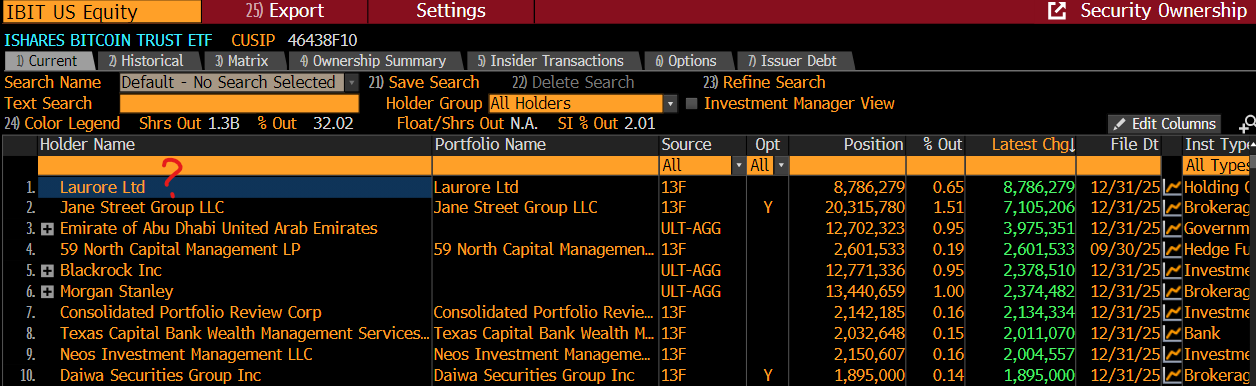
    New 13F disclosures and a Bloomberg overview of the ownership structure of BlackRock’s spot Bitcoin ETF IBIT show who reported the largest purchases in the fourth quarter of 2025. What is striking is, on the one hand, the density of US banks and institutions, and on the other hand, a name that no one knows: Laurore Ltd.

    The mysterious top buyer of BlackRock’s Bitcoin ETF

    Laurore Ltd appears in first place among acquisitions as the new major holder. Jeff Park (ProCap CIO and Bitwise Advisor) wrote in addition:

    “Something caught my eye in the latest 13F filings. The biggest new entrant into IBIT is something called Laurore Ltd. No website, no press, no trace.”

    Park points out in his post that “Zhang Hui” appears as the submitter and that the entity is Hong Kong-based. He also argues that the name “Zhang Hui” was deliberately chosen to be generic and that the “Ltd” structure could indicate an offshore company that provides a Chinese entity with access to US markets and thus enables Bitcoin exposure via a regulated ETF rather than crypto exchanges.

    Park’s conclusion is:

    “Why would you do that? Because Chinese investors are not allowed to hold Bitcoins. This could be an early sign that Chinese institutional capital is flowing into Bitcoin, […] about a BlackRock ETF that is registered with the SEC in a regulated jurisdiction and is hiding in a place that seems as transparent and opaque as one can imagine.”

    Bloomberg ETF analyst James Seyffart underscored how difficult it is to classify: “I tried to figure it out for almost an hour this morning… I found absolutely nothing.”

    Jane Street buys Bitcoin, but…

    Second on the list is investment giant Jane Street. However, Nik Bhatia (founder of The Bitcoin Layer) provided the reason why the Bitcoin community should not be too euphoric via X:

    “Jane Street holds IBIT so she can write options, do arbitrage, and do everything a quantitative trading shop does to make money quickly. Markets run in two directions – and pros make money on the way up as well as the way down.”

    Michael Green (Chief Strategist and Portfolio Manager at Simplify Asset Management) warned in a similar vein, before too bullish interpretation of the IBIT stock:

    “Jane Street may have a position in IBIT, but that position is most likely almost entirely offset by undisclosed options (on IBIT) and futures positions. They are certainly not ‘accumulating’ a Bitcoin position – that’s how market making works.”

    Outside the table, two reports from the Abu Dhabi area are particularly noticeable. The Q4-13F data reports report Mubadala as having 12,702,323 IBIT shares as of December 31, 2025, valued at approximately $630.6 million, an increase of approximately 46% from previously reported levels.

    Al Warda Investments reported 8,218,712 IBIT shares at the end of the year, up from 7,963,393 shares valued at $517.6 million as of September 30 – a slight increase. In total, both addresses in the data have an IBIT exposure of well over $1 billion as of the reporting date.

    The Top 10 in Q4 2025

    Behind Laurore Ltd. and Jane Street, the Bloomberg data show Emirates of Abu Dhabi United Arab Emirates in third place with 12,702,323 shares (≈ 630.6 million US dollars). Behind them is 59 North Capital Management LP with 2,601,533 shares (≈ 129.2 million US dollars) and Blackrock Inc with 12,771,336 shares (≈ 634.0 million US dollars).

    BlackRock Bitcoin ETF Q4 2025 Top Buyers
    Top buyers of the BlackRock Bitcoin ETF in Q4 2025, source: @dgt10011 on X

    The other major Q4 buyers include Morgan Stanley with 13,440,659 shares (≈ 667.3 million US dollars), Consolidated Portfolio Review Corp with 2,142,185 shares (≈ 106.3 million US dollars), Texas Capital Bank Wealth Management Services with 2,032,648 shares (≈ 100.9 million US dollars), Neos Investment Management LLC with 2,150,607 shares (≈ 106.8 million US dollars) and Daiwa Securities Group Inc with 1,895,000 shares (≈ 94.1 million US dollars).

  • RWA world premiere: First stock corporation pays dividends in tokenized gold

    RWA world premiere: First stock corporation pays dividends in tokenized gold


    • In a statement that caught the attention of the traditional commodity sector and the crypto industry, Tether announced that its gold token XAU₮ will be used to pay dividends to shareholders for the first time.
    • The Elemental Royalty Corporation, which holds rights to the income of mining companies worldwide, is the first public company in the world to no longer pay its dividends exclusively in fiat money.

    Die Decision of the Denver, CO-based company marks a turning point in connecting traditional commodity business and digital asset infrastructure.

    Although gold has been a secure store of value for thousands of years, the actual, physical transfer of ownership has always been associated with high logistical hurdles. This has changed with the Tether token XAU₮: The token represents one troy ounce of gold, which is physically deposited in the form of a London Good Delivery bar.

    Elemental Royalty shareholders can therefore receive their dividend directly in digital gold, which can be redeemed at any time, transferred globally and divisible.

    New dividend policy

    In parallel to the Tether announcement, Elemental Royalty released its own statement in which the company explains its new dividend policy. The annual distribution is $0.12 per share and is paid quarterly.

    Shareholders can choose whether they would like to receive the dividend in FIAT money as before or in the form of XAU₮ tokens. The company emphasizes that this option not only demonstrates innovation, but also creates a new form of value retention.

    With a strong balance sheet, over $50 million in cash and cash equivalents and no long-term debt, Elemental Royalty believes it is well positioned to maintain this modern form of distribution over time.

    Tokenized gold connects two worlds

    The world’s first introduction of dividend payments in tokenized gold shows how real-world assets are increasingly integrated into digital infrastructures.

    While cryptocurrencies are still perceived by many as a speculative asset class, tokenized gold offers a combination of traditional value stability and modern tradability.

    Tether has been offering the XAU₮ token for years as a digital counterpart to physical gold that can be transferred around the clock.

    Tether Token XAUT
    Image created with ChatGPT-AI (DALL-E)

    The decision by a listed company to pay dividends in this form brings the concept to global attention for the first time.

    Importance for the crypto and commodity sector

    The cooperation between Tether and Elemental Royalty could serve as a blueprint for other companies. The crypto industry has proven that tokenized assets outside of the real estate sector are not impractical, but can find real applications in everyday business life.

    This opens up an opportunity for the precious metals industry to appeal to new groups of investors who prefer physical gold but expect digital flexibility.

    Elemental Royalty Corporation’s move may have triggered an expansion of the role of RWA tokenization in the global financial system.

  • VeChain rolls out VeBetterDAO update: More control, tougher hurdles

    VeChain rolls out VeBetterDAO update: More control, tougher hurdles


    • VeChain will soon implement a governance change in the VeBetterDAO so that node and dApp endorsers can distribute their points much more flexibly in the future.
    • The core of the change is a 49-point cap per endorser and dApp.

    VeChain plans to soon implement a governance change in the VeBetterDAO ecosystem that will give node and dApp endorsers significantly finer control over their endorsement points.

    Specifically, it is about the implementation of the community proposal “Unlocking Endorsement Capital to Foster Growth and Protecting the VeBetterDAO ecosystem”, the implementation of which VeChain on X announced as immediate on Tuesday. The VeChain Foundation wrote via X:

    “Coming soon – stay tuned for updates and get ready to distribute your referral points more differentiated in the future!”

    VeChain’s VeBetterDAO governance becomes more decentralized

    The proposal was originally published on July 18, 2025; The text was later expanded or made more precise. It does not have a classic “VIP” number (VeChain Improvement Proposal) in this form – in the community it is referenced via the title. In VeBetterDAO itself, governance changes are generally carried out via the on-chain governance system (B3TRGovernor/TimeLock).

    At its core, the proposal addresses two problems in the previous endorsement design: First, endorsement capital was unnecessarily tied up in an “all-or-nothing” scheme. Second, a single large node can effectively single-handedly carry a dApp endorsement, a centralization risk that contradicts the DAO idea.

    The VeChain Foundation quoted a post from VeBetter Dao community member BreakingBallz:

    “The proposal will be implemented very soon. We should all be excited. This was a collaborative effort voted on by both the general community and dApp endorsers.”

    The proposal targets two weak points of the previous endorsement design: tied endorsement capital and too much power of individual large nodes. In the Discourse it says:

    “While the current VeBetterDAO endorsement model is functional, it imposes noticeable limitations: it locks up valuable endorsement capital and lowers security for node holders. The ‘all-or-nothing’ system forces endorsers to allocate their entire score to a single dApp.”

    This results in the core change: In the future, endorsers should be able to distribute their points across several dApps instead of relying on the entire stack on one application. VeChain describes exactly this goal: Endorsement points will soon be allocated “with more nuanced control.”

    The central security mechanism is a cap of 49 points per endorser and dApp. BreakingBallz writes:

    “There is now a 49-point cap per endorser and per dApp. This means that at least three endorsers will be required to bring a dApp into the DAO.”

    After implementation, the community expects a noticeable re-sorting in the short term: BreakingBallz writes that with the 49-point cap, “over 20 dApps” will enter a two-week grace period.

    This grace period is intended as a buffer in the endorsement system: If an app’s score falls below the 100-point threshold, it remains active for two weeks, but must collect enough endorsements again within this time, otherwise it will be marked as inactive for allocation rounds.

    BreakingBallz therefore combines the new freedom with a clear expectation of endorsers:

    “You now have more freedom to spread your points – but with that comes responsibility. Look beyond the ‘highest kickback’. Higher rewards often mask a lack of community value.”

  • Vitalik Buterin warns of prediction markets mutating into casinos

    Vitalik Buterin warns of prediction markets mutating into casinos


    • Ethereum inventor Vitalik Buterin warns in a blog post that many of the currently popular prediction markets have lost the social benefits they once had.
    • Instead of gaining information and preventing real economic risks, it would be about highly speculative bets businessmodel, that to a steady influx of inexperienced players instructed be.

    Vitalik Buterin describes the current “business model” of the prediction market as follows: On the one hand, there are well-informed traders who systematically make profits. On the other side are the notorious money losers, whose losses finance the entire system.

    Things become problematic at the latest when such prediction markets act as digital backroom casinos and build communities that reinforce false opinions in order to attract more naive players. This creates a cycle that is not sustainable. As soon as speculative interest wanes – for example in a bear market – liquidity dries up and the markets threaten to collapse. Buterin warns that this reliance on gambling-motivated customers threatens the long-term viability of the industry.

    Hedging instead of gambling

    In order to make prediction markets future-proof, Buterin calls for a return to their actual purpose: risk hedging. He sees great potential in establishing prediction markets as instruments that can be used to hedge against real risks, such as political decisions, supply chain disruptions or economic developments.

    He also suggests using AI models that analyze individual expenses and create personalized risk portfolios. These could help customers hedge against price fluctuations or inflation – an approach that would take prediction markets out of the gambling corner.

    Get out of the game of luck
    Buld created with ChatGPT-AI (DALL-E).

    Price indices as an alternative to stablecoins?

    Buterin’s idea of ​​using prediction markets as a basis for new, productivity-based price indices is particularly far-reaching. In the long term, these could even replace stablecoins by reflecting real shopping baskets such as housing, transport and food.

    Such a system would be less susceptible to speculative risks and could create a more stable, transparent form of digital store of value. Buterin sees this as a way to make prediction markets a central building block of a decentralized financial infrastructure that offers real economic benefits.