Category: Coins

Digital assets, cryptocurrencies, blockchain, and currency news.

  • The Next Trillion-Dollar Currency May Not Be a Stablecoin—It May Not Even Have a Name Yet

    The Next Trillion-Dollar Currency May Not Be a Stablecoin—It May Not Even Have a Name Yet

    AI agents may soon use a dedicated cryptocurrency or stablecoin to conduct autonomous financial transactions, according to executives from OKX Europe and Binance.

    “There will be an AI currency coming,” said Erald Ghoos, CEO of OKX Europe, in a video interview. “This is not going to be fiat, for sure. It will be a stablecoin or some other crypto token, whatever this is going to be, that is going to be by far, by far the largest currency that this world has ever seen.”

    Ghoos predicted the emergence of one “super currency” designed specifically for AI agents. “It could be a stablecoin, or it could be something else. Let’s see what works.”

    Why AI agents may need crypto wallets

    Siu agreed that AI agents will need crypto-based money rather than conventional bank accounts, potentially in the form of stablecoins. He said traditional banking is currently unsuitable because AI agents cannot open bank accounts and conventional payment systems require human identity verification.

    “To make an agent truly autonomous, you need a way for them to use and own money,” he said. “A crypto wallet would seem the most obvious way. It’s going to be a long while before any bank opens a bank account for an AI agent. Crypto basically solves all of that. Crypto is the perfect machine banking system.”

    Could AI agents use multiple tokens?

    The executives differed on whether AI agents will eventually rely on one dominant currency. Siu does not necessarily expect a single settlement currency to take over. Instead, he said AI agents could transact across thousands of tokens without requiring their human owners to understand each one.

    “The agent knows what to do,” he said. “The human never has to focus his attention on a thousand tokens.”

  • Veteran Trader Predicts XRP Could Be Forming a Major Price Bottom

    Veteran Trader Predicts XRP Could Be Forming a Major Price Bottom

    $XRP price is testing a critical support zone near $1.40 after giving back roughly half of its recent gains. The token rose 71.8% from $0.988 to $1.698 before entering a 20% correction. Veteran analyst Matthew Dixon believes the decline may have created a potential major bottom, but says confirmation is still needed.

    $XRP Chart Signals a Possible Major Bottom

    Crypto analyst and veteran financial trader Matthew Dixon said the $XRP chart has become more constructive, although he does not yet view the move as a confirmed new bull trend.

    Dixon said,

    “$XRP, the chart has become substantially more constructive, but I would call it a potential major bottom rather than a confirmed new bull trend.”

    Dixon believes the decline from approximately $3.65 may have completed an A-B-C correction. He also highlighted $XRP’s move into the $1.00 support zone and its strong weekly rebound as signs that selling pressure may be easing.

    For the bullish setup to strengthen, $XRP must hold above the $1.20-$1.30 range before breaking above $1.70. A move past $2.00 would provide stronger evidence that the broader uptrend has resumed.

    However, Dixon warned that the recent recovery may only be an oversold bounce. If $XRP fails to clear the $1.55-$1.70 resistance area and turns lower, the token could retest $0.94.

    3.2 Billion $XRP Establish Key Support at $1.35

    On-chain data from crypto analyst Ali Martinez also supports the outlook for a strong demand zone. Martinez noted that approximately 3.2 billion $XRP were traded between $1.35 and $1.38, making this range an important support area.

    As long as the support holds, $XRP could next encounter resistance at $1.60, where roughly 1.99 billion $XRP were traded.

    The next resistance levels are $1.68, supported by trading volume of 1.98 billion $XRP, and $1.86, where approximately 3.47 billion $XRP changed hands.

    A break above $1.86 could clear the way toward $2.19, a level where another 3.12 billion $XRP were previously traded.

    $XRP Faces Downside Risk Below $0.94

    If buyers fail to defend the current support zone, $XRP could face additional selling pressure. Dixon also warned that a weekly close below $0.94 could weaken the bullish setup and push the price toward $0.75, followed by the $0.55-$0.60 range.

    For now, $XRP is trading between support at $1.35-$1.38 and resistance at $1.70-$1.86. A decisive break above or below these levels could determine the token’s next major move.

  • Bitcoin Faces Major Change Tomorrow in Big Day for Crypto Markets

    Bitcoin Faces Major Change Tomorrow in Big Day for Crypto Markets

    Bitcoin Knots Developer Targets August 30 for Proposed BLAKE2b Mining Transition

    Luke Dashjr, a Bitcoin developer and leading figure in the Bitcoin Knots project, has identified Sunday, August 30th, as the target date for a major Proof of Work (PoW) change that could alter Bitcoin’s mining algorithm.

    Dashjr said miners using SHA-2 should stop mining on Saturday to prepare for a mainnet rehearsal of Bitcoin Knots version 29.4.1rc4.

    According to Dashjr’s post, Bitcoin Knots version 29.4.1rc4 will be configured to produce the final SHA-2 block before the proposed transition. After the online version of the New York Post’s Sunday morning print edition is published, the “canonical blake2b_headline” parameter will be shared for use at the beginning of the new BLAKE2b-based chain.

    If the process proceeds smoothly, Dashjr said the final version of Bitcoin Knots 29.4.1 will be released as planned on September 1st. The blockchain history created on August 30th would also be preserved.

    However, the developer said that an unexpected problem could allow the system to revert to the last SHA-2 block, followed by another attempt using version rc5.

    Dashjr also recommended that miners who want to begin mining from the first day after the proposed change prepare in advance on testnet4 using Bitcoin Knots rc3.

    What Would Change in Bitcoin Mining?

    Bitcoin’s current Proof of Work system uses the SHA-256 hashing algorithm, which belongs to the SHA-2 family. Miners perform SHA-256 calculations to create new Bitcoin blocks.

    The change described by Dashjr would introduce BLAKE2b for Proof of Work calculations. Like SHA-256, BLAKE2b is a cryptographic function that converts data into fixed-length hash values. The two algorithms have different computational structures, however, meaning that most existing Bitcoin ASIC mining devices cannot directly mine BLAKE2b.

    If implemented, the proposed change could therefore involve more than a software update. It could also have significant consequences for the hardware supporting a substantial share of Bitcoin’s mining infrastructure.

    The “last SHA-2 block” referenced by Dashjr would be the final block created under Bitcoin’s current SHA-256-based Proof of Work rules. After that block, nodes running the new rules could begin following blocks produced with BLAKE2b.

    However, if other Bitcoin network participants do not accept the same change, the blockchain could split into two chains operating under different rules. Dashjr’s announcement should therefore not be viewed as a definitive protocol change accepted by the entire Bitcoin network. It specifically describes a planned process for Bitcoin Knots software and users who choose to adopt the proposed rules.

    This is not investment advice.

  • Bitcoin Miners Evolve Beyond Crypto Proxies Into High-Performance Computing Hubs

    Bitcoin Miners Evolve Beyond Crypto Proxies Into High-Performance Computing Hubs

    Bitcoin surged 21.5% between the Aug. 17 and Aug. 21 closes, but six of the seven major U.S.-listed Bitcoin miners ended the same trading period lower. MARA Holdings gained 16.1%, making it the closest performer to BTC, while Cipher Digital fell 14.8%, TeraWulf declined 11.2%, Hut 8 dropped 8.1% and IREN lost 6.8%.

    The divergence shows that stocks still widely treated as Bitcoin proxies are increasingly responding to factors beyond the cryptocurrency itself.

    Bitcoin miners diverge as AI businesses expand

    The Nasdaq-100 ETF QQQ fell 2.3% during the same sessions as long-term Treasury yields remained volatile, placing the miners within a weaker technology-equity environment. Their changing corporate structures help explain the split. Several former mining specialists now derive revenue, financing needs or future valuations from long-duration debt, artificial intelligence infrastructure and Bitcoin sales that help finance those projects.

    Construction schedules, equipment procurement and customer concentration have therefore become important parts of valuations that once depended primarily on mining economics and hash prices.

    Company filings show that the major public miners are at different stages of their transition toward artificial intelligence and high-performance computing.

    TeraWulf generated $31.9 million of its $44.8 million in second-quarter revenue from high-performance-computing leases, compared with approximately $12.8 million from digital assets. Hut 8 said its Beacon Point leases cover 949 megawatts of contracted IT capacity and represent $26.6 billion in base-term contract value, subject to future delivery and tenant performance.

    IREN reported $70.5 million in AI cloud revenue and $66.7 million in Bitcoin mining revenue for its June quarter, placing AI above mining in its current revenue mix. In an Aug. 27 release, the company reported operating annual recurring revenue of $1 billion as of Aug. 26 and contracted annual recurring revenue of $4 billion tied to 2026 capacity. That capacity is targeted to become operational by Dec. 31, subject to commissioning, testing and customer acceptance.

    IREN’s quarter also included a $450.4 million impairment, largely related to decommissioned mining hardware as its sites are converted for AI operations.

    Cipher continued to report second-quarter revenue from Bitcoin mining, but it has contracted 700 megawatts of high-performance-computing capacity across three sites and began delivering its first capacity at Black Pearl in August.

    Riot Platforms occupies a more balanced position. The company reported $113.7 million in mining revenue, $23.2 million from data centers and $37.3 million from engineering during a $174.2 million quarter. Its 241 megawatts of contracted AI capacity carry approximately $9.8 billion in company-estimated long-term revenue, giving investors a contract book to value alongside the 11,380 Bitcoin Riot held as of June 30.

    CleanSpark might have served as a mining-only control earlier in the year, but that classification changed before the August breakout. The company signed a 20-year, $6.6 billion agreement. MARA now offers the closest large mining-led comparison, although it is also exploring adjacent energy and computing businesses.

    Bitcoin beta and technology-market exposure

    CryptoSlate analyzed Alpaca/IEX historical equity closes for HUT, WULF, IREN, CIFR, RIOT, MARA, CLSK and QQQ, along with Alpaca’s BTC/USD closes, from Aug. 22, 2024 through Aug. 24, 2026.

    Daily stock returns used exchange trading days. Each Bitcoin return covered the interval between consecutive stock-market dates, meaning Monday observations included the weekend. Ten-year Treasury yields came from the Federal Reserve’s DGS10 series.

    Close-to-close returns from Aug. 17 through Aug. 21 captured the initial separation by comparing Bitcoin’s rally with QQQ as a broad technology-equity reference for the same sessions.

    The longer analysis used rolling 90-trading-day correlations and univariate Bitcoin betas. One comparison ended Aug. 22, 2025, while the current comparison ended Aug. 24, 2026.

    A Bitcoin beta of 1.10 means that a 1% daily move in Bitcoin was associated with an average 1.10% move in the miners during that period. Correlation measures how consistently the stocks’ directions and magnitudes moved alongside Bitcoin.

    Bitcoin beta declined from the comparable 2025 period for six companies, while IREN remained near 0.93. Bitcoin correlation fell for six companies and increased for WULF, rising from an already low 0.17 to 0.22.

    In the current period, QQQ correlation exceeded Bitcoin correlation for all seven companies. Their daily returns therefore tracked the Nasdaq proxy more consistently than the cryptocurrency they mine.

    MARA retained the group’s highest Bitcoin correlation and beta, consistent with its greater dependence on mining economics. HUT, WULF and CIFR ranked in the bottom half for current Bitcoin correlation as their data-center contracts gained more importance in investor estimates.

    IREN complicates that pattern. Its Bitcoin beta remained steady even as its QQQ correlation reached 0.60, allowing its operating mining business and substantial AI pipeline to influence the same return series.

    CryptoSlate also conducted a 2026 year-to-date regression using daily Bitcoin returns, QQQ returns and daily changes in the 10-year Treasury yield. The three-factor model explained approximately 28% to 45% of daily variation across the seven miners. The estimated effect of a 10-basis-point increase in Treasury yields ranged from a 0.52% decline for WULF to a 0.79% gain for CIFR.

    Four rate coefficients were negative and three were positive, providing no evidence of a common duration trade across the group. The mixed results also make a simple bond-market analogy difficult. Higher yields can reduce the present value of cash flows expected years in the future and increase project financing costs, but daily equity returns also reflect tenant announcements, construction progress, Bitcoin holdings, power prices and capital raises.

    Contracts explain why the companies carry different exposures, while the data show no consistent interest-rate trade across the sector.

    AI contracts create a second risk map

    TeraWulf provides the clearest example of a company whose income statement has already moved into a new category. High-performance-computing leases supplied approximately 71% of its second-quarter revenue, and its filings describe the repurposing or curtailment of mining equipment as computing capacity expands.

    A Bitcoin rally can support TeraWulf’s remaining mining operations, but the equity valuation now also depends on tenant payments, construction execution and the financing associated with its computing campus.

    Cipher shows how a company’s stock-market identity can change before its reported revenue mix does. Its June quarter still reflected Bitcoin mining, but investors can also model its contracted computing capacity and the company-estimated $793 million in average annual net operating income associated with its base lease terms.

    The gap between current revenue and promised capacity makes delivery schedules, capital costs and counterparty quality central factors for the share price.

    Riot and IREN display both types of exposure more clearly, although their current revenue mixes have diverged. Mining accounts for most of Riot’s current revenue, while AI cloud revenue slightly exceeded Bitcoin mining revenue in IREN’s June quarter.

    Their mining operations remain sensitive to digital-asset prices, while signed AI agreements add projected cash flows from another business line. Each quarterly filing can change the relative importance of Bitcoin production and data-center delivery, making beta a function of business mix rather than a permanent characteristic of the company.

    Contract announcements also contain significant uncertainty. Base-term value represents payments expected over many years, while revenue and net operating income estimates depend on timely delivery. Project-level debt may protect a parent company’s balance sheet, but only within the limits of the relevant structure.

    A multiyear contract value can help identify a company’s strategic direction, but it cannot replace a discounted cash-flow model or completed operating capacity.

    Mining stocks now combine crypto, AI and infrastructure risk

    The Aug. 17 breakout captured a genuine separation, and the longer sample confirms a broader reclassification of the sector. MARA rose alongside Bitcoin, every company retained a positive current Bitcoin beta, and mining cash flow continues to fund or support several AI buildouts.

    Bitcoin is now one factor among several. Its influence is lowest where contracted computing capacity has become the central part of the equity story.

    “Bitcoin miners” now describe these companies’ origin more reliably than their destination. Investors who buy the group through a mining-focused basket may receive varying exposure to Bitcoin production, hyperscaler credit, construction schedules, power-delivery risk, project finance and technology-equity multiples.

    The contracts help explain why the stocks separated, while their remaining Bitcoin betas show that their original identity still travels with them.


  • Interpol Arrests 58 in Crackdown on Cryptocurrency Investment Scams

    Interpol Arrests 58 in Crackdown on Cryptocurrency Investment Scams

    INTERPOL has reported 58 arrests, 263 identified suspects and $2.67 million in seized assets following a 22-country operation targeting cryptocurrency investment scams, romance fraud and money laundering networks.

    According to an official INTERPOL release published on Aug. 25, Operation Jackal IV ran for eight months, from November 2025 through June 2026. The operation focused on financial systems used by organized crime groups in West Africa.

    Authorities from 22 countries across six continents participated, including the United States, the United Kingdom, Canada, the United Arab Emirates, South Africa, Argentina, Nigeria, Romania and several European countries.

    Investigators targeted groups such as Black Axe and similar criminal organizations accused of operating romance scams, fake cryptocurrency investment schemes, business email fraud and other financial crimes. Police also traced the shell companies, bank accounts, digital wallets and external service providers allegedly used to receive or conceal stolen funds.

    INTERPOL supported the operation by helping agencies exchange intelligence across borders, analyze financial activity and coordinate enforcement actions. It also provided specialist training for investigators handling money laundering cases.

    “By following illicit financial flows across borders, we are attacking the very lifeblood of organized crime and making it increasingly difficult for criminal networks to profit from their activities,” said Tomonobu Kaya, director of the INTERPOL Financial Crime and Anti-Corruption Centre.

    Operation Jackal IV leads to 58 arrests

    Operation Jackal IV resulted in 58 arrests and identified another 263 people suspected of links to the targeted criminal networks, INTERPOL said.

    In Argentina, federal police uncovered a Crime-as-a-Service network suspected of providing website domains and money laundering support to West African crime groups. Investigators identified 196 people connected to the operation and arrested 17 suspects.

    An INTERPOL Operational Support Team assisted Argentine authorities in examining seized information. The team analyzed the material for connections among suspects, criminal groups and overseas partners while helping local investigators develop further leads.

    South African authorities carried out the operation’s largest reported enforcement action, arresting 39 people during raids at seven locations in Johannesburg. Police linked the sites to a group accused of running romance and investment scams targeting retirees in English-speaking countries.

    According to INTERPOL, members of the network handled different stages of the fraud. Some worked as “conversion” agents, while others served as “retention” agents. These roles involved turning initial contacts into paying victims and persuading existing victims to continue sending money.

    Police seized $2.67 million, blocked 257 bank accounts and collected evidence during the Johannesburg raids. An INTERPOL support team also assisted South African investigators in examining the network’s financial and international links.

    INTERPOL’s release lists 17 arrests in Argentina and 39 in South Africa, accounting for 56 of the 58 arrests stated in its headline total. However, the same release separately reports 11 arrests in Romania, bringing the country-level figures mentioned in the statement to 67. INTERPOL did not explain whether the Romanian arrests were included in the headline figure or represented the result of a connected investigation.

    Romanian crypto investment scam allegedly moved €143 million

    Romanian police dismantled a call center accused of promising investors large returns from stocks and cryptocurrencies. INTERPOL said suspects redirected victims’ deposits to electronic wallets they controlled instead of placing the funds in legitimate investments.

    Investigators estimated that the group stole and laundered approximately €143 million worldwide. Police arrested 11 people and seized about €330,000 in cash and cryptocurrency, six properties and several luxury watches.

    In Italy, investigators identified one person suspected of involvement in a money laundering network operating across Europe. According to INTERPOL, the network used shell companies, remittance services and cash withdrawals to conceal the origin of funds.

    The agency said a single bank account processed €845,000 through 560 transactions involving 20 financial instruments. Investigators did not report an arrest in the Italian case, which remained focused on identifying one suspect.

    Operation Jackal IV also found that some West African crime groups were purchasing Crime-as-a-Service tools from external providers, often through dark web markets. INTERPOL said these arrangements allowed fraud groups to outsource website infrastructure, money laundering and other technical services rather than managing every part of their operations themselves.

    In July, crypto.news reported on another INTERPOL operation that resulted in 5,811 arrests and the interception of $293 million in illicit assets across 97 countries and territories. Operation First Light also identified more than 142,000 victims and blocked over 31,000 bank accounts while targeting romance scams, investment fraud and related money laundering.

    Thai police uncovered a cryptocurrency laundering network during that earlier operation. INTERPOL said one wallet processed more than $122.5 million over 10 months. Investigators alleged that the network moved proceeds from romance scams through several digital assets and used cross-chain swaps to make the funds more difficult to trace.

    U.S. authorities pursue overseas crypto scam proceeds

    The United States was among the 22 countries participating in Operation Jackal IV, although INTERPOL’s release did not describe a specific U.S. arrest or asset seizure connected to the operation.

    American authorities have separately pursued overseas networks accused of targeting U.S. residents with similar romance and cryptocurrency investment schemes. In July, the Department of Justice sought the forfeiture of $25 million in cryptocurrency recovered through five investigations involving suspected victims in the United States and Canada.

    According to the U.S. Attorney’s Office for the District of Columbia, the five cases involved fake cryptocurrency platforms and laundering networks linked to China, Malaysia and Cambodia. Prosecutors said the DOJ’s Scam Center Strike Force had seized more than $800 million since its creation in November 2025.

    One investigation involved more than 270 suspected victim transfers and approximately $10.4 million in cryptocurrency. Another covered over 200 romance scam victims and $12.1 million in assets. Under the civil forfeiture process, eligible victims may seek compensation if courts approve the government’s claims to the recovered funds.

    During a separate enforcement action in June, Coinbase froze over $3 million in cryptocurrency tied to alleged Southeast Asian scam networks. The exchange worked with the DOJ, Meta, Microsoft, Starlink and overseas law enforcement agencies to identify financial transfers and online infrastructure linked to romance and investment fraud.

    Meta disabled more than 1.4 million accounts, pages and groups connected to suspected scams, while Microsoft suspended about 20,000 accounts. Starlink terminated service for thousands of internet kits associated with suspected unlawful activity, and the Royal Thai Police arrested 63 people linked to scam operations.

  • NFL Returns to DraftKings and FanDuel While Still Shunning Prediction Markets

    NFL Returns to DraftKings and FanDuel While Still Shunning Prediction Markets

    The NFL has renewed its commercial betting partnerships with DraftKings, FanDuel and Fanatics Betting and Gaming, while keeping prediction-market products outside the scope of the new agreements.

    Announced Aug. 27, the multi-year deals restore a sponsorship category that had been vacant since the previous agreements expired at the end of March. The three companies receive rights to NFL trademarks, visibility at the Super Bowl and NFL Draft, and access to real-time play-by-play data, Next Gen Stats and BetVision through Genius Sports. Financial terms were not disclosed.

    NFL betting partnerships focus on game integrity

    All three operators agreed to follow the NFL’s core game-integrity policies. They will also work with the league “to prohibit wagers the league finds objectionable, including bets tied to officiating and injuries, along with those that can be known in advance or easily manipulated by a single person.”

    Renie Anderson, the NFL’s executive vice president and chief revenue officer, said the companies “share our vision for innovation and fan engagement, but most importantly, our commitment to protecting the integrity of the game.”

    The restrictions closely resemble the Commodity Futures Trading Commission’s proposed rules for prediction markets. In a June 10 notice of proposed rulemaking, the CFTC said standard sports contracts, including game-winner markets, championship futures and most currently traded products, could serve the public interest.

    Under the proposal, contracts involving player injuries, officiating outcomes, specific in-game actions such as a named player’s pitch or shot, physical altercations and pre-collegiate sports would be prohibited.

    NFL has no immediate prediction-market plans

    Asked about prediction markets, Anderson told ESPN: “That’s not a space that we’re considering right now commercially.” DraftKings, FanDuel and Fanatics all operate prediction-market products, but the data and intellectual-property rights included in the new NFL agreements do not cover those offerings, Front Office Sports reported.

    The NFL has held discussions for months with Kalshi, Polymarket and the CFTC, but no agreement has been reached. Sources told the outlet that no prediction-market deals will be in place when the NFL season begins Sept. 9.

    “I don’t see a scenario where the NFL is ready by the start of the season,” one prediction-market industry source said. “I would be incredibly shocked if anything at all happens this season.”

    A source familiar with the NFL’s position told Front Office Sports that the league has been urging the CFTC to adopt rules reflecting the integrity and consumer-protection standards used in legalized sports betting. The source said the NFL is particularly concerned about injury-related markets, which it considers “easily manipulable and offensive” to players.

    In July, the NFL told the CFTC that the agency’s proposal fell significantly short on integrity, consumer protection and manipulation safeguards. Anderson also told ESPN that “in order to advertise in our game, you also have to have official data, because you have to agree to our integrity requirements.”

    Player availability markets draw scrutiny

    Kalshi does not list a market explicitly tied to an injury, but it offers contracts on whether individual players will compete. One example involves whether Patrick Mahomes, who tore an anterior cruciate ligament in December, will play in Week 1.

    Polymarket US self-certified a nearly identical product on Aug. 25 and withdrew it the next day. Both exchanges hold seats on the CFTC’s Innovation Advisory Committee, along with DraftKings chief executive Jason Robins.

    Previous NFL betting deals expired in March

    The NFL’s previous five-year agreements with FanDuel, DraftKings and Caesars were worth nearly $1 billion combined. They expired March 31 after negotiations with the two largest partners stalled over a proposed price increase for official streaming data distributed through Genius Sports.

    Genius remains the NFL’s exclusive data-distribution partner under the new agreements and continues to provide the real-time betting-pattern monitoring used in the league’s integrity program.

    Other major sports leagues have taken a different approach to prediction markets. The NHL partnered with Kalshi and Polymarket last October, while MLB reached an agreement with Polymarket in March, followed by individual clubs.

    Individual NFL teams have also asked about their own arrangements. However, a source at a prediction-market company told Front Office Sports that “everybody wants a partner in this space,” while noting that team-level deals would not currently be permitted.

  • Why Is Ripple Hiring a London Metal Exchange Treasury Executive Now?

    Why Is Ripple Hiring a London Metal Exchange Treasury Executive Now?

    Ripple has hired a senior London Metal Exchange (LME) treasury executive as the company expands its focus on institutional trading, tokenization and corporate finance.

    Joseph Thompson, senior vice president and head of treasury at the LME, is leaving the exchange on Aug. 31 to join Ripple’s Trading and Markets team. According to the original hire report, his responsibilities are expected to include work related to tokenized real-world assets.

    The appointment adds experience from one of the world’s largest commodities exchanges to a company increasingly focused on liquidity, collateral and blockchain-based capital markets.

    Ripple Expands Institutional Finance Strategy

    Thompson’s appointment follows Ripple’s broader push into corporate treasury services and institutional financial infrastructure.

    Ripple acquired GTreasury for $1 billion in 2025, adding an established treasury management platform to its business. The platform has since been integrated into Ripple Treasury, which combines traditional cash management with digital-asset capabilities.

    Ripple has also launched native digital-asset functionality across its Treasury platform. Coinpaper’s coverage of Ripple’s SWIFT tools showed how the company is increasingly positioning its products alongside existing financial infrastructure rather than targeting only crypto-native users.

    Tokenization Becomes a Larger Focus

    Ripple has also increased its exposure to tokenized assets. Recent investments in ZILO and Licuido were aimed at strengthening issuance, transfer agency and collateral infrastructure for institutional markets.

    The $XRP Ledger is gaining more tokenized products as well. Aviva Investors recently launched a tokenized liquidity fund on XRPL, expanding the network’s real-world asset footprint.

    Ripple and Boston Consulting Group have estimated that tokenized assets could approach $19 trillion by 2033, although adoption will depend heavily on regulation and institutional demand.

    Thompson’s appointment does not mean that the LME itself is adopting Ripple technology. Instead, it highlights Ripple’s effort to recruit expertise from traditional market infrastructure as the company seeks to expand beyond payments and further into institutional finance.

    For background on the relationship between Ripple, $XRP and the $XRP Ledger, Coinpaper’s evergreen $XRP guide provides a concise overview.

  • Sberbank to Accept Bitcoin, Ethereum and USDT as Loan Collateral Under New Russian Crypto Rules

    Sberbank to Accept Bitcoin, Ethereum and USDT as Loan Collateral Under New Russian Crypto Rules

    Sberbank, Russia’s largest financial institution, is preparing to launch a lending product that would accept Bitcoin ($BTC), Ethereum ($ETH), and Tether ($USDT) as eligible collateral. The initiative follows new Central Bank of Russia regulations scheduled to take effect on September 1, according to Crypto Briefing.

    New Rules Open the Door to Crypto-Backed Lending

    The regulatory framework represents a significant shift in Russia’s approach to digital assets. Until now, the use of cryptocurrencies in lending had been largely unaddressed or restricted. The new rules establish a legal basis for banks to accept digital currencies as collateral, creating a pathway for traditional financial institutions to integrate crypto assets into their services.

    Sberbank’s plans extend beyond crypto-backed loans. The bank also intends to launch a cryptocurrency wallet and a digital custody service before the end of the year. These services would allow customers to store and manage digital assets under the bank’s oversight, further connecting conventional finance with the crypto economy.

    Potential Impact on Russia’s Crypto Market

    Sberbank’s initiative could have a notable effect on Russia’s cryptocurrency market, which has experienced changing regulatory signals in recent years. Allowing the country’s largest bank to accept crypto as collateral may indicate a more pragmatic position from the central bank and could encourage wider adoption among institutional and retail investors.

    For Sberbank, the move provides an opportunity to serve customers who hold digital assets but may not have sufficient traditional collateral. It could also establish the bank as an early leader in Russia’s banking sector and create a precedent for other financial institutions.

    What Crypto-Backed Loans Could Mean for Investors

    For Russian investors and cryptocurrency holders, the proposed lending product could create new ways to access liquidity without selling digital assets. Using $BTC, $ETH, or $USDT as collateral would allow borrowers to maintain exposure to potential price appreciation while obtaining fiat currency for other purposes.

    However, crypto-backed borrowing also carries risks. If the value of the collateral falls significantly, borrowers could face liquidation.

    Frequently Asked Questions

    What cryptocurrencies will Sberbank accept as loan collateral?

    Sberbank plans to accept Bitcoin ($BTC), Ethereum ($ETH), and Tether ($USDT) as loan collateral.

    When will Russia’s new cryptocurrency regulations take effect?

    The Central Bank of Russia’s new regulations are scheduled to take effect on September 1.

    What other cryptocurrency services is Sberbank planning to launch?

    Sberbank also plans to launch a cryptocurrency wallet and a digital custody service within the year.

    Related Reading

    • Dormant Bitcoin Activity Hits Lowest Level Since Q3 2022, Galaxy Research Says
    • $BTC.top Founder Sells Half His $ETH Holdings as Bitcoin Rally Faces First Test
    • Ethereum Supply Rises by 20,125 $ETH in a Week, Breaking Post-Merge Trend
    • Bitcoin Perpetual Futures Long/Short Ratios Show Slight Bearish Tilt on Major Exchanges
    • Ethereum Weekly Forecast: Profit-Taking Caps Rally as Network Activity Stalls
  • Upbit Remains Korea’s No. 1 Crypto Exchange as Rally Revives Trading Volumes

    Upbit Remains Korea’s No. 1 Crypto Exchange as Rally Revives Trading Volumes

    Upbit continues to lead South Korea’s cryptocurrency exchange market, recording approximately $1.04 billion in spot trading volume over a 24-hour period as traders return to the crypto market. Its turnover exceeded the combined volume of its three closest domestic competitors.

    Upbit leads South Korea’s crypto exchange market

    Upbit, operated by Dunamu, processed about $1.04 billion in spot trades within 24 hours, surpassing the combined volume of Bithumb, Coinone and Korbit, now known as Digital X.

    Bithumb recorded approximately $632.6 million in volume, while Coinone reached about $67.9 million. Korbit, operating as Digital X, registered close to $11 million.

    The increase followed Bitcoin’s rise above $80,000 in late August, marking its first move past that level since mid-May. The rally encouraged South Korean retail traders to return to local crypto exchanges and put money back into domestic order books.

    Founded in October 2017, Upbit holds South Korea’s first virtual asset service provider license and lists more than 180 tokens. Bithumb, which launched in 2014, lists over 440 assets.

    Before the August 20 rally, Upbit’s daily turnover generally ranged between 300 billion and 600 billion won. By Saturday afternoon, however, volume had briefly climbed to 4.61 trillion won—nearly ten times the level recorded a week earlier. Bithumb also exceeded 2 trillion won during the same period.

    Cryptopolitan separately reported that Upbit’s daily volume rose 273% to approximately $1.84 billion, its busiest session since mid-March. XRP was the most actively traded token on both Upbit and Bithumb.

    South Korean crypto exchanges face weaker revenue

    Presto Research analyst Min Jung described Korean traders as “return-chasers” who buy assets that are already rising.

    During the first half of 2026, South Korea’s four largest crypto exchanges collectively lost nearly 500 billion won, or $364 million. Falling cryptocurrency prices reduced the value of assets held by the exchanges, while weak trading activity resulted in lower fee revenue.

    Trading fees are the exchanges’ main source of income. They accounted for 96.91% of Dunamu’s first-half revenue, which fell by half compared with the previous year.

    Dunamu’s operating profit dropped 79.7% year on year during the first half, while Bithumb’s operating profit declined even further, falling 83.4%.

    Cryptopolitan reported that first-half trading volume across South Korean exchanges fell 54.6% from the previous year to $366.58 billion. Part of the decline was attributed to capital flowing into South Korea’s stock market, which reached record highs amid strong performances from companies including Samsung and SK Hynix.

    Smaller exchanges cut fees to compete with Upbit

    As crypto trading activity returns, smaller exchanges are waiving fees to attract regular traders and support platforms facing financial pressure.

    Coinone said it would eliminate trading fees for all listed coins until further notice. Digital X, formerly Korbit, introduced zero-fee trading across its market through August 2027.

    After the change, Digital X’s average hourly trading volume increased 36-fold, rising from 270 million won to 9.8 billion won. However, 87% of the increase came from trading in a single stablecoin, RLUSD, which the exchange distributed to large traders during a special event.

    Coinone’s trading volume tripled to 8.2 billion won per hour after it removed fees, but activity soon returned to normal levels.

    Bithumb used a similar strategy with a 68-day fee-free period last year. Although its trading volume increased temporarily, the exchange’s market share did not exceed 30%. Bithumb repeated the strategy for seven days in February.

    Upbit and Bithumb have so far waived fees only on selected tokens. Upbit, for example, removed charges on stablecoins such as Tether (USDT-USD) starting July 26.

    Meanwhile, Digital X’s parent company, Mirae Asset Financial Group, is reportedly negotiating to acquire Korbit for up to 140 billion won, or $97.5 million.

  • Bitcoin Drops After Warsh Speech as Rate-Hike Odds Reach 57% — Can BTC Reclaim $80K?

    Bitcoin Drops After Warsh Speech as Rate-Hike Odds Reach 57% — Can BTC Reclaim $80K?

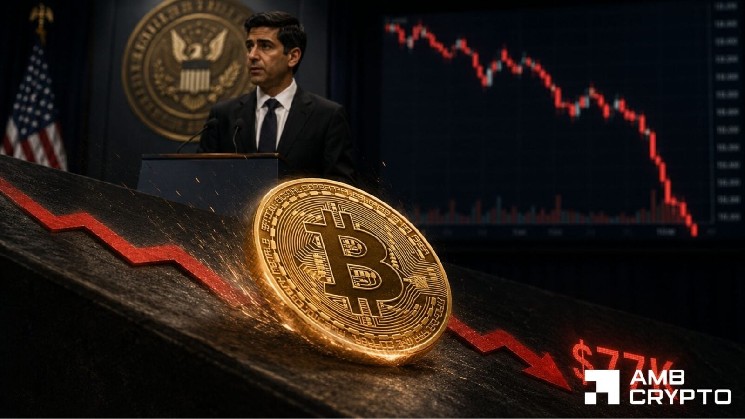
    Bitcoin price fell 3% to $77,000 after Federal Reserve Chair Kevin Warsh delivered a hawkish speech at the Jackson Hole event, signalling that the central bank may not be finished fighting inflation despite recent macroeconomic data.

    We must be confident that underlying inflation is moving to our objective, clearly and at sufficient speed. Otherwise, we have work to do.

    Discussing the latest summer inflation data, Warsh added:

    While this summer’s PCE and CPI readings were better than expected, they do not tell me that underlying trends have meaningfully improved.

    Why did Bitcoin fall below $80,000?

    U.S. equities and cryptocurrency markets interpreted Warsh’s comments as hawkish. The tech-heavy Nasdaq fell 0.52%, while the S&P 500 declined 0.25%. Crypto markets followed, with Bitcoin leading the downturn with a 3% drop.

    Source: $BTC/USDT, TradingView

    Bitcoin had rallied 30% in the second half of August, supported by the Treasury’s planned $1 trillion intervention to curb rising bond yields. The upswing also helped BTC reclaim its crucial 200-day moving average.

    However, the rally has stalled below $80,000, delaying Bitcoin’s attempt to reclaim the 50-week moving average at $81,800 and officially mark the end of the BTC bear-market cycle.

    Can Bitcoin rally despite September Fed rate hike fears?

    Inflation directly influences Federal Reserve interest-rate policy and risk sentiment across financial markets. Following Warsh’s speech, interest-rate traders raised the probability of a September Fed rate hike to 57%, a 20% increase from the previous week. The repricing reinforced renewed fears of another rate hike.

    Source: CME FedWatch

    Bitcoin options traders, including sophisticated professionals and institutional investors, also moved to increase downside protection.

    This was reflected in the BTC 25 Delta Skew, which rose from -10% to nearly 5%, representing a 15% increase and signalling renewed demand for downside hedging.

    During Bitcoin’s explosive rally last week, the metric fell below 0% for the first time this year. That indicated traders were reducing their downside hedges as many analysts expected the rally, supported by the so-called debasement trade, to continue amid concerns over U.S. fiscal debt and turmoil in the bond market.

    Source: Velo

    The metric’s weekend spike now suggests that Warsh has forced Bitcoin bulls to reassess their strategy.

    Analyst Luke Gromen, however, believes the bond-market crisis will overshadow Federal Reserve rate decisions in the short term.

    It remains a variant perception that both Fed hikes or cuts will cause the long end to rise…even as long bond yields are now up on Warsh’s ‘hawkish’ speech today.

    If fears of a Fed rate hike intensify and weigh on market sentiment, Bitcoin’s price could retrace toward its 200-day moving average at $69,300.

    However, if the debasement-trade narrative continues, the $80,000 level could become support for the next leg of the uptrend.

    Bitcoin price outlook

    Bitcoin fell 3% to $77,000 after Kevin Warsh’s hawkish Jackson Hole speech. The Nasdaq declined 0.52%, while the S&P 500 fell 0.25%. Meanwhile, the probability of a September Fed rate hike increased to 57%.