Category: Coins

Digital assets, cryptocurrencies, blockchain, and currency news.

  • Bitcoin Drops After Warsh Speech as Rate-Hike Odds Reach 57% — Can BTC Reclaim $80K?

    Bitcoin Drops After Warsh Speech as Rate-Hike Odds Reach 57% — Can BTC Reclaim $80K?

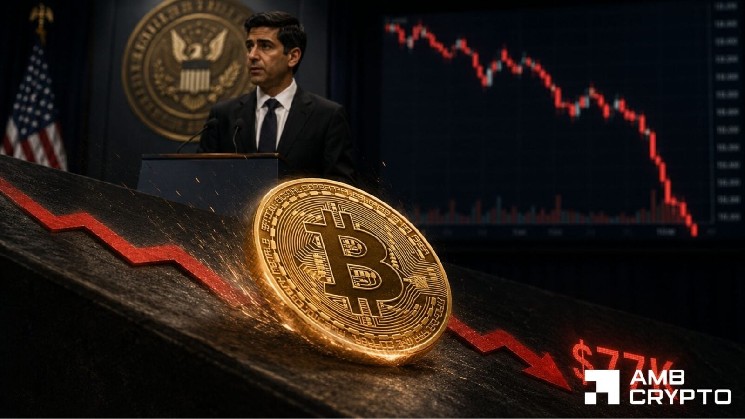
    Bitcoin price fell 3% to $77,000 after Federal Reserve Chair Kevin Warsh delivered a hawkish speech at the Jackson Hole event, signalling that the central bank may not be finished fighting inflation despite recent macroeconomic data.

    We must be confident that underlying inflation is moving to our objective, clearly and at sufficient speed. Otherwise, we have work to do.

    Discussing the latest summer inflation data, Warsh added:

    While this summer’s PCE and CPI readings were better than expected, they do not tell me that underlying trends have meaningfully improved.

    Why did Bitcoin fall below $80,000?

    U.S. equities and cryptocurrency markets interpreted Warsh’s comments as hawkish. The tech-heavy Nasdaq fell 0.52%, while the S&P 500 declined 0.25%. Crypto markets followed, with Bitcoin leading the downturn with a 3% drop.

    Source: $BTC/USDT, TradingView

    Bitcoin had rallied 30% in the second half of August, supported by the Treasury’s planned $1 trillion intervention to curb rising bond yields. The upswing also helped BTC reclaim its crucial 200-day moving average.

    However, the rally has stalled below $80,000, delaying Bitcoin’s attempt to reclaim the 50-week moving average at $81,800 and officially mark the end of the BTC bear-market cycle.

    Can Bitcoin rally despite September Fed rate hike fears?

    Inflation directly influences Federal Reserve interest-rate policy and risk sentiment across financial markets. Following Warsh’s speech, interest-rate traders raised the probability of a September Fed rate hike to 57%, a 20% increase from the previous week. The repricing reinforced renewed fears of another rate hike.

    Source: CME FedWatch

    Bitcoin options traders, including sophisticated professionals and institutional investors, also moved to increase downside protection.

    This was reflected in the BTC 25 Delta Skew, which rose from -10% to nearly 5%, representing a 15% increase and signalling renewed demand for downside hedging.

    During Bitcoin’s explosive rally last week, the metric fell below 0% for the first time this year. That indicated traders were reducing their downside hedges as many analysts expected the rally, supported by the so-called debasement trade, to continue amid concerns over U.S. fiscal debt and turmoil in the bond market.

    Source: Velo

    The metric’s weekend spike now suggests that Warsh has forced Bitcoin bulls to reassess their strategy.

    Analyst Luke Gromen, however, believes the bond-market crisis will overshadow Federal Reserve rate decisions in the short term.

    It remains a variant perception that both Fed hikes or cuts will cause the long end to rise…even as long bond yields are now up on Warsh’s ‘hawkish’ speech today.

    If fears of a Fed rate hike intensify and weigh on market sentiment, Bitcoin’s price could retrace toward its 200-day moving average at $69,300.

    However, if the debasement-trade narrative continues, the $80,000 level could become support for the next leg of the uptrend.

    Bitcoin price outlook

    Bitcoin fell 3% to $77,000 after Kevin Warsh’s hawkish Jackson Hole speech. The Nasdaq declined 0.52%, while the S&P 500 fell 0.25%. Meanwhile, the probability of a September Fed rate hike increased to 57%.


  • FOGO Reports $400 Million Token Theft in Exploit; Chain Remains Operational

    FOGO Reports $400 Million Token Theft in Exploit; Chain Remains Operational

    FOGO, a layer-1 blockchain built on the Solana Virtual Machine (SVM), reported that approximately 400 million FOGO tokens were stolen in an exploit. The project said its blockchain was not compromised; instead, the tokens were transferred to an address controlled by the attacker.

    FOGO said it is coordinating with cryptocurrency exchanges, investigative authorities, and blockchain forensic specialists to trace the stolen assets and support efforts to recover the funds.

    FOGO Token Contract Targeted in Exploit

    The incident became public after FOGO’s official X account issued a security alert urging users to remain vigilant. According to the announcement, the exploit affected the token contract rather than the underlying blockchain infrastructure.

    This distinction indicates that FOGO’s core network remains operational, while a vulnerability in the token’s smart contract or an associated protocol enabled the attacker to remove a significant number of tokens.

    The FOGO team is working with exchanges to freeze or flag the stolen assets. It has also engaged blockchain forensic analysts to track the movement of the funds. Exchange cooperation can be important in incidents of this kind, as platforms may be able to identify or restrict assets before they move through mixers or cross-chain bridges.

    Market and Community Impact

    The theft of 400 million FOGO tokens could create significant market pressure, particularly if the amount represents a large share of the total supply. Token holders may face increased price volatility, while the exploit could raise concerns about the project’s security practices.

    FOGO’s public communication and rapid response may help limit long-term reputational damage. However, the incident adds to the growing number of cryptocurrency security breaches linked to smart contract vulnerabilities.

    The exploit also highlights the risks users face when interacting with new or lesser-known tokens. Thorough security audits and careful due diligence remain important before launching or using token contracts.

    What the FOGO Exploit Means for the Wider DeFi Ecosystem

    Security incidents involving layer-1 ecosystems can affect the broader decentralized finance sector even when the underlying blockchain remains secure. Exploits involving token contracts often lead to increased scrutiny from regulators and may intensify calls for stronger security standards.

    FOGO’s immediate priorities are tracking the stolen tokens, supporting recovery efforts, and maintaining transparency with its community. The longer-term challenge will be restoring user confidence and continuing to attract developers to the platform.

    FOGO Token Theft Investigation Continues

    The theft of approximately 400 million FOGO tokens is a serious incident, but the continued operation of the blockchain provides some reassurance that the breach was limited to the token contract. FOGO’s coordination with exchanges, authorities, and forensic specialists is a positive step, although the recovery of the funds remains uncertain.

    The community will be watching the investigation closely, including how FOGO addresses the vulnerability and manages the project’s reputation after the exploit.

    FAQs About the FOGO Exploit

    What was exploited in the FOGO incident?

    The exploit targeted the FOGO token contract rather than the underlying SVM blockchain. The attacker exploited a vulnerability in the token’s smart contract and stole approximately 400 million FOGO tokens, while FOGO’s core blockchain infrastructure was not compromised.

    How is FOGO responding to the token theft?

    FOGO said it is working with cryptocurrency exchanges to freeze or trace the stolen tokens. The team is also coordinating with investigative authorities and blockchain forensic specialists to track the funds and support recovery efforts.

    What should FOGO token holders do now?

    Token holders should monitor FOGO’s official channels for updates and remain alert to phishing attempts and scams that may follow the incident. Users should keep their assets in secure, self-custodied wallets where appropriate and wait for further guidance from the FOGO team.

    Related Reading

    • First Quantum-Resistant Bitcoin Transaction Completed, but 7M BTC Remain Exposed
    • Tron Plans Quantum-Resistant Upgrade by Year-End, Says Justin Sun
    • StarkWare Executes First Quantum-Resistant Bitcoin Transaction on Mainnet
    • Realio Network Halts Chain After 124.4M RIO Token Theft, User Funds at Risk
    • Cardano Community Advances Talks on Quantum-Resistant Wallet Upgrades
  • BIT-Linked Addresses Boost ETH Longs to 29,500 on Hyperliquid, Data Shows

    BIT-Linked Addresses Boost ETH Longs to 29,500 on Hyperliquid, Data Shows

    Wallets linked to BIT, the crypto options trading platform formerly known as Matrixport, have increased their long position in Ethereum ($ETH) on the Hyperliquid exchange, according to on-chain data shared by analyst ai_9684xtpa.

    The associated address cluster added 8,000 $ETH to its long position during an early-morning market decline on [date], at an average entry price of $2,440.49 per $ETH. The purchase lifted the group’s cumulative position to 29,500 $ETH, currently valued at approximately $72 million.

    The position is showing an estimated $1 million in unrealized losses, highlighting the risks created by continued volatility in the cryptocurrency market.

    BIT-Linked Wallets Rank Among Hyperliquid’s Largest Positions

    BIT, originally established as Matrixport, is a Singapore-based digital asset platform offering trading and investment products, including crypto options. Traders and analysts closely monitor activity from wallets associated with major platforms because large positions can affect market sentiment and liquidity.

    Hyperliquid is a decentralized perpetual futures exchange that has recorded substantial growth in trading volume and open interest. Based on the available data, the BIT-linked address cluster ranks fifth on Hyperliquid by overall position size, making it one of the most significant identifiable positions on the platform.

    What the Ethereum Long Position Could Mean

    Adding to an Ethereum long position during a price dip may indicate confidence in $ETH’s medium-term outlook, despite the position’s current paper loss. Traders often view this type of accumulation as a potential bet on a rebound, although leveraged positions remain exposed to sharp price movements and liquidation risk.

    The data shared by ai_9684xtpa is based on on-chain activity and does not necessarily represent BIT’s official trading strategy. BIT has not publicly commented on these specific transactions.

    Why the Hyperliquid Wallet Activity Matters

    Monitoring large wallet movements on platforms such as Hyperliquid can provide insight into the trading behavior of institutional investors and high-net-worth market participants. However, on-chain data should be interpreted cautiously. A wallet cluster may be linked to multiple entities, and the exact ownership of the addresses has not been confirmed.

    The transaction also illustrates the expanding role of decentralized exchanges in crypto derivatives trading. Because positions and wallet activity are visible on-chain, these platforms offer market participants a more transparent view of trading flows and evolving market dynamics.

    Frequently Asked Questions

    What is BIT, formerly known as Matrixport?

    BIT is a digital asset trading platform that offers services including options and structured products. The company was rebranded from Matrixport and is known for providing institutional-grade crypto trading products.

    What is Hyperliquid?

    Hyperliquid is a decentralized perpetual futures exchange that allows users to trade crypto assets with leverage. The platform has gained attention for its speed and transparency, with trading positions visible on-chain.

    How reliable is the data from ai_9684xtpa?

    The data is based on publicly verifiable on-chain analysis. However, the ownership of the associated addresses has not been confirmed, and the figures may not reflect the entity’s complete trading activity or total positions.

    The accumulation of a 29,500 $ETH long position by BIT-linked addresses on Hyperliquid is a notable development in the crypto derivatives market. Although the position currently carries an estimated paper loss, its size represents a substantial market commitment that could influence perceptions of Ethereum’s outlook and available liquidity. Investors should conduct their own research and carefully consider the risks of leveraged trading in volatile cryptocurrency markets.

    Related Reading

    • Bitwise’s BHYP Stakes $74.9M in $HYPE: A Milestone for Institutional Crypto Adoption
    • Four Anonymous Wallets Move $53.9M in $HYPE From Coinbase to Hyperliquid for Staking
    • Unit xyz Moves to Acquire $15M in $HYPE on Coinbase, Boosting Holdings to 1M Tokens
    • Decentralized Perp Exchange Volume Climbs 9.1% to $423B, Hyperliquid Dominates with 58% Share
    • Crypto Futures Liquidations Top $213M in One Hour as Market Volatility Spikes
  • Tokenized Assets Are More Active Than the Data Shows

    Tokenized Assets Are More Active Than the Data Shows

    Estimates of how much tokenized real-world assets (RWAs) are actually being used in decentralized finance (DeFi) range from less than 1% to 7%, 11.7% and nearly 20%. All of these figures were published this year, and each can be defended. The problem is that they do not measure the same thing.

    The lowest estimate receives the most attention. Of the roughly $51 billion in tokenized real-world assets on public blockchains, it suggests that only a single-digit percentage is actively used. The figure is often cited as evidence that onchain finance remains a toy: a great deal of tokenized “value,” but very little of it operating in public markets.

    That criticism is not without merit. An asset that moves onchain, incurs transaction fees and gains no additional utility is a worse product than the traditional asset it replicates. However, the statistic used to support that criticism is nearly meaningless—not because the percentage is too low, but because both sides of the calculation are misleading.

    Where tokenized RWA utilization figures come from

    The sub-1% estimate covers only three tokenized money market funds, rather than the broader market. BlackRock’s BUIDL, Circle’s USYC and Franklin Templeton’s iBENJI hold a combined $7.2 billion and have approximately $50 million deployed.

    Expanding the sample produces a utilization rate of 11.7% according to DeFiLlama. Using CoinShares’ $7.4 billion second-quarter estimate against RWA.xyz’s $38 billion total produces a figure of about 19%. The resulting 20-fold gap reflects the lack of agreement over what should be measured, not necessarily a change in the underlying market.

    Why the denominator distorts the calculation

    According to Bernstein research, private credit accounts for approximately 47% of the $51 billion in tokenized real-world assets onchain. Private credit also tends to move infrequently in traditional finance. Tokenization does not change its redemption schedule or its holder base.

    Including private credit in the denominator of a metric intended to measure composability is therefore a category error rather than evidence of disappointing adoption. A meaningful assessment of DeFi usage must distinguish between assets designed for frequent onchain activity and assets whose underlying structure makes limited movement normal.

  • First-Ever Spot XRP ETF Plunges 45%

    First-Ever Spot XRP ETF Plunges 45%

    The world’s first spot $XRP ETF has dropped nearly 45% from its all-time high, highlighting continued volatility in the cryptocurrency as it struggles to break above key resistance levels.

    Hashdex Nasdaq $XRP Fundo de Índice (XRPH11), listed on Brazil’s B3 exchange, closed at $2.11 on Friday. That price represents a 44.45% decline from the fund’s peak.

    Brazil’s first spot $XRP ETF extends its decline

    Launched in April 2025, XRPH11 became the first spot $XRP ETF to provide direct exposure to the cryptocurrency through a regulated exchange-traded fund structure. The fund tracks the Nasdaq $XRP Reference Price Index and holds $XRP directly.

    After rising sharply in the months following its launch, XRPH11 entered a prolonged downturn that intensified throughout 2026. The fund is now down more than 57% over the past year and approximately 31% year to date.

    XRPH11 all-time price chart. Source: TradingView

    North American spot $XRP ETFs attract larger inflows

    Although Brazil pioneered the spot $XRP ETF market, larger North American markets soon surpassed it.

    Canada launched its first spot $XRP ETFs in June 2025. Purpose Investments introduced XRPP, while 3iQ listed XRPQ on the Toronto Stock Exchange. Both funds offered regulated $XRP exposure supported by institutional-grade custody solutions.

    The United States followed later in 2025 with several spot $XRP ETF launches. Products from REX-Osprey, Canary Capital, Bitwise, Grayscale, Franklin Templeton, and 21Shares expanded access to $XRP through traditional brokerage accounts.

    By 2026, seven spot $XRP ETFs were trading in the United States. Together, they had attracted approximately $1.5 billion in cumulative net inflows and held more than 1 billion $XRP tokens in custody.

    Limited impact on $XRP price discovery

    Despite being the first product of its kind, XRPH11 has had a limited effect on $XRP price discovery compared with its North American counterparts.

    The Brazilian $XRP investment fund attracted relatively modest assets, while institutional capital and trading volumes increasingly shifted toward larger U.S. and Canadian products.

    At the same time, broader cryptocurrency market volatility and continued token releases from escrow weighed on investor sentiment.

    At press time, $XRP was trading at $1.38, down approximately 2.5% over the previous 24 hours. On the weekly timeframe, the asset had declined nearly 7%.

    $XRP seven-day price chart. Source: Finbold

    Overall, $XRP’s recent momentum has been pressured by the broader retreat across the cryptocurrency market.

    Featured image via Shutterstock

  • HYPE Price Surges as Whale Activity Signals Potential for Another Leg Higher

    HYPE Price Surges as Whale Activity Signals Potential for Another Leg Higher

    $HYPE price has broken above the $70-$75 resistance band, extending its recovery into the $80-$85 region and significantly improving Hyperliquid’s weekly market structure. The move has coincided with renewed whale-sized activity in Hyperliquid’s spot market, while recent trading volumes have cooled from previously overheated levels.

    This combination places $HYPE at a pivotal technical juncture. If buyers can establish $75 as support, the next advance could target $90 and potentially $100.

    Whale Activity Enters the Higher Price Range

    Spot-market data provides an important confirmation of the recent price action. Hyperliquid’s Spot Average Order Size chart shows larger orders becoming more prominent as $HYPE advances, with recent whale-sized activity appearing near the upper end of the range displayed on the dashboard.

    The presence of larger orders at elevated prices suggests that significant market participants are active around the breakout, rather than the rally being driven solely by smaller transactions. If sizeable orders continue to appear while $HYPE holds above the breakout zone, they could provide stronger evidence that liquidity is supporting the new trading range.

    The Spot Volume Bubble Map offers additional context. Recent readings have moved toward cooling conditions after earlier heating and overheating phases. This indicates that trading intensity has moderated while the price remains elevated, creating a healthier setup than one in which price continues accelerating alongside increasingly extreme volume.

    $HYPE Price Analysis: Why $75 Matters

    Hyperliquid’s weekly chart shows a series of technical thresholds rather than an isolated price spike. After forming a base around $40-$45, the token recovered through the $55-$60 region before spending time absorbing supply below $75.

    $HYPE has maintained the higher-low sequence established during its recovery, while the latest breakout has pushed the price into the $80-$85 region. A successful retest of $75 would confirm that buyers have absorbed the supply previously concentrated around that level.

    From there, a sustained move above $85 would bring $90 into focus. A breakout through the $90-$95 area could then place the psychological $100 threshold in play. The weekly RSI has also risen alongside the price, reflecting the strength of the advance.

    The path toward $100 now depends primarily on whether the market accepts prices above the breakout zone. $HYPE has shown that buyers can clear $75; the next test is whether they can defend that level as profit-taking and new supply enter the market.

    Continued whale-sized activity at higher prices would strengthen the setup if it occurs alongside stable spot prices and a series of higher lows. A decisive break above $85-$90 would provide further confirmation that demand is absorbing the available supply.

    Conversely, a loss of $75 followed by a break below $70 would weaken the breakout thesis. In that scenario, $HYPE could revisit the $60-$65 region, where the previous consolidation offers a more substantial support reference.

    Final Outlook for $HYPE

    $HYPE price has moved beyond a multi-month resistance structure, but the breakout’s durability is still being established. Whale data adds significance to the current setup because larger orders are appearing as $HYPE trades at elevated levels, while the volume profile no longer shows the same degree of overheating seen during the strongest phase of the advance.

    If $HYPE converts $75 into firm support and subsequently clears $90, the $100 level becomes a credible next target. Until then, the breakout’s quality will depend above all on whether buyers can defend the ground they have reclaimed.

    Source: cryptonews.net

  • Unit xyz Moves to Acquire $15 Million in HYPE on Coinbase, Increasing Holdings to 1 Million Tokens

    Unit xyz Moves to Acquire $15 Million in HYPE on Coinbase, Increasing Holdings to 1 Million Tokens

    Unit xyz, a tokenization protocol within the Hyperliquid ecosystem, is reportedly preparing to purchase $15 million worth of $HYPE tokens through Coinbase. The transaction, highlighted by the Hyperliquid News X account, would increase Unit xyz’s total $HYPE holdings to 1 million tokens if completed.

    Why Unit xyz Is Increasing Its $HYPE Holdings

    The reported purchase comes as Hyperliquid expands its presence in the digital asset market and its native $HYPE token gains attention from institutional and retail investors. Acquiring tokens through a major exchange such as Coinbase may reflect a strategy of building exposure through a transparent, regulated venue.

    Tokenization protocols such as Unit xyz can use token holdings to support asset representation, liquidity provision, and governance participation. The planned acquisition also reflects a broader trend of blockchain protocols building reserves to support operations and demonstrate long-term commitment to their networks.

    Potential Market Impact and Community Response

    The report has prompted discussion across crypto communities, with some observers describing the purchase as a potentially bullish signal for $HYPE liquidity and adoption. Others note that large orders on centralized exchanges can affect market sentiment, although the ultimate impact will depend on execution, trading volume, and available market depth.

    Hyperliquid’s ecosystem is known for its growth in perpetuals trading and decentralized finance (DeFi). Greater exposure to $HYPE could give Unit xyz additional capacity to support tokenized assets connected to the ecosystem and potentially attract more users to its platform.

    What the Reported Purchase Means for Investors

    The development highlights the growing relationship between DeFi protocols and exchange-based liquidity. It also underscores the importance of tracking both on-chain activity and exchange data when assessing institutional or protocol-level buying.

    However, the purchase remains unconfirmed until an official report verifies its completion. Market conditions can change quickly, and the potential effect on $HYPE will depend on factors including the size and timing of the order, liquidity, trading activity, and overall market sentiment.

    Frequently Asked Questions

    What is Unit xyz?

    Unit xyz is a tokenization protocol within the Hyperliquid ecosystem that focuses on representing real-world or digital assets on-chain. It uses $HYPE tokens for operational and governance purposes.

    Why is Unit xyz reportedly buying $HYPE on Coinbase?

    The purchase is likely intended to increase Unit xyz’s $HYPE reserves, which could support its tokenization services, liquidity requirements, or strategic position within the Hyperliquid network. Using a major exchange such as Coinbase may provide a transparent and accessible route for executing the transaction.

    How could the purchase affect the price of $HYPE?

    A large purchase could increase short-term demand, but the broader price impact will depend on market conditions, trading volume, liquidity, and investor sentiment. A completed transaction may be viewed as a positive signal, although investors should exercise caution and conduct their own research.

    Related Reading

    • Decentralized Perp Exchange Volume Climbs 9.1% to $423B, Hyperliquid Dominates with 58% Share
    • Dogecoin Price Pulls Back After Rally to Three-Month High: What’s Next for DOGE?
    • Hyperliquid’s Largest Long Whale Opens $79M Bitcoin Position Amid Market Turmoil
    • Goldman Sachs Emerges as Top Institutional Holder of Spot Solana ETFs, 13F Filings Show
    • North Korea’s Lazarus Group Moves $19.42M in Bitcoin, On-Chain Data Shows

    Source: cryptonews.net

  • Cardone Capital Adds 1,200 BTC, Doubles Down on Bitcoin and Multifamily Housing

    Cardone Capital Adds 1,200 BTC, Doubles Down on Bitcoin and Multifamily Housing

    U.S. real estate investment firm Cardone Capital has expanded its Bitcoin treasury by purchasing 1,200 $BTC. The company, led by founder Grant Cardone, announced the acquisition on X, formerly Twitter, while also reporting growth in its multifamily housing portfolio.

    Cardone Capital Expands Its Bitcoin Holdings

    Grant Cardone said Cardone Capital had added approximately 2,000 apartment units and another 1,200 $BTC. The purchase brings the firm’s total Bitcoin holdings to more than 4,000 $BTC, following an earlier disclosure that it held over 2,800 $BTC.

    The move reflects Cardone’s public support for Bitcoin as a potential hedge against inflation and a store of value. He has repeatedly emphasized diversification into hard assets, and Cardone Capital’s treasury strategy now combines multifamily real estate with cryptocurrency.

    Institutional Interest in Bitcoin and Real Estate

    Cardone Capital’s Bitcoin purchase comes as more institutions and corporations add the cryptocurrency to their balance sheets. While some companies are shifting their focus toward data centers and artificial intelligence infrastructure, Cardone Capital continues to prioritize multifamily housing alongside Bitcoin.

    This approach reflects the view among some investors that Bitcoin can complement traditional real estate holdings. The firm’s continued accumulation also highlights changing institutional attitudes toward digital assets as regulatory clarity improves and Bitcoin exchange-traded funds gain traction in the U.S. market.

    Why Cardone Capital’s Bitcoin Strategy Matters

    Cardone Capital’s decision to increase its Bitcoin holdings indicates that mid-sized investment firms are becoming more comfortable allocating capital to cryptocurrency, beyond the large technology companies and hedge funds that have already entered the market.

    Maintaining a portfolio that combines multifamily housing with Bitcoin also gives the firm exposure to income-producing real estate and a volatile asset with potentially higher growth prospects. For investors, the strategy underscores the importance of diversification and the growing acceptance of Bitcoin as a potential corporate treasury asset.

    The move may also encourage other real estate companies to consider digital assets as part of their long-term investment strategies.

    What Cardone Capital’s Bitcoin Purchase Means

    Cardone Capital’s latest acquisition reinforces its commitment to both real estate and cryptocurrency. By expanding its multifamily housing portfolio while increasing its $BTC reserves, the firm is positioning itself across two major asset classes and participating in the broader institutional shift toward digital assets.

    Frequently Asked Questions

    How much Bitcoin does Cardone Capital now hold?

    Based on the latest announcement, Cardone Capital holds more than 4,000 $BTC after adding 1,200 $BTC to its previous holdings of over 2,800 $BTC.

    Why is Cardone Capital investing in Bitcoin?

    Grant Cardone has publicly described Bitcoin as a hedge against inflation and a store of value. The firm is using Bitcoin to diversify its treasury assets beyond traditional real estate investments.

    Is Cardone Capital’s move part of a broader trend?

    Yes. Institutions and corporations have been adding Bitcoin to their balance sheets, particularly as regulatory clarity improves and Bitcoin ETFs become more established in the U.S. market.

    Related Reading

    • Bitcoin and Gold Slide as Fed Chair Signals Hawkish Stance
    • Crypto Futures Liquidations Top $213M in One Hour as Market Volatility Spikes
    • Bitcoin Drops Below $77,000 as Market Faces Renewed Selling Pressure
    • Crypto Futures Liquidations Top $107 Million in One Hour as Market Volatility Spikes
    • Bitcoin Slips Below $78,000 as Crypto Market Faces Renewed Selling Pressure
  • Bitcoin Whale’s BTC Holdings Begin Moving After 15 Years of Dormancy

    Bitcoin Whale’s BTC Holdings Begin Moving After 15 Years of Dormancy

    Six long-dormant Bitcoin wallets created between 2011 and 2014 have become active again, according to data from Galaxy Research. Between August 16 and 26, the wallets transferred a combined 553.59 $BTC, worth approximately $40 million at current prices.

    Bitcoin wallets inactive for more than 15 years move funds

    One of the wallets had reportedly been inactive for more than 15 years. Its renewed activity indicates that some Bitcoin holdings from the cryptocurrency’s earliest years are beginning to move on-chain again.

    Galaxy Research found that five of the six wallets transferred their Bitcoin to addresses not associated with any known cryptocurrency exchange. As a result, there is no clear evidence that the transactions were intended as direct sales.

    The remaining wallet transferred 40 $BTC to Boerse Stuttgart Digital, a Germany-based provider of cryptocurrency custody and transaction services. However, the transfer does not necessarily indicate that the Bitcoin was sold. The assets may instead have been moved into custody or transferred for another institutional transaction purpose.

    ‘Sleeping Bitcoin’ activity reaches its lowest level since 2022

    Alex Thorn, head of research at Galaxy Digital, said on-chain activity involving long-dormant Bitcoin has declined significantly in recent months. Thorn said activity among legacy coins, described as “sleeping Bitcoin,” fell to its lowest level since the third quarter of 2022 by the second quarter of 2026.

    Thorn also expects the total value of transfers from Bitcoin wallets that have been inactive for long periods throughout 2026 to be less than half the level recorded last year.

    This is not investment advice.