Category: Coins

Digital assets, cryptocurrencies, blockchain, and currency news.

  • SEC Reviews Automatic Filing Pathways After Surge in Exotic Crypto and Event-Linked ETF Proposals

    SEC Reviews Automatic Filing Pathways After Surge in Exotic Crypto and Event-Linked ETF Proposals

    Wall Street is pushing the exchange-traded fund format into nearly every corner of finance. Investors can now find ETFs offering Bitcoin exposure, two- or three-times the daily performance of a stock, private assets, and contracts linked to elections or economic data.

    The ETF began as a low-cost way to own a diversified market portfolio. It has since become a distribution system for investments that once required a futures account, private placement, crypto exchange, or careful review of a structured-note prospectus.

    The Securities and Exchange Commission is examining how far that system can expand. In a June 30 request for public comment, the agency identified crypto assets, commodities, leveraged products, single-stock ETFs, blockchain-based investments, private assets, and event contracts. Comments are due Aug. 31.

    The review extends beyond any individual application. The SEC is assessing whether its existing rules give staff sufficient time and authority to evaluate products whose economic behavior can differ substantially from the diversified funds investors traditionally associate with ETFs.

    According to the SEC’s concept release, assets in U.S. ETFs grew from more than $4 trillion at the end of 2019 to more than $12 trillion at the end of 2025. Over the same period, the number of products increased from nearly 1,900 to more than 4,600.

    The ETF ticker can hide the product’s real risks

    An ETF packages a portfolio into shares that trade throughout the day on an exchange. Investors can buy that exposure through the same brokerage account they use for ordinary stocks.

    Through the creation-and-redemption process, authorized participants exchange large blocks of ETF shares for the underlying basket or its cash equivalent. This mechanism helps keep the market price close to the portfolio’s net asset value.

    What began as operational infrastructure became a retail investing habit. ETFs offer intraday trading, transparent pricing, broad brokerage access and, in many structures, more favorable tax treatment than comparable mutual funds.

    Asset managers also gained products that could be placed in model portfolios and trading applications. Each successful launch encouraged sponsors to put increasingly specialized exposures behind the same familiar interface.

    The regulatory framework developed around the original ETF model. Early funds needed individual exemptive orders for features such as exchange trading and in-kind redemptions, which did not fit neatly within rules designed for open-end mutual funds.

    In 2019, the SEC adopted Rule 6c-11. The rule allows qualifying ETFs registered under the Investment Company Act of 1940 to operate without seeking a separate order for every launch, provided they satisfy conditions involving portfolio information, trading data and the arbitrage mechanism.

    Rule 6c-11 made ETF launches faster and more standardized, helping the product count more than double by the end of 2025. A plain index fund, a concentrated thematic portfolio and a derivatives strategy can now look nearly identical on a brokerage screen, even though their holdings, valuation methods and potential losses may be very different.

    The term ETF describes the container, not necessarily the investment inside it.

    The common brokerage screen also obscures important legal distinctions. Many stock and bond ETFs are registered investment companies under the 1940 Act, while spot Bitcoin and Ethereum products commonly use commodity-trust structures registered under the Securities Act of 1933.

    Exchange-traded notes represent another category. They are unsecured debt obligations whose returns depend on the issuer’s promise. Brokerage platforms may display all three structures side by side under a broad exchange-traded product label.

    Those legal categories affect custody, board oversight, diversification, borrowing, derivatives use, valuation and the remedies available if an issuer or service provider fails. A familiar ticker makes an exposure easier to buy, but it does not remove those underlying differences. That is why the SEC is examining the conditions attached to the ETF wrapper as closely as the portfolio itself.

    Crypto expanded the ETF model

    Spot crypto products became a turning point because investors viewed an exchange listing as a bridge between an unfamiliar asset and an established brokerage account.

    The SEC’s approval of spot Bitcoin products in 2024 gave advisers and institutions access to a regulated trading venue, standardized disclosures and conventional custody relationships. The agency emphasized that its approval was not an endorsement of Bitcoin itself.

    In practice, the distinction between legal approval and perceived legitimacy became harder to see as the ETF menu expanded.

    Many investors see an ETF ticker at a major broker and assume that the underlying exposure has passed through a common regulatory filter. Yet one product may hold a broad equity basket while another owns a volatile commodity or rolls derivatives that can diverge from a reference asset. Crypto demonstrated the commercial value of that familiarity.

    Sponsors have since applied the same distribution model to staking, options overlays, token products promising a multiple of an asset’s daily move and baskets of digital assets. Each structure may serve a specific investment purpose, while introducing its own custody, valuation, trading-hours and concentration risks.

    Crypto markets trade around the clock, but ETF shares trade during exchange hours. The creation process must bridge those different trading schedules when prices move sharply overnight or over a weekend.

    Event-contract funds push the ETF model into even less familiar territory. They tie returns to election results, economic releases or other defined events while packaging the exposure in shares that trade like ordinary funds.

    CryptoSlate identified more than two dozen event-linked ETF proposals, illustrating how quickly a niche contract market could reach retail brokerage accounts once an ETF provides the distribution channel.

    The regulatory challenge is based on how the product functions. An event contract may trade on an exchange overseen by the Commodity Futures Trading Commission, while the fund shares and related disclosures fall within the SEC’s jurisdiction.

    That can place the risks across several rulebooks. Regulators may need to examine how a contract settles, who provides prices, what happens when trading is halted and whether the fund can meet redemptions near the event date.

    Those questions apply differently across the categories covered by the SEC’s concept release. A private-asset fund may face stale valuations and limited exit opportunities. A single-stock leveraged product may reset daily and compound away from its stated multiple over longer periods. A token-based product may depend on custody or staking arrangements with no close equivalent in a traditional index fund.

    A product-by-product framework could attach conditions to each source of risk more precisely than a single definition of novelty.

    The SEC’s ETF approval process faces new pressures

    The SEC must also determine whether its filing process gives staff enough time to review unfamiliar structures before they reach the market.

    Certain registration statements and post-effective amendments can become effective automatically after a statutory or rule-based waiting period. Some amendments filed under Rule 485 can take effect immediately when they meet specified conditions.

    These pathways make routine fund updates and launches more efficient, but they can also carry portfolios that SEC staff have not previously encountered.

    SEC Chair Paul Atkins said in May that several sponsors had agreed to delay novel ETF launches, including event-contract products, while the agency evaluated the issues.

    A voluntary delay gives staff additional time to assess current filings. A lasting policy could require rule amendments, enhanced disclosure conditions, a separate review process or a clearer boundary around which products qualify for automatic treatment.

    Each option carries a cost. Broad restrictions could slow conventional fund launches and give established issuers an advantage over smaller sponsors. A narrow rule could leave staff racing against automatic deadlines whenever a new payoff structure emerges.

    The SEC must also protect the arbitrage mechanism that keeps ETF shares close to net asset value. Disclosure alone cannot solve problems created by assets that are too difficult to price or acquire during the creation-and-redemption process.

    Crypto issuers have a direct interest in the outcome, even as event contracts draw much of the attention. New staking structures, tokenized securities, multi-asset baskets and products offering daily return multiples could face additional filing requirements depending on how the SEC defines novelty and which safeguards it requires.

    A framework focused on custody, valuation, liquidity and payoff complexity could give sponsors a clearer path to market. A wrapper-level restriction, by contrast, could group economically different crypto products together.

    The SEC has already published public comment letters and meeting records ahead of the Aug. 31 deadline. After the comment period closes, the agency will need to evaluate the submissions, determine whether its existing authority and disclosure standards are sufficient, and publish any proposed rule amendments through the normal notice-and-comment process.

    Existing products and pending applications will continue to provide data on premiums, discounts, trading quality and investor use during that review.

    ETFs conquered Wall Street by making investment exposure easy to distribute. The wrapper has become financial infrastructure for nearly every kind of portfolio. A brokerage customer can move from an S&P 500 fund to Bitcoin, a two-times stock position or an election-linked contract with a few taps, even though each investment enters a different economic world.

    The SEC now has to decide which exposures require a different regulatory gate before a familiar ticker persuades investors that the existing gate has already done all the work.


  • Bitwise Moves $15.4 Million Worth of XRP Out of Circulation

    Bitwise Moves $15.4 Million Worth of XRP Out of Circulation

    Bitwise has extended its buying streak for XRP with a purchase worth $15.4 million, drawing attention as XRP’s recent rally loses momentum and the token returns to negative territory.

    Bitwise XRP purchase highlights institutional demand

    According to recent data highlighted by Whale Insider, the leading asset management firm has continued accumulating XRP despite mixed price action. The latest purchase comes after a recent breakout that increased confidence across the XRP ecosystem and supported stronger demand from retail and institutional investors.

    Momentum has also carried into the XRP exchange-traded fund (ETF) market, where all existing funds have recorded steady daily inflows over the past two weeks. This continued capital injection has coincided with growing institutional demand for Bitwise’s XRP product.

    Bitwise’s latest XRP purchase has drawn particular attention because it occurred as XRP reversed from its recent bullish performance and began trading lower. The buying activity suggests that some institutional investors remain interested in the asset despite its short-term weakness.

    XRP retreats to the $1.30 level

    Despite sustained institutional demand, XRP’s momentum appears to be fading. The cryptocurrency has paused its price rally and returned to red territory, with the latest on-chain data showing a retreat to around $1.30.

    XRP has declined by approximately 2% over the past 24 hours, indicating that speculative trading may currently be outweighing underlying demand. Even after slowing from its recent surge, however, XRP continues to post the strongest monthly price gain following several months of extreme volatility.

  • “This Seems Incorrect”: Ripple CTO Emeritus Slams Kalshi’s CFTC Argument

    “This Seems Incorrect”: Ripple CTO Emeritus Slams Kalshi’s CFTC Argument

    A new legal and regulatory debate is emerging over whether U.S. states or the Commodity Futures Trading Commission (CFTC) should oversee the rapidly expanding prediction markets industry. The dispute follows a federal appeals court ruling that Kalshi cannot prevent Nevada gaming regulators from supervising its platform.

    Kalshi and the CFTC maintain that sports event contracts qualify as “swaps” under the 2010 Dodd-Frank financial reforms, giving the agency authority to oversee them through its regulation of national swaps markets.

    David Schwartz, Ripple’s CTO emeritus, responded to an X post by sports betting and gaming attorney Daniel Wallach. Wallach argued that the CFTC’s rulemaking was effectively “dead on arrival” under the major-questions doctrine, which restricts federal agencies from asserting broad powers without clear authorization from Congress.

    Schwartz challenged that reasoning, saying the central issue is whether Congress delegated authority to regulate gambling conducted through exchange-traded contracts.

    “This seems to be incorrect to me. The question is only whether Congress delegated the power to regulate gambling through exchange-traded contracts. As Kalshi correctly points out, traditional sportsbook gambling is very different,” Schwartz wrote.

    This seems to be incorrect to me. The question is only whether Congress delegated the power to regulate gambling through exchange traded contracts. As Kalshi correctly points out, traditional sportsbook gambling is very different. https://t.co/EY6MKlq1Mx
    — David ‘JoelKatz’ Schwartz (@JoelKatz) August 28, 2026

    Elaborating on his position, Schwartz stated: “Of course Congress didn’t intend to replace state-regulated sportsbook gambling with exchange-traded products outside of state regulation. It meant to create a new, uniform federal framework for creating exchange-traded products outside of state regulation.”

    How the Kalshi prediction markets case began

    The legal battle started in March 2025, when the Nevada Gaming Control Board issued Kalshi a cease-and-desist letter. The regulator alleged that the company’s sports event contracts amounted to an unlicensed sports pool under Nevada gaming law.

    Kalshi countered that the CFTC’s authority over swaps preempted Nevada’s gambling regulations.

    On Friday, the 9th U.S. Circuit Court of Appeals in San Francisco upheld Nevada’s authority to regulate Kalshi’s prediction market activities. Circuit Judge Ryan Nelson said the contracts bear the characteristics of sports betting, “a quintessential form of gambling” that falls outside the CFTC’s regulatory jurisdiction.

    “The CFTC is not a national gambling regulator,” Nelson said, adding that “it is difficult, then, to conclude that Congress intended to ​upend its decades of careful regulation ​of gambling based on broad definitions of the words used in a Wall Street Reform Bill.”

  • TRON Now Holds Half of USDT: What It Means for Crypto Users

    TRON Now Holds Half of USDT: What It Means for Crypto Users

    TRON Now Holds More Than Half of the World’s USDT Supply: What It Means for Users

    TRON now hosts about half of the world’s USDT supply. As of late August 2026, approximately 51.4% of all USDT was circulating on TRON, representing around $94.2 billion.

    That concentration suggests TRON is becoming the leading network for moving dollar-linked assets on-chain. However, TRON’s dominance also raises questions about network risk, centralization, and the best blockchain for everyday USDT payments.

    Why Is So Much USDT on TRON?

    TRON became popular for USDT transfers primarily because it is fast and inexpensive. Sending USDT on TRON typically costs less than a few cents and takes only a few seconds. By comparison, the same transfer on Ethereum can cost several dollars when network demand is high.

    These low fees make TRON useful for frequent payments, including freelancer payments, international remittances, and transfers between cryptocurrency exchanges. Exchanges have also supported the growth of TRC-20 USDT by often offering it as the default withdrawal network, bringing more USDT onto TRON.

    TRON’s growing user base has reinforced this trend. The network passed 400 million accounts in August 2026, with more than 4.6 million daily active accounts during the previous 30 days.

    Does TRON’s USDT Dominance Make It Better for Everyday Payments?

    For simple transfers, TRON can be a practical choice. Most users want payments that are fast and inexpensive. However, the network’s large share of the global USDT supply also creates risks.

    Concentration risk: About half of the world’s USDT is held on a single network. A major technical failure or regulatory action affecting TRON could therefore impact a significant portion of the USDT market.

    Greater centralization: TRON relies on a smaller group of validators, known as Super Representatives, to operate the network. This makes TRON more centralized than Ethereum.

    These concerns may be less important for everyday transfers. They become more significant for users planning to hold large amounts of USDT on TRON over an extended period.

    What USDT Transfer Data Shows

    Data from the TRON ecosystem indicates that approximately 93% of the network’s stablecoin transfers take place between individual wallets rather than between exchanges. This suggests that a substantial share of activity involves people moving money, not only institutions shifting funds.

    Smaller transfers are also becoming more common. TRON’s share of USDT transfers below $1,000 increased from about 43% to 52% between quarters. These payments are commonly associated with remittances, salaries, and transfers between individuals.

    At the same time, TRON processes hundreds of millions of dollars in card payments each quarter. Taken together, these figures suggest that users rely on TRON for regular payments as well as cryptocurrency trading.

    Why the BIS Has a Different View of Stablecoin Payments

    Not everyone believes stablecoins are the future of everyday payments. On August 28, 2026, Bank for International Settlements General Manager Pablo Hernandez de Cos argued that stablecoins may not function effectively as a large-scale payment system.

    He identified tokenized deposits—regular bank deposits represented as blockchain tokens—as a better option for everyday payments. His main concerns include:

    • Bank funding: If people move money from bank accounts into stablecoins, banks have less money available to lend, which could make borrowing more expensive.
    • Different types of money: Moving between stablecoins and bank deposits is not as straightforward as transferring money between two bank accounts. Users may effectively have to exchange one form of money for another.
    • Dollarization: If people around the world increasingly use dollar-based stablecoins, other countries may find it harder to control their economies and currencies.

    USDT on TRON vs. Tokenized Bank Deposits

    The main difference between USDT on TRON and tokenized bank deposits is who controls the money and how it moves.

    USDT is issued by Tether, a private company. A tokenized deposit is issued by a licensed bank and represents money held in a bank account.

    USDT on TRON operates on a public blockchain that anyone can use. Tokenized deposits typically operate on systems controlled by banks.

    USDT can be sent to anyone with a TRON wallet anywhere in the world at any time. Tokenized deposits are generally limited to customers of a bank or to users connected through participating banks.

    With USDT, users rely on Tether to maintain sufficient reserves and on TRON to keep its network secure. With tokenized deposits, users rely on the issuing bank and the banking system behind it.

    In simple terms, USDT on TRON is more open, global, and easy to transfer today. Tokenized deposits are being developed as a more traditional, bank-based alternative for the future.

    Choosing a USDT Network: TRON or Ethereum?

    Users deciding where to send or hold USDT should consider several factors:

    • Fees: TRON is generally much cheaper for small transfers. Ethereum fees can become expensive when the network is busy.
    • Speed: Both networks process transactions quickly, but TRON’s low fees make it more practical for frequent, small payments.
    • Liquidity and exchange support: TRON currently holds a large amount of USDT and is supported by many exchanges, making it easier to move larger amounts of the stablecoin.
    • Compatibility: Always confirm which network the receiving wallet or exchange supports. TRC-20 USDT and ERC-20 USDT operate on different networks, and sending USDT through the wrong network can result in permanent loss of funds.

    TRON has introduced features that make it easier for developers to build across different networks. However, this does not mean that a transaction sent through the wrong network can automatically be recovered.

    Bottom Line for USDT Users

    For users making frequent small USDT transfers, TRON can be a good choice because of its low fees. Users moving large amounts or placing a higher priority on decentralization may prefer Ethereum or newer, lower-cost Ethereum-based networks.

    Regardless of the network selected, always check the network before sending USDT. This simple step can help prevent costly and potentially irreversible mistakes.

    Related: Fed Chair’s Strong Economy Message: What It Means for Treasury Yields and Bitcoin

    Source: cryptonews.net

  • Japanese Tech Giant Announces “Real SHIB Coin” Giveaway for Holders

    Japanese Tech Giant Announces “Real SHIB Coin” Giveaway for Holders

    Japanese crypto exchange Rakuten Wallet has announced an upcoming Shiba Inu ($SHIB) event in Fukuoka, where eligible holders will have the opportunity to receive a physical “real $SHIB coin.”

    In an X post addressed to the $SHIB community, Rakuten Wallet said its Securities Investment Academy event in Fukuoka, Japan, on September 12 will feature a presentation by Matsuda, a senior analyst at Rakuten Wallet. The exchange will also distribute the physical souvenir coins at its booth during the event.

    【SHIBホルダーの皆さまへ🐕✨】9/12(土)開催の楽天証券投資アカデミー@福岡に、楽天ウォレットのシニアアナリスト松田が登壇します‼️そして当日、楽天ウォレットブースにて「リアルSHIBコイン」配布企画、やります!🎁… pic.twitter.com/Cofc0vKrGg
    — 楽天ウォレット (@Rakuten_Wallet) August 28, 2026

    Shiba Inu holders can qualify for a real $SHIB coin by showing a screenshot of their $SHIB holdings in Rakuten Wallet. The exchange also said it plans to hold seminars in Sapporo and Osaka in October, following the Fukuoka event, with physical $SHIB coins expected to be distributed there as well.

    Rakuten Wallet introduced the physical Shiba Inu coin in July, describing it as the first of its kind to use sandblasting technology, also known as a blast finish. The metal souvenir has no technical connection to the Shiba Inu blockchain.

    Rakuten Wallet expands support for Shiba Inu

    Rakuten Wallet has continued to support Shiba Inu since adding the meme coin to its lineup in April. The listing allows millions of users in Japan to convert Rakuten Points, the company’s loyalty points, into $SHIB and use the tokens through the Rakuten Pay payment system at 5 million retail locations nationwide.

    In June, shortly after $SHIB became available on the platform, Rakuten Wallet announced dedicated content for the cryptocurrency. The initiative included a special video titled “Understanding $SHIB,” presented by Rakuten Wallet senior analyst Matsuda.

    Altcoins are trading lower across the board as most tokens give back recent gains and market attention remains focused on Bitcoin. At the time of writing, $SHIB was down 3.61% over 24 hours at $0.0000051. The altcoin season index stood at 33 out of 100, indicating conditions remained firmly dominated by Bitcoin.

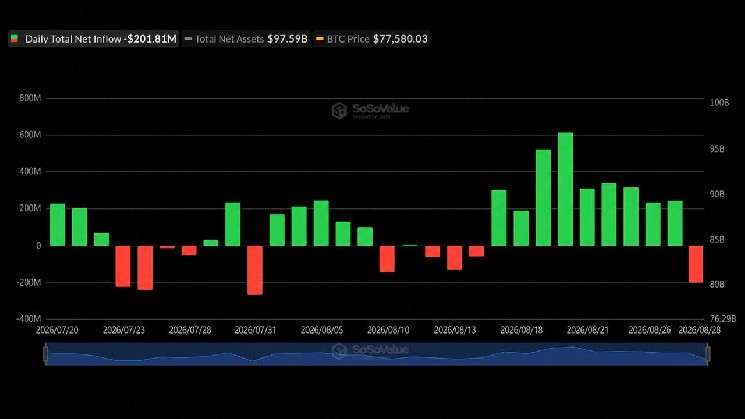
  • Bitcoin ETFs End 9-Day Inflow Streak With $202 Million Outflow as Ether ETFs Gain $102 Million

    Bitcoin ETFs End 9-Day Inflow Streak With $202 Million Outflow as Ether ETFs Gain $102 Million

    Bitcoin ETFs End Nine-Day Inflow Streak

    U.S. spot bitcoin exchange-traded funds (ETFs) ended a nine-session run of daily inflows on August 28, recording approximately $202 million in net outflows. The streak began on August 17 and had attracted roughly $3.04 billion before breaking.

    The nine-day inflow period pushed total bitcoin ETF assets beyond a milestone that few expected to arrive so quickly. Bitcoin.com News reported that the funds surpassed $100 billion in net assets on August 27. BlackRock’s iShares Bitcoin Trust (IBIT) led that day with $277.6 million in inflows, while Fidelity’s FBTC recorded $83.6 million in outflows and Grayscale’s GBTC lost another $27.2 million.

    Bitcoin ETFs have experienced sharp moves in both directions this year. In May, the same group of funds recorded a then-record nine-day outflow streak, losing approximately $2.8 billion as bitcoin’s price fell from about $80,000 to $73,000.

    Spot Ether ETFs Extend Buying Streak

    Spot ether ETFs moved in the opposite direction on August 28, attracting $102 million and extending their own inflow streak to 10 consecutive sessions.

    Ether ETFs have also benefited from strong demand earlier in August, when the category recorded $2.6 billion in inflows during its strongest week since October. BlackRock’s ETHA accounted for much of the activity and helped triple the sector’s typical trading volume.

    Ether’s price has broadly followed bitcoin’s performance, even as the two cryptocurrency ETF markets have briefly moved in different directions.

    Bitcoin Price Holds Near $77,500

    The bitcoin ETF outflows came at a notable point for the cryptocurrency market. Bitcoin opened August 28 at $80,261.86 before falling to its current level of approximately $77,500.

    Bitcoin is up only 1% over the past week, making a single day of ETF selling appear more consistent with profit-taking than panic selling. The market was also preparing for the expiration of roughly $6.4 billion in Deribit options that Friday.

    One negative session does not erase the previous $3 billion inflow run. ETF investors will be watching the next session’s data to determine whether the outflows were a temporary setback or the beginning of a longer trend. Spot ether ETFs, meanwhile, enter the new week with their 10-day inflow streak intact.

    Source: cryptonews.net

  • Bitcoin’s Failed $81,000 Breakout Puts $75,000 Back on the Table

    Bitcoin’s Failed $81,000 Breakout Puts $75,000 Back on the Table

    Bitcoin is trading near $78,000 heading into the weekend, positioned between support at $77,000 and resistance at $80,000 after a sharp rejection above $81,000 on Aug. 28.

    A confirmed break below $77,000 could expose the mid-$75,000s. Conversely, a sustained move back above $80,000 would bring Bitcoin’s Aug. 28 high near $81,300 and the $82,000–$83,000 zone back into focus.

    Bitcoin Reverses After Jackson Hole Rate Shock

    Bitcoin reversed from its Aug. 28 intraday high after Kevin Warsh’s Jackson Hole remarks pushed the probability of a September rate hike to around 55%, up from roughly 40% before the speech. Warsh said the Fed still had work to do if inflation failed to return toward its target.

    The resulting repricing pushed Bitcoin back below $80,000 by the close. A level buyers had briefly reclaimed turned into resistance, leaving $77,000 as the immediate level traders must defend.

    Friday’s Bitcoin Options Expiry Removes a Major Market Anchor

    Approximately 81,700 Bitcoin options worth about $6.44 billion expired on Deribit Friday at 08:00 UTC. The expiry removed a positioning cluster that had helped anchor Bitcoin near key strike prices throughout the week.

    Calls outnumbered puts by a ratio of 0.83. The largest concentration of call open interest was around $75,000 and $80,000, the same two levels now defining the weekend’s downside and upside scenarios.

    U.S.-traded spot Bitcoin ETFs recorded nine consecutive days of net inflows through Aug. 27, totaling roughly $3 billion. That source of demand pauses over the weekend because ETF creation and redemption activity follows the same weekday schedule as U.S. equity trading.

    CME shifted to 24/7 trading in late May, with only a weekly maintenance window interrupting the schedule. Regulated institutional derivatives can now respond directly to Saturday and Sunday price moves, well before the Sunday evening Globex reopening that previously marked the return of futures activity.

    As a result, Bitcoin enters the weekend with one of its strongest recent demand channels offline while the market that once remained largely dormant is still fully active.

    Key Bitcoin Price Levels Traders Are Watching

    Above the current price, $80,000 is the key trigger. A sustained reclaim would suggest that buyers absorbed the Aug. 28 hawkish shock and turned the failed breakout into a bear trap.

    That move could open a path toward the Aug. 28 high near $81,300 and then toward the $82,000–$83,000 zone, where fresh options positioning overlaps with technical resistance.

    Below the market, $77,000 plays the same role in reverse. Bitcoin’s Aug. 28 low was printed near $77,078. A loss of that level followed by sustained acceptance below it over several hours would shift the setup from consolidation toward continued downside.

    The initial target would be $75,000–$75,500, an area that already carries heavy options interest from the Aug. 28 expiry.

    A deeper break below $75,000 could expose the low $70,000s, with $72,000–$73,000 emerging as the next significant target if selling pressure holds. The $69,000–$70,000 region remains a longer-term support zone.

    Reaching that area over a single weekend would likely require a larger liquidation event or an additional macroeconomic shock beyond the Aug. 28 repricing.

    Bitcoin Price Targets From Citi and Bernstein

    Citi cut its 12-month Bitcoin target to $82,000 from $112,000 in July, reduced its ETF inflow assumption to zero, and placed its recession-driven bear case near $53,000. That makes the weekend’s $82,000–$83,000 upside zone notable in its own right because it now overlaps with a major bank’s full-year base case from only eight weeks ago.

    Bernstein’s longer-term outlook is far above the levels relevant to this weekend. The bank has pointed toward $150,000 by mid-2027 and as high as $500,000 in a debasement-driven bull case.

    That forecast applies to an entirely different timeframe and provides context for where Bitcoin could trade over the coming years.

    Bitcoin Bull and Bear Cases for the Weekend

    The bullish scenario has Bitcoin reclaiming $80,000 and clearing the Aug. 28 high. CME’s continuous futures market could reinforce that move through the weekend even without support from ETF flows.

    Under that path, $82,000–$83,000 becomes the next major test, while the failed breakout above $81,000 could be interpreted as a shakeout within an intact uptrend.

    The bearish scenario has Bitcoin losing $77,000 and establishing genuine acceptance below the level, forcing out buyers who chased the move above $80,000 earlier in the week.

    In that case, $75,000–$75,500 would become the immediate target. A further breakdown there could open $72,000–$73,000 as the market prices in a correction that has grown beyond the Aug. 28 single-day rate shock.

    Bitcoin’s next major move could be decided before U.S. ETF desks reopen Monday, with regulated futures now trading continuously through the weekend.

  • Hyperliquid Gets Its First HIP-4 Outcome DEX With OUT

    Hyperliquid Gets Its First HIP-4 Outcome DEX With OUT

    Hyperliquid has recorded its first reported builder-deployed outcome exchange after OUT completed deployment through the network’s permissionless market framework.

    Hyperliquid’s block explorer shows a successful on-chain transaction registering the Outcome DEX under the name OUT through the HIP-4 deployment framework. The transaction confirms the deployment, but does not establish whether OUT has opened markets for live trading.

    No separate announcement or verifiable website detailing OUT’s markets, liquidity, or trading activity was available at the time of writing.

    How Hyperliquid’s HIP-4 framework works

    According to Hyperliquid’s developer documentation, HIP-4 allows approved deployers to create outcome markets without seeking validator approval for each individual contract. Every market must still use a template previously approved by the validator set.

    Templates define a contract’s basic structure, possible results, and settlement process. After validators approve a template, deployers can use it to create separate markets that meet the framework’s requirements.

    A YES/NO template gives traders two possible outcomes. Multi-result templates can cover questions with several possible answers, although Hyperliquid’s main HIP-4 documentation says multi-outcome support was not included in the initial mainnet release and would be introduced in stages.

    Hyperliquid’s deployer page, updated on Aug. 13, lists functions for activating a DEX, selecting templates, setting a deployer fee scale, and creating markets. The documentation currently labels HIP-4 deployer actions as testnet-only. As a result, OUT’s deployment should not yet be described as a confirmed permissionless mainnet launch without additional evidence.

    As crypto.news previously reported in July, Hyperliquid’s permissionless deployment plan was scheduled to begin on testnet before moving to mainnet. The proposal required market operators to stake 500,000 $HYPE and allowed validators to slash deployers for incorrect or delayed settlement, according to the July report.

    Hyperliquid’s framework also requires separate stakes for HIP-3 and HIP-4 operations because a single $HYPE allocation cannot support both deployments simultaneously. At current prices, that requirement could create a substantial entry cost for independent teams seeking to operate both perpetual and outcome exchanges.

    HIP-4 outcome contracts avoid leverage and liquidations

    Hyperliquid introduced HIP-4 on testnet in February and activated its first outcome contracts on mainnet on May 2. A July explainer described the products as fully collateralized contracts that settle within a fixed range at expiration.

    Unlike perpetual futures, an outcome position does not use borrowed funds or recurring payments between long and short traders. HIP-4 has no funding rate, while fully funded positions eliminate the liquidation process used to close leveraged trades when collateral falls below maintenance requirements.

    In a binary market, a YES token settles at 1 if the stated event occurs and at 0 if it does not. The NO side receives the opposite result. A trader who buys YES at 0.60 can earn 0.40 per contract if the event occurs, while the purchase price represents the maximum possible loss.

    Hyperliquid’s documentation presents HIP-4 as a general-purpose tool rather than a system limited to conventional prediction questions. Its fixed-range structure can also support bounded, options-style products with known maximum payouts and losses when positions open.

    Trading takes place through HyperCore, Hyperliquid’s on-chain order-book engine. HyperCore also powers the network’s spot, perpetual, and HIP-3 builder-deployed markets, allowing HIP-4 products to use the same matching infrastructure and order types.

    Protocol documentation states that fees are not charged when an outcome position opens. Charges may apply when a trader closes, burns, or settles a position, although Hyperliquid waived outcome-market fees during the initial testing period.

    Bitcoin and CPI contracts tested HIP-4 settlement

    Hyperliquid’s first mainnet HIP-4 product was a recurring Bitcoin binary contract. The market settled each day at 06:00 UTC against the $BTC mark price published through HyperCore, providing an objective data point for determining whether YES or NO tokens received the payout.

    The network later expanded beyond crypto prices. In May, a U.S. CPI contract allowed traders to take positions on the annual inflation rate reported by the Bureau of Labor Statistics.

    The CPI market offered three possible results: below 4.3%, exactly 4.3%, or above 4.3%. It used USDC as collateral and was scheduled to settle using the official BLS release. Early activity stood at approximately $3,000 in volume and $5,000 in open interest.

    According to Galaxy Research, validator-settled markets later covered Federal Reserve decisions and sporting events. The research firm said validators could publish approved off-chain results through regular network operations, reducing reliance on a separate oracle provider.

    Galaxy reported that HIP-4 recorded $2.38 million in 24-hour Bitcoin outcome volume by its 25th day. The figure represented about 20% of the combined $BTC prediction-market volume measured between Hyperliquid and Polymarket during that period, according to the firm’s June report.

    Activity later declined after an initial increase linked to World Cup markets. Blockworks data cited in a July market report placed HIP-4 open interest at about $182,000 and cumulative notional activity at approximately $881,000 at the time. Those figures covered a later snapshot and used a different measurement period.

    U.S. access depends on event-contract regulation

    For American traders, OUT does not have the same regulatory status as Kalshi, which offers event contracts through a Commodity Futures Trading Commission-registered designated contract market. Hyperliquid has not announced that OUT is registered with the CFTC or available to U.S. users.

    Hyperliquid Policy Center and Multicoin Capital addressed the regulatory divide in a July prediction-market rules filing. The groups asked the CFTC to publish clear federal standards for reviewing event contracts and to explain publicly why specific contracts are approved or rejected.

    Their submission said settlement terms should determine whether a contract falls into restricted categories involving gaming, war, assassination, or unlawful activity. The filing was an industry policy request and did not authorize HIP-4 exchanges to serve U.S. traders.

    State and federal regulators have also disputed whether some sports event contracts qualify as federally regulated derivatives or state-regulated wagers. Kalshi, Crypto.com, and Robinhood have faced state challenges over sports-related products even when the contracts were offered through federally regulated market structures.

    Users in the United States remain unable to access Hyperliquid, according to an August filing cited by Hyperliquid Strategies. The company said it was unaware of a pending CFTC approval process for the network and warned that a route into the regulated U.S. market could not be assured.

  • Ditching ‘digital gold’: BPI Study Finds Everyday Americans Prefer Control and Micro-Investing

    Ditching ‘digital gold’: BPI Study Finds Everyday Americans Prefer Control and Micro-Investing

    Research into Bitcoin messaging suggests that the cryptocurrency’s adoption challenge may be increasingly about presentation rather than awareness. Focus group participants were confused by the “Digital gold,” theme, which ranked near the bottom in national testing. The strongest-performing messages centered on control, proven performance, security and ease of access.

    Bitcoin messaging focused on control and accessibility

    One message stressed that buyers do not need to go “all-in,” emphasizing that they decide how much to invest, “even if that’s just $10 to start.” Another highlighted Bitcoin’s historical four-year returns. Messages featuring familiar financial companies, including Fidelity and Charles Schwab, aimed to ease concerns about security and complexity.

    The research found that these messages could shift consumer interest. After respondents viewed 19 messages, the share who said they were “not interested at all” in owning Bitcoin fell from 39% to 32%. Meanwhile, the proportion who were very or extremely interested rose from 19% to 24%—a roughly 12-point net shift toward interest, according to the researchers.

    Financial advisors rank as the most trusted Bitcoin advocates

    The study also examined who consumers want to hear from about the potential benefits of Bitcoin ownership. Contrary to assumptions that crypto interest is primarily driven by celebrities or influencers, those groups ranked among the least trusted advocates.

    Respondents instead favored personal financial advisors, selected by 33%; retirement planning experts, chosen by 25%; and trusted friends or family members who already own Bitcoin, cited by 23%.

  • Swift’s $1.5 Quadrillion Network Faces a Blockchain Test

    Swift’s $1.5 Quadrillion Network Faces a Blockchain Test

    Blockchain technology could reshape the infrastructure underpinning cross-border payments, according to Debo Sen, head of digital assets at Citi. Swift’s extensive global network could position the organization to connect traditional banking systems with emerging blockchain-based payment infrastructure.

    “If anybody can pull it off, it’s Swift because of the network effect it has,” Sen said. “Swift is well-positioned. They have 11,500 banks connected to them. They understand how the banks work. The banks are familiar and comfortable.”

    Swift’s role in global payments

    Swift’s messaging system, which has facilitated the movement of quadrillions of dollars since its creation in 1973, does not hold or transfer customer funds directly. Instead, it sends standardized payment instructions that enable banks to debit and credit accounts, often through networks of correspondent banks.

    The system facilitated an estimated $5 trillion in transfers each day, equivalent to approximately $1.2 quadrillion to $1.5 quadrillion annually, within a global payments market that McKinsey has estimated at about $2 quadrillion.

    Cross-border payment processes can take between one and five business days, depending on the banks, currencies and compliance checks involved. However, the payment instruction itself may reach the destination bank much faster.

    Jack Pouderoyen, head of digital asset strategy at Swift, said 75% of payment instructions arrive within 10 minutes, even though the underlying transfer of funds may take longer because of the banks, currencies and settlement systems involved.