Author: Evan Mercer

  • Crypto Falls Amid $386M Liquidation Wave, Rate-Hike Fears

    Crypto Falls Amid $386M Liquidation Wave, Rate-Hike Fears

    Bitcoin Volatility Spikes as Price Drops 2.5% in 14 Hours

    Bitcoin ($BTC) and the broader cryptocurrency market saw heightened volatility on September 9. The flagship asset rallied to an intraday high of $79,760 before reversing sharply, shedding 2.49% over roughly 14 hours to trade near $77,770.

    Liquidations Surge as Long Positions Unwind

    The pullback forced $BTC to retest a local support zone around $77,900. That move triggered the largest single-day liquidation total in nearly a week, with $269.96 million in long positions and $116.62 million in shorts forcibly closed, according to market data.

    Spot Bitcoin ETF Flows Show Demand Slowdown

    Institutional appetite appeared to cool. Over the prior two trading sessions, U.S. spot Bitcoin ETFs recorded a combined net outflow of $166.8 million, based on figures from Farside Investors.

    Long-Term Holders Take Profits

    On-chain analysis indicates that long-term holders have been realizing gains. Selling pressure from this cohort likely contributed to the short-term correction. However, the $76,000 demand zone held firm, preserving the bullish case for a recovery bounce.

    Key Supply Zone Remains Contested

    Between $76,000 and $82,000 lies a critical battleground. Approximately 35% of the total Bitcoin supply was accumulated at or above this range, making it a pivotal area for both bulls and bears in the longer-term outlook.

    Macro Headwinds Intensify

    The cryptocurrency retreat coincided with a broader risk-off shift. Rising oil prices reignited concerns over accelerating inflation, pushing the probability of a U.S. Federal Reserve rate hike to 60.2%.

    Technical Outlook: Bullish Structure Intact but Tested

    4-Hour Chart Holds Key Demand

    On the 4-hour timeframe, Bitcoin maintains a bullish market structure. Last week’s surge to $82,300 confirmed trend continuation. Despite the deep retracement, price remains above the $77,000 demand zone (marked in cyan on TradingView charts).

    A decisive break below $76,264 would be required to invalidate the bullish 4-hour structure and flip the bias bearish.

    Liquidation Heatmap Highlights Magnetic Levels

    CoinGlass’s 1-week liquidation heatmap identifies the nearest high-density liquidity cluster at $77,400. Volatility could pull price toward this level before a potential move higher.

    To the upside, notable magnetic zones sit at $79,700, $80,500, and $82,000 — levels traders should monitor for resistance or breakout confirmation.

    Summary

    • Negative spot ETF flows and long-term holder profit-taking drove the 24-hour retracement.
    • Over $200 million in long liquidations amplified the downside move.
    • Macro pressure persists: higher oil prices fuel inflation fears, with Fed rate-hike odds at 60.2%.
    • Short-term bias remains bullish provided the $76,000–$77,000 zone holds.
  • Binance Delists $100 Million FDV USD Stablecoin

    Binance Delists $100 Million FDV USD Stablecoin

    Binance has announced plans to delist Pax Dollar (USDP) following a periodic review that found the stablecoin no longer meets the exchange’s listing standards. The move will phase out USDP across spot trading, margin products, and ancillary services over the coming months, with key deadlines stretching into late 2026.

    Spot Trading Halt and Order Cancellation

    All USDP spot trading pairs will cease on September 24, 2026, at 03:00 UTC. Any open spot orders will be automatically canceled once trading stops. USDP, a dollar-pegged stablecoin issued by Paxos, has long been regarded as one of the sector’s regulated alternatives, making the delisting notable for market participants who rely on compliant stablecoin options.

    Broader Service Wind-Down

    The removal extends well beyond the spot market. Binance Margin will delist USDP on September 11 at 06:00 UTC, while Binance Buy and Sell Crypto will end support a few hours earlier. Simple Earn support expires on September 17, after which remaining positions will be automatically redeemed and transferred to users’ Spot Accounts.

    Critical Deposit and Withdrawal Deadlines

    Deposits will no longer be credited after September 25 at 03:00 UTC. Standard withdrawals remain available until November 24 at 03:00 UTC, giving holders a roughly two-month window to move funds off the platform.

    Possible Automatic Conversion After November 25

    Binance indicated that after November 25, any residual USDP balances might be converted into other stablecoins, though the exchange stressed this conversion is not guaranteed. If conversion proves unfeasible, withdrawals could still be processed depending on network conditions.

    Delisting Reflects Exchange Policy, Not Paxos Failure

    Binance did not cite a specific violation. Instead, it reiterated the criteria used in periodic reviews: trading volume and liquidity, development activity, network security, legal compliance, project transparency, tokenomics, and community sentiment. The decision reflects Binance’s internal listing framework and does not imply that Paxos has ceased supporting USDP or that the token has lost its dollar backing.

    Market Impact: Liquidity and Accessibility Concerns

    Losing distribution on one of the world’s largest trading platforms is significant for any stablecoin. Liquidity, exchange integrations, and seamless conversion paths are core to stablecoin utility. Removing USDP from Binance reduces its accessibility and may accelerate concentration of stablecoin activity around dominant alternatives such as USDT and USDC.

  • Cardano’s x402 Move Could Shift ADA’s Q4 Outlook: Here’s Why

    Cardano’s x402 Move Could Shift ADA’s Q4 Outlook: Here’s Why

    Cardano Diverges From Market Trend With 8% Monthly Gain as x402 Integration Goes Live

    Cardano is bucking the broader cryptocurrency trend, posting an 8% gain in September after a near 17% surge in August. While ADA still trails Ethereum’s 30% August advance, the token could overtake its rival’s performance in Q4 to rank among the year’s top-performing altcoins.

    x402 Payments Now Live on Cardano Mainnet and Testnets

    The catalyst appears to be the network’s official integration of the x402 codebase via a working implementation. This move brings x402 payment support to Cardano’s mainnet, preprod, and preview testnets, positioning the blockchain at a pivotal junction as on-chain payment infrastructure evolves.

    Solana Currently Dominates x402 Volume

    According to a recent AMBCrypto report, Solana commands roughly 80% of x402 payment volume and recently overtook Base as the leading chain for x402 transactions. Cardano’s implementation grants developers access to the same AI-powered payment use case, though code support alone may not drive network demand. Sustained adoption will require attracting developers, applications, and meaningful payment volume — a potential fresh catalyst for ADA heading into the fourth quarter.

    2026 Roadmap Progress Reflected in Price Action

    Cardano is positioning 2026 as a period of significant advancement. The upcoming Leios scaling upgrade — designed to boost throughput and overall performance — is a critical roadmap component. Combined with x402 integration, these upgrades signal that Cardano is laying groundwork for the next phase of ADA’s development trajectory.

    This fundamental progress is translating into on-chain strength. ADA is outperforming most major large-cap assets with its approximately 8% monthly gain. Notably, the ADA/ETH ratio has posted its first monthly green candle after three consecutive months of declines, indicating Cardano is gaining ground against Ethereum.

    Source: TradingView (ADA/ETH)

    DeFi Liquidity Expands as Stablecoin Supply Grows

    Cardano’s decentralized finance sector is also gathering momentum. DeFiLlama data shows the network’s total stablecoin market capitalization increased nearly 5% this week, adding roughly $3 million in liquidity. With x402 payments now integrated, this liquidity expansion appears to be more than a fleeting spike.

    Outlook: Momentum Building Into Q4

    As Cardano’s development progresses and the network integrates into a payments-focused future, ADA’s recent outperformance may be just the beginning. Should the current trend persist, the ADA/ETH ratio has the potential to break out in the near term.

    Key Takeaways

    • Cardano’s x402 integration could elevate its role in AI-powered payments.
    • Leios upgrade, stronger DeFi liquidity, and ADA’s gains point to growing momentum.
  • Bitcoin Holds $78,000 as Altcoin Market Falters

    Bitcoin Holds $78,000 as Altcoin Market Falters

    Bitcoin Holds $78K as Crypto Market Cap Dips to $2.76 Trillion

    Bitcoin traded at $78,378 on Tuesday, gaining roughly 1% over the past 24 hours and the past week, even as the broader cryptocurrency market slipped. Total crypto market capitalization fell nearly 1% to $2.76 trillion, with Bitcoin outperforming most altcoins. BTC’s own market cap hovered near $1.57 trillion, supported by daily trading volume between $29 billion and $35 billion across major exchanges.

    Range-Bound Trading Persists Below $83,000

    Bitcoin has remained stuck in a tight range below $83,000 for close to two weeks, a consolidation pattern that mirrors a similar quiet stretch in July and August. That earlier range eventually resolved into a bullish breakout. Currently, price is holding above a short-term floor near $77,000, with a recent low of $76,230 marking the next line of defense if the range breaks down.

    Some technical analysts argue that a clean daily close above $83,000 could open the door to a larger structural move, with a measured target projecting toward $160,000. That figure is framed as a pattern-based projection rather than a direct price forecast.

    Key Support Levels in Focus

    The broader uptrend dating from the July low remains intact as long as Bitcoin defends the $70,500 to $75,180 zone. A break below $70,500 would signal the first real crack in market structure, since that level represents the 50% retracement of the recent rally.

    Cycle-based timing models suggest a weaker stretch ahead, with a possible low forming in October, a period of calm into November, and a deeper dip near year-end before conditions improve heading into 2026.

    Sentiment Remains in Greed Territory

    Despite sideways price action, market sentiment has not cooled. The Fear and Greed Index sits at 69, firmly in “Greed” territory, indicating traders have not lost confidence even as price refuses to commit to a direction.

    What Analysts Are Watching Next

    • Break above $83,000: Would signal the range is finally resolving to the upside.
    • Drop below $76,230, then $70,500: Would point to a deeper pullback and potential trend change.
    • Historical rhyme: Whether this range snaps the way July–August’s did, with a fast move once the breakout occurs.

    For now, Bitcoin remains in a holding pattern. The levels are clear, the next move is not, and both short-term charts and longer-term timing signals agree on one thing: the market is building toward a decision, even if the direction remains unknown.

  • Binance Founder CZ Highlights Numerous Entry and Exit Opportunities in Crypto Market

    Binance Founder CZ Highlights Numerous Entry and Exit Opportunities in Crypto Market

    Changpeng Zhao, widely known as CZ, the founder and former chief executive of Binance, has shared his perspective on navigating cryptocurrency market cycles. In a brief post on X, the platform formerly known as Twitter, Zhao highlighted the dual-sided nature of market volatility.

    “The market offers many opportunities for entry or exit. All you have to do is make the right decision.”

    Zhao’s commentary underscores a core tenet of active trading: that fluctuating price action creates distinct windows for both accumulating and distributing assets. His remarks come during a period where digital asset valuations continue to react sharply to macroeconomic signals and shifting investor sentiment.

    Volatility as a Strategic Tool

    Market observers note that the Binance founder’s assessment aligns with the view that high volatility, while often cited as a risk, simultaneously functions as a mechanism for tactical portfolio management. Sharp price declines can present potential entry points for long-term positions, while rapid appreciations offer moments to secure profits or reduce exposure.

    Notably, Zhao refrained from endorsing any specific token, price target, or trading methodology. His statement was deliberately broad, framing market participation as an exercise in judgment rather than a reaction to a singular catalyst.

    Context Drives Decision-Making

    Investment choices in the crypto sector remain contingent on a complex interplay of factors. These include real-time liquidity conditions, trading volume trends, broader macroeconomic developments, and the prevailing psychological state of market participants. By emphasizing the necessity of evaluating these conditions, Zhao’s post serves as a reminder that opportunity recognition is inextricably linked to risk assessment.

    As one of the most recognizable figures in the blockchain industry, Zhao’s public communications continue to draw significant attention from retail and institutional participants alike. His influence persists despite his departure from Binance’s operational leadership, reflecting his enduring role in shaping market discourse.

    This article is for informational purposes only and does not constitute investment advice.

  • Fidelity Launches FIDD Stablecoin for On-Chain Finance

    Fidelity Launches FIDD Stablecoin for On-Chain Finance

    Fidelity Digital Assets Renews Institutional Push for Fidelity Digital Dollar ($FIDD)

    Fidelity Digital Assets reinforced its institutional strategy for the Fidelity Digital Dollar ($FIDD) on September 9, positioning the Ethereum-based stablecoin for payments, settlement, and tokenized markets. The company’s public dashboard showed approximately 50.09 million $FIDD outstanding, giving the token a market capitalization of about $50.09 million at its $1 redemption value.

    The announcement expands on $FIDD’s intended use cases rather than introducing a new token. Fidelity originally unveiled the stablecoin in January 2026 and began publishing reserve reports in February. Its latest communication frames $FIDD as a bridge between conventional financial accounts and blockchain-based markets.

    The future of finance is on-chain. Fidelity Digital Dollar ($FIDD) is a dollar-backed stablecoin designed with institutional-standards and built to meet institutions’ evolving needs in an increasingly digital financial landscape.

    — Fidelity Digital Assets (@DigitalAssets) September 9, 2026

    Issuance Structure and Reserve Management

    Fidelity Digital Assets, National Association issues $FIDD and allows eligible customers to purchase or redeem each unit for $1. The national trust bank manages token issuance, custody, and trading, while Fidelity Management & Research Company oversees the assets backing the circulating supply.

    According to Fidelity’s published terms, reserves may include:

    • Treasury securities with no more than three months remaining to maturity
    • Overnight reverse repurchase agreements
    • Government money market funds
    • Deposits at regulated U.S. banks

    Fidelity states the assets remain in segregated accounts, including accounts at Bank of New York Mellon. Notably, $FIDD does not distribute interest earned from reserves to token holders; Fidelity Digital Assets retains the income. The terms also clarify that $FIDD is not legal tender, receives no FDIC or SIPC insurance, and carries no government agency guarantee.

    Payment-Focused Design for Institutional and Retail Use

    Fidelity describes $FIDD as a payment instrument rather than an investment vehicle designed to generate returns. The company identified several target applications:

    • Continuous settlement
    • Account funding
    • Capital transfers
    • Tokenized real-world assets

    The stablecoin operates as an ERC-20 token on Ethereum. Holders can transfer it to eligible Ethereum addresses, though network gas fees apply. Fidelity reserves the right to restrict addresses or freeze associated tokens when it suspects sanctions violations, fraud, criminal activity, or other legal and operational risks.

    Eligible customers can buy or sell $FIDD through Fidelity Digital Assets, Fidelity Crypto, and Fidelity Crypto for Wealth Managers. The token is also available on Kraken and Bullish, extending access beyond Fidelity’s proprietary platforms.

    Redemption Process and Eligibility Requirements

    Direct redemption remains subject to eligibility requirements. Holders need an approved Fidelity account and must complete identity verification, anti-money laundering, and sanctions checks. Fidelity says qualifying redemptions generally settle almost immediately but may require up to two business days.

    Daily Disclosures and Monthly Reserve Attestations

    Fidelity publishes $FIDD’s circulating supply and reserve net asset value after each business day. It also prepares monthly reserve reports examined by PricewaterhouseCoopers under standards established by the American Institute of Certified Public Accountants.

    These reports assess whether the reserve value equals or exceeds the nominal value of outstanding $FIDD on a specified reporting date. The process constitutes an attestation of management’s reserve information, not a full audit of Fidelity Digital Assets’ financial statements.

    At the time of review, Fidelity’s dashboard showed $FIDD trading at $1 with about 50.09 million units outstanding. CoinGecko also placed the token close to its intended peg. However, Fidelity’s terms warn that prices on third-party markets may temporarily move above or below $1.

    Competitive Landscape in a Concentrated Market

    $FIDD enters a dollar-stablecoin market dominated by Tether’s USDT and Circle’s USDC. Fidelity is competing through its custody, trading, and asset-management infrastructure rather than through the size of $FIDD’s current circulation.

    Institutional stablecoin services continue expanding across lending markets. As crypto.news reported, Compound opened a USDC lending market with defined collateral requirements and loan-to-value ratios reaching 87%. Stablecoin lending is also expanding internationally; Coinbase recently extended USDC lending into Brazil through Morpho-powered markets, demonstrating how dollar tokens are integrating into regional financial services.

    Key Questions for $FIDD Adoption

    The next test for $FIDD is whether Fidelity can generate regular use beyond exchange trading and transfers between customer accounts. The company indicated additional exchanges may support the token but provided no listing timetable, circulation target, or expected transaction volume.

    Future daily disclosures will show whether $FIDD’s supply grows, while monthly reserve reports will provide evidence about its backing. Adoption will depend on exchange distribution, institutional integrations, and whether clients use $FIDD for settlement rather than holding it primarily as on-chain cash.

  • Trezor Warns Users After Hackers Breach Email Provider to Send Phishing Alerts

    Trezor Warns Users After Hackers Breach Email Provider to Send Phishing Alerts

    Trezor Warns Users of Phishing Campaign Exploiting Legitimate Email Infrastructure

    Hardware wallet manufacturer Trezor alerted users on Wednesday, September 9, 2026, about a sophisticated phishing campaign that exploited the company’s third-party email provider to distribute a fraudulent security notice. While Trezor wallets themselves remained unaffected, the attack targeted something more difficult to secure than software: user trust in communications from verified senders.

    Fabricated Vulnerability Sent from Verified Domain

    The phishing email carried the subject line: “Critical Security Alert: STM32 Entropy Vulnerability.” The message claimed Trezor engineers had discovered a design defect in STM32 chips used in the company’s products, warning that one in four devices could become compromised and that recovery phrases might lack sufficient randomness or entropy. This language closely mirrored issues described in the recent Coldcard firmware exploit.

    According to a report by Decrypt, Trezor identified the message as fraudulent and urged recipients not to click any links.

    Email Passed All Authentication Checks

    What made the campaign particularly effective was its delivery mechanism. One recipient reported the email originated from [email protected], traversed the Sendinblue campaign infrastructure, and successfully passed DKIM, SPF, and DMARC authentication checks—technical validations typically used to verify sender legitimacy.

    Trezor confirmed it had disabled the domain used for the malicious alerts and launched an investigation into how threat actors accessed its legitimate sending infrastructure. The company issued its public warning shortly after 4:30 PM Eastern Time on September 9, just hours after users began reporting the suspicious emails.

    Broader Pattern Suggests Compromised Marketing Provider

    The breach may extend beyond Trezor. Nick Neuman, co-founder and CEO of Casa, indicated a similar trend appears to be affecting BitBox users, suggesting a common marketing email provider may have been compromised.

    This highlights a systemic vulnerability: wallet manufacturers can strengthen device security, but their brand reputation remains exposed through third-party dependencies—including email service providers, shipping partners, and payment processors—that they do not fully control.

    Distinction Between Data Breaches and Device Exploits

    Security analysts emphasize the critical difference between data breaches and device exploits. A previous Cryptopolitan report revealed phishing attempts against Ledger users have expanded into physical mail, yet these incidents compromise identity and contact information rather than directly exposing financial assets.

    The 2026 hardware wallet security landscape illustrates this distinction clearly:

    • SafePal disclosed an authorization error in an order tracking plugin exposed data for approximately 39,798 customers, confirming seed phrases, private keys, and wallet credentials were not compromised.
    • Trezor’s ShipMonk breach ultimately affected 80,689 customers after the company discovered legacy U.S. order records from 2019–2021 were also exposed.
    • Ledger’s Global-e incident in January exposed customer order details and contact information, though the exact number of affected users was not disclosed.

    In an August comparison, Memeburn correctly categorized Ledger, Trezor, and SafePal under “data breaches” while identifying Coldcard as a “device exploit.” The 13,689 figure Memeburn cited for Trezor predates the company’s September 4 update.

    Coldcard Exploit Represents Distinct Threat Category

    Coldcard stands apart from the data exposure incidents. According to Galaxy Research on August 14, the firmware flaw resulted in 190 confirmed victims, over 86,000 affected addresses, and at least $112.7 million (1,778.84 BTC) in stolen assets. Other estimates place potential losses near $130 million.

    Leaked Purchase Data Fuels Industrialized Phishing

    The danger of exposed shipping records lies in their utility for targeted attacks. Chainalysis estimated crypto scams and fraud stole $17 billion in 2025, with impersonation scams growing more than 1,400% year over year. The firm also found scams linked to AI vendors generated 4.5 times more revenue per operation than those without such connections.

    A hardware wallet purchase record—combining name, email, phone number, home address, and confirmation of crypto security device ownership—provides criminals with the context to craft highly convincing emails, calls, letters, or even physical approaches.

    Security Perimeter Extends Beyond the Device

    The lesson from Trezor’s latest incident is not that hardware wallets failed. It is that the security perimeter now encompasses the entire ecosystem surrounding them, and attackers increasingly need only a single trusted-looking message to breach defenses.

  • Consensys and MetaMask to Separate Into Two Independent Companies by End of 2026

    Consensys and MetaMask to Separate Into Two Independent Companies by End of 2026

    Consensys has announced a strategic separation into two independent companies, marking the end of a single-company structure that has persisted for over a decade. The reorganization will create MetaMask, focused on consumer self-custodial finance, and a new Consensys entity dedicated to Ethereum protocols and institutional infrastructure. The split is expected to close by the end of 2026.

    MetaMask Pivots to Consumer Finance Platform

    The newly independent MetaMask will take ownership of the self-custodial wallet, which the company reports has surpassed 100 million downloads across approximately 190 countries and facilitated trillions of dollars in cumulative transaction volume. Joe Lubin, who co-founded Consensys, will step in full-time as Chairman and Chief Executive Officer of MetaMask while serving as Executive Chairman of the new Consensys.

    “MetaMask grew out of that work into the world’s most widely used self-custodial wallet, and today it’s becoming something larger: a platform where people don’t just hold their assets, but manage their money in its many diverse forms and aspects. Stepping into this role full-time is a recognition that consumer finance deserves the same focus and ambition that we’ve brought to building Ethereum itself,” Lubin noted.

    The independent company will remain Ethereum-first while expanding its Money Account offering—a self-custodial account designed to combine automated earning, instant spending, and one-click trading in a single balance. This push follows MetaMask’s launch of its own dollar stablecoin, mUSD, issued through Stripe-owned Bridge, as part of a broader move into everyday payments that includes a Mastercard-linked card. Lubin has also confirmed that MetaMask will issue its own token, with a DAO planned to fund the wallet’s growth.

    Consensys Retains Institutional Infrastructure Stack

    The newly focused Consensys will retain the Protocols Group, including the Linea Layer-2 network, the Besu execution client, and Teku, alongside its tokenization and stablecoin work for banks and asset managers. Mike Kriak will run Consensys as Chief Executive Officer, with David Cunningham serving as President.

    Consensys will concentrate on the infrastructure that banks and market operators use to move tokenized assets on-chain. Its Besu client already underpins permissioned EVM networks in traditional finance, and the firm established the Swiss-based Linea Association to decentralize the Linea zkEVM network, which launched the LINEA token for governance.

    “Financial institutions and market infrastructure are moving to always-on operations with tokenization at the core,” said David Cunningham, President of Consensys. “Consensys Software Inc. has built the open-source technology that is the foundation of this transition.”

    Citi’s June 2026 “Tokenization 2030” report, cited in the announcement, estimated that tokenized assets could reach $5.5 trillion to $8.2 trillion by 2030. Lubin said the two companies “will keep building the same ecosystem, just with the focus each market now demands.”

  • Crypto Wins Regardless of Clarity Act Vote, Coinbase’s Armstrong Says

    Crypto Wins Regardless of Clarity Act Vote, Coinbase’s Armstrong Says

    Coinbase CEO Highlights Bipartisan Progress on Crypto Legislation, Flags Ethics Negotiations

    Coinbase CEO Brian Armstrong said significant bipartisan progress has been made on comprehensive cryptocurrency legislation, though key ethics provisions for elected officials remain under negotiation.

    Broad Coalition Backs Measure

    Armstrong described the legislative process as collaborative, noting extensive input from stakeholders across the political spectrum and industry.

    “There’s been a lot of good bipartisan compromise, hundreds of pages of input from both sides,” he said, adding that law enforcement groups, banks and crypto companies are behind it.

    He confirmed that the “must-have issues” Coinbase had previously raised “have now been resolved.”

    Ethics Provisions for Officials Still Unresolved

    One outstanding issue involves ethics rules for elected officials who hold digital assets. When asked whether the legislation adequately addresses potential conflicts of interest, Armstrong indicated negotiations are ongoing.

    “the details are still being worked out and negotiated.”

    He outlined the current positions:

    the White House has “already put out an offer on the table that has a very strong ethics provision,” while Democrats “have requested something a little bit beyond that, which would include divestiture.”

    Despite the gap, Armstrong expressed optimism that a resolution is near.

    “appear to be very close to a solution.”

    Armstrong Pushes Back on Regulatory Arbitrage Claims

    Responding to criticism from JPMorgan Chase CEO Jamie Dimon — who has accused Coinbase of leveraging the bill’s stablecoin provisions for regulatory arbitrage against traditional banks — Armstrong did not name Dimon directly but characterized the opposition as self-interested.

    critics with large payments businesses face a “competitive issue” and are “talking their own book.”

    Armstrong countered that major financial institutions support the legislation, citing Goldman Sachs, BNY Mellon and Fidelity as backers.

    Agentic Finance Identified as Next Growth Frontier

    Looking beyond current legislative fights, Armstrong pointed to agentic finance as an emerging area with significant potential.

    “still early, but that’s the big TAM that’s on the horizon.”

  • Bitcoin Sell Pressure Hits One-Month Low as Long-Term Holders Reduce Profit-Taking

    Bitcoin Sell Pressure Hits One-Month Low as Long-Term Holders Reduce Profit-Taking

    Bitcoin On-Chain Sell-Side Risk Drops Below Half of August Peak, Glassnode Reports

    Bitcoin’s on-chain sell-side risk has declined to less than half its August high, signaling reduced potential selling pressure even as a significant cluster of older coins remains held above current market prices. Analytics firm Glassnode detailed the shift in a September 9 report covering on-chain data through September 7.

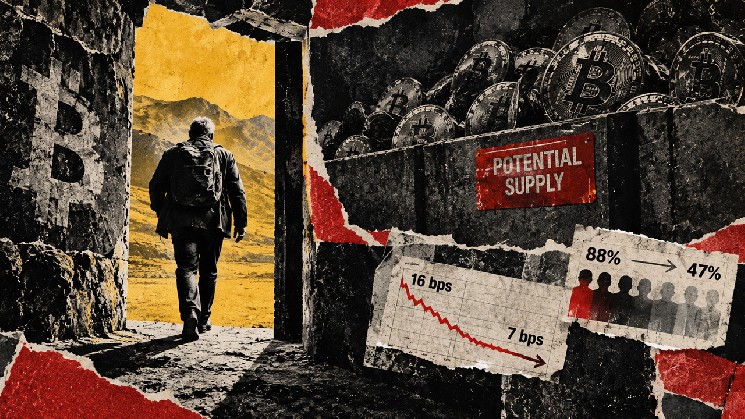
    Sell-Side Risk Ratio Falls to 7 Basis Points

    The firm’s Sell-Side Risk Ratio stood at 7 basis points per day on a seven-day basis, down sharply from 16 basis points at August’s peak. This metric aggregates on-chain profits and losses and divides the total by realized capitalization, measuring value realization relative to that capital base to indicate potential selling pressure.

    Long-term holders accounted for 47% of realized profit during the period, compared with 88% at the August peak. The decline suggests older holders are contributing a smaller share of the market’s realized profit, though the percentage does not measure their share of all Bitcoin sales.

    A ratio below half its earlier level does not mean the volume of Bitcoin sold on exchanges has halved.

    Profit Realization Spikes Moderate

    Glassnode separately reported that the realized-profit spike on September 3 was less than half the size of August’s spike. That comparison tracks profit spikes specifically, distinct from the seven-day risk measure. Together, the findings describe quieter realization activity and a changed mix of holders taking profits.

    Overhead Supply Cluster Holds at $83,000–$86,000

    The report identifies roughly 1.07 million BTC acquired between $83,000 and $86,000, almost all held by long-term holders. That block of coins barely changed over 30 days. The holdings remain potential supply, while the realization data describe what holders have recently been doing.

    Exchange Demand Remains a Separate Test

    Reports noted negative exchange spot flow on September 8. Spot cumulative volume delta (CVD) remained negative despite improving, meaning aggressive exchange selling still outweighed aggressive buying in that measure.

    CVD tracks the balance of executed trading, while sell-side risk tracks on-chain profit-and-loss realization relative to realized capitalization. A lower reading in the latter does not require the former to turn positive.

    Bitcoin holders are realizing less profit and loss relative to the capital base, while the overhead coins remain largely in place. Treating that entire block as immediate selling pressure would overstate the evidence. A sustained advance would still require buyers to absorb the supply that actually comes to market.

    Related Reading: Bitcoin’s next $80,000 breakout has $47 billion more profitable supply to absorb