Author: Evan Mercer

  • Former Alameda CEO Caroline Ellison Joins Manifund

    Former Alameda CEO Caroline Ellison Joins Manifund

    The Hire Predated the Public Announcement

    Manifund announced that Caroline Ellison began a work trial on July 13 and accepted a full-time role on August 10. During that period, she published work and supported users under the name “Carol.” Her stated responsibilities include developing the funding platform, operations, customer support, and research into how philanthropic funding should be directed. The September 11 post was therefore an identity disclosure rather than a same-day hiring decision.

    Manifund Is Not a Crypto Return

    Ellison has not returned to a cryptocurrency exchange, trading firm, or custody business. Manifund is a 501(c)(3) charity that hosts public grant proposals, fundraising, and regranting programmes. Its website lists 486 funded projects, $17.2 million directed to projects, and $5.46 million distributed through regrantors.

    The connection is not entirely separate from FTX. Manifund co-founder Austin Chen wrote that the FTX Future Fund had provided seed funding to Manifold and influenced the philanthropic model Manifund later adopted. That background helps explain why an FTX-related hire is material to Manifund’s donors and grant recipients, even though the organisation is not a crypto platform.

    The Reconciliation Tool Found Errors, But It Does Not Explain Access

    Manifund says Ellison built a reconciliation tool that found several incorrectly registered transactions in the five- to six-figure range. If the errors were identified and corrected as Manifund describes, the tool could improve the accuracy of its records.

    Finding an incorrect record is different from preventing an unauthorised payment before it happens. The announcement does not describe the platform’s approval structure or Ellison’s access to payment systems, so the public record does not allow readers to assess those controls.

    Transparency and Controls Are Different Things

    Manifund describes itself as unusually transparent, saying that its grant proposals, evaluations, finances, source code, and meeting notes are public. The company acknowledged that using a pseudonym for Ellison was a compromise on that principle, although Chen said he still supported the decision.

    Public proposals and source code make parts of Manifund easier to inspect. They do not, on their own, show how the charity separates payment authority, record-keeping, and independent review. A small team makes those role boundaries especially relevant because fewer people may be involved in approving, recording, and reviewing the same transaction. A September 3 Manifund hiring post described the team as “2ish FTE” and listed grant payouts, incoming donations, bookkeeping, and work with auditors among its operations and finance tasks.

    The FTX Record Makes the Role Material

    Ellison pleaded guilty in 2022 to fraud, conspiracy, and money-laundering-related charges tied to FTX and Alameda Research. The U.S. Department of Justice said she admitted her role in schemes that defrauded FTX customers and investors before cooperating with prosecutors.

    Ellison’s guilty plea and cooperation explain why her identity is material to donors and grant recipients. The announcement acknowledges that concern, but does not specify how Manifund has divided operational and financial responsibilities since hiring her. Coindoo’s earlier overview of the FTX case explains the different outcomes for the executives involved. That legal history provides the context for scrutiny; it does not establish how Manifund operates today.

    The Next Disclosure Should Be Operational

    Manifund has identified Ellison and explained why it initially used a pseudonym. It could reduce the remaining uncertainty by explaining whether significant payouts require more than one approval, who can modify financial records, and how reconciliation work is independently reviewed. That would give donors and grant recipients a clearer basis to judge the platform’s safeguards than a general promise of transparency.

  • Former Alameda CEO Caroline Ellison Joins Manifund in Full-Time Role

    Former Alameda CEO Caroline Ellison Joins Manifund in Full-Time Role

    Caroline Ellison, the former Alameda Research CEO who cooperated with prosecutors following the collapse of FTX, has accepted a full-time position at Manifund, a nonprofit grant-making platform. Manifund cofounder Austin Chen announced the hire, stating that Ellison will focus on improving the platform’s technical infrastructure and researching how philanthropic capital can be allocated more effectively.

    From Work Trial to Full-Time Role

    Ellison began a work trial on July 13 and transitioned to a full-time role on August 10. For her first two months, she operated under the pseudonym “Carol.” For observers of the cryptocurrency sector, the nature of her new role is the critical detail. Ellison is not returning to a trading desk or a treasury management position. Instead, her responsibilities center on technical infrastructure, logistics, and customer support. One early project involved building a reconciliation tool that uncovered misreported transactions in the Manifund database totaling “5-6 figures.”

    Manifund’s Funding Model and Ellison’s Mandate

    Manifund operates as an open platform connecting charitable donors with fundraisers. The organization utilizes three primary financing mechanisms:

    • Publicly disclosed proposals backed directly by donors.
    • Regrantors who distribute grant budgets according to donors’ directives.
    • Impact-certificate markets where donors fund winning or deserving projects.

    According to the organization, Manifund has financed 486 projects, raised $17.2 million, and transferred $5.46 million through regrantors. Ellison’s remit covers the technical and operational backbone of these initiatives. She has stated she will continue to improve Manifund’s technical systems, operations, and customer service, while the selection of funded projects will remain outside her purview.

    Navigating Regulatory Restrictions

    This distinction is legally significant. Ellison remains subject to regulatory sanctions stemming from the FTX case. In December 2025, the SEC filed proposed final consent judgments barring her from serving as an officer or director for 10 years and imposing a conduct-based injunction for five years. Separately, in August, the CFTC imposed a five-year trading ban and a 10-year registration bar. Legal observers note that a technical and operational role at a private charity appears to fall outside the scope of these limitations.

    Ellison pleaded guilty in December 2022 to fraud and conspiracy charges related to FTX. She subsequently cooperated with prosecutors and testified against Sam Bankman-Fried. She began a two-year prison sentence in November 2024 and was released in January 2026.

    Organizational Ties to the FTX Future Fund

    The hiring carries added sensitivity due to Manifund’s history with the FTX Future Fund. Chen acknowledged he had “a keen debt” to the fund, which backed the initial Manifold initiative that preceded Manifund, noting that most of Manifund’s concepts are based on that earlier work. Given the SEC’s allegations that Alameda Research misappropriated FTX customer funds for trading and investments, Ellison’s appointment carries weight beyond a standard personnel decision.

    Transparency Concerns and Pseudonym Use

    Manifund promotes transparency as a core value. Chen conceded that allowing Ellison to work under a pseudonym for several months meant the organization had “compromised on transparency.” This admission has fueled debate regarding the platform’s commitment to its stated principles.

    Debate Over Redemption and Reputation

    Chen framed the decision explicitly around the concept of second chances:

    I believe in redemption.

    — Austin Chen, Manifund cofounder

    He argued that Ellison admitted wrongdoing, worked to make creditors whole, and served her prison sentence. Ellison echoed this sentiment:

    I’m very grateful to Austin for giving me a second chance, and judging me on my current work performance rather than my past.

    — Caroline Ellison

    Not all stakeholders agree. Responding to the announcement, Cate Hall, former CEO of Astera Institute, characterized the decision as:

    truly terrible judgment

    — Cate Hall, former CEO of Astera Institute

    This divergence of opinion underscores the significance of the hire. While Ellison is not re-entering crypto finance, her new role tests the boundaries of reputational rehabilitation after one of the largest frauds in financial history. For Manifund, the ultimate verdict will depend less on the symbolism of the hiring and more on whether donors believe the platform’s transparency, controls, and results justify the trust Chen is asking them to extend.

  • BitMEX Shuts Down on September 23: How to Verify If Your Remaining Balance Is Withdrawable

    BitMEX Shuts Down on September 23: How to Verify If Your Remaining Balance Is Withdrawable

    BitMEX Closure: Key Withdrawal Deadlines and Fee Traps Before September 23, 2026

    Anyone still holding a balance on BitMEX must verify two critical factors before the exchange ceases trading on September 23, 2026, at 04:00 UTC: whether the amount exceeds the minimum withdrawal threshold for each asset, and which network offers the lowest withdrawal fee. Both details are publicly available in the exchange’s wallet interface and together determine if a remaining balance can be moved at all. As of September 11, 2026, data collected by cryptoticker.io shows that on 14 of 62 open withdrawal routes, the network fee matches or exceeds the minimum withdrawal amount, potentially rendering small balances immobile.

    What Happens on September 23 and What Remains Accessible

    The operating company, HDR Global Trading, announced the closure on July 23, 2026, outlining a three-stage wind-down:

    • July 23, 2026: New account registrations stopped.
    • August 26, 2026, 04:00 UTC: Risk limits applied; positions can only be reduced, not increased.
    • September 23, 2026, 04:00 UTC: Trading ceases. All open positions at that moment are force-closed immediately.

    The exchange strongly encourages users to close positions and withdraw funds as soon as practicable. Crucially, account access does not end on the cut-off date. Users can still log in, view wallet balances and transaction history, and withdraw funds. The final date closes trading only; withdrawals remain open.

    Minimum Withdrawal Amount vs. Network Fee: The Double Barrier

    The minimum withdrawal amount is the smallest quantity the platform will accept for a withdrawal of a given asset. If a balance falls below this threshold, the system rejects the order regardless of fee affordability. Only after clearing this hurdle is the network fee deducted. When the fee is in the same order of magnitude as the minimum amount, a withdrawal at the lower limit leaves little or nothing.

    For example, Bitcoin’s minimum withdrawal is 1,000 satoshi (0.00001 BTC, ~€0.67 on September 11). The fee ranges from a standard 1,000 satoshi up to a technical ceiling of 10,000,000 satoshi, varying with network load.

    14 Withdrawal Routes Where Fees Match or Exceed Minimum Amounts

    Comparing the on-file fee against the minimum withdrawal amount for each of the 62 open routes reveals 14 cases where the ratio is at least 1:1. In five of these, the fee is considerably larger than the minimum. The data condenses eleven asset-network pairs because USDT is affected on three chains simultaneously. One entry shows a dust value at the eighth decimal place where both minimum and fee sit at the technically smallest value.

    Practical impact: a holder of two or three APE tokens clears the minimum but loses most to fees. Anyone sitting exactly at the lower limit receives nothing. For other routes, ratios are modest: AAVE, Avalanche, and NEAR fees are ~7% of the minimum; POL ~1%; XRP ~2%.

    GATA: The Only Token With No Open Withdrawal Route

    GATA stands out as the only one of 51 crypto assets with both deposit and withdrawal switches inactive on September 11. The asset remains listed as active at account level, and its on-file fee (5 tokens) matches the minimum withdrawal amount exactly. Whether this is a temporary technical shutdown or permanent delisting cannot be determined from the interface alone. Holders should contact the platform directly rather than wait for a reopening.

    Network Choice Is the Most Effective Cost Lever

    The choice of withdrawal network drastically affects cost, largely independent of balance size. Several assets operate across four to six networks with identical minimum amounts but widely varying fees.

    • USDT: 0.05 USDT via Arbitrum, 0.10 USDT via Optimism, 0.50 USDT via Ethereum, 1.00 USDT via Tron, BNB Chain, and Solana — a 20x spread.
    • USDC: 0.05 USDT via Arbitrum, 0.07 via Avalanche, 0.10 via Base, 0.50 via Ethereum, 1.00 via Solana.
    • Ether: 0.00025 ETH on Ethereum mainnet; 0.00005 ETH on Arbitrum, Optimism, and Base (one-fifth the cost). Minimum is 0.0005 ETH on all four.

    Two caveats apply: the receiving wallet must support the chosen network, and forwarding from the destination address incurs additional fees. If the ultimate destination is an EU-supervised exchange, verify which networks it accepts for deposits before selecting a chain.

    How to Check Your BitMEX Balance in Four Steps

    1. List all remaining balances, including dust. Open the wallet overview and note every asset, especially tiny remainders from old settlements — these are most vulnerable to the upcoming account fee.
    2. Compare each balance to its minimum withdrawal amount. If below the threshold, consider swapping internally to an asset with a reachable threshold, or write it off. Note that a swap triggers a taxable disposal.
    3. Select the cheapest chain your counterparty accepts. Compare per-network fees against the deposit options of your target address. For stablecoins, the difference between chains often exceeds the entire minimum amount.
    4. Close positions yourself before September 23. Open positions will be force-closed at the deadline. Closing early lets you control timing and price. As of August 22, 2026, four futures contracts still traded past the closure date.

    Forced Closure and Tax Implications

    For tax purposes, a forced closure is equivalent to a voluntary one: a transaction occurs and a gain or loss is realized. The same applies to internal swaps used to lift a balance above the withdrawal threshold. In Germany, futures and derivatives are taxed under Section 20 of the Income Tax Act; the one-year holding period under Section 23 does not apply. Exact classification depends on the product and personal circumstances — consult a tax adviser.

    Export your trading history and settlements while account access exists. Post-closure exports tend to be laborious, and missing records turn next year’s tax filing into reconstruction work. A portfolio tracker with tax reporting can ingest the raw data if complete.

    Limitations of This Survey

    The figures reflect the interface state on September 11, 2026. They do not guarantee execution speed, confirmation times, or potential short-notice re-enabling of assets. Fee fields are parameters on file; Bitcoin’s fee range is explicit, and actual charges may differ. Unchecked areas include internal swap trading fees, verification processing times, and the technical activation date of the announced account fee. The wallet interface provides no insight on these. For binding answers on a specific balance, contact the provider directly.

    Also, an unfavorable fee-to-minimum ratio does not imply a high fee relative to your balance. Withdrawing 400 USDT over Tron costs 1 USDT (0.25%). The trap primarily catches small balances near the lower limit.

    Lessons for Users of Non-EU-Supervised Venues

    BitMEX shaped the perpetual futures market for over eleven years and is winding down orderly after a board decision. For users in Germany, the key takeaway: where a provider operates outside the European supervisory framework, there is no national deposit guarantee and no authority to compel withdrawals. Only the provider’s terms and notices apply.

    Anyone continuing to trade perpetual futures should verify the next venue’s regulatory supervision and which withdrawal routes it maintains. For custody, the principle holds: assets not actively traded need not sit on a trading venue.

    Timeline: Announcement to Final Date

    • July 23, 2026: Closure announced; new account openings stopped.
    • August 26, 2026, 04:00 UTC: Risk limits take effect; new positions blocked; only reductions allowed.
    • September 11, 2026: Survey cut-off. 62 of 68 routes open for withdrawals; 50 for deposits.
    • September 23, 2026, 04:00 UTC: Trading ends; remaining positions force-closed.
    • Afterwards: Account access and withdrawals remain; announced account fee applies to unwithdrawn assets.

    Key Takeaways for Withdrawing Your BitMEX Balance

    • Check every balance against its minimum withdrawal amount today. On 14 of 62 open routes, the fee meets or exceeds that minimum; small balances may need an internal swap first. Decide the destination beforehand — consult an overview of EU-supervised exchanges for supported networks.
    • Pick the chain by fee, not habit. For USDT and USDC, a 20x cost gap separates the cheapest and most expensive routes. If the balance won’t be traded further, move it to self-custody; see a hardware wallet comparison for device options.
    • Export trading history before trading ends. Forced closures are ordinary taxable transactions; you’ll need records for next year’s return. Raw data can be imported into a tax and portfolio tool if complete.

    The exchange’s notice is in the official closure statement; market context is available from Crypto Briefing and other outlets.

    (As of September 11, 2026. This article is not investment advice. Prices and fee structures change; verify terms with the provider before acting.)

  • Binance Bitcoin Reserves Hit 2-Year High — Is Selling Pressure Building?

    Binance Bitcoin Reserves Hit 2-Year High — Is Selling Pressure Building?

    Binance Bitcoin Holdings Surge to 693,000 BTC, Highest Level in Nearly Two Years

    Binance’s Bitcoin (BTC) reserves have climbed above 693,000 BTC, marking the highest level in almost two years. According to data from CryptoQuant, the exchange’s holdings have risen by approximately 77,000 BTC since the end of April.

    Why Are Investors Moving Bitcoin to Binance?

    The most straightforward explanation for this surge is that investors transferred Bitcoin to Binance during periods of strong price appreciation—primarily the May rally and the more recent August rally. When traders anticipate selling, they often move BTC from personal or cold wallets to exchanges to facilitate large trade execution.

    While a rising exchange balance can signal that potential selling supply is building up, it is not a definitive confirmation of an imminent sell-off.

    Three Key Drivers Behind the Inflow

    1. Deep Liquidity Attracts Large Orders

    Binance’s deep liquidity makes it the preferred platform for traders executing substantial BTC orders. Large trades can be filled with minimal market price impact, drawing significant volume to the exchange.

    2. SAFU Fund Deployment

    The Secure Asset Fund for Users (SAFU)—Binance’s emergency protection mechanism—intends to deploy $1 billion to secure roughly 15,000 BTC to help the Bitcoin community through the current transitional period.

    3. Rise in Scams and Hacks

    Total losses from scams and hacks have already crossed $1.732 billion in 2026. Following incidents such as the ColdCard exploit—where the attacker is still moving stolen Bitcoin—some holders have temporarily moved funds to established third-party platforms for safety.

    Is This an Early Warning Sign of a Sell-Off?

    The surge coincides with Bitcoin’s supply growth accelerating in 2026 at a faster pace than in several previous years. By around day 250, the 2026 supply growth line has reached roughly 6–7 million BTC. Compared with 2025 and earlier years at similar points, the 2026 pace appears relatively strong, suggesting more BTC is entering the market.

    Source: CryptoQuant

    However, this influx has also generated FUD (fear, uncertainty, and doubt). If a large portion of the over 693,000 BTC held on Binance eventually moves into the market for sale, it could increase available supply and potentially create additional downward pressure on price.

    BNB Price Action: $725 Reclaim Critical for Recovery

    At press time, BNB was trading at $712.97 after a modest daily and weekly decline, but with a monthly gain of over 16%. AMBCrypto recently reported that BNB is testing the $700 support level.

    • Holding above $700 could stabilize the price.
    • A break below $700 could push BNB toward $680–$690.
    • For a recovery, BNB must first reclaim $725, followed by resistance around $750.

    Optimism remains, however, as BNB Chain gains momentum in real-world asset (RWA) tokenization. Tokenized-asset holders have risen 320% in 30 days, with the user base potentially reaching 800,000.

    Bitcoin Price Context

    Bitcoin’s price was down at $76,983.20 at press time. Yet unrealized profit remains elevated near $120K, indicating underlying bullish support in the market.

    Source: CryptoQuant

    Key Takeaways

    • Binance’s deep liquidity is the primary reason it became the first choice for Bitcoin holders.
    • Rising scams and hacks explain why some holders temporarily moved Bitcoin to established third-party platforms.
  • 463 Billion Shiba Inu in 24 Hours: Can Bulls Save SHIB Price?

    463 Billion Shiba Inu in 24 Hours: Can Bulls Save SHIB Price?

    Shiba Inu Exchange Outflows Surge as SHIB Tests Critical Support Zone

    Shiba Inu ($SHIB) is approaching a pivotal technical support area while exchange data reveals a significant shift in token distribution. Recent on-chain metrics show hundreds of billions of SHIB tokens exiting centralized exchanges, a development that typically reduces immediate sell-side pressure and could provide a supply-side tailwind for bulls.

    Exchange Netflow Turns Sharply Negative

    According to the latest exchange flow data, the measured period recorded approximately 461.4 billion $SHIB in outflows against 229.0 billion $SHIB in inflows. This produces a negative netflow of roughly 232.4 billion $SHIB, meaning substantially more tokens left tracked exchanges than entered them.

    Exchange reserves corroborate the outflow trend. Total reserves declined by 0.27% to approximately 86.97 trillion $SHIB, while the dollar value of those reserves fell 1.43% to $440.9 million. Notably, transfer counts increased only 0.87% to 4,429, suggesting the withdrawal imbalance stems from larger average transaction sizes rather than a surge in transaction volume.

    Persistent exchange outflows generally benefit price action by reducing immediately available sell-side liquidity. However, the signal alone does not guarantee a recovery. The seven-day moving average of mean exchange outflows has decreased by 37.5%, indicating withdrawal intensity is weakening relative to its recent baseline.

    Technical Picture: SHIB at a Decisive Support Cluster

    The price chart underscores why the coming sessions are critical. $SHIB has reversed from its September local high of $0.00000555 and is currently trading near $0.00000505. The correction also broke the rising trendline that underpinned the late-August recovery.

    Price has now landed on a significant support cluster:

    • A longer-term moving average sits near $0.00000496
    • An intermediate (orange) moving average rests around $0.00000504

    If bulls can defend the $0.00000495–$0.00000505 zone, a momentum rebuild toward $0.0000053 and ultimately the $0.0000055–$0.0000057 region becomes plausible.

    Momentum Indicators Flash Caution

    Short-term momentum currently favors sellers. The Relative Strength Index (RSI) has dropped to approximately 47.3, falling below its signal line near 54.2. This confirms buyers have lost their near-term advantage.

    Outlook: Outflows Help, but Price Confirmation Required

    The 461 billion $SHIB outflow is a constructive development, yet bulls still need price confirmation to validate a recovery. Should the current support cluster fail, $SHIB could quickly retreat toward the $0.0000047–$0.0000045 area despite the positive exchange flow data.

  • Meteora’s $20M Fee Surge Drives 18% MET Rally, But Next Leg Faces Hurdle

    Meteora’s $20M Fee Surge Drives 18% MET Rally, But Next Leg Faces Hurdle

    Meteora Surges 18% as Reward Campaigns Drive User Growth and Fee Revenue

    Meteora’s native token, $MET, delivered one of the most significant gains in the market, rallying 18%. The surge appears to be fueled by recent reward campaigns designed to incentivize stakers and traders who refer liquidity providers to the protocol.

    Protocol Fee Generation and Incentive Structure

    Under the current mechanism, traders receive rewards for locking up $MET, earning a percentage of the fees generated by the protocol. According to data from DeFiLlama, Meteora accumulated $20.3 million in fees over the last 30 days, with approximately $1.03 million generated in the past 24 hours alone.

    Active Addresses and Transaction Volume Spike

    On-chain activity underscores the growing bullish sentiment. Active addresses—a key metric for user engagement—increased by over 40,000 between September 1 and September 10, reaching a daily high of 151,706. Simultaneously, transaction volume climbed sharply. DeFiLlama reports that transactions rose to 4.19 million, up from 2.96 million on September 1, representing an increase of 1.23 million transactions. Such heightened activity typically correlates with increased asset uptake and near-term price performance.

    Perpetual Market Signals Moderate Bullish Positioning

    The perpetual futures market reflects a constructive outlook. Data from CoinGlass shows the Funding Rate at 0.0060% over the past 24 hours. A moderately positive funding rate suggests investors are neither excessively bullish nor bearish, often indicating potential for further upside, particularly if supported by spot market dynamics.

    Spot Market Netflow Reveals Profit-Taking

    Despite the bullish structural signals, spot traders appear to be realizing gains. The Spot Market Netflow recorded an outflow of $474,000, following a larger $2.56 million sell-off. This suggests profit-taking activity among spot holders even as derivatives positioning leans positive.

    Key Takeaways

    • Meteora’s active addresses grew by over 40,000 to 151,706, while daily transactions surged to 4.19 million.
    • $MET’s positive funding rate points to bullish perpetual positioning.
    • Spot market netflow outflows of $474,000 indicate ongoing profit-taking.
  • Bitcoin Recovers From CPI Dip as US Inflation Holds at 3.4%

    Bitcoin Recovers From CPI Dip as US Inflation Holds at 3.4%

    US Inflation Data Triggers Brief Bitcoin Dip Before Recovery Above $77,000

    Bitcoin experienced a sharp but short-lived decline toward $76,000 following the release of the latest US Consumer Price Index (CPI) report, which showed underlying price pressures running slightly hotter than economists anticipated. The cryptocurrency quickly reversed course, reclaiming the $77,000 level, while Ethereum and several major altcoins maintained gains throughout the trading session.

    Core CPI Exceeds Forecasts, Keeping Federal Reserve Policy in Focus

    The US Bureau of Labor Statistics reported that the Consumer Price Index rose 0.4% in August, accelerating from July’s 0.1% increase and matching consensus estimates. On a year-over-year basis, headline inflation held steady at 3.4%, remaining well above the Federal Reserve’s 2% target.

    The core inflation measure, which strips out volatile food and energy components, increased 0.3% month-over-month — above the 0.2% increase most economists had projected. However, the annual core inflation rate edged down from 2.5% to 2.4%.

    Gasoline prices accounted for over one-third of the monthly headline increase, surging 3.9% and lifting the broader energy index 2.1%. Shelter costs rose 0.3%, while food prices edged up 0.1%.

    Bitcoin Volatility Reflects Trader Uncertainty on Rate Outlook

    Bitcoin initially slid to approximately $76,050 immediately after the data release before recovering to trade above $77,100. The token’s intraday range spanned $76,400 to $79,550, highlighting the divided sentiment among market participants interpreting the inflation implications for US interest rates.

    The stronger-than-expected core reading could reinforce a more hawkish stance from the Federal Reserve at its September 15-16 policy meeting. Elevated interest rates typically reduce the appeal of riskier assets as investors find alternative yield opportunities in safer instruments.

    Ethereum Outperforms as Broader Crypto Market Shows Resilience

    Ethereum led the major cryptocurrencies during the session, trading near $2,543 — a gain of nearly 3.2% after reaching intraday highs of $2,648. Solana advanced approximately 1.5% to around $101, while BNB climbed 1.4% to roughly $723. Dogecoin added a modest 0.5%, and XRP was little changed near $1.35.

    Notably, gains across the altcoin complex began before the CPI release, meaning they cannot be attributed to the inflation data. However, the market’s refusal to follow Bitcoin’s initial slide lower suggests the sell pressure was isolated rather than systemic.

    Key Takeaways

    • US headline inflation held at 3.4% year-over-year; monthly core CPI (0.3%) exceeded the 0.2% forecast.
    • Bitcoin briefly dipped toward $76,000 before recovering above $77,000, with an unusually wide $3,000+ intraday range.
    • Ethereum and major altcoins held gains, indicating the initial Bitcoin weakness did not trigger a broader market sell-off.
  • Bittensor (TAO) Falls 7% After Raydium Rally: What’s Next?

    Bittensor (TAO) Falls 7% After Raydium Rally: What’s Next?

    Bittensor ($TAO) ranked among the altcoins posting notable drawdowns over the past 24 hours, slipping nearly 7% in a single session. The token has traded in the red each day since Monday, September 7, extending a losing streak that now spans five consecutive sessions.

    Derivatives and Spot Demand Weaken

    Data from Coinalyze shows Open Interest declining 14.3% in 24 hours, while spot Cumulative Volume Delta (CVD) has also trended lower since Monday. The combined drop signals a lack of conviction from both spot buyers and derivatives participants. If the current trajectory holds, $TAO could record a fifth straight day of losses—a setback for bulls who recently watched the asset climb to a three-month high near $277 following its launch on Raydium.

    Weekly Structure Remains Bearish

    On the weekly timeframe, the technical picture underscores the downtrend. A swing low registered at $167.8 in April 2025 was breached by a weekly candle close at $163.2 in February 2026, confirming a bearish swing structure. Key levels to monitor include:

    • $142.8 and $377.8 — primary swing points on the weekly chart
    • $291.6 — a June high that, if cleared, could unlock short- to medium-term upside
    • $300 — psychological round number and critical supply zone

    The weekly Relative Strength Index (RSI) sits at 49, indicating neutral momentum, yet On-Balance Volume (OBV) has declined steadily since October, reflecting persistent bear-market conditions. A genuine bullish recovery would require a decisive break above the $377.8 swing point, with $300 acting as the first major hurdle.

    Resistance Cluster at $291.6–$300 Caps Upside

    Despite a relief rally from below $200 to nearly $280 in recent weeks, price structure remains bearish. The $291.6 high from June sits just beneath the $300 supply zone, creating a dual-layer resistance cluster. Overcoming this zone would demand aggressive, sustained buying pressure—demand that may not materialize if Bitcoin struggles to reclaim the $80,000 level after its recent rejection.

    Trader Outlook: Wait for Deeper Discount

    Swing traders and investors are advised to exercise patience. A pullback toward the $190 region could offer a more favorable risk-reward entry for those anticipating the next bullish $TAO reaction.

    Key Takeaways

    • $TAO declined ~7% in 24 hours; Open Interest fell just over 14%.
    • Weekly structure is bearish; bulls have failed to flip $300 into support.
    • Next meaningful upside requires a weekly close above $377.8.
    • Near-term bias favors further drawdown unless Bitcoin regains $80K and spurs broad risk-on flows.
  • Bitcoin Cash Drops 10%: What’s Next for BCH Whales?

    Bitcoin Cash Drops 10%: What’s Next for BCH Whales?

    Bitcoin Cash Drops 10% as Whale Activity Diverges Across Spot and Futures Markets

    Bitcoin Cash (BCH) declined approximately 10% over the past 24 hours, but the sell-off masked a notable divergence in how large investors are positioning across spot and perpetual futures markets. According to on-chain and derivatives data, whale-sized orders dominated trading volume on both sides of the market, yet their directional bias tells a more nuanced story.

    Whale Orders Surge in Both Spot and Futures

    Analysis from CryptoQuant shows that average order sizes spiked across BCH markets during the decline. The Futures Average Order Size reached 164.47, while the Spot Average Order Size came in at 152.51, indicating heavy participation from large-volume traders in both venues.

    However, average order size alone does not reveal whether those orders were buys or sells. To gauge directional conviction, analysts looked at actual positioning data.

    Futures Market Shows Aggressive Short Positioning

    In the perpetual futures market, the surge in order size coincided with rising selling pressure. The Bitcoin Cash Open Interest Weighted Funding Rate turned deeply negative, printing -0.0244% at the time of writing, per CoinGlass data.

    With roughly $356 million in open interest, the extremely negative funding rate suggests the majority of positions are held by sellers. This implies whales have likely been opening short positions on BCH during this period, betting on further downside.

    Spot Market Signals Accumulation, Not Distribution

    The spot market tells a different story. CoinGlass data shows the Spot Netflow over the past 24 hours reached approximately -$3.45 million. A negative netflow of this magnitude typically indicates heavy buying on centralized exchanges, with traders withdrawing BCH to private wallets—a behavior often associated with long-term accumulation.

    This creates a clear split: futures whales are shorting aggressively, while spot whales are accumulating.

    Liquidation Cluster Below Current Price Adds Downside Risk

    The one-month Liquidation Heatmap from CoinGlass reveals a significant concentration of liquidation liquidity—over $4 million—clustered near the $208 level, below current prices. Such clusters can act as magnets during volatile moves, though they do not guarantee a decline.

    Spot Flow Remains the Key Swing Factor

    Market structure at current levels will likely hinge on spot trader behavior. If the cohort currently accumulating BCH begins to sell more than they buy, it could weaken support and accelerate a move toward the liquidation zone. For now, spot demand remains the critical counterweight to bearish futures positioning.

    Key Takeaways

    • BCH fell ~10% in 24 hours amid heavy whale volume in both spot and perpetual markets.
    • Futures data shows aggressive short positioning: Open Interest Weighted Funding Rate at -0.0244% on ~$356M open interest.
    • Spot Netflow of -$3.45M signals exchange outflows and likely long-term accumulation.
    • Liquidation heatmap highlights $4M+ in liquidity near $208, a potential downside target if spot support cracks.
  • L-BTC Resumes Trading With Reserves Covering Just 85% of Supply

    L-BTC Resumes Trading With Reserves Covering Just 85% of Supply

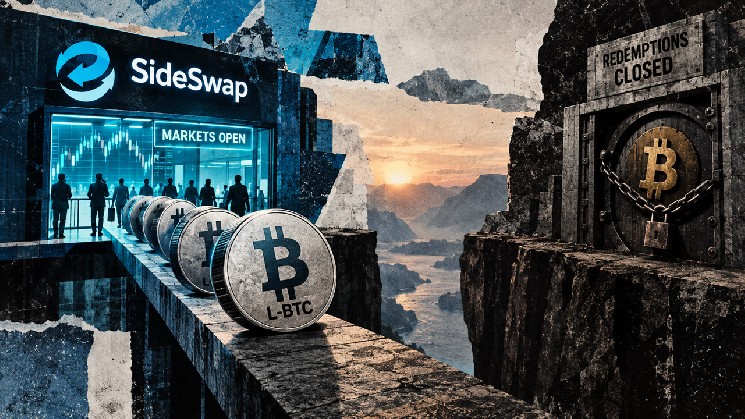
    SideSwap Reopens Liquid Markets While Bitcoin Peg Remains Suspended

    SideSwap has reopened trading on the Liquid network even as the bridge back to Bitcoin stays closed, creating a market price for Liquid Bitcoin (L‑$BTC) before holders can redeem it for actual BTC.

    Reserve Data Shows 85% Coverage and a 627 BTC Gap

    At 22:55 UTC on Sept. 10, a Blockstream explorer endpoint recorded 4,229 L‑$BTC outstanding. A simultaneous reading of the federation reserve address showed 3,601 BTC. Those figures imply reserve coverage of roughly 85.15% and a shortfall of about 627 BTC at that moment.

    SideSwap’s own Sept. 10 statement cited an earlier snapshot of 4,205 L‑$BTC and 3,597 BTC in reserve. The later API readings used here are slightly higher on both sides, while the coverage ratio remains near 85%. Each row represents a separate time‑stamped view, making the reserve ratio a live measure rather than a settled loss estimate.

    Trading Venue and Federation Operate Under Separate Mandates

    SideSwap runs the trading venue and wallet. The Liquid Federation controls the Bitcoin reserve and authorizes the peg‑out process, while Blockstream provides core technology and publishes network status. Their distinct roles explain how venue trading can resume ahead of federation redemption.

    SideSwap describes its swap venue as a central‑limit‑order‑book market with L‑$BTC as the base asset and registered Liquid assets as quotes. Its documentation does not identify a direct L‑$BTC/BTC order book. At publication time, no reproducible post‑restart L‑$BTC/BTC price, bid‑ask spread, depth, slippage measure, or cross‑venue comparison was publicly available. The evidence confirms the reopening of SideSwap’s venue, while leaving the actual post‑restart discount or premium unmeasured.

    Price Parity Is Now a Confidence Signal, Not Proof of Backing

    Before the incident, redemption arbitrage kept the two assets aligned: a trader could buy discounted L‑$BTC, redeem it for BTC, and repeat until the discount narrowed. Suspended federation peg‑outs remove that enforcement route, so price parity becomes a confidence signal rather than proof of backing.

    A near‑par L‑$BTC price would indicate that participating buyers expect most value to be recoverable. Expectations of recapitalization could support that price. A thin order book could do the same for small orders while offering much worse execution for larger positions.

    Reserve Gap Traces Back to Sept. 6 Incident

    The reserve gap followed the Sept. 6 incident. A transaction shows 3,400 BTC returning on Sept. 7, matching earlier recovery coverage. A 22:55 UTC reading showed about 598.50048115 BTC at the address identified through that history. Supply and reserve balances can change separately, so that address balance and the later reserve gap are related evidence rather than interchangeable totals.

    Liquid Restart Proceeds in Stages

    An official Blockstream status update described the restart’s first phase. As of 10:00 UTC on Sept. 10, block production had resumed in a controlled mode without transactions. Required functionary and bridge‑node updates had been deployed, while peg operations—including PAK‑authorized peg‑outs—remained suspended during reserve restoration.

    By 22:55 UTC, the Liquid explorer’s block‑tip endpoint had reached height 4,051,868, confirming continuing block production at the snapshot time. Transaction availability still depended on the separately published operating status.

    Liquid’s homepage later said issued‑asset transfers had resumed while L‑$BTC transfers and peg‑outs remained paused. SideSwap, meanwhile, said its swaps and all markets were open. The two statements address different surfaces and leave the precise scope of L‑$BTC market settlement less clear than SideSwap’s headline alone suggests.

    This distinction also applies to transactions caught in the pause. SideSwap said peg‑ins and peg‑outs already in progress through its service would be completed after blocks resumed. It also said Bitcoin payouts completed before the pause were final. The statement covers SideSwap’s service and offers no federation‑wide guarantee for transactions initiated through other providers.

    Other issued assets have separate backing arrangements. SideSwap noted that assets such as USDt and DePix depend on their issuers rather than the L‑$BTC reserve. Their ability to move or trade therefore gives holders limited information about the condition of the Bitcoin peg.

    Restoring the Peg Requires Reserves and a Working Bridge

    Liquid’s protocol documentation defines one L‑$BTC as a claim backed by one BTC held by the federation. The peg‑out process burns L‑$BTC, validates an authorized Bitcoin destination, and releases BTC from the federation reserve.

    Direct peg‑outs require a registered Peg‑out Authorization Key. General users usually depend on a federation participant, exchange, or peg‑out partner. A dependable exit therefore requires sufficient reserve BTC and functioning authorized infrastructure through which holders can reach it.

    The Elements project released version 23.3.4, including a change that hardens proof‑cache keys. Blockstream said required functionary and bridge‑node updates had been deployed. Completion of a full independent review of the network and peg process remained undisclosed in the reviewed official updates.

    Reserve restoration is the other condition. SideSwap said Blockstream CEO Adam Back had stated that the L‑$BTC‑to‑BTC peg would receive one‑for‑one coverage. SideSwap added that it lacked insight into the method or timing. Blockstream’s status page described restoration as in progress without naming a capital source or deadline.

    Clear operating conditions form the final piece. Holders need a federation announcement that peg‑outs have resumed, an explanation of any limits or staged access, and confirmation from the provider handling their redemption route. SideSwap separately promised to explain changes to its own peg service before reopening it.

    Until those conditions are met, L‑$BTC’s market price measures confidence in the recovery process. The reserve data and disabled peg‑outs determine whether holders can actually leave Liquid with Bitcoin at par.