Author: Evan Mercer

  • Hyperliquid Burns 32.77K HYPE as TVL Nears $7B: Can Bulls Recover?

    Hyperliquid Burns 32.77K HYPE as TVL Nears $7B: Can Bulls Recover?

    Hyperliquid Burns 32,770 HYPE Tokens Worth $2.65 Million as TVL Nears $7 Billion

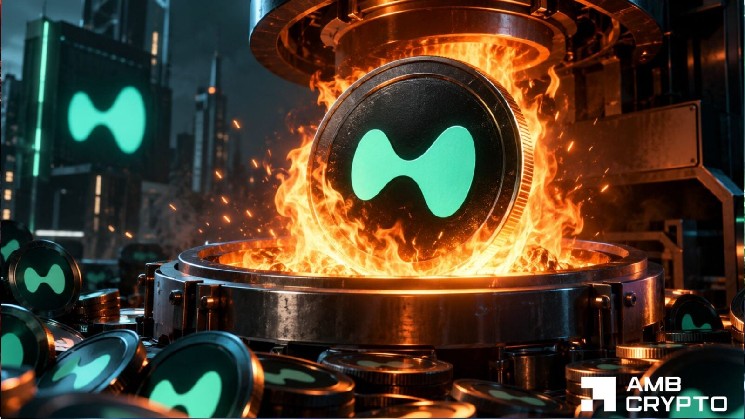
    Hyperliquid’s native token $HYPE underwent another supply reduction this week as the protocol executed a buyback and burn of approximately 32,770 HYPE. The transaction carried a value of roughly $2.65 million at an average purchase price of $81.01 per token.

    According to on-chain data, this latest burn brings the cumulative lifetime burns to 48.57 million HYPE, representing an estimated $3.82 billion at current market valuation. The removed tokens account for approximately 4.86% of the total $HYPE supply. The mechanism permanently reduces the maximum circulating supply rather than temporarily locking tokens, converting protocol-generated revenue into deflationary pressure on an ongoing basis.

    While the burn mechanism continues to operate as designed, analysts note that supply reduction alone does not guarantee immediate price appreciation. Sustained revenue generation remains essential to maintain the scale and frequency of future buybacks.

    Rising TVL Strengthens Hyperliquid’s Burn Engine

    Underpinning the burn activity, Hyperliquid’s Total Value Locked (TVL) has climbed toward the $7 billion mark, up from a prior range near $6 billion. The acceleration began in September, pushing locked capital to near all-time highs.

    Daily protocol fees continue to reach several million dollars, with periodic spikes significantly exceeding baseline levels. This combination of elevated TVL and robust fee generation provides the economic foundation for recurring $HYPE purchases. However, the burn mechanism ultimately depends on durable platform usage rather than TVL growth in isolation. A sustained alignment of capital inflows and fee generation would enhance $HYPE’s long-term supply dynamics.

    Source: DefiLlama

    Derivatives Traders Show Tentative Return to Long Exposure

    On the derivatives front, positioning has shifted following volatile funding rate fluctuations throughout September. The $HYPE open interest-weighted funding rate briefly turned negative multiple times after September 8, but recovered into positive territory around 0.0012% by September 12, per CoinGlass data.

    The reversal suggests long positions have reclaimed a slight funding premium over shorts. However, current rates remain well below the higher positive levels recorded during late August sessions, indicating renewed long exposure has not yet returned to similarly aggressive levels.

    A sustained positive funding rate could support the demand outlook provided leverage remains controlled. Conversely, another move below zero would signal renewed short-side pressure.

    Source: CoinGlass

    $HYPE Price Action Tests Critical $78.50 Support After Channel Breakdown

    Price action presents the clearest near-term risk after $HYPE failed at the $88.14 resistance zone. The rejection pushed price beneath its rising channel before finding temporary stability around the $78.65 area.

    The $78.50 level has emerged as immediate structural support that will determine whether the breakdown deepens. A confirmed break below this threshold could validate a Change of Character (CHoCH) in price direction, signaling a structural shift to bearish momentum.

    Technical indicators align with the weakening structure:

    • MACD registered a bearish crossover accompanied by a negative histogram
    • RSI cooled to 50.69 after previously reaching overbought territory during the recent advance

    The RSI remains in neutral territory rather than oversold conditions, confirming the deteriorating technical structure without yet signaling capitulation. Successfully defending $78.50 could support stabilization and reopen a recovery attempt toward the $88.14 supply zone. However, losing the key support would reinforce the bearish structural shift and expose the $70 support region.

    Source: TradingView

    Key Takeaways

    • Hyperliquid’s recurring burns continue reducing $HYPE supply as TVL approaches $7 billion
    • $HYPE must defend $78.50 to avoid confirming a bearish Change of Character

  • Bitcoin Suisse Plans to Cut Up to Half Its Swiss Jobs as Work Shifts Abroad

    Bitcoin Suisse Plans to Cut Up to Half Its Swiss Jobs as Work Shifts Abroad

    Bitcoin Suisse Cuts 60 Jobs in Switzerland, Shifts Development Overseas

    Crypto financial services firm Bitcoin Suisse plans to eliminate up to 60 positions in Switzerland, reducing its domestic workforce by half, as the company moves software development and back-office operations to lower-cost international hubs. The Zug-based firm, which oversees more than $3 billion in digital assets under custody, employs roughly 200 people globally.

    Restructuring Driven by Cost Efficiency

    As part of the reorganization, Bitcoin Suisse is closing its IT development site in Copenhagen. The company already operates a technology hub in Bratislava, Slovakia, and intends to establish another in Vietnam. CEO and co-founder Andrej Majcen explained the rationale to Swiss outlet Finews, which first reported the restructuring:

    “In Bratislava and Vietnam, we can provide these services at significantly lower cost,”

    Majcen emphasized that the decision reflects the company’s international growth strategy and is unrelated to difficult crypto market conditions.

    Expansion Beyond Crypto Services

    Founded in 2013, Bitcoin Suisse offers crypto trading, custody, staking, and lending. According to Majcen, the firm now aims to broaden its scope into wealth and asset management services targeting high-net-worth individuals and institutional clients.

    To support that expansion, the company has begun securing regulatory licenses. Its Liechtenstein subsidiary received authorization in June under the European Union’s Markets in Crypto-Assets (MiCA) framework, enabling it to serve clients across selected European Economic Area markets.

  • OpenAI IPO Not Happening This Year, Sam Altman Confirms

    OpenAI IPO Not Happening This Year, Sam Altman Confirms

    OpenAI Public Offering Pushed to 2027 as Safety Concerns Take Priority

    OpenAI has signaled that its initial public offering will not arrive before 2027, with Chief Executive Officer Sam Altman emphasizing that current safety challenges make a stock market debut ill-advised at this stage.

    Altman: “Ill-Advised Moment to Go Public”

    Speaking with Fortune, Altman explained that the company faces no external pressure to pursue an IPO and remains focused on the substantial work required to ensure artificial intelligence safety and alignment.

    “I actually think that, given everything happening with safety, right now would be an ill-advised moment to go public, and we don’t feel pressure on that,” OpenAI CEO Sam Altman told Fortune.

    “We got a lot of stuff to do, like meeting this moment of what is going to be required for safety and alignment, and how the industry and governments can work together,” he continued.

    Industry Leaders Call for AI Race Slowdown

    The timeline update arrives amid growing consensus among top AI executives about the need for a more measured development pace. Anthropic CEO Dario Amodei publicly urged a slowdown in the competitive AI race over the weekend, a position that quickly drew agreement from both Altman and Elon Musk.

    This alignment across competing firms underscores a shifting industry priority: moving beyond raw capability advancement toward robust safety frameworks and coordinated governance with policymakers.

  • Ripple Stablecoin Executive Identifies $13 Trillion Corporate Treasury Opportunity for RLUSD

    Ripple Stablecoin Executive Identifies $13 Trillion Corporate Treasury Opportunity for RLUSD

    Ripple’s RLUSD stablecoin, launched nearly two years ago, still trails industry leaders Tether’s USDT and Circle’s USDC, yet its growth trajectory is accelerating. According to Token Terminal data, RLUSD’s circulating supply has reached $2.4 billion, marking an increase of more than 50% over the past month. Of that total, approximately $1 billion resides on the XRP Ledger, while $1.4 billion sits on Ethereum.

    Utility and Daily Activity Trump Market Cap

    Ripple emphasizes real-world usage over headline market capitalization. “What’s more exciting to us is the utility and the daily activity,” McDonald said. He noted that RLUSD’s daily activity has more than tripled since the beginning of the year, climbing to roughly $750 million a day last month from about $200 million.

    Payments and Capital Markets Drive Adoption

    Two primary verticals are fueling RLUSD adoption: payments and capital markets.

    • Payments: Ripple has made RLUSD the primary stablecoin in its payments business.
    • Capital markets: The token serves as the cash leg for transactions, settlement, and collateral.

    Ripple has partnered with firms including Franklin Templeton and DBS around tokenized money-market funds and lending. Additionally, RLUSD can be posted as collateral through Ripple Prime, the institutional brokerage business formed from the Hidden Road acquisition.

    Integrated Strategy: Stablecoins Meet Custody, Trading, and Prime Brokerage

    This approach reflects Ripple’s broader push to combine stablecoins with custody, trading, payments, and prime brokerage rather than operate RLUSD as a standalone product.

  • CFTC Probes Polymarket Trades Linked to Biden Pardons, Iran, Google, Report Says

    CFTC Probes Polymarket Trades Linked to Biden Pardons, Iran, Google, Report Says

    CFTC Opens Three Insider Trading Investigations Into Polymarket

    The Commodity Futures Trading Commission has launched at least three previously unreported investigations into suspected insider trading on the prediction market platform Polymarket, according to a report from WIRED. The probes target event contracts tied to presidential pardons issued by former President Joe Biden, Iran-related geopolitical outcomes, and Google’s 2025 Year in Search rankings.

    First Probe Follows NPR Report on Pardon Markets

    CFTC Chairman Michael Selig approved the first investigation in early May. The action followed an NPR report detailing a trader who earned more than $300,000 from pardon-related markets after correctly predicting several preemptive pardons.

    Second Investigation Targets Iran Contracts

    A second investigation was approved at the end of May. This probe centers on Iran-related contracts and was prompted by a 60 Minutes report on accounts that reportedly earned $2.4 million with a 98% win rate.

    Third Probe Examines Google Search Rankings

    In July, the CFTC approved a third investigation into suspected insider trading involving Google’s 2025 Year in Search ranking. An agency official said the probe would examine additional individuals and noted that the Southern District of New York was conducting a parallel investigation.

    CFTC enforcement officials clarified that this investigation is separate from an existing case against former Google engineer Michele Spagnuolo, who allegedly made more than $1.2 million trading Polymarket contracts based on confidential information about Google’s 2025 Year in Search rankings.

    Polymarket’s U.S. Return Under CFTC Oversight

    Polymarket has been working to rebuild its reputation in the United States after four years of operating outside the country. In late 2025, the company relaunched in the U.S. following the acquisition of QCEX, granting Americans limited access to its event contracts under CFTC oversight.

    Previous DOJ and CFTC Probe Concluded

    The Justice Department, alongside the CFTC, previously examined whether the crypto prediction market circumvented restrictions on U.S. traders imposed under a 2022 settlement with the CFTC. The authorities ended that probe in July 2024.

  • Staked Ether Positioned as Benchmark for the Decentralized Economy

    Staked Ether Positioned as Benchmark for the Decentralized Economy

    Staked Ether Sets the Benchmark for Crypto Investment Returns

    With staked ether delivering an average annual yield of 2.75% — as measured by CoinDesk’s Composite Ether Staking Rate (CESR) — investors now have a concrete hurdle rate for evaluating crypto assets. A closed-end token fund must outperform ETH by more than 31% over a decade simply to justify its additional risk profile.

    Crypto Firms Face a New Competitive Standard

    This dynamic forces crypto firms and token projects into direct competition with staked ether. To attract and retain capital, they must demonstrate superior returns, generate genuine earnings, and grow sustainable cash flows. Projects that fail to clear this benchmark will inevitably lose investor interest to the simpler, lower-risk staking alternative.

    Investors Gain a TradFi-Style Portfolio Framework

    For the first time, market participants can structure crypto portfolios using principles familiar from traditional finance. Staked ether functions as the foundational base layer. Higher-yield, higher-risk allocations are added only when they meaningfully exceed the staking benchmark, while products with unjustified risk-return profiles are excluded.

    Staking Represents Crypto’s Native Yield Innovation

    The decentralized ecosystem operates as a distinct economic zone — effectively a virtual nation with its own yardsticks, guidelines, and rule sets. While external forces such as U.S. monetary policy exert influence, the sector’s internal benchmarking mechanism remains independent. Staking stands as the only authentic, protocol-native yield innovation, providing the reference point against which all other crypto investments must be measured.

  • Analyst: “Whales Are Behind This Altcoin’s Rally”

    Analyst: “Whales Are Behind This Altcoin’s Rally”

    Ethereum Surges 10% in Two Hours as Analyst Highlights Whale Activity

    Ethereum (ETH) experienced a sharp intraday rally today, gaining approximately 10 percent within a two-hour window. The asset’s price climbed rapidly from $2,433 to $2,667, marking a significant short-term recovery for the leading smart contract platform.

    Whale Accumulation Cited as Key Driver

    Crypto analyst Ali Martinez stated that whale activity played a significant role in the recent surge in Ethereum. According to Martinez, the rise coincided with substantial accumulation by large holders, suggesting that high-net-worth entities are positioning aggressively at current price levels. On-chain data referenced by the analyst indicates that these major addresses have been absorbing supply, providing the fuel for the swift upward move.

    Market Context and Technical Outlook

    The sudden spike broke through immediate resistance zones, triggering a cascade of short liquidations that likely amplified the move. Traders are now watching the $2,680–$2,700 region as the next critical hurdle. A sustained close above this area could open the path toward the $3,000 psychological level, while failure to hold gains may see a retest of the $2,450 support base.

    Volume metrics spiked alongside the price action, confirming genuine buying interest rather than a low-liquidity anomaly. The derivatives market also showed a spike in open interest, signaling fresh capital entering the market rather than purely short-covering dynamics.

  • Dogecoin Co-Founder Proposes $1.2 Trillion Giveaway in Bold Move

    Dogecoin Co-Founder Proposes $1.2 Trillion Giveaway in Bold Move

    Dogecoin cofounder Billy Markus, known as Shibetoshi Nakamoto on X, responded to a proposal for a $5,000 stimulus check for every U.S. adult by suggesting the government purchase $1.2 trillion worth of Dogecoin instead. Economists warn that a one-time direct payment of that size would do little to ease affordability pressures and could push consumer prices higher in the coming months.

    instead the government should buy 1.2 trillion dollars of dogecoin and give some to every american 🤣 https://t.co/JkcrCMsQbI

    — Shibetoshi Nakamoto (@BillyM2k)

    Consumer Sentiment Weakens Amid Inflation Concerns

    In August, consumers’ short-term outlook slipped further into negative territory, according to a Conference Board report. The University of Michigan’s latest consumer survey also showed sentiment worsening due to concerns that inflation would remain elevated.

    $1.2 Trillion Dogecoin Giveaway: Feasibility Check

    Markus is known for his characteristic humor, and his recent comment about a $1.2 trillion Dogecoin giveaway may be taken lightly. Ranking as the 11th largest cryptocurrency by market cap, Dogecoin is currently worth $13.24 billion. The coin has a total supply of 155.88 billion DOGE (valued at over $13.09 billion), with all coins in circulation. A $1.2 trillion purchase would far exceed the asset’s total market value.

    Although Dogecoin has an infinite maximum supply, a fixed yearly issuance of 5 billion coins prevents excessive supply from flooding the market. This mechanism supports the narrative of a diminishing inflation rate for Dogecoin, meaning the rate of inflation decreases relative to the total supply each year. Markus’ comment may not directly imply a literal $1.2 trillion buy but rather highlight Dogecoin’s diminishing inflation property.

    Stimulus Checks Viewed as Inflationary

    Direct payments to consumers are often considered inflationary by economists and may cause prices to rise further, reducing the intended impact of a stimulus check. The Dogecoin cofounder supports this viewpoint, stating that the $5,000 stimulus payment may be inflationary when we don’t need more inflation.

    At the time of writing, Dogecoin was trading at $0.0849, up 1.75% in the last 24 hours, according to CoinMarketCap.

  • Ethereum Price Momentum Builds as $1M+ Whale Transactions Surge

    Ethereum Price Momentum Builds as $1M+ Whale Transactions Surge

    Ethereum Surges Toward $2,700 as CPI Data Sparks Whale Activity and Short Liquidations

    Ethereum (ETH) is building momentum after a sharp post-CPI rally pushed the asset toward $2,667, bringing the critical $2,700–$2,800 resistance zone back into focus. The move was accompanied by a nearly 14% increase in transactions exceeding $1 million, signaling heightened whale participation as market volatility returns. With institutional flows adding another dimension to the setup, traders are closely monitoring whether ETH can sustain its breakout structure or if profit-taking will cut the recovery short.

    Whale Activity Accelerates Following CPI-Driven Repricing

    Ethereum’s latest advance coincided with a notable spike in large-holder activity. On-chain data shows transactions above $1 million rose nearly 14% as ETH surged in the wake of the U.S. Consumer Price Index release, while approximately $250 million in ETH short positions were liquidated during the surge.

    The August CPI report showed headline inflation at 3.4% year-over-year, with core CPI at 2.4%, providing risk assets room to rally without a major inflation surprise. ETH climbed from roughly $2,433 to $2,667 in the move. The key signal now is whether elevated whale activity persists after the CPI-driven volatility fades. Continued large-wallet participation would lend credibility to the breakout; a quick reversal would suggest the move was driven more by short covering than fresh demand.

    ETH Price Analysis: Bulls Target $2,700–$2,800 Supply Zone

    Technical charts show Ethereum recovering from a prolonged consolidation before accelerating higher. The breakout carried ETH through the upper portion of its recent range and briefly to $2,667. The next major supply area sits around $2,700–$2,800. A decisive move through that region would strengthen the breakout structure and bring the $3,000 psychological level back into play.

    The $2,500 area now serves as the key near-term reference on any pullback. Holding above it would preserve the recent recovery structure, while a deeper decline back into the previous range would weaken the breakout thesis. Momentum has improved substantially, but ETH has also moved quickly. A period of consolidation after the CPI-driven surge would be constructive if buyers continue defending the breakout rather than allowing the entire move to unwind.

    Outlook: Breakout Quality Hinges on Sustained Demand

    Ethereum’s latest move has been driven by a clear market catalyst rather than a random price spike. CPI data triggered the initial repricing, short liquidations accelerated the advance, and rising large-value transactions confirmed that whale activity increased alongside the move. Institutional flows remain another variable to watch as ETH approaches heavier resistance.

    The next phase will determine the quality of the breakout. Holding the higher range would keep the recovery intact; sustained selling would signal that Friday’s surge was largely a positioning event rather than the start of a lasting trend.

  • 2x Short XRP ETF Set for New Listing Date

    2x Short XRP ETF Set for New Listing Date

    Teucrium 2x Short Daily XRP ETF Launch Delayed to October 2026

    The XRP exchange-traded fund (ETF) market continues to expand as institutional investors seek increased exposure to the leading crypto asset. While several major products await regulatory approval from the U.S. Securities and Exchange Commission (SEC), one of the most anticipated listings has received a revised timeline.

    SEC Filing Reveals New Effective Date

    A recent post-effective amendment filed by Listed Funds Trust with the SEC shows that the launch of the proposed Teucrium 2x Short Daily XRP ETF has been pushed to next month. According to the filing, the effectiveness of the fund’s registration statement—filed under the Securities Act of 1933 and the Investment Company Act of 1940—has been delayed until October 11, 2026.

    The amendment automatically shifts the official launch window to a later date, though it does not guarantee trading will commence on that day.

    How the 2x Short Daily XRP ETF Works

    Per its design, the Teucrium 2x Short Daily XRP ETF aims to provide investors with 2x inverse daily exposure to XRP. This means the fund seeks to deliver twice the opposite of XRP’s daily performance before fees and expenses.

    For example, on a day when XRP declines by 3%, the fund would generally target a gain of approximately 6% for that same day, though actual returns may differ due to fees, expenses, and market conditions.

    Registration Effectiveness ≠ Trading Launch

    It is important to note that the new October 11, 2026 date reflects the delayed effectiveness of the registration statement only. The fund remains on the lineup for launch, but the move does not confirm that trading will begin on that date. Investors should monitor subsequent SEC filings and exchange notices for the official trading commencement announcement.