Author: Evan Mercer

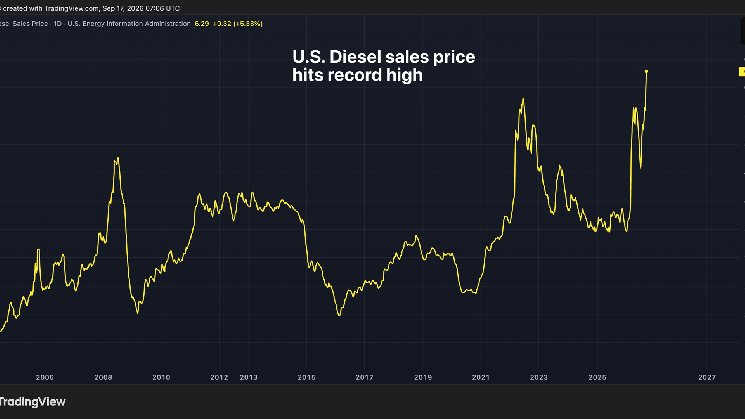
  • U.S. Diesel Prices Hit Record High as Bitcoin, Gold Struggle

    U.S. Diesel Prices Hit Record High as Bitcoin, Gold Struggle

    Diesel Prices Surge Amid Middle East Tensions and Tight Refining Capacity

    Diesel prices are climbing sharply, driven primarily by escalating geopolitical tensions in the Middle East. The ongoing conflict involving the U.S., Israel, and Iran has disrupted crude oil flows and inflated risk premiums on refined products. Constrained refinery capacity worldwide, combined with robust demand from freight and industrial sectors, has amplified the price move, transforming a regional supply shock into a global price spike.

    Federal Reserve Policy Adds Pressure

    The Federal Reserve’s Wednesday rate hike underscores how policymakers remain biased toward using interest rate increases to combat inflation stemming from oil-supply shocks—a strategy some observers characterize as a mistake. Record diesel prices now present a significant headwind for gold, bitcoin, and technology stocks.

    Like gold, bitcoin is widely viewed as a store of value and a sovereign hedge. However, historically, higher borrowing costs have weighed on the cryptocurrency’s market value, as evidenced during the 2022 Fed tightening cycle.

    Rate Hike Details and Forward Guidance

    On Thursday, the Fed raised rates by 25 basis points, lifting the benchmark borrowing cost to the 3.75%-4% range. Goldman Sachs and Morgan Stanley both anticipate an additional 25 basis point hike in October.

    Global Central Banks Follow Suit

    Other major central banks are also tightening monetary policy. The European Central Bank recently increased rates, and the Bank of Japan (BOJ) is expected to do the same on Friday.

  • Bithumb Announces New Cryptocurrency Listing

    Bithumb Announces New Cryptocurrency Listing

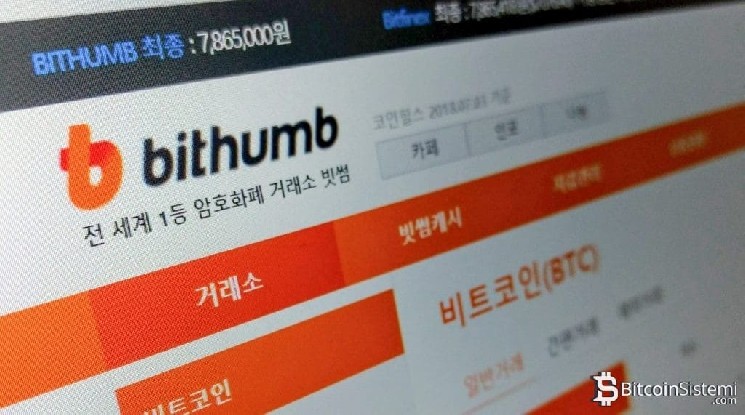
    Bithumb Lists Travala (AVA) on KRW Market Starting September 17, 2026

    South Korean cryptocurrency exchange Bithumb has announced the addition of Travala’s native token, AVA, to its Korean won (KRW) trading market. Trading is scheduled to begin on Thursday, September 17, 2026, at 2:00 PM KST.

    Trading Details and Network Support

    Bithumb will support AVA deposits and withdrawals exclusively via the Ethereum (ERC-20) network. The exchange explicitly stated that deposits made through other networks will not be supported. Deposit and withdrawal operations are expected to open within two hours of the announcement’s publication.

    • Initial reference price: 214 KRW
    • Required deposit confirmations: 33

    About Travala and the AVA Token

    Travala operates as a blockchain-based travel booking platform that enables users to purchase flights, hotels, car rentals, and other travel services using cryptocurrency. The platform integrates with major online travel agencies including Expedia and Booking.com, and accepts payments in over 100 crypto assets, including Bitcoin (BTC) and Ethereum (ETH).

    Within the Travala ecosystem, AVA functions as a utility token used for:

    • Staking-based loyalty and client programs
    • Rewards for user activity
    • Governance participation

    Launch Restrictions and User Warnings

    Bithumb has implemented several temporary trading restrictions for the initial launch period:

    • Buy orders will be limited for the first five minutes after trading opens.
    • Sell orders outside specified price ranges will also be restricted during the same five-minute window.
    • Only limit orders will be supported for approximately the first two hours.

    The exchange further warned users that AVA deposits and withdrawals can only be processed using supported networks and compatible cryptocurrency service providers.

    Disclaimer: This article is for informational purposes only and does not constitute investment advice.

  • Bitcoin Volatility Persists After Fed Rate Hike as Analysts Outline Key Support Levels

    Bitcoin Volatility Persists After Fed Rate Hike as Analysts Outline Key Support Levels

    Bitcoin Support Levels to Watch: Analyst Lark Davis Highlights $73K and $67K Zones Amid Regulatory Uncertainty

    Cryptocurrency investor and analyst Lark Davis has outlined key technical support levels for Bitcoin should the asset face further downside pressure. In an assessment shared via X, Davis identified the 200-day exponential moving average (EMA) near $73,000 as the first critical line of defense, with a deeper correction potentially targeting $67,000 if that level fails.

    200-Day EMA at $73,000 Serves as Immediate Pivot

    The 200-day EMA is a widely followed long-term trend indicator used by investors to gauge macro momentum. According to Davis, he is closely monitoring whether Bitcoin can hold above this threshold. A sustained break below the 200-day EMA would signal weakening long-term structure and could invite additional selling pressure.

    $67,000 Marked as Secondary Support in Deeper Correction Scenario

    Should Bitcoin lose the $73,000 zone, Davis points to approximately $67,000 as the next notable support area. This level aligns with prior consolidation zones and could act as a magnet for dip buyers if a more pronounced pullback materializes.

    Macro Headwinds Cited as Catalysts for Near-Term Weakness

    Davis attributes potential continued market softness to two primary drivers: evolving cryptocurrency regulatory developments in the United States — including progress around the Clarity Act — and the Federal Reserve’s interest rate policy. Both factors have historically correlated with risk-asset volatility and could keep Bitcoin range-bound or pressured in the short term.

    Analyst Sees Low Probability of New Cycle Low

    Despite the cautious technical outlook, Davis emphasized that he does not believe current conditions are severe enough to push Bitcoin to a new cycle low. While downward pressure may persist, the structural bull case remains intact unless key support levels are decisively broken on high volume.

    What Investors Should Monitor Next

    Market participants are advised to track three core variables in the coming weeks:

    • Federal Reserve policy signals — particularly around rate-hike trajectory and inflation data
    • Legislative progress on the Clarity Act and broader U.S. crypto regulatory framework
    • Bitcoin price action around the $73,000 and $67,000 technical zones

    This article is for informational purposes only and does not constitute investment advice.

  • South Korea Targets 26 Polymarket Users in $12.7M Betting Case

    South Korea Targets 26 Polymarket Users in $12.7M Betting Case

    South Korean police have booked 26 Polymarket users over alleged illegal gambling involving 17.6 billion won, roughly $12.7 million, with 18 cases referred to prosecutors by September 15. The Asia Business Daily reported on September 17, citing National Police Agency materials provided to lawmaker Yoon Kun-young’s office, that the Gangwon Provincial Police Agency Cyber Investigation Unit recorded a highest individual betting amount of approximately 5.7 billion won.

    Police traced users through blockchain records

    Investigators began preliminary inquiries in March and formally booked users from May, according to Digital Asset reporting from the same police material. Police said a conventional list of domestic users was not available from the platform because Polymarket uses a non-custodial peer-to-peer structure, so investigators traced public blockchain transactions with open-source intelligence tools. Public blockchain transaction data allowed investigators to identify individual users even though Polymarket does not maintain a real-name customer list in the form associated with centralized platforms. The published police material did not disclose the wallet addresses linked to the 26 suspects, preventing independent address-by-address checks of the reported wager totals.

    As crypto.news reported in June, the Gangwon police inquiry had already become the first known South Korean investigation focused on domestic Polymarket users. Authorities at the time were examining whether event-contract activity could fall within the country’s gambling laws. The newest police figures show that 18 of the 26 booked users had been referred to prosecutors by September 15. The materials reviewed do not report indictments, trial dates, or court judgments involving those cases.

    Police say Polymarket trades can meet gambling rules

    Investigators are relying on Article 246 of South Korea’s Criminal Act. The provision states that gambling can carry a fine of up to 10 million won, while habitual gambling can result in imprisonment of up to three years or a fine of up to 20 million won. The current text took effect on September 13, 2026.

    Police have cited a 2008 Supreme Court ruling addressing the role of chance in gambling. The court held that gambling can exist when property is wagered on an outcome the parties cannot certainly predict or freely control, even when a participant’s ability affects the result. Applying that precedent, police told Digital Asset that Polymarket activity can satisfy Article 246 when users stake digital assets on an event and either receive settlement proceeds or lose their purchase amount depending on an uncertain result. Police said similarities to derivatives or the lack of a separate guideline do not automatically exclude gambling charges.

    Users dispute gambling classification

    Users under investigation dispute that interpretation. The Asia Business Daily reported that their side describes Polymarket as a “virtual asset-based derivatives market” where probability contracts can be bought and sold before final settlement. That argument has not been accepted by a court in the cases reported so far.

    Attorney Kim Tae-rim of AXIS Law told the publication that courts may examine structural features such as order-book trading and the ability to exit positions before maturity. Kim said the contracts claimed by users as prediction derivatives fall outside the existing Capital Markets Act framework, limiting the usefulness of that statute as a direct criminal defense.

    South Korea blocked Polymarket before the referrals

    South Korea’s Broadcasting, Media and Communications Review Committee voted on August 18 to block domestic access to Polymarket after finding that the service provided what the regulator considered an illegal gambling environment to local users. The committee focused on markets tied to politics, economics, sports, elections, and weather, where users put assets at risk on events they cannot control. Regulators said Polymarket manages market rules and settlement infrastructure while receiving economic benefit from activity on the platform.

    As crypto.news reported after the August 18 decision, Polymarket argued during the review that its non-custodial P2P model, absence of Korean-language services, and lack of Korean won payments meant it should not be treated as an operator of an illegal gambling venue. The regulator rejected that position, saying “Technical characteristics or service structure do not constitute grounds for evading the applicability of domestic law.” It cited South Korea-focused markets and the platform’s winner-takes-all settlement structure when ordering access blocked.

    The August action followed an earlier hearing process. Regulators had postponed a final decision while giving Polymarket time to present its position before the access restriction was approved the following month.

    Polymarket’s U.S. venue operates under separate rules

    Polymarket currently tells users that its international platform and its U.S. business operate through separate legal entities. Its website states that the international platform is not regulated by the U.S. Commodity Futures Trading Commission. Polymarket US, by comparison, operates through QCX LLC. CFTC records list QCX LLC d/b/a Polymarket US as a designated contract market, with the designation dated July 9, 2025.

    The U.S. structure does not change the legal basis stated by South Korean police. Investigators have based the domestic user cases on South Korea’s Criminal Act, while the media review committee has said a platform’s technical or service structure cannot by itself prevent the application of domestic law. Polymarket affiliate had filed three National Futures Association applications connected with plans for margin trading. Those filings concern the regulated U.S. business and are separate from the South Korean police cases.

    No court ruling identified in the reviewed South Korean sources has yet decided whether Polymarket’s order-book probability contracts fall outside Article 246 because of their claimed derivatives-like features. Eighteen case files have been sent to prosecutors, while the published police materials do not report an indictment decision or hearing date for any of the users. Polymarket’s website continues to identify QCX LLC d/b/a Polymarket US as its CFTC-regulated designated contract market while stating that the international platform operates separately and is not regulated by the CFTC.

  • Zcash Aims to Burn Fees, Recycle Them Into Miner Rewards

    Zcash Aims to Burn Fees, Recycle Them Into Miner Rewards

    Zcash Advances Network Sustainability Mechanism for NU7 Upgrade

    The Network Sustainability Mechanism (NSM) proposal is gaining momentum on the Zcash network as a core component of the upcoming NU7 upgrade. This protocol redesign removes a portion of $ZEC from active circulation through transaction fees and recycles that value into future validator rewards, marking a departure from the traditional token-burning model that permanently destroys digital assets.

    NSM Core Proposal: Solving the Security Budget Crisis

    The NSM proposal defines the deployment parameters for Zcash’s NU7 upgrade and has attracted support for addressing the network’s long-standing “security budget” crisis. By routing 60% of transaction fees into a secondary protocol reserve, the mechanism establishes a permanent capital pool designed to sustain block subsidies over time. This structure decouples network security from the volatility of daily fee markets, providing predictable funding for validators regardless of short-term demand fluctuations.

    Beyond economic stability, the upgrade positions $ZEC as a differentiated asset signaled for multi-decade durability. The proposal also lays technical groundwork for a potential future transition to a Proof-of-Stake (PoS) consensus algorithm, while satisfying community governance requirements without expanding the token supply.

    A Circular Strategy: Recycling Value Instead of Burning

    Zcash’s NSM introduces a multi-pronged approach to counter the long-term decline of block subsidies:

    • Value recycling replaces permanent token destruction with a reserve-and-redistribution model.
    • Issuance smoothing prevents hashrate shocks by storing fee revenue during high-traffic periods and releasing it gradually during extended bear markets.
    • Security decoupling insulates validator incentives from speculative fee volatility.

    Under this design, the protocol accumulates fees during network congestion and smoothly pays out the stored capital to validators when fee revenue drops, ensuring consistent security funding across market cycles.

    Hard Cap Preserved: No New Token Minting

    Despite the protocol alterations, Zcash’s maximum hard cap of 21 million $ZEC remains unchanged. The NSM does not authorize new coin creation. Instead, it withdraws already-minted $ZEC from active circulation into a reserve pool, temporarily reducing the circulating supply. Those same coins are then slowly re-issued to validators over time, maintaining the fixed supply ceiling while improving token velocity dynamics.

    Block Time Slashed to 25 Seconds for Faster Finality

    A complementary core decision approved alongside the NSM for NU7 reduces the target block time from 75 seconds to 25 seconds. This tripling of block production speed fundamentally transforms the network’s user experience and operational profile.

    Benefits for Exchanges, Merchants, and Wallets

    The faster block interval delivers several practical advantages:

    • Improved finality: Transactions reach irreversible confirmation significantly faster, helping exchanges and merchants mitigate chain reorganization risk.
    • Responsive wallet experience: Balance updates and transaction confirmations occur three times faster, reducing user anxiety during retail and peer-to-peer payments.
    • Modern network feel: The shift moves Zcash from a deliberate, slower transactional model to a highly responsive chain aligned with current user expectations for speed.

    Looking Ahead: NU7 as a Foundation for Long-Term Viability

    Together, the NSM’s economic redesign and the block time reduction form a cohesive upgrade package aimed at securing Zcash’s relevance for decades. By recycling fee value, preserving the hard cap, and accelerating throughput, the NU7 upgrade addresses structural challenges in security funding, tokenomics, and usability—positioning the protocol for a sustainable, competitive future.

  • Derive (DRV) Surges 40% Following v3 Upgrade Plan; Can It Maintain All-Time High?

    Derive (DRV) Surges 40% Following v3 Upgrade Plan; Can It Maintain All-Time High?

    Derive ($DRV) surged more than 40% over the last 24 hours while major assets such as Bitcoin (BTC) and Ethereum (ETH) traded in the red. Daily trading volume for the altcoin jumped over 463%, crossing $25 million at press time.

    Price Action and Key Technical Levels

    The token had been recovering from a 52% correction that followed its previous all-time high (ATH) of $0.19. An initial rally driven by the Upbit listing gave way to a bear phase lasting more than two months before the recent breakout.

    Market bulls have now pushed $DRV back toward the $0.19–$0.20 supply zone — the fourth test of this resistance area. The current leg up began on August 19, lifting the price from $0.09 to $0.20, and at one point printed a new ATH of $0.28 before settling around $0.24 at press time.

    Technical Indicators Favor Bulls on the 4-Hour Chart

    • Moving Averages: Price is trading above both the 100 and 200 EMAs, a classic bullish structure.
    • Bull Bear Power (BBP): The oscillator flipped green over the past three sessions, signaling strengthening buying pressure.

    However, a break below the $0.13 support zone could trigger a return to the correction phase. In that scenario, bullish reactions may be anticipated at $0.11 and $0.09.

    Fundamental Catalysts: V3 Upgrade, Buybacks, and Staking

    Investor enthusiasm has been sustained by a series of protocol-level developments:

    V3 Upgrade and OP Stack Wind-Down

    Derive posted its V3 plan on the project forum, triggering a 20% sentiment-driven rally. The upgrade will migrate custody to Ethereum mainnet and split risk books, enabling faster listings for real-world assets (RWAs) and additional altcoins. The existing OP Stack chain is being wound down as part of this transition.

    Fee-Fueled Buyback Program

    Protocol fees continue to feed $DRV buybacks, with 35% of fees allocated to repurchases. The 84th weekly buyback event acquired 199,760 $DRV at an average price of $0.14, bringing the cumulative total to 27.645 million tokens.

    Source: Derive Explorer

    Staking Locks Up Majority of Supply

    Over 67.63% of the circulating supply is currently held in the staked address, keeping available liquidity tight and supporting price stability during rallies.

    Outlook

    $DRV’s ability to sustain its breakout past the $0.19–$0.20 zone will depend on the interplay between these fundamentals — ongoing buybacks, high staking participation, and the V3 mainnet migration — and the technical structure on lower timeframes. A successful flip of the $0.19–$0.20 resistance into support could open the path toward further price discovery, while a rejection would likely see the altcoin retest the $0.13–$0.11 demand area.

  • US House Passes Bill to Make Data Centers Pay More of Their Grid Costs

    US House Passes Bill to Make Data Centers Pay More of Their Grid Costs

    The U.S. House of Representatives passed the Ratepayer Protection Act (H.R. 9340) on Wednesday by a vote of 417-3, marking the first congressional bill to address the economic impact of rapidly expanding data centers on the nation’s power grid.

    Federal Standard for Large-Load Cost Allocation

    The legislation establishes a federal standard requiring state utility regulators to consider whether “full incremental cost” should be recovered from large-load consumers for generation, transmission, or distribution upgrades necessary to serve them. The bill defines large-load consumers as entities consuming at least 100 megawatts of energy at a single location and mandates that these companies provide financial guarantees before utilities make infrastructure investments.

    While state authorities must adopt the regulation, they retain the right to reject it. Energy policy experts suggest this opt-out provision weakens the framework, though supporters argue it creates a federal benchmark without overriding state ratemaking authority.

    No Cap on Electricity Prices

    The Act does not restrict electricity prices or affect residential bills. Its primary focus is identifying which entities pay for infrastructure required to serve hyperscale data centers and AI compute facilities.

    Rep. Frank Pallone (D-N.J.), the ranking Democrat on the House Energy and Commerce Committee, called the measure “imperfect” and said it addressed only part of the problem, according to Politico. The bill now advances to the Senate for consideration.

    Industry Commitments and Regulatory Pressure

    The legislation follows President Donald Trump’s March 4 Ratepayer Protection Pledge. The Brookings Institution notes that Amazon, Google, Meta, Microsoft, OpenAI, Oracle, and xAI have committed to securing new power and covering delivery-infrastructure upgrades for their data centers. However, translating these voluntary commitments into enforceable protections remains dependent on state regulators and utilities.

    Record Demand Strains Grid Infrastructure

    Pressure on the grid is already measurable. The Energy Information Administration projects electricity sales will reach an all-time high of 4,135 billion kilowatt-hours in 2026, driven partly by data centers and industrial production, while residential prices hit 18.2 cents per kilowatt-hour.

    An ICF analysis published by Brookings suggests residential tariffs could surge 15% to 40% by 2030, with some potentially doubling by 2050. A University of California study estimates data centers may account for 11.8% of total U.S. electricity consumption by 2030.

    The Federal Energy Regulatory Commission has directed six regional grid operators to justify or reform large-load tariffs, including measures to prevent cost shifting and accelerate interconnection.

    Capacity Costs Skyrocket in Key Markets

    As previously reported by Cryptopolitan, PJM capacity costs surged approximately 1,038% compared to 2024 rates. An Ohio brick manufacturer’s monthly capacity fee jumped from $1,600 to $12,000. Data centers now drive roughly 40% of PJM’s unprecedented $16.4 billion capacity auction.

    Shifting Economics of AI Infrastructure

    PwC, using Oxford Economics modeling, estimates global data center investment will reach $2.5 trillion by 2030. The International Energy Agency identifies electricity supply and grid access as central constraints on AI expansion, while Boston Consulting Group says geography, financing, and compute costs increasingly shape AI economics.

    Requiring large-load customers to absorb more infrastructure costs could reduce cost shifting to households and businesses while raising upfront project expenses. Regions with abundant power, faster connections, and lower financing costs may gain a competitive edge in attracting the next wave of AI infrastructure investment.

  • Zcash Surges 23% as Bitcoin, Major Tokens Rally Despite Fed’s First Rate Hike Since 2023

    Zcash Surges 23% as Bitcoin, Major Tokens Rally Despite Fed’s First Rate Hike Since 2023

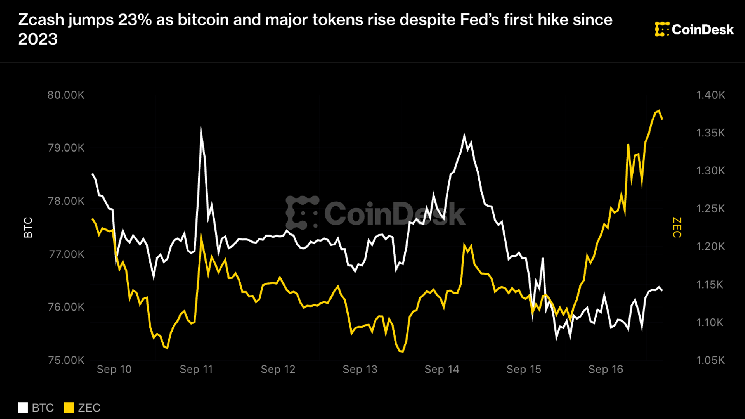
    Privacy-focused cryptocurrency Zcash (ZEC) surged 23% over the past 24 hours, leading gains across major digital assets as Bitcoin and the broader crypto market rallied overnight into Asian trading hours Thursday. The move coincided with a recovery in U.S. stock futures following the Federal Reserve’s first interest-rate increase since 2023.

    Market Snapshot: ZEC Leads, Bitcoin Holds Near $76K

    At the time of writing, ZEC traded near $1,369, significantly outperforming the market. Bitcoin edged up less than 1% to approximately $76,258, while Solana (SOL) gained nearly 3% to just below $100. BNB and HYPE, the native token of the crypto trading platform Hyperliquid, each added more than 2%. Ether (ETH), XRP, and Dogecoin (DOGE) posted gains between 1% and 2%.

    Paradigm Co-Founder Highlights Zcash as Bitcoin Privacy Complement

    The sharp rally in ZEC followed public comments from Matt Huang, co-founder of prominent crypto investment firm Paradigm. In a post on X, Huang discussed Zcash’s role as a privacy layer for Bitcoin and disclosed that his firm holds a position in the token.

    “a private complement to Bitcoin.”

    Huang, whose firm owns ZEC, described the protocol as “a private complement to Bitcoin.” He expressed support for continued funding of Zcash’s core developers while advocating that governance votes by coin holders should be combined with other decision-making mechanisms for network upgrades.

    Zcash Governance and Monetary Policy in Focus

    Zcash enables users to transact without publicly revealing sender, recipient, or transaction amounts. Its community recently backed proposals aimed at accelerating payment speeds while maintaining the protocol’s scheduled reductions in new coin issuance—a disinflationary feature shared with Bitcoin’s halving cycle.

    The convergence of positive macro tailwinds, high-profile institutional endorsement, and ongoing protocol improvements appears to be driving renewed investor interest in privacy-preserving digital assets.

  • Jupiter Token Falls 10% as $0.24 Support Breaks, Protocol Inflows Turn Negative

    Jupiter Token Falls 10% as $0.24 Support Breaks, Protocol Inflows Turn Negative

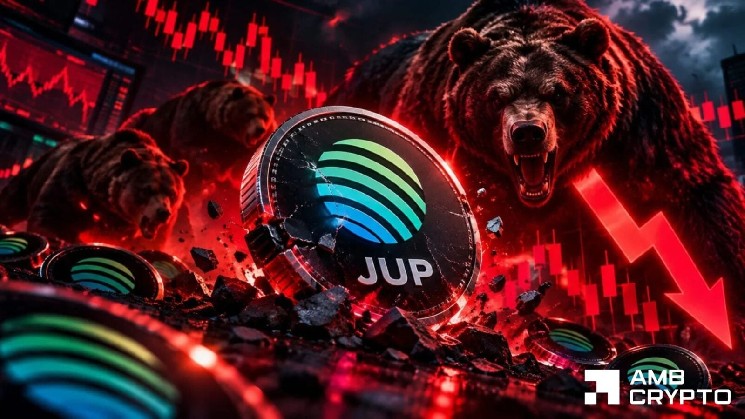
    Jupiter (JUP) suffered a sharp decline during the latest cryptocurrency sell-off as traders broadly reduced exposure to risk assets. The entire digital asset market came under heavy selling pressure, with most established coins recording significant losses.

    Jupiter Price Breaks Key Support

    Amid the bearish shift, JUP lost the $0.24 support level and fell to an intraday low of $0.20, dropping below its short-term 9-day and 21-day moving averages. At the time of writing, the token was trading near $0.21, down 10.2% on the daily chart. Trading volume rose 20% to $50 million over the same period, indicating heightened sell-side activity.

    Protocol Inflows Turn Negative

    Data from DefiLlama shows Jupiter’s USD inflows swung sharply negative, plummeting from $33 million to -$55 million. This reversal suggests a substantial outflow of capital from the network, confirming intense selling pressure.

    Derivatives Data Shows Reduced Exposure

    Futures market metrics from CoinGlass reinforce the risk-off narrative. Jupiter’s Open Interest declined 15% to $55.7 million, while derivatives volume fell 6% to $69 million. The drop in Open Interest signals that investors are actively closing positions and reducing leverage.

    Futures Netflows Signal Aggressive Panic

    According to CoinGlass, Jupiter futures recorded $16.8 million in outflows against $13.97 million in inflows. Netflows consequently collapsed 172% to -$2.8 million, a clear indicator of aggressive market panic and dominant bearish sentiment.

    Technical Outlook: Risk of Further Decline

    The TradingView Bulls vs. Bears indicator dropped to -49, reaching levels last seen in mid-August. A negative reading confirms that sellers have significantly outweighed buyers. If selling pressure persists and sentiment remains risk-averse, JUP could breach the $0.20 support and target $0.19. To invalidate this bearish structure, the price must close back above the short-term moving averages near $0.23.

    Summary

    • JUP declined 10%, breaking $0.24 support to hit a low of $0.20.
    • The drop was driven by strong selling pressure after sentiment turned risk-off, prompting investors to reduce exposure.
    • On-chain and derivatives data confirm capital outflows, falling Open Interest, and negative futures netflows.
    • Technical indicators remain bearish; a close above $0.23 is needed to shift the short-term outlook.
  • Crypto VC funding hits $5.68B in Q2, Galaxy says

    Crypto VC funding hits $5.68B in Q2, Galaxy says

    Venture investment in crypto and blockchain companies surged 31% in the second quarter of 2026 compared to the first quarter, while deal volume rose 10%, according to a September 16 report from Galaxy Research. The rebound pushed total first-half investment to $10.018 billion across 744 deals, putting the industry on pace for roughly $20.037 billion for the full year — slightly below the $20.3 billion recorded in 2025.

    Q2 Rebound Driven by Later-Stage Financing

    The second quarter saw $5.683 billion deployed across 384 deals, a sharp recovery from Q1 when startups received around $4 billion across 355 deals. Galaxy’s Q1 report showed capital falling by about half quarter-over-quarter after a large later-stage financing surge in late 2025.

    The Q2 rebound was larger in dollar terms than in transaction volume. Capital increased 31% while deal count rose only 10%, indicating that larger financings accounted for much of the quarterly increase. Galaxy said the rise was driven primarily by later-stage transactions, with mature companies receiving approximately 78% of the capital invested during the quarter.

    Deal Sizes Reach New Highs

    Galaxy reported a median crypto deal size of roughly $4.9 million in Q2, a new high. However, valuation information was available for only 16% of Q2 transactions and was heavily weighted toward later-stage companies.

    By transaction count, pre-seed rounds accounted for 21% of completed deals, while later-stage investments represented 26%. This distribution produced a large gap between the number of early-stage transactions and the amount of capital committed to mature companies. Early-stage businesses continued to attract deals, but larger financing rounds drove the majority of dollars invested.

    Trading and Exchange Category Dominates Capital Allocation

    Trading, exchange, investing and lending companies received roughly $3.523 billion during the quarter, representing close to three-fifths of all crypto venture capital invested in Q2. DeFi followed with approximately $478 million. More than 90% of the capital invested in the trading, exchange, investing and lending category went to later-stage companies.

    By deal count, trading, exchange, investing and lending companies recorded 51 transactions. DeFi and payments/rewards each recorded 40 deals. Web3, NFT, DAO, metaverse and gaming companies completed 37 deals, followed by tokenization with 36, enterprise blockchain with 34, and infrastructure with 32.

    Bitcoin Price Correlation Remains Weak

    Galaxy’s data shows that the relationship between bitcoin prices and crypto venture activity remains weaker than during the 2017 and 2021 cycles. Bitcoin reached new highs in late 2025 while venture activity moved unevenly, although both bitcoin and venture investment increased during Q2 2026.

    U.S. Companies Capture Lion’s Share of Capital

    U.S.-headquartered companies captured 73.5% of the capital represented in Galaxy’s Q2 dataset. The United Kingdom followed with 4%, while France accounted for 3.2%. The U.S. share was smaller when measured by transaction count: American companies represented 39.1% of the 384 deals, followed by the United Kingdom at 7% and Singapore at 5.7%.

    The geographic concentration was higher than in Q1, when U.S.-based startups received 70.2% of capital and represented 43.5% of completed transactions, according to Galaxy’s earlier report.

    Recent Notable Financing Activity

    Recent financing activity has included transactions involving exchanges, stablecoin payments, and tokenized markets. Payward, the parent company of Kraken, was the largest disclosed crypto funding deal during the September 5–11 period after Nasdaq Ventures agreed to invest $100 million in the company. Latitude raised $35 million in a Series A during the same week to develop stablecoin-based cross-border payment infrastructure, while Antarctic Exchange announced a $7 million financing tied to its derivatives trading platform.

    Fundraising Concentrated Among Fewer New Funds

    Five new crypto-focused funds raised approximately $3.9 billion in Q2, according to Galaxy. The firm said the number of new funds was the lowest for a quarter since Q3 2019. Galaxy cited macroeconomic conditions, investor interest in artificial intelligence, spot crypto exchange-traded products, and digital asset treasury companies as factors competing for allocator capital.

    The report stated that “fund managers still face a difficult environment.”

    The dollar amount raised was higher than the roughly $1.1 billion secured across eight new funds in Q1. Galaxy’s first-quarter report described Q1 as the lowest quarterly new-fund count since Q3 2020. If first-half fundraising continues at the same pace, Galaxy estimates that crypto venture funds could raise around $10 billion during 2026, above the $8.75 billion raised in 2025. The average fund size reached approximately $377.98 million, while the median fund size stood near $80 million.

    Weekly Activity Shows Continued Momentum

    During September 5–11, five disclosed crypto funding deals totaled $151 million, according to crypto.news. Payward’s $100 million transaction accounted for roughly two-thirds of the weekly total. Galaxy’s next quarterly dataset will provide the next measurement of venture activity after the Q2 rebound.