Author: Evan Mercer

  • Solana Tokenized Stock TVL Surges to $87.4M Amid DeFi Boom

    Solana Tokenized Stock TVL Surges to $87.4M Amid DeFi Boom

    Solana DeFi Growth Accelerates as Tokenized Stock TVL Hits $87.4 Million

    Solana is making significant strides in the decentralized finance sector, with its total value locked (TVL) in tokenized stocks reaching $87.4 million, according to data highlighted by CryptoTwitter commentator @tokenterminal. This marks a substantial increase from previous levels and signals burgeoning interest in tokenized assets within Solana’s ecosystem.

    Solana Captures 35.2% of Tokenized Stock Market

    The surge reflects a broader DeFi trend where innovative financial products are attracting fresh capital. As of the latest data, Solana accounts for approximately 35.2% of the total TVL in tokenized stocks, underscoring its critical role in this segment.

    This growth is particularly noteworthy because the total value locked across all tokenized stocks in DeFi has skyrocketed by over 1,960% in the past year, reaching $247.8 million. The dominance of chains like Solana, Robinhood, and BNB Chain—which collectively hold 89.5% of this market—highlights the increasingly competitive landscape in decentralized finance.

    Why Solana’s Infrastructure Matters for Tokenized Assets

    Solana is a blockchain platform designed for decentralized applications, facilitating fast and low-cost transactions. Its architecture within the DeFi ecosystem is significant, as its infrastructure supports a variety of tokenized assets, positioning it as a key player in the evolving financial landscape. The ongoing growth in Solana’s stablecoin supply further cements its position as a critical player in emerging markets.

    Key Levels for Traders to Monitor

    Market participants should keep a close eye on Solana’s developments in the DeFi space, especially as it continues to attract significant capital into tokenized stocks. With TVL rising, analysts may look for potential resistance levels around $90 million as a significant benchmark.

    The growing interest in Solana’s ecosystem may also lead to increased volatility, making it essential for traders to monitor not only price movements but also broader market sentiment.

    Data referenced in this article is based on current market trends and on-chain metrics.

  • Kaiko Data Reveals Bitcoin Volatility

    Kaiko Data Reveals Bitcoin Volatility

    Bitcoin Volatility Surges Amid Federal Reserve Policy Uncertainty

    Bitcoin’s recent volatility has surged, reflecting renewed uncertainty surrounding Federal Reserve policy decisions. According to data from KaikoData, the 30-day rolling volatility for Bitcoin spiked following the August Jackson Hole speech, eased temporarily, and then climbed again into September. This pattern suggests traders should closely monitor future Fed communications for clearer guidance on interest rates, which directly impacts market sentiment across digital asset markets.

    Mixed Signals Across Crypto Markets

    The broader cryptocurrency market indicates mixed signals, with various assets experiencing different momentum shifts. As Bitcoin grapples with climbing volatility, reduced forward guidance from the Federal Reserve adds an element of unpredictability. This uncertainty is particularly relevant for traders engaged in the derivatives market, where open interest and funding rates serve as crucial indicators of market sentiment. The potential for liquidation cascades also rises as traders navigate this volatile landscape.

    Key Data Points

    • Bitcoin’s 30-day rolling volatility spiked after the August Jackson Hole speech
    • Volatility eased before climbing again into September
    • Reduced Fed forward guidance leaves markets uncertain about interest rate trajectory
    • Traders are advised to watch for clearer Fed signals moving forward

    Market Conditions and Trading Activity

    Bitcoin’s price remains relatively unchanged as volatility increases, with no significant trading volume reported in the past 24 hours. The current market environment showcases hesitancy among traders as they respond to the Federal Reserve’s policy indications. This volatility trend may lead to increased caution in the market as traders reassess their positions amid the shifting landscape.

    As the leading cryptocurrency, Bitcoin’s price volatility and market influence make it particularly sensitive to macroeconomic policy shifts. The Federal Reserve’s policy decisions significantly affect financial markets, including cryptocurrencies, given their impact on interest rates and overall economic conditions.

    Levels to Watch

    Traders are monitoring potential shifts in Bitcoin’s volatility based on upcoming Fed announcements. Key levels to watch will be the reactions to new guidance, which could either stabilize or exacerbate current volatility trends. Risks remain high, especially if traders encounter sudden market movements that could lead to significant liquidations.

    This article is for informational purposes only and does not constitute financial advice.

  • NYDFS’s Asrow Addresses Stablecoin Regulation at Stablecon

    NYDFS’s Asrow Addresses Stablecoin Regulation at Stablecon

    At the recent Stablecon conference, New York Department of Financial Services (NYDFS) Acting Superintendent Asrow emphasized the critical role of inter-agency collaboration in shaping effective stablecoin regulation. The remarks, delivered on September 16, 2026, reinforce New York’s position as a pioneer in digital asset oversight, building on more than a decade of experience regulating virtual currencies.

    Regulatory Leadership and Collaborative Approach

    The stablecoin sector continues to expand as digital assets transform traditional financial infrastructure. Acting Superintendent Asrow’s address at Stablecon signals NYDFS’s commitment to evolving its regulatory framework through coordination with fellow regulators. This strategy aims to create a resilient environment that encourages responsible innovation while maintaining rigorous consumer protections—a proactive posture that contrasts with the more tentative regulatory timelines observed in other jurisdictions.

    Key Takeaways

    • NYDFS is spearheading stablecoin regulatory development.
    • Acting Superintendent Asrow presented at Stablecon on September 16, 2026.
    • The discussion centered on the necessity of collaboration among regulatory bodies.
    • New York leverages over ten years of virtual currency supervisory experience.
    • The framework prioritizes user safety alongside innovation enablement.

    Market Context and Implications

    The broader cryptocurrency market is currently navigating mixed momentum across various digital assets. In this environment, regulatory clarity from influential bodies like NYDFS plays a pivotal role in shaping trader sentiment and industry dynamics. As these frameworks mature, they are expected to bolster market confidence and accelerate stablecoin adoption across diverse platforms.

    NYDFS regulates financial services and products in New York, including virtual currencies. Its stablecoin framework is widely regarded as a benchmark for other jurisdictions, reflecting the state’s dual mandate to advance the digital asset ecosystem and safeguard consumers.

    Forward-Looking Considerations

    Market participants should closely monitor how NYDFS’s evolving regulatory model influences approaches in other regions. As other regulators observe New York’s proactive measures, they may adopt comparable frameworks, potentially driving increased interest and investment in stablecoins and reshaping the market landscape in the months ahead.

  • Bitcoin Faces 2022 Parallels as Federal Reserve Resumes Rate Hikes

    Bitcoin Faces 2022 Parallels as Federal Reserve Resumes Rate Hikes

    Bitcoin Bear Market Nears One-Year Mark as Fed Rate Hikes and Energy Shock Cloud Outlook

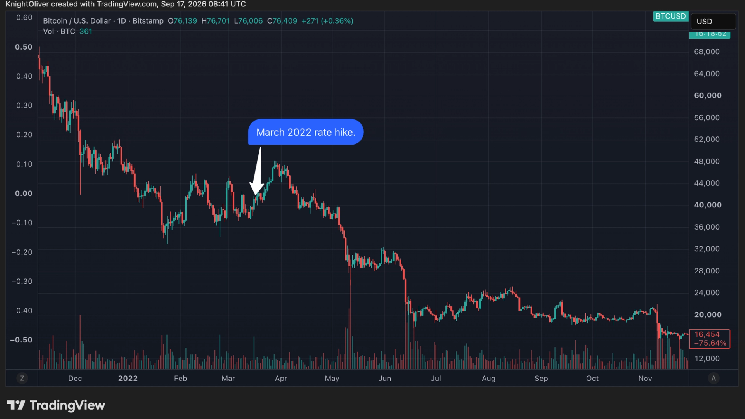
    Bitcoin’s prolonged downturn is approaching the one-year milestone, raising questions about whether a new Federal Reserve rate-hiking cycle could extend the crypto winter. The market’s recent behavior echoes the aftermath of the Fed’s initial March 2022 hike, when bitcoin rallied roughly 18% over 12 days before plummeting around 50%. That pattern suggests any near-term relief rally may give way to further losses, though a single comparable cycle offers limited predictive evidence.

    Inflation Progress Meets Fresh Energy Shock

    The Federal Reserve’s decision to raise rates on Wednesday stemmed from persistent inflation pressures. Annual headline inflation has remained above the 2% target for over five years. However, core inflation — which excludes volatile food and energy components — has eased to 2.4%, its lowest level in five years, signaling meaningful progress.

    That progress now faces a significant headwind. Escalating geopolitical tensions in the Middle East have propelled both West Texas Intermediate and Brent crude oil prices well above $100 per barrel. The surge threatens to reignite inflationary pressures and squeeze economic growth simultaneously.

    Rising Yields Amplify Pressure on Risk Assets

    Global bond yields have climbed in response, with the benchmark U.S. 10-year Treasury yield reaching 5%. The move tightens financial conditions further and adds downward pressure on risk assets, including cryptocurrencies. Bitcoin’s 2022 decline coincided with broad-based losses across equities, bonds, and metals, alongside internal turmoil within the crypto industry — a correlation that underscores its sensitivity to macroeconomic liquidity cycles.

    Key Question for Crypto Markets

    With the bear market nearing its first anniversary, market participants are weighing whether the current tightening cycle — compounded by an energy-driven inflation resurgence — will prolong the downturn or if the asset class has already priced in the worst of the macroeconomic storm.

  • Bitwise CIO: Bitcoin Rally Could Continue Unless Debt Concerns Ease

    Bitwise CIO: Bitcoin Rally Could Continue Unless Debt Concerns Ease

    Bitcoin Price Rally Driven by US Debt Concerns, Not Crypto Regulation, Says Bitwise CIO Matt Hougan

    Bitcoin’s recent price surge appears to be fueled primarily by mounting concerns over the United States fiscal outlook rather than progress on cryptocurrency-specific legislation, according to analysis from Bitwise Chief Investment Officer Matt Hougan.

    Inverse Correlation Between Regulatory Odds and Bitcoin Price

    Hougan shared a chart on social media platform X demonstrating a striking divergence between regulatory expectations and market performance. Between July 1 and September 15, the probability of the US Clarity Act passing this year plummeted from 39% to 18% on prediction market Polymarket. During that same period, Bitcoin’s price increased by approximately 38%.

    The data suggests that market expectations regarding cryptocurrency regulatory developments are not aligning with Bitcoin’s price movement. Hougan argues that concerns about the US debt outlook have become a significant factor in current market pricing.

    Clarity Act Stalls in Senate

    The Clarity Act represents one of several legislative proposals aimed at establishing a clearer regulatory framework for crypto assets in the United States. Its progress through Congress has been hindered by procedural hurdles.

    A previous cloture vote in the US Senate failed to secure the necessary support to advance the bill to the next legislative stage. The cloture procedure is designed to end debate on a bill, paving the way for consideration by the full Senate.

    Macro Factors Trump Sector-Specific News

    Hougan’s assessment indicates that Bitcoin’s recent performance is linked not only to developments within the crypto sector but also to broader macroeconomic factors, particularly the US fiscal outlook and investor debt concerns. However, the future trajectory of Bitcoin’s price depends on numerous market conditions beyond any single narrative.

    This article is for informational purposes only and does not constitute investment advice.

  • Bitwise CIO: Bitcoin Rally May Persist Unless Debt Concerns Subside

    Bitwise CIO: Bitcoin Rally May Persist Unless Debt Concerns Subside

    Bitwise Chief Investment Officer Matt Hougan suggests Bitcoin’s price rally could persist while U.S. debt concerns remain unresolved, pointing to a divergence between crypto regulatory expectations and actual market performance.

    In a post on social platform X, Hougan shared a chart tracking the relationship between legislative odds and Bitcoin’s price action from July 1 to September 15. The data shows the probability of the Clarity Act passing this year fell from 39% to 18% on the prediction market Polymarket. Over that same window, Bitcoin climbed roughly 38%.

    Regulatory Odds Drop While Bitcoin Rallies

    The disconnect indicates that expectations around U.S. crypto legislation are not driving Bitcoin’s recent gains. Instead, Hougan argues that worries over the U.S. fiscal trajectory and mounting debt have become a dominant force in market pricing.

    The Clarity Act is a bipartisan bill designed to establish a clearer regulatory framework for digital assets. Its progress has stalled after a Senate cloture vote — intended to end debate and advance the bill to a full floor vote — failed to secure the necessary 60-vote threshold.

    Macro Factors Eclipse Sector-Specific News

    Hougan’s analysis underscores a broader shift: Bitcoin’s price action is increasingly correlated with macroeconomic sentiment, particularly investor anxiety over U.S. government borrowing and long-term fiscal sustainability, rather than developments specific to the crypto industry.

    Still, the firm cautions that Bitcoin’s future path depends on a wide range of market conditions, and the current dynamic could shift quickly.

    This article is for informational purposes only and does not constitute investment advice.

  • Ripple Integrates XRP Payments With Stripe, Tempo AI Standard in New Developer Kit

    Ripple Integrates XRP Payments With Stripe, Tempo AI Standard in New Developer Kit

    Ripple has expanded its XRP Ledger developer toolkit to support a new payments standard designed for artificial intelligence agents, broadening the options for machines to pay for data, computing power, and other digital services using cryptocurrency.

    XRPL AI Starter Kit Adds Machine Payments Protocol Support

    Version 1.1 of the XRPL AI Starter Kit now integrates the Machine Payments Protocol (MPP) and the Open Wallet Standard, according to a blog post from RippleX developers. The Open Wallet Standard enables software to manage wallets across multiple blockchains through a single, unified interface.

    The update positions both XRP and RLUSD—Ripple’s dollar-pegged stablecoin—as native payment options for developers building AI-driven services.

    RippleX Commits to Multi-Standard Strategy

    “Our job is to make $XRP and $RLUSD first-class options wherever developers are building,” RippleX head of product Jazzi Cooper wrote on X.

    Ripple previously added support for x402, a separate web payments standard, in June. By backing both MPP and x402, the company is pursuing a multi-standard approach rather than betting on a single protocol.

    How MPP Enables AI Commerce

    The Machine Payments Protocol, co-authored by payments giant Stripe and Tempo—a blockchain purpose-built for payments—gives AI agents a standardized way to transact autonomously. An AI agent, defined as software that executes tasks on a user’s behalf, can now request a resource, receive a price quote, authorize payment, and receive the requested service in a seamless flow.

    Why This Matters for the Agent Economy

    As developers build services that charge machines per request, those AI agents need a currency the seller accepts and the software rails to send it. Ripple’s latest move aims to ensure XRP and RLUSD are among the default choices for this emerging machine-to-machine economy.

  • U.S. Diesel Prices Hit Record High as Bitcoin and Gold Struggle

    U.S. Diesel Prices Hit Record High as Bitcoin and Gold Struggle

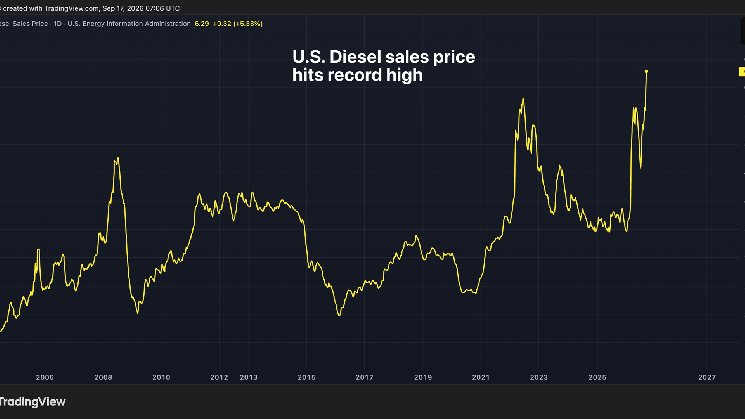
    Diesel prices are surging globally, driven primarily by escalating geopolitical tensions in the Middle East. The ongoing conflict involving the U.S., Israel, and Iran has disrupted crude oil flows and injected significant risk premiums into refined product markets. Compounding the supply-side pressure, tight refinery capacity and robust demand from both freight and industrial sectors have amplified the price move, transforming a regional supply shock into a worldwide spike at the pump.

    Federal Reserve Policy Under Scrutiny Amid Supply-Driven Inflation

    The Federal Reserve’s decision on Wednesday to raise its benchmark borrowing cost by 25 basis points to the 3.75%–4% range has drawn criticism from market observers. Critics argue the hike demonstrates a policy bias toward using interest rate increases to combat inflation rooted in oil-supply shocks—a strategy some view as a fundamental mistake. Higher borrowing costs historically act as a headwind for non-yielding assets, and the current environment is no exception.

    Record Diesel Prices Create Headwinds for Gold, Bitcoin, and Tech Stocks

    Record-high diesel prices are pressuring traditional safe-haven assets and growth equities alike. Both gold and bitcoin are widely viewed as stores of value and hedges against sovereign risk. However, historical precedent shows that rising interest rates weigh heavily on cryptocurrency valuations, a dynamic clearly illustrated during the Fed’s aggressive tightening cycle in 2022. Technology stocks, sensitive to discount rates and economic growth forecasts, face similar downward pressure.

    Global Central Banks Extend Tightening Cycle

    The shift toward restrictive monetary policy is not isolated to the United States. The European Central Bank has recently implemented its own rate increase, and the Bank of Japan (BOJ) is widely expected to follow suit with a hike on Friday. Major Wall Street institutions, including Goldman Sachs and Morgan Stanley, anticipate the Fed will deliver an additional 25 basis point increase at its October meeting, signaling that the global tightening cycle remains firmly in place.

  • U.S. Diesel Prices Hit Record High as Bitcoin, Gold Struggle

    U.S. Diesel Prices Hit Record High as Bitcoin, Gold Struggle

    Diesel Prices Surge Amid Middle East Tensions and Tight Refining Capacity

    Diesel prices are climbing sharply, driven primarily by escalating geopolitical tensions in the Middle East. The ongoing conflict involving the U.S., Israel, and Iran has disrupted crude oil flows and inflated risk premiums on refined products. Constrained refinery capacity worldwide, combined with robust demand from freight and industrial sectors, has amplified the price move, transforming a regional supply shock into a global price spike.

    Federal Reserve Policy Adds Pressure

    The Federal Reserve’s Wednesday rate hike underscores how policymakers remain biased toward using interest rate increases to combat inflation stemming from oil-supply shocks—a strategy some observers characterize as a mistake. Record diesel prices now present a significant headwind for gold, bitcoin, and technology stocks.

    Like gold, bitcoin is widely viewed as a store of value and a sovereign hedge. However, historically, higher borrowing costs have weighed on the cryptocurrency’s market value, as evidenced during the 2022 Fed tightening cycle.

    Rate Hike Details and Forward Guidance

    On Thursday, the Fed raised rates by 25 basis points, lifting the benchmark borrowing cost to the 3.75%-4% range. Goldman Sachs and Morgan Stanley both anticipate an additional 25 basis point hike in October.

    Global Central Banks Follow Suit

    Other major central banks are also tightening monetary policy. The European Central Bank recently increased rates, and the Bank of Japan (BOJ) is expected to do the same on Friday.

  • Bithumb Announces New Cryptocurrency Listing

    Bithumb Announces New Cryptocurrency Listing

    Bithumb Lists Travala (AVA) on KRW Market Starting September 17, 2026

    South Korean cryptocurrency exchange Bithumb has announced the addition of Travala’s native token, AVA, to its Korean won (KRW) trading market. Trading is scheduled to begin on Thursday, September 17, 2026, at 2:00 PM KST.

    Trading Details and Network Support

    Bithumb will support AVA deposits and withdrawals exclusively via the Ethereum (ERC-20) network. The exchange explicitly stated that deposits made through other networks will not be supported. Deposit and withdrawal operations are expected to open within two hours of the announcement’s publication.

    • Initial reference price: 214 KRW
    • Required deposit confirmations: 33

    About Travala and the AVA Token

    Travala operates as a blockchain-based travel booking platform that enables users to purchase flights, hotels, car rentals, and other travel services using cryptocurrency. The platform integrates with major online travel agencies including Expedia and Booking.com, and accepts payments in over 100 crypto assets, including Bitcoin (BTC) and Ethereum (ETH).

    Within the Travala ecosystem, AVA functions as a utility token used for:

    • Staking-based loyalty and client programs
    • Rewards for user activity
    • Governance participation

    Launch Restrictions and User Warnings

    Bithumb has implemented several temporary trading restrictions for the initial launch period:

    • Buy orders will be limited for the first five minutes after trading opens.
    • Sell orders outside specified price ranges will also be restricted during the same five-minute window.
    • Only limit orders will be supported for approximately the first two hours.

    The exchange further warned users that AVA deposits and withdrawals can only be processed using supported networks and compatible cryptocurrency service providers.

    Disclaimer: This article is for informational purposes only and does not constitute investment advice.