Author: Evan Mercer

  • Solana Launches STOCKLANA for Continuous Trading

    Solana Launches STOCKLANA for Continuous Trading

    Key Highlights

    • Solana launches STOCKLANA, enabling 24/7 stock trading with over $125,000 in prize incentives.
    • Initial social response shows strong community interest with 619 likes and 80 retweets on the announcement tweet.
    • The initiative aims to unify stock and crypto trading experiences while driving broader adoption of the Solana blockchain.

    Solana Unveils STOCKLANA for Round-the-Clock Stock Trading

    Solana has officially announced the launch of STOCKLANA, a new trading initiative that allows users to trade stocks 24 hours a day, seven days a week. The announcement, made via the project’s official X account, highlights a prize competition exceeding $125,000 designed to incentivize participation and stress-test the platform’s capabilities. According to the tweet, the program positions Solana as an emerging player in the continuous trading ecosystem, bridging traditional equity markets with the always-on nature of cryptocurrency infrastructure.

    Strategic Push for User Engagement and Platform Adoption

    The rollout of STOCKLANA represents a calculated strategic move by the Solana Foundation to deepen user engagement across its high-performance blockchain. By removing time-zone restrictions inherent in legacy stock exchanges, the platform targets active traders seeking uninterrupted market access. The substantial prize pool—surpassing $125,000—serves as a direct acquisition lever, rewarding early adopters for volume and activity. Early social metrics underscore the tactic’s initial resonance: the announcement tweet garnered 619 likes and 80 retweets, signaling robust community curiosity and a willingness to experiment with the novel trading paradigm.

    Market Context and Technical Positioning

    While the broader cryptocurrency market continues to flash mixed signals, Solana’s focus on innovative trading infrastructure differentiates it from competitors relying solely on DeFi primitives or meme-coin liquidity. STOCKLANA emphasizes a unified user experience, allowing participants to navigate both equity and digital asset markets within a single interface. The project’s current trading volume stands at zero—a baseline expected for a freshly launched product—but the incentive structure is explicitly designed to catalyze liquidity rapidly. Solana’s underlying architecture, optimized for high throughput and low latency, provides the technical bedrock necessary to support the order-flow demands of continuous, cross-asset trading.

    Why This Matters

    The introduction of STOCKLANA reflects a broader industry trend: the convergence of traditional finance (TradFi) market structures with blockchain-native settlement and access layers. As regulators globally clarify frameworks for tokenized securities and 24/7 market operations, platforms that can demonstrate reliable, compliant, and liquid continuous trading will capture first-mover advantage. For Solana, success here validates its thesis that a monolithic, high-speed Layer 1 can serve as the settlement layer for a diverse suite of financial applications beyond native crypto use cases. The coming weeks will reveal whether prize-driven bootstrapping translates into sustained organic volume, a critical metric for the platform’s long-term positioning in the tokenized equities race.

    Frequently Asked Questions

    What is STOCKLANA and how does it differ from traditional stock exchanges?

    STOCKLANA is a Solana-backed initiative enabling 24/7 trading of stocks, removing the fixed trading hours imposed by legacy exchanges like NYSE or Nasdaq. It combines this continuous access with a prize competition exceeding $125,000 to incentivize early participation.

    What has been the initial community response to the launch?

    The official announcement tweet received 619 likes and 80 retweets, indicating strong early interest from the Solana community and crypto traders exploring cross-asset opportunities.

    Does STOCKLANA currently have active trading volume?

    As of the announcement, STOCKLANA’s trading volume stands at $0, which is typical for a newly launched platform. The prize incentives are structured to rapidly bootstrap liquidity and user activity in the coming days.

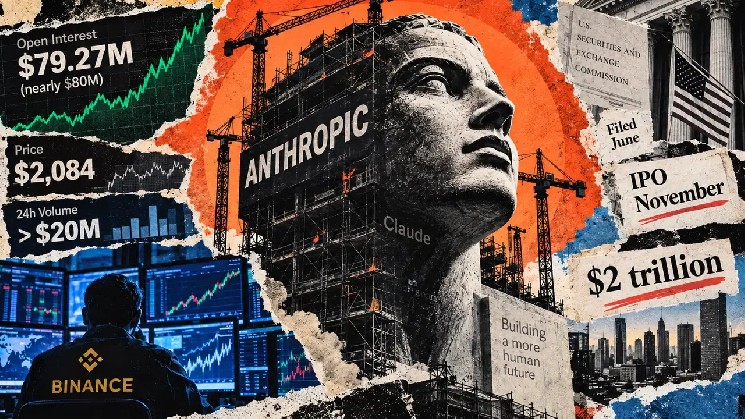
  • Anthropic’s Potential $2 Trillion IPO Drives $80 Million Crypto Trade

    Anthropic’s Potential $2 Trillion IPO Drives $80 Million Crypto Trade

    Key Highlights

    • Crypto derivatives tied to Anthropic’s anticipated IPO have reached nearly $80 million in open interest, with Binance accounting for roughly 40% of trading volume.
    • Circle CEO Jeremy Allaire publicly urged Anthropic to go public, arguing that public-market scrutiny would strengthen governance and transparency for frontier AI companies.
    • Anthropic confidentially filed for an IPO in June and is reportedly targeting a November listing at a potential $2 trillion valuation, which would rank among the largest offerings ever.

    Crypto Markets Price Anthropic’s IPO Before Wall Street

    Speculative fervor around Anthropic’s prospective initial public offering has migrated into cryptocurrency derivatives markets, where traders have accumulated nearly $80 million in open interest on pre-stock futures contracts despite the company having disclosed no offering price, share count, or final valuation. According to CoinGlass data, the ANTHROPIC pre-stock contract traded around $2,147 with more than $20 million changing hands in futures volume over 24 hours. Binance has emerged as the dominant venue, capturing approximately 40% of the activity. The instrument does not represent actual equity in the Claude developer; CoinGlass shows no circulating supply or spot trading, and Anthropic remains privately held. Instead, the price reflects derivatives markets attempting to value exposure to a company whose shares are not yet publicly available.

    Pre-IPO Perpetuals Surge as New Asset Class

    Anthropic’s derivatives activity is part of a broader shift in which crypto exchanges are building tradable instruments around Silicon Valley’s most valuable private companies. Binance Research reported that open interest across Anthropic and OpenAI pre-IPO perpetuals surpassed $160 million in September, up from roughly $1 million in April and a 179% increase from the prior month. The two companies accounted for about 95% of pre-IPO perpetual volume during the first half of September. These cash-settled derivatives reference an anticipated public company valuation or share price and require no underlying shares to support the contracts, meaning traders are effectively taking opposing positions on what the company could eventually be worth. The structure allows crypto markets to react to corporate developments almost immediately—OpenAI-linked instruments rose after the release of its Astra model and fell after Chief Executive Sam Altman signaled a potential IPO delay.

    Allaire Urges Anthropic to Embrace Public Scrutiny

    Circle Chief Executive Jeremy Allaire has added his voice to the debate, publicly urging Anthropic to complete its transition to public markets. “Take the leap, Anthropic,” Allaire said, arguing that concerns about volatile markets, valuation and AI safety strengthen rather than weaken the case for exposing the company to greater scrutiny. Drawing on Circle’s experience after taking the USDC issuer public in June 2025—pricing its IPO at $31 per share with a total offering of about $1.2 billion including the full exercise of the underwriters’ overallotment option—Allaire said going public imposed audited financial reporting, quarterly disclosures, independent board governance, and Sarbanes-Oxley controls that made Circle easier for banks, governments, and enterprise customers to evaluate. He argued that frontier AI companies are approaching a similar inflection point as their technology becomes embedded across businesses and economic infrastructure, and that model capabilities, safety procedures, computing commitments, revenue concentration, and corporate governance are increasingly matters of public interest.

    Dual Track: Traditional Investors Wait, Crypto Traders Act

    Anthropic now approaches the public markets from two directions. Traditional investors are waiting for its prospectus and the financial disclosures needed to judge whether a valuation approaching $2 trillion is justified—Reuters reported earlier this month that some investors were discussing that figure, while The Wall Street Journal reported the company plans to stage the IPO in November, later than the October timetable previously expected. Anthropic is also considering releasing another AI model ahead of the listing as competition with OpenAI intensifies. Meanwhile, crypto traders have already built nearly $80 million in outstanding futures positions behind a market trying to answer the valuation question in real time. Rising open interest signals increased participation and leverage, though it does not by itself demonstrate overwhelmingly bullish sentiment, as every futures position has both a long and short side. The gap between these two markets should narrow once Anthropic makes its registration documents public, allowing traders to compare the assumptions embedded in pre-IPO contracts with the revenue, costs, risks, and share structure the company actually presents to prospective shareholders.

    Why This Matters

    The emergence of liquid pre-IPO derivatives for Anthropic and OpenAI marks a structural shift in how private-market valuations are discovered and traded. Historically, price discovery for venture-backed unicorns occurred in infrequent funding rounds or secondary markets with limited access. Now, crypto perpetuals provide continuous, leveraged, and globally accessible pricing signals—albeit detached from underlying equity. For Anthropic, this creates a parallel reference price that could influence institutional sentiment ahead of its formal roadshow. For regulators, it raises questions about market integrity, investor protection, and the boundary between derivative speculation and securities offerings. Allaire’s intervention underscores a growing view among public-market veterans that AI labs wielding infrastructure-scale influence should accept the disclosure and governance obligations of listed companies. The November IPO timeline, if confirmed, will test whether traditional underwriters and crypto-native traders converge on a shared valuation—or whether the pre-market derivatives have already priced in expectations that the public filing cannot support.

    Frequently Asked Questions

    What are Anthropic pre-stock futures and do they represent real shares?
    No. The ANTHROPIC pre-stock contracts traded on platforms like Binance are cash-settled derivatives referencing an anticipated public valuation. They are not backed by actual Anthropic shares, carry no ownership rights, and CoinGlass shows no circulating supply or spot market for the instrument.
    When is Anthropic expected to go public and at what valuation?
    The Wall Street Journal reported Anthropic plans to stage its IPO in November, later than an earlier October target. Investors have discussed a potential valuation of up to $2 trillion, though the company has not disclosed an offering price, share count, or final valuation. Anthropic confidentially filed a draft registration statement with the SEC in June.
    Why is Circle CEO Jeremy Allaire urging Anthropic to go public?
    Allaire argues that public-market discipline—audited financials, quarterly reporting, independent governance, and Sarbanes-Oxley compliance—would strengthen Anthropic’s credibility with banks, governments, and enterprise customers. He draws a parallel to Circle’s 2025 IPO and contends that frontier AI companies now operate at a scale where transparency is a matter of public interest, though he also notes an IPO cannot substitute for AI-specific regulation.
  • Microtransactions Dominate Bitcoin Usage, Signaling Major Shift

    Microtransactions Dominate Bitcoin Usage, Signaling Major Shift

    Key Highlights

    • Micro-transactions under 0.01 BTC now represent nearly 80% of all Bitcoin network activity, signaling a fundamental shift in on-chain usage patterns.
    • The transition from large-value transfers to high-frequency, small-value transactions aligns with rising institutional interest in Bitcoin exchange-traded products (ETPs).
    • Analysts suggest the trend could enhance price stability and accelerate mainstream adoption by demonstrating Bitcoin’s utility for everyday payments.

    Bitcoin Network Dynamics Shift Toward Micro-Transaction Dominance

    Recent on-chain data reveals a structural transformation within the Bitcoin network, where transactions valued below 0.01 BTC—equivalent to roughly $600 at current prices—now account for approximately 80% of total transaction volume. This marks a decisive departure from historical patterns dominated by large-value settlements and whale movements, suggesting the protocol is increasingly functioning as a medium for frequent, low-value exchanges rather than solely a store-of-value settlement layer.

    Changing User Behavior and Institutional Catalysts

    The surge in micro-transaction activity coincides with growing traction for Bitcoin exchange-traded products, particularly in the United States following the SEC’s approval of spot Bitcoin ETFs in January 2024. Asset managers such as Grayscale Investments have reported that Bitcoin ETPs are attracting capital flows at a pace rivaling, and in some periods exceeding, traditional gold-backed funds. This institutional wrapper is lowering barriers to entry for retail and advisory audiences, potentially driving the increased on-chain fragmentation observed in recent months.

    Scalability Implications and Network Utility

    As the proportion of sub-0.01 BTC transactions climbs, questions around Bitcoin’s base-layer scalability and fee market dynamics intensify. While the Lightning Network and other layer-2 solutions are designed to absorb high-frequency, low-value traffic, the persistence of such activity on-chain indicates either growing user comfort with base-layer fees or delayed adoption of off-chain alternatives. The trend underscores the evolving narrative of Bitcoin as both a reserve asset and a functional payment rail, a dual role that could reshape long-term demand dynamics.

    Why This Matters

    The dominance of micro-transactions represents a potential inflection point for Bitcoin’s maturation as a financial asset. Historically, high concentrations of large transactions correlated with speculative cycles and custodial reshuffling. A shift toward granular, user-initiated activity suggests deeper integration into commercial and peer-to-peer economies. Coupled with the institutionalization via ETPs—now recognized by major allocators as a legitimate portfolio diversifier alongside gold—this on-chain evolution may support a more resilient price floor and broader acceptance in regulatory and commercial frameworks. Market participants should monitor whether layer-2 adoption accelerates in response to base-layer congestion, and how fee revenue trends affect miner economics post-halving.

    Frequently Asked Questions

    What qualifies as a micro-transaction on the Bitcoin network?

    In the context of the recent data, a micro-transaction is defined as any on-chain Bitcoin transfer valued below 0.01 BTC, which at current market prices represents approximately $600 or less.

    How do Bitcoin ETPs influence on-chain transaction patterns?

    Bitcoin exchange-traded products, such as those offered by Grayscale, BlackRock, and Fidelity, enable traditional investors to gain exposure without self-custody. Increased ETP adoption often correlates with higher on-chain activity as issuers manage creation and redemption baskets, while broader accessibility may spur retail usage for payments and transfers.

    Does the rise in micro-transactions affect Bitcoin’s scalability?

    A sustained high volume of small on-chain transactions can increase network congestion and fee pressure, potentially accelerating demand for layer-2 solutions like the Lightning Network. However, it also demonstrates real-world utility, which is a positive signal for long-term adoption.

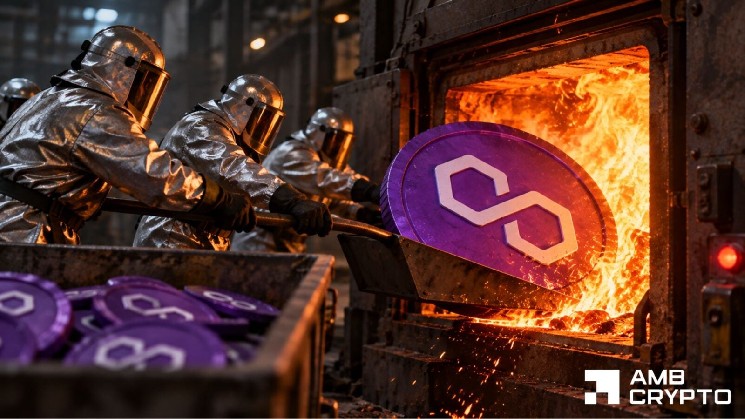
  • Polygon to Burn 100M POL as Revenue Hits $24.5M, Token Impact Uncertain

    Polygon to Burn 100M POL as Revenue Hits $24.5M, Token Impact Uncertain

    Key Highlights

    • Polygon Foundation CEO Sandeep Nailwal announced a plan to permanently burn 100 million $POL tokens, representing approximately 1% of the circulating supply, pending Security Council approval.
    • The burn mechanism is fueled by protocol revenue that reached $24.5 million year-to-date, with DeFiLlama data confirming annual revenue crossing $25 million—a two-year high.
    • $POL price surged 10% on the announcement, contributing to a weekly 20% recovery, though whale sell-offs of over 30 million tokens and resistance at the 50-week moving average ($0.11) pose near-term headwinds.

    Polygon Unveils Aggressive $POL Deflationary Strategy Ahead of Anticipated Bull Cycle

    Polygon Foundation CEO Sandeep Nailwal took to X on Friday to outline a bold tokenomics shift designed to position the network for the next cryptocurrency market upswing. The centerpiece of the announcement is a proposal to permanently remove 100 million $POL tokens from circulation—a figure equivalent to roughly 1% of the current circulating supply. The initiative is funded directly by the protocol’s own revenue streams, which Nailwal highlighted have reached $24.5 million year-to-date. The proposal currently awaits final sign-off from the Polygon Security Council before implementation can begin, after which the foundation intends to conduct manual quarterly burns.

    Polygon is printing revenue. $24.5m YTD. We are deploying a change that lets anyone in the community trigger its burn.

    — Sandeep Nailwal, CEO, Polygon Foundation

    Revenue Growth and Competitive Positioning Drive the Burn Mechanism

    The burn capacity is anchored in Polygon’s evolving revenue model. Base fees on the network automatically accumulate $POL in a collector wallet, which currently holds 121 million $POL valued at approximately $1.2 million. According to data from DeFiLlama, the protocol’s annualized revenue has surpassed $25 million, marking a two-year high. Nailwal asserted that Polygon’s strategic pivot toward payments—specifically stablecoin-based transfers—has yielded fee traction three times that of Arbitrum and five times that of Near Protocol. This revenue foundation is what makes the recurring burn mechanism sustainable, moving beyond a one-time event to a structural deflationary feature.

    Market Reaction: Price Surge Meets Technical Resistance and Whale Selling

    The announcement catalyzed an immediate market response, with $POL surging 10% on Friday. The move extended the token’s weekly gain to 20%, aided by a broader market tailwind as Bitcoin reclaimed the $80,000 level. However, the rally unfolds against a backdrop of significant technical hurdles. The token had previously rallied 80% in Q3, climbing from $0.07 to $0.11, before a sharp pullback in late August. Since September, price action has consolidated above the $0.09 support level, which coincides with the 200-day Moving Average.

    Overhead Resistance and On-Chain Signals Temper Optimism

    While the daily Relative Strength Index (RSI) remained below overbought territory at press time—suggesting room for further upside—the Average True Range (ATR) was flat, signaling low volatility that could make a decisive breakout difficult. The $0.11 level represents a critical confluence of resistance: it marked the local high of the August rally and aligns with the 50-week Moving Average, which previously capped gains. Adding to the selling pressure, on-chain analytics from Santiment revealed that key whale wallets dumped over 30 million $POL in the last three days. This profit-taking activity could stall the recovery, increasing the probability of a retest of the $0.09 support if the $0.11 barrier holds. Conversely, a clean break above the 50-week MA could signal the start of the next major recovery leg.

    Why This Matters

    Polygon’s move signals a maturation of Layer 2 tokenomics, shifting from inflationary emissions to a revenue-backed, deflationary model. By tying token burns directly to protocol fees—generated largely through stablecoin payment volume—Polygon creates a direct feedback loop between network utility and token scarcity. This contrasts with many peers that rely solely on staking rewards or fixed supply caps. The initiative also underscores the growing importance of real-yield metrics in crypto valuation; DeFiLlama’s verification of $25M+ annual revenue provides a tangible fundamental anchor. For investors, the interplay between the new burn mechanism, whale distribution patterns, and the $0.11 technical resistance will be the key variables determining whether $POL can convert short-term speculative interest into a sustained trend reversal.

    Frequently Asked Questions

    What triggers the $POL token burn and how much will be removed?

    The burn is triggered by protocol revenue accumulated in the collector wallet, which currently holds 121 million $POL. The initial proposal seeks to permanently burn 100 million $POL—approximately 1% of circulating supply—pending Security Council approval, followed by manual quarterly burns thereafter.

    How does Polygon’s revenue compare to competing Layer 2 networks?

    According to CEO Sandeep Nailwal, Polygon’s fee traction from stablecoin-based payments is currently 3x that of Arbitrum and 5x that of Near Protocol. DeFiLlama data corroborates this, showing Polygon’s annualized revenue crossing $25 million, a two-year high.

    What are the key price levels to watch for $POL following the burn announcement?

    Immediate resistance sits at $0.11, which aligns with the 50-week Moving Average and the August local high. Support is established at $0.09, reinforced by the 200-day Moving Average. A break above $0.11 could signal trend continuation, while rejection may lead to a retest of $0.09, especially given recent whale selling of over 30 million tokens.

  • NEAR Protocol Marks 5 Years of 100% Uptime

    NEAR Protocol Marks 5 Years of 100% Uptime

    Key Highlights

    • NEAR Protocol achieved over 1 million transactions per second (TPS) in verified benchmarks while maintaining 100% uptime across five years of operation.
    • Dynamic resharding and post-quantum signing are now live, marking significant scalability and security upgrades for the layer-1 blockchain.
    • Technological milestones position NEAR as an infrastructure leader, potentially driving developer adoption and ecosystem growth amid mixed market signals.

    NEAR Protocol Sets New Performance Benchmarks With Million-TPS Throughput

    NEAR Protocol has announced a suite of infrastructure milestones that collectively underscore its positioning as a high-throughput, enterprise-grade layer-1 blockchain. The network recorded over 1 million transactions per second in verified benchmarking environments, a figure that places it among the highest-performing public blockchains by raw capacity. Equally notable, the protocol has sustained 100% uptime since its mainnet launch five years ago, a reliability metric that distinguishes it in an industry where network outages have affected several major competitors. The announcements were shared via the project’s official channels, accompanied by a link to the formal disclosure for community verification.

    Dynamic Resharding and Post-Quantum Cryptography Go Live

    Beyond raw throughput, NEAR has activated two architectural upgrades designed to future-proof the network. Dynamic resharding — a mechanism that allows the blockchain to adjust its shard count in real time based on demand — is now operational, enabling elastic scalability without requiring hard forks or manual governance interventions. Simultaneously, the network has implemented post-quantum signing, integrating cryptographic primitives resistant to quantum-computing attacks. These features reflect a deliberate strategy to address both present-day scalability bottlenecks and long-term cryptographic risk, catering to developers building applications that require predictable performance and forward-compatible security.

    Market Context: Technical Strength Amid Trading Lull

    Despite the technical fanfare, on-chain and exchange data show NEAR’s trading volume currently unavailable, suggesting a temporary lull in speculative activity. Analysts note that such disconnects between fundamental upgrades and short-term market attention are common in crypto cycles, particularly when macro conditions suppress risk appetite. However, the protocol’s role as a foundational layer for decentralized applications — emphasizing usability, low finality latency, and now quantum-resistant tooling — may attract builder mindshare over time. Projects seeking reliable infrastructure for high-frequency use cases, such as gaming, payments, or real-world asset tokenization, could increasingly evaluate NEAR’s stack as a viable alternative to more congested or less upgradeable networks.

    Why This Matters

    The convergence of million-TPS benchmarking, five-year uptime, live dynamic resharding, and post-quantum cryptography represents a rare full-stack maturity milestone in the layer-1 landscape. Most blockchains optimize for one or two of these dimensions; NEAR’s simultaneous progress across throughput, reliability, adaptive scaling, and cryptographic agility signals a platform engineered for production-grade workloads rather than speculative narratives. As the industry shifts toward modular architectures and application-specific chains, base layers that offer predictable performance and upgradeable security primitives are likely to capture disproportionate developer mindshare. NEAR’s roadmap — now demonstrably executing on these vectors — positions it to benefit from the next wave of institutional and enterprise blockchain adoption, where infrastructure robustness is a procurement requirement, not a marketing claim.

    Frequently Asked Questions

    What does NEAR Protocol’s 1 million TPS benchmark mean for real-world usage?

    The 1 million TPS figure was achieved in a verified benchmarking environment and represents theoretical peak capacity under optimized conditions. Actual application throughput will depend on smart contract complexity, network topology, and user behavior, but the headroom suggests NEAR can support high-frequency use cases — such as on-chain order books, real-time gaming, or micropayment streams — without congestion-induced fee spikes.

    How does dynamic resharding differ from static sharding used by other blockchains?

    Static sharding fixes the number of shards at launch or requires a hard fork to change, limiting flexibility. NEAR’s dynamic resharding allows the protocol to split or merge shards automatically in response to load, maintaining optimal resource utilization without governance delays or network disruptions. This elasticity is critical for handling unpredictable demand surges from viral applications or seasonal traffic patterns.

    Why implement post-quantum signing now when quantum computers remain experimental?

    Cryptographic migrations take years to standardize, deploy, and achieve ecosystem-wide adoption. By integrating post-quantum primitives today — specifically lattice-based signatures resistant to Shor’s algorithm — NEAR ensures that accounts and contracts created now remain secure against future quantum advances. This proactive approach aligns with NIST’s post-quantum cryptography standardization timeline and reduces the risk of a disruptive, emergency migration later.

  • AI Gives Scammers ‘Superpowers’ Instead of Taking Their Jobs

    AI Gives Scammers ‘Superpowers’ Instead of Taking Their Jobs

    Key Highlights

    • AI is dramatically reducing the cost of running fraud operations, enabling small teams to conduct large-scale scams that previously required extensive human labor.
    • Chainalysis data shows AI-linked scam operations generate 4.5 times more revenue ($3.2 million vs $719,000) than non-AI operations, though causality remains unclear.
    • Human trafficking in scam compounds persists alongside AI automation, with FinCEN documenting large transnational criminal organizations using both forced labor and AI-enabled services simultaneously.

    The Economics of AI-Enabled Fraud

    Fraud has always demanded surprising amounts of manual labor. Romance scams require weeks of sustained conversation, investment fraud needs operators to answer questions and maintain believable identities, and impersonation scams demand performers who can keep an act together long enough to extract money. Artificial intelligence is now automating significant portions of that work, allowing the same criminal operation to reach exponentially more victims without adding human operators.

    This shift caught the attention of the Financial Action Task Force. President Giles Thomson told the Financial Times this month that AI could let “one or two people in a basement with a very big server” do work that once required a much larger scam operation. The observation captures a grimly efficient version of the productivity boom promised across legitimate industries.

    The critical change is not that AI will make scammers unemployed. Rather, every scam becomes cheaper to run. A single operator can maintain more fake identities, sustain more simultaneous conversations, and attempt more fraud attempts concurrently, creating the appearance of a large organization without the overhead. For an enterprise built on stealing money, that represents a compelling productivity gain.

    Data Reveals Scale of AI-Adoption Among Criminal Groups

    Blockchain analysis firm Chainalysis found that scam operations with observed links to AI vendors generated average on-chain revenue of $3.2 million per operation, compared with $719,000 for operations without those links—roughly 4.5 times as much revenue per operation. The data does not prove that buying an AI subscription automatically quadruples criminal income; larger operations may simply be more likely to purchase sophisticated tools, and Chainalysis cannot observe every AI use case through blockchain data alone. However, the figures illustrate why criminals have a powerful incentive to automate.

    Traditional confidence fraud is labor-intensive because someone must maintain the illusion. A fake investment adviser needs to answer questions, a romance scammer must remember previous conversations, and an impersonator must sound enough like a colleague or executive to avoid suspicion. AI makes that sustained attention cheap. Criminals do not need software to feel empathy—only software that can imitate empathy well enough to keep a target engaged.

    This capability allows one operator to manage more conversations, in more languages, for longer periods, while generating convincing documents, images, voices, and identities. The expensive part of the scam—maintaining the human performance—can increasingly be rented from a model.

    Losses Mount as FBI and Anthropic Document Real-World Impact

    The financial toll is already substantial. The FBI’s 2025 Internet Crime Complaint Center report recorded 22,364 complaints containing AI-related information and approximately $893.3 million in adjusted losses. Those cases span fake romantic identities, business impersonation, and other frauds built on convincing victims they are dealing with a real person.

    An even more direct example emerged from Anthropic’s August 2025 misuse report. The company documented an actor using Claude Code in an extortion campaign targeting at least 17 organizations. According to Anthropic, the model assisted with technical work, analyzed information, and helped prepare extortion demands that sometimes exceeded $500,000. The company subsequently banned the accounts and shared information with authorities. The significance lies not in the specific model or victim count, but in the demonstration that work previously requiring different people with different skills can now be coordinated by one operator with software assisting across multiple operational phases.

    Victims do not see the smaller organization behind the curtain. They encounter a convincing email, a believable identity, a professional-looking service, or a person who appears to know exactly what they are discussing. AI lets a tiny operation present the surface area of a much larger one.

    Why Crypto Remains a Prime Target for Automated Fraud

    For cryptocurrency, this dynamic is particularly effective because the distance between persuasion and payment is exceptionally short. A scammer can spend days or weeks building trust, but once the victim agrees, moving crypto can take seconds. Making the first part cheaper means criminals can push far more people toward the second.

    The Scam Factories Aren’t Disappearing

    There is a tempting narrative that AI will take scammers’ jobs, but the reality inside actual scam compounds complicates that picture. Many workers in these operations are not willing participants.

    Amnesty International’s 2025 investigation into Cambodian scam compounds documented at least 53 sites and interviewed 58 survivors from eight nationalities, finding evidence of trafficking, forced labor, confinement, and violence. Those operations have not been replaced by two people and a server. FinCEN’s September analysis of Southeast Asian scam centers describes large transnational criminal organizations operating alongside AI-enabled services and other specialized criminal infrastructure.

    The two models coexist because automation does not necessarily shrink an industry—sometimes it simply increases how much the same workforce can produce. A scam operation that automates part of every conversation faces two choices: attempt the same amount of fraud with fewer people, or keep the people and dramatically increase the number of targets. For victims, neither outcome is comforting.

    This is why the idea that AI will put scammers out of work misses the more important economic change. The relevant unit is not how many people the criminal enterprise employs, but how cheaply it can attempt another fraud. If the cost of producing a convincing fake identity falls, more fake identities become economical. If one person can supervise dozens of conversations instead of five, the number of people a gang can approach expands accordingly. The internet already made distribution almost free; AI is now reducing the cost of persuasion.

    When Bots Start Talking to Bots

    The defense industry has responded with automation of its own. Telecom provider O2 created Daisy, an AI grandmother designed to keep phone scammers talking for as long as possible. In the company’s account, Daisy answered scammers more than 1,000 times and spent hundreds of hours in conversation, with some calls lasting around 40 minutes. The concept works by attacking a resource that used to be scarce: the scammer’s time.

    But that defense weakens when the scammer’s side of the conversation is also automated. If one bot spends 40 minutes discussing a fictional bank problem with another bot pretending to be someone’s grandmother, neither criminal nor victim has lost 40 minutes of human life. Two organizations can congratulate themselves on engagement metrics while the electricity meter does most of the work.

    That absurd endpoint reveals where the defensive problem is moving. Wasting scammers’ time helps when human attention is expensive. As AI makes that attention cheaper, defenses must move closer to the point where criminals still need something real: an account capable of receiving money, an exchange or payment service that lets them move proceeds, a mule network or bank to process transfers, and victims to authorize those transfers. Those choke points are harder to automate away.

    Interpol’s 2026 global fraud assessment describes more than 1,500 transnational fraud cases involving $1.1 billion in reported losses and highlights international efforts to stop payments after fraud has been detected. CryptoSlate has previously covered how AI is increasing the scale of crypto scams. The next stage concerns what happens when convincing fraud becomes abundant.

    Familiar voices can no longer carry as much trust when voices can be generated for fractions of a cent. Video calls become weaker evidence when faces can be synthesized. A long, thoughtful conversation means less when maintaining it costs almost nothing. That leaves ordinary people doing more verification while criminals do less manual work. The great promise of automation was that software would take tedious tasks away from humans. Fraud has found a particularly irritating implementation: the machine handles the impersonation, while the person receiving the message must investigate whether anybody involved is real. AI may eventually reduce the number of humans required to run a scam. Unfortunately, it also makes running another scam much cheaper.

    Why This Matters

    The convergence of AI automation and transnational fraud represents a fundamental shift in the economics of deception. For decades, the primary constraint on fraud scale was human labor—scammers needed people to write scripts, maintain personas, and manipulate victims in real time. AI removes that bottleneck, allowing criminal enterprises to industrialize the “persuasion layer” of their operations. This does not merely increase the volume of attacks; it changes their nature. Deepfake audio and video, synthetic identities, and autonomous conversation agents make traditional verification cues—voice recognition, video calls, personal details—unreliable. Meanwhile, the persistence of forced-labor scam compounds in Southeast Asia, documented by Amnesty International and FinCEN, shows that automation complements rather than replaces human exploitation. The defensive imperative is shifting from detecting malicious content (which AI can perfect) to securing the financial rails where criminals must ultimately cash out. Interpol’s focus on payment interception and the growing emphasis on exchange-level controls reflect this reality. For individuals, the takeaway is stark: trust nothing that can be generated, verify through out-of-band channels, and assume that any unsolicited request for money or credentials is automated until proven otherwise.

    Frequently Asked Questions

    How much more revenue do AI-linked scam operations generate compared to traditional ones?

    According to Chainalysis data cited in the report, scam operations with observed links to AI vendors generated average on-chain revenue of $3.2 million per operation, compared to $719,000 for operations without those links—approximately 4.5 times higher. However, researchers caution this correlation does not prove AI adoption causes higher revenue; larger operations may simply be more likely to adopt advanced tools.

    Are AI tools replacing human trafficked workers in scam compounds?

    No. Amnesty International’s 2025 investigation documented at least 53 Cambodian scam compounds with evidence of trafficking, forced labor, and violence, interviewing 58 survivors from eight nationalities. FinCEN’s analysis confirms large transnational criminal organizations operate alongside AI-enabled services. Automation appears to increase the productivity of existing workforces rather than eliminate them, allowing gangs to scale operations without reducing headcount.

    What defensive strategies are emerging against AI-automated fraud?

    Defenses are shifting toward “choke points” that remain hard to automate: financial infrastructure where criminals must move money. Examples include O2’s “Daisy” AI that wastes scammers’ time (though this becomes less effective when scammers also use bots), Interpol-coordinated payment interception efforts across 1,500+ transnational cases involving $1.1 billion in losses, and exchange-level controls to block illicit crypto transfers. The focus is moving from content detection to transaction prevention.

  • ZCAT Launches on Solana, Enabling $ZEC Rewards for Holders

    ZCAT Launches on Solana, Enabling $ZEC Rewards for Holders

    Key Highlights

    • $ZCAT launches on Solana with a novel rewards mechanism distributing $ZEC to holders every two hours.
    • CryptoTwitter analyst @Route2FI calculates the structure yields roughly $15 daily per $5,000 invested, implying an 184% APY.
    • The integration underscores Solana’s expanding DeFi versatility and its ability to onboard experimental tokenomics at low cost.

    New Token $ZCAT Brings Automated $ZEC Yield to Solana DeFi

    Mechanics of the $ZCAT–$ZEC Rewards Loop

    The Solana blockchain has added a fresh primitive to its decentralized-finance toolkit with the launch of $ZCAT, a token programmed to distribute $ZEC rewards to holders on a fixed two-hour cycle. Unlike traditional staking contracts that require manual delegation or lock-up periods, $ZCAT’s rewards are credited automatically to any wallet holding the asset, creating a passive income stream that compounds roughly twelve times per day. According to on-chain data referenced by prominent CryptoTwitter analyst @Route2FI, a $5,000 position in $ZCAT at current pricing would generate approximately $15 in $ZEC every 24 hours, translating to an annualized yield of 184% before accounting for token-price volatility or impermanent-loss risk.

    Solana’s Cost Advantage Enables High-Frequency Payouts

    Solana’s sub-cent transaction fees and 400-millisecond block times make the every-two-hour distribution schedule economically viable—on many competing chains the gas cost alone would consume a meaningful share of the reward. The network’s throughput also absorbs the concurrent claim traffic without congestion, a practical consideration that likely influenced the developers’ choice of Solana over higher-fee alternatives. Beyond the immediate yield appeal, the deployment demonstrates how Solana’s execution environment can support experimental tokenomics that would be prohibitively expensive elsewhere, reinforcing the chain’s narrative as a sandbox for DeFi innovation.

    Market Implications for $ZCAT and $ZEC Liquidity

    Early trading data shows brisk volume on decentralized exchanges such as Raydium and Orca, where $ZCAT/$SOL and $ZCAT/$USDC pairs have attracted liquidity providers chasing the enhanced yield. The constant sell-pressure from recipients converting $ZEC rewards into stablecoins or SOL creates a natural market-making flow that could deepen order books for both assets over time. However, analysts caution that the 184% APY figure assumes static token prices; a sharp decline in $ZCAT or $ZEC valuation would compress real returns quickly. Participants are advised to monitor on-chain metrics—holder growth, reward-claim compliance, and liquidity-pool depth—as leading indicators of whether the experiment graduates from speculative novelty to sustainable primitive.

    Why This Matters

    The $ZCAT launch is emblematic of a broader shift: Layer-1 blockchains are increasingly differentiated not just by throughput but by the types of financial primitives they can host cost-effectively. Solana’s ability to settle thousands of micro-distributions daily at near-zero cost opens design space for real-time streaming rewards, subscription-style yield products, and high-frequency automated market-maker incentives that were previously impractical. If $ZCAT’s model proves resilient, it could become a template for other projects seeking to bootstrap liquidity through programmable, high-frequency incentives—accelerating the convergence of DeFi user experience toward the seamlessness of centralized finance while retaining non-custodial principles.

    Frequently Asked Questions

    How do I claim $ZEC rewards from holding $ZCAT?

    Rewards are distributed automatically to any Solana wallet holding $ZCAT every two hours; no manual claiming transaction or staking interface is required. The $ZEC tokens appear directly in the holder’s associated token account.

    Is the 184% APY figure guaranteed?

    No. The 184% APY cited by @Route2FI is a point-in-time calculation based on current $ZCAT and $ZEC market prices and the fixed emission schedule. Actual returns will fluctuate with token-price movements, changes in circulating supply, and potential protocol parameter updates.

    Where can I trade $ZCAT and $ZEC on Solana?

    Both tokens are listed on major Solana-native decentralized exchanges including Raydium and Orca, with $ZCAT/$SOL, $ZCAT/$USDC, and $ZEC/$SOL pairs actively trading. Always verify the official mint addresses before transacting.

  • Shiba Inu (SHIB) Builds ‘Bull Combo’: Will Weekly Chart Finally Delete a Zero?

    Shiba Inu (SHIB) Builds ‘Bull Combo’: Will Weekly Chart Finally Delete a Zero?

    Key Highlights

    • Shiba Inu ($SHIB) forms a classic bullish RSI divergence on the weekly chart while trading near a local bottom at $0.00000547, signaling potential seller exhaustion.
    • The token has posted a 6.72% weekly gain and established local support, but faces critical resistance at the 200-week moving average near $0.0000122.
    • A confirmed breakout above the 200-week MA is required to validate the bullish setup and potentially remove another zero from SHIB’s price.

    Bullish RSI Divergence Emerges on Shiba Inu Weekly Chart

    A rare technical configuration has materialized on Shiba Inu ($SHIB) that has caught the attention of cryptocurrency analysts and traders. The meme-inspired asset is currently trading near its local bottom at $0.00000547, reflecting a 6.72% weekly gain. More significantly, the weekly chart displays a textbook bullish Relative Strength Index (RSI) divergence, a pattern that historically precedes trend reversals after prolonged downtrends.

    Over the past several months, SHIB’s price action has consistently printed lower lows. However, the RSI oscillator on the weekly timeframe has countered this trajectory by forming a series of higher lows. This negative correlation between price momentum and the indicator typically signals that selling pressure is waning and that a hidden influx of liquidity may be accumulating beneath the surface. The divergence suggests the bearish trend is running out of steam, providing a technical foundation for a potential recovery.

    Local Support Holds as Moving Averages Come Into Focus

    Buyers have successfully established a local support level, halting aggressive bearish momentum and reducing the probability of further near-term declines. The current green weekly candle has allowed the price to defend critical lows, while the asset attempts to convert short-term moving averages into dynamic support zones. Such price stabilization, combined with the RSI divergence, often precedes impulsive breakouts from extended consolidation or downtrend phases, according to technical analysis sourced from TradingView.

    Critical Resistance Looms at the 200-Week Moving Average

    Despite the constructive technical signals, the path to “removing another zero” from SHIB’s price remains obstructed by a formidable barrier. The primary resistance sits significantly higher at $0.0000122, where the 200-week moving average (MA) resides. This long-term trend filter acts as the principal overhead resistance on the broader chart and has historically rejected price advances, often triggering deep corrections when tested.

    For the current bullish combo to evolve into a sustained uptrend, a decisive breakout above the 200-week MA is essential. Until that level is reclaimed, the market remains under strong psychological pressure, and the recent surge risks being classified as a temporary rebound rather than a trend reversal. The asset’s trajectory hinges entirely on whether buying momentum can accumulate sufficiently to penetrate this key moving average.

    Why This Matters

    The formation of a bullish RSI divergence on the weekly timeframe represents one of the most closely watched reversal signals in technical analysis, particularly for assets that have endured prolonged bear markets. For Shiba Inu, a token with a massive circulating supply and a dedicated retail following, the psychological milestone of “removing a zero” carries outsized narrative weight. A successful break of the 200-week MA would not only validate the divergence but could also reignite speculative interest and liquidity flows into the SHIB ecosystem. Conversely, failure at this resistance would likely extend the consolidation phase, testing the resolve of long-term holders and potentially inviting further downside toward the established local bottom.

    Frequently Asked Questions

    What is the current price of Shiba Inu and its weekly performance?
    As of the latest analysis, Shiba Inu ($SHIB) is trading near $0.00000547, reflecting a 6.72% gain on the weekly chart.
    What is the key technical signal supporting a potential SHIB rally?
    A classic bullish RSI divergence has formed on the weekly timeframe, where price has made lower lows while the RSI has printed higher lows, indicating exhausted selling pressure.
    What is the main resistance level SHIB must overcome to confirm an uptrend?
    The critical resistance is the 200-week moving average at approximately $0.0000122. A confirmed breakout above this level is necessary to validate the bullish setup and target higher prices.
  • 30-Year Veteran Analyst: “This Trend Could Fuel Bitcoin in the Coming Period”

    30-Year Veteran Analyst: “This Trend Could Fuel Bitcoin in the Coming Period”

    Key Highlights

    • Macro investor Jordi Visser argues AI agents will drive Bitcoin adoption by requiring blockchain infrastructure for machine-to-machine transactions.
    • Visser predicts tokenization will unlock dormant assets as programmable collateral, creating a growth dynamic independent of traditional liquidity cycles.
    • The analyst identifies privacy-focused projects like Zcash and NEAR as early beneficiaries of the AI-agent economy.

    AI Agents Poised to Reshape Cryptocurrency Fundamentals, Says Macro Investor Jordi Visser

    Experienced macro investor Jordi Visser has articulated a thesis positioning artificial intelligence agents as a transformative catalyst for Bitcoin and the broader cryptocurrency market. In a detailed analysis, Visser contends that evaluating Bitcoin’s trajectory exclusively through conventional macroeconomic lenses—global liquidity, interest-rate regimes, or money-supply metrics—is becoming an increasingly incomplete framework. While acknowledging that Bitcoin’s price history shows strong correlation with liquidity conditions, he argues that the maturation of genuine cryptocurrency utility could decouple the asset class from traditional economic cycles.

    Blockchain as Essential Infrastructure for Machine-to-Machine Economies

    Central to Visser’s argument is the inevitability of advanced AI agents interacting directly with one another, a dynamic he asserts will require blockchain settlement rails. “Agents will interact with each other. Blockchain is necessary,” Visser stated, emphasizing that the proliferation of autonomous software actors is “extremely positive for the cryptocurrency sector.” He envisions these agents evolving from analytical tools into full-fledged economic participants capable of executing purchases, payments, reservations, and complex financial decisions. Digital wallets controlled by such agents, he predicts, could become critical infrastructure in the emerging machine-to-machine economy.

    Tokenization and Programmable Finance Unlock Dormant Capital

    Visser further argues that this shift will accelerate the tokenization of assets currently dormant within the traditional financial system, enabling them to serve as programmable collateral. He describes a mechanism distinct from legacy liquidity indicators, where automated, code-driven financial transactions become commonplace. This programmable layer, he suggests, could foster competition between corporate-owned AI agents and consumers’ personal agents over pricing, privacy protections, and transaction terms—creating novel use cases for privacy-centric crypto projects and decentralized finance applications.

    Why This Matters: The Convergence of AI and Crypto Economics

    Visser’s framework highlights a structural inflection point: as AI agents multiply, traditional employment and productivity metrics may lose relevance. He notes his own firm operates with fewer than 15 human employees while deploying nearly 100 digital AI agents, illustrating how current economic statistics struggle to capture this transformation. For Bitcoin specifically, Visser maintains a 30-year conviction horizon, viewing the convergence of AI autonomy and blockchain verification as a powerful拓展 of real-world cryptocurrency utility that could sustain value appreciation independent of fiat monetary cycles. The heightened September interest in privacy-oriented protocols such as Zcash and NEAR, he suggests, reflects early market recognition of this AI-agent privacy narrative.

    Frequently Asked Questions

    How does Jordi Visser believe AI agents will use blockchain technology?

    Visser argues that advanced AI agents will need to transact directly with each other—making purchases, payments, and financial decisions autonomously—and that blockchain provides the necessary trust-minimized settlement layer for these machine-to-machine interactions.

    What is the significance of tokenization in Visser’s thesis?

    Tokenization, according to Visser, will bring currently dormant assets into active economic circulation as programmable collateral, creating a new growth mechanism for crypto that operates independently of traditional liquidity indicators like interest rates or money supply.

    Which crypto projects does Visser associate with the AI-agent privacy trend?

    Visser specifically links increased September interest in Zcash and NEAR to the strengthening narrative around AI agents requiring privacy-preserving transaction infrastructure for commercial negotiations.

    This is not investment advice.

  • Peter Brandt’s Favorite Analyst Weighs In on Bitcoin: “It’s Important for It to Break Through This Level by the End of the Week”

    Peter Brandt’s Favorite Analyst Weighs In on Bitcoin: “It’s Important for It to Break Through This Level by the End of the Week”

    Key Highlights

    • Technical analyst Aksel Kibar identifies a weekly close above $82,800 as a critical threshold for Bitcoin, potentially confirming a bullish rectangular pattern reversal or double bottom formation.
    • Kibar emphasizes that formation breakouts validated by significant moving averages—such as the 52-week EMA—provide dual confirmation of both trend direction and pattern completion.
    • The analyst distinguishes between investor and trader timeframes, advising long-term participants to watch weekly candles while short-term traders monitor daily candlesticks for entry timing.

    Kibar Flags $82,800 as Pivotal Level for Bitcoin Pattern Completion

    Technical analyst Aksel Kibar has highlighted the $82,800 price level as a decisive inflection point for Bitcoin (BTC), stating that a weekly candle close above this mark could validate a major bullish chart structure. According to Kibar, the cryptocurrency may be completing either a rectangular pattern reversal or a double bottom formation, both of which have developed near the 52-week exponential moving average (EMA)—a long-term trend filter he has tracked for approximately one year.

    Kibar stressed that an intraday spike above $82,800 would not satisfy the technical requirements for confirmation. Instead, the formation demands a clear weekly candle close above the threshold. “The trend is confirmed, and at the same time, the breakout of the chart formation is also validated. This is how I evaluate the completion of formations,” Kibar stated, describing the dual signal generated when a pattern breakout coincides with a breach of a major moving average.

    Moving Averages as Context, Not Triggers

    The analyst clarified that he does not treat moving average crossovers as standalone buy or sell signals. “I am hesitant to consider moving averages as trading signals on their own… I do not view a price crossing a moving average as a direct buy or sell signal,” Kibar explained. He argued that the critical factor is price breaking the structural boundaries of identifiable technical formations, with moving averages serving as supplementary validation rather than primary triggers.

    Kibar also differentiated his analytical framework by timeframe. He characterized his current outlook as primarily investor-focused, relying on weekly intervals to assess pattern maturity. For market participants operating on shorter horizons, he suggested monitoring daily candlesticks to refine entry timing, acknowledging that execution tactics may differ between long-term positioning and active trading.

    Why This Matters

    The $82,800 level sits near the 52-week EMA, a widely watched institutional trend metric that often acts as a demarcation between bull and bear market regimes. A confirmed weekly close above both the pattern resistance and this moving average would represent a rare confluence of structure and trend confirmation—historically a precursor to sustained directional moves. For Bitcoin, which has chopped in a broad range for months, such a breakout could signal the end of accumulation and the start of a new markup phase. Market participants should watch for weekly candle closure data and volume confirmation to distinguish a valid breakout from a failed test.

    Frequently Asked Questions

    What specific price level does Aksel Kibar identify as critical for Bitcoin?
    A weekly candle close above $82,800 is required to confirm the potential rectangular pattern reversal or double bottom formation.
    Does Kibar use moving average crossovers as entry signals?
    No. Kibar explicitly states he does not view a price crossing a moving average as a direct buy or sell signal, but rather as contextual validation when combined with a chart pattern breakout.
    How does Kibar differentiate between investors and traders in his analysis?
    He frames his formation analysis from an investor’s perspective using weekly candles, while suggesting short-term traders monitor daily candlesticks for tactical entry timing.