Author: Evan Mercer

  • Bitcoin Hits $85,000 as Short Squeeze Liquidates $648 Million in Bearish Bets

    Bitcoin Hits $85,000 as Short Squeeze Liquidates $648 Million in Bearish Bets

    Key Highlights

    • Bitcoin surged 5.4% to $84,984, breaking decisively above the September range high of $82,284 set on Sept. 4.
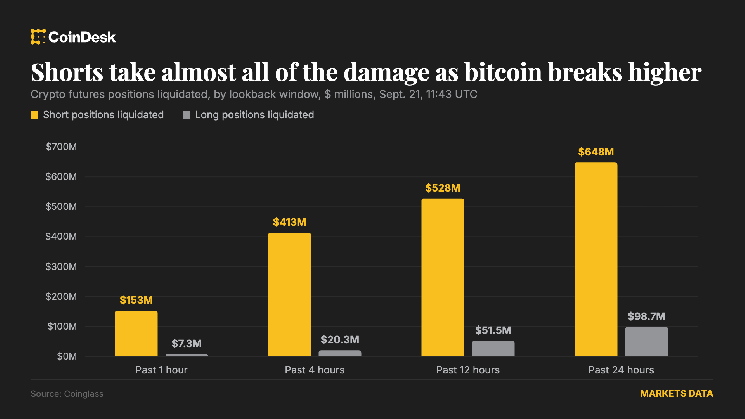
    • The rally was fueled primarily by a massive short squeeze, with $746 million in positions liquidated over 24 hours—$647.9 million of them shorts.
    • Open interest rose 7.59% to $156 billion and volume jumped 39% to $224 billion, indicating traders are re-establishing positions rather than exiting the market.

    Bitcoin Breaks September Resistance on Heavy Short Liquidations

    Bitcoin BTC extended its breakout above the top of its September trading range on Monday, changing hands at $84,984 during the late European morning session. The move represents a 5.4% gain over the prior 24 hours and leaves the asset well clear of the $82,284 high recorded on Sept. 4, which had previously capped upside attempts throughout the month.

    Forced Buying Drives Momentum Rather Than Fresh Conviction

    According to market analysts and data from Coinglass, the rally is being propelled predominantly by forced buying stemming from a cascading short squeeze rather than an influx of new long-side conviction. Over the past 24 hours, $746 million in total positions were liquidated, of which $647.9 million were short positions. In the most recent hour alone, an additional $159.9 million in positions were wiped out, with 95% of those liquidations on the short side.

    Bitcoin shorts accounted for $277.5 million of the 24-hour liquidation total, while Ether (ETH) shorts contributed $122.8 million. The disproportionate short-side washout underscores a market that was heavily positioned for downside or range-bound price action, leaving bears vulnerable to a sharp upside repricing.

    Open Interest and Volume Signal Position Replenishment

    Despite the massive short covering, open interest across the market has risen 7.59% to $156 billion, and 24-hour trading volume has surged 39% to $224 billion. This combination—rising open interest alongside heavy liquidations—suggests that traders are actively replacing the positions being closed out rather than stepping back from the market. The data points to a structural repositioning, with new participants or existing players re-entering on the long side as the breakout confirms.

    Why This Matters

    The break above the September range high marks a technically significant development for Bitcoin, which had been consolidating in a relatively tight band for weeks. The fact that the move was catalyzed by a short squeeze rather than organic spot buying introduces a degree of fragility: if the forced buying exhausts itself without follow-through from spot accumulators, a pullback toward the former resistance—now potential support—around $82,000 could materialize. However, the concurrent expansion in open interest and volume suggests the market is not merely covering shorts but rebuilding directional exposure. Traders will be watching closely for sustained spot bid interest, funding rate normalization, and whether the $85,000 level can flip to support in the coming sessions. The next key technical hurdle lies near the late-July highs around $87,500–$88,000.

    Frequently Asked Questions

    What triggered Bitcoin’s break above the September range?

    The breakout was driven primarily by a massive short squeeze, with $746 million in positions liquidated over 24 hours—$647.9 million of them shorts—forcing bearish traders to buy back positions and accelerating upside momentum.

    Does rising open interest during a short squeeze signal bullish continuation?

    Yes. The 7.59% increase in open interest to $156 billion, combined with a 39% volume surge to $224 billion, indicates traders are replacing liquidated shorts with new long positions rather than exiting the market, suggesting conviction behind the move.

    What are the key levels to watch after this breakout?

    Immediate support now sits at the former September high of $82,284. Upside targets include the late-July highs near $87,500–$88,000. Sustained spot buying and funding rate normalization will be critical for follow-through.

  • Bitcoin and Altcoin Rally Extends: BTC Hits Eight-Month High Amid Liquidations Update

    Bitcoin and Altcoin Rally Extends: BTC Hits Eight-Month High Amid Liquidations Update

    Key Highlights

    • Bitcoin surged 2.5% in one hour to breach $85,000 for the first time since January 30, posting a 9.1% weekly gain and nearing a 30% monthly increase.
    • Ethereum rallied 6% to surpass $2,730, while top altcoin gainers included Sui (22.3%), Venice Token (22%), and Sei (20%) over the last 24 hours.
    • A short-squeeze liquidated approximately $400 million in leveraged positions within hours, contributing to a 24-hour total of $750 million across 136,931 traders.

    Bitcoin Breaks $85,000 as Broad Crypto Rally Accelerates

    Bitcoin extended its recovery on Tuesday, climbing above the psychologically significant $85,000 threshold for the first time since January 30. The flagship cryptocurrency added 2.5% in a single hour, lifting its seven-day advance to 9.1% and its 30-day gain to nearly 30%. The move comes despite lingering macroeconomic headwinds, including last week’s negative developments surrounding the Clarity Act and Federal Reserve policy signals, suggesting that internal market dynamics are currently outweighing external regulatory and monetary concerns.

    Oil Decline Correlates with Risk-On Sentiment

    Market analysts noted that the cryptocurrency rally coincides with a four-day slide in international oil prices. The drop in energy costs has historically eased inflation expectations, fostering a more favorable environment for risk-on assets such as equities and digital currencies. This correlation appears to be fueling renewed buying pressure across the board, with Bitcoin acting as the primary catalyst for broader market participation.

    Altcoins Outperform as Ethereum Reclaims $2,700

    Ethereum led the major altcoin charge, surging 6% over the past 24 hours to trade above $2,730—its first visit above the $2,700 level since the end of January. Other layer-one protocols posted strong gains, with XRP advancing 6.6%, Solana climbing 7%, and HyperLiquid (HYPE) rising approximately 4%. The breadth of the rally indicates improving sentiment across multiple blockchain ecosystems rather than a Bitcoin-only phenomenon.

    Mid-Cap Tokens Lead Percentage Gainers

    According to CoinMarketCap data, the most explosive moves occurred in the mid-cap segment. The platform reported the following 24-hour leaders: “Sui (SUI – 22.3%), Venice Token (VVV – 22%), Sei (SEI – 20%), Near Protocol (NEAR – 19.9%), Render (RENDER – 17.9%) and Avalanche (AVAX – 13.9%)”. These outsized returns highlight speculative appetite returning to higher-beta assets, often a hallmark of early-stage bull market rotations.

    Short Liquidations Fuel Price Discovery

    The rapid ascent triggered a massive unwinding of bearish leverage. Approximately $400 million worth of leveraged trades were liquidated in the space of a few hours, with the vast majority representing short positions. Over the full 24-hour window, total liquidations reached $750 million, affecting 136,931 individual accounts. The single largest liquidation occurred on Binance’s BTC/USDT perpetual contract, valued at $11.29 million, underscoring the intensity of the short squeeze on the dominant trading venue.

    Why This Matters

    The simultaneous breakout in Bitcoin and Ethereum, combined with aggressive short covering and broad altcoin participation, suggests a potential regime shift from consolidation to trend expansion. The $85,000 level for Bitcoin has acted as stiff resistance since January; a sustained close above it could invite fresh institutional and retail inflows. Meanwhile, the scale of short liquidations—$750 million in 24 hours—indicates that a significant portion of the market was positioned for further downside, creating structural fuel for continued upside if momentum persists. Traders will now watch for follow-through volume and whether the Clarity Act and Fed narratives reassert influence in the coming sessions.

    Frequently Asked Questions

    What triggered the latest Bitcoin surge above $85,000?
    The rally appears driven by a combination of falling oil prices improving risk sentiment, a sharp short squeeze liquidating $400 million in bearish bets within hours, and broad-based buying across major and mid-cap altcoins.
    Which altcoins posted the largest 24-hour gains?
    Per CoinMarketCap, the top performers were Sui (SUI) at 22.3%, Venice Token (VVV) at 22%, Sei (SEI) at 20%, Near Protocol (NEAR) at 19.9%, Render (RENDER) at 17.9%, and Avalanche (AVAX) at 13.9%.
    How significant were the liquidations?
    Total liquidations reached $750 million over 24 hours, impacting 136,931 traders. The largest single liquidation was an $11.29 million BTC/USDT position on Binance, highlighting the force of the short-covering rally.

    *This is not investment advice.

  • NEAR Intents Launches Unified Liquidity Solution for DeFi

    NEAR Intents Launches Unified Liquidity Solution for DeFi

    Key Highlights

    • NEAR Protocol launches NEAR Intents to create a unified liquidity layer for cross-chain DeFi operations.
    • ZCash users gain access to Cash App and PayPal transactions through NEAR Intents integration.
    • Traders monitor NEAR’s ecosystem growth as cross-chain volume rises across the cryptocurrency market.

    NEAR Protocol Unveils NEAR Intents to Unify Cross-Chain Liquidity

    NEAR Protocol has officially introduced NEAR Intents, a new architectural concept designed to function as a unified liquidity layer across blockchain networks. The announcement, published via the official NEAR Protocol Twitter account, signals a strategic push to streamline decentralized finance (DeFi) interactions by reducing fragmentation between previously isolated ecosystems. As cross-chain transaction volumes climb industry-wide, the initiative positions NEAR as a foundational infrastructure provider for next-generation liquidity routing.

    ZCash Integration Expands Real-World Payment Utility

    A practical demonstration of the technology’s reach is already live: ZCash users can now transact through mainstream financial applications including Cash App and PayPal, enabled by NEAR Intents integration. This development bridges privacy-focused cryptocurrency holdings with widely adopted consumer payment rails, broadening the scope of DeFi usability beyond native crypto interfaces. The integration underscores NEAR Protocol’s long-standing focus on facilitating seamless transactions and interoperability between disparate blockchain networks.

    Market Context: Mixed Signals Amid Growing Cross-Chain Momentum

    The broader cryptocurrency market is currently displaying mixed momentum across altcoins, yet cross-chain activity continues to accelerate. NEAR Intents arrives at a pivotal moment when liquidity solutions are becoming a critical component of the DeFi stack. Regulatory clarity around decentralized finance remains an evolving landscape that influences how projects like NEAR Protocol develop technologies and expand market reach. By targeting the interoperability layer directly, NEAR aims to capture value from the increasing demand for frictionless asset movement across chains.

    Why This Matters

    Unified liquidity layers represent a structural shift in DeFi architecture, moving away from fragmented, chain-specific liquidity pools toward aggregated, intent-based settlement. NEAR Intents could reduce slippage, lower transaction costs, and simplify user experience by abstracting away the complexity of bridging and routing. For developers, the framework may lower barriers to building cross-chain applications. For users, it brings crypto closer to the seamless payment experiences found in traditional finance. The ZCash-to-Cash App/PayPal pathway illustrates how such infrastructure can unlock real-world utility for privacy coins and other niche assets.

    Frequently Asked Questions

    What is NEAR Intents?

    NEAR Intents is a concept introduced by NEAR Protocol to create a unified liquidity layer that enables cross-chain transactions and DeFi interactions across multiple blockchain networks.

    How does the ZCash integration work with Cash App and PayPal?

    Through NEAR Intents integration, ZCash users can now transact via popular platforms like Cash App and PayPal, bridging privacy-focused cryptocurrency with mainstream payment applications.

    Why are traders watching NEAR Protocol’s developments closely?

    Traders are monitoring the impact of NEAR Intents on cross-chain liquidity, as successful implementation could drive increased engagement and liquidity within NEAR’s ecosystem amid rising cross-chain volumes.

  • Crypto Rallies on Bullish Bounce After Fed Rate Hike: Weekly Outlook

    Crypto Rallies on Bullish Bounce After Fed Rate Hike: Weekly Outlook

    Key Highlights

    • Bitcoin holds near $84,000, demonstrating resilience despite the Federal Reserve’s benchmark rate holding at 4.00% following last week’s hawkish stance.
    • The SEC’s conditional five-year exemption window for tokenized securities pilot trading opens September 22, allowing select institutional venues to trade tokenized stocks on public blockchains.
    • Major governance votes are underway across Lido DAO, Uniswap, and CoW DAO, addressing liquidity provisions, protocol fee extensions, and solver competition redesigns.

    Bitcoin Resilience Amid Macro Uncertainty

    Cryptocurrency markets opened the week on a firm footing, with bitcoin BTC trading at $83,915.85 and testing the psychologically significant $84,000 threshold. The digital asset’s stability comes as investors digest the Federal Reserve’s latest policy posture, which maintained the benchmark target rate at 4.00% after last week’s hawkish signaling. While traditional risk assets often react negatively to restrictive monetary policy, bitcoin’s current price action suggests a decoupling from immediate rate-sensitive impulses, at least in the near term.

    The macroeconomic calendar this week centers on a cluster of high-impact U.S. data releases that could recalibrate rate-cut expectations. Initial jobless claims for the period ending September 19 are estimated at 201,000, up from the previous 196,000, while new home sales for August are forecast to decline to 700,000 from 739,000. Durable goods orders are expected to contract 0.3% month-over-month in August after a 1.1% gain previously, and the final University of Michigan Consumer Sentiment Index for September is seen at 47.8, down sharply from 51.7. Canadian retail sales for August are also due, estimated at -0.8% versus a prior 0.6% gain. Cross-asset markets continue to process the divergent policy paths emerging from the Bank of Japan and the Bank of England, adding another layer of complexity to the global liquidity backdrop.

    SEC Tokenized Securities Pilot Framework Goes Live

    A pivotal regulatory milestone arrives on September 22, when the U.S. Securities and Exchange Commission’s conditional five-year exemption window officially opens. This framework permits select institutional venues to commence pilot trading of tokenized stocks directly on public blockchains. The initiative represents the most concrete step yet by U.S. regulators to bridge traditional securities infrastructure with distributed ledger technology, potentially unlocking new paradigms for settlement efficiency, fractional ownership, and market accessibility. Market participants will be closely monitoring which venues receive approval and the volume dynamics during the pilot’s early phase.

    Governance Activity Intensifies Across Major DAOs

    Decentralized autonomous organizations are driving a busy week of on-chain governance. Lido DAO is voting on a proposal to authorize a contingent LDO centralized-exchange liquidity market-making mandate, budgeting up to $1.5 million in recallable LDO and 480,000 USDC to maintain orderbook depth and mitigate potential exchange delisting risks. Voting concludes September 21. Uniswap Governance is conducting a temperature check on extending its protocol fee collection and UNI burn infrastructure to Arc, a Layer 1 network built by Circle, with voting ending September 23. Meanwhile, CoW DAO is voting on a redesign of its solver quote competition, allocating a dedicated quote reward budget equal to 10% of protocol revenue to enhance price routing and order conversion; this vote wraps up September 25.

    Token Unlock Schedule Presents Supply Dynamics

    Several notable token unlocks are scheduled this week, introducing incremental supply into circulating markets. Canton (CC) unlocks 0.38% of its circulating supply, valued at approximately $17.17 million, on September 21. Toncoin (TON) follows on September 22 with a 1.3% unlock worth $51.2 million. Humanity (H) releases 14.7% of its circulating supply, valued at $20.8 million, on September 23. No major token launches are confirmed for the period, and the conference calendar remains clear.

    Why This Matters

    The convergence of bitcoin’s price resilience, the SEC’s tokenized securities pilot launch, and heightened DAO governance activity signals a maturing market structure where regulatory engagement, institutional infrastructure, and decentralized coordination are advancing simultaneously. The SEC pilot, in particular, could establish precedent for how traditional assets are issued, traded, and settled on-chain, potentially attracting broader institutional participation. Meanwhile, the governance votes at Lido, Uniswap, and CoW reflect the growing operational sophistication of major protocols as they address liquidity sustainability, cross-chain fee architectures, and execution quality—issues critical to long-term protocol viability. Traders should monitor this week’s macro data for signals on the Fed’s next move, as any shift in rate expectations could rapidly reassert correlation between digital assets and traditional risk markets.

    Frequently Asked Questions

    What is the SEC’s tokenized securities pilot framework?

    The SEC’s conditional five-year exemption window, opening September 22, allows select institutional venues to conduct pilot trading of tokenized stocks directly on public blockchains. This regulatory sandbox aims to test distributed ledger technology for securities settlement and trading under supervised conditions.

    Why are the Lido, Uniswap, and CoW DAO votes significant?

    These governance proposals address critical operational priorities: Lido seeks to secure exchange liquidity for LDO to prevent delistings; Uniswap explores extending its fee and burn mechanism to Circle’s Arc network; CoW Protocol aims to improve solver competition and order routing through a dedicated reward budget. Outcomes will shape protocol economics and cross-chain strategies.

    Which macroeconomic data points should crypto traders watch this week?

    Key releases include U.S. initial jobless claims (Sept. 24, 8:30 a.m. ET), new home sales (Sept. 24, 10:00 a.m. ET), durable goods orders (Sept. 25, 8:30 a.m. ET), and the final Michigan Consumer Sentiment Index (Sept. 25, 10:00 a.m. ET). These indicators will influence Federal Reserve policy expectations and broader risk sentiment.

  • Binance Announces Support for Altcoin Network Upgrade

    Binance Announces Support for Altcoin Network Upgrade

    Key Highlights

    • Binance will suspend LUNA deposits and withdrawals on September 21, 2026, at approximately 5:00 PM UTC to support the Terra network upgrade at block height 22,942,000.
    • Spot trading and other market transactions for Terra-based tokens will remain fully operational during the upgrade window.
    • Binance will manage all technical requirements on behalf of users; deposits and withdrawals will resume automatically once the network is confirmed stable, with no separate announcement planned.

    Binance Prepares for Terra Network Upgrade with Temporary Transfer Pause

    Global cryptocurrency exchange Binance has confirmed its support for an upcoming network upgrade on the Terra (LUNA) blockchain, implementing a temporary suspension of deposit and withdrawal services to ensure the transition proceeds securely for its user base. The move aligns with standard industry practice for major blockchain protocol upgrades, where centralized exchanges pause on-chain transfers to mitigate risks such as transaction failures, chain splits, or replay attacks during the migration.

    Upgrade Timeline and Operational Impact

    According to the official announcement, deposit and withdrawal operations via the Terra network are scheduled to be halted on September 21, 2026, at approximately 5:00 PM UTC. The Terra network upgrade itself is expected to activate roughly one hour later, at block height 22,942,000, at approximately 6:00 PM UTC. This buffer allows Binance to finalize internal node updates and validate network stability before the protocol change takes effect.

    Critically, the suspension applies exclusively to on-chain deposit and withdrawal transactions. The exchange emphasized that spot trading and all other market operations for Terra-based tokens will continue without interruption. Users retain full ability to buy, sell, and trade LUNA and associated assets on Binance markets throughout the upgrade period.

    User Experience and Technical Management

    Binance has stated that it will execute all necessary technical procedures on behalf of its customers, including node software updates and any required consensus participation. No action is required from users during this process. The exchange’s infrastructure team will monitor the upgrade in real time, validating block production, finality, and network health before re-enabling transfer services.

    The announcement did not specify a fixed resumption time for deposits and withdrawals. Instead, Binance indicated that services will be restored once the Terra network is assessed to be operating stably and securely following the upgrade’s completion. Notably, the exchange confirmed it will not issue a separate announcement regarding the reopening of these operations. Users are advised to monitor their account interfaces directly for the restoration of transfer functionality and to anticipate potential delays as the network settles.

    Why This Matters

    Network upgrades are pivotal events for proof-of-stake blockchains like Terra, often introducing protocol improvements, security patches, or governance changes. For exchanges, supporting these upgrades is a core operational responsibility that balances user asset safety with service continuity. Binance’s decision to pause only on-chain transfers—while keeping markets live—reflects a mature risk management approach: it prevents users from sending funds into a potentially unstable chain state while preserving liquidity and price discovery. The absence of a follow-up resumption announcement places the onus on users to verify service status proactively, a common practice among major exchanges during non-contentious upgrades. As Terra continues to evolve its ecosystem, seamless exchange support remains critical for maintaining token accessibility and investor confidence.

    Frequently Asked Questions

    Will I be able to trade LUNA on Binance during the upgrade?

    Yes. Binance confirmed that spot trading and all other market transactions for Terra network tokens will remain fully operational throughout the upgrade window. Only deposit and withdrawal functions via the Terra blockchain are temporarily suspended.

    Do I need to take any action with my LUNA holdings on Binance?

    No. Binance will handle all technical requirements for the network upgrade on behalf of users. No manual steps—such as token swaps, wallet migrations, or consensus participation—are required from account holders.

    How will I know when deposits and withdrawals are available again?

    Binance stated it will not publish a separate announcement for the resumption of transfer services. Users should monitor the deposit and withdrawal pages within their Binance accounts directly; functionality will be restored automatically once the exchange confirms the Terra network is stable and secure post-upgrade.

  • Kalshi Faces ‘fake crypto volume’ Allegations as Critic Flags Identical $5,500 Trades

    Kalshi Faces ‘fake crypto volume’ Allegations as Critic Flags Identical $5,500 Trades

    Key Highlights

    • Analyst Beni alleges wash trading on Kalshi’s ether perpetual market, citing repetitive $5,500 trade sizes accounting for up to 58% of volume across four days as “undeniable proof” of manipulation.
    • The allegations center on a CFTC-filed rebate schedule allowing Self-Clearing Members to trade at net-zero fees via a 0.3-basis-point maker rebate offsetting a 0.3-basis-point taker fee.
    • Kalshi representative IcoBeast.eth initially dismissed concerns on X but later issued a detailed rebuttal as the discussion gained traction.

    Wash Trading Allegations Surface Around Kalshi Ether Perpetuals

    Market structure analyst Beni has leveled serious accusations of volume manipulation against Kalshi’s ether perpetual futures market, presenting data patterns he characterizes as conclusive evidence of wash trading. The core of the argument rests on the identification of highly unusual, repetitive trade sizes of exactly $5,500 that appeared across four distinct trading sessions. According to Beni’s analysis, these uniform transactions single-handedly constituted up to 58% of the platform’s total ether perpetual trading volume during those periods, a statistical anomaly he labeled undeniable proof of artificial volume inflation.

    Zero-Cost Trading Incentives Under Scrutiny

    The allegations draw a direct line between the observed trading patterns and Kalshi’s fee structure, specifically a rebate schedule filed with the Commodity Futures Trading Commission (CFTC). The schedule permits Self-Clearing Members to operate at a net-zero fee cost, balancing a 0.3-basis-point maker rebate against a 0.3-basis-point taker fee. In standard market mechanics, rebates serve as financial incentives—typically partial fee refunds or cash payments—designed to compensate high-volume market makers for providing liquidity. However, Beni argues that when the marginal cost of trading against oneself drops to zero, the economic barrier to self-dealing evaporates, creating a powerful incentive for participants to artificially inflate volume metrics without incurring transaction costs.

    Platform Response Evolves From Dismissal to Detailed Rebuttal

    The response from Kalshi, voiced through the pseudonymous account IcoBeast.eth on X, followed a two-stage trajectory. Initially, the platform brushed off the wash trading concerns, asserting that its existing fee structure alone should act as a sufficient deterrent against manipulative behavior. As the analytical thread gained viral momentum within the crypto trading community, the tone shifted. IcoBeast.eth subsequently published a comprehensive, point-by-point breakdown intended to refute the methodology and conclusions of the wash trading analysis, signaling the seriousness with which the platform now treats the reputational challenge.

    Why This Matters

    The controversy touches on a fundamental tension in the rapidly evolving crypto derivatives landscape: the reliability of volume as a metric for market health and the regulatory adequacy of rebate structures overseen by the CFTC. Kalshi operates as a designated contract market (DCM) under CFTC jurisdiction, placing it under a stricter regulatory umbrella than many offshore competitors. If allegations of systemic wash trading on a regulated U.S. venue are substantiated, it could prompt regulatory review of rebate programs that enable zero-cost self-trading. For market participants, the episode underscores the difficulty of distinguishing genuine organic liquidity from incentivized or fabricated volume, a distinction critical for risk management, price discovery, and institutional adoption of crypto derivatives.

    Frequently Asked Questions

    What specific pattern did Beni identify as evidence of wash trading?
    Beni identified repetitive trade sizes of exactly $5,500 that accounted for up to 58% of Kalshi’s ether perpetual volume across four separate days, calling this pattern undeniable proof of manipulation.
    How does Kalshi’s rebate structure allegedly enable wash trading?
    A CFTC-filed rebate schedule allows Self-Clearing Members to pay a net-zero fee via a 0.3-basis-point maker rebate offset by a 0.3-basis-point taker fee, which Beni argues removes the cost barrier to trading against oneself.
    How has Kalshi responded to the allegations?
    Kalshi representative IcoBeast.eth initially dismissed the concerns on X, citing the fee structure as a deterrent, but later issued a detailed rebuttal as the analysis gained widespread attention.
  • Analysts Say Binance ETH Withdrawals Hit Highest Level Since 2023, Flag Bullish Signal

    Analysts Say Binance ETH Withdrawals Hit Highest Level Since 2023, Flag Bullish Signal

    Key Highlights

    • Binance Ethereum withdrawals hit a three-year high, with monthly averages exceeding 90,000 transactions—roughly double the rate seen at the start of 2024.
    • CryptoQuant analyst Darkfost links the surge to investors moving ETH into self-custody wallets, signaling a shift toward longer-term holding strategies rather than active exchange trading.
    • While exchange outflows suggest growing preference for personal custody, Darkfost cautions that withdrawal data alone does not conclusively prove long-term investment intent.

    Binance Ethereum Withdrawals Surge to Highest Level Since 2021

    On-chain analytics firm CryptoQuant has flagged a notable acceleration in Ethereum withdrawals from Binance, the world’s largest cryptocurrency exchange by volume. According to analyst Darkfost, the platform’s average monthly ETH withdrawal count has climbed above 90,000, marking the most elevated sustained level since 2021. The current pace is approximately twice the monthly average recorded in the opening months of 2024, underscoring a pronounced shift in how market participants are managing their Ethereum holdings.

    Analyst Interprets Outflows as Signal of Accumulation Behavior

    Darkfost’s analysis of on-chain data frames the withdrawal spike as a noteworthy behavioral indicator. The analyst stated that the large volume of ETH leaving exchange wallets could be linked to the transfer of purchased assets to personal wallets or other external addresses, suggesting a tendency towards longer-term holdings. This pattern aligns with a broader market narrative in which investors increasingly favor self-custody solutions—such as hardware wallets or non-custodial software wallets—over leaving assets on centralized platforms for short-term speculative trading.

    Self-Custody Preference Grows Amid Custody Landscape Evolution

    The movement of assets from exchange-controlled addresses to user-controlled addresses may indicate that investors prefer to store those assets in addresses under their own control rather than holding them on exchanges for short-term trading. This trend coincides with heightened regulatory scrutiny of centralized custodians, high-profile exchange failures in recent years, and the maturation of user-friendly self-custody tooling. However, Darkfost emphasized that exchange exits alone do not definitively prove that investors intend to hold assets long-term; funds could be rotated to other venues, deployed in decentralized finance protocols, or staged for over-the-counter transactions.

    Why This Matters

    Sustained high withdrawal volumes from a dominant venue like Binance serve as a real-time barometer of investor sentiment and custody preferences. If the elevated outflow rate persists, it would suggest a structural reduction in the exchange-resident ETH supply, potentially tightening available liquidity for short-term traders and altering market dynamics during periods of volatility. Conversely, a reversion to lower withdrawal levels could signal renewed comfort with exchange-based custody or a shift back toward active trading strategies. Market observers will likely monitor the weekly and monthly withdrawal trends closely as a leading indicator for medium- and long-term Ethereum market behavior.

    Frequently Asked Questions

    What is driving the surge in Ethereum withdrawals from Binance?

    CryptoQuant analyst Darkfost attributes the increase to investors transferring ETH to personal or external wallets, indicating a preference for self-custody and longer-term holding over keeping assets on the exchange for active trading.

    Does a high withdrawal count guarantee bullish long-term price action for ETH?

    Not necessarily. While outflows suggest reduced exchange supply, Darkfost cautions that withdrawals alone do not definitively prove long-term holding intent; funds may move to other exchanges, DeFi protocols, or OTC desks.

    How does the current withdrawal rate compare to historical levels?

    The monthly average of ETH withdrawals on Binance has reached its highest point since 2021 and is roughly double the rate observed at the beginning of 2024.

  • Binance ETH Withdrawals Hit Highest Level Since 2023, Analysts Report

    Binance ETH Withdrawals Hit Highest Level Since 2023, Analysts Report

    Key Highlights

    • Binance’s average monthly Ethereum withdrawal count has exceeded 90,000, reaching a three-year high and roughly doubling the pace seen at the start of the year.
    • CryptoQuant analyst Darkfost links the surge to investors moving $ETH to personal wallets, signaling a shift toward self-custody and potential long-term holding.
    • While exchange outflows suggest accumulation, Darkfost cautions that withdrawals alone do not definitively prove long-term holding intent.

    Binance Ethereum Withdrawals Hit Three-Year Peak Amid Accumulation Signals

    On-chain data from CryptoQuant reveals that Ethereum withdrawals from Binance have surged to their highest monthly average since 2023, with the exchange now processing more than 90,000 $ETH withdrawals per month on average. According to analyst Darkfost, this metric has approximately doubled compared to levels recorded at the beginning of the year, marking the most elevated accumulation activity in the last three years. The spike coincides with a broader trend of assets leaving centralized exchanges, a pattern often interpreted by market observers as a precursor to reduced sell-side pressure.

    Analyst Darkfost Highlights Shift Toward Self-Custody

    Darkfost stated that the large amount of $ETH being moved out of cryptocurrency exchanges is noteworthy in terms of investor behavior. The analyst noted that withdrawals from exchanges could be linked to the transfer of purchased Ethereum assets to personal wallets or other external addresses, suggesting a tendency towards longer-term holdings. The transfer of assets from exchanges to personal or external wallets may indicate that investors prefer to store those assets in addresses under their own control rather than holding them on exchanges for short-term trading.

    Custody Preferences Evolving But Intent Remains Nuanced

    Despite the compelling correlation between exchange outflows and accumulation narratives, Darkfost emphasizes a critical caveat: exchange exits alone do not definitively prove that investors intend to hold assets long-term. Funds withdrawn from Binance could be redirected to decentralized finance protocols, staking services, or over-the-counter desks rather than cold storage. This distinction matters for market structure analysis because the ultimate destination of the withdrawn $ETH determines whether selling pressure is genuinely removed or merely relocated.

    Why This Matters

    The sustained elevation of Ethereum withdrawals from Binance—the world’s largest cryptocurrency exchange by volume—serves as a real-time barometer of investor sentiment and custody preferences. Historically, prolonged periods of net exchange outflows have coincided with bullish market phases, as they reduce the immediately available supply for trading. However, the current macroeconomic backdrop, including evolving regulatory scrutiny of centralized platforms and the upcoming Ethereum network upgrades, adds layers of complexity. Market participants should monitor whether the 90,000-withdrawal monthly threshold holds in subsequent months, as a reversal could signal renewed trading appetite or profit-taking, while persistence would reinforce the accumulation thesis.

    Frequently Asked Questions

    Who is Darkfost and what is CryptoQuant?

    Darkfost is an analyst at CryptoQuant, a blockchain analytics firm that provides on-chain data and market insights for cryptocurrencies including Bitcoin and Ethereum.

    Does a high withdrawal count guarantee Ethereum’s price will rise?

    No. While large exchange outflows often correlate with accumulation and reduced sell-side supply, Darkfost explicitly notes that withdrawals alone do not definitively prove long-term holding intent. Price action depends on multiple factors including demand, macro conditions, and overall market sentiment.

    What does “self-custody” mean in this context?

    Self-custody refers to investors holding their Ethereum in personal wallets where they control the private keys, rather than leaving assets on a centralized exchange like Binance. This gives the holder full control but also full responsibility for security.

  • Binance Announces Support for Terra Network, LUNA Price Surges 15%

    Binance Announces Support for Terra Network, LUNA Price Surges 15%

    Key Highlights

    • Binance, the world’s largest cryptocurrency exchange by trading volume, announced support for the upcoming Terra (LUNA) network upgrade on Monday.
    • LUNA token price surged following the announcement, extending its weekly gains to nearly 30% as market sentiment improved.
    • The exchange’s backing signals significant institutional confidence in the Terra ecosystem’s technical roadmap and long-term viability.

    Binance Commits Support for Terra Network Upgrade

    The world’s largest cryptocurrency exchange, Binance, confirmed on Monday that it will support the impending Terra (LUNA) network upgrade, a move that triggered an immediate positive price response for the native token. The announcement, made through the exchange’s official channels, outlines technical readiness for the protocol transition, including the suspension of deposits and withdrawals during the upgrade window to ensure user fund safety.

    According to the exchange’s statement, Binance will handle all technical requirements involved in the network upgrade for LUNA holders on its platform, eliminating the need for individual users to take manual action. This custodial support is particularly significant for retail investors who may lack the technical expertise to navigate mainnet transitions independently.

    Market Reaction Drives LUNA Weekly Gains Near 30%

    Following the Binance announcement, the LUNA token experienced a sharp price appreciation, extending its weekly performance to gains of almost 30%. The surge reflects renewed market confidence in the Terra ecosystem after a period of heightened volatility and uncertainty surrounding the project’s technical direction. Trading volumes across major pairs spiked in tandem, indicating strong buyer interest catalyzed by the exchange’s endorsement.

    Analysts suggest that support from a Tier-1 exchange like Binance serves as a critical validation signal for blockchain projects undergoing major protocol changes. The exchange’s rigorous due diligence process before announcing support for network upgrades typically reassures market participants about the technical soundness and security of the proposed changes.

    Why This Matters: Institutional Backing Stabilizes Terra Ecosystem

    The Terra network has been navigating a complex recovery phase following the historic collapse of its algorithmic stablecoin UST and the original LUNA token in May 2022. The current LUNA token, often referred to as LUNA 2.0, operates on a revived chain with a revised governance model and tokenomics. Major exchange support for protocol upgrades is a key milestone in re-establishing infrastructure reliability and developer confidence.

    Binance’s participation reduces fragmentation risk during the upgrade, ensuring liquidity continuity and minimizing the potential for chain splits or user confusion. For the broader cryptocurrency market, the event underscores the pivotal role centralized exchanges play in the governance and operational stability of proof-of-stake networks, particularly during critical consensus changes.

    Frequently Asked Questions

    What does Binance supporting the Terra network upgrade mean for LUNA holders on the exchange?

    LUNA holders on Binance do not need to take any action. The exchange will manage all technical aspects of the upgrade, including token swaps or mainnet transitions, and will temporarily pause deposits and withdrawals during the process to protect user assets.

    Why did LUNA price increase nearly 30% weekly after this announcement?

    The price surge reflects restored market confidence. Support from the world’s largest crypto exchange validates the upgrade’s technical credibility and reduces execution risk, encouraging both retail and institutional buying interest.

    Is this upgrade related to the 2022 Terra collapse?

    This upgrade pertains to the current Terra 2.0 chain (LUNA), which launched after the 2022 collapse of the original Terra Classic (LUNC) and UST. It represents ongoing development of the revived ecosystem, not a remediation of the prior failure.

  • X Sues Bitcoin Influencers Over Alleged £207K Scheme

    X Sues Bitcoin Influencers Over Alleged £207K Scheme

    Key Highlights

    • X Internet Unlimited Company and X Corp. filed a High Court lawsuit in England on September 17 against Vivek Kumar Sen, Zamyang Sherpa, and “persons unknown” alleging a coordinated network manipulated engagement across six Bitcoin-focused accounts to extract at least £207,384 from the Creator Revenue Sharing program.
    • The complaint identifies six primary accounts—@Vivek4real_, @Bitcoin_Teddy, @saylordocs, @TrendingBitcoin, @Kalshibacktest, and @PolyBackTest—alleging they operated “as a single coordinated network” with substantially similar posts appearing within seconds or minutes of each other and cross-engagement patterns designed to inflate monetizable metrics.
    • The legal action comes as X retired its Creator Revenue Sharing program in early September and launched the Original Content Rewards program, which explicitly excludes fraudulent, paid, promoted, or artificially generated impressions and requires identity verification through Stripe for non-U.S. creators.

    X Files UK High Court Lawsuit Alleging Coordinated Fraud Scheme

    X Internet Unlimited Company and X Corp. have initiated legal proceedings in the Business and Property Courts of England and Wales under claim number BL-2026-001161, filing particulars of claim on September 17 that name two identified defendants—Vivek Kumar Sen and Zamyang Sherpa—alongside unidentified account operators described as “persons unknown.” The lawsuit alleges that a coordinated network of Bitcoin-focused accounts systematically manipulated engagement metrics to fraudulently qualify for and collect payments from X’s Creator Revenue Sharing program between August 2023 and February 2026. The claims have not been adjudicated, and no publicly accessible defense filing or court judgment responding to the September 17 particulars of claim was located as of September 21.

    Six Primary Accounts Identified in Alleged Payout Network

    The complaint centers on six primary accounts enrolled in Creator Revenue Sharing: @Vivek4real_, @Bitcoin_Teddy, @saylordocs, @TrendingBitcoin, @Kalshibacktest, and @PolyBackTest. X’s filing links payment accounts associated with the first three to Sen and the remaining three to Sherpa, while alleging that other people may have operated or controlled parts of the network. Three additional handles—@BTC_Vibes, @MrSuperBitcoin, and @Laserlump—appear in Annex A as accounts that allegedly repeatedly liked, replied to, and reposted material from the primary accounts as part of the same activity, with the company stating further investigation and disclosure could identify more accounts or incidents.

    X claims the defendants operated the accounts “as a single coordinated network” to increase monetizable engagement. The company alleges substantially similar posts appeared across accounts within short periods while the accounts liked, reposted, and replied to one another’s material. Specific examples cited in the filing include: on August 13, @Vivek4real_, @saylordocs, and @Bitcoin_Teddy allegedly replied to the same third-party post within 31 seconds; on July 23, July 26, and August 3, @TrendingBitcoin, @Vivek4real_, and @Bitcoin_Teddy allegedly published matching content within minutes; and on August 5, @Vivek4real_ and @TrendingBitcoin allegedly published substantially similar posts only 11 seconds apart. X characterizes those activities as deliberate engagement manipulation, though the claims remain allegations presented by the company.

    Financial Claims Exceed £207,000 with Additional Investigation Costs

    The financial claim covers payments X says it made because the disputed accounts appeared eligible for Creator Revenue Sharing. The company’s schedule lists £74,332.44 for @Vivek4real_, approximately £50,065 plus a smaller payment converted from Paraguayan guaraní for @Bitcoin_Teddy, £49,441.91 for @saylordocs, £22,938.35 for @TrendingBitcoin, £3,490.71 for @Kalshibacktest, and £6,705.25 for @PolyBackTest—totaling no less than £207,384 in Creator Revenue Sharing losses. X estimates another £75,000 or more in investigation, analysis, remediation, and prevention expenses, though the filing notes that second amount was not yet fully known.

    The complaint alleges the defendants supplied misleading information through associated payment accounts and used overlapping devices, software clients, cookies, and other identifiers. X claims some accounts were connected through financial details that did not match the apparent account operators. Those allegations form part of X’s case for deceit, unlawful-means conspiracy, breach of contract, unjust enrichment, and knowing receipt connected with the older program. The filing seeks delivery or repayment of the disputed funds, damages, equitable or restitutionary compensation, interest under Section 35A of the Senior Courts Act 1981, legal costs, and any further relief the court considers appropriate. The September 17 pleading carries statements of truth from two X legal directors.

    Account Suspensions Preceded Legal Action Amid Program Transition

    X says it suspended the defendants’ accounts on August 18 for what it described as coordinated revenue-sharing fraud and platform manipulation, filing the court action one month later. The suspensions occurred while X was preparing to retire the monetization system at issue in the lawsuit. According to X’s official Creator Revenue Sharing guidance, new enrollments stopped August 7 and existing participants could continue earning only through September 7, with the final payout for earnings under the former program scheduled around September 11. As previously reported, the platform had been considering USDC and other stablecoins as possible creator-payment options while moving away from the old revenue-sharing model, though no stablecoin payment system had been confirmed at the time.

    The older program rewarded eligible creators partly according to engagement generated by their posts. To qualify, users had to meet requirements including an X Premium subscription, more than five million organic impressions over the previous three months, more than 500 verified followers, and compliance with platform rules. X relied heavily on those rules in its pleading, stating that Creator Revenue Sharing terms permitted it to withhold or recover payments when creators artificially inflated views, used bots, or manipulated the platform. In related enforcement actions, X tightened monetization enforcement in March for creators posting undisclosed AI-generated war videos, imposing temporary suspensions from revenue sharing and permanent removal for repeat violations.

    Why This Matters

    This lawsuit illuminates the ongoing challenges platforms face in policing monetization programs vulnerable to coordinated inauthentic behavior. The alleged scheme—spanning nearly three years and involving multiple accounts, overlapping technical identifiers, and cross-border payment details—demonstrates how sophisticated actors can exploit engagement-based revenue models. X’s transition to the Original Content Rewards program, which bases payouts on qualified impressions from original material viewed by Premium subscribers in the Home Timeline and expressly excludes fraudulent or artificially generated impressions, reflects a broader industry shift toward more verifiable monetization metrics. The case also highlights the legal strategy platforms may pursue to recover funds and deter future abuse: combining civil claims for deceit, conspiracy, breach of contract, and unjust enrichment with platform-level enforcement actions such as account suspensions. For creators and advertisers, the outcome could signal how aggressively platforms will pursue clawbacks and legal remedies when program integrity is compromised.

    Frequently Asked Questions

    Who are the named defendants in X’s UK lawsuit?
    Vivek Kumar Sen and Zamyang Sherpa are the two named defendants, along with unidentified operators referred to as “persons unknown” in the High Court filing.
    How much money does X allege was fraudulently obtained?
    X claims total Creator Revenue Sharing losses of no less than £207,384 across six primary accounts, plus an estimated £75,000 or more in investigation and remediation costs.
    What program replaced Creator Revenue Sharing?
    X launched the Original Content Rewards program on September 8, which bases payouts on qualified impressions from original content viewed by Premium subscribers and explicitly excludes fraudulent, paid, promoted, or artificially generated impressions.