Author: Evan Mercer

  • THORChain Privacy Upgrade Drives RUNE 26% Higher — Can Bulls Break $0.65?

    THORChain Privacy Upgrade Drives RUNE 26% Higher — Can Bulls Break $0.65?

    THORChain ($RUNE) Surges 26% After v3.20 Upgrade Enables Privacy Coin Swaps

    $RUNE rallied more than 26% in the past 24 hours, making it the top gainer among the top 200 cryptocurrencies by market capitalization. The price spike coincided with the launch of the THORChain v3.20 upgrade and a broader recovery across the crypto market. Daily trading volume tripled to exceed $20 million, though it remains modest relative to the token’s market cap.

    THORChain v3.20 Goes Live, Unlocking XMR and ZEC Swaps

    The network confirmed that the v3.20 upgrade went live on August 26. The release introduces native cross-chain swapping for Monero (XMR) and Zcash (ZEC) against Bitcoin (BTC), Ethereum (ETH), and major stablecoins. By bridging privacy-focused assets directly into THORChain’s liquidity pools, the upgrade expands the protocol’s addressable market and brings a new cohort of privacy-conscious users into its ecosystem.

    This development arrives three months after an exploit drained over $10 million from THORChain across BTC, ETH, and BSC networks. Since then, the protocol has rebuilt confidence, with swap volume data from DeFiLlama showing consistent dominance from Bitcoin and Ethereum. The chain currently averages roughly $7 million in daily BTC swaps and $10 million in daily ETH swaps.

    Source: DeFiLlama

    Short Liquidations Amplify the Move

    The sudden influx of buying pressure triggered a cascade of short liquidations in the perpetual futures market. According to CoinGlass data, $RUNE short positions worth roughly ten times the value of long positions were wiped out during the surge, adding fuel to the upside momentum.

    Source: CoinGlass

    Technical Outlook: Can Bulls Flip $0.65 Resistance?

    On the daily timeframe, the 200-day Exponential Moving Average (EMA) signals a shift to a long-term bullish trend. However, horizontal price structure remains bearish. $RUNE is still trading below the $0.65 zone, which marks the last lower high of the prior downtrend. Bulls tested this supply zone but faced immediate rejection, leaving it unclear whether buyers have the conviction to breach resistance decisively.

    Source: $RUNE/USDT on TradingView

    On-chain and derivative metrics offer mixed signals. Cumulative Volume Delta (CVD) data shows aggressive accumulation, with 1.78 million $RUNE bought on Binance as of press time. Meanwhile, a Sentiment reading of 80 indicates the crowd is convinced the rally is sustainable. Yet the move remains largely sentiment-driven, raising the risk of a short-lived spike if the market structure fails to confirm a trend change.

    Key Takeaways

    • $RUNE surged over 26% in 24 hours after the THORChain v3.20 upgrade, leading all top-200 crypto assets.
    • The upgrade enables direct swaps for Monero (XMR) and Zcash (ZEC) into BTC, ETH, and stablecoins, expanding THORChain’s user base.
    • Short liquidations were extreme, with shorts liquidated at roughly 10x the volume of longs.
    • Price remains below the critical $0.65 resistance; a successful flip to support would confirm a structural shift to bullish.
    • CVD and sentiment data show strong buying interest, but sustainability depends on whether the rally transitions from sentiment-driven to structure-confirmed.
  • Jito (JTO) Price Falls Despite $24M Spot Buying – Bears at Risk

    Jito (JTO) Price Falls Despite $24M Spot Buying – Bears at Risk

    Jito’s native token JTO is showing a notable divergence between its price action and spot market behavior, according to data from CoinGlass. While the token has declined approximately 9.69% this week, spot market data reveals consistent accumulation over the past four days, suggesting investors are treating the pullback as a buying opportunity.

    Spot Accumulation Amid Price Decline

    The spot market has recorded net inflows of $2.02 million across exchanges over the four-day period, with total buy volume reaching roughly $24.72 million. This persistent accumulation, where outflows (accumulation) exceed inflows (distribution), typically signals a bullish near-term outlook as market participants anticipate future outperformance.

    The single largest accumulation day occurred on August 25, accounting for the majority of the netflow. Notably, JTO’s price dropped 15.13% between the high and low of that day’s candle, per TradingView data. The combination of heavy buying during a sharp intraday decline indicates that investors may view the lower prices as an attractive entry point.

    On-Chain Capital Expansion

    On-chain metrics reinforce the accumulation narrative. Total Value Locked (TVL) across the Jito protocol has surged by $243.81 million since August 19, bringing the total to approximately $1.017 billion, according to DeFiLlama. TVL measures capital deposited to earn yield and is widely regarded as a gauge of confidence in a protocol’s long-term prospects.

    Protocol revenue has also climbed, with daily fees hitting roughly $504,000 — the highest level since May 11. This concurrent rise in TVL and fee generation suggests that capital commitments are being matched by genuine increases in protocol activity.

    Funding Rate Signals Growing Short Positions

    Despite the bullish spot and on-chain signals, derivatives data warrants caution. CoinGlass reports that the funding rate has fallen from 0.0143% to 0.0060%, indicating a growing dominance of short positions in the perpetual futures market. If this trend continues and the funding rate flips negative, it could exert additional downside pressure on JTO in the near term.

    For now, the market remains in a clear accumulation phase, with spot buyers absorbing supply even as leveraged traders build bearish bets.

    Key Takeaways

    • Spot investors purchased roughly $24.72 million worth of JTO over four days, driving a netflow of $2.02 million.
    • TVL has grown $243.81 million to $1.017 billion, accompanied by a multi-month high in protocol fees.
    • Funding rate decline signals rising short interest, presenting a potential headwind if the trend accelerates.

    Sources: CoinGlass, DeFiLlama, TradingView

  • Genius Group Plans $827M Bitcoin Treasury, $800M AI Treasury

    Genius Group Plans $827M Bitcoin Treasury, $800M AI Treasury

    Genius Group Proposes Perpetual Preferred Securities to Fund $2 Billion Bitcoin and AI Treasury Strategy

    Genius Group announced on August 27 its intention to raise capital through publicly registered perpetual preferred securities, targeting an $827 million Bitcoin treasury and an $800 million AI portfolio within a $2 billion total-asset goal for fiscal 2031. The NYSE American-listed company plans to utilize its $1.2 billion shelf registration, which the Securities and Exchange Commission declared effective on July 18, 2025, to issue the securities over time.

    Preferred Securities Structure and Initial Offering Details

    Under the preliminary proposal, Genius Group would seek $12.5 million in its first preferred securities offering. The company expects the instruments to be non-convertible and to carry a variable dividend paid monthly. Funds from the sale would be allocated among the Bitcoin treasury, the AI treasury, and a U.S. dollar reserve equal to approximately 18 months of preferred dividend payments. Genius Group did not disclose how much of the initial proceeds each allocation would receive.

    Discussions have begun with investment banks experienced in preferred securities and digital asset treasury financing. However, the final issue price, dividend rate, offering size, exchange listing, and sale date remain undecided. Any offering would require separate materials filed with or furnished to the SEC, and the structure will depend on board approval, applicable securities laws, regulatory requirements, and market conditions, according to the announcement.

    Shareholder Authorization and Current Financial Position

    Shareholders provided corporate authority at Genius Group’s annual meeting in July. Approximately 97.58% of votes supported giving the board authority to issue preferred shares, while 99.54% approved a mandate allowing the company to repurchase up to 20% of its ordinary shares.

    The company currently reports net assets of $106.6 million, following a 57% year-over-year increase announced on August 13. Genius Group calculated its net asset value at $0.62 per ordinary share. With GNS closing at $0.18 on August 26, the company said its stock was trading at approximately 0.29 times book value, compared with what it described as a 2.60-times average for the U.S. education sector.

    Five-Year Net Asset Value Projection

    Management has forecast that net asset value could reach between $2 and $4 per share over five years if the company executes its financing, asset-purchase, and share-buyback plans. The projection also depends on market conditions and the performance of Bitcoin and its AI investments.

    Chief executive Roger James Hamilton described perpetual preferred capital as a way to fund treasury purchases without issuing more ordinary shares.

    “Every dollar of preferred capital deployed into our Bitcoin and AI Treasury that generates returns above the preferred dividend rate flows directly to our ordinary shareholders’ net asset value.”

    Returns above the dividend cost could add to the assets attributable to ordinary investors. If the acquired assets lose value or earn less than the dividend rate, however, the preferred payment obligations would remain senior to ordinary shareholder distributions. Genius Group identified Bitcoin price volatility, changes in private technology company valuations, financing costs, and capital availability among the factors that could cause actual results to differ from its forecasts.

    Strategy’s Bitcoin Financing Program Serves as Reference Model

    For its proposed securities, Genius Group has taken Strategy’s Bitcoin financing program as its main reference. The company said Strategy has raised more than $16 billion through four perpetual preferred stock series since introducing STRK in January 2025.

    The preferred securities have no fixed maturity and do not require repayment on a set date. Their dividends and senior claims still create costs that treasury assets must cover before any excess return reaches ordinary shareholders.

    Investor demand has emerged for some of the products. In May, Strategy’s STRC security recorded $1.53 billion in daily trading volume, crypto.news reported, drawing attention to the use of dividend-paying stock to fund corporate Bitcoin holdings.

    Market prices can also depart from the issue or liquidation value. STRC fell to an intraday low of $82.50 on June 18 before closing near $88.59, well below the approximately $100 level around which the security was designed to trade.

    Strategy later used Bitcoin sales to support the preferred program. An August 10 SEC filing showed that the company sold 1,690 BTC for $108.6 million between August 3 and August 9, using the proceeds to repurchase about 1.15 million STRC shares. A subsequent filing showed Strategy spent $132.2 million on additional STRC repurchases and $52.4 million on related dividends during the following week. It also placed $149.1 million into its U.S. dollar reserve, bringing the cash pool to $4.8 billion.

    For U.S. investors, Genius Group’s final prospectus will determine the economic and legal terms of the proposed security. Until those documents are available, its dividend rate, liquidation preference, call provisions, exchange access, and possible tax treatment remain unconfirmed.

    Bitcoin Purchase Timeline and Treasury Evolution

    Before developing the dual-treasury plan, Genius Group pursued a Bitcoin-first policy under which it intended to hold at least 90% of its reserves in BTC. The company adopted the policy in November 2024 and planned an initial $120 million purchase program. By January 2025, it held 420 BTC after buying another $5 million at an average price of $95,912 per coin. Holdings later reached a peak of 440 BTC.

    A U.S. court order disrupted the program in early 2025 by restricting the company from selling shares, raising funds, or buying Bitcoin during a legal dispute tied to its asset purchase agreement with Fatbrain AI. Genius Group reduced its Bitcoin holdings while seeking relief from the restrictions.

    After the order was lifted, the company resumed purchases in June 2025 and increased its balance to 100 BTC. Management also restored a target of accumulating 1,000 BTC. Liquidity needs later forced another change. Genius Group sold its remaining Bitcoin during the first quarter of 2026 and used the funds as part of the repayment of $8.5 million in debt.

    Before the final sale, the company reported holding 84 BTC valued at approximately $5.7 million in March. Its April 1 operating update said it would rebuild the treasury when management considered market conditions more favorable. Under the latest timetable, Bitcoin purchases are expected to restart in the fourth quarter of 2026. The company has not disclosed the size or price of its first planned acquisition.

    AI Portfolio Launches with Private Company Exposure

    Genius Group established the second part of its treasury in May 2026, when the board authorized an AI portfolio with an initial investment plan of up to $100 million. The company made its first allocation in June through funds providing exposure to private companies, including OpenAI, Anthropic, Anduril, and Databricks.

    SpaceX held the largest look-through weighting at 13.5% of the AI portfolio, according to the company. Genius Group said its portfolio also contained exposure to xAI, Figure AI, Replit, and other companies involved in AI models, robotics, and infrastructure.

  • Sparrow Bitcoin Privacy Wallet Releases Update After AI Flags Security Issues

    Sparrow Bitcoin Privacy Wallet Releases Update After AI Flags Security Issues

    Privacy-focused Bitcoin wallet Sparrow Wallet released version 2.5.4 on Thursday following an AI-assisted code review that produced the majority of the update’s fixes, developer Craig Raw told Decrypt.

    AI Review Prompted by Evolving Threat Landscape

    Raw said the review was driven primarily by the release of unrestricted Chinese AI models and the new ability to search large codebases for potential exploits. He did not identify the specific models used to review Sparrow’s code.

    The initiative followed a July attack that exploited a flaw in Coldcard’s seed-generation code. That vulnerability allowed an attacker to reconstruct private keys without physical access to the devices. Coldcard manufacturer Coinkite stated it believed AI may have helped the attacker discover the flaw.

    “Obviously, the Coldcard incident triggered a great deal of activity within the Bitcoin space itself, but it was really the sudden arrival of the capability to search large codebases for potential exploits,”

    Raw told Decrypt.

    Asked which fixes originated from the AI-assisted review, Raw replied:

    “Most of them—it was the bulk of the work in this release.”

    Key Security Enhancements in Version 2.5.4

    Launched in 2020, Sparrow Wallet provides privacy and security tools such as coin control, Tor support, and hardware wallet and air-gapped signing capabilities to keep private keys offline.

    The official changelog lists dozens of security changes designed to reduce trust in external services. Highlights include:

    • Verification that transactions returned by Electrum servers match the requested data.
    • Cryptographic proof checks that transactions were recorded in a Bitcoin block.
    • Verification of the latest chain block before displaying transactions as confirmed.

    BitBox02 hardware-wallet security is strengthened, now requiring firmware version 9.4.0 or later and anti-klepto protection to prevent a compromised device from leaking private-key information during signing.

    Additional changes affect Ledger, Trezor, and Keycard device handling, multisignature wallets, Payjoin, wallet imports, and partially signed Bitcoin transactions. The update also redacts Bitcoin Core credentials and other secrets from debug logs, restricts access to wallet and backup directories, and closes local DNS leaks when using Tor.

    No Evidence of Exploitation, but Update Recommended

    Raw emphasized that the volume of changes does not indicate an immediate threat to user funds.

    “Nothing was found that was likely to put funds at risk,”

    he said, adding that he personally reviewed each issue.

    “Every issue raised was carefully reviewed by myself, and multiple independent AI passes,”

    Raw stated.

    He reported no evidence that the issues were exploited or that Sparrow users were affected, and considers such exploitation unlikely. Nevertheless, he recommends installing the update, while acknowledging that users with air-gapped setups may hesitate to modify their configurations.

    “I always want people to update, and I recommend it—but of course there are those who are perhaps running Sparrow on air-gapped computers who are reluctant to make any changes to their setup,”

    Raw said.

    “In these cases, I would encourage reading the changelog regardless to make an informed choice.”

    Broader AI Security Push in Bitcoin Ecosystem

    Sparrow’s review reflects a wider trend across the Bitcoin ecosystem, where developers are increasingly using AI to scan wallets, payment protocols, and code libraries for vulnerabilities before attackers can exploit them.

  • Trump Family Crypto Schemes Cost Investors Over $4.7 Billion

    Trump Family Crypto Schemes Cost Investors Over $4.7 Billion

    Trump Family Crypto Ventures Cost Investors Over $4.7 Billion, Public Citizen Report Finds

    A new report from the watchdog group Public Citizen reveals that investors in cryptocurrency schemes launched by the Trump family have collectively lost more than $4.7 billion. The findings, published Thursday, arrive as President Donald Trump urges the Senate to pass crypto market structure legislation next month.

    Official Trump Memecoin Drives $3.2 Billion in Investor Losses

    The Official Trump (TRUMP) memecoin stands as the primary source of losses, accounting for $3.2 billion. The president unveiled the token three days before beginning his second term. According to Public Citizen, the token surged to a trading price above $73 within two days of its launch before collapsing. It currently trades below $2, as reported by Cointelegraph and Raw Story.

    Public Citizen emphasized that the $3.2 billion figure represents wealth transferred to early insiders rather than vanished funds. Data shows that 1% of wallets captured 80% of gains, while 65% of holders remain underwater, collectively nursing the $3.2 billion loss.

    President Trump did not lose money on the venture. He neither invested nor spent cash on his wallet, which is valued at $271 million. Additionally, he earned $635 million in licensing fees from the token last year, according to Raw Story.

    World Liberty Financial Tokens and NFT Trading Cards Add to Losses

    World Liberty Financial’s governance token—linked to the project founded by Eric Trump and Donald Trump Jr.—accounts for at least another $1 billion in total losses. The token peaked at $0.33 in September 2025 and now trades below $0.06. Public Citizen notes that private purchasers who bought in at $0.015 or $0.05 are up 15% to 283%, while public market buyers near the peak may be down 83%.

    The 2022 Trump NFT trading cards, initially sold at $99 each, saw overall value plummet from $12.3 million to $3 million, leaving holders nearly $9.3 million in losses. Trump collected $7.2 million in licensing fees and royalties from the cards.

    One asset avoided significant harm. Public Citizen says that buyers of World Liberty’s USD1 stablecoin haven’t suffered major losses.

    Trump’s Crypto Earnings Top $1.4 Billion Amid Investor Losses

    The report tallies the former president’s earnings across these projects:

    • $7.2 million from NFT trading cards
    • $600 million-plus from World Liberty token sales and equity position
    • $635 million from memecoin licensing fees
    • $197 million in capital contributions to World Liberty

    These figures align with Trump’s 2025 crypto-related earnings totaling $1.4 billion, excluding his equity positions in the companies.

    The White House did not immediately respond to a Cointelegraph request for comment. Spokesperson Anna Kelly previously stated there were no conflicts of interest regarding Trump’s crypto assets.

    Public Citizen Urges Ethics Provisions in CLARITY Act

    Zach Everson, research director for Public Citizen’s Trump Accountability Project and the report’s author, urged critics not to mock buyers. Trust me, I get the desire to sneer, he wrote in a Thursday post, before arguing that buyers got screwed over nevertheless.

    Public Citizen used the findings to renew its call for ethics provisions in the Digital Asset Market Clarity (CLARITY) Act, arguing that the president’s policy choices and personal portfolio cannot be separated and that any market-structure law should force a sitting president and his family to divest from the industry.

    Legislative Timing and Senate Hurdles

    The timing is deliberate. Trump met with crypto executives last week and called for a fair version of the CLARITY Act to pass once the Senate reconvenes. The bill faces a cloture vote on September 15 and requires at least 60 senators to advance.

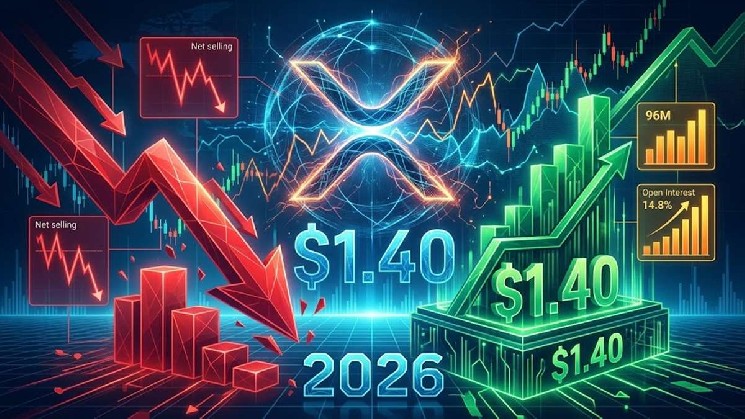
  • XRP Selling Pressure Hits 2026 High as Price Holds Firm Above $1.40

    XRP Selling Pressure Hits 2026 High as Price Holds Firm Above $1.40

    XRP’s derivatives market is flashing its strongest net selling pressure of 2026, with Binance recording approximately $96 million in sell-side dominance. The surge follows a sharp 70% rally in XRP that has intensified speculative activity among derivatives traders. Despite the bearish signal, XRP continues to trade above $1.40 while Binance Open Interest has climbed 14.8%, signaling stronger market participation.

    Divergence Between Derivatives Selling and Spot Resilience

    The divergence between aggressive derivatives selling and resilient spot prices is giving traders a critical signal to monitor. The broader altcoin market has also strengthened in recent sessions, adding more than $183 billion in total capitalization within days. That represented an increase of roughly 20%, while XRP gained about 70% over the same period, making it one of the stronger performers during the recovery.

    XRP Selling Pressure Reaches 2026 Peak

    Data highlighted by CryptoQuant shows that XRP’s net taker volume on Binance has shifted sharply toward sellers. Sell-side dominance has reached approximately $96 million, marking the strongest reading recorded since the start of 2026.

    The metric tracks aggressive market orders and can provide insight into how traders are positioning around short-term price movements. In XRP’s case, the increase suggests that some derivatives participants are using the recent rally to take bearish positions or secure profits after the rapid advance.

    However, elevated selling activity does not automatically mean that XRP’s uptrend has ended. Strong spot demand can absorb derivatives selling, while liquidations or short-term hedging can also influence net taker volume. The current price structure therefore remains important. Holding above $1.40 despite heavier derivatives selling suggests buyers have so far absorbed the additional supply pressure.

    Binance Open Interest Adds Another Signal

    At the same time, XRP’s Binance Open Interest has increased by approximately 14.8%. The rise means more capital is entering outstanding derivatives positions as traders respond to the token’s recent move.

    Higher Open Interest combined with strong selling pressure can increase volatility because a larger number of leveraged positions are exposed to sudden price movements. If XRP continues to hold its support levels, short positions could eventually face pressure from another upside move. Conversely, a decisive break below $1.40 would strengthen the bearish interpretation and could encourage further profit-taking or liquidations.

  • Aave V4 Deposits Surge 30% Weekly to Hit Record $806M

    Aave V4 Deposits Surge 30% Weekly to Hit Record $806M

    Aave V4 Deposits Surge 30% in One Week to Record $806 Million

    Aave V4 deposits have reached a record $806 million after climbing 30% over seven days, while active loans have increased to $206 million. The milestone marks a significant acceleration for the protocol’s latest version, which has more than doubled its total value locked in less than four weeks.

    Rapid Growth Across Multiple Markets

    Aave’s on-chain dashboard shows that V4 deposits reached $806 million on Aug. 27, extending a rapid rise that began earlier in the month. Deposits passed $500 million on Aug. 19 and exceeded $600 million two days later before adding more than $200 million over the following six days.

    Within the total, V4 deposits on Ethereum passed $500 million on Aug. 25. The dashboard divides the capital among several markets with separate collateral rules, borrowing limits, and risk settings instead of placing every asset inside one common lending pool.

    Ethereum Core is the largest market, holding $378 million, or about 47% of all V4 deposits. EtherFi Cash on Optimism follows with $257 million, giving the two markets a combined $635 million and nearly 79% of the version’s deposits, based on figures from the dashboard.

    Among the remaining markets, Ethereum Global Dollar holds $75 million, and Ethereum Prime accounts for $63 million. Avalanche Core has attracted $18 million, while Ethereum Plus holds another $15 million. Combined, the six listed markets account for the full $806 million reported on the dashboard.

    The latest figures have placed V4 well above the $400 million level reported in mid-August. Deposits had stood near $350 million at the start of the month, meaning the value supplied to the system has more than doubled in less than four weeks.

    Borrowing Activity Rises in Tandem

    Borrowing has risen alongside deposits, with active V4 loans reaching $206 million. EtherFi accounts for $62 million of the total as users deposit wrapped EtherFi staked Ether, known as weETH, as collateral to borrow wrapped Ether.

    According to the dashboard, the EtherFi market has reached a utilization rate of 92%. Utilization measures the portion of deposited assets currently being borrowed, making the figure important for both lenders and borrowers. High utilization can increase returns for suppliers, but it can also raise borrowing costs and leave less immediately available liquidity for withdrawals.

    A recent crypto.news report on Aave’s debt concentration found that Ether staking and restaking tokens, including weETH, rsETH and wstETH, made up about 66.2% of collateral among the protocol’s largest leveraged positions. WeETH alone accounted for roughly 42%, while WETH represented about 73% of the debt held by that group.

    The report also found that 9% of positions carried roughly half of Aave’s total debt. Average health factors for the group stood near 1.06, while debt-to-equity ratios were close to 10.7 times, according to the analysis. A health factor below 1 can trigger an automatic liquidation under Aave’s rules.

    Such figures cover Aave’s lending system beyond the new V4 markets and therefore should not be treated as a direct measure of V4 risk. Still, they provide context for the 92% utilization recorded in the EtherFi market, where weETH collateral supports borrowing in the closely related WETH asset.

    WeETH Dominates V4 Deposit Composition

    WeETH is also the largest individual asset supplied to V4, with deposits of $97 million. The Global Dollar stablecoin, or USDG, ranks second at $90 million, followed by WETH and USDC at $81 million each.

    Liquid staking and yield-bearing assets account for several other large positions. LiquidETH holds $77 million, while liquidUSD accounts for $58 million. Wrapped Bitcoin deposits have reached $54 million, giving users another crypto asset that can be deployed under V4’s market-specific collateral settings.

    The seven named assets together represent $538 million, or about two-thirds of all V4 deposits. Other supported tokens make up the remainder of the $806 million total.

    Hub-and-Spoke Architecture Differentiates V4

    V4’s structure separates its markets into liquidity hubs and specialized spokes. Hubs manage supplied capital and accounting, while spokes set the terms for individual borrowing markets, including which collateral can be used and how much users can borrow.

    The design differs from Aave V3, where each market generally operates as its own pool. V3 still holds approximately $31 billion in deposits, nearly 38 times the amount recorded in V4. The comparison shows that most Aave capital remains in the older system even as deposits move into the new version.

    During the Aave V4 launch in April, the protocol presented the hub-and-spoke model as a way to create lending markets with tailored risk controls without dividing liquidity across entirely separate pools. Supported uses included fixed-rate loans, tokenized real-world asset collateral, and structured credit.

    Aave’s DAO had previously approved $25 million in stablecoin funding and 75,000 AAVE tokens for protocol development. The funding framework established V4 as the system’s long-term technical base while directing revenue from specified Aave Labs products to the DAO treasury.

    Avalanche Deployment Adds Tokenized Treasury Access

    Outside Ethereum and Optimism, Avalanche Core accounts for $18 million of current V4 deposits. Aave launched V4 on Avalanche in July, making the network its first V4 deployment beyond Ethereum.

    As reported in July, Aave said the Avalanche rollout would support lending markets backed by tokenized real-world assets. Planned collateral included tokenized U.S. Treasuries, money market funds, private credit and corporate bonds.

    The planned Treasury-backed markets provide a direct connection to U.S. financial assets, although on-chain access does not by itself determine whether a product can legally be offered to U.S. investors. Any access rules would depend on the issuer, the structure of the tokenized instrument, and the regulations applying to its distribution.

    Avalanche’s deployment also sits alongside an effort to reduce support for markets with little activity. In July, an Aave governance proposal targeted six deployments and dozens of low-use reserves covering about $98.1 million in supplied assets and $15.6 million in debt.

    The proposal called for retiring deployments on Sonic, Scroll, zkSync, Metis, Soneium and Aptos while removing 50 low-adoption reserves and 21 matured Pendle principal tokens from other markets. Under the proposed process, Aave would first freeze affected reserves and cut their supply and borrowing caps before gradually reducing the remaining positions.


  • Next currency crisis may be harder to contain due to stablecoins, New York Fed report finds

    Next currency crisis may be harder to contain due to stablecoins, New York Fed report finds

    A new study from the Federal Reserve Bank of New York reveals that dollar-pegged stablecoins flow more aggressively into digital wallets linked to countries undergoing currency or banking crises, highlighting a growing challenge for central banks attempting to manage capital flight.

    Crisis-Linked Wallets Show Higher Stablecoin Receipts

    Researchers Pablo Azar, Maryam Farboodi, and Nish Sinha found that wallets associated with nations experiencing financial distress were 1.8% more likely to receive dollar stablecoins during the week a crisis began. Receipt volumes across these wallets also increased significantly during those periods, according to an August staff paper published by the New York Fed.

    The analysis covered nine crisis episodes across eight countries between 2021 and 2025, including monetary disruptions, banking restrictions, sanctions, and devaluations affecting Argentina, Egypt, Iran, Myanmar, Nigeria, Russia, Turkey, and the United Kingdom.

    Methodology: Linking On-Chain Activity to Country Signals

    To trace stablecoin flows, the researchers linked Ethereum Name Service (ENS) registrations carrying country indicators—such as languages, scripts, and national identifiers—with transfer histories for 19 major dollar-pegged stablecoins.

    During crisis weeks, tagged wallets recorded both a higher probability of receiving stablecoins and larger receipt volumes. A separate specification found no significant increase in the two weeks before the shocks, while the probability of receiving stablecoins rose 1.9% during the crisis week itself.

    Sending activity increased later, with wallets becoming 1.3% more likely to send stablecoins two weeks after the crisis began. The sequence supports the researchers’ argument that demand for blockchain-based dollars rises when confidence in domestic financial arrangements comes under pressure.

    Data Limitations and Scope

    The dataset does not represent every resident or crypto wallet in the countries studied. Its roughly 4.5 million observations are wallet-event-week records, and the sample focuses on wallet-country pairs that received stablecoins at some point within a 53-week window around each crisis.

    The result therefore captures a change in behavior among wallets already connected to stablecoin activity rather than showing that stablecoin adoption rose by 1.8% across an entire national population.

    Stablecoins Complicate the Capital-Control Playbook

    The findings feed directly into a longstanding constraint on monetary policy described by the Mundell-Fleming framework: countries cannot simultaneously maintain a fixed exchange rate, unrestricted capital mobility, and independent control over domestic interest rates.

    Governments seeking to protect a currency while retaining monetary autonomy have traditionally restricted capital movement through banks and other regulated intermediaries. The New York Fed researchers model stablecoins as weakening that enforcement channel.

    A household facing restrictions on buying or transferring dollars through its bank may instead receive dollar-denominated tokens into a blockchain wallet. As access to those rails expands, the government must devote more resources to enforcement or allow more of the pressure to emerge through currency depreciation or domestic interest rates.

    The paper does not establish that stablecoins caused particular currencies to weaken during the nine episodes. Instead, the observed wallet activity supports the model’s central assumption that financial stress encourages stablecoin adoption. Its broader monetary-policy consequences remain theoretical.

    Centralized Issuers and Regulated Exchanges Remain Control Points

    Governments retain significant points of control. Major dollar tokens such as USDT and USDC are issued by centralized companies that can freeze addresses, while regulated exchanges can be required to restrict transactions or identify customers.

    Those powers shift enforcement away from a country’s banking system toward a wider network of issuers, exchanges, and blockchain addresses. Transfers between self-custodied wallets can leave governments with fewer immediate domestic chokepoints even when issuers retain the ability to intervene at other stages.

    Market Growth Amplifies Policy Challenge

    The policy challenge becomes more consequential as stablecoins expand from a niche crypto product into a global dollar-payment network. The market has already grown beyond $300 billion and is expected to reach trillions of dollars before the end of the decade.

    Blockchain analysis firm Chainalysis projects an even steeper rise in activity, estimating that adjusted stablecoin transaction volume could reach $719 trillion by 2035 through organic growth alone and approach $1.5 quadrillion if broader macro and adoption trends accelerate usage.

    That growth would increase the number of routes available to households seeking dollar exposure during periods of domestic financial stress, but it would not put stablecoins entirely beyond government reach.

    Regulatory Warnings Highlight Enforcement Gaps

    Federal Reserve Vice Chair for Supervision Michael Barr warned in June that U.S. stablecoin legislation left an illicit-finance vulnerability around secondary-market transfers involving unhosted wallets.

    The Bank for International Settlements (BIS) has identified a similar problem for monetary policy, arguing that stablecoin dollarization can threaten monetary sovereignty while restrictions may prove less effective when bearer-like tokens circulate through self-custodied wallets.

    That creates a more fragmented enforcement map. Governments can exert substantial control over banks, stablecoin issuers, and regulated trading venues, but may have less visibility or immediate reach when dollar tokens move between private wallets without returning to those intermediaries.

    Stablecoins Becoming a Macroeconomic Constraint

    The distinction becomes particularly important during a currency crisis, when demand for an alternative store of value and payment rail can rise just as authorities try to restrict capital movement.

    The New York Fed paper suggests that this choice of financial infrastructure is becoming part of the macroeconomic constraint itself. As stablecoin networks grow, effective capital mobility increasingly depends on both the controls governments impose and the blockchain rails households can still access.

    At the scale projected for the next decade, that could turn stablecoins from an alternative payment mechanism into a material constraint on how governments defend currencies during periods of financial stress.

  • Connecticut Sues Kalshi Over Sports Prediction Contracts

    Connecticut Sues Kalshi Over Sports Prediction Contracts

    Connecticut has filed a lawsuit against prediction market operator Kalshi, escalating a nationwide legal battle over whether such platforms can offer sports-related contracts without state gambling licenses. The action, filed Thursday by Attorney General William Tong, alleges that Kalshi’s sports contracts function as traditional sports wagers and violate state consumer protection laws.

    State Alleges Unlicensed Sports Gambling

    The complaint targets contracts covering team wins, game scores, and point spreads. Connecticut officials contend these products cross the line into unlicensed sports gambling, an activity reserved for licensed operators under state law. The lawsuit follows a 2023 enforcement order directing Kalshi and two other platforms to cease offering unlicensed sports wagering to Connecticut residents.

    Kalshi Claims Federal Preemption

    Kalshi has challenged Connecticut’s authority in federal court, arguing its contracts qualify as regulated financial instruments under the Commodity Exchange Act. The company maintains that the Commodity Futures Trading Commission (CFTC) holds exclusive jurisdiction over its markets, preempting state gambling regulations.

    Regulatory Conflict Expands Across States

    Connecticut’s lawsuit opens a new front in Kalshi’s growing regulatory challenges. New York has launched a similar challenge against the company’s sports prediction markets. Meanwhile, a federal court recently blocked Minnesota from enforcing a ban against prediction markets, a ruling that bolstered Kalshi’s argument for federal oversight.

    However, a Connecticut judge recently denied Kalshi’s motion to halt the state’s enforcement efforts. The company has appealed that decision.

    National Implications for Prediction Markets

    The outcomes of these cases could define how regulators classify prediction markets across the United States. The central question remains whether states retain the power to regulate sports-related event contracts independently, or whether federal commodities law provides a complete shield for platforms like Kalshi.

  • Polygon Falls 12% Amid Heavy Selling Pressure; Can POL Recover?

    Polygon Falls 12% Amid Heavy Selling Pressure; Can POL Recover?

    Polygon (POL) is facing significant downside pressure after its recent uptrend collapsed at the $0.12 resistance level. The altcoin has now closed at lower lows for two consecutive sessions, breaching the $0.11 support floor to hit an intraday low of $0.105. At the time of writing, POL was changing hands near $0.108, representing a 12.3% decline on the daily chart. Trading volume has also contracted sharply, falling 34% to $157 million, signaling a notable reduction in market participation.

    Polygon Faces Intense Bearish Pressure

    The rejection at $0.12 on August 25 came despite a massive 690% surge in exchange outflows, a metric typically associated with strong buying pressure, according to data from CoinGlass. However, that buying momentum proved short-lived as investors quickly shifted to selling, driving the asset lower under heavy bearish pressure.

    Derivatives Data Shows Leverage Exiting the Market

    On the derivatives front, the bearish narrative is reinforced by declining open interest and volume. CoinGlass data indicates that POL’s Open Interest dropped 11.3% to $111 million, while derivatives volume plunged 38% to $157 million. The simultaneous decline in both metrics suggests that leverage is leaving the market, with traders actively closing positions rather than opening new ones.

    Futures market flows corroborate this trend. Over the past 24 hours, POL recorded $49.43 million in futures outflows against $39.3 million in inflows, resulting in a netflow decline of 196% to negative $3.04 million.

    Spot Market Sell Volume Dominates

    Seller dominance extends to the spot market. Data from Coinalyze shows that Polygon registered 139 million in sell volume over the same period. Historically, such persistent selling pressure across both spot and derivatives markets weakens market structure and often precedes further price declines.

    Technical Indicators: Mixed Signals

    From a technical perspective, the Relative Strength Index (RSI) has formed a bearish crossover, dropping to 69. While this crossover signals rising selling momentum, the RSI remains within the bullish zone (above 50), indicating that both buyers and sellers are active, though sellers have not yet fully seized control.

    Conversely, the Directional Movement Index (DMI) paints a more resilient picture. The Positive Directional Indicator (DI+) jumped to 45, while the Negative Directional Indicator (DI-) fell to 12, with the Average Directional Index (ADX) rising to 50. This configuration suggests that upward momentum remains strong and has historically preceded trend continuation. Despite aggressive selling, bulls appear to be holding the line, keeping the uptrend intact.

    Key Support Levels to Watch

    The immediate battleground is the $0.10 psychological support level. If buyers can defend this floor, a recovery toward the $0.12 resistance is likely, with $0.14 serving as the next key upside target. However, a failure to hold $0.10 would likely trigger a deeper correction toward $0.094.

    Final Summary

    • POL faced rejection at $0.12, dropping 12.3% and breaking below $0.11 support to a low of $0.105.
    • The decline was driven by heavy selling pressure across spot and derivatives markets.
    • Derivatives data shows leverage exiting (falling Open Interest) and negative futures netflows.
    • Technical indicators are mixed: RSI shows bearish crossover but remains bullish; DMI/ADX signals strong underlying uptrend momentum.
    • $0.10 support is critical; a hold could lead to a reclaim of $0.12, while a break targets $0.094.

    Sources: CoinGlass, Coinalyze, TradingView