Author: Evan Mercer

  • Aave V4 Deposits Surge to $806M on 30% Weekly Gain

    Aave V4 Deposits Surge to $806M on 30% Weekly Gain

    Aave V4 Deposits Surge 30% in a Week to Record $806 Million

    Aave’s Version 4 protocol has reached a new all-time high in user deposits, hitting $806 million according to the platform’s live onchain dashboard. The figure represents a 30% increase over the past seven days and extends a steep growth trajectory that began in mid‑August.

    Rapid August Milestones

    Separate protocol announcements tracked the ascent: V4 deposits crossed $500 million on August 19, breached $600 million two days later, and surpassed $800 million six days after that. A further update noted that Ethereum‑based V4 deposits alone exceeded $500 million on August 25. EtherFi Cash has emerged as the second‑largest market within the V4 ecosystem.

    Borrowing Activity Grows Alongside Deposits

    The dashboard shows $216 million in active loans across V4. In the EtherFi Cash market specifically, Aave measured $62 million of active loans where weETH collateral backs WETH borrowing at 92% utilization.

    Deployment Breakdown by Network and Market

    V4 is currently deployed on Ethereum, Optimism, and Avalanche. The largest market by deposits is Ethereum Core at $378 million, followed by EtherFi Cash on Optimism at $257 million. Ethereum Global Dollar holds $75 million, Ethereum Prime $63 million, while Avalanche Core and Ethereum Plus account for $18 million and $15 million respectively.

    Asset Composition of Deposits

    The deposit mix is led by weETH at $97 million and USDG at $90 million. WETH and USDC each represent $81 million, followed by liquidETH ($77 million), liquidUSD ($58 million), and WBTC ($54 million).

    V3 Still Dominates Total Liquidity

    Despite V4’s rapid growth, Aave’s V3 protocol retains a far larger deposit base. The equivalent V3 dashboard shows $31 billion in user deposits, with Ethereum Core alone holding $25 billion.

    Architectural Shift: Hub‑and‑Spoke vs. Market‑per‑Pool

    The two versions organize liquidity differently. According to Aave’s documentation, V4 replaces V3’s market‑per‑pool design with a hub‑and‑spoke system. Hubs consolidate liquidity and accounting, while spokes apply separate borrowing rules and risk limits to particular markets.

    EtherFi Cash Targets $500 Million Lending Capacity

    On August 27, TokenLogic reported that the EtherFi Cash market had been live for two weeks and was progressing toward a $500 million lending‑capacity target.

  • WSJ: UAE Royal Sheikh Tahnoon Bin Zayed Holds 49% Stake in Trump-Linked World Liberty Financial Banking Venture

    WSJ: UAE Royal Sheikh Tahnoon Bin Zayed Holds 49% Stake in Trump-Linked World Liberty Financial Banking Venture

    UAE National Security Adviser Reportedly Holds 49% Stake in Trump-Linked Crypto Banking Venture

    The Wall Street Journal reports that Sheikh Tahnoon bin Zayed Al Nahyan, the United Arab Emirates’ national security adviser, holds a 49% stake in the banking venture of World Liberty Financial (WLFI), the cryptocurrency project associated with the Trump family. The report identifies Sheikh Tahnoon as a key backer and shareholder of the U.S. bank that WLFI is preparing to launch through its unit, World Liberty Trust.

    Regulatory Milestone: OCC Conditional Approval

    The Office of the Comptroller of the Currency (OCC), the primary U.S. federal banking regulator, has conditionally approved a bank charter for World Liberty Trust. This conditional approval represents a significant regulatory step for the venture, though it remains subject to specific conditions and final authorization. The OCC’s decision allows the charter process to advance while the applicant works to meet all regulatory requirements.

    Profile: Sheikh Tahnoon bin Zayed Al Nahyan

    Sheikh Tahnoon serves as the UAE’s national security adviser and is a member of the Abu Dhabi royal family. Often referred to as the “spy sheikh” due to his intelligence portfolio, he is a prominent figure in Emirati finance and technology investment. His reported involvement adds a substantial international dimension to the Trump family’s cryptocurrency banking initiative, prompting questions about foreign investment in U.S. financial institutions and the regulatory scrutiny such arrangements attract.

    Implications for Crypto-Banking Convergence

    This development underscores the accelerating intersection between traditional banking and cryptocurrency, as well as the growing participation of sovereign-linked investors in U.S. financial ventures. If finalized, the bank would mark a notable entry of a crypto-aligned entity into the regulated U.S. banking system.

    However, the involvement of a foreign royal family member raises potential concerns regarding national security and compliance with U.S. banking laws, particularly around foreign ownership thresholds and influence. The OCC’s conditional approval suggests these issues are under active review, but the final outcome remains uncertain.

    Why This Development Matters

    For industry observers, this story highlights the evolving landscape of cryptocurrency regulation and the complex relationships between political figures, financial innovation, and international capital. The outcome could set a precedent for how crypto-related banking ventures are treated by U.S. regulators, especially when foreign stakeholders hold significant equity positions.

    Key Facts at a Glance

    • Entity: World Liberty Financial (WLFI) / World Liberty Trust
    • Reported Stakeholder: Sheikh Tahnoon bin Zayed Al Nahyan (49% per WSJ)
    • Regulatory Status: Conditional bank charter approval from the OCC
    • Significance: Potential first crypto-aligned bank with major foreign sovereign-linked ownership

    Related Developments

    This is a developing story. Further details are expected to emerge as regulatory processes advance and additional reporting becomes available.

  • Moving Self-Custody Bitcoin to Wall Street Now 25 Times Easier, $5 Billion Already Transferred

    Moving Self-Custody Bitcoin to Wall Street Now 25 Times Easier, $5 Billion Already Transferred

    BlackRock and Bitwise Slash Minimums for In-Kind Bitcoin-to-ETF Conversions

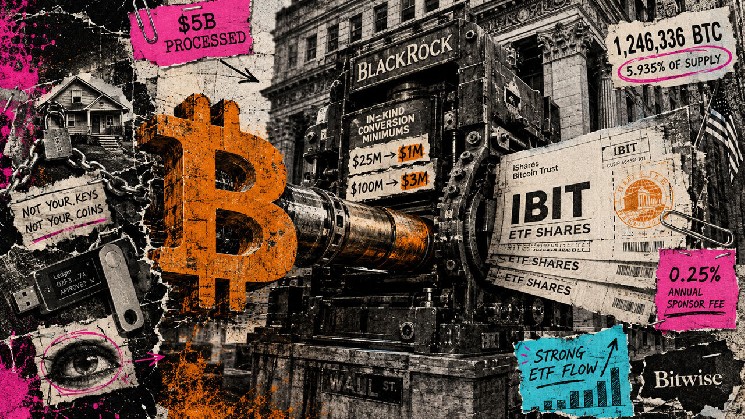
    BlackRock has reduced the minimum transaction size for converting privately held Bitcoin into shares of its iShares Bitcoin Trust (IBIT) from $25 million to $1 million, a 96% cut confirmed to Bloomberg in July. Bitwise followed with an even steeper reduction, lowering its floor from an initial $100 million to $50 million and now to $3 million—a 97% total decline. While the dollar thresholds still exclude most retail investors, the moves signal a structural shift: institutional custody is evolving from a niche whale service into a repeatable wealth-management product.

    In-Kind Creation Removes Friction and Potential Tax Events

    The mechanics rely on in-kind creation, a process the SEC approved for crypto exchange-traded products (ETPs) in July 2025, ending the original cash-only restriction. An eligible holder transfers Bitcoin through an authorized participant; the trust issues ETF shares at settlement, and the intermediary credits those shares to the holder’s brokerage account. This compresses what was previously a multi-step sequence—selling Bitcoin, wiring dollars, and repurchasing ETF exposure—into a single institutional transaction.

    The efficiency gain is more than operational. Selling Bitcoin can realize a taxable gain, while in-kind transactions may defer that gain for some holders. Because the tax outcome depends on the holder’s legal structure, each conversion requires individual tax advice. BlackRock says the program has already processed more than $5 billion in conversions to date.

    Wealth-Management Channels Expand Access

    A referral program announced in June by Morgan Stanley and Galaxy illustrates how the workflow is embedding into wealth management. Eligible clients lend crypto to Galaxy, which coordinates an in-kind creation with an authorized participant before ETF shares arrive in the client’s chosen account. Galaxy cut its minimum for referred clients from $25 million to $5 million and said onboarding that can exceed four weeks may be shortened by up to 75%.

    Activity data underscores the trend. Grayscale completed 62% of its gross Bitcoin creations in kind in June, up from 28% in March. At 21Shares, completed transactions averaged about $5 million over the three months through July, according to Bloomberg.

    US Spot Bitcoin ETFs Now Hold Nearly 6% of Total Supply

    Institutional adoption is measurable on-chain. As of August 25, US spot Bitcoin ETFs collectively held 1,246,336 BTC across 13 funds, equal to 5.935% of the 21 million supply, per Bitbo. IBIT alone held 765,389.9 BTC (3.645% of supply), with BlackRock reporting net assets of $60.65 billion on the same date.

    Physical Security Risks Drive Custody Reassessment

    BlackRock’s head of digital assets, Robbie Mitchnick, told Bloomberg that kidnappings, ransom demands, and custody failures can motivate holders to move some or all of their coins into an ETF. The company has not broken down the $5 billion in conversions by motive, so the crime data provides environmental context rather than direct causation.

    The physical threat is quantifiable. Chainalysis documented 46 violent crypto incidents through late June 2026, estimating attackers successfully stole more than $30 million in the first half of the year—already over half of 2025’s record $58 million. Only 12 of the 46 attempts produced a payment. CertiK counted 52 verified incidents in the same period, up 33.3% year-over-year, with $124.1 million in recorded exposure (a broader measure including losses and ransom demands). Home invasions jumped from one to 20 incidents year-over-year, while kidnappings rose from 12 to 16.

    Self-custody removes intermediaries from the authorization chain, leaving the holder as the final signer. A properly secured wallet resists remote theft, but a criminal inside the home can target the person who controls the seed phrase, hardware device, or second multisig signer. The true cost of self-custody therefore extends far beyond a hardware wallet: multisig coordination, inheritance planning, private security, reporting, and recovery all consume capital or attention. BlackRock describes IBIT as a way to simplify the operating and custody complexity of direct ownership.

    Trade-Offs: Sponsor Fees and Concentrated Custody

    IBIT carries a 0.25% annual sponsor fee and depends on brokerage and market infrastructure. The owner holds a security tracking Bitcoin’s price while the fund’s custodians retain the coins. Direct custody preserves the ability to withdraw, transfer on-chain, and verify assets in a personal wallet.

    Moving coins into ETFs reduces individual key risk but concentrates Bitcoin inside a smaller set of institutional firms. CryptoSlate calculated in April that funds naming Coinbase as a custodian or primary custodian represented 84.1% of US Bitcoin ETF assets under a broad method; a stricter count excluding multi-custodian funds with undisclosed allocations still reached 80.8%, or about $74.06 billion. Those percentages describe funds connected to Coinbase in some custody capacity; exact allocations among providers remain undisclosed.

    The custody map is diversifying. BlackRock’s documents name Anchorage as an available additional custodian. ARK lists Coinbase alongside BitGo and Anchorage. Fidelity uses its own digital-asset subsidiary, and VanEck uses Gemini. The market can therefore move more coins into institutional custody while distributing them among more providers.

    Parallel Demand Channels: Fresh Capital and Existing Coins

    The conversion program is widening amid a fresh burst of ETF demand. Farside data show US spot Bitcoin ETFs absorbed $2.57 billion across seven positive sessions from August 17 through August 25, with IBIT capturing $1.82 billion (71% of the total). Daily net inflows and direct Bitcoin conversions measure different activity and belong in separate datasets, but together they show two routes operating simultaneously: new capital buying ETF shares while existing coin holders gain a cheaper path to place Bitcoin they already own inside the same funds.

    Self-Custody Remains an Option as Institutional Packaging Gets Cheaper

    Bitcoin’s protocol still lets holders control an asset that can move anywhere the network reaches. Wealthy owners can continue paying for the security, coordination, and recovery systems that direct control requires. Wall Street now sells Bitcoin price exposure in a conventional account and assumes much of that operational burden for qualifying clients. The self-custody option stays available as the fund industry cuts the entry price for its packaged solution by 96% at BlackRock and 97% at Bitwise. More than $5 billion has already passed through IBIT, demonstrating how institutional adoption advances through coins leaving private wallets alongside dollars arriving from buyers who never held Bitcoin.

  • Virtu, Tradeweb Complete On-Chain Repo Using Marshall Islands Digital Bond

    Virtu, Tradeweb Complete On-Chain Repo Using Marshall Islands Digital Bond

    Virtu Financial, M1X Global, and Tradeweb have completed an on-chain repurchase agreement (repo) transaction using a sovereign digital bond as collateral, with the full transaction settling on the Canton Network. The milestone marks the first repo to combine natively issued sovereign collateral with fully on-chain atomic settlement between regulated counterparties.

    Sovereign Digital Bond Used as Collateral

    The transaction utilized USDM1, a U.S. dollar-denominated sovereign bond issued on-chain by the Republic of the Marshall Islands. The bond is backed 1:1 by short-term U.S. Treasurys, pays a coupon while serving as collateral, and is structured under New York law as a fully collateralized sovereign obligation. USDM1 is available for trading on Tradeweb, with institutional custody provided by Anchorage Digital, BitGo, and tZERO.

    Atomic Settlement in Under 10 Minutes

    Executed on Tradeweb’s electronic trading platform, the complete repo and repurchase cycle settled in under 10 minutes. Both companies confirmed this represents the first instance of tokenized sovereign debt being used as collateral in an institutional financing transaction, rather than solely as an asset for issuance or trading. The model remains an early-stage example, and broader adoption across institutional repo markets is not yet certain.

    Canton Network Sees Accelerating Institutional Activity

    Canton is a blockchain network designed for institutional finance, featuring privacy and permissioning capabilities tailored for regulated transactions and tokenized assets. Thursday’s repo follows a July transaction where Tradeweb facilitated the real-time transfer of a tokenized U.S. Treasury from Franklin Templeton to Virtu Financial on Canton, settling against USDCx.

    Network activity accelerated significantly in August. FalconX and Interstice launched a cross-chain swap engine connecting Canton with Ethereum, Solana, and Robinhood Chain. Simultaneously, World Liberty Financial launched its USD1 stablecoin natively on the Canton Network.

    2027 Pilot for State Benefits Distribution

    Digital Asset and the American Idea Foundation, founded by former U.S. House Speaker Paul Ryan, also announced plans this month for a 2027 pilot. The initiative would use the Canton Network to distribute state-administered benefits across three U.S. states, further signaling growing institutional interest in permissioned blockchain infrastructure for regulated financial workflows.

  • Grayscale Says Zcash Can Challenge Bitcoin’s Network Effects as Privacy Demand Grows

    Grayscale Says Zcash Can Challenge Bitcoin’s Network Effects as Privacy Demand Grows

    Grayscale Research Positions Zcash as Potential Bitcoin Challenger Amid AI Privacy Concerns

    Zcash could emerge as a meaningful competitor to Bitcoin’s dominance among digital assets as rapid artificial intelligence adoption increases demand for financial privacy and raises concerns over AI-powered surveillance, according to a new research report from Grayscale.

    Second-Mover Advantages in Privacy Technology

    Grayscale head of research Zach Pandl argues that Zcash ($ZEC) possesses “second mover advantages” that could help it challenge Bitcoin’s (BTC) entrenched network effects—a feat previous alternatives such as Litecoin (LTC) have failed to achieve. Central to Pandl’s argument is financial privacy: Zcash’s ability to shield transaction information could become increasingly valuable as AI systems grow more capable of analyzing financial activity at scale.

    Valuation Gap Suggests Upside Potential

    The report follows a roughly 19-fold increase in $ZEC over the past year. Despite those gains, Zcash remains valued at less than 1% of Bitcoin’s market capitalization, a disparity Grayscale sees as evidence of further upside if Zcash can capture market share. The research notes that Zcash could be valued at more than $4,000 if its market capitalization reached 5% of Bitcoin’s. Source: Grayscale

    Pandl acknowledged that Bitcoin’s liquidity and entrenched network remain powerful defenses of its dominant position. Grayscale also warned that Zcash remains a high-risk investment and that any further gains could be volatile and uneven.

    Institutional Capital Flows Into Zcash Ecosystem

    Interest in the Zcash ecosystem is broadening alongside $ZEC‘s strong price performance. Nasdaq-listed privacy technology company Cypherpunk Technologies recently expanded its Zcash exposure by acquiring a mining fleet from Winklevoss Capital in a $33.33 million equity-based transaction.

    The operation is already online across U.S. facilities, producing about 4.2 GSol/s of Equihash hashrate, or roughly 18% of the Zcash network’s total computing power. Cypherpunk said the deal made its mining arm the network’s largest active fleet.

  • Strive CEO Predicts Bitcoin Could Surpass $500,000 in Four to Five Years

    Strive CEO Predicts Bitcoin Could Surpass $500,000 in Four to Five Years

    Strive Asset Management CEO Matt Cole has projected that Bitcoin could surpass $500,000 within the next four to five years, citing accelerating erosion of the U.S. dollar’s purchasing power as the primary catalyst. In a recent interview, Cole argued that fiscal pressures and monetary expansion will drive capital toward the digital asset as a store of value, reinforcing a narrative gaining traction among institutional investors.

    Macroeconomic Foundations Behind the Forecast

    Cole’s outlook centers on structural concerns regarding U.S. fiscal policy. He highlighted the expanding national debt and the potential for accelerated money supply growth as forces that could weaken the dollar more rapidly than observed over the past 15 years. Data from BitcoinTreasuries, which tracks corporate Bitcoin holdings, indicates this view aligns with a broader institutional shift toward treating Bitcoin as a hedge against inflation and fiat depreciation.

    While Bitcoin’s historical volatility remains a factor, its adoption as a treasury reserve asset by public companies and increasing integration into mainstream finance have strengthened the case for long-term allocation. Cole’s four- to five-year horizon reflects a medium-term conviction distinct from the short-term speculation common in crypto markets.

    Market Implications of a $500,000 Bitcoin

    Reaching $500,000 would represent roughly a fivefold increase from current levels. Such a move would likely trigger significant capital reallocation, potentially diverting funds from traditional safe havens like gold and U.S. Treasuries. Analysts point to Bitcoin’s fixed supply of 21 million coins and decentralized architecture as structural advantages for investors seeking protection against currency devaluation.

    However, skeptics emphasize that price trajectory depends on a complex interplay of regulatory developments, technological evolution, and market sentiment. The prediction, while bold, mirrors a growing institutional appetite for digital assets. The coming years will be pivotal in determining whether Bitcoin cements its role as a mainstream financial asset or remains a speculative vehicle.

    Investor Takeaways: Diversification and Risk Management

    For retail investors, Cole’s forecast underscores the importance of monitoring macroeconomic trends and their impact on asset valuations. If dollar depreciation accelerates, assets like Bitcoin may offer a hedge — but they carry elevated risk and volatility. Diversification remains essential, and any exposure should align with individual financial goals and risk tolerance.

    Frequently Asked Questions

    What is Strive Asset Management?

    Strive is an investment firm co-founded by Vivek Ramaswamy, focused on asset management with a mission to promote corporate accountability and shareholder value. The firm has been vocal about its views on Bitcoin and other digital assets.

    Why does Matt Cole believe the dollar will decline faster?

    Cole points to factors such as rising national debt, potential monetary expansion, and fiscal policies that could accelerate the erosion of the dollar’s purchasing power compared to the past 15 years.

    Is a $500,000 Bitcoin price realistic?

    While the prediction is ambitious, it is not impossible. Bitcoin has shown significant growth over the past decade, but such a price would require substantial market adoption and favorable macroeconomic conditions. It remains a speculative outlook.

    Related Reading

  • Mantle Stablecoins and Tokenized Assets Hit $880M

    Mantle Stablecoins and Tokenized Assets Hit $880M

    Mantle’s Onchain Asset Base Nears $880 Million as Tokenized Equities and Stablecoin Supply Expand

    Mantle has accumulated roughly $880 million in stablecoins and tokenized assets, reflecting rapid growth across equities, U.S. Treasuries, funds, and yield-bearing products. According to Blockworks Research data, the network’s stablecoin circulating supply stands at approximately $550 million, while tokenized assets account for another $330 million.

    Stablecoin Composition Heavily Weighted Toward USDT0

    Stablecoins provide the bulk of liquid capital on Mantle. The latest dashboard readings show a combined circulating supply of about $553.7 million, with USDT0 dominating at $440.03 million—nearly 80% of the total. USDe ranks second at $57.93 million, followed by USDC at $34.15 million and conventional USDT at $12.96 million. Smaller contributions come from AUSD ($5.15 million), World Liberty Financial’s USD1 ($2.29 million), and Aave’s GHO ($1.23 million).

    Recent flow data highlights strong inflows for the two largest assets: a daily net inflow of $18.42 million for USDT0 and $9.94 million for USDC. Over a 30-day period, USDC supply grew 33.93% while USDT0 rose 9.51%. Smaller tokens posted sharper percentage gains from lower bases—GHO surged 203.5% and USD1 jumped 190.89%—while USDe, standard USDT, and AUSD each saw modest declines.

    Tokenized Equities Catalog Grows to 155 Products

    Equities have become a larger segment of Mantle’s tokenized-asset lineup. Nansen counted 155 tokenized equities on the network at the end of June, up from just 10 in April, per an August 25 report. The selection spans public companies, private businesses, and exchange-traded funds, including instruments tied to SpaceX and Franklin Templeton’s U.S. Equity Index ETF.

    In November 2025, Mantle integrated Backed’s xStocks via an arrangement with Bybit, bringing tokens linked to Apple, Nvidia, and Strategy shares onto the network. Bybit facilitated direct deposits and withdrawals between its centralized exchange and Mantle. Backed stated its xStocks platform had processed over $1.6 billion in tokenized equity volume, with each token backed one-to-one by an underlying security held through licensed Swiss custodians.

    Investors should assess each product individually, as tokenized equities do not uniformly confer legal ownership, voting rights, or shareholder protections. Some offerings deliver only synthetic price exposure. Backed’s one-to-one model differs from derivative-based tokens that track share prices without transferring a claim on the underlying stock.

    RWA Yield Vault Opens to DeFi Users

    Mantle is also deploying stablecoin liquidity into yield products. On August 25, the network launched its RWA vault to DeFi users after a Bybit-distributed version surpassed $200 million in assets under management. The vault accepts USDC and USDT0 through Fluxion, employing a non-leveraged strategy designed by CIAN. Grove connects deposits to yield from the Sky ecosystem, while Fluxion provides the user interface.

    Deposited assets gain exposure to returns from sUSDS, the savings version of Sky’s USDS stablecoin. The savings rate is set by Sky governance and can fluctuate. Mantle’s launch materials cited a target annual percentage yield of up to 6.5%, inclusive of campaign incentives such as Fluxion Points and an allocation of 5.14 million GROVE tokens—actual rewards depend on participation rules and token prices.

    Without leverage, the vault eliminates one liquidation risk vector, though users remain exposed to smart-contract failures, stablecoin price volatility, liquidity conditions, and changes to Sky’s governance-set rate. The self-custodial version also shifts control: Fluxion users approve transactions from their own wallets and manage private keys, unlike the prior exchange-account model via Bybit.

    Broader Network Metrics Show Scale

    Additional Blockworks figures underscore Mantle’s growth: treasury value of approximately $1.8 billion, cumulative spot decentralized exchange volume of $20 billion, and more than 150 deployed decentralized applications.

    U.S. Investors Face Access and Regulatory Constraints

    For U.S. participants, the availability of tokenized American equities on a public blockchain does not guarantee legal access in every state or for every investor. Eligibility hinges on issuer terms, distribution controls, and applicable federal and state securities regulations.

    Stablecoin yield raises separate regulatory questions. The GENIUS Act bars payment stablecoin issuers from paying interest or yield directly to holders, while rewards from exchanges, brokers, and DeFi protocols remain under congressional review. Mantle and its partners characterize the vault’s return as strategy-generated yield from sUSDS—not a direct payment from a stablecoin issuer—with Fluxion Points and GROVE incentives provided separately.

    Tokenized-stock models vary in their treatment of U.S. securities. In August, Crypto.com introduced tokenized derivatives linked to 1,500 U.S. equities and ETFs for eligible users in the European Economic Area and other approved markets, offering price exposure without legal ownership or shareholder rights.

    Meanwhile, regulated U.S. market infrastructure is advancing. The Depository Trust Company received an SEC no-action letter in December 2025 for a defined tokenization service covering eligible assets held in DTC custody for three years. Potential assets include Russell 1000 stocks, major index ETFs, U.S. Treasuries, and certain corporate bonds. DTC has selected Stellar for part of its multi-chain strategy, targeting deployment in the first half of 2027.

  • Trump Crypto Ventures Leave Investors $4.7 Billion Underwater, Report Shows

    Trump Crypto Ventures Leave Investors $4.7 Billion Underwater, Report Shows

    Public Citizen estimates that investors in five Trump-linked cryptocurrency ventures have suffered at least $4.7 billion in combined losses through 2025, while former President Donald Trump personally generated approximately $1.4 billion in crypto-related income during the same period, according to the nonprofit watchdog’s analysis and the president’s financial disclosures.

    Breakdown of Estimated Investor Losses Across Trump Crypto Products

    The $4.7 billion figure aggregates both realized and unrealized losses across the following assets:

    • Official Trump memecoin ($TRUMP): $3.2 billion
    • World Liberty Financial governance token ($WLFI): At least $1 billion
    • Trump Media digital-asset treasury: $450 million
    • Trump Digital Trading Cards (NFTs): $9.3 million
    • World Liberty $USD1 stablecoin: No major loss assigned

    Public Citizen noted that $USD1 is designed to maintain a $1 peg and has not experienced a sustained de-pegging event. The organization emphasized that unrealized losses reflect current market values for holders who have not sold, meaning final totals could shift if prices recover or decline further.

    $TRUMP Memecoin: Wealth Transfer from Late Buyers to Early Insiders

    Launched on January 17, 2025 — three days before Trump returned to the White House — the $TRUMP token surged from under $1 to an all-time high of $73.43 before surrendering most of those gains. Citing blockchain intelligence firm Nansen, Public Citizen reported that approximately 1 million retail wallets (65% of those analyzed) were underwater by a combined $3.2 billion.

    Only about $400 million of that total represented realized losses through sales. The top 1% of profitable wallets captured roughly $2.7 billion (80% of all gains), while wallets that entered during the token’s first two days collected nearly 90% of profits.

    In July, crypto.news reported Nansen’s finding that nearly 989,000 wallets accumulated $3.81 billion in realized and paper losses through June 30. Public Citizen attributed the discrepancy to different wallet filters and measurement dates.

    Trump’s Estimated $1.4 Billion in 2025 Crypto Income

    While investors absorbed losses, Public Citizen calculated Trump’s proceeds from the ventures:

    • $635 million in licensing fees from $TRUMP (via CIC Digital LLC, a Trump-owned company that licensed its brand rather than investing directly)
    • $557 million from $WLFI token sales ($527 million in 2025 + ~$30 million in late 2024)
    • $65.6 million from an equity transaction tied to World Liberty Financial
    • $7.2 million+ from digital trading card licensing and royalties

    Two project-affiliated companies retained 80% of $TRUMP’s 1 billion-token supply, scheduled to unlock over three years, and also earn trading-fee revenue regardless of token price direction.

    Trump’s June 2026 annual financial disclosure placed his 2025 crypto-related income above $1 billion, with some calculations nearing $1.4 billion. The filing also listed a cold-wallet Bitcoin position worth over $50 million, a smaller Ethereum holding, and ~$1.8 million in ether staking rewards, along with ongoing exposure to $WLFI and $USD1 (often reported in value ranges per federal ethics rules).

    $WLFI Token: Peak Buyers Down Over 80%

    $WLFI hit a record $0.3313 on September 1, 2025, but Public Citizen valued it at $0.05744 at report time — an 83% decline for peak buyers.

    The largest estimated loss came from AI Financial Corporation (formerly ALT5 Sigma), a Nasdaq-listed firm that acquired 7.28 billion $WLFI tokens for ~$1.46 billion in August 2025. By June 2026, the position was valued at $421 million, implying a ~$1.04 billion paper loss.

    Among ~31,000 likely retail wallets purchasing $WLFI via Ethereum DEXs, Nansen found 25,000 (82%) underwater as of August 3, with $54 million in losses versus $24 million in gains. Centralized exchange activity was excluded due to lack of public account-level data, making the $1 billion estimate a minimum.

    Trump Media Shareholders Face $450 Million Treasury Loss

    Public Citizen attributed a $450 million loss to Trump Media shareholders tied to the company’s digital-asset treasury, noting investors bought shares in a publicly traded U.S. corporation that later allocated corporate funds to cryptocurrencies.

    White House Denies Ethics Concerns

    White House spokesperson Anna Kelly denied that the president’s business interests create an ethics problem. She stated that “neither Trump nor his family has engaged in conflicts of interest,” and the White House maintains that “the president does not participate in the management of his companies.”

    CLARITY Act and Renewed Push for Presidential Divestiture

    Following its loss estimate, Public Citizen called for the CLARITY Act to require a sitting president and immediate family members to divest from crypto ventures, arguing that federal digital-asset policy and the president’s private financial interests “cannot be separated.”

    The bill would:

    • Establish federal categories for digital assets
    • Divide oversight between the SEC and CFTC
    • Impose registration, custody, disclosure, and customer-asset rules for firms serving U.S. investors

    Ethics restrictions remain a key dispute in Senate negotiations, alongside DeFi rules and stablecoin yield provisions. Democratic lawmakers have pressed for limits on crypto holdings by elected officials; the White House rejects claims that Trump’s ventures influence policy.

    Senate Investigation Requests and Upcoming Procedural Vote

    Senators Elizabeth Warren and Richard Blumenthal separately asked the SEC in August to investigate whether the $TRUMP token facilitated fraud or improper enrichment after its price fell ~98% from peak. Their request did not establish securities fraud, and the SEC would first need to determine whether federal securities laws apply to the token.

    Trump met with crypto executives and federal regulators at the White House on August 19, urging lawmakers to approve a “fair version” of the legislation. Attendees included leaders from Coinbase, Robinhood, Kraken, Ripple, and other digital-asset firms.

    The Senate’s scheduled procedural vote is set for September 15 at 2:15 p.m. Eastern. Sixty senators must support cloture to begin debate; passage would still leave amendments, a final Senate vote, and reconciliation with the House-approved text.

  • Bitcoin’s 22% Rally Needs Real Demand to Outlast Treasury Liquidity Boost

    Bitcoin’s 22% Rally Needs Real Demand to Outlast Treasury Liquidity Boost

    Bitcoin’s recent breakout appears to have been triggered by a shift in U.S. Treasury-market liquidity, but analysts say the rally’s staying power hinges on whether exchange-traded fund inflows and spot demand can replace the initial macroeconomic boost.

    Treasury Buybacks Spark 22% Surge and Short Squeeze

    Bitcoin surged roughly 22% during its breakout week as long-term Treasury yields fell and the dollar weakened following the U.S. Treasury’s decision to expand buybacks of longer-dated government debt. The move also triggered a major short squeeze, while demand for U.S. spot Bitcoin exchange-traded funds accelerated.

    The Treasury announced on Aug. 19 that it would at least double the maximum size of liquidity-support buybacks for 10-to-20-year and 20-to-30-year nominal Treasuries, raising them from $2 billion to at least $4 billion per operation. The larger operations are scheduled to begin Sept. 9 and continue through the current refunding quarter.

    Macro Forces Drove First Stage of Rally, Analysts Say

    Fabian Dori, chief investment officer at FINMA-regulated digital asset bank Sygnum, told crypto.news that Bitcoin’s behavior alongside other markets suggests the first stage of the rally had a strong macro component.

    “The clearest tell is the combination of cross-asset behavior and crypto-market plumbing.”

    Dori said the Treasury’s announcement temporarily pushed long-term yields lower while weakening the dollar and lifting both gold and Bitcoin. In his view, those moves were consistent with investors seeking hard assets amid renewed concerns about currency debasement rather than a rally driven exclusively by crypto-specific demand.

    Martin Lee, Market Insights Lead at DWF Labs, pointed to a similar divergence across markets. AI and technology assets remained under pressure while gold and Bitcoin ETFs attracted capital as debasement concerns returned, he told crypto.news.

    As crypto.news reported earlier, U.S. spot Bitcoin ETFs received about $1.92 billion during the breakout week, their largest weekly inflow in 10 months. At the same time, the price surge forced traders positioned for further weakness out of the market. Lee said a record $2.7 billion in crypto short positions were liquidated as Bitcoin cleared its previous trading range, meaning part of the apparent spot demand reflected traders buying Bitcoin to cover bearish positions.

    Derivatives Data Points to Mixed Drivers

    Derivatives data provides another clue about the nature of the breakout. Dori noted that Bitcoin-denominated open interest fell during the rally while funding rates remained contained. Bitcoin futures open interest recently declined to roughly 587,584 BTC, its lowest level in nearly five months, from around 645,760 BTC on Aug. 14.

    Rather than showing traders aggressively piling into leveraged long positions, Dori said the combination points toward forced short covering playing an important role. Still, he does not view the entire rally as a macro trade.

    “So the right interpretation is probably mixed.”

    Dori said the first impulse saw Bitcoin behave more like gold, as lower long-term yields, a weaker dollar, and debasement concerns drove demand. A second, crypto-specific impulse came from ETF inflows alongside regulatory developments in Washington, including the SEC’s Regulation Crypto proposal and renewed White House pressure for progress on the CLARITY Act.

    ETF Flows Sustain Momentum as Bond-Market Impact Fades

    ETF flows provide some evidence that demand has continued beyond the initial Treasury shock. U.S. spot Bitcoin ETFs recorded eight consecutive sessions of inflows through Wednesday, attracting about $2.8 billion over the streak.

    The continued inflows matter because the initial reaction in the bond market has already weakened. BNY Markets said the decline in the term premium following the Treasury announcement had largely retraced, with long-term yields returning close to levels seen before the Aug. 19 announcement.

    Bitcoin has therefore reached a point where crypto-specific buying may need to carry more of the rally if the original rate impulse continues to fade.

    Sept. 9 Buyback Launch Is Next Liquidity Test

    The larger Treasury buybacks do not begin until Sept. 9, raising the question of how much of their expected impact markets have already priced in. Dori said markets normally react when such policies are announced rather than waiting for the operations themselves to begin. More important than the immediate size of the purchases, in his view, was the signal that the Treasury is willing to intervene when longer-term borrowing costs become excessively high.

    Whether that support lasts will depend on what happens after the announcement’s effect fades. Dori said rising long-end yields would suggest that the buybacks are failing to provide the expected support, while a rebuilding of the Treasury General Account could withdraw liquidity. Rapid increases in funding rates and open interest would also indicate that leverage, rather than underlying demand, had begun driving Bitcoin higher. Weakening ETF flows or tighter dollar funding conditions would remove another source of marginal demand.

    Lee similarly argued that anticipation alone cannot sustain the rally indefinitely.

    “A rally on anticipation is only as durable as the flow that follows it.”

    He identified ETF flows, futures basis and funding, and Bitcoin’s previous trading range as three key indicators to watch before Sept. 9. A week of negative ETF creations while Bitcoin holds near current levels could indicate that the anticipation trade is unwinding, Lee said. He added that the three-month futures basis moved back above the 10-year Treasury yield during the rally; a reversal below that level would suggest the cash-and-carry bid had failed to persist. The more bearish combination would be Bitcoin closing back inside its pre-breakout range while ETF flows turn negative, which Lee said would indicate that leverage drove much of the move without a durable structural bid emerging.

    Liquidity Analysis Extends Beyond Fed Policy Rate

    Both analysts also argue that investors looking only at the Federal Reserve’s policy rate may miss important forces influencing crypto prices. Dori said Treasury cash management, particularly changes in the Treasury General Account and the mix of issuance and buybacks, has recently become an important marginal driver of liquidity. The term premium then transmits changes at the long end of the Treasury curve into risk assets.

    Other channels include bank balance-sheet capacity, private credit creation, stablecoin growth and global dollar funding conditions, while the Federal Reserve’s balance sheet remains important over a longer horizon. Lee similarly ranks dollar funding conditions and real yields ahead of the policy rate for short-term crypto market behavior, followed by the term premium. Treasury cash balances and reserve dynamics influence the liquidity underneath those markets, while issuance matters partly through its effect on longer-term yields.

    For Lee, Bitcoin’s reaction to the Treasury buyback announcement showed how quickly a change at the long end of the yield curve can affect crypto even without a change in the Fed’s policy-rate outlook.

    Warsh’s Jackson Hole Speech in Focus

    The liquidity debate now shifts toward Federal Reserve Chair Kevin Warsh’s first Jackson Hole keynote on Friday. The latest inflation data gives the Fed a complicated backdrop. The Bureau of Economic Analysis reported that headline Personal Consumption Expenditures inflation rose 0.2% in July and 3.7% from a year earlier. Core PCE increased 0.2% for the month and 3.3% annually. Real consumer spending was nearly unchanged during July, while the personal saving rate stood at 3%.

    Dori said Warsh could affect short-term rate expectations by explaining how the Fed views current inflation pressures, including those connected with oil markets. Treasury is attempting to influence the longer end of the curve through its buyback program, while the Fed has more direct control over short-term rates.

    “If both were to get aligned, that would be a powerful support for risk assets.”

    However, Dori said a simple change in expectations for the September Federal Open Market Committee meeting may not be enough to materially alter institutional crypto positioning. Instead, investors should watch for any signal that changes the broader liquidity outlook, such as greater tolerance for oil-driven inflation, a different balance between inflation risks and economic growth, or comments capable of repricing the Treasury term premium.

    Lee said institutions should remain defensive if inflation, bond yields and the Fed’s policy outlook provide conflicting signals. Bitcoin’s reaction alongside gold could offer another clue about how investors are treating the asset. If Bitcoin rises with gold while long-duration bonds sell off, Lee said it would strengthen the case that investors are treating BTC as a hedge against fiscal and currency concerns. If Bitcoin instead falls alongside gold, its rate sensitivity would remain dominant, and institutions would have greater reason to reduce exposure.

    For both analysts, the next stage of Bitcoin’s rally therefore depends less on any single inflation reading or September rate decision than on whether the liquidity conditions behind the breakout persist. It will also follow whether sustained ETF and spot demand can take over as the initial Treasury-driven impulse fades.


  • MemeToro vs AlphaPepe Tokenomics Compared: Top 2026 Crypto Presales

    MemeToro vs AlphaPepe Tokenomics Compared: Top 2026 Crypto Presales

    MemeToro vs. AlphaPepe: Comparing Two 2026 Crypto Presale Contenders

    Two projects are drawing attention in the 2026 crypto presale landscape: MemeToro and AlphaPepe. While both operate in the memecoin presale category, their strategies, progress, and utility narratives differ significantly. MemeToro has reached Stage 6 at $0.00350 and is approaching $100,000 raised, whereas AlphaPepe has advanced to Stage 20 with more than $2.5 million raised from over 11,100 unique wallet holders.

    Understanding their tokenomics and utility models helps clarify why investors are tracking both as potential best crypto presale opportunities for 2026.

    MemeToro: AI-Powered Launch Infrastructure on BNB Chain

    MemeToro’s $MT token anchors an ecosystem built around AI-assisted memecoin creation and launch infrastructure. Currently in Stage 6 with a token price of $0.00350, the project’s fundraising is nearing $100,000.

    The project’s defining feature is its AI-powered launchpad on BNB Chain. The platform employs an AI agent to help identify trends and develop memecoin concepts, while an automated security scanner is designed to detect developer backdoors and honeypot-style mechanisms before deployment.

    This infrastructure focus gives MemeToro a clear utility narrative within the AI crypto presale category. Rather than relying solely on community hype, the project is building a product around the process of creating and evaluating new meme tokens. For investors comparing a crypto presale with established meme assets, that infrastructure focus is an important distinction. The $MT narrative is tied directly to the platform’s future ecosystem.

    Video overview of the MemeToro ecosystem

    AlphaPepe: Broad Ecosystem With Rewards, Rankings, and CEX Roadmap

    AlphaPepe has progressed considerably further through its fundraising cycle. The project has surpassed $2.5 million raised and attracted more than 11,100 unique wallet holders. Its Stage 20 presale is priced between $0.02789 and $0.02817, and a 48-hour Bonus Drop gives buyers an opportunity to unlock additional ALPE tokens.

    AlphaPepe’s ecosystem includes several features designed around user engagement and participation:

    • Rewards programs
    • Rankings and leaderboards
    • Referral incentives
    • Marketplace activity
    • Planned exchange partnerships

    Project updates highlight upcoming trading partnerships with centralized exchanges (CEXs) including Azbit and BiFinance. That gives AlphaPepe a strong listing and community-growth narrative alongside its presale momentum.

    Side-by-Side Comparison: MemeToro vs. AlphaPepe

    The clearest way to compare the projects is to examine what each is attempting to build. MemeToro positions itself around AI and launch infrastructure, while AlphaPepe builds an ecosystem around community activity, rewards, rankings, referrals, and exchange access.

    Metric MemeToro ($MT) AlphaPepe (ALPE)
    Presale Stage Stage 6 Stage 20
    Token Price $0.00350 $0.02789–$0.02817
    Funds Raised Approaching $100,000 Over $2.5 million
    Wallet Holders Not disclosed 11,100+
    Core Utility AI launchpad & security scanner Rewards, rankings, referrals, CEX roadmap
    Chain BNB Chain Not specified in source

    This comparison is useful for investors researching the latest crypto presale market. MemeToro offers exposure to an AI-powered BNB Chain launchpad, while AlphaPepe offers a broader community and rewards ecosystem with established presale momentum.

    Both fit into the expanding memecoin presale category, but their product narratives are distinct. MemeToro’s strongest differentiator is AI-driven infrastructure, while AlphaPepe’s strength lies in its established presale momentum and engagement-focused ecosystem.

    MemeToro ($MT) Presale Links