Author: Evan Mercer

  • Ripple Prepares XRP Ledger for Quantum Computing Before ‘Q-Day’ Arrives

    Ripple Prepares XRP Ledger for Quantum Computing Before ‘Q-Day’ Arrives

    Quantum computing could force financial institutions to overhaul how they protect transactions, identities, assets and sensitive information, Ripple executive Akinyele said.

    “The financial system was not built with quantum computing in mind,” Akinyele said. “As quantum capabilities advance, institutions will need to rethink how they secure transactions, identities, assets and sensitive data.”

    Ripple’s four-stage quantum-resistance plan

    Ripple has outlined a four-stage plan for the $XRP Ledger that covers the period before and after a serious quantum-computing threat emerges. The first steps involve identifying which parts of the network could be vulnerable and testing alternative cryptographic methods against the blockchain’s current workload.

    Later stages would operate existing security systems alongside quantum-resistant alternatives before transitioning the wider network to the new technology.

    The plan also includes an emergency response if quantum computing develops faster than expected. Ripple says the network would need a mechanism to act before attackers could exploit older cryptographic protections.

    The $XRP Ledger already enables users to replace the keys that control an account without changing the account itself. Ripple says this feature could simplify a future migration, although the network’s independent validators would still need to coordinate any broader changes to transaction rules.

    “That upgrade will go well beyond swapping out one cryptographic algorithm for another,” Akinyele said. “It will require more agile infrastructure, stronger key management, clearer upgrade paths and systems that can evolve without disrupting the financial activity they support.”

    Source: cryptonews.net

  • Crypto Faces $3.63 Billion Security Crisis Despite Audited Protocols

    Crypto Faces $3.63 Billion Security Crisis Despite Audited Protocols

    Crypto scams and hacks continued at a high frequency in 2026, with attackers carrying out 207 separate hacks during the first half of the year. Despite the increase in incidents, total losses fell to $972 million, less than half of the $2.3 billion stolen during the first half of 2025.

    CoinGecko’s recent report, titled ‘2026’s State of Crypto Security’, documented 245 security incidents affecting crypto platforms between January 2025 and July 2026. Together, the incidents resulted in $3.63 billion in losses.

    Crypto hack losses remain concentrated

    The 10 largest attacks accounted for more than 72.5% of all stolen funds. Decentralized exchanges (DEXs) and decentralized applications (dApps) faced significant exposure to smart-contract exploits, which caused approximately $546 million in losses.

    However, crypto security threats increasingly extended beyond core code. More than $1.8 billion was lost through infrastructure and supply-chain vulnerabilities, including weaknesses in third-party services, integrations, and software updates. High-profile examples included security failures at Bybit and KelpDAO.

    Of the 245 documented incidents, 147 involved audited protocols. These incidents accounted for 88.44% of all stolen capital.

    Only about 11% of the attacks targeting audited protocols exploited vulnerabilities within the scope of the relevant audits, resulting in approximately $396 million in losses. Most attacks instead involved infrastructure, third-party services, governance systems, front ends, or human error.

    Crypto insurance coverage declines

    Despite the increase in crypto hacks, active insurance coverage declined from $163.2 million to $130.2 million, covering 20.2% of the sector. Cumulative payouts, meanwhile, remained at approximately $33 million.

    The on-chain insurance sector also struggled to scale. By August 2026, five of nine on-chain insurance protocols had become inactive or pivoted to other activities.

    SEC reviews crypto custody rules

    The developments came as the SEC revisited its Custody Rule to clarify who can safeguard customers’ crypto assets.

    On 25th August, the agency submitted proposed amendments to OIRA for review. Publication was expected by October 2026, followed by at least 60 days of public comments. The rules are not yet effective, however. Further analysis and a second SEC vote would still be required, meaning mandatory compliance could take several years.

    The report’s key findings show that the largest 10 attacks accounted for more than 72.5% of all stolen funds, while 147 of the 245 documented incidents involved audited protocols and represented 88.44% of all stolen capital.

    Source: cryptonews.net

  • Ripple Prime Expands Into Equity Derivatives With Delta One Launch

    Ripple Prime Expands Into Equity Derivatives With Delta One Launch

    Ripple has expanded its institutional brokerage business with the launch of Delta One within Ripple Prime, adding equity derivatives to a platform that already covers foreign exchange, fixed income, derivatives, and digital assets.

    The Delta One service went live on Aug. 27 for institutional investors, including hedge funds, asset managers, and other financial institutions. Clients can execute total return swaps linked to U.S.-listed equities, indices, and digital assets, while also using cross-margining across supported asset classes through a single counterparty relationship.

    Ripple Prime Adds Equity Derivatives

    Ripple Prime President Noel Kimmel said:

    “The launch of our Delta One business is an important development for Ripple Prime and a natural extension of the platform we’ve built.”

    “Clients can now access equities, FX, derivatives, fixed income, and digital asset prime brokerage, clearing, and financing all through a single counterparty that is built for the future of finance: cross-asset, structurally aligned, 24/7. This is in line with what institutional market participants are asking for today, and we are proud to be the ones delivering it,”

    The expansion follows Ripple Prime’s U.S. digital asset spot prime brokerage launch in November. That service added institutional over-the-counter spot trading alongside swaps, futures, and options, broadening Ripple Prime’s institutional trading capabilities.

    Total Return Swaps Broaden Market Access

    Total return swaps give investors economic exposure to an asset or index without requiring direct ownership. The Commodity Futures Trading Commission describes total return swaps as agreements in which payments depend on changes in the value of a specified asset, index, or related derivative, multiplied by an agreed notional amount.

    The structure can help institutions manage market exposure through derivatives while consolidating positions across supported asset classes. Ripple Prime’s institutional derivatives operations also include clearing and financing services as markets move toward continuous trading.

    Ripple Prime Expands Its Institutional Platform

    Ripple said its Delta One operation differs from desks that combine derivatives services with market-making or proprietary trading businesses. According to the company, the operation focuses solely on clearing and financing flows.

    The business developed from Ripple’s acquisition of Hidden Road, which was later rebranded as Ripple Prime. The acquisition provided the foundation for Ripple Prime’s broader institutional brokerage platform.

    Delta One Launch Follows New Financing

    Ripple said the new business enters the equity derivatives market with more than $1 billion in regulatory net capital. On Aug. 18, Ripple Prime closed an upsized $275 million private placement of senior unsecured notes.

    The senior notes offering was completed to support Ripple Prime’s continued growth and followed a $200 million debt facility obtained earlier in the year from funds managed by Neuberger Specialty Finance.

    With Delta One now live, institutional clients can access equities, indices, digital assets, foreign exchange, fixed income, and derivatives through Ripple Prime’s broader brokerage, clearing, and financing platform.

  • Ethena’s 95% Buyback Plan Faces One Problem: Trigger Is 50% Above USDe’s Current Level

    Ethena’s 95% Buyback Plan Faces One Problem: Trigger Is 50% Above USDe’s Current Level

    Ethena Foundation has opened a governance vote that could direct 95% of net protocol revenue toward $ENA buybacks once $USDe supply reaches tiered milestones. The proposal also includes an end to future monthly investor unlocks.

    The market reacted immediately after Ethena Foundation announced the changes on August 27. $ENA rose 10.4% to $0.1677, outperforming a broader market in which 87 of 100 tracked assets declined.

    However, the buyback mechanism remains conditional. The first activation milestone requires $USDe supply to reach $7.5 billion, while current supply is below $5 billion. That means the protocol needs roughly 50% supply growth before the first buybacks can begin.

    What Ethena proposed for $ENA

    The proposal contains four changes: two structural measures that apply regardless of market conditions and two measures dependent on future growth.

    Ethena Foundation plans to buy locked $ENA from certain seed investors and end future monthly investor unlocks. Stopping the recurring unlocks would remove a continuing source of token supply that has weighed on $ENA rallies since 2024.

    The conditional measures would introduce a governance-approved fee switch. Depending on $USDe issuance milestones ranging from $7.5 billion to more than $15 billion, between 5% and over 15% of gross revenue would be allocated to the Ethena Foundation. Of the collected funds, 95% would be used for secondary-market $ENA buybacks and 5% for growth.

    A separate agreement would also place most of the intellectual property and economic benefits associated with the protocol with the foundation and ecosystem rather than with shareholders in Ethena Labs.

    Why the $7.5 billion milestone matters

    The 95% allocation is significant, but it only applies once the revenue pool is activated. The trigger has not yet been reached.

    $USDe supply has fallen below $5 billion, compared with a peak near $15 billion in October and $11.7 billion in August 2025. Public data on stablecoin supply by issuer is tracked by DefiLlama. With the first fee-switch milestone set at $7.5 billion, supply must increase by roughly 50% before the mechanism generates its first buyback.

    A fee switch is a governance decision that redirects part of a protocol’s revenue toward token holders, often through buybacks or distributions, instead of leaving the revenue entirely with users or the operating company.

    The 95% figure describes the share of a pool that becomes available only above a threshold the protocol is currently well below. An authorization sets a maximum allocation, not a guaranteed schedule of purchases. The more important variables are whether the threshold is reached and how quickly buybacks are executed.

    Can $USDe supply return to $7.5 billion?

    $USDe has traded at much higher supply levels before, which supports the possibility of a recovery. However, the reason for the previous contraction also creates a risk.

    $USDe is a synthetic dollar backed by a delta-neutral strategy. Ethena holds spot crypto assets while shorting equivalent perpetual futures, allowing it to capture the funding rate paid by leveraged long positions. That funding rate generates revenue and generally increases with bullish leverage. Current funding rates across major venues are available through CoinGlass.

    The decline from approximately $15 billion to below $5 billion followed weaker conditions in crypto derivatives markets. When funding rates compress, the yield on staked $USDe falls, encouraging deposits to move toward other opportunities. As a result, renewed supply growth depends on sustained bullish positioning in derivatives markets—the same condition that has recently been absent.

    The relationship between funding conditions and $ENA valuation was highlighted on August 21, when the token traded at $0.1323 and was estimated at roughly 1.1 times annualized revenue. The low multiple appeared attractive because the market was valuing revenue that investors expected to be cyclical. The subsequent contraction in $USDe supply demonstrated that cyclicality in practice.

    What is $ENA’s revenue multiple?

    $ENA is trading at roughly 1.2 times annualized revenue, still among the lowest valuations measured for a token with meaningful protocol revenue.

    Ethena generated $4,034,157 in fees over a 24-hour period, all of which was recorded as protocol revenue. Annualized, that represents approximately $1.47 billion. DefiLlama updates protocol fee and revenue data daily.

    With a market capitalization of approximately $1.8 billion at the current price, $ENA’s valuation is about 1.2 times annualized revenue. By comparison, Hyperliquid trades at approximately 41 times revenue, up from 24 times three weeks earlier. Most tokens in the top 100 have no revenue against which to calculate a multiple.

    That valuation remains dependent on the limitations of annualizing a single day of revenue. Revenue generated during favorable market conditions is not necessarily a stable long-term base. It reflects what the model earns when funding rates are positive, while the contraction in $USDe supply shows what can happen when those conditions reverse.

    Risks facing the $ENA buyback plan

    The main risks include existing emissions, the time required to reach the milestone and the possibility that buybacks will be too small to materially affect the market even after they begin.

    Independent analysis has estimated that $ENA faces more than $300 million in scheduled emissions during 2026 at current prices. One model estimates annualized buybacks of approximately $26 million under a particular scenario. On those figures, buybacks would equal roughly 0.1% of daily trading volume, below the 1% to 2% level often considered necessary to have a meaningful market impact.

    Ending future monthly investor unlocks changes part of that calculation and may ultimately prove to be the more important immediate announcement. However, emissions that have already been scheduled will not disappear simply because future unlocks are halted.

    The proposal also faces a structural trade-off. Revenue directed toward $ENA buybacks is revenue that is not paid to staked $USDe holders. Yet the yield on sUSDe helps attract the deposits needed to expand $USDe supply toward the buyback milestone. Increasing one incentive can weaken the other.

    What to watch next

    Ethena has proposed directing 95% of net protocol revenue into $ENA buybacks, but the first milestone requires $USDe supply to reach $7.5 billion from a current level below $5 billion. Approximately 50% growth is needed before any buyback can occur.

    Ending future investor unlocks is an immediate measure. The buyback program is real but conditional. The market has treated the two announcements as though they have the same effect, even though the buyback depends on a supply base that has contracted by roughly two thirds since October.

    The key metric to monitor is $USDe supply, not the 95% headline. Supply growth will determine whether the proposed revenue mechanism reaches $ENA.

    This article is for information only and is not investment advice. Crypto assets are extremely volatile and you can lose your entire stake. Always do your own research.

    Source: cryptonews.net

  • AI Memecoin Agent 2026: How MemeToro Uses AI for Automated Token Discovery

    AI Memecoin Agent 2026: How MemeToro Uses AI for Automated Token Discovery

    The 2026 meme coin market is moving toward faster, more automated systems. Rather than relying entirely on influencers or manual research, traders and developers are exploring AI agents that can monitor trends, analyze smart contracts, and support token launches.

    MemeToro is building around this shift with an AI memecoin agent designed to connect automated token discovery with launchpad infrastructure on $BNB Chain. The approach could change how new meme assets are evaluated and introduced to the market.

    The Meme Coin Market Is Moving Toward Automated Discovery

    Traditional meme coin discovery often depends on social media. Traders monitor X, Telegram, Discord, and other online communities in search of tokens that could gain traction.

    Speed is a major challenge. A narrative can become popular before a human trader has enough time to verify a project’s smart contract, liquidity, and development structure.

    An AI memecoin agent can operate continuously. It can monitor social signals, identify unusual changes in engagement, and compare those movements with on-chain activity.

    The goal is not simply to buy every token that begins trending. A useful AI system needs to combine momentum indicators with risk filters.

    That is where MemeToro’s approach becomes relevant. Its architecture is designed to connect trend discovery with automated validation, allowing potential token launches to be evaluated before they reach the wider market.

    The broader AI memecoin sector is already demonstrating this trend. Projects such as GOAT, Fartcoin, Turbo, Zerebro, and Ribbita show how autonomous technology can become part of meme-based crypto ecosystems. MemeToro is extending the concept toward launchpad infrastructure.

    MemeToro’s AI Agent Goes Beyond Trend Tracking

    MemeToro’s AI agent is designed to do more than observe social activity. Its system can analyze trends, generate token concepts, and manage structured launch workflows, creating a more complete model of automated token discovery.

    The project has also released more than 2,800 lines of code related to the AI agent. One notable feature is the use of guardrails that can reject proposals involving manipulation, tragedy-based themes, or high prompt-injection risks.

    These restrictions are important because autonomous systems need defined boundaries. Without them, an AI model could generate inappropriate concepts or respond to malicious instructions.

    The MemeToro framework attempts to address this challenge by placing ethical and security controls around the agent.

    Its contract-scanning capability is another important component. The system is designed to inspect smart contracts for potential vulnerabilities, including backdoors and honeypot-style mechanisms.

    For an AI memecoin agent, this provides a practical use case. Traders do not only need help finding tokens; they also need tools that can help them assess whether interacting with those tokens is sensible.

    Why $BNB Chain Matters to MemeToro

    MemeToro is building its launchpad on $BNB Chain, giving the project a different infrastructure environment from many Solana-focused meme platforms.

    Solana is known for fast finality and high-volume trading, making it a major hub for speculative meme activity. $BNB Chain, meanwhile, offers low-cost transactions and an established ecosystem for decentralized applications.

    For MemeToro, choosing $BNB Chain supports the idea of frequent, low-cost interactions with an automated launchpad.

    This could become useful if AI-driven token launches increase. Developers and traders need infrastructure capable of handling repeated transactions without making every interaction prohibitively expensive.

    The AI memecoin model therefore depends on more than artificial intelligence alone. It also requires blockchain infrastructure, liquidity, smart contract standards, and an interface that traders can use effectively.

    MemeToro’s combination of these components differentiates its approach.

    Can an AI Memecoin Agent Change Meme Trading?

    An AI memecoin agent could have a significant impact because meme markets are highly sensitive to information. Such a system can potentially:

    • Monitor social narratives continuously, helping identify emerging trends without constant manual observation.
    • Screen smart contracts automatically, helping traders identify potentially dangerous code before interacting with a token.
    • Analyze market and liquidity signals, giving users additional information when deciding whether a token deserves attention.
    • Support structured token launches, reducing the manual work required to move from an idea to deployment.

    However, these capabilities should not be confused with guaranteed returns. AI models can make incorrect judgments, social momentum can disappear rapidly, and liquidity conditions can change faster than automated systems can respond.

    The value of MemeToro’s AI memecoin agent will therefore depend on whether traders and developers find its signals useful in real-world conditions. If successful, the model could help shift meme coin trading from purely social discovery toward a more automated and data-driven process.

    Visit MemeToro

    Follow MemeToro on X

    Join MemeToro on Telegram

    Watch MemeToro on YouTube

    Source: cryptonews.net

  • Capital B’s €21 Million Bitcoin Raise Carries Heavy Warrant Dilution Risk

    Capital B’s €21 Million Bitcoin Raise Carries Heavy Warrant Dilution Risk

    Bitcoin treasury company Capital B plans to raise €21.01 million through a private share placement and use the proceeds, together with operating funds, to purchase up to 270 additional Bitcoin.

    The proposed transaction would leave Capital B’s reported Bitcoin backing per diluted share virtually unchanged immediately after completion. However, the warrants attached to the new shares could create substantial additional dilution if exercised.

    Capital B plans €21 million Bitcoin financing

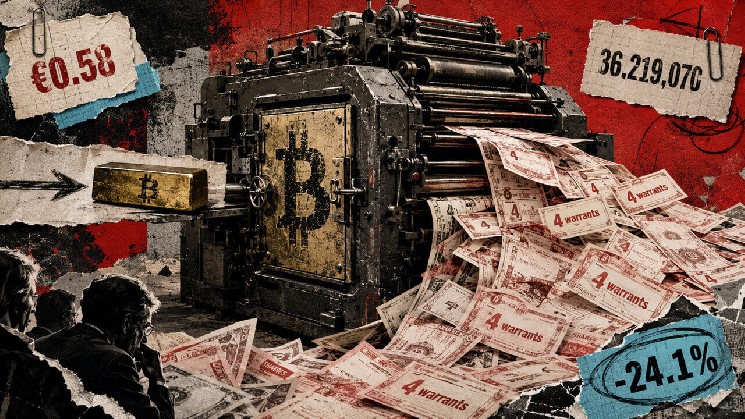
    Capital B announced a private placement of 36,219,070 shares with attached warrants at €0.58 per unit. The financing is expected to generate €21.01 million in gross proceeds, or approximately €19.9 million after fees.

    Closing was expected no earlier than Aug. 31. At the time of the announcement, neither the new shares nor the planned Bitcoin purchase had been completed.

    Capital B said the financing proceeds and operating funds could increase its Bitcoin treasury from 3,145 $BTC, confirmed on Aug. 17, to a potential 3,415 $BTC.

    Immediate Bitcoin-per-share impact is nearly flat

    Based on the diluted shareholder figures in Capital B’s Aug. 28 release, the company held approximately 7.4725 $BTC per million shares before the placement. If Capital B reaches 3,415 $BTC and has 457,096,891 diluted shares after the placement, the resulting figure would be approximately 7.4711 $BTC per million shares.

    That represents a decrease of roughly 0.02%, making the immediate effect of the transaction essentially flat relative to Capital B’s stated objective of increasing Bitcoin per diluted share over time.

    Infographic outlines Capital B’s Bitcoin holdings, diluted share counts, and $BTC per million shares across three dilution scenarios and financing estimates.

    Warrants could increase dilution

    Before the reverse-split adjustment, each new share carries two warrants exercisable at €0.75, €0.98 and €1.27. If all the warrants were exercised, Capital B would issue 144,876,280 additional shares and receive a further €135.82 million.

    If every new warrant were exercised and no additional Bitcoin were attributed to the resulting proceeds, the potential 3,415 $BTC treasury would be spread across 601,973,171 displayed diluted shares. That would equal approximately 5.6730 $BTC per million shares, or 24.1% below the pre-placement ratio.

    The warrants have five-year terms and depend on investors choosing to exercise them. The related shares and cash therefore have not yet been received.

    An investor holding 1% of Capital B before the placement would see that stake fall to 0.9% on the ordinary post-placement basis and to 0.72% on the company’s diluted basis without participating in the financing. Full exercise of the new warrants would reduce those figures to 0.65% and 0.55%, respectively.

    Capital B also says its displayed diluted calculation excludes older BSA families, specified warrants attached to convertible bonds and unissued capacity under a €300 million TOBAM program. Those items are not included in the 24.1% dilution scenario.

    Broader financing capacity

    In June, Capital B shareholders authorized significantly broader financing capacity, including up to €5 billion in capital increases and €100 billion in credit instruments.

    The Aug. 28 placement provides a priced example of the company’s financing strategy. The proposed Bitcoin purchase would broadly match the immediate expansion in shares, while the attached warrants will determine whether Capital B’s longer-term Bitcoin-per-share ratio improves or declines.

  • 12 Years Later, Bitcoin Remembers the Man Who Got There First

    12 Years Later, Bitcoin Remembers the Man Who Got There First

    Before Bitcoin carried a significant market value, it had its first real recipient. On January 12, 2009, Hal Finney became the first person to receive a Bitcoin transaction when Satoshi Nakamoto sent him 10 $BTC. The event is now recognized as the moment digital cash moved from a concept on a whiteboard to a functioning network.

    Finney was not a random early user who happened to be in the right place. He was a technology veteran who had already spent decades developing tools that would influence Bitcoin. During the early 1990s, he was an active participant on cypherpunk mailing lists, a community of programmers and privacy advocates whose ideas helped shape Bitcoin’s design.

    Finney later became the second employee hired by Phil Zimmermann at PGP Corporation, the company behind Pretty Good Privacy (PGP) encryption software. He remained a key contributor there until retiring in 2011.

    In 2004, several years before Bitcoin was created, Finney developed Reusable Proofs of Work (RPoW), an early cryptocurrency prototype built on Hashcash. The project demonstrated concepts that Bitcoin would later formalize.

    A Fight He Didn’t Step Away From

    Finney publicly disclosed his amyotrophic lateral sclerosis (ALS) diagnosis in October 2009, less than a year after receiving the first Bitcoin transaction. ALS is a progressive disease that attacks the nerve cells responsible for controlling muscle movement.

    In March 2013, Finney wrote that he had become “essentially paralyzed,” but he continued participating in Bitcoin’s early community as the disease progressed. He was declared legally dead on August 28, 2014, in Phoenix, Arizona, at age 58. His family then carried out cryopreservation arrangements with the Alcor Life Extension Foundation, which had been made years earlier.

    The Satoshi Question That Won’t Go Away

    Finney’s proximity to Bitcoin’s creation, his background in cryptography and his engineering degree from Caltech have fueled years of speculation that he was Satoshi Nakamoto or worked closely with Bitcoin’s anonymous creator.

    Bitcoin.com News has previously examined the evidence pointing to Hal Finney being Satoshi, presenting the circumstantial case that continues to resurface whenever the identity question returns. Finney consistently denied creating Bitcoin, and no verified evidence has conclusively resolved the mystery.

    What 10 Bitcoin Became

    The anniversary arrives at a significant moment for the asset Finney helped bring to life. Bitcoin’s price crossed $80,000 for the first time since May on August 25, rising approximately 28% over eight days and briefly reaching an intraday high above $81,000.

    At that price level, the 10 $BTC Finney received from Satoshi Nakamoto in January 2009 would be worth approximately $805,000 today. That figure would have seemed unimaginable to almost anyone when the transaction was first processed.

    Finney never lived to see Bitcoin reach even a small fraction of its current price. Yet the tools he developed, the questions his life continues to raise about Bitcoin’s origins and his enduring place in the answer to “who received the first bitcoin” ensure that his influence on the network has not faded.

    Twelve years later, people are still logging on to remember him.

    Source: cryptonews.net

  • Grant Cardone Buys $5.3 Billion Worth of Bitcoin to Fuel Real Estate-Bitcoin Hybrid Model

    Grant Cardone Buys $5.3 Billion Worth of Bitcoin to Fuel Real Estate-Bitcoin Hybrid Model

    Cardone Capital Expands Real Estate-Bitcoin Strategy

    Cardone Capital has expanded its real estate-Bitcoin strategy with the purchase of another 1,200 BTC and approximately 2,000 multifamily units.

    The $5.3 billion private equity firm is using rental cash flow to support regular Bitcoin purchases.

    The strategy combines …

    Source: cryptonews.net

  • Crypto Presale to Buy Now: MemeToro Tokenomics and AI Agent Shape the Best Memecoin Narrative for 2026

    Crypto Presale to Buy Now: MemeToro Tokenomics and AI Agent Shape the Best Memecoin Narrative for 2026

    The 2026 crypto presale market is moving beyond simple meme branding as investors look for projects with clearer utility. MemeToro is positioning itself around that shift with an AI-powered launchpad on the $BNB Chain, focused on token creation, automated security screening, and AI-driven market ideas.

    MemeToro has reached Stage 6 of its presale, with $MT priced at $0.00350 and fundraising approaching $100,000. For investors searching for a crypto presale to buy now, the project combines the attention of the memecoin market with an infrastructure-focused approach.

    MemeToro Tokenomics and Stage 6 Presale Progress

    MemeToro’s current presale structure places $MT at a baseline price of $0.00350 during Stage 6. The project is nearing the $100,000 fundraising milestone, giving investors a clear indication of its current presale progress.

    The $MT token is designed to support the broader MemeToro ecosystem rather than function solely as a social meme asset. Its utility is connected to a platform focused on AI-assisted memecoin creation and launch infrastructure.

    Tokenomics are an important consideration for investors evaluating a crypto presale because they show how a token connects to the underlying product. MemeToro links $MT to an ecosystem designed to launch and evaluate new meme assets, giving the project a more defined utility narrative than a token based only on community speculation.

    This approach also places MemeToro within the growing AI crypto presale sector, where blockchain projects are combining artificial intelligence with automated tools and infrastructure.

    AI Agent Supports Memecoin Creation

    MemeToro’s AI agent is designed to identify market trends and transform those signals into new token concepts. Rather than relying entirely on developers to manually spot trends, the platform aims to automate parts of the creative and analytical process.

    This could make memecoin creation more systematic. The AI model can assist with concept generation, while the launchpad provides the infrastructure required to move an idea toward deployment.

    MemeToro also includes an automated security scanner designed to detect developer backdoors and honeypot-style mechanisms before tokens are deployed. The platform’s broader presale narrative is built around:

    • AI-assisted token creation
    • Automated security screening
    • $BNB Chain infrastructure
    • Ecosystem-focused $MT utility

    For readers following crypto presale news, the project reflects the growing connection between artificial intelligence and blockchain automation. MemeToro applies that trend to the memecoin market. A video is also available for people who prefer a visual overview of the MemeToro ecosystem.

    Combining AI Infrastructure with the Meme Coin Market

    Meme coins have traditionally relied on speed, community attention, and cultural relevance. AI may help make the process of identifying trends and developing new concepts faster and more structured.

    MemeToro is built around that intersection. Its stated objective is not simply to launch another meme token, but to create an environment where AI can help generate and screen future memecoin projects.

    This positioning gives MemeToro relevance among investors researching the best crypto presale opportunities in 2026. It also places the project alongside DeFi presale initiatives and other utility-focused blockchain launches.

    The Stage 6 milestone adds to the project’s current presale narrative. With $MT priced at $0.00350 and fundraising approaching $100,000, MemeToro is progressing through its presale while developing its underlying launchpad.

    For anyone researching the latest crypto presale market, MemeToro represents a combination of early-stage token exposure and an AI-focused infrastructure narrative.

    More Information on the MemeToro ($MT) Presale

    Source: cryptonews.net

  • Bybit Launches Equity Perpetual Options for SpaceX and Nvidia Markets

    Bybit Launches Equity Perpetual Options for SpaceX and Nvidia Markets

    Bybit has launched Perp Options, a new derivatives product it describes as the industry’s first options contract built on equity perpetuals. The crypto exchange said SpaceX and Nvidia will serve as the first underlying assets, according to a company announcement published on August 28.

    The initial markets, SPCX for SpaceX and NVDA for Nvidia, are scheduled to begin live trading on September 17, 2026, at 20:00 UTC. Bybit said the contracts will be available for trading 24 hours a day.

    How Bybit Perp Options Work

    Bybit’s new options will settle in USDT and use a contract multiplier of 1, matching the structure of the exchange’s existing equity perpetual contracts.

    The products will integrate with Bybit’s Unified Trading Account and Portfolio Margin systems. This will allow users to cross-hedge spot, perpetual and options positions through a single margin account.

    Bybit said the contracts are designed to support strategies including spreads, straddles and covered calls. The product gives traders a way to apply established options strategies to equity exposure while settling positions in a stablecoin.

    SpaceX and Nvidia Lead Bybit’s Equity Options Roadmap

    Bybit plans to add TSLA, QQQ, SOXL and MU contracts at a later stage, along with additional expiry dates. The exchange did not provide a timeline for those additions.

    The September 17 launch date and 20:00 UTC start time are the only specific scheduling details disclosed so far. Bybit also did not announce initial listing fees or leverage limits for the new contracts.

    SpaceX is a notable first underlying because it is a privately held company whose shares are not listed on a public exchange. Bybit’s product could therefore provide traders with indirect exposure to the company through a crypto-native derivatives market.

    Bybit Expands Its Equity Derivatives Offering

    The launch builds on Bybit’s existing range of equity perpetuals, which give crypto-focused traders access to U.S. stocks and exchange-traded funds around the clock. It also follows the exchange’s recent efforts to expand its options business, including an overhaul of its options analytics earlier this month.

    Rival exchange OKX has pursued a similar strategy. In March, it launched 20 equity perpetual swaps designed for 24/7 trading.

    Bybit’s Perp Options launch reflects a broader trend among crypto exchanges, which are packaging traditional equities as stablecoin-settled derivatives that can trade beyond conventional stock-market hours. The company’s description of the product as an industry first is its own characterization and has not been independently verified.