Author: Evan Mercer

  • Kevin Warsh’s Jackson Hole Speech Prompts Markets to Reassess Fed Rate Outlook

    Kevin Warsh’s Jackson Hole Speech Prompts Markets to Reassess Fed Rate Outlook

    Federal Reserve Chair Kevin Warsh used his first Jackson Hole speech to outline his approach to monetary policy, inflation control, economic conditions, financial markets and the growing role of artificial intelligence in the economy.

    Markets reacted quickly, with investors adjusting expectations for the Federal Reserve’s next policy decisions. Treasury yields moved higher as traders increased bets that the central bank could keep interest rates elevated or consider additional increases if inflation fails to improve further.

    🇺🇸 Kevin Warsh just delivered his first ever Jackson Hole speech as Fed Chair, and the tone was hawkish1. Inflation data doesn’t show meaningful improvement, 2% target remains firm and fixed2. Fed has more work to do unless underlying inflation moves toward target with speed…
    — Bull Theory (@BullTheoryio) August 28, 2026

    The post from Bull Theory on X described Warsh’s speech as hawkish and highlighted his comments on inflation, economic activity, artificial intelligence investment and monetary policy. The discussion reflected market attention on Warsh’s first major public address as Fed chair.

    Warsh’s message centered on the need for clearer evidence that inflation is moving steadily toward the Federal Reserve’s 2% goal before policymakers change direction.

    Inflation Remains the Federal Reserve’s Main Focus

    Warsh said recent inflation data has not improved enough for the Federal Reserve to become comfortable with current price trends. He reiterated that the central bank’s 2% inflation target remains unchanged.

    The Fed chair said policymakers must continue monitoring underlying inflation measures. He added that more work would be necessary if inflation does not move toward the target at a faster pace.

    Investors viewed the remarks as a signal that the Federal Reserve is not ready to shift toward easier monetary policy. Market participants had been watching Jackson Hole for indications that the Fed might become more supportive of interest-rate cuts.

    Instead, Warsh maintained a firm position on inflation control. His comments increased attention on upcoming economic releases, including inflation reports and employment data.

    Short-term Treasury markets reflected the change in expectations. The two-year Treasury yield, which is particularly sensitive to expectations for Federal Reserve policy, moved higher after the speech.

    Strong US Economy Gives the Fed More Policy Space

    Warsh also discussed the condition of the US economy. He said consumer spending remained healthy and business investment continued to expand.

    The Fed chair pointed to strong economic activity as evidence that higher interest rates have not caused a major slowdown. He also noted that unemployment remains low.

    Warsh said business investment had increased at a strong pace, with spending on artificial intelligence infrastructure contributing to recent growth. He said companies are investing heavily in new technology, although the timing of productivity gains remains uncertain.

    The comments gave investors another factor to consider when assessing future monetary policy. Strong economic activity could allow the Federal Reserve to maintain tighter financial conditions for longer if inflation remains above target.

    Markets had been watching whether economic weakness would force the central bank to consider faster rate cuts. Warsh’s remarks provided a different signal by emphasizing continued economic strength.

    Treasury Yields Rise as Markets Reprice Interest Rates

    The initial market response centered on interest-rate expectations. Treasury yields rose after Warsh indicated that additional measures may be needed if inflation does not improve.

    The increase in short-term yields showed that traders were changing their expectations for upcoming Federal Reserve meetings and factoring in a greater risk of tighter policy.

    The US dollar also attracted attention after the speech as markets assessed the prospect of higher interest rates. A stronger interest-rate outlook can increase demand for dollar-denominated assets.

    Equity markets were mixed as investors evaluated the effect of higher borrowing costs on companies. Technology stocks remained in focus because of their role in artificial intelligence investment and their future earnings outlook.

    Warsh did not provide specific guidance on the next rate decision. Instead, he indicated that future action would depend on economic data.

    The approach marked a shift away from detailed forward guidance. Warsh has previously supported a Federal Reserve that communicates less about future decisions and places greater emphasis on incoming economic information.

    Artificial Intelligence Investment Enters the Fed’s Policy Discussion

    Artificial intelligence was another major topic in Warsh’s Jackson Hole address. The Fed chair discussed how AI investment could influence productivity and economic growth.

    Warsh said companies are spending heavily on AI-related infrastructure. However, he questioned how quickly those investments would translate into broader productivity gains.

    The discussion showed that the Federal Reserve is monitoring technology trends as part of its economic assessment. AI development could affect employment, business investment and future growth rates.

    The comments gave financial markets another theme to consider alongside inflation and interest rates. As the Fed maintains a cautious policy stance, investors are watching whether AI investment can help increase corporate profits and productivity.

    Warsh’s priorities became clearer in his first Jackson Hole speech: keeping inflation on a steady path, relying on economic data and avoiding hasty decisions on monetary policy.

    Traders turned to rate futures and the Treasury market’s higher yields to assess short-term expectations and monitor the Federal Reserve’s next moves.

    Upcoming inflation and employment data, along with comments from other Fed officials, will shape the market’s next response.
  • Aptos Integrates Circle’s CCTP V2 for Seamless USDC Transfers

    Aptos Integrates Circle’s CCTP V2 for Seamless USDC Transfers

    Aptos Adds Support for Circle’s CCTP V2 to Enable Faster Cross-Chain USDC Transfers

    Aptos has announced support for Circle’s Cross-Chain Transfer Protocol (CCTP) V2, enabling more efficient $USDC transfers between Aptos and other supported blockchain networks. The integration strengthens Aptos’s interoperability strategy while giving users and developers a faster way to move liquidity across chains.

    What Circle’s CCTP V2 Brings to Aptos

    CCTP V2 is designed to streamline cross-chain $USDC transfers by improving the token’s burn-and-mint process. The updated protocol reduces transaction times and friction, supporting near-instant finality across compatible networks.

    For the Aptos ecosystem, CCTP V2 provides access to more efficient stablecoin infrastructure. The integration could help attract additional decentralized finance protocols and institutional participants that use $USDC for liquidity, trading, lending, and payments.

    The move also supports Aptos’s broader positioning as a high-performance layer-1 blockchain. Built around the Move programming language, Aptos has focused on speed and scalability. Adding CCTP V2 reinforces its goal of creating a connected and user-friendly blockchain ecosystem.

    Why Cross-Chain USDC Support Matters

    $USDC is one of the most widely used stablecoins in the cryptocurrency market, with a market capitalization exceeding $30 billion. By supporting CCTP V2, Aptos can connect to a larger pool of capital and users who prefer $USDC for on-chain financial activity.

    Developers may also be able to build applications that rely on smoother cross-chain $USDC flows. Increased access to liquidity could contribute to greater activity across Aptos-based trading, lending, payments, and decentralized finance applications.

    For Circle, the Aptos integration expands the reach of its stablecoin and supports its role in cross-chain infrastructure. CCTP V2 forms part of Circle’s effort to establish $USDC as a widely used standard for transferring digital value across blockchain networks.

    Benefits for Aptos Developers and Users

    Developers building on Aptos can use CCTP V2 as a standardized framework for cross-chain $USDC transfers. This may reduce the need to create custom bridging solutions, which can involve additional development costs, complexity, and security risks.

    Users may benefit from faster and less expensive transfers when moving $USDC between Aptos and other supported networks. A simpler transfer process can improve access to liquidity and make it easier to use DeFi applications across multiple chains.

    The integration could also support broader institutional participation. Regulated stablecoins such as $USDC are often preferred by traditional financial institutions entering the digital-asset market. CCTP V2 gives those participants a more efficient route to engage with decentralized finance on Aptos.

    Aptos Strengthens Its Interoperability Strategy

    Aptos’s support for Circle’s CCTP V2 represents a practical step toward a more interconnected blockchain ecosystem. Faster cross-chain $USDC transfers improve the network’s usefulness for both developers and users while strengthening its position among competing layer-1 blockchains.

    As interoperability becomes a growing priority across the crypto industry, integrations such as CCTP V2 are likely to become increasingly important. Aptos is moving early to meet demand for faster, more efficient movement of stablecoin liquidity across networks.

    FAQs

    What is CCTP V2?

    CCTP V2 is Circle’s upgraded Cross-Chain Transfer Protocol. It enables faster and more secure $USDC transfers between supported blockchain networks by optimizing the burn-and-mint process.

    How does CCTP V2 benefit Aptos users?

    Aptos users can transfer $USDC between supported chains with reduced transaction times and lower costs, making it easier to move liquidity and access DeFi applications.

    Could CCTP V2 attract more developers to Aptos?

    Yes. The standardized cross-chain infrastructure provided by CCTP V2 simplifies development and could attract projects that require seamless $USDC interoperability.

    Source: cryptonews.net

  • Avici Hack Losses Surpass $1 Million as Stolen Funds Are Laundered Through Tornado Cash

    Avici Hack Losses Surpass $1 Million as Stolen Funds Are Laundered Through Tornado Cash

    Avici Hack Losses Surpass $1 Million as Stolen Solana Funds Move Through Tornado Cash

    Losses from the hack of Solana-based neobank Avici have surpassed $1 million after the attacker moved the stolen assets through Tornado Cash, a crypto mixing service commonly used to obscure transaction trails.

    Blockchain security firm Onchain Lens tracked the funds and reported that the hacker address beginning with FVNFzq converted 10,000 $SOL into 1.02 million USDC. The attacker then bridged the assets into 418 ETH before depositing them into Tornado Cash.

    The exploit is believed to have involved vulnerabilities in Avici’s smart contract permissions and signature verification systems, although the precise attack method has not been fully disclosed.

    How the Avici Attack Unfolded

    On-chain data indicates that the attacker first transferred the stolen $SOL from Avici’s smart contract to a personal wallet. Within hours, the funds were exchanged for a stablecoin and bridged to Ethereum, following a laundering pattern frequently seen in cryptocurrency exploits.

    The use of Tornado Cash, a privacy protocol sanctioned by the U.S. Treasury in 2022, suggests an intentional effort to make the transactions more difficult to trace. Attackers increasingly use mixing services in decentralized finance exploits to complicate investigations by law enforcement agencies and blockchain analytics firms.

    Smart Contract Security Under Scrutiny

    Security experts have identified weaknesses in Avici’s smart contract permission controls and signature verification processes as likely entry points. These types of flaws can allow attackers to alter transaction parameters or forge signatures, making unauthorized withdrawals possible.

    The incident adds to broader concerns about security across the Solana ecosystem, which has experienced a rise in decentralized finance hacks and exploits over the past year. Solana’s high transaction throughput and low fees have attracted developers, but rapid innovation can sometimes outpace comprehensive security auditing.

    What the Avici Hack Means for DeFi Users

    The Avici incident highlights the risks faced by users of decentralized finance platforms. Smart contract vulnerabilities can result in the total loss of deposited funds, while the pseudonymous nature of blockchain transactions makes recovery difficult. Recovering assets becomes even more challenging when attackers route them through privacy protocols.

    Users should conduct due diligence before depositing assets into any DeFi protocol. This includes reviewing available audit reports, assessing the platform’s security controls, and considering insurance options where available.

    Avici Response and Next Steps

    Avici has not released an official statement about the hack. Incidents of this kind typically lead to internal investigations and may result in stronger security protocols. In some cases, affected platforms negotiate with attackers for the return of stolen funds, although the use of Tornado Cash may indicate that the attacker does not intend to cooperate.

    Law enforcement agencies and blockchain analytics firms are expected to monitor the movement of the stolen assets. However, the anonymity and obfuscation provided by crypto mixing services create significant challenges for tracing and recovery.

    FAQs About the Avici Hack

    What is Avici?

    Avici is a Solana-based neobank that offers digital banking services using blockchain technology. It allows users to manage assets and complete transactions through decentralized applications.

    How was the Avici hack executed?

    The attacker exploited vulnerabilities in Avici’s smart contract permissions and signature verification systems, enabling unauthorized withdrawals. The stolen $SOL was then exchanged and bridged to Ethereum before being deposited into Tornado Cash.

    Can the stolen Avici funds be recovered?

    Recovery is highly unlikely because the attacker used Tornado Cash, a mixing service designed to obscure the destination of funds. Although the U.S. Treasury has sanctioned Tornado Cash, tracing assets moved through the service remains extremely difficult.

    Source: cryptonews.net

  • Ireland Moves $38M in Bitcoin Tied to Drug Dealer’s Lost Fishing Rod

    Ireland Moves $38M in Bitcoin Tied to Drug Dealer’s Lost Fishing Rod

    Another 500 BTC linked to an Ireland-based asset seizure has moved from a decade-old Bitcoin wallet, renewing questions about how Irish authorities accessed the funds.

    On Friday, Aug. 28, 2026, 500 BTC worth approximately $38 million was transferred from a wallet created on Jan. 23, 2016. The funds moved from a legacy P2PKH (Pay-to-PubKey-Hash) wallet to a newer P2SH (Pay-to-Script-Hash) address, according to btcparser.com.

    The 500 BTC transfer from the 2016 wallet. Image source: Mempool.space.

    The coins had not moved in more than a decade. When they were last active, Bitcoin traded at roughly $382, valuing the 500 BTC at about $191,217. At current prices, the same holdings are worth approximately $38 million.

    Mystery Surrounds Collins’ Bitcoin Seed Phrase

    Arkham Intelligence labels the funds “Clifton Collins.” Bitcoin.com News reporter Kevin Helms first reported on Collins nearly six years ago, on Jan. 4, 2021. Collins, described as a cannabis dealer, was arrested and forfeited approximately $3 million worth of BTC to Irish authorities.

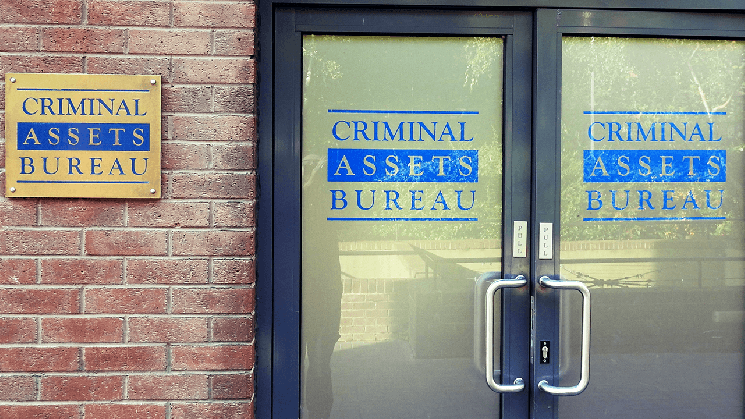
    Helms also reported that Ireland’s Criminal Assets Bureau (CAB) could not access another 6,000 BTC associated with Collins. Collins said the seed phrase had been written on paper and hidden inside a fishing rod.

    CAB and Europol’s European Cybercrime Centre have never officially said that they recovered the fishing rod, despite seizing portions of the Bitcoin over an extended period. CAB last moved Collins-linked BTC during the first week of July, following an earlier transfer in March.

    With the latest 500 BTC transaction, CAB has recovered a total of 2,000 BTC, currently valued at approximately $155 million. As of Friday evening, neither Irish officials nor Europol’s cybercrime unit had confirmed a fourth recovery, as they did with previous transactions. Arkham data indicates that the funds were transferred to Coinbase Prime.

    Bitcoin Blockchain Tracks Transfers Despite Official Silence

    The central mystery is how law enforcement obtained Collins’ seed phrase. Neither Europol nor CAB has stated, “We found the rod.” According to Irish Times reporter Conor Lally, the official explanation was that authorities used “highly complex technical expertise and decryption resources,”

    It remains unclear whether Collins had a backup of the seed phrase that he did not initially disclose to CAB or whether authorities eventually located the fishing rod.

    Collins told police that the rod was at a house he had rented. However, when officers searched for it, the fishing rod was missing and no one knew where it had gone. Another tenant may have later found it and alerted Irish authorities, but the circumstances have not been publicly established.

    The full story may never be disclosed. The Bitcoin blockchain, however, continues to provide a public record of the transfers, including the latest movement of 500 BTC.

  • Bitcoin Wallets Untouched for 10 Years Move $40 Million, Mostly Avoiding Exchanges

    Bitcoin Wallets Untouched for 10 Years Move $40 Million, Mostly Avoiding Exchanges

    Bitcoin wallet activity does not necessarily signal selling. The public blockchain records bitcoin moving from one address to another, but it usually cannot reveal whether the owner sold the coins, changed wallets, transferred them to a custodian or simply reorganized their holdings.

    Five of the six decade-old wallets that moved bitcoin this month sent their holdings to addresses with no known links to cryptocurrency exchanges. The sixth transferred 40 $BTC to Boerse Stuttgart Digital, a German crypto custody and trading provider.

    Bitcoin Wallets Linked to New York Lawsuit

    Two of the six wallets carry labels linking them to a New York lawsuit. In the case, a pseudonymous plaintiff known as Noah Doe is seeking control of bitcoin held across 39,069 dormant addresses under the state’s lost-property laws.

    The plaintiffs sent tiny amounts of bitcoin to those addresses along with onchain legal notices. They argue that the coins could be treated as abandoned if no one establishes ownership.

    CoinDesk reported in June that one address named in the case moved 35.55 $BTC after remaining untouched since March 2011. It was one of the first visible responses from a wallet targeted in the lawsuit.

    Coldcard Vulnerability Triggers Wider Bitcoin Movements

    After a flaw in certain Coldcard hardware wallets was disclosed in late July, roughly 210,000 $BTC left wallets classified by Glassnode as belonging to long-term holders in a single week.

    The vulnerability made poorly generated wallet keys easier for attackers to guess. As a result, some users moved bitcoin into newly created wallets or regulated custody, even when their own coins were not directly exposed.

    Source: cryptonews.net

  • How Bitcoin Is Drifting Away From Tech Stocks and Into Gold’s Territory

    How Bitcoin Is Drifting Away From Tech Stocks and Into Gold’s Territory

    Bitcoin’s relationship with traditional markets may be undergoing a significant shift. For much of the past year, Bitcoin traded closely alongside the Nasdaq, reinforcing its image as a technology-linked asset. However, that correlation has weakened sharply.

    Bitcoin’s 90-day correlation with the Nasdaq has fallen from above 60% to 33%, according to recent data from Grayscale.

    Source: Grayscale

    At the same time, Bitcoin’s correlation with gold has moved higher. The relationship is now above 50% after Bitcoin spent much of last year trading relatively independently from the precious metal.

    This does not mean Bitcoin has suddenly become gold. However, markets may be treating the two assets more similarly than before, particularly as investors reassess Bitcoin’s role as a scarce, non-sovereign asset.

    Source: TradingView

    Bitcoin has outperformed gold in recent weeks

    Over the past five weeks, Bitcoin has gained approximately 22.2%, compared with a 13.3% increase for gold.

    Although the two assets may now be moving in a more similar direction, Bitcoin remains the higher-beta version of the trade. If this trend continues, BTC could further establish itself as a scarcity asset without losing the upside potential that attracts investors.

    Changpeng Zhao says Bitcoin could overtake gold

    Speaking at Bitcoin Asia 2026 in Hong Kong, Binance founder Changpeng “CZ” Zhao said Bitcoin could overtake gold during the next bull market.

    “I think Bitcoin will overtake gold pretty soon… In the next bull run, it could happen.”

    The main obstacle is that governments already have decades of infrastructure built around gold, including valuation systems, custody arrangements and reserve-management frameworks.

    Zhao said any transition from gold to Bitcoin would likely happen gradually, even if market prices moved more quickly. Gold remains roughly 10 times larger than Bitcoin by market size, although the gap has narrowed.

    He also said he regularly advises governments to establish cryptocurrency reserves, with Bitcoin making up approximately half of the allocation.

    “Bitcoin will, for sure, become more important than gold.”

    Bitcoin’s role as a reserve asset

    For years, Bitcoin has shifted between being viewed as a technology investment and a store of value. If its correlation with the Nasdaq continues to weaken while its relationship with gold strengthens, that distinction could become less relevant.

    The bigger question may be whether institutions and governments begin treating Bitcoin as a reserve asset in its own right. Gold still holds important advantages, but Bitcoin has several factors supporting its case, including limited supply, portability and a growing institutional investor base.

    • Bitcoin’s 90-day correlation with the Nasdaq has fallen to 33%.
    • Bitcoin has outperformed gold over the past five weeks, rising about 22.2% compared with gold’s 13.3% gain.
    • Binance founder Changpeng “CZ” Zhao expects Bitcoin could eventually overtake gold as a reserve asset.
  • Binance Launches Agent OS for AI-Connected Financial Applications

    Binance Launches Agent OS for AI-Connected Financial Applications

    Binance has introduced Agent OS, a framework designed to connect artificial intelligence applications with digital-asset financial infrastructure. Announced on August 27, the system provides a controlled interface for applications that need to access trading, payments and other cryptocurrency services.

    Binance Agent OS targets the AI tool layer

    Agent OS is intended to give AI applications structured access to financial capabilities rather than relying on unrestricted browser automation. This allows an agent to discover markets, prepare an action and submit a transaction while permissions and confirmation requirements remain managed by the surrounding infrastructure.

    Controls remain essential for automated crypto transactions

    Connecting software to an exchange does not make an instruction safe by itself. Applications still require limits on account access, transaction sizes, supported assets and execution frequency. Users also need clear records showing what an agent requested and what the underlying system actually executed.

    Crypto platforms compete for AI agent activity

    Binance’s announcement forms part of a wider effort to make blockchain networks more accessible to software agents. Other projects are developing agent communication protocols, while payment providers are expanding consumer access to cryptocurrency through products such as MoonPay’s payment integrations.

    The framework’s practical test will be whether developers adopt it without weakening user authorization or operational safeguards.

    Source: cryptonews.net

  • Bitcoin and Gold Plunge as Kevin Warsh Signals Tighter Federal Reserve Policy

    Bitcoin and Gold Plunge as Kevin Warsh Signals Tighter Federal Reserve Policy

    Investors turned cautious on August 28 as the U.S. dollar strengthened and markets assessed more hawkish comments from Federal Reserve Chair Kevin Warsh during his first speech as Fed chair at Jackson Hole, Wyoming.

    Bitcoin dropped below $79,000, while gold and silver also suffered steep losses. The sell-off reportedly erased approximately $670 billion in market value in just seven minutes.

    The common factor was a stronger dollar and rising expectations that the Federal Reserve may need to keep interest rates high to bring inflation under control.

    Warsh Signals That Further Tightening Remains Possible

    Warsh suggested that the Fed’s fight against inflation may not be over, saying that financial conditions don’t seem restrictive enough right now. Although he did not promise an immediate rate hike, the Fed chair made clear that additional monetary tightening remains on the table.

    That outlook is changing investor positioning, particularly for assets that tend to perform well when money is inexpensive and interest rates are low.

    What the Sell-Off Means for Bitcoin and Gold

    Warsh’s remarks and the broader market sell-off have added uncertainty for investors. The key question is whether Bitcoin’s and gold’s recent gains reflected genuine, long-term market shifts or were driven largely by expectations that monetary policy would become increasingly supportive.

    Investors are now watching the dollar, Treasury yields and interest-rate expectations for further signals. A stronger dollar could make conditions more difficult for both Bitcoin and gold by reducing their appeal.

    If the dollar continues to rise and yields remain elevated, Bitcoin may face further pressure. However, if markets interpret Warsh’s comments as a warning rather than a signal of aggressive rate hikes, the latest decline could prove to be another sharp market swing rather than the start of a prolonged downturn.

    Warsh’s speech was not the only factor behind the decline. Markets were already highly sensitive, with investors preparing for a significant signal on the future direction of monetary policy.

    For now, Bitcoin’s decline and gold’s underperformance suggest that investor sentiment has shifted away from hedging against currency devaluation and toward assessing how many additional interest-rate hikes markets may still need to price in.

    Source: cryptonews.net

  • Crypto Futures See $275 Million in Liquidations as Long Positions Bear the Brunt

    Crypto Futures See $275 Million in Liquidations as Long Positions Bear the Brunt

    Crypto derivatives traders faced a sharp market reversal over the past 24 hours, triggering approximately $275 million in liquidations across major perpetual futures markets. Long positions accounted for most of the forced closures, suggesting that many traders were positioned for further price gains before the downturn.

    Bitcoin, Ethereum and Solana Lead Crypto Liquidations

    Bitcoin (BTC) recorded the largest liquidation volume, with $154.85 million in positions wiped out. Long positions made up 85.44% of Bitcoin liquidations.

    Ethereum (ETH) followed with $97.65 million in liquidations, including 77.97% from long positions. Solana (SOL) saw $23.12 million in positions liquidated, with longs representing 68.67% of the total.

    The high concentration of long liquidations indicates that many traders were betting on continued upside. A sudden decline forced those positions to close, adding selling pressure and potentially accelerating the market’s price drop.

    What the Liquidation Wave Means for Traders

    The latest data highlights the risks of using leverage in cryptocurrency markets. Even a relatively modest price movement can trigger a cascade of liquidations when traders are heavily positioned in the same direction.

    The dominance of long liquidations also points to a rapid shift in market sentiment, as bullish positions were unwound. Liquidation events can sometimes coincide with short-term market bottoms or tops, depending on the broader trend, but the current outlook remains uncertain.

    Macroeconomic developments and regulatory news continue to influence cryptocurrency prices, making it difficult to determine whether the latest move represents a temporary reversal or the beginning of a broader trend.

    Why Crypto Liquidations Matter

    Liquidation data offers insight into market leverage, trader positioning and overall risk appetite. While forced closures directly affect individual traders, they can also amplify volatility across the wider crypto market.

    For investors and market observers, a sharp increase in liquidations can serve as an early warning of heightened volatility and provide clues about how traders are positioned ahead of potential price moves.

    Key Takeaways From the Crypto Futures Sell-Off

    • Approximately $275 million in major perpetual futures positions were liquidated over 24 hours.
    • Long positions made up the majority of liquidations across Bitcoin, Ethereum and Solana.
    • Bitcoin accounted for $154.85 million in liquidations, followed by Ethereum at $97.65 million and Solana at $23.12 million.
    • The liquidation wave underscores the risks of high leverage and one-sided positioning.
    • Traders are watching for signs of stabilization or additional volatility as the market absorbs the move.

    FAQs About Crypto Futures Liquidations

    What are crypto futures liquidations?

    Liquidations occur when a trader’s position is forcibly closed because of insufficient margin, typically after an adverse price movement. In futures trading, an exchange closes the position when losses pass a predetermined threshold.

    Why are most liquidations long positions?

    When cryptocurrency prices fall sharply, long positions—bets that prices will rise—lose value quickly. If the losses exceed the trader’s margin, the exchange closes the position, resulting in a long liquidation. High long-liquidation volumes often signal a sudden market decline.

    How can traders reduce the risk of liquidation?

    Traders can lower liquidation risk by using less leverage, setting stop-loss orders and maintaining sufficient margin. Diversifying positions and staying informed about market conditions can also help limit potential losses.

    Source: cryptonews.net

  • Upbit Temporarily Suspends HBAR Deposits and Withdrawals for Hedera Wallet Maintenance

    Upbit Temporarily Suspends HBAR Deposits and Withdrawals for Hedera Wallet Maintenance

    Upbit, one of South Korea’s largest cryptocurrency exchanges, has temporarily suspended $HBAR deposits and withdrawals while maintenance is carried out on the Hedera wallet system.

    The suspension took effect immediately. Upbit has not announced when deposits and withdrawals will resume and has advised users to follow its official announcements for further updates.

    Upbit Suspends $HBAR Deposits and Withdrawals

    The suspension applies to all $HBAR deposits and withdrawals on Upbit. According to the exchange’s notice, the maintenance is intended to support the stability and security of the Hedera network wallet.

    Trading of $HBAR against the Korean won (KRW) and other trading pairs remains available. However, users may experience delays in processing pending transactions until the wallet maintenance is complete.

    Upbit has previously introduced similar temporary suspensions for other digital assets during network upgrades and wallet maintenance. Such measures are commonly used by major cryptocurrency exchanges to protect user funds and maintain network integrity.

    Impact on $HBAR Traders

    Although $HBAR trading remains active on Upbit, users cannot transfer the asset into or out of the exchange while the suspension is in effect. This may limit arbitrage opportunities and complicate liquidity management for traders who depend on rapid transfers between exchanges.

    The announcement could also contribute to short-term volatility in the $HBAR market. Similar maintenance-related suspensions have historically been associated with minor price fluctuations, although no specific market impact has been confirmed in this case.

    Hedera has not issued a separate statement about the maintenance. Coordinated wallet maintenance is common when exchanges need to align their integrations with network operations and updates.

    What $HBAR Users Should Do

    Users with pending $HBAR deposits or withdrawals should monitor Upbit’s official announcements for information about the service restoration. The exchange has said it will notify users once the Hedera wallet system becomes operational again.

    Until the suspension is lifted, users should avoid initiating $HBAR transfers to or from Upbit to reduce the risk of processing problems or potential loss of funds.

    Frequently Asked Questions

    Why did Upbit suspend $HBAR deposits and withdrawals?

    Upbit suspended $HBAR deposits and withdrawals to perform maintenance on the Hedera wallet system and support network stability and security.

    Can I still trade $HBAR on Upbit during the suspension?

    Yes. Trading of $HBAR against KRW and other available pairs remains active. Only deposits and withdrawals are temporarily suspended.

    How long will the $HBAR suspension last?

    Upbit has not provided a specific timeline. Users should monitor the exchange’s official announcements for updates on when deposits and withdrawals will resume.