Author: admin

  • Quantum computer protection for Bitcoin: BIP-360 is now official

    Quantum computer protection for Bitcoin: BIP-360 is now official


    • Bitcoin developers have officially released BIP-360. It proposes P2MR, a Taproot-like output without “key-path”.
    • Bitcoin developers primarily have one risk in mind: If a public key is public for a long time, a future quantum computer could use it to calculate the private key.

    An updated version of BIP-360 is in the official Bitcoin BIP repository merged on GitHub been. The draft (“Pay-to-Merkle-Root”, P2MR) proposes a new output type via soft fork: Taproot logic via Tapscript and script trees is retained in the core, but the key path spend is eliminated. It is precisely this key path that is considered a weak point in the quantum context.

    In short: P2MR is “Taproot without Key Path”. The output only commits to the Merkle root of a script tree (32 bytes) and no longer to an internal key. Anyone who issues such an output can only do so via the script path; a key path spend simply no longer exists.

    First step towards Bitcoin quantum security

    The draft is very consciously based on a specific threat model: so-called “long exposure” attacks. This refers to situations in which public keys or spend scripts have been open for so long that a future “cryptographically relevant quantum computer” with Shor could derive private keys from public keys. P2MR is intended to mitigate exactly this risk with elliptic curve cryptography – nothing more, but also nothing less.

    According to the text, P2MR is not sufficient for “short exposure”, i.e. cases in which a public key is only visible for a short time (e.g. in the mempool). This could require post-quantum signatures in Bitcoin later. The authors suggest a separate proposal for this, but only after further research.

    The implementation is also important: BIP-360 is designed as a soft fork and should not touch existing Taproot outputs. P2MR runs on SegWit v2 (Bech32m); corresponding mainnet addresses would start with bc1z.
    Without SegWit v2/P2MR support, nodes and wallets do not understand these expenses. The draft also reminds that non-updated nodes generally treat SegWit v2 outputs as “anyone-can-spend”, but in practice typically neither relay nor mine them.

    The price for the additional hardness in the long exposure model is quite concrete: P2MR swaps the slim Taproot key path for a spend that is always “Script Path” – and therefore always looks like “Script Path”. In a simple example calculation, a minimum P2MR witness is 37 bytes larger than a Taproot key path witness (signature only).

    With deeper script trees, the overhead increases by 32 m bytes (m = Merkle tree depth). Conversely, P2MR is 32 bytes smaller than an equivalent Taproot script path spend because an internal public key no longer needs to be carried in the control block.

    When it comes to privacy, the trade-off is also rather sober: Anyone who uses P2MR inevitably signals “script path” when spending because there is no longer a key path. This is less a “leak” than a structural feature, but it is a visible feature.

    BIP-360 names Hunter Beast, Ethan Heilman and Isabel Foxen Duke as authors. Anduro, a research-focused company working on quantum-resistant approaches to Bitcoin, commented on X:

    “Bitcoin has taken an important step towards future quantum resistance. […] BIP also addresses criticism that Bitcoin developers are not taking the quantum threat seriously.”

    The next exciting phase only begins after the draft status. If BIP-360 progresses, the debate will probably revolve less around the basic principle of “Taproot without Key Path” – but rather around the follow-up questions:

    How does Bitcoin address short exposure? Which post-quantum signatures are realistic? Which upgrade mechanism does this work smoothly? Which opcode strategy is practical? And above all: How do wallets and users manage a migration that does not fail in reality due to UX, coordination and inertia?

  • With Playnance, creators become owners of a digital business for one dollar

    With Playnance, creators become owners of a digital business for one dollar


    • For a starting price of $1, interested future Playnance partners will receive a live website with its own subdomain that can generate daily onchain income and payouts via the PlayW3 infrastructure.
    • The model is based on a 50/50 revenue share, one of the highest proportions in the industry, with daily automated onchain payouts directly to partners’ wallets.

    Tel Aviv, Israel, 12. Februar 2026, Chainwire

    Playnance has its global affiliate program Be The Boss expanded to include PlayW3. This means you can set up a branded, fully functional social casino website in just a few minutes – without any technical setup and without onboarding.

    The one-dollar entry point represents a shift in the digital economy: platform infrastructure and distribution are no longer reserved only for entry-level users with significant capital, large technical resources, or entire teams of developers. Instead, ownership of a digital business is instantly available, operational and accessible worldwide – from day one.

    In contrast to affiliate or pure recommendation models Be The Boss real business ownership instead of just traffic monetization. Each partner – a so-called boss – runs a complete social casino business, fully supported by Playnance’s proprietary blockchain infrastructure.

    Once activated, the social casino goes live immediately so partners can focus on community building, engagement and reach.

    Each social casino also acts as a decentralized distribution node in the PlayW3 system and brings new communities, target groups and local user bases into the network.

    With every new boss who starts and expands his business, the network grows organically – supported by the constantly increasing community reach instead of centralized marketing.

    Each social casino offers access to over 10,000 social games as well as social prediction markets, sports-based social events, crash games, interactive financial markets, cash tournaments, jackpots and integrated bonus and retention mechanisms. All technology, gaming support, on-chain processing and payouts are handled directly by Playnance via PlayW3 – for maximum transparency and simple operational processes.

    The Be The Bossprogram is already live and active worldwide. Over 2,000 partners are already running their own digital businesses, and more than $1.9 million has been paid out to bosses so far. A $250 million partner pool has been deployed to support long-term revenue as the network grows – each new platform strengthens reach and engagement across the network.

    Pini Peter, CEO of Playnance, says:

    “We believe that access to digital opportunities should not be limited by capital or technical barriers. Be The Boss is designed to make business ownership accessible and practical – so creators and communities can run a true digital business from day one.
    What’s important is that the model is already live, scaled and driven by engagement, not hype.”

    At the center of the social casino system is the G Cointhe utility token that generates website activity, rewards and daily onchain revenue. With every new boss who goes live with their business and onboards new communities, activity on PlayW3 increases – and with it the use of G Coin in gameplay, participation mechanics and rewards.

    This creates a reinforcing economic cycle: partner growth increases distribution, increasing user activity creates real token demand, and token-based rewards in turn increase engagement across the network.

    About Playnance

    Founded in 2020, Playnance is a Web3 infrastructure and consumer web company. It develops and operates live, non-custodial onchain websites that enable customers to interact with blockchain systems through familiar Web2 mechanisms.

    Playnance is focused on making the interaction between customers and OncChain execution as seamless as possible by keeping consumer services available at scale.

    Contact

    Chief Marketing Officer
    Sarah Peter
    [email protected]

  • IOTA, Sui, Cardano, Avalanche submit response to UK crypto regulation

    IOTA, Sui, Cardano, Avalanche submit response to UK crypto regulation


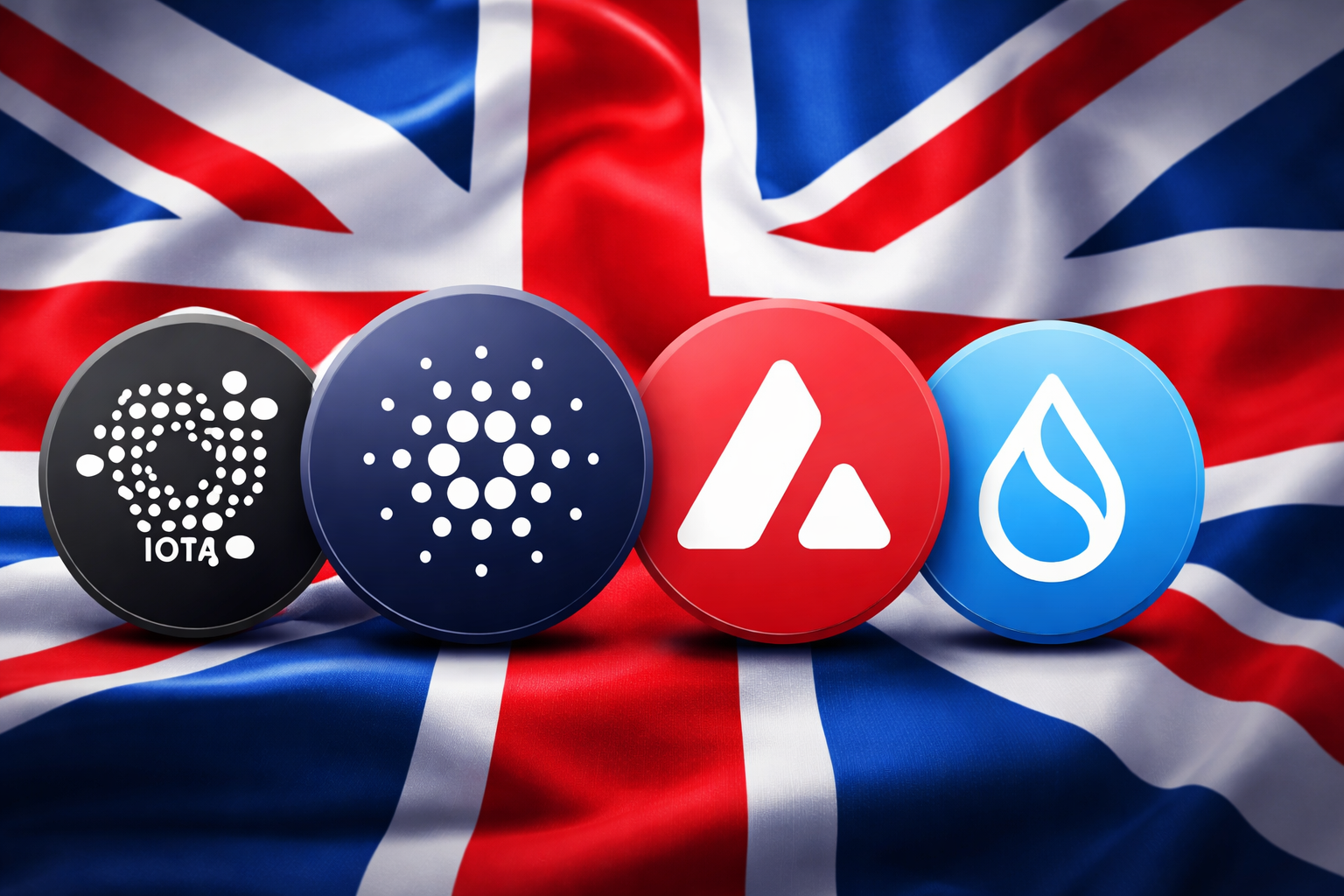
    • IOTA, Sui, Cardano and the Avalanche Policy Coalition demand in their statement on the FCA consultation CP25/40: Regulation should start where custody or verifiable, one-sided control arises, not with code, nodes or neutral infrastructure.
    • The main point of contention is the FCA idea of ​​a “clear controlling person”.

    IOTA, together with the Sui Foundation, the Cardano Foundation and the Avalanche Policy Coalition, has a joint one opinion submitted for FCA consultation CP25/40.

    The common thread: The FCA should not work with a watering can when it comes to regulation, but should start where someone holds assets or can unilaterally turn the adjusting screws. Not where people “just” write software or operate infrastructure like nodes. IOTA puts this together on X as a guideline for the paper:

    “Our point: focus on custody & control, remain proportionate and support non-custodial, decentralized innovation for the UK.”

    What IOTA, Sui, Cardano and Avalanche’s representatives demand

    The distinction becomes clearest when it comes to staking. According to the IOTA Foundation, there is a fundamental difference whether a provider keeps customer money or whether users keep it themselves and the process takes place on the protocol side. This is how IOTA puts it on X:

    “Regulation must clearly distinguish between custodian-based and non-custodial models. Custodial staking (where companies secure assets) = appropriate retail notices, consent + documentation. Non-custodian/protocol staking (no control over user assets/keys) should not fall under the same regime.”

    In the letter, all signatories of the letter emphasize: Staking is not “a” model. It ranges from completely custodial to setups where no one but the user sees the keys. This is exactly why, so the argument goes, the FCA needs to make a clear separation, otherwise infrastructure will end up in the same regulatory package as custodians.

    The DeFi part is about the FCA term “clear controlling person”. The four organizations are not saying that the term should go away. They want it to be defined in a way that can be determined technically and not by gut feeling. IOTA puts it like this in an X post:

    “The FCA concept of a ‘clear controlling person’ needs a technical, objective definition. Duties should scale with custody, discretion and unilateral control – not with code writing, governance participation or neutral infrastructure.”

    The logic behind it: DeFi does not work like a classic intermediary. Self-custody and automated execution shift the question of where risk arises and who actually has the power to unilaterally change things. Accordingly, regulation should be based where there is demonstrable control, not where someone builds tools or runs as a validator/infra provider.

    IOTA is trying to move the point beyond “industry wants fewer rules”. The framing is consumer protection plus legal certainty: clear boundaries so that rules apply where there are real custody and control risks and not everything is regulated by default. IOTA writes about this on X:

    “Smarter scoping = better consumer protection where the risk is real, plus legal certainty that protects non-custodial innovation from being out-regulated.”

    In the end, a lot depends on a detailed question: how clearly the FCA defines “control”. This is exactly what decides whether non-custodial staking setups and DeFi infrastructure in the UK pass as neutral or whether they suddenly receive obligations that are actually intended for custodians and intermediaries. This would virtually eliminate DeFi in the UK.

  • Cardano boss Hoskinson: “Midnight is not after Monero or Zcash customers”

    Cardano boss Hoskinson: “Midnight is not after Monero or Zcash customers”


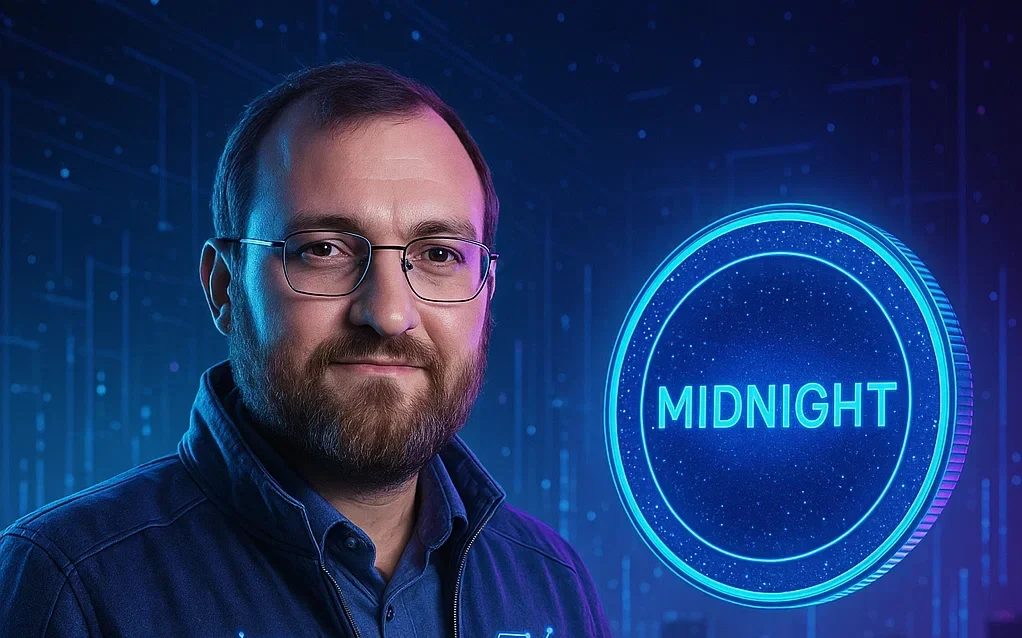
    • Cardano boss Charles Hoskinson made it clear in a recent question and answer session at Consensus in Hong Kong that Midnight, the new privacy chain in the Cardano system, is not looking to poach customers of classic privacy coins such as Monero and Zcash.
    • Their communities are highly specialized and technically savvy and know exactly what type of data protection they need. Midnight is aimed at a completely different target group: customers who unknowingly disclose sensitive data because data protection tools are not available or are too complicated.

    Cardano boss Charles Hoskinson took the opportunity to fundamentally classify the data protection model of Monero and Zcash. Both cryptocurrencies rely on a binary understanding of data protection: either a transaction is completely hidden or completely transparent.

    Although this “ON/OFF model” is attractive to purists, it is unsuitable for real-world applications in which selective handling of data is commonplace because it is necessary. This applies, for example, to audits, compliance processes or business documentation.

    Midnight pursued hence the concept of “rational data protection”, which is active by default but can be relaxed in a controlled and logged manner if the situation requires it.

    Midnight as a data protection tool for the mainstream

    With the upcoming mainnet launch in March, Midnight is deliberately positioning itself not as a classic privacy coin, but as an infrastructure for the mass market. The chain is intended to fundamentally guarantee data protection without customers having to make technical decisions.

    At the same time, Midnight remains interoperable because data can be selectively disclosed. Hoskinson emphasized that billions of people today don’t know how much they reveal in their everyday digital lives – and this is exactly where Midnight comes in. The aim is to normalize data protection instead of treating it as a special feature.

    Differentiation from Monero and Zcash

    Hoskinson’s statement should also be understood as a strategic clarification. Cardano’s Midnight is not intended to compete with Monero and Zcash, but rather to create a new category: a privacy chain that is both customer-friendly and compliance-ready.

    Mobero and Zcash
    Image created with ChatGPT-AI (DALL E)

    While Monero and Zcash remain the home for privacy purists, Midnight is intended for those customers who need solid data protection without actively engaging with cryptography or privacy mechanisms.

    This creates a clear target group priority: radical data protection on the one hand, complete transparency of classic blockchains on the other – and in between a new model with “adjusting screws” that can be used to adapt it to customer requirements.

  • True that means behind ‘H’ on indicators exterior folks’s homes has been shared


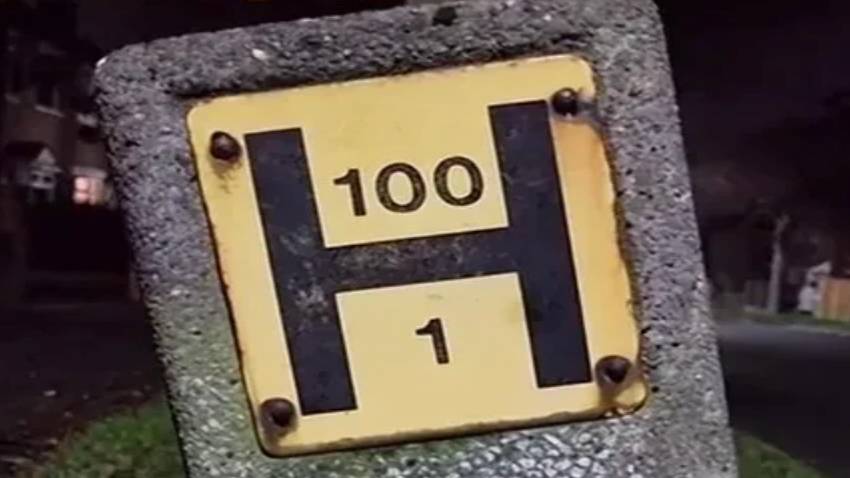
    Take a little bit stroll round just about any city within the UK and you will see all these ‘H-signs’ across the place. Should you’ve ever questioned what they imply, you then’ve come to the appropriate place.

    South Yorkshire Hearth and Rescue took to TikTok to elucidate it in a fast video, the place they stated ‘they exist to inform firefighters the place the closest hydrant is positioned’.

    Easy, proper? Properly, there’s a bit extra to it.

    These yellow and black markers are essential for emergency providers as a result of they make hydrants simple to search out in a rush. And whenever you’re coping with a blazing constructing, each second counts.

    The enormous ‘H’ tells the fireplace brigade there’s a hydrant close by, however the numbers on the signal are the place it will get attention-grabbing.

    You’ll normally spot a big quantity between the gaps within the ‘H’, and typically a smaller one as properly.

    The larger quantity on the high reveals the diameter of the water primary in millimetres, so firefighters know precisely what measurement connection they’re coping with. That manner, they will shortly work out the strain and move accessible earlier than hooking all the things up.

    So subsequent time you see a type of ‘H’ indicators, you’ll comprehend it’s not random avenue furnishings – it’s a significant marker that might make all of the distinction in an emergency.

    You have in all probability seen these indicators throughout (Getty Inventory Photograph)

    The quantity beneath the ‘H’ tells you what number of metres away the hydrant is, so if it is a little bit bit away you may know you are not standing straight on it.

    Among the indicators even include a little bit arrow pointing folks in the appropriate route, however that is fairly uncommon.

    Now you recognize what these indicators imply you can discover your nearest hydrant and understand how huge the water primary is, ought to that ever be pertinent data in your life.

    One thing else the emergency providers would really like you to know is that you simply should not park on the hydrants themselves, as a result of in the event that they must take care of a fireplace it will actually assist in case your automobile wasn’t parked proper over the entry level to their nearest water supply.

    You will additionally get in hassle for damaging or obstructing one, in addition to portray over the intense yellow colors.

    @southyorkshirefire

    you already knew this, proper? #firefightertok

    ♬ Sailing – yourmusic4ever💯

    Brits must also go away the hydrant itself and entry to the water primary to the professionals, because it’s unlawful to make use of them to get water for any goal apart from firefighting until you get permission to take action.

    In different phrases, do not go on a hydrant hunt after which attempt to entry the water your self.

    There are many indicators across the UK that are thought-about fairly complicated, together with among the ones on the street which drivers actually should know higher.

  • Uniswap Labs and Securitize: New Liquidity Options for BlackRock’s BUIDL

    Uniswap Labs and Securitize: New Liquidity Options for BlackRock’s BUIDL


    • The new collaboration between Uniswap Labs and Securitize shows how popular RWA tokenization has become as a financial instrument.
    • Both companies want to jointly develop new liquidity options for BlackRock’s tokenized money market fund BUIDL.

    The USD Institutional Digital Liquidity Fund “BUIDL” is one of the preferred institutional onchain assets and now manages several billion dollars. Its integration into blockchain infrastructures highlights how quickly the boundaries between traditional finance and the DeFi world of finance are dissolving.

    UniswapX as RWA trading infrastructure

    Core of the collaboration is the integration of BUIDL into UniswapX, Uniswap’s new RFQ-based trading architecture. Using this model, qualified market participants can obtain binding price offers from market makers and process transactions completely on-chain.

    Securitize takes care of regulatory processing, whitelisting and compliance checks for investors. This creates an environment in which institutional investors can, for the first time, move a tokenized BlackRock fund via decentralized trading infrastructure without violating regulatory requirements.

    Execution occurs 24/7, which represents a significant efficiency gain over traditional markets.

    Importance for BlackRock, Uniswap and Securitize

    For BlackRock, the cooperation is a further step towards providing tokenized fund products with real demand and at the same time opening up new liquidity channels.

    The ability to trade BUIDL shares via DeFi rails increases the attractiveness of the fund for institutional investors looking for fast settlement processes and flexible trading hours.

    Uniswap, in turn, is positioning itself as an infrastructure partner for the next generation of tokenized assets. The integration of one of the world’s largest RWA financial products strengthens the protocol’s role in the institutional segment.

    RWA tokenization
    Image created with ChatGPT-AI (DALL E)

    In this way, Securitize consolidates its position as a leading provider of regulated tokenization and compliance layers between TradFi and DeFi.

    Signal for the RWA sector

    The collaboration shows that RWA tokenization has now entered a phase of steady adoption since its inception. With BlackRock, Uniswap and Securitize, three heavyweights from different areas are working together to combine liquidity, efficiency and legal certainty achieved through regulation.

    It is a strong signal for the RWA sector: institutional products are increasingly being traded on public blockchains, and the DeFi infrastructure is becoming part of global capital markets.

    The integration of BUIDL could thus become a model for other fund products that take the step onto the blockchain.

  • Aviva Investors wants to offer tokenized fund products on XRPL

    Aviva Investors wants to offer tokenized fund products on XRPL


    • The asset manager Aviva Investors, part of the British insurance group Aviva plc, has announced its strategic collaboration with Ripple.
    • The aim of the cooperation is to tokenize selected fund products on the XRP ledger XRPL and thus complete Aviva’s entry into digital assets.

    This is a remarkable step for the industry: Aviva Investors manages more than 240 billion British pounds and is one of the most influential financial managers in Europe. The DecisionChoosing the XRP Ledger as the technological basis is a sign of the newfound confidence in Ripple after the company’s positive outcome in the trial against the US Securities and Exchange Commission.

    Tokenization as an efficiency booster for the fund market

    The new cooperation is intended to convert traditional fund structures into digital, tokenized units. This should make processes such as issuing, trading, processing and reporting significantly more efficient.

    Aviva Investors emphasizes that tokenization will reduce both costs and operational complexity in the long term. At the same time, they open up new opportunities for tailor-made products that can be structured more quickly and marketed globally. The first tokenized products are expected to be ready for the market as early as 2026, with Aviva initially wanting to offer them to selected institutional customers.

    Why on XRPL?

    The XRP Ledger has been considered one of the most stable public blockchains for years. It offers fast transaction confirmations, low fees, and an energy-efficient consensus mechanism without mining.

    Ripple also highlights the built-in compliance, asset issuance and programmable rules capabilities that are critical for regulated financial products.

    With over four billion transactions processed and more than 120 independent validators, Ripple sees XRPL as the ideal infrastructure for the next generation of tokenized real-world assets.

    The partnership with Aviva Investors is intended to underpin this claim and attract other institutional players.

    Ripple-Aviva cooperation
    Image created with ChatGPT-AI (DALL E)

    Signaling effect for the European financial industry

    Aviva Investors’ decision has potentially far-reaching implications for the European fund market. While tokenization is already part of normal industry business in the USA and Asia, many European asset managers have so far acted cautiously.

    The fact that a heavyweight like Aviva is now taking this step could be the starting signal for other European institutions. Ripple, in turn, is strengthening its position in Europe and expanding its strategy to establish real-world assets on XRPL.

    For the European crypto industry, it could be the beginning of a wave of RWA tokenization.

  • Digital EU product passport comes with infrastructure from Vechain and Rekord

    Digital EU product passport comes with infrastructure from Vechain and Rekord


    • The European Union is preparing a comprehensive new industry policy regulation with the Ecodesign for Sustainable Products Regulation (ESPR) – Vechain and Rekord have the solution.
    • At its center is the Digital Product Passport (DPP), which will become mandatory for the first product groups from 2026.

    While most companies still have to deal with unclear specifications and sometimes complex, sometimes contradictory data requirements, VeChain and Rekord are proving to be competent partners for solving the problem.

    Both processed more than 100,000 DPP-relevant data transactions in a month-long live operation, thereby demonstrating that the infrastructure for the new EU transparency obligation already exists.

    Regulatory pressure is building – but the industry is not prepared

    In the future, the Digital Product Passport will map the entire value chain of a product: origin, materials, supply chain, repairs, sustainability metrics and recyclability. The EU is pursuing the goal of anchoring transparency and circular economy throughout the entire manufacturing industry.

    But according to current industry surveys, less than half of companies know what data they will have to collect and store in the future. At the same time, time pressure is increasing because the first mandatory DPP categories are due to be introduced in 2026. You therefore quickly need applications that can be integrated without extensive system modifications and that reflect the requirements of the new regulation at an early stage.

    Rekord and VeChain: Security through industrial data integration

    The cooperation between Rekord and VeChain is intended to provide these applications. Rekord provides an “API‑first trust layer” that captures company data in a tamper-proof manner and integrates it into existing systems without having to change production or ERP structures.

    With the VeChainThor blockchain, VeChain delivers an energy-efficient, scalable and cost-effective infrastructure that has proven itself in industrial supply chains for years. Together, the two partners enable the capture, validation and tamper-proof storage of DPP data throughout the entire product life cycle.

    VeChain Already Live in 300+ Cases Ahead of EU Digital Product Passport Mandate
    Image created with ChatGPT-AI (DALL E)

    The approximately 100,000 on-chain transactions that have already been processed show that the method is not just a concept, but works as a procedure in real corporate environments.

    Early implementation as a competitive advantage

    While many companies are still waiting for final technical specifications from the EU, the VeChain record initiative shows that production-ready DPP systems can already be implemented today.

    Companies that rely on interoperable and tamper-proof data architectures at an early stage can reduce regulatory risks and at the same time open up new business models – for example through digital guarantees, automated take-back systems or transparent sustainability reports.

    For VeChain, the development means a further strengthening of its own position in the area of ​​real industrial applications, while Rekord establishes itself as a central integration partner for DPP projects in Europe. The message of the message is clear – the Digital Product Passport can come:
    We already have the technical infrastructure for this.

  • Ripple is betting everything on XRP: Garlinghouse is aiming for the “trillion” league

    Ripple is betting everything on XRP: Garlinghouse is aiming for the “trillion” league


    • Ripple emphasizes that XRP and XRPL are at the center of its future strategy.
    • According to CEO Garlinghouse, Ripple has a chance to become the first “trillion-dollar” crypto company.

    Ripple conveyed a clear message at the XRP Community Day: XRP and the XRP Ledger are not just “part” of the product strategy, but the linchpin on which the company is aligned. During the nearly 9-hour event, Ripple executives, especially CEO Brad Garlinghouse and President Monica Long, made some interesting statements that should make the XRP community bullish.

    So explained Garlinghouse during Community Day, for example, stated that he firmly believes that there will be at least one trillion-dollar crypto company by no later than this, and of course that could be Ripple. Garlinghouse said:

    “There will be a trillion dollar crypto company, I don’t doubt that for a second. I believe Ripple has a chance to be that company – and maybe there will be more than one.”

    With regard to regulatory decisions in the USA, Garlinghouse was confident that there will be an agreement on the Clarity Act within the next two months: He sees a “75 percent” probability that the Clarity Act will be “very close” to being signed by the end of April.

    XRP as the “North Star” of the strategy

    Garlinghouse also positioned Ripple not as a “one-chain” bet, but as a provider in a “multi-chain environment”. At the same time, he emphasized that XRP is a top priority internally:

    “XRP is the North Star for Ripple. It is our purpose. When we think about what we do at Ripple Payments, Ripple Prime, Ripple Treasury, Custody and RLUSD – everything is designed to build utility, trust and liquidity around XRPL.”

    As evidence of institutional interest, Garlinghouse pointed to capital flows, even during a weak market environment:

    “Even last week, when there was massive market devastation, there were positive XRP ETF inflows of $30 million to $40 million. Public markets want to invest in crypto. Customers want that.”

    Garlinghouse was particularly offensive in formulating Ripple’s self-image as a regulation-oriented infrastructure: “We want to be the most regulated, the most compliant, because we are focused on institutional flows – that is the priority,” he said.

    Garlinghouse referred, among other things, to the approval received in December 2025 from the Office of the Comptroller of the Currency (OCC) to act as a national trust bank. This OCC approval allows Ripple to offer custody and settlement services as a regulated financial institution.

    When asked about a possible Fed master account, Garlinghouse made a promising suggestion:

    “There has been a lot of speculation about what we might do in the future. There have been comments about a Fed master account, which we find quite exciting. And there are things we might do in the future that I won’t go into today.”

    What is crucial, however, is the distance from before: If you had told him ten years ago that Ripple had “even conditional approval” or even such a level of “involvement” from the OCC, that would be “massive progress” compared to the start of the journey.

    President Monica Long also calls XRP “the North Star for Ripple” and makes it clear: “XRP and the Ledger are our reason for being.” Ripple understands its purpose to be “building use cases,” applying technology to real-world problems; XRP is the north star that guides product strategy and decisions.

    For the current year, Long particularly highlighted the decentralized exchange (DEX) on the XRP Ledger. Ripple wants to bring payment flows that customers already use for stablecoin-based cross-border payments to the Decentralized Exchange.

    Long also proposed “Payments Credit” as a second focus, and short-term credit lines are common in payment transactions in order to temporarily finance liquidity. The idea is to link the financing needs of payment service providers with XRP holders “who want to use their XRP” and “earn more returns” via a lending protocol. She pointed out that the lending protocol is still “up for vote,” but that Ripple is “crossing its fingers” that it will be implemented as an amendment.

    Thirdly, long custody moved into a larger institutional context: banks not only wanted to store digital assets, but also wanted to actively push into tokenization – from tokenized deposits to funds, stocks, bonds. Ripple’s custody product should enable exactly that.

  • James Van Der Beek’s Dawson Creek co-star Katie Holmes shares emotional tribute after loss of life aged 48


    James Van Der Beek’s co-star Katie Holmes has shared a handwritten word paying tribute to the late actor, who died aged 48.

    It was confirmed that the American actor, who performed the eponymous lead function in Dawson’s Creek, had handed away yesterday (11 February). The star had been identified with colorectal most cancers in 2023, going public along with his analysis the next yr.

    On the father-of-six’s Instagram, a tribute was posted, saying: “Our beloved James David Van Der Beek handed peacefully this morning.

    “He met his remaining days with braveness, religion, and beauty. There may be a lot to share relating to his needs, love for humanity and the sacredness of time.

    “These days will come. For now we ask for peaceable privateness as we grieve our loving husband, father, son, brother, and pal.”

    Now, Katie Holmes, his Dawson’s Creek co-star, has paid a touching tribute to her long-time pal.

    The beloved actor leaves behind six kids and his spouse Kimberly (Kevin Winter/Getty Photos)

    She started: “I fashioned some phrases with a heavy coronary heart. It is a lot to course of. I’m so grateful to have shared in a bit of James’ journey. He’s beloved.”

    The Batman Begins actress additionally vowed to assist handle his widow, Kimberly, and their six kids.

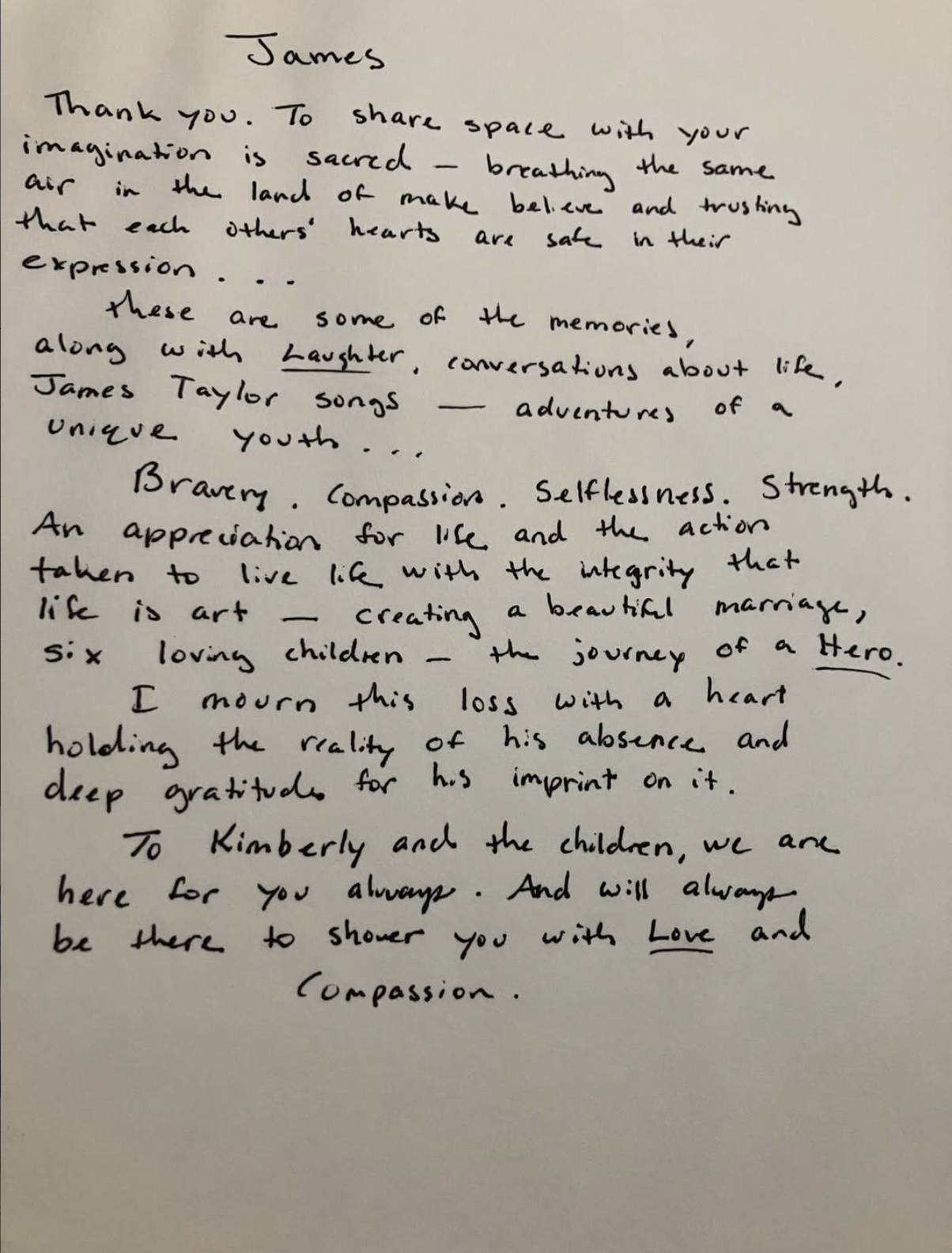
    Holmes added: “James. Thanks. To share area together with your creativeness is sacred – respiration the identical air within the land of make consider and trusting that one another’s hearts are protected of their expression…”

    She shared the heartfelt on Instagram (katieholmes/Instagram)

    Holmes additionally shared some recollections from their time collectively on the hit 90s and noughties present, which helped to kickstart Van Der Beek’s profession and noticed him seem in different hit comedy collection corresponding to How I Met Your Mom and Ugly Betty.

    She wrote: “These are a number of the recollections together with Laughter, conversations about life, James Taylor songs – adventures of a singular youth…

    “Bravery. Compassion. Selflessness. Power. An appreciation for all times and the motion taken to dwell life with the integrity that life is artwork – creating a ravishing marriage, six loving kids – the journey of a Hero.

    The 2 have been long-time mates after starring collectively in Dawson’s Creek ( SGranitz/WireImage)

    “I mourn this loss with a coronary heart holding the truth of his absence and deep gratitude for his imprint on it.

    “To Kimberly and the youngsters, we’re right here for you all the time. And can all the time be there to bathe you with Love and compassion.”

    A fundraiser has additionally been launched to help the household and has raised over $1 million in lower than 24 hours since its launch, whereas Van Der Beek additionally left a remaining heartbreaking message to his followers.