Tag: XRP

  • Iran-Linked Ripple XRP Study Reveals Surprising Facts as US-Iran War Escalates

    Iran-Linked Ripple XRP Study Reveals Surprising Facts as US-Iran War Escalates

    Escalating tensions between the United States and Iran have renewed interest in an Iran-backed study examining Ripple’s XRP for cross-border payments. The research has resurfaced as financial sanctions and disruptions to international money transfers dominate headlines, drawing fresh scrutiny to the digital asset’s potential utility in restricted financial corridors.

    Sanctions Pressure Highlights Alternative Payment Rails

    The recent conflict has thrust the mechanics of global value transfer into sharp focus. As traditional banking channels face restrictions, analysts and policymakers are revisiting technical assessments of blockchain-based settlement systems. The Iranian study, which evaluates XRP’s speed and cost efficiency for cross-border transactions, is being cited in discussions about circumventing financial blockades.

    XRP Gains Attention Amid Financial Uncertainty

    Market observers note that the geopolitical climate has turned heads toward XRP specifically. The asset’s design for institutional liquidity management and its existing partnerships with financial institutions position it as a frequently referenced case study in debates over the future of sanctioned economies’ access to global markets.

  • Republicans Introduce New Version of Key Crypto Bill for BTC, XRP, ETH

    Republicans Introduce New Version of Key Crypto Bill for BTC, XRP, ETH

    Senate Republicans have circulated a revised 630-page version of the CLARITY Act mere days before a pivotal procedural vote that could shape the regulatory future of the broader cryptocurrency market, including major assets such as Bitcoin, XRP, and Ethereum.

    Partisan Dynamics Remain Unresolved

    Journalist Brendan Pedersen reported Thursday that the latest legislative text remains a Republican proposal rather than a bipartisan agreement. Democrats who have previously expressed interest in crypto legislation remain skeptical, according to Pedersen. A Democratic aide characterized the unresolved ethics dispute as the “biggest stumbling block by far.”

    “This latest proposal does nothing to resolve those concerns,” the aide said.

    Sept. 15 Cloture Vote Looms as Critical Test

    The Senate’s cloture motion on the motion to proceed to the CLARITY Act is scheduled to ripen on Sept. 15 at 2:15 p.m. ET. This procedural vote determines whether debate on the legislation can advance; it is not a final vote on passage. With the current draft still lacking bipartisan support, Republicans will need to persuade enough Democrats to allow the legislation to move forward.

    Key Revisions in the Updated Draft

    The updated legislation introduces several notable changes to the regulatory framework:

    Decentralization Definitions Refined

    The revised draft draws a clearer distinction between genuinely decentralized protocols and what it terms “non-decentralized finance trading protocols.” The text specifies that merely participating in a decentralized governance mechanism or an incident-response security council does not automatically constitute control.

    Developer Protections Retained

    The bill maintains significant protections for software developers, a provision viewed as critical for innovation in the digital asset space.

    Focus on Digital-Commodity Markets

    The revised DeFi language explicitly focuses parts of the regulatory regime on digital-commodity cash and spot markets, narrowing the scope of certain oversight mechanisms.

    Credit Union Provisions Strengthened

    Another notable revision strengthens language concerning credit unions. Regulators, including the National Credit Union Administration (NCUA), would retain their full supervisory and enforcement powers. The bill also makes technical changes to the GENIUS Act intended to place credit-union accounts on more equal footing with bank deposits when dealing with tokenized financial products.

    Political Hurdle Outweighs Technical Changes

    While the updated draft modifies several regulatory mechanics of the CLARITY Act, it does not resolve the core political dispute most likely to determine whether the legislation can advance. The Sept. 15 cloture vote represents the next major test, and the outcome will signal whether a path forward exists for comprehensive crypto market structure legislation in the current Congress.

  • Bitcoin, Ethereum, XRP Plunge as US PPI Surges to 5.4%, Fed Rate‑Hike Odds Hit 74%

    Bitcoin, Ethereum, XRP Plunge as US PPI Surges to 5.4%, Fed Rate‑Hike Odds Hit 74%

    Bitcoin, Ethereum, and XRP extended their losing streak on Thursday after fresh U.S. inflation data fueled speculation that the Federal Reserve will raise interest rates at its upcoming policy meeting. The renewed sell-off across major cryptocurrencies highlights the asset class’s continued sensitivity to macroeconomic shifts and central bank signaling.

    Inflation Data Triggers Rate-Hike Bets

    The latest consumer price figures came in hotter than expected, reinforcing the narrative that the Fed’s tightening cycle may not be over. Markets quickly repriced the probability of a rate hike at the September 15–16 Federal Open Market Committee (FOMC) meeting, sending risk assets — including digital assets — lower.

    Crypto Market Reacts to Macro Pressure

    Bitcoin slipped below key technical levels, while Ethereum and XRP mirrored the downturn. The correlation between crypto and equities remains elevated, meaning that any hawkish tilt from the Fed tends to weigh on both traditional and digital risk markets simultaneously.

    FOMC Meeting in Focus

    Traders are now laser-focused on the September 15–16 FOMC gathering. A rate increase — or even hawkish forward guidance — could prolong the current correction in crypto prices. Conversely, a pause with dovish undertones might provide a short-term relief rally.

    The September 15-16 FOMC meeting could be weighed on risk assets on the crypto market.

  • When Will XRP Hit $100? Data Shows Not Yet — Here’s Why

    When Will XRP Hit $100? Data Shows Not Yet — Here’s Why

    XRP Price Potential Tied to Tokenized Asset Growth on XRP Ledger, Analysts Say

    Crypto analysts tracking XRP’s institutional infrastructure argue the token’s path to triple-digit prices depends on a single metric that remains far from target levels: the total value of tokenized assets actually deployed on the XRP Ledger.

    Current Ledger Metrics Show Concentrated Activity, Rising Volume

    Recent data indicates the XRP Ledger recorded fewer active accounts in the second quarter, yet trading volume per account roughly tripled. Tokenized assets on the ledger reached $3.72 billion, representing a 30x increase year-over-year. The takeaway is that XRP trading activity is concentrating into fewer accounts, while the value moving through those accounts has grown dramatically.

    Despite this growth, the ledger’s $4.26 billion in tokenized value remains far short of the scale commentators believe is required to justify $100 or $1,000 XRP price targets.

    Analyst: Institutional Groundwork Determines Timeline

    Addressing community frustration, analyst Zach Rector framed XRP’s current price as a function of where the institutional adoption timeline actually stands, not where the market wishes it stood. He argued that Ripple and its partners are deliberately not rushing the rollout of institutional infrastructure.

    “That right there is why we’re not at a $100 XRP or $1,000 XRP,”

    Rector said, pointing to a path that would need to climb from billions into the tens and eventually hundreds of billions, and ultimately trillions, before those price levels become realistic.

    The message is that reaching $100 or $1,000 XRP isn’t off the table long-term, but it isn’t happening in the near term simply because the underlying institutional groundwork hasn’t reached that scale yet.

    New Partnership Expands Institutional Infrastructure

    Adding to that groundwork, Settlement CEO Adam Popat discussed a newly announced partnership with Ripple, describing it as the culmination of roughly a decade of working relationships. The deal fully integrates Ripple’s custody platform with Settlement’s digital asset lifecycle management system, giving large institutions a single interface to issue, manage, and custody assets on the XRP Ledger without switching between separate systems.

    Popat called it the first offering of its kind in the market, designed specifically to simplify institutional entry into XRP Ledger tokenization in a compliant, regulated way.

    Scaling Trajectory Underway But Early

    The case for eventual triple-digit XRP prices rests on tokenized asset value continuing to scale from its current $4.26 billion toward the tens or hundreds of billions, and eventually trillions—a trajectory commentators say is underway but still early. Until that scaling happens, expectations for $100 or $1,000 XRP in the near term remain, by their own admission, ahead of where the actual institutional timeline currently sits.

  • XRP Price Target Following Cup-and-Handle Retest

    XRP Price Target Following Cup-and-Handle Retest

    XRP Price Analysis: Cup-and-Handle Pattern Suggests Potential Breakout Toward $3.63 and Beyond

    XRP has entered a critical technical phase following its August rally, with the weekly chart now signaling a possible cup-and-handle breakout formation. The current price structure indicates the recent decline may represent a retest of this breakout level. If XRP maintains key support and eventually clears the handle resistance, technical projections point to several upside targets, including $3.6330, $6.8899, and $13.5687.

    As of early September, XRP trades around $1.39, reflecting a gain of approximately 3.5% over the past week. The broader structure originates from XRP’s decline from its July 2025 cycle high near $3.65 to a low of roughly $0.99 in mid-August 2026, a drawdown of nearly 73%. That August low sparked a sharp recovery, with XRP surging more than 60% in just a few days to reach an interim high near $1.70.

    Catalysts Behind the August Rebound

    The rebound coincided with several positive developments: expectations of increased liquidity injections, renewed optimism surrounding the CLARITY Act, whale accumulation activity, and continued inflows into spot XRP exchange-traded funds. However, the rally proved short-lived.

    August Flash Crash Forms the Handle

    On August 22, XRP experienced a flash crash that erased more than 37% of its value intraday. The move triggered approximately $500 million in leveraged long liquidations before the token found stability. Since then, XRP has consolidated throughout the first week of September within a tightening range between $1.30 and $1.50.

    This consolidation range gives the weekly chart a structure that could evolve into the handle portion of a larger cup-and-handle formation. Within this framework, XRP faces resistance around $1.45 to $1.50, while buyers have established stronger support near $1.35, followed by the $1.30 to $1.31 zone. As long as XRP defends these levels, the bullish structure remains valid.

    Weekly Chart Also Shows Descending Wedge

    On the weekly timeframe, XRP’s recent price action also forms a descending wedge, with two converging trendlines containing the August rally and subsequent pullback. The current consolidation near $1.30 to $1.40 could represent the handle before XRP attempts to reclaim the resistance shelf above it.

    Fibonacci Extensions Target $3.63, $6.89, and $13.57

    Fibonacci extensions drawn from the prior price swing provide a series of potential upside objectives. The first target sits at $2.4062, followed by $3.6330, $6.8899, and finally $13.5687. The $3.6330 level carries particular significance because it aligns with XRP’s July 2025 cycle high near $3.65.

    This makes the $3.63 area a crucial test if XRP completes the cup-and-handle breakout. A decisive move beyond that region could then shift market focus toward the higher $6.8899 and $13.5687 Fibonacci extensions. Reaching the $13.5687 target from the current $1.39 price would require a rally of more than 800%, demanding substantially stronger momentum than the initial breakout.

    Key Support at $1.35 Must Hold

    Several factors continue to support the bullish interpretation. First, XRP has remained above its 20-week exponential moving average (EMA), a level it failed to reclaim in May before dropping toward $0.98. Additionally, a potential golden cross — where the 50-week moving average crosses above the 200-week moving average — could develop, adding weight to the longer-term bullish case.

    However, momentum has already cooled. The weekly Relative Strength Index (RSI) has fallen to around 58 after previously reaching overbought territory, while trading volume has declined since early September. These conditions indicate XRP needs renewed buying pressure to push through the $1.45 to $1.50 resistance zone and confirm the handle breakout.

    For now, $1.35 remains the pivotal level for the bullish setup. A daily and weekly close below it would weaken the structure, while a break under $1.30 could expose the next support around $1.23. Such a move would place the cup-and-handle thesis under serious pressure before XRP could reach the $2.4062 or $3.6330 targets.

  • Firelight Raises $8 Million and Expands Beyond XRP to Make DeFi Less Intimidating for Fintechs

    Firelight Raises $8 Million and Expands Beyond XRP to Make DeFi Less Intimidating for Fintechs

    Firelight is also evaluating a wider range of liquid assets that do not currently generate substantial yield, CEO Anthony DeMartino told CoinDesk in an interview.

    “There’s a bunch of different assets that we’re considering,” DeMartino said. “Anything … that’s a solid asset, that has good liquidity to it, that doesn’t provide its own natural yield, will eventually be eligible to be posted as collateral.”

    Bringing fintech money onchain

    Firelight is targeting an opportunity beyond crypto-native traders as fintech companies, neobanks and payments providers increasingly integrate onchain yield products into their applications.

    The risk of customer capital being lost in an exploit can become a significant obstacle when a product is ready to launch, DeMartino said. Firelight aims to provide a protection layer that makes the transition to onchain products less daunting.

    “This isn’t built for degens,” he said. “This is built to bring the next wave of capital in. We want to be that protection layer to allow that adoption.”

    DeMartino expects more money currently held in bank accounts to move into fintech earn products powered by stablecoins, onchain vaults and wallets. Sentora, he said, has also been working to bring yield products to fintech applications, including payroll and remittance platforms.

    The gap in onchain protection remains substantial. Approximately $80 billion is locked in DeFi, according to Firelight, while only a fraction of a percent is covered by onchain protection.

  • Crypto Weekly: Solana Leads Altcoin Gains as XRP and DOGE Decline

    Crypto Weekly: Solana Leads Altcoin Gains as XRP and DOGE Decline

    Crypto markets ended the week virtually flat after a volatile stretch that saw bitcoin and major altcoins retreat from multi-week highs before recovering late in the session. The choppy trading followed a sharp rally the previous week, when digital assets added more than $500 billion in combined market value in seven days.

    Crypto market capitalization began the week near $2.74 trillion, fell below $2.7 trillion on Aug. 23, and then recovered to $2.79 trillion by Friday. By Saturday afternoon, however, total market capitalization had slipped to approximately $2.73 trillion, leaving the crypto economy nearly unchanged for the week.

    Bitcoin Recovers After Volatile Trading

    Momentum from the previous week’s U.S. Treasury bond buyback announcement carried into Tuesday, Aug. 25, briefly pushing bitcoin above $81,000 before the rally stalled. Bitcoin then consolidated between $77,000 and $79,000 for two days before surging again Thursday and reclaiming $81,000 for the second time in a week.

    Bitcoin fell below $77,000 in the period surrounding Federal Reserve Chair Kevin Warsh’s Jackson Hole address. The leading cryptocurrency later recovered some of its losses, returning above $78,000 by Saturday afternoon and recording a modest 1% weekly gain. The move kept bitcoin on track to end August more than 20% higher.

    Bitcoin and Gold Fuel Scarce-Asset Debate

    Bitcoin’s parallel movement with gold during the week renewed debate over whether institutional investors are shifting toward a broader debasement trade to hedge against the erosion of fiat currencies. Industry experts, however, described the trend as a structural evolution rather than a straightforward hedging strategy.

    Himanshu Sahay, co-founder and CTO of Arch Lending, said the simultaneous movement in bitcoin and gold was notable but should not automatically be viewed as evidence of an institutional flight from fiat debasement alone.

    “What I do think we’re seeing is a broader reassessment of scarce assets,” Sahay said. “Gold has traditionally played that role, while bitcoin increasingly occupies a similar position for investors who are comfortable with a higher-volatility asset. The fact that they’re moving together is important because it suggests bitcoin is increasingly being traded within a broader macro framework rather than purely on crypto-specific narratives. That’s a meaningful evolution for the asset.”

    Altcoin Performance Diverges

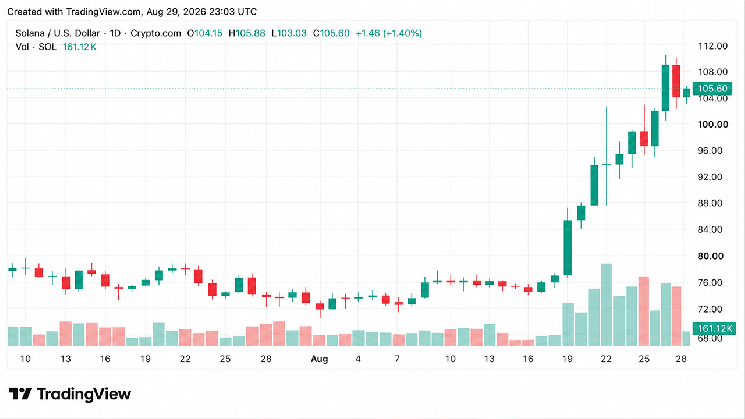
    Altcoin performance varied sharply, with several tokens recording double-digit gains or losses. Solana (SOL) led the advancing assets after Charles Schwab announced plans to add SOL, AVAX and LINK to its accounts in the near future.

    Privacy-focused cryptocurrency Monero (XMR) also posted strong gains, rising from $425 to close the week at $463 on Saturday. Among large-cap digital assets, RAIN recorded the strongest weekly performance, climbing 24%.

    On the losing side, XRP, one of the previous week’s top performers, declined nearly 7%. Dogecoin fell 7.2%, while ADA, XLM and BCH each dropped more than 10%.

    Despite the mixed performance across individual tokens, the combined altcoin market capitalization increased by just over 4%, rising from $1.13 trillion at the start of the week to $1.18 trillion on Aug. 29.

  • XRP Gains Attention on Nasdaq as SEC Approves XRP-Related Issue: Details Explained

    XRP Gains Attention on Nasdaq as SEC Approves XRP-Related Issue: Details Explained

    Bitcoin and altcoins are driving renewed momentum across the cryptocurrency market, while positive developments are also emerging for $XRP. Evernorth Holdings, an $XRP treasury company, has moved closer to its planned Nasdaq listing after reaching another key stage in its proposed merger with Armada Acquisition Corp. II.

    Evernorth’s SEC Registration Statement Takes Effect

    Evernorth Holdings announced that its Form S-4 registration statement filed with the U.S. Securities and Exchange Commission (SEC) for the merger has gone into effect. Shareholders are scheduled to vote on the proposed merger with special purpose acquisition company Armada Acquisition Corp. II on September 30, 2026.

    The registration statement becoming effective represents a significant milestone in the transaction and advances Evernorth’s plans to become a publicly traded $XRP-focused treasury company.

    $XRP Treasury Company Could Trade Under the XRPN Ticker

    If shareholders approve the merger and all other closing conditions are satisfied, the combined company is expected to trade on Nasdaq under the ticker symbol “XRPN.” The company would operate as a treasury business focused on $XRP.

    Evernorth founder and CEO Asheesh Birla said, “Today is a significant milestone toward completing the business merger we proposed. Our goal was to create an actively managed $XRP treasury with the transparency and governance demanded by public markets. With the entry into force of the registration statement, we are one step closer to realizing our vision.”

    Evernorth’s major investors include Ripple, SBI Group, Pantera Capital, Kraken, GSR, and Arrington Capital. The company said it has secured more than $1 billion in gross proceeds and committed capital from investors.

    This is not investment advice.

  • Ripple Reports 80% of Users Donate to Humanitarian Causes

    Ripple Reports 80% of Users Donate to Humanitarian Causes

    Ripple Highlights User Humanitarian Engagement as 80% Report Donating or Volunteering

    Ripple is generating industry discussion this week not through a product launch or regulatory filing, but via a striking claim about its community: 80% of its users actively donate money or volunteer for humanitarian causes. The statistic, shared in a recent company post, has thrust Ripple humanitarian donations into the crypto spotlight, prompting debate over whether user goodwill can translate into stronger market positioning for the payments firm.

    Key Takeaways

    • Ripple states 80% of its users participate in humanitarian donating or volunteering, per a company post.
    • The claim aligns with Ripple’s core pitch: faster, cheaper cross-border payments that aid distribution.
    • Analysts are monitoring whether the community response lifts Ripple’s reputation and XRP market sentiment.
    • Future crypto donation regulations could shape how Ripple and peers manage philanthropic activity.
    • The humanitarian push coincides with Ripple’s expansion via EDX Markets integration and RLUSD stablecoin growth in Turkey.

    Community Ethos Drives Ripple’s Humanitarian Narrative

    Ripple frames the 80% figure as evidence of a user base motivated by more than price speculation. The data originates from the company’s own reporting rather than an independent survey, yet it has ignited conversation about how deeply Ripple’s community is embedded in social causes.

    Reputation in crypto often hinges on community behavior as much as technology. High participation in humanitarian efforts could differentiate Ripple from competitors focused solely on institutional deals. If the trend persists, it may pressure other platforms to spotlight or incentivize similar philanthropic engagement among their users.

    Technology Infrastructure for Aid Distribution

    Ripple’s humanitarian pitch rests on a practical advantage: moving aid funds faster and cheaper than traditional banking rails allow. The company positions its cross-border payment network as critical for organizations needing to transfer funds rapidly during emergencies.

    By explicitly tying its settlement speed and low transaction costs to humanitarian outcomes, Ripple gives its infrastructure a mission-driven narrative. That framing matters for adoption, as nonprofits and institutions evaluating crypto rails often weigh mission alignment alongside technical performance.

    Market Sentiment and Regulatory Outlook

    For traders, the immediate question is whether goodwill drives demand. Ripple’s values-driven story arrives amid mixed crypto market signals, where narrative shifts can influence sentiment even without fundamental changes.

    Observers should track Ripple’s humanitarian initiatives as a potential driver of user engagement and market perception. A positive community response could increase demand for Ripple’s services over time. This narrative runs parallel to concrete business moves, including the EDX Markets integration expanding institutional brokerage access and the RLUSD stablecoin surpassing a $1.7 billion market cap following its Turkey launch.

    Separate analysis from The Motley Fool noted XRP’s price briefly dipped below $1 in August 2026 before recovering, with the token’s market cap near $91 billion — a reminder that Ripple’s corporate and philanthropic momentum does not always correlate directly with XRP price action, given the token’s structural independence from the company’s daily operations.

    Regulatory Uncertainty Remains a Wild Card

    Future rules governing crypto donations could reshape how Ripple and similar firms operate, especially if regulators increase scrutiny of digital asset flows through charitable channels. For now, the humanitarian angle provides Ripple a distinct narrative in a market saturated with technical upgrades and partnership announcements — one built on crypto community philanthropy rather than infrastructure alone.

    Frequently Asked Questions

    What percentage of Ripple users participate in humanitarian aid?

    Ripple reports that 80% of its users are actively donating or volunteering for humanitarian aid.

    How does Ripple support humanitarian efforts using technology?

    Ripple focuses on enabling faster and cheaper cross-border payments that facilitate humanitarian aid distribution.

    What impact could Ripple’s humanitarian initiatives have on the market?

    Strong community participation in humanitarian aid could enhance Ripple’s reputation and positively influence market sentiment.

    Are there regulatory considerations related to Ripple’s humanitarian aid efforts?

    Future regulatory developments around crypto donations may affect Ripple’s operations and how it engages in humanitarian initiatives.

  • XRP Selling Pressure Hits 2026 High as Price Holds Firm Above $1.40

    XRP Selling Pressure Hits 2026 High as Price Holds Firm Above $1.40

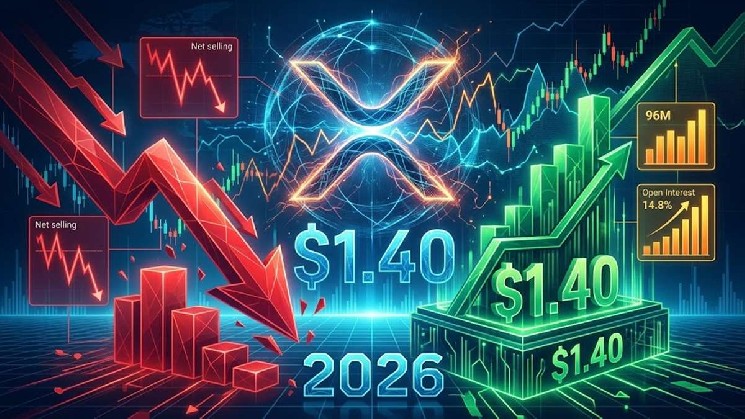
    XRP’s derivatives market is flashing its strongest net selling pressure of 2026, with Binance recording approximately $96 million in sell-side dominance. The surge follows a sharp 70% rally in XRP that has intensified speculative activity among derivatives traders. Despite the bearish signal, XRP continues to trade above $1.40 while Binance Open Interest has climbed 14.8%, signaling stronger market participation.

    Divergence Between Derivatives Selling and Spot Resilience

    The divergence between aggressive derivatives selling and resilient spot prices is giving traders a critical signal to monitor. The broader altcoin market has also strengthened in recent sessions, adding more than $183 billion in total capitalization within days. That represented an increase of roughly 20%, while XRP gained about 70% over the same period, making it one of the stronger performers during the recovery.

    XRP Selling Pressure Reaches 2026 Peak

    Data highlighted by CryptoQuant shows that XRP’s net taker volume on Binance has shifted sharply toward sellers. Sell-side dominance has reached approximately $96 million, marking the strongest reading recorded since the start of 2026.

    The metric tracks aggressive market orders and can provide insight into how traders are positioning around short-term price movements. In XRP’s case, the increase suggests that some derivatives participants are using the recent rally to take bearish positions or secure profits after the rapid advance.

    However, elevated selling activity does not automatically mean that XRP’s uptrend has ended. Strong spot demand can absorb derivatives selling, while liquidations or short-term hedging can also influence net taker volume. The current price structure therefore remains important. Holding above $1.40 despite heavier derivatives selling suggests buyers have so far absorbed the additional supply pressure.

    Binance Open Interest Adds Another Signal

    At the same time, XRP’s Binance Open Interest has increased by approximately 14.8%. The rise means more capital is entering outstanding derivatives positions as traders respond to the token’s recent move.

    Higher Open Interest combined with strong selling pressure can increase volatility because a larger number of leveraged positions are exposed to sudden price movements. If XRP continues to hold its support levels, short positions could eventually face pressure from another upside move. Conversely, a decisive break below $1.40 would strengthen the bearish interpretation and could encourage further profit-taking or liquidations.