Tag: XRP

  • XRP Surges 8.7% as Peter Brandt’s Chart Analysis Points to $5.40 Target

    XRP Surges 8.7% as Peter Brandt’s Chart Analysis Points to $5.40 Target

    Key Highlights

    • Veteran trader Peter Brandt projects XRP could reach $5.40 based on long-term monthly chart analysis, implying approximately 251% upside from current levels.
    • XRP surged 8.7% to $1.54 in 24-hour trading, reaching a session high of $1.57 before pulling back, with the token trading in an 11% range between $1.41 and $1.57.
    • Institutional developments accelerated as South African banking giant Absa launched digital asset custody built on Ripple technology, while the U.S. Senate rejected cloture on the CLARITY Act in a 49-50 vote.

    Peter Brandt’s Technical Analysis and $5.40 Price Target

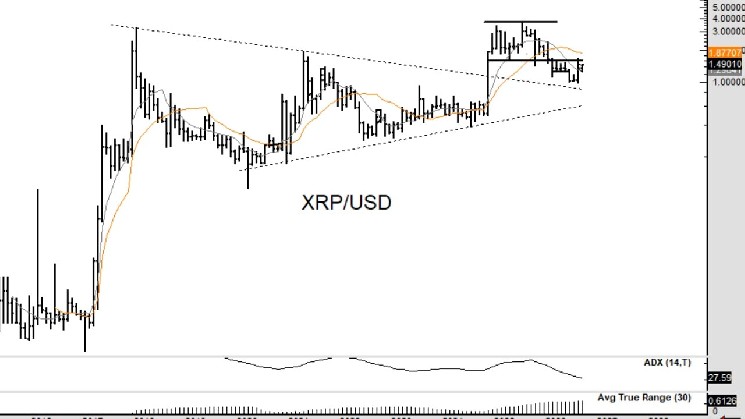
    Veteran commodity trader Peter Brandt shared a bullish long-term projection for XRP on September 21, posting a monthly chart on X that he says implies an eventual advance to $5.40. The target would represent a substantial premium over recent trading ranges, requiring approximately 251% appreciation from the $1.54 level where XRP traded at the time of publication.

    Brandt, who entered the commodity trading business in 1976 and founded Factor Trading in 1980, emphasized the distinction between a public chart presentation and an executed trade. “This is my long-term chart of $XRP It implies an eventual advance to $5.40.” he wrote. “A claim of a ‘call’ or simple presentation of a chart is $NOT a trade. People who claim ‘trades’ need to provide proof or else the claims are BS. An X post is $NOT proof,” he added. His use of the term “eventual” frames the $5.40 objective as a long-term technical target rather than a near-term prediction, and he explicitly noted that proving an actual trade would require verifiable records showing entry, exit, and result.

    XRP Price Action and Market Performance

    Bitcoin.com Markets data confirmed XRP trading at $1.54, up 8.7% or $0.12 over the preceding 24 hours. The token established a session low of $1.41 early in the period before climbing steadily through most of the trading day. The advance peaked at $1.57 late in the session, after which XRP eased back to the $1.54 level, leaving it approximately 2% below its 24-hour high and roughly 9% above its low. The session’s full trading range spanned about 11% from low to high, reflecting heightened volatility accompanying the price discovery.

    Institutional Infrastructure Expansion and Regulatory Context

    The price rally coincided with significant institutional infrastructure developments. South African lender Absa, one of Africa’s largest banking groups, launched Absa Digital Asset Custody on September 21, built on Ripple’s custody technology. The launch occurred 11 months after Ripple and Absa announced their partnership, marking a concrete step in institutional adoption across the African continent.

    Asset manager 21Shares outlined a four-pillar investment case for XRP centered on regulatory clarity, institutional access, measurable utility, and fixed supply. The firm noted that while expanding XRP Ledger (XRPL) activity may not directly translate into sustained XRP demand, growing network activity could support demand through transaction fees, account reserves, and bridge transfers. 21Shares cited approximately $4 billion in tokenized assets and roughly $1.6 billion in RLUSD supply, with more than half circulating on the XRPL.

    On the regulatory front, the U.S. Senate rejected cloture on the CLARITY Act in a 49-50 vote. Ripple maintained that the failed vote did not alter XRP’s established legal position or disrupt demand across payments, stablecoins, and institutional markets, suggesting the token’s regulatory framework remains intact despite legislative setbacks.

    Why This Matters

    The convergence of technical analysis from a respected veteran trader, meaningful price appreciation with elevated volume, and tangible institutional infrastructure deployment creates a multi-layered bullish narrative for XRP. Brandt’s $5.40 target, while framed as a long-term technical implication rather than a trading recommendation, draws attention to the monthly chart structure that has historically preceded major trend advances in commodity and digital asset markets. The Absa custody launch demonstrates Ripple’s expanding institutional footprint beyond North America into African financial markets, while 21Shares’ analytical framework highlights the fundamental metrics—institutional access, on-chain utility, and regulatory standing—that professional allocators increasingly prioritize. The Senate’s CLARITY Act outcome, while a legislative disappointment for broader crypto regulatory clarity, appears to have had minimal immediate market impact on XRP specifically, reinforcing Ripple’s assertion that the token’s legal classification is settled. Market participants will likely monitor whether XRP can sustain above the $1.50 psychological level and build a higher base for the next leg toward Brandt’s long-term projection.

    Frequently Asked Questions

    What is Peter Brandt’s track record in technical analysis?

    Peter Brandt has over 45 years of commodity trading experience, founding Factor Trading in 1980 after beginning his career in 1976. He has managed institutional trading operations and authored two books on commodity trading and classical chart patterns, establishing him as a recognized authority in traditional technical analysis applied to digital assets.

    Does the Absa Digital Asset Custody launch directly increase XRP demand?

    Not necessarily. The custody service is built on Ripple’s technology infrastructure, but 21Shares notes that expanding XRPL activity may not translate directly into sustained XRP demand. However, the firm argues that growing network activity could support demand indirectly through transaction fees, account reserves, and bridge transfer mechanisms on the ledger.

    How significant was the Senate CLARITY Act vote for XRP specifically?

    According to Ripple, the failed cloture vote on the CLARITY Act did not change XRP’s established legal position or disrupt demand across its core use cases in payments, stablecoins, and institutional markets. The token’s regulatory classification remains intact regardless of the legislative outcome.

  • XRP Leads Crypto Options Market With Massive Implied Move

    XRP Leads Crypto Options Market With Massive Implied Move

    Key Highlights

    • Coinbase Markets data shows XRP options imply a one-standard-deviation move of 8.9% through September 27, the highest volatility premium among major cryptocurrencies including Bitcoin, Ethereum, and Solana.
    • XRP derivatives volume surged to approximately $6.8 billion in 24 hours with open interest climbing to $3.56 billion, while short liquidations reached $17 million as price rallied 6.7% to $1.51.
    • Binance’s XRP/USDT long-to-short account ratio of 2.18 signals increasingly crowded long positioning, creating potential downside risk if the rally stalls despite seven-day cumulative net outflows of $293 million.

    Options Market Signals Elevated Volatility Expectations

    XRP is emerging as the cryptocurrency market’s most significant volatility bet heading into late September. According to Coinbase Markets, crypto options currently price in a one-standard-deviation move of roughly 8.9% for XRP through September 27. This implied volatility figure surpasses Solana at 8.0%, Ethereum at 6.9%, and Bitcoin at 5.0%, positioning XRP at the top of the volatility spectrum among the four major digital assets tracked by the exchange.

    More notably, XRP’s expected move registers at approximately 1.79 times its historical median seven-day move of about 5%, representing the widest volatility premium among the quartet. With XRP changing hands at $1.51 at press time, an 8.9% symmetric move would correspond to approximately $1.37 on the downside or $1.64 on the upside. It is important to note that the options market is not predicting which of those directions XRP will take; rather, traders are paying for protection or exposure to a rather significant price swing in either direction.

    Derivatives Activity Explodes Amid Price Rally

    XRP derivatives activity has recorded a sharp increase alongside the recent price appreciation. CoinGlass data shows XRP futures generated approximately $6.8 billion in trading volume over the past 24 hours. Open interest has climbed to approximately $3.56 billion while XRP trades near $1.51, up roughly 6.7% over the same period.

    The latest rally has taken a significant toll on bearish traders. Approximately $19.2 million worth of XRP positions were liquidated during the past 24 hours, with short positions accounting for roughly $17 million of that amount. This forced covering of bearish bets has likely contributed to the upward price momentum, creating a feedback loop that amplified the move.

    Positioning Dynamics Create Two-Sided Risk

    Positioning is now increasingly tilted in the opposite direction. The Binance XRP/USDT long-to-short account ratio stands at roughly 2.18, indicating that long positions significantly outnumber shorts among accounts on the world’s largest cryptocurrency exchange by volume. That creates a rather peculiar setup. The first stage of the rally was capable of forcing bearish traders out of their positions. However, increasingly crowded long positioning could become a problem for the bulls if XRP stumbles.

    Over the past 24 hours, CoinGlass shows roughly $1.81 billion in futures inflows and nearly the same amount in outflows, suggesting high turnover and active two-sided trading. Over seven days, however, cumulative net flow remains negative by roughly $293 million, indicating that despite the recent surge, the broader weekly trend has seen capital exiting XRP futures. Such conditions—elevated implied volatility, crowded positioning, and mixed flow signals—can produce large moves in either direction, leaving the market vulnerable to sharp reversals.

    Why This Matters

    The convergence of extreme options-implied volatility and heavily skewed futures positioning places XRP at a critical juncture for short-term price discovery. The 8.9% implied move through September 27 suggests options market makers are pricing in a potential catalyst or event risk—whether related to the ongoing SEC litigation, broader macroeconomic data releases, or technical breakout dynamics. Meanwhile, the long-to-short ratio of 2.18 on Binance signals complacency among bulls; should the rally falter, a cascade of long liquidations could accelerate downside moves, mirroring the short squeeze that helped drive the recent ascent. For market participants, the key takeaway is not directional bias but the heightened probability of an outsized move, demanding rigorous risk management and position sizing appropriate for a volatility regime nearly double the historical norm.

    Frequently Asked Questions

    What does the 8.9% implied volatility for XRP options actually mean?
    It means options traders are pricing in a one-standard-deviation price move of roughly 8.9% (approximately $0.13 on either side of the $1.51 spot price) through September 27. This is a measure of expected magnitude, not direction.
    Why are short liquidations significant for XRP’s price action?
    Short liquidations force bearish traders to buy back XRP to close positions, creating incremental buying pressure that can accelerate upward price moves. The $17 million in short liquidations over 24 hours likely contributed to the 6.7% rally.
    What risk does the 2.18 long-to-short ratio on Binance pose?
    A ratio this elevated suggests long positions are crowded. If XRP reverses, a wave of long liquidations could trigger a sharp correction, as leveraged bulls rush to exit simultaneously—similar to how short covering fueled the recent rally.
  • XRP Lags Latest Crypto Rally: Will It Catch Up to Rivals’ Gains?

    XRP Lags Latest Crypto Rally: Will It Catch Up to Rivals’ Gains?

    Key Highlights

    • Large cryptocurrency whales have accumulated over $2 billion worth of XRP, driving an 8.22% price surge in three days according to analyst Ali Martinez.
    • On-chain URPD data indicates limited resistance up to $1.60, a level where approximately 2.5 billion XRP previously changed hands and may trigger profit-taking.
    • XRP currently trades near $1.49, up 6.33% in 24 hours and 5.08% over the past week, outperforming recent altcoin market trends.

    Whale Accumulation Sparks XRP Price Surge

    After lagging behind other altcoins during the recent broader market rally, XRP has reclaimed investor attention following aggressive accumulation by large-scale holders. According to crypto analyst Ali Martinez, whales have purchased more than $2 billion worth of XRP in recent sessions, a volume significant enough to shift market dynamics and catalyze a sharp price recovery. The buying pressure has translated into an 8.22% gain over just three trading days, signaling renewed conviction among high-net-worth participants in the token’s near-term trajectory.

    On-Chain Metrics Point to $1.60 as Critical Resistance

    Martinez’s analysis relies heavily on URPD (UTXO Realized Price Distribution) data, which maps the price levels at which the current circulating supply last moved on-chain. The metric reveals a relative absence of realized supply between current prices and $1.60, suggesting that few holders are sitting on break-even or loss positions in that range. This structural characteristic typically reduces selling pressure during upward moves, as there are fewer incentivized exit points for traders looking to recover costs.

    The $1.60 Supply Wall

    However, the same data identifies $1.60 as a zone of heavy historical activity. Approximately 2.5 billion XRP changed hands near this price level in the past, creating a dense cluster of realized cost basis. Martinez warns that as price approaches this region, a significant portion of those holders may look to liquidate positions at or near break-even, introducing substantial selling pressure. The analyst characterizes this as the next major resistance zone where profit-taking could stall or reverse the current uptrend.

    Current Market Position and Momentum

    As of the latest data, XRP is trading at approximately $1.49, representing a 6.33% increase over the past 24 hours and a 5.08% gain over the trailing seven days. The token’s ability to sustain momentum above the $1.45 level has kept the path toward $1.60 technically viable, though the on-chain supply distribution suggests the final approach to that level may encounter increasing friction. Volume profiles and order book depth will be critical indicators of whether whale demand can absorb the anticipated supply wall.

    Why This Matters

    The resurgence of whale activity in XRP highlights a broader pattern where large capital flows often precede sustained trend changes in mid-cap crypto assets. Unlike retail-driven pumps, accumulation of this magnitude—exceeding $2 billion—typically reflects strategic positioning ahead of anticipated catalysts, whether regulatory clarity, institutional adoption, or network-level developments on the XRP Ledger. The URPD framework used by Martinez offers a more granular view of holder psychology than traditional technical indicators, mapping actual economic pain points rather than arbitrary chart levels. For market participants, the $1.60 zone represents not just a price target but a behavioral test: whether new demand can overwhelm the latent supply from prior market cycles. A decisive break above this level could signal a shift in market structure, while rejection may consolidate XRP in a lower range until fresh catalysts emerge.

    Frequently Asked Questions

    What is driving the recent XRP price increase?

    The primary driver is accumulation by large holders (whales) who have purchased over $2 billion worth of XRP, according to analyst Ali Martinez. This concentrated buying pressure has pushed the price up 8.22% in three days.

    What does the URPD data suggest about XRP’s next resistance?

    URPD (UTXO Realized Price Distribution) data shows limited on-chain supply between current levels and $1.60, indicating minimal resistance. However, $1.60 itself is a major supply zone where ~2.5 billion XRP last transacted, making it a likely profit-taking target.

    Is XRP expected to continue rising past $1.60?

    Analyst Ali Martinez suggests there is room for gains up to $1.60 based on current on-chain structure, but warns that the dense cluster of realized supply at that level may trigger significant selling pressure, potentially stalling further upside without new demand catalysts.

  • 15 Altcoins Surge in South Korea Trading Volume as XRP Tops List Again

    15 Altcoins Surge in South Korea Trading Volume as XRP Tops List Again

    Key Highlights

    • XRP dominated South Korean altcoin trading with $213.8 million in 24-hour volume across Upbit and Bithumb, nearly double the runner-up.
    • Gravity (G) surged to second place with $119.6 million, driven primarily by Upbit activity, while Ethereum ($ENA) secured third at $72.1 million.
    • Five additional tokens—CAP, DRV, ONDO, ZIL, and BFC—each surpassed $39 million in combined volume, signaling broad altcoin momentum on Korea’s top exchanges.

    South Korean Exchanges Report Surge in Altcoin Trading Led by XRP

    South Korea’s two largest cryptocurrency exchanges, Upbit and Bithumb, have recorded extraordinary altcoin trading activity over the past 24 hours, with a combined analysis revealing concentrated investor interest in a select group of digital assets. Data aggregated from both platforms shows XRP commanding a dominant lead, posting approximately $213.8 million in total trading volume—nearly double the volume of the second-ranked token and establishing it as the clear focal point of Korean retail crypto trading during the period.

    Gravity and Ethereum Follow as Volume Concentrates in Top Tier

    Trailing XRP, Gravity (G) emerged as the session’s standout performer with roughly $119.6 million in combined volume. The bulk of G’s activity originated on Upbit, though Bithumb contributed a notable $16.5 million, indicating cross-exchange participation. Ethereum ($ENA) rounded out the top three at $72.1 million, while Cap ($CAP) and Derive ($DRV) each cleared the $50 million threshold at $58.2 million and $57.1 million respectively, underscoring a deepening liquidity pool beyond the market’s largest caps.

    Broad-Based Participation Across Mid-Cap Altcoins

    The volume distribution extends well beyond the top five. Ondo (ONDO) registered $49.4 million, followed closely by Zilliqa (ZIL) at $47.6 million and Bifrost (BFC) at $39.1 million. Major layer-one protocols also maintained significant presence: Solana (SOL) at $38.6 million, Avalanche (AVAX) at $34.3 million, and Zama (ZAMA) at $30.5 million. The data further shows active trading in Celer Network (CELR) ($27.2M), MultiversX (EGLD) ($23.4M), Worldcoin (WLD) ($16.8M), Lorenzo Protocol (BANK) ($16.1M), and even Dogecoin (DOGE) at $7.1 million, painting a picture of diversified speculative engagement across the Korean market.

    Why This Matters

    The concentration of hundreds of millions of dollars in 24-hour altcoin volume on Upbit and Bithumb reflects the outsized influence of South Korean retail traders on global crypto price discovery and liquidity. Historically, Korean exchange activity has served as a leading indicator for altcoin rallies, with the “Kimchi premium” and localized narratives driving disproportionate volume in specific tokens. The current breadth—spanning payments (XRP), infrastructure (Gravity, Celer), DeFi (Ondo, Derive), and L1s (Solana, Avalanche)—suggests a risk-on rotation rather than a single-narrative play. Market participants should monitor whether this volume sustains into subsequent sessions, as persistent Korean demand often precedes broader exchange listings and global retail FOMO cycles.

    Frequently Asked Questions

    Which altcoin had the highest 24-hour trading volume on Upbit and Bithumb combined?
    XRP led with approximately $213.8 million in total trading volume across both exchanges.
    How much volume did Gravity (G) generate, and which exchange contributed the most?
    Gravity (G) recorded roughly $119.6 million in combined volume, with the majority executed on Upbit and over $16.5 million on Bithumb.
    Did any other tokens besides the top three exceed $50 million in volume?
    Yes, Cap ($CAP) at $58.2 million and Derive ($DRV) at $57.1 million both surpassed the $50 million mark.

    This article reports on exchange-reported trading data and does not constitute investment advice.

  • XRP $2 Dream Returns: Whales Absorb $2.2 Billion Tokens in 96-Hour Spree

    XRP $2 Dream Returns: Whales Absorb $2.2 Billion Tokens in 96-Hour Spree

    Key Highlights

    • XRP whale addresses accumulated approximately 1.54 billion tokens worth $2.2 billion in a 96-hour window, pushing total whale holdings to 9.81 billion tokens according to Santiment data tracked by Ali Martinez.
    • A bullish inverse head and shoulders pattern has formed on the daily XRP/USD chart with key support established at $1.33, current price holding at $1.40, and critical neckline resistance at $1.55.
    • Despite significant XRP inflows to Binance that typically signal selling pressure, aggressive buying demand is absorbing supply and withdrawing tokens to cold wallets, reducing immediate sell-off risk.

    Whale Accumulation Reaches Historic Pace in Second Half of 2026

    One of the most significant XRP buying campaigns of the second half of 2026 is currently unfolding across cryptocurrency markets. Over a compressed 96-hour period, large-scale investors—commonly referred to as whales—have absorbed approximately 1.54 billion XRP tokens from circulating supply. At prevailing exchange rates, this accumulation represents roughly $2.2 billion in notional value, signaling conviction among high-net-worth participants. The surge has propelled the $2.00 per token price target back into realistic territory for the first time in months.

    On-chain analytics platform Santiment has documented a sharp shift in sentiment among key network participants. According to data shared by analyst Ali Martinez, the supply distribution chart displays a near-vertical surge in whale address holdings. Combined balances have broken out of a prolonged consolidation phase in a matter of days, climbing toward peak levels and reaching a collective 9.81 billion XRP tokens held by whale entities. This rapid expansion of concentrated holdings suggests coordinated accumulation rather than organic retail-driven demand.

    Inverse Head and Shoulders Pattern Defines Technical Battlefield

    Pattern Anatomy: Support, Base, and Resistance

    The buying spree coincides with the formation of a rare and closely watched technical structure on the daily XRP/USD chart: an inverse head and shoulders pattern. This bullish reversal formation comprises three critical price zones that are currently dictating market dynamics. Large investors have established a robust defense zone around $1.33, forming a solid right shoulder that has thus far rejected multiple downside probes. The token’s price is currently consolidating around $1.40, demonstrating firm stability above this support base. However, the primary obstacle for buyers remains the pattern’s neckline at $1.55—a level that has capped previous recovery attempts.

    Exchange Inflows Absorbed, Cold Wallet Withdrawals Accelerate

    Adding complexity to the technical picture, on-chain trackers have recorded a large inflow of XRP to the Binance exchange. Under typical market conditions, such deposit volumes would trigger panic selling and price depreciation as traders anticipate liquidation. The current environment, however, is defying this convention. Aggressive buying demand is fully absorbing the incoming supply, with tokens being rapidly withdrawn from exchange custody into cold wallets for long-term holding. This migration significantly reduces available selling pressure and limits the risk of sudden, cascading sell-offs that could derail the emerging uptrend.

    Why This Matters

    The convergence of historic whale accumulation, a textbook bullish chart pattern, and exchange supply absorption creates a high-probability setup for a sustained XRP rally. The $1.55 neckline represents the linchpin: a confirmed daily close above this level would validate the inverse head and shoulders formation and technically project a measured move toward the psychological $2.00 threshold. For market participants, the critical variable is whether the current 96-hour momentum can be sustained through the resistance test. The behavior of whale addresses—specifically whether they continue withdrawing to cold storage rather than redistributing to exchanges—will serve as the most reliable on-chain confirmation of trend durability. With Ripple’s ongoing legal clarity and expanding institutional partnerships providing fundamental tailwinds, a breakout could attract substantial follow-through from both algorithmic and discretionary capital.

    Frequently Asked Questions

    What is the significance of the 9.81 billion XRP whale holding figure?

    This figure, sourced from Santiment data via analyst Ali Martinez, represents the combined XRP balance across all identified whale addresses. The rapid increase from a prolonged plateau to this peak level in just days indicates coordinated, high-conviction accumulation by the largest non-exchange entities on the network.

    Why are XRP inflows to Binance not causing price declines?

    Typically, large exchange deposits signal intent to sell. In this case, on-chain data shows the deposited tokens are being rapidly purchased and withdrawn to cold wallets. This absorption indicates demand exceeds the new supply, neutralizing selling pressure and suggesting accumulation rather than distribution.

    What confirms the inverse head and shoulders pattern?

    The pattern requires a confirmed daily candle close above the $1.55 neckline resistance. Until that occurs, the formation remains incomplete and subject to failure. A successful breakout would technically target the $2.00 level based on the pattern’s measured move projection.

  • CFTC Submits Secret Two-Part Crypto Rules Package to White House

    CFTC Submits Secret Two-Part Crypto Rules Package to White House

    Key Highlights

    • The CFTC has submitted a two-part crypto regulation proposal (RIN 3038-AF80) to the White House OIRA, outlining frameworks for “Regulation Crypto Asset Transactions” and “Regulation Crypto Asset Markets.”
    • The proposal introduces a new “crypto asset markets” exchange category for spot trading digital commodities like Bitcoin and XRP under CFTC oversight, though final rules are unlikely before late 2027.
    • Bitcoin surged to $80,000 and total crypto market capitalization rose 5.11% to $2.76 trillion, defying bearish macroeconomic signals including Fed rate hikes and oil above $100.

    CFTC Advances Dual-Track Crypto Framework Through White House Review

    The U.S. Commodity Futures Trading Commission has formally submitted a comprehensive two-part regulatory proposal to the White House Office of Information and Regulatory Affairs, marking a significant step toward federal oversight of digital asset markets. Filed under identifier RIN 3038-AF80, the submission is divided into “Regulation Crypto Asset Transactions” and “Regulation Crypto Asset Markets,” signaling the agency’s intent to establish a dedicated regulatory architecture for digital commodities.

    New Exchange Category for Digital Commodity Spot Trading

    While the proposal’s specific details remain confidential during the initial White House review, the structural outline strongly suggests the creation of a novel “crypto asset markets” designation. This new category would authorize both existing and prospective exchanges to conduct spot trading of digital commodities—specifically citing Bitcoin (BTC) and XRP—under direct CFTC supervision. The move addresses a long-standing regulatory gap where spot markets for assets deemed commodities have operated without a dedicated federal framework.

    Extended Rulemaking Timeline Projects 2027 Implementation

    The administrative process facing the proposal is extensive. OIRA has up to 99 days to complete its review before the measure returns to the Commission for a formal vote. Subsequent publication in the Federal Register would trigger two separate 60-day public comment periods. Given this procedural sequence, market participants and legal observers anticipate that a final, binding rule is unlikely to take effect until late 2027, underscoring the deliberate pace of U.S. financial regulation.

    Regulatory Momentum Builds Despite Legislative Setback

    This submission represents the latest in a coordinated series of administrative actions by the CFTC and the Securities and Exchange Commission following the rejection of the Clarity Act. Just yesterday, the CFTC announced an exception for crypto and prediction market software providers from broker classification under specified conditions. Concurrently, the SEC introduced a five-year “Innovation Exemption” rule permitting on-chain trading of certain tokenized stocks. Together, these measures demonstrate a regulatory strategy advancing through rulemaking channels rather than waiting for congressional action.

    pic.twitter.com/N87oIV8mXC — Mike Selig (@ChairmanSelig) September 16, 2026

    Why This Matters

    The CFTC’s proposal arrives at a critical juncture for U.S. crypto policy. With comprehensive legislation stalled, the agency is leveraging its existing authority under the Commodity Exchange Act to claim jurisdiction over spot markets for digital commodities. The proposed “crypto asset markets” category would provide a regulated venue for Bitcoin and XRP trading—assets the CFTC has consistently classified as commodities—potentially resolving the jurisdictional ambiguity that has hindered institutional adoption. The extended timeline reflects the complexity of designing a framework that accommodates decentralized technology within traditional exchange regulation, while the simultaneous SEC and CFTC actions suggest a de facto inter-agency coordination emerging in the absence of statutory clarity.

    Frequently Asked Questions

    What digital assets would fall under the proposed “crypto asset markets” framework?

    The proposal outline specifically identifies Bitcoin (BTC) and XRP as examples of digital commodities that would be eligible for spot trading on CFTC-regulated “crypto asset markets” exchanges.

    When could these regulations actually become enforceable?

    Given the 99-day OIRA review, Commission vote, Federal Register publication, and two mandatory 60-day public comment periods, a final binding rule is not expected to take effect until late 2027.

    How does this relate to the SEC’s recent “Innovation Exemption” for tokenized stocks?

    Both actions reflect parallel regulatory tracks: the CFTC is building a framework for digital commodities like Bitcoin, while the SEC is creating a controlled environment for tokenized securities. Together, they represent a bifurcated administrative approach to crypto regulation in the absence of new legislation.

  • XRP Spot Trading Volume Surges to $1.36 Billion as Price Climbs 7% to $1.41

    XRP Spot Trading Volume Surges to $1.36 Billion as Price Climbs 7% to $1.41

    Key Highlights

    • XRP spot trading volume surged to approximately $1.36 billion over a 24-hour weekend period, according to CoinGlass data.
    • The token’s price rallied roughly 7% to reclaim the $1.41 level, signaling renewed buyer interest.
    • Total tracked turnover across exchanges approached $4.9 billion on CoinMarketCap, indicating broad-based market participation.

    Weekend Volume Spike Propels XRP Above $1.40

    XRP demonstrated significant market momentum over the weekend as spot trading volume climbed to approximately $1.36 billion in a single 24-hour window, data from CoinGlass shows. The surge in on-exchange activity coincided with a price appreciation of roughly 7%, enabling the digital asset to retake the psychologically important $1.41 threshold. The move marks a notable recovery for the token, which has traded in a relatively tight range throughout the preceding weeks.

    Exchange Data Points to Broad-Based Participation

    While CoinGlass recorded the spot volume at $1.36 billion, aggregated figures from CoinMarketCap painted an even more expansive picture of market engagement. Total tracked turnover across all monitored trading venues approached $4.9 billion during the same period. The disparity between spot and total tracked volumes suggests heightened activity in derivatives markets, including perpetual futures and options, alongside traditional spot buying and selling. Such elevated derivatives turnover often accompanies strong directional conviction among traders.

    Technical Reclamation of Key Resistance

    The push above $1.41 represents a technical breakthrough for XRP, as the level had previously acted as resistance during multiple testing episodes in recent sessions. Reclaiming this price point shifts the near-term market structure in favor of bulls, potentially opening a path toward the next cluster of seller liquidity near the $1.50-$1.55 zone. Market observers will be watching closely for follow-through volume during the traditional Asian and European trading sessions to validate the sustainability of the weekend advance.

    Why This Matters

    Weekend trading sessions in cryptocurrency markets are typically characterized by lower liquidity and thinner order books, making the observed volume spike particularly noteworthy. A $1.36 billion spot volume print during a traditionally quiet period suggests institutional or algorithmic participants were actively accumulating positions, rather than retail-driven speculation alone. The concurrent rise in total tracked turnover to nearly $4.9 billion underscores that the move was supported across both spot and derivative venues, reducing the likelihood of a false breakout driven solely by leveraged positioning. For XRP, which remains entangled in ongoing regulatory proceedings in the United States, sustained trading above $1.40 could improve market sentiment and attract renewed interest from market makers and liquidity providers who have remained cautious amid legal uncertainty.

    Frequently Asked Questions

    What drove the sudden increase in XRP trading volume over the weekend?

    The source data attributes the volume surge to heightened spot and derivatives activity across major exchanges, though it does not specify a single catalyst. Such moves often follow technical breakouts, macroeconomic news, or developments in the Ripple Labs vs. SEC legal case.

    Is the $1.41 price level significant for XRP?

    Yes. The $1.41 mark has acted as a key resistance level in recent trading. Reclaiming it on high volume is viewed by technical analysts as a bullish signal that could precede further upside toward the $1.50-$1.55 region, provided buying pressure sustains.

    How does CoinGlass data differ from CoinMarketCap’s total tracked turnover?

    CoinGlass reported $1.36 billion in spot volume specifically, while CoinMarketCap’s $4.9 billion figure represents aggregate turnover across spot, futures, and options markets. The gap highlights substantial derivatives activity accompanying the spot rally.

  • XRP $2 Roadmap: Weekly Close Could Trigger 35% Rally

    XRP $2 Roadmap: Weekly Close Could Trigger 35% Rally

    Key Highlights

    • XRP is forming a technically precise inverse head-and-shoulders pattern on the daily chart with a neckline at $1.55, projecting a 35% upside target near $2.00 upon confirmed breakout.
    • On-chain data shows 1.5–1.6 billion XRP moved to Binance over 30 days—a six-month high—yet price remains stable in the right shoulder range, signaling strong absorption by buyers.
    • A potential golden cross is developing as the 50-day EMA approaches the 200-day EMA, while Ripple advances XRP Ledger integration with Stripe and Tempo for AI-driven micropayments.

    Inverse Head-and-Shoulders Pattern Nears Completion on Daily Chart

    XRP is on the verge of confirming a major bullish reversal structure that has been developing throughout the summer. According to analysts, including well-known chart tracker Ali Martinez, the token has carved out a mathematically precise inverse head-and-shoulders formation on the daily timeframe. The pattern’s anatomy is clearly defined: the left shoulder formed during June’s consolidation phase, the head marked the absolute bottom at the August lows around $1.00, and the right shoulder is currently taking shape in a tight plateau between $1.32 and $1.36.

    The $1.55 Neckline Is the Critical Trigger

    The decisive level is the pattern’s neckline at $1.55. A daily candle close above this resistance would technically complete the formation and activate a measured move projection of approximately 35%, targeting the psychological $2.00 threshold. Martinez’s chart annotation, shared via X.com, displays the emerging structure with a price objective of $2.10. Adding confluence to the setup, the 50-day exponential moving average (EMA) has moved within 2% of the 200-day EMA, teasing a medium-term golden cross that would further validate the bullish bias.

    On-Chain Data Reveals Massive Whale Deposits Absorbed Without Panic

    While technical geometry paints an optimistic picture, on-chain metrics from CryptoQuant provide the fundamental underpinning. Over the past 30 days, large investors have transferred a six-month record of 1.5–1.6 billion XRP to Binance. In exchange operations, deposits of this magnitude typically serve as margin collateral, derivatives backing, or fuel for over-the-counter transactions rather than immediate spot selling. The critical observation is that this enormous liquidity influx has failed to trigger price collapse or panic; instead, XRP has held firmly within the right-shoulder boundaries. This resilience suggests buyers are aggressively absorbing supply, potentially creating a structural shortage once whale inflows subside.

    Regulatory Clarity and Utility Expansion Bolster Confidence

    Buyer conviction is further reinforced by a stabilizing regulatory and developmental backdrop. The U.S. Senate’s rejection of the CLARITY Act on September 15 delivered a short-term negative headline, yet the Commodity Futures Trading Commission (CFTC) continues to classify XRP as a digital commodity, largely insulating it from Securities and Exchange Commission (SEC) enforcement ambiguity. Simultaneously, Ripple is advancing the token’s core utility: beta testing of XRP Ledger integration into Stripe and Tempo infrastructure commenced on September 17, carving a dedicated niche for XRP in instant micropayments between autonomous AI agents—a rapidly emerging use case.

    Why This Matters

    The convergence of a textbook technical breakout, unprecedented on-chain absorption capacity, and expanding real-world utility positions XRP at a pivotal inflection point. For market participants, the $1.32–$1.33 right-shoulder support represents the line in the sand; a defense here keeps the $2.00 roadmap intact. A confirmed daily close above the $1.55 neckline would shift the burden of proof to bears and likely accelerate momentum as algorithmic and trend-following strategies engage. Beyond the immediate trade, the Stripe and Tempo integration signals a strategic pivot toward machine-to-machine economies, potentially unlocking a structural demand vector independent of speculative cycles. Traders and investors should monitor the neckline breakout, golden cross confirmation, and whale deposit trends as the primary validation signals for the next leg higher.

    Frequently Asked Questions

    What price level confirms the inverse head-and-shoulders breakout for XRP?

    A daily candle close above the $1.55 neckline resistance confirms the pattern completion and activates the measured move target toward $2.00.

    Why did 1.5–1.6 billion XRP move to Binance recently, and is it bearish?

    Large transfers to exchanges often serve as collateral for derivatives or OTC deals rather than spot selling. The fact that price held firm during this record inflow suggests strong buyer absorption, which is generally interpreted as bullish.

    How does the Stripe and Tempo integration affect XRP’s long-term outlook?

    The beta integration enables XRP Ledger to facilitate instant micropayments between autonomous AI programs, creating a fundamental utility driver in the emerging agent-to-agent economy that could sustain demand beyond speculative trading.

  • XRPL’s New Lending Tool Could Lock Up XRP From Minutes to Decades

    XRPL’s New Lending Tool Could Lock Up XRP From Minutes to Decades

    Key Highlights

    • The XRP Ledger Foundation released xrpld 3.4.0 on September 16 with LendingProtocolV1_1, introducing closed-ended vaults with fixed subscription, investment, and redemption periods and cash-basis interest accounting.
    • Deposited assets in closed-ended vaults are locked during the investment phase, which can range from 60 seconds to just under 30 years, while interest is recognized only when borrowers actually pay it.
    • Both the base LendingProtocol and SingleAssetVault amendments remain below the 28-of-35 validator threshold required for activation, meaning the features are not yet live on the mainnet.

    XRP Ledger 3.4.0 Introduces Structured Lending With Fixed-Term Vaults

    The XRP Ledger Foundation shipped xrpld version 3.4.0 on September 16, embedding the LendingProtocolV1_1 code path that defines a new generation of closed-ended lending vaults. The release adds two structural changes: a fixed calendar that locks depositor capital for a predetermined term, and a shift to cash-basis accounting that records interest income only when borrowers make payments. Together, these changes aim to make the risk-return profile of on-ledger lending more transparent for participants.

    Unlike open-ended pools that allow continuous deposits and withdrawals, the new closed-ended vaults move through three distinct phases. At creation, the vault sets a SubscriptionDate and a RedemptionDate that remain immutable. During the subscription window, depositors may add assets and redeem shares freely. Once the investment phase begins, the protocol blocks new deposits and withdrawals, committing the vault’s capital to loan funding. Only when the redemption date arrives can depositors withdraw their share of the proceeds. The investment period must be at least 60 seconds and strictly less than 30 years, providing a wide but bounded range for term design.

    Cash-Basis Accounting Separates Expected From Realized Returns

    The accounting overhaul addresses a longstanding ambiguity in how vault income is reported. Under the prior whole-life model, scheduled interest could be booked at loan origination, before the borrower delivered any cash. A missed payment would then force the system to unwind income that had already appeared in the vault’s net asset value. The LendingProtocolV1_1 implementation stamps newly created vaults with a cash-basis accounting version, recognizing interest strictly as borrowers pay it. Vaults created under the earlier rules permanently retain legacy whole-life accounting, ensuring backward compatibility without forced migration.

    For depositors, the practical effect is a cleaner separation between a claim on a borrower and realized vault income. Scheduled payments remain off-balance-sheet receivables until cash arrives, making the reported asset value less dependent on money that has not yet been received. The change also alters how much debt a broker appears to carry against protocol limits, because future interest no longer enters the total at origination. This may create additional headroom for new loans under the protocol’s measurements, though actual utilization still depends on real borrowers and funding.

    Amendment Governance Remains the Critical Gate

    Despite the code being present in the 3.4.0 release, the features are not yet accessible on the live network. A dashboard snapshot fetched on September 17 showed the base LendingProtocol amendment at 13 of 35 trusted-validator votes and SingleAssetVault at 16 of 35, both below the displayed activation threshold of 28. The LendingProtocolV1_1 amendment itself did not appear in the responding node’s feature feed, nor was an activation countdown visible. Network governance therefore remains the first measurable hurdle: the amendments must become visible, attract sufficient validator support, and complete the two-week activation window before any vault can be created.

    Single-asset vaults can denominate their principal in XRP, an issued trust-line token, or a Multi-Purpose Token. This flexibility means that lasting XRP demand from the lending system depends entirely on later choices by application developers, borrowers, and depositors. Moving already-owned XRP into a vault produces a visible locked balance without requiring a market purchase, and applications could build lending pools around issued assets while leaving XRP outside the principal flow entirely.

    Why This Matters

    The introduction of closed-ended vaults and cash-basis accounting represents a maturation of the XRP Ledger’s native lending architecture. By enforcing a visible commitment period and recognizing income only upon receipt, the protocol reduces the opacity that can obscure credit risk in decentralized lending markets. However, the economic significance for XRP holders hinges on adoption metrics that have yet to materialize: the number of XRP-denominated vaults created, the volume of XRP deposited, loan origination activity, repayment performance, and whether depositors renew after the first redemption cycle. Until those on-chain indicators emerge, the system’s capacity to generate sustained demand for XRP—beyond a temporary liquidity sink—remains an open question. The next concrete milestones are the amendment activation process and the subsequent launch of application-level lending products that choose XRP as their principal asset.

    Frequently Asked Questions

    When will the new lending features be available on the XRP Ledger mainnet?
    The features require the LendingProtocol and SingleAssetVault amendments to reach a 28-of-35 validator supermajority and complete a two-week activation period. As of September 17, voting stood at 13 and 16 respectively, with LendingProtocolV1_1 not yet visible in the feature feed.
    Can depositors withdraw their assets early from a closed-ended vault?
    No. Once the investment phase begins at the SubscriptionDate, the protocol blocks all deposits and withdrawals until the RedemptionDate. The lock is enforced at the protocol level for the full term, which can range from 60 seconds to just under 30 years.
    Does this update create new demand for XRP?
    Not automatically. The vault design supports XRP, issued trust-line tokens, and Multi-Purpose Tokens as principal assets. Sustained XRP demand would require applications to select XRP for their vaults, borrowers to seek XRP-denominated credit, and depositors to repeatedly fund and renew positions after observing repayment performance.
  • XRP Ledger Hub Mysteriously Gains Stability, Ripple CTO Emeritus Notes

    XRP Ledger Hub Mysteriously Gains Stability, Ripple CTO Emeritus Notes

    Key Highlights

    • Ripple CTO David Schwartz reports his XRP Ledger hub server has climbed back above 500 connected peers after a mysterious stability improvement over the past two weeks.
    • The hub recorded 501 active peers at the latest reading, nearing a two-week high of 509, with significantly fewer peer disconnects observed since early September.
    • Schwartz confirmed he has no explanation for the sudden reliability gain, prompting community speculation ranging from network optimizations to playful theories about a “Stablegeist.”

    Ripple CTO David Schwartz Reports Unexplained Stability Surge in Personal XRP Ledger Hub

    Ripple Chief Technology Officer David Schwartz has disclosed a notable and unexplained improvement in the performance of his personal XRP Ledger (XRPL) infrastructure. In a post on X (formerly Twitter) dated September 17, Schwartz revealed that his hub server has “mysteriously gotten more stable and reliable with fewer peer disconnects” over the preceding two-week period, allowing it to sustain a peer count exceeding 500 for the first time in recent memory.

    Hub Performance Metrics Show Marked Improvement

    The improvement is visible in operational data covering September 3 through September 17. According to a chart shared by Schwartz, the hub registered 501 active peers at the time of his posting, sitting just below a two-week peak of 509 connected peers. For a hub operator, maintaining a high peer count with low churn is a key indicator of network health. A server that frequently loses peers must expend resources re-establishing connections to exchange ledger data, transactions, and consensus messages. The reduction in disconnects suggests Schwartz’s node is experiencing longer-lived, more predictable peer-to-peer sessions, resulting in a more efficient networking environment.

    Cause Remains Unknown Despite Community Speculation

    Despite the positive metrics, Schwartz was explicit that he has not identified a root cause. “Over the past two weeks my hub has mysteriously gotten more stable and reliable with fewer peer disconnects. I’m not sure of the cause, but I’ll take it. I’m back over 500 peers!” he wrote. The admission prompted immediate discussion among his followers. One user inquired whether he had a working theory for the sudden change, while another speculated about the potential deployment of an AI model on the hub infrastructure. Other responses were more lighthearted; one commenter jokingly attributed the stability to a “Stablegeist,” while another asked which XRP community “Riddler” was currently on duty. As of the latest update, Schwartz has not offered a technical hypothesis.

    Why This Matters

    The stability of hub servers is a foundational component of the XRP Ledger’s peer-to-peer topology. Hubs act as high-capacity relay points that facilitate rapid propagation of transactions and consensus data across the network. When a prominent hub—particularly one operated by the network’s lead architect—experiences unexplained volatility or stability, it can signal underlying changes in network topology, peer behavior, or unreleased software optimizations. While Schwartz’s observation is specific to his own infrastructure and not a network-wide event, the lack of a clear cause underscores the opaque nature of decentralized network dynamics. Developers and node operators will likely monitor whether similar stability patterns emerge across other high-degree nodes in the coming weeks, which could indicate a broader protocol-level shift or an environmental factor affecting connectivity.

    Frequently Asked Questions

    What is an XRP Ledger hub server?

    An XRP Ledger hub server is a high-capacity node that maintains persistent connections with a large number of other servers (peers) on the network. These hubs are critical for efficiently relaying ledger data, transactions, and consensus messages across the decentralized topology, ensuring low-latency propagation and network resilience.

    Why is David Schwartz’s hub performance significant?

    As Ripple’s CTO and one of the original architects of the XRP Ledger, Schwartz’s personal infrastructure serves as a bellwether for network health. Changes in his hub’s peer count and stability can reflect broader network conditions, software behavior, or connectivity trends that may affect other node operators.

    Has Ripple or the XRPL Foundation commented on the cause?

    No. David Schwartz explicitly stated he does not know the cause of the improvement, and no official statement has been issued by Ripple or the XRPL Foundation regarding network-wide changes that could explain the stability increase observed on his specific hub between September 3 and September 17.