Tag: XRP

  • XRP Slides Below $1.30 Support as Traders Turn Bearish Short-Term

    XRP Slides Below $1.30 Support as Traders Turn Bearish Short-Term

    Ripple’s XRP token suffered a sharp 9.82% single-day decline on Tuesday, September 15, dropping from $1.42 to $1.28. The sell-off caught many market participants off guard, as the altcoin had spent much of late August repeatedly testing the $1.45 local resistance zone.

    Derivatives Data Signals Waning Speculative Interest

    According to data from CryptoQuant, XRP’s Open Interest (OI) has contracted significantly over the past month. OI fell from $1.128 billion in late August to $871 million at the time of writing, representing a 23% decline equivalent to roughly $257 million.

    This reduction in open derivatives contracts coincided with XRP’s rejection from the $1.50 higher-timeframe supply zone. The data suggests that derivatives positions were either voluntarily closed or forcibly liquidated in large numbers. The combination of decreasing speculative interest and a price slide below the $1.30 support level paints a cautious picture for the near term.

    Institutional Demand vs. Market Headwinds

    On-chain metrics reveal a divergence between institutional appetite and price action. Throughout September, XRP spot ETF flows have remained positive, with growing fund balances acquiring more tokens and reducing available supply.

    Despite this institutional demand, price action has lagged. AMBCrypto reported earlier this month that the disconnect was partly attributed to declining Bitcoin (BTC) prices, as the broader market priced in increasing odds of a rate hike.

    Key Technical Levels Under Pressure

    The $1.30 level had been identified as a critical short-term support zone. However, aggressive selling in the futures markets—accompanied by the declining Open Interest—overwhelmed buyers, causing XRP to lose this foothold in recent sessions.

    Daily Timeframe Structure and Fibonacci Analysis

    Analyzing the XRP/USDT pair on TradingView, the daily swing structure remains technically bullish. An earlier downtrend established a lower high at $1.184 (dotted green line), which was subsequently breached by the August rally, flipping the market structure to the upside.

    Price action has since tested the 61.8% Fibonacci retracement level. At the time of writing, the former $1.30 support is being retested as resistance. Without a renewed influx of strong demand across both spot and futures markets, XRP could continue its retracement toward the $1.14 level.

    Exchange Supply Ratio Holds Steady

    The exchange supply ratio—which measures the proportion of XRP’s circulating supply held on centralized exchange wallets—declined steadily from April through July. Since then, the metric has stabilized around 2.6%.

    If the ratio resumes its previous downtrend, analysts typically interpret it as a sign of accumulation and a shift of coins into cold storage. Conversely, a further price decline accompanied by a rising supply ratio would undermine the current bullish bias, which has already been damaged by the rejection at the key $1.50 supply zone.

    Summary

    • XRP failed to breach the $1.50 supply zone and dropped below the $1.30 support level.
    • Derivatives data shows increased sell pressure and declining speculative interest, signaling short-term bearish sentiment.
    • Spot ETF inflows remain positive, highlighting a divergence between institutional accumulation and current price weakness.
    • Technical structure suggests a potential retracement toward $1.14 if buying pressure does not return.

  • Ripple Legal Chief Offers Bullish XRP Outlook After CLARITY Act Failure

    Ripple Legal Chief Offers Bullish XRP Outlook After CLARITY Act Failure

    The U.S. Senate failed to advance the CLARITY Act on September 15, with a 49–50 procedural vote falling short of the 60-vote threshold required to move the legislation to formal floor debate. The outcome stalls a bill that previously passed the House of Representatives in July 2025 by a 294–134 margin.

    Senate Deadlock Halts Legislative Momentum

    The procedural vote concluded with 49 senators voting in favor and 50 against, preventing the measure from proceeding along its immediate regulatory path. Senate negotiations had stalled over objections surrounding public ethics standards and the regulatory oversight of decentralized protocols, despite the strong bipartisan showing in the lower chamber.

    Ripple Leadership Affirms Legal Standing

    Ripple Chief Legal Officer Stuart Alderoty emphasized that the company and its digital asset operate on established legal ground following the legislative impasse. In a post on his X account, Alderoty stated:

    Don’t forget – Ripple and $XRP stand on settled ground. The 2023 federal Court ruling established $XRP is not a security.
    And in March the SEC and CFTC issued a joint interpretation naming $XRP a digital commodity. SEC Chairman Atkins and a CFTC Chairman Selig understand these… https://t.co/63ML5xmbAP

    Alderoty referenced the 2023 federal court ruling that established programmatic sales of $XRP on exchanges do not constitute securities, effectively decoupling those transactions from classification as investment contracts.

    Market Reaction and Technical Indicators

    Over the past 24 hours, $XRP declined 7.95% to $1.29, according to CoinMarketCap metrics. Technical indicators suggest the breach below the 200-day moving average at $1.355 likely accelerated defensive sell orders following the Senate vote.

    Judicial Precedents and Regulatory Framework

    The company anchors its stance in administrative determinations established prior to the legislative debate. Official March 2026 documentation issued jointly by the Securities and Exchange Commission (SEC) and the Commodity Futures Trading Commission (CFTC) categorized $XRP among sixteen digital assets recognized as digital commodities.

    According to financial sector reports, this interagency interpretation limits the company’s operating exposure to direct disputes regarding the commercial nature of the asset. Industry representatives note that the absence of comprehensive federal legislation shifts the task of defining operating boundaries back to agency-level technical rulemaking.

    Business Operations Continue Uninterrupted

    Corporate leadership maintains that business operations will proceed without adjustments in the wake of the legislative stall. According to remarks by Chief Executive Officer Brad Garlinghouse, commercial activity and cross-border agreements are maintaining their standard operational momentum.

    The Commodity Futures Trading Commission’s formal roadmap outlines the release of updated regulatory guidance for the spot market toward the end of the fourth quarter, which may provide further clarity on the regulatory treatment of digital commodities.

  • XRP Sinks 10% as Clarity Act Fails, Bitcoin Slides Toward $76,000

    XRP Sinks 10% as Clarity Act Fails, Bitcoin Slides Toward $76,000

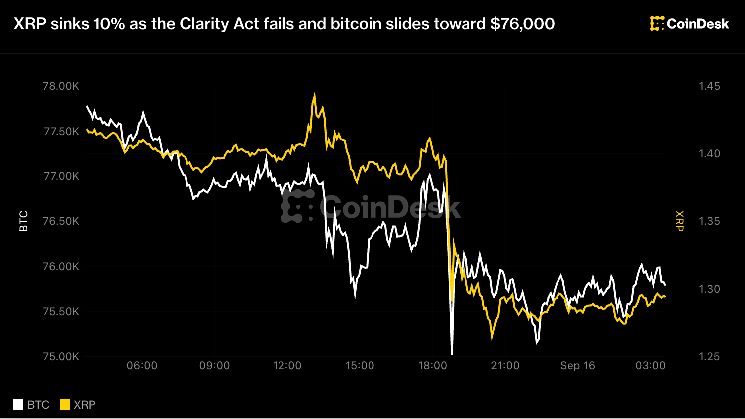
    XRP led a broad cryptocurrency sell-off Wednesday morning, plunging nearly 10% to $1.30 during Asian trading hours after the U.S. Senate failed to advance the Clarity Act, according to CoinDesk data.

    Major Tokens Slide Across the Board

    Ether followed with a decline of nearly 5% to approximately $2,410. Solana dropped 5% to just above $97, while Dogecoin fell nearly 5%. Zcash and Hyperliquid’s HYPE each slipped close to 4%, and Bitcoin retreated nearly 3% to just above $76,000. BNB and Tron proved the most resilient, each down only about 1%.

    Clarity Act Fails on Cloture Vote

    The legislation fell short on a 49-50 cloture vote, the procedural threshold requiring 60 senators to move a bill to debate. Multiple Republicans joined Democrats in voting against the measure. Negotiators had produced more than 600 pages of compromise text, but the provision that ultimately derailed the bill centered on ethics language designed to prevent senior government officials from maintaining crypto business interests.

    Senator Slotkin Cites Ethics Concerns

    Senator Elissa Slotkin, a Michigan Democrat, explained her opposition by stating the “the ethics provisions in this bill are simply too thin,” pointing to President Donald Trump, his children and his Cabinet earning money in crypto.

    She also said the Commodity Futures Trading Commission lacks the staffing to implement the law, and that the bill left gaps on money laundering and terrorist financing.

    Today, I voted no on the Clarity Act, legislation meant to regulate cryptocurrency in America.The ethics provisions in this bill are simply too thin. President Trump, his children, and his Cabinet are making billions of dollars in the crypto space, in part from bilking everyday…

    — Sen. Elissa Slotkin (@SenatorSlotkin) September 15, 2026

    Crypto Equities Hit Harder Than Tokens

    Publicly traded crypto companies suffered steeper losses than the underlying assets. Coinbase shares fell nearly 9% to $174.42, while Circle dropped more than 9% to $88.26. Galaxy Digital declined 8% and Gemini slid 7%. Bullish and Riot Platforms each lost 5%, eToro fell 4%, and Robinhood, MARA Holdings, CleanSpark, IREN and Core Scientific all dropped between 3% and 4%.

    Regulatory Path Forward Shifts to SEC

    Attention now turns to the regulators the bill was intended to constrain. The Securities and Exchange Commission is already advancing its proposed Reg Crypto framework and rules for tokenized securities, which now represents the primary pathway to the regulatory certainty the industry sought from Congress.

    Political and Market Implications

    Industry political action committees, including Fairshake, must now decide how to approach senators who voted against the legislation ahead of the November 3 election. A new Congress will convene in January 2027.

    Meanwhile, the Federal Reserve is scheduled to announce its rate decision later Wednesday, with traders leaning toward a quarter-point hike. The decision lands on a market that has just watched its legislative push collapse and is already selling risk assets.

  • Bitcoin, Ethereum, XRP Plunge After CLARITY Act Fails in Senate Vote

    Bitcoin, Ethereum, XRP Plunge After CLARITY Act Fails in Senate Vote

    Bitcoin, Ethereum, XRP Face Selling Pressure After Senate CLARITY Act Vote Fails

    Major cryptocurrencies including Bitcoin (BTC), Ethereum (ETH), and XRP came under fresh selling pressure Thursday after the U.S. Senate failed to advance the CLARITY Act, a key piece of digital-asset market structure legislation.

    Senate Procedural Vote Falls Short of 60-Vote Threshold

    A procedural vote on the bill did not secure the 60 votes needed to overcome a filibuster, effectively stalling the legislation. The defeat concludes months of negotiations between Republicans and Democrats over the regulatory framework for digital assets.

    Market Reaction Reflects Regulatory Uncertainty

    The immediate market reaction underscores how sensitive crypto prices remain to policy developments in Washington. Traders had been monitoring the CLARITY Act closely, viewing its passage as a potential catalyst for institutional adoption and clearer compliance guidelines.

    According to the latest market data, the three assets erased earlier gains following news of the vote’s failure, with selling pressure accelerating during the U.S. trading session.

    What the CLARITY Act Would Have Done

    The bipartisan bill aimed to establish clear jurisdictional boundaries between the Securities and Exchange Commission (SEC) and the Commodity Futures Trading Commission (CFTC) for digital asset oversight. It also sought to define when a token qualifies as a security versus a commodity — a distinction that has been central to enforcement actions and industry uncertainty.

    Outlook for Crypto Regulation in Congress

    With the legislative calendar tightening ahead of the November elections, the path forward for comprehensive crypto market structure legislation remains unclear. Market participants will now watch for potential attachment to must-pass spending bills or renewed bipartisan efforts in the next session.

  • XRP Price Poised for 40% Surge on CLARITY Act Vote, But Major Catch Remains

    XRP Price Poised for 40% Surge on CLARITY Act Vote, But Major Catch Remains

    Senate Prepares for CLARITY Act Vote as XRP Eyes Breakout

    The United States Senate is scheduled to vote on the CLARITY Act, a development coinciding with technical signals suggesting XRP is positioning for a potential price breakout.

    Analyst CasiTrades Weighs in on XRP Outlook

    Crypto analyst CasiTrades indicates there is potential for more significant price action for XRP. However, the analyst cautioned that Ripple’s XRP may encounter massive resistance should the rally advance to key price levels.

  • Critical Week for Altcoins: Analyst Assesses Ethereum (ETH), XRP, SUI Outlook

    Critical Week for Altcoins: Analyst Assesses Ethereum (ETH), XRP, SUI Outlook

    A pivotal week is unfolding for Bitcoin and the broader cryptocurrency market, with a convergence of major financial events and key technical setups drawing intense trader focus. The calendar kicks off on September 15 with the highly anticipated Clarity Act vote, followed by the Federal Reserve’s interest rate decision on Wednesday. Against this macroeconomic backdrop, prominent cryptocurrency analyst Ali Martinez has issued updated technical analyses for Ethereum (ETH), XRP, and Sui (SUI), highlighting specific price levels and chart patterns that could dictate near-term market direction.

    Ethereum Eyes $3,000 on Ascending Triangle Breakout

    Martinez has identified a developing ascending triangle formation on the Ethereum 12-hour chart. According to his analysis, a decisive break above the pattern’s upper resistance zone could trigger a significant upward leg. The analyst draws a historical parallel, noting that ETH previously surged approximately 31 percent in just three days following a breakout from a similar structure. Should history rhyme, Martinez projects a measured move targeting the psychological $3,000 resistance level.

    SUI Flashes Potential Reversal Signal at Key Support

    For Sui, the TD Sequential indicator on the 12-hour timeframe has presented a new signal, which the analyst suggests could indicate a possible trend reversal. This signal materialized after SUI pulled back to the critical $0.70–$0.72 support zone. However, Martinez cautions that this single indicator does not, by itself, confirm the establishment of a new uptrend, urging traders to seek additional confirmation before committing capital.

    XRP Consolidates Ahead of Potential Triangle Apex Breakout

    Martinez also highlighted a significant technical formation for XRP. In a recent post, he outlined a scenario where the asset holds above the $1.31–$1.35 support zone. If this floor remains intact, the price action could compress toward the apex of the prevailing triangle formation. The analyst identifies $1.38 as the crucial resistance level to watch. A strong breakout above this threshold would strengthen the bullish case, potentially clearing a path for a rally toward the $1.60 region. Martinez notes that while he expects price to migrate toward the triangle’s peak if support holds, no specific ultimate price target was provided in the analysis.

    Disclaimer: This content is for informational purposes only and does not constitute investment advice.

  • Final CLARITY Act Draft Ends Ripple Supply Debate, Attorney Says

    Final CLARITY Act Draft Ends Ripple Supply Debate, Attorney Says

    Attorney Bill Morgan stated that the newly released final text of the CLARITY Act resolves a long-standing debate in the cryptocurrency sector. He asserted that XRP will be classified as a commodity in secondary markets irrespective of the volume of supply Ripple continues to hold.

    “Deal with it Bitcoin maxis,”

    Morgan wrote, referencing critics who have long argued that Ripple’s substantial XRP holdings should disqualify the token from commodity status.

    What the Final Draft Actually Does

    Senate Republicans released the finalized 635-page CLARITY Act text Sunday night ahead of Tuesday’s cloture vote, describing it as their “last, best and final” offer to Democrats. The draft reflects 126 changes requested by Democrats during negotiations.

    Ethics Provisions and Divestiture Requirements

    The most significant update centers on ethics provisions backed by President Trump. Federal officials covered under the bill would be required to either divest significant digital asset holdings or place them into a qualified blind trust.

    State attorneys general would gain authority to enforce bans on officials issuing, sponsoring, or holding major stakes in digital assets. Exchanges would be barred from listing any digital asset issued in violation of those rules. Penalties for violations would run 20% of the transaction value or $500,000, whichever is greater, with the rules taking effect within 360 days of enactment.

    Stablecoin Oversight and Circuit Breaker Mechanism

    Other changes include a new “circuit breaker” mechanism giving federal regulators, specifically the Treasury, authority to intervene on stablecoin yield if community banks experience significant deposit flight into stablecoins.

    Narrowed Protections and Conflict-of-Interest Rules

    The Blockchain Regulatory Certainty Act’s protections were narrowed to cover only the Bank Secrecy Act and civil enforcement, removing language that previously extended protections to certain criminal cases.

    The bill also adds tighter restrictions on conflicts of interest and affiliate trading involving digital commodity exchanges, brokers, and dealers. It clarifies that state consumer protection laws remain fully applicable and that developer protections do not exempt anyone from derivatives law or affect prediction markets.

  • Bitcoin, ETH, XRP Rally Threatened as September 16 Fed Rate Hike Odds Surge to 86%

    Bitcoin, ETH, XRP Rally Threatened as September 16 Fed Rate Hike Odds Surge to 86%

    Bitcoin, Ethereum, and XRP are bracing for a fresh macroeconomic headwind as market-implied odds of a Federal Reserve rate hike at the September 16 Federal Open Market Committee (FOMC) meeting have climbed sharply.

    Bitcoin Faces Key Test Ahead of September FOMC Decision

    According to the CME FedWatch Tool, the probability of a 25-basis-point increase has surged in recent sessions, reflecting sticky inflation data and resilient labor-market readings that have pushed traders to reprice the terminal-rate outlook. The shift puts risk assets—including the largest cryptocurrencies by market capitalization—on alert for heightened volatility in the days leading up to the policy announcement.

    Rate-Hike Expectations Reaccelerate

    Fed futures now show a materially higher chance of a hike compared with a week ago, when the consensus leaned strongly toward a pause. The repricing follows a run of economic releases—including consumer-price-index and producer-price-index reports—that came in above forecast, reviving concerns that the central bank’s disinflation progress has stalled.

    Crypto Market Implications

    Bitcoin, often viewed as a liquidity-sensitive asset, has historically sold off when rate-hike expectations rise, as higher discount rates pressure valuations across the risk spectrum. Ethereum and XRP tend to exhibit even higher beta to macro shifts, amplifying downside moves during hawkish repricing episodes. Traders are monitoring key technical levels on BTC/USD, ETH/USD, and XRP/USD pairs for signs of trend exhaustion or breakout confirmation once the FOMC statement and accompanying Summary of Economic Projections are released.

    What to Watch on September 16

    • Policy rate decision: Whether the Fed raises the federal funds target range by 25 basis points or holds steady.
    • Dot-plot projections: Updated median forecasts for the policy path through 2024 and beyond.
    • Chair Powell’s press conference: Tone on inflation persistence, labor-market tightness, and the reaction function for future meetings.

    Market participants will parse every word for clues on whether the hiking cycle has truly ended or if one more increase remains on the table before a prolonged pause. The outcome will likely set the near-term trajectory for digital-asset prices as well as traditional risk markets.

  • XRP ‘Anti-Volatile’ Pattern Returns, Echoing Prior 240-Day Sideways Drift

    XRP ‘Anti-Volatile’ Pattern Returns, Echoing Prior 240-Day Sideways Drift

    XRP’s brief August rally has lost momentum, with the token’s price retreating to the $1.34–$1.37 range. Daily volatility has nearly evaporated, evidenced by Bollinger Bands tightening into a narrow horizontal line on the daily chart, according to TradingView data. Historically, this state of “anti-volatility” signals only one outcome for XRP: the market is hitting pause.

    Previous Cycles Point to Extended Sideways Action

    Historical patterns show that after such a lull, the asset typically enters a sluggish sideways drift lasting up to 240 days. The market’s current stillness is not without catalyst. Major participants and speculators are openly reluctant to establish positions ahead of a pivotal week that could reshape the macroeconomic landscape.

    Two Critical Events Loom Next Week

    First, the U.S. Senate is scheduled to vote on the CLARITY Act on September 15. The legislation stalled throughout the summer, prompting institutions to freeze activity, while inflows into XRP exchange-traded funds plunged by 93%.

    Second, the Federal Reserve will announce its interest rate decision on September 16. U.S. inflation is accelerating again, with the Producer Price Index jumping to 5.4%, while Brent crude has surged above $107. Markets are pricing in a hawkish outcome with a 70% probability, driving major capital into cash positions.

    XRP/USD daily chart showing Bollinger Bands squeeze and declining volatility, Source: TradingView

    Holder Sentiment Provides Downside Support

    Despite macro pressure, XRP is being shielded from a deeper decline by a sharp shift in holder behavior. According to analytics platform CryptoQuant, the peak inflow of coins onto exchanges on September 9 was followed by a rapid outflow. In a single day, XRP reserves on Binance alone fell to 2.631 billion tokens.

    The price drop to a local low of $1.33 forced traders to stop selling and begin withdrawing assets from trading platforms while awaiting the upcoming catalysts.

    Two Historical Timeframes Frame the Consolidation

    Raw data from XRP’s previous accumulation periods reveals two clear scenarios:

    Short Cycle (79–89 Days)

    This duration matches how long the token accumulated strength during previous local cycles in 2025. If history repeats, the chart will not “wake up” until late November or early December 2026.

    Macro Cycle (Up to 240 Days)

    This aligns almost exactly with the previous exhausting sideways period before the August 31 breakout: nearly eight months, or 236 days. In the worst-case scenario, XRP will not emerge from its current consolidation until spring 2027.

    The timer for a potentially prolonged flat has already started. Its actual duration will be determined by the Senate vote and the Federal Reserve’s decision over the next few days.

  • XRP Faces Key Test as Historical Pattern Points to Possible Pullback

    XRP Faces Key Test as Historical Pattern Points to Possible Pullback

    XRP Weekly Super Trend Flips Bullish, But Analyst Warns of Historical Pattern

    XRP’s weekly Super Trend indicator turned bullish on August 17 after the token rallied roughly 70% from $0.98 to $1.70. However, analyst ChartNerd cautions that this exact signal has marked local tops before deep pullbacks in every previous cycle dating back to 2019, and XRP is currently stalling at the resistance level that decided those earlier setups.

    Bullish Signal Meets Key Resistance Zone

    ChartNerd’s analysis focuses on the price action following XRP’s recovery from the $0.98 area. The token advanced about 70% toward $1.70, where it encountered the 50-week exponential moving average (EMA), currently near $1.52. Simultaneously, XRP has been trading between that resistance and the 20-week EMA around $1.29 to $1.30.

    “Whilst beneath the 50 and above the 20, we’re simply compressing,”

    ChartNerd said, describing the recent price action as a period of chop while traders wait for a clearer direction.

    That caution stems from XRP’s earlier cycle history. In 2022, the token rallied about 90% from its cycle low before a bullish Super Trend flip appeared around the 50-week EMA, a move followed by a 45% correction. In 2019, another bullish flip during the bear market preceded a 56% correction, and after the 2020 cycle low, XRP also printed a bullish flip before falling 32%.

    ChartNerd argues this pattern has appeared often enough to warrant caution.

    “Bullish super trends usually mark local tops,”

    the analyst said, while stressing that historical behavior does not guarantee the same outcome this time.

    He also placed a greater structural change around $1.90, noting that XRP would need to clear the $1.50 to $1.90 zone before the move toward its previous high looks more convincing. A short-term push above $1.52 is still possible, the analyst said, but even a close above the 50-week EMA would not automatically remove the historical warning.

    Price Action Remains Choppy This Week

    As CryptoPotato reported earlier, XRP dipped toward $1.39 during one leg of Bitcoin’s recent slide before buyers stepped back in to push it to $1.44. At the time of writing, the token had fallen close to 4% in the last 24 hours and was again trading near $1.38, according to CoinGecko data. It is up 1.5% over the past week but down more than 53% from a year ago, and remains about 62% below its all-time high of $3.65 from July 2025.

    Bitcoin has been chopping between $77,600 and $80,000 over the past few days, and XRP’s swings have largely tracked that back-and-forth rather than moving on independent catalysts.

    Futures Volume Surges, ETF Inflows Slow

    The Ripple token’s futures volume picked up in August, with trading across the three biggest exchanges topping $64 billion, the busiest month in half a year. Spot XRP ETFs continued adding money, although the pace slowed significantly, with weekly inflows dropping to just under $19 million last week after bringing in more than $110 million the week before. So far this week, SoSoValue data shows net inflows have hit about $13.83 million.