Tag: Spot Bitcoin ETFs

  • Bitcoin Tops $80K as Crypto Market Flips to Greed—but Is the Rally Misleading?

    Bitcoin Tops $80K as Crypto Market Flips to Greed—but Is the Rally Misleading?

    Crypto market sentiment has shifted sharply in just a few days. After spending months between “Fear” and “Extreme Fear,” the market has now moved into “Greed.”

    At press time, the Crypto Fear and Greed Index stood at 68, placing it in the “Greed” zone. CoinShares’ recent report, ‘From despair to greed in a week: a rally is not a verdict’, highlighted a more favorable environment for Bitcoin’s rally.

    However, the shift does not indicate a fundamental improvement across the entire cryptocurrency industry.

    Source: Alternative

    Why did crypto sentiment change so quickly?

    Jean-Marie Mognetti, CEO of CoinShares, believes conditions surrounding digital assets have become more favorable, particularly for Bitcoin [$BTC]. However, most individual crypto projects have not suddenly become stronger businesses simply because their prices have increased.

    Mognetti put it best when he said:

    This is where the rally becomes more dangerous to interpret.

    Just one month earlier, more than 100 crypto projects had reportedly shut down, entered bankruptcy, or disappeared in 2026. Major industry names were also announcing closures or filing for bankruptcy, creating the impression that the crypto sector was entering another major downturn.

    The situation then changed rapidly. Bitcoin climbed back above $80,000, other digital assets followed, and options traders began placing large bets that Bitcoin could rise above $82,000.

    What is driving the Bitcoin rally?

    Several factors have contributed to the latest crypto market rally. The most prominent was last week’s White House meeting, during which President Trump urged Congress to pass a “fair version” of the CLARITY Act.

    Treasury buybacks, a hawkish tone from the Federal Reserve, and US federal debt surpassing US$40 trillion were additional factors supporting the market’s momentum.

    Despite these developments, the rally has not resolved the fundamental problems that caused more than 100 crypto projects to disappear in 2026. Many failed after running out of funds or experiencing security issues, while cryptocurrency exploits caused more than $1 billion in losses during the first half of 2026.

    These developments suggest that the rally has genuine support from a stronger macroeconomic backdrop. However, rising prices do not automatically validate every asset participating in the rally.

    Mognetti added:

    What deserves scepticism is the assumption that a rising market validates everything rising with it.

    The warning is significant because a similar level of market greed preceded Bitcoin’s correction of more than 30% in October 2025.

    This time, the total crypto market capitalization has risen by more than 22% in a week. However, the weekly relative strength index is extremely overbought, so caution remains warranted. Longer-term data, meanwhile, continues to indicate that the rally may have further room to run.

    Crypto sentiment has not reached peak greed

    Institutional demand remains a key difference in the current market cycle. Spot Bitcoin ETFs recorded more than $1 billion in inflows last week alongside a 21% $BTC rally. October’s inflows, however, exceeded $3 billion, suggesting there may still be scope for stronger institutional demand.

    The Coinbase Premium Index previously reached 0.18, reflecting strong accumulation by US investors. That signal is currently absent. As a result, despite short-term overbought conditions, sentiment around 75 may not yet represent peak greed or guarantee an imminent correction.

    These changes followed Bitcoin’s move back above $80,000. Nevertheless, some concerning market data suggest that the rally could continue while also highlighting the risks of interpreting rising prices as evidence of broad-based strength across the crypto industry.

  • Bitcoin Price Falls After Warsh’s Hawkish Jackson Hole Keynote

    Bitcoin Price Falls After Warsh’s Hawkish Jackson Hole Keynote

    Bitcoin has pulled back from its weekly high of $81,455, but its August gains remain substantial. As of Aug. 29, 2026, at 8:30 a.m., bitcoin was trading at approximately $77,588 to $77,984 per coin. The leading cryptocurrency had declined about 2% to 2.5% over the previous 24 hours, while still gaining 23.2% against the U.S. dollar since Aug. 15.

    Bitcoin’s initial rally followed the Treasury’s mid-August announcement about expanding bond buybacks. During the same week, U.S. President Donald Trump met with several cryptocurrency industry executives and made positive comments about the sector. He discussed bringing Hyperliquid to the United States and remained open to acquiring substantial amounts of $BTC after receiving advice from members of his administration.

    Those developments helped drive demand for spot bitcoin exchange-traded funds (ETFs), which recorded nine consecutive days of inflows. The streak ended Friday, when spot bitcoin ETFs posted their first day of outflows, with approximately $202 million leaving the funds.

    Sticky Inflation Meets Positive Crypto News

    Several developments put pressure on bitcoin toward the end of the week. U.S. inflation remained persistent, with the personal consumption expenditures (PCE) price index rising in July. Bitcoin initially absorbed the news and recovered from a modest decline before reaching its weekly high of $81,455.

    Additional positive developments supported the market, including a proposed draft to rewrite U.S. Securities and Exchange Commission (SEC) custody rules and Charles Schwab’s expansion of its digital asset offerings.

    Hawkish Jackson Hole Speech Pressures Bitcoin

    Market sentiment shifted during the Jackson Hole Economic Policy Symposium, where Federal Reserve Chair Kevin Warsh delivered his first speech at the annual event. Speaking at 10 a.m. EDT on Friday, Warsh addressed the symposium’s theme, “Financial Innovation: Implications for Payments and Policy.”

    The keynote was viewed as hawkish. Warsh said the U.S. central bank has “work to do” and argued that specific financial conditions remain difficult. He also said forward guidance had “overstayed its welcome.”

    Following the speech, the probability of a rate hike rose immediately from 35% to the mid-50% range. Treasury yields increased, while precious metals such as gold posted modest declines.

    Before Warsh’s keynote, bitcoin was trading sideways near $79,500. After the speech, its price briefly fell below $77,000 before buyers absorbed the intraday selling pressure. The move also coincided with the first day spot bitcoin ETFs recorded outflows after their extended inflow streak.

    Despite the break in consecutive inflow days, August remains a strong month for spot bitcoin ETF demand, with approximately $3.1 billion to $3.3 billion entering the funds.

    Bitcoin Tests $77,000 Support as Technical Indicators Signal Overheating

    Bitcoin’s immediate resistance this weekend is positioned between $79,500 and $80,300, a range the cryptocurrency lost following the Federal Reserve chair’s speech. Resistance becomes stronger at higher price levels.

    Support is currently holding near the $76,800 to $77,000 zone. Bitcoin’s 24-hour trading volume was approximately $28.731 billion. Technical indicators suggest momentum had already become stretched before the keynote. The daily relative strength index (RSI) was at 70, while the Stochastic indicator was higher at 85, indicating overbought conditions.

    Although the RSI is neutral and the Stochastic indicator points to overheating, the moving average convergence divergence (MACD) remains positive. Taken together, the oscillators and moving averages suggest bullish momentum is still intact despite bitcoin’s latest decline—at least for now.

  • SEC Reviews Automatic Filing Pathways After Surge in Exotic Crypto and Event-Linked ETF Proposals

    SEC Reviews Automatic Filing Pathways After Surge in Exotic Crypto and Event-Linked ETF Proposals

    Wall Street is pushing the exchange-traded fund format into nearly every corner of finance. Investors can now find ETFs offering Bitcoin exposure, two- or three-times the daily performance of a stock, private assets, and contracts linked to elections or economic data.

    The ETF began as a low-cost way to own a diversified market portfolio. It has since become a distribution system for investments that once required a futures account, private placement, crypto exchange, or careful review of a structured-note prospectus.

    The Securities and Exchange Commission is examining how far that system can expand. In a June 30 request for public comment, the agency identified crypto assets, commodities, leveraged products, single-stock ETFs, blockchain-based investments, private assets, and event contracts. Comments are due Aug. 31.

    The review extends beyond any individual application. The SEC is assessing whether its existing rules give staff sufficient time and authority to evaluate products whose economic behavior can differ substantially from the diversified funds investors traditionally associate with ETFs.

    According to the SEC’s concept release, assets in U.S. ETFs grew from more than $4 trillion at the end of 2019 to more than $12 trillion at the end of 2025. Over the same period, the number of products increased from nearly 1,900 to more than 4,600.

    The ETF ticker can hide the product’s real risks

    An ETF packages a portfolio into shares that trade throughout the day on an exchange. Investors can buy that exposure through the same brokerage account they use for ordinary stocks.

    Through the creation-and-redemption process, authorized participants exchange large blocks of ETF shares for the underlying basket or its cash equivalent. This mechanism helps keep the market price close to the portfolio’s net asset value.

    What began as operational infrastructure became a retail investing habit. ETFs offer intraday trading, transparent pricing, broad brokerage access and, in many structures, more favorable tax treatment than comparable mutual funds.

    Asset managers also gained products that could be placed in model portfolios and trading applications. Each successful launch encouraged sponsors to put increasingly specialized exposures behind the same familiar interface.

    The regulatory framework developed around the original ETF model. Early funds needed individual exemptive orders for features such as exchange trading and in-kind redemptions, which did not fit neatly within rules designed for open-end mutual funds.

    In 2019, the SEC adopted Rule 6c-11. The rule allows qualifying ETFs registered under the Investment Company Act of 1940 to operate without seeking a separate order for every launch, provided they satisfy conditions involving portfolio information, trading data and the arbitrage mechanism.

    Rule 6c-11 made ETF launches faster and more standardized, helping the product count more than double by the end of 2025. A plain index fund, a concentrated thematic portfolio and a derivatives strategy can now look nearly identical on a brokerage screen, even though their holdings, valuation methods and potential losses may be very different.

    The term ETF describes the container, not necessarily the investment inside it.

    The common brokerage screen also obscures important legal distinctions. Many stock and bond ETFs are registered investment companies under the 1940 Act, while spot Bitcoin and Ethereum products commonly use commodity-trust structures registered under the Securities Act of 1933.

    Exchange-traded notes represent another category. They are unsecured debt obligations whose returns depend on the issuer’s promise. Brokerage platforms may display all three structures side by side under a broad exchange-traded product label.

    Those legal categories affect custody, board oversight, diversification, borrowing, derivatives use, valuation and the remedies available if an issuer or service provider fails. A familiar ticker makes an exposure easier to buy, but it does not remove those underlying differences. That is why the SEC is examining the conditions attached to the ETF wrapper as closely as the portfolio itself.

    Crypto expanded the ETF model

    Spot crypto products became a turning point because investors viewed an exchange listing as a bridge between an unfamiliar asset and an established brokerage account.

    The SEC’s approval of spot Bitcoin products in 2024 gave advisers and institutions access to a regulated trading venue, standardized disclosures and conventional custody relationships. The agency emphasized that its approval was not an endorsement of Bitcoin itself.

    In practice, the distinction between legal approval and perceived legitimacy became harder to see as the ETF menu expanded.

    Many investors see an ETF ticker at a major broker and assume that the underlying exposure has passed through a common regulatory filter. Yet one product may hold a broad equity basket while another owns a volatile commodity or rolls derivatives that can diverge from a reference asset. Crypto demonstrated the commercial value of that familiarity.

    Sponsors have since applied the same distribution model to staking, options overlays, token products promising a multiple of an asset’s daily move and baskets of digital assets. Each structure may serve a specific investment purpose, while introducing its own custody, valuation, trading-hours and concentration risks.

    Crypto markets trade around the clock, but ETF shares trade during exchange hours. The creation process must bridge those different trading schedules when prices move sharply overnight or over a weekend.

    Event-contract funds push the ETF model into even less familiar territory. They tie returns to election results, economic releases or other defined events while packaging the exposure in shares that trade like ordinary funds.

    CryptoSlate identified more than two dozen event-linked ETF proposals, illustrating how quickly a niche contract market could reach retail brokerage accounts once an ETF provides the distribution channel.

    The regulatory challenge is based on how the product functions. An event contract may trade on an exchange overseen by the Commodity Futures Trading Commission, while the fund shares and related disclosures fall within the SEC’s jurisdiction.

    That can place the risks across several rulebooks. Regulators may need to examine how a contract settles, who provides prices, what happens when trading is halted and whether the fund can meet redemptions near the event date.

    Those questions apply differently across the categories covered by the SEC’s concept release. A private-asset fund may face stale valuations and limited exit opportunities. A single-stock leveraged product may reset daily and compound away from its stated multiple over longer periods. A token-based product may depend on custody or staking arrangements with no close equivalent in a traditional index fund.

    A product-by-product framework could attach conditions to each source of risk more precisely than a single definition of novelty.

    The SEC’s ETF approval process faces new pressures

    The SEC must also determine whether its filing process gives staff enough time to review unfamiliar structures before they reach the market.

    Certain registration statements and post-effective amendments can become effective automatically after a statutory or rule-based waiting period. Some amendments filed under Rule 485 can take effect immediately when they meet specified conditions.

    These pathways make routine fund updates and launches more efficient, but they can also carry portfolios that SEC staff have not previously encountered.

    SEC Chair Paul Atkins said in May that several sponsors had agreed to delay novel ETF launches, including event-contract products, while the agency evaluated the issues.

    A voluntary delay gives staff additional time to assess current filings. A lasting policy could require rule amendments, enhanced disclosure conditions, a separate review process or a clearer boundary around which products qualify for automatic treatment.

    Each option carries a cost. Broad restrictions could slow conventional fund launches and give established issuers an advantage over smaller sponsors. A narrow rule could leave staff racing against automatic deadlines whenever a new payoff structure emerges.

    The SEC must also protect the arbitrage mechanism that keeps ETF shares close to net asset value. Disclosure alone cannot solve problems created by assets that are too difficult to price or acquire during the creation-and-redemption process.

    Crypto issuers have a direct interest in the outcome, even as event contracts draw much of the attention. New staking structures, tokenized securities, multi-asset baskets and products offering daily return multiples could face additional filing requirements depending on how the SEC defines novelty and which safeguards it requires.

    A framework focused on custody, valuation, liquidity and payoff complexity could give sponsors a clearer path to market. A wrapper-level restriction, by contrast, could group economically different crypto products together.

    The SEC has already published public comment letters and meeting records ahead of the Aug. 31 deadline. After the comment period closes, the agency will need to evaluate the submissions, determine whether its existing authority and disclosure standards are sufficient, and publish any proposed rule amendments through the normal notice-and-comment process.

    Existing products and pending applications will continue to provide data on premiums, discounts, trading quality and investor use during that review.

    ETFs conquered Wall Street by making investment exposure easy to distribute. The wrapper has become financial infrastructure for nearly every kind of portfolio. A brokerage customer can move from an S&P 500 fund to Bitcoin, a two-times stock position or an election-linked contract with a few taps, even though each investment enters a different economic world.

    The SEC now has to decide which exposures require a different regulatory gate before a familiar ticker persuades investors that the existing gate has already done all the work.

  • Bitcoin’s Failed $81,000 Breakout Puts $75,000 Back on the Table

    Bitcoin’s Failed $81,000 Breakout Puts $75,000 Back on the Table

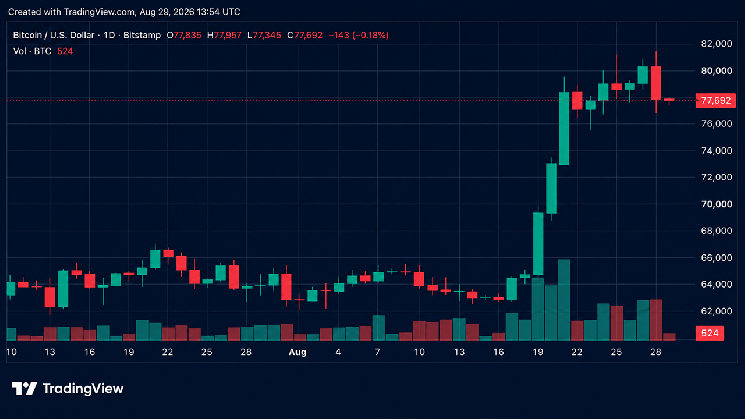
    Bitcoin is trading near $78,000 heading into the weekend, positioned between support at $77,000 and resistance at $80,000 after a sharp rejection above $81,000 on Aug. 28.

    A confirmed break below $77,000 could expose the mid-$75,000s. Conversely, a sustained move back above $80,000 would bring Bitcoin’s Aug. 28 high near $81,300 and the $82,000–$83,000 zone back into focus.

    Bitcoin Reverses After Jackson Hole Rate Shock

    Bitcoin reversed from its Aug. 28 intraday high after Kevin Warsh’s Jackson Hole remarks pushed the probability of a September rate hike to around 55%, up from roughly 40% before the speech. Warsh said the Fed still had work to do if inflation failed to return toward its target.

    The resulting repricing pushed Bitcoin back below $80,000 by the close. A level buyers had briefly reclaimed turned into resistance, leaving $77,000 as the immediate level traders must defend.

    Friday’s Bitcoin Options Expiry Removes a Major Market Anchor

    Approximately 81,700 Bitcoin options worth about $6.44 billion expired on Deribit Friday at 08:00 UTC. The expiry removed a positioning cluster that had helped anchor Bitcoin near key strike prices throughout the week.

    Calls outnumbered puts by a ratio of 0.83. The largest concentration of call open interest was around $75,000 and $80,000, the same two levels now defining the weekend’s downside and upside scenarios.

    U.S.-traded spot Bitcoin ETFs recorded nine consecutive days of net inflows through Aug. 27, totaling roughly $3 billion. That source of demand pauses over the weekend because ETF creation and redemption activity follows the same weekday schedule as U.S. equity trading.

    CME shifted to 24/7 trading in late May, with only a weekly maintenance window interrupting the schedule. Regulated institutional derivatives can now respond directly to Saturday and Sunday price moves, well before the Sunday evening Globex reopening that previously marked the return of futures activity.

    As a result, Bitcoin enters the weekend with one of its strongest recent demand channels offline while the market that once remained largely dormant is still fully active.

    Key Bitcoin Price Levels Traders Are Watching

    Above the current price, $80,000 is the key trigger. A sustained reclaim would suggest that buyers absorbed the Aug. 28 hawkish shock and turned the failed breakout into a bear trap.

    That move could open a path toward the Aug. 28 high near $81,300 and then toward the $82,000–$83,000 zone, where fresh options positioning overlaps with technical resistance.

    Below the market, $77,000 plays the same role in reverse. Bitcoin’s Aug. 28 low was printed near $77,078. A loss of that level followed by sustained acceptance below it over several hours would shift the setup from consolidation toward continued downside.

    The initial target would be $75,000–$75,500, an area that already carries heavy options interest from the Aug. 28 expiry.

    A deeper break below $75,000 could expose the low $70,000s, with $72,000–$73,000 emerging as the next significant target if selling pressure holds. The $69,000–$70,000 region remains a longer-term support zone.

    Reaching that area over a single weekend would likely require a larger liquidation event or an additional macroeconomic shock beyond the Aug. 28 repricing.

    Bitcoin Price Targets From Citi and Bernstein

    Citi cut its 12-month Bitcoin target to $82,000 from $112,000 in July, reduced its ETF inflow assumption to zero, and placed its recession-driven bear case near $53,000. That makes the weekend’s $82,000–$83,000 upside zone notable in its own right because it now overlaps with a major bank’s full-year base case from only eight weeks ago.

    Bernstein’s longer-term outlook is far above the levels relevant to this weekend. The bank has pointed toward $150,000 by mid-2027 and as high as $500,000 in a debasement-driven bull case.

    That forecast applies to an entirely different timeframe and provides context for where Bitcoin could trade over the coming years.

    Bitcoin Bull and Bear Cases for the Weekend

    The bullish scenario has Bitcoin reclaiming $80,000 and clearing the Aug. 28 high. CME’s continuous futures market could reinforce that move through the weekend even without support from ETF flows.

    Under that path, $82,000–$83,000 becomes the next major test, while the failed breakout above $81,000 could be interpreted as a shakeout within an intact uptrend.

    The bearish scenario has Bitcoin losing $77,000 and establishing genuine acceptance below the level, forcing out buyers who chased the move above $80,000 earlier in the week.

    In that case, $75,000–$75,500 would become the immediate target. A further breakdown there could open $72,000–$73,000 as the market prices in a correction that has grown beyond the Aug. 28 single-day rate shock.

    Bitcoin’s next major move could be decided before U.S. ETF desks reopen Monday, with regulated futures now trading continuously through the weekend.

  • Bitcoin Rally Stalls, but Long-Term Sentiment Remains Bullish

    Bitcoin Rally Stalls, but Long-Term Sentiment Remains Bullish

    Bitcoin fell to $76,877 on Friday after Federal Reserve Chair Kevin Warsh delivered a hawkish keynote at Jackson Hole, confirming the resistance zone that had limited the cryptocurrency earlier in the week.

    September rate-hike expectations rose to approximately 56%, up from about 35% a day earlier, after Warsh said the Federal Reserve still has “work to do” on inflation. Despite the sell-off, Myriad traders continued to favor Bitcoin rising to $84,000 over falling to $55,000.

    Bitcoin declined from an overnight high of $81,455, surrendering most of its double-digit weekly gain. The high was reached within a resistance zone that had already capped several attempted breakouts this year.

    Myriad: How high will Bitcoin go? Click to make your prediction.

    Warsh’s Jackson Hole speech drives Bitcoin lower

    Warsh marked his 100th day as Fed chair by offering markets no fresh policy guidance, but his comments were enough to pressure risk assets. In his keynote, he said the Fed needs to see inflation moving clearly toward its target and doing so at a sufficient pace before it can declare its work complete. Until then, the central bank still has “work to do.”

    Traders interpreted the remarks as hawkish. According to the CME Group’s FedWatch tool, the probability of a September rate hike increased to 55.7% from 35.4% the previous day.

    The move also affected leveraged crypto positions. CoinGlass data showed approximately $481 million in liquidations across the cryptocurrency market during the 24 hours surrounding the speech. More than $360 million involved long positions caught off guard by Bitcoin’s decline. Bitcoin ended Friday at $77,557, down 3.39%.

    Bitcoin price analysis: What the charts show

    From a technical perspective, the pullback looks more like a consolidation phase than a confirmed trend reversal. Bitcoin’s Relative Strength Index stands at 69.7, below the overbought level above 80 that preceded Tuesday’s rejection. Meanwhile, the Average Directional Index is near 39.5, still indicating a strong trend rather than a broken one.

    Bitcoin remains within the bullish move that carried it from the June low near $68,858 to this week’s high around $81,455. If selling intensifies, traders are likely to monitor the $73,670-$75,157 area first. A close below that zone would put both the 50-week moving average and the June breakout structure under pressure.

    On the upside, the $81,000-$82,500 area remains the key resistance shelf. Bulls need to reclaim it to establish a path toward fresh highs.

    Myriad traders continue to favor Bitcoin at $84,000

    The longer-term bullish outlook is reflected in Myriad’s “BTC next move” market, which has been active since late February. The market has recorded $231,000 in trading volume and has no fixed resolution date.

    Its two outcomes—a move to $84,000 or a decline to $55,000—have repeatedly exchanged the lead since spring as Bitcoin’s price moved sharply in both directions. That pattern changed this month: the probability of the $84,000 outcome rose by 31.7 percentage points to 77%, compared with 23% for the $55,000 scenario. Friday’s rejection from resistance did not materially alter that split.

    Myriad: Where does Bitcoin go next? Click to make your prediction.

    The last time traders were this bullish was around April.

    Bitcoin’s fundamental support remains intact

    The fundamental case for higher Bitcoin prices has not significantly changed. U.S. spot Bitcoin exchange-traded funds recorded $2.8 billion in inflows over eight consecutive days through Wednesday, their longest such streak since April.

    The demand followed a Treasury Department announcement that it would at least double its purchases of long-dated bonds beginning September 9. The move supports a segment of the bond market that has faced weak demand since June. Lower long-term yields and a weaker dollar revived the “debasement trade” that helped Bitcoin climb from approximately $62,000 to $80,000 this month.

    Warsh’s remarks did not change that backdrop. He outlined no explicit interest-rate path and instead highlighted an inflation condition the Fed has not yet met.

    Why Bitcoin traders should watch the bears

    In the short term, the market setup still calls for caution. Warsh’s rejection of forward guidance leaves traders without a clear policy signal until the Fed’s next rate decision. Bitcoin therefore remains vulnerable to headline-driven volatility around every inflation report released before then.

    The PCE price index is increasing at an annual rate of 3.7%, nearly twice the Fed’s 2% target, and Warsh provided no timetable for inflation to return to that level.

    Bitcoin has already faced multiple rejections at the current resistance zone in recent months. Warsh’s speech gave bulls no clear reason to expect the Federal Reserve to make the next attempt at a breakout easier.

    Disclaimer

    The views and opinions expressed by the author are for informational purposes only and do not constitute financial, investment, or other advice.

  • Bitcoin’s 22% Rally Needs Real Demand to Outlast Treasury Liquidity Boost

    Bitcoin’s 22% Rally Needs Real Demand to Outlast Treasury Liquidity Boost

    Bitcoin’s recent breakout appears to have been triggered by a shift in U.S. Treasury-market liquidity, but analysts say the rally’s staying power hinges on whether exchange-traded fund inflows and spot demand can replace the initial macroeconomic boost.

    Treasury Buybacks Spark 22% Surge and Short Squeeze

    Bitcoin surged roughly 22% during its breakout week as long-term Treasury yields fell and the dollar weakened following the U.S. Treasury’s decision to expand buybacks of longer-dated government debt. The move also triggered a major short squeeze, while demand for U.S. spot Bitcoin exchange-traded funds accelerated.

    The Treasury announced on Aug. 19 that it would at least double the maximum size of liquidity-support buybacks for 10-to-20-year and 20-to-30-year nominal Treasuries, raising them from $2 billion to at least $4 billion per operation. The larger operations are scheduled to begin Sept. 9 and continue through the current refunding quarter.

    Macro Forces Drove First Stage of Rally, Analysts Say

    Fabian Dori, chief investment officer at FINMA-regulated digital asset bank Sygnum, told crypto.news that Bitcoin’s behavior alongside other markets suggests the first stage of the rally had a strong macro component.

    “The clearest tell is the combination of cross-asset behavior and crypto-market plumbing.”

    Dori said the Treasury’s announcement temporarily pushed long-term yields lower while weakening the dollar and lifting both gold and Bitcoin. In his view, those moves were consistent with investors seeking hard assets amid renewed concerns about currency debasement rather than a rally driven exclusively by crypto-specific demand.

    Martin Lee, Market Insights Lead at DWF Labs, pointed to a similar divergence across markets. AI and technology assets remained under pressure while gold and Bitcoin ETFs attracted capital as debasement concerns returned, he told crypto.news.

    As crypto.news reported earlier, U.S. spot Bitcoin ETFs received about $1.92 billion during the breakout week, their largest weekly inflow in 10 months. At the same time, the price surge forced traders positioned for further weakness out of the market. Lee said a record $2.7 billion in crypto short positions were liquidated as Bitcoin cleared its previous trading range, meaning part of the apparent spot demand reflected traders buying Bitcoin to cover bearish positions.

    Derivatives Data Points to Mixed Drivers

    Derivatives data provides another clue about the nature of the breakout. Dori noted that Bitcoin-denominated open interest fell during the rally while funding rates remained contained. Bitcoin futures open interest recently declined to roughly 587,584 BTC, its lowest level in nearly five months, from around 645,760 BTC on Aug. 14.

    Rather than showing traders aggressively piling into leveraged long positions, Dori said the combination points toward forced short covering playing an important role. Still, he does not view the entire rally as a macro trade.

    “So the right interpretation is probably mixed.”

    Dori said the first impulse saw Bitcoin behave more like gold, as lower long-term yields, a weaker dollar, and debasement concerns drove demand. A second, crypto-specific impulse came from ETF inflows alongside regulatory developments in Washington, including the SEC’s Regulation Crypto proposal and renewed White House pressure for progress on the CLARITY Act.

    ETF Flows Sustain Momentum as Bond-Market Impact Fades

    ETF flows provide some evidence that demand has continued beyond the initial Treasury shock. U.S. spot Bitcoin ETFs recorded eight consecutive sessions of inflows through Wednesday, attracting about $2.8 billion over the streak.

    The continued inflows matter because the initial reaction in the bond market has already weakened. BNY Markets said the decline in the term premium following the Treasury announcement had largely retraced, with long-term yields returning close to levels seen before the Aug. 19 announcement.

    Bitcoin has therefore reached a point where crypto-specific buying may need to carry more of the rally if the original rate impulse continues to fade.

    Sept. 9 Buyback Launch Is Next Liquidity Test

    The larger Treasury buybacks do not begin until Sept. 9, raising the question of how much of their expected impact markets have already priced in. Dori said markets normally react when such policies are announced rather than waiting for the operations themselves to begin. More important than the immediate size of the purchases, in his view, was the signal that the Treasury is willing to intervene when longer-term borrowing costs become excessively high.

    Whether that support lasts will depend on what happens after the announcement’s effect fades. Dori said rising long-end yields would suggest that the buybacks are failing to provide the expected support, while a rebuilding of the Treasury General Account could withdraw liquidity. Rapid increases in funding rates and open interest would also indicate that leverage, rather than underlying demand, had begun driving Bitcoin higher. Weakening ETF flows or tighter dollar funding conditions would remove another source of marginal demand.

    Lee similarly argued that anticipation alone cannot sustain the rally indefinitely.

    “A rally on anticipation is only as durable as the flow that follows it.”

    He identified ETF flows, futures basis and funding, and Bitcoin’s previous trading range as three key indicators to watch before Sept. 9. A week of negative ETF creations while Bitcoin holds near current levels could indicate that the anticipation trade is unwinding, Lee said. He added that the three-month futures basis moved back above the 10-year Treasury yield during the rally; a reversal below that level would suggest the cash-and-carry bid had failed to persist. The more bearish combination would be Bitcoin closing back inside its pre-breakout range while ETF flows turn negative, which Lee said would indicate that leverage drove much of the move without a durable structural bid emerging.

    Liquidity Analysis Extends Beyond Fed Policy Rate

    Both analysts also argue that investors looking only at the Federal Reserve’s policy rate may miss important forces influencing crypto prices. Dori said Treasury cash management, particularly changes in the Treasury General Account and the mix of issuance and buybacks, has recently become an important marginal driver of liquidity. The term premium then transmits changes at the long end of the Treasury curve into risk assets.

    Other channels include bank balance-sheet capacity, private credit creation, stablecoin growth and global dollar funding conditions, while the Federal Reserve’s balance sheet remains important over a longer horizon. Lee similarly ranks dollar funding conditions and real yields ahead of the policy rate for short-term crypto market behavior, followed by the term premium. Treasury cash balances and reserve dynamics influence the liquidity underneath those markets, while issuance matters partly through its effect on longer-term yields.

    For Lee, Bitcoin’s reaction to the Treasury buyback announcement showed how quickly a change at the long end of the yield curve can affect crypto even without a change in the Fed’s policy-rate outlook.

    Warsh’s Jackson Hole Speech in Focus

    The liquidity debate now shifts toward Federal Reserve Chair Kevin Warsh’s first Jackson Hole keynote on Friday. The latest inflation data gives the Fed a complicated backdrop. The Bureau of Economic Analysis reported that headline Personal Consumption Expenditures inflation rose 0.2% in July and 3.7% from a year earlier. Core PCE increased 0.2% for the month and 3.3% annually. Real consumer spending was nearly unchanged during July, while the personal saving rate stood at 3%.

    Dori said Warsh could affect short-term rate expectations by explaining how the Fed views current inflation pressures, including those connected with oil markets. Treasury is attempting to influence the longer end of the curve through its buyback program, while the Fed has more direct control over short-term rates.

    “If both were to get aligned, that would be a powerful support for risk assets.”

    However, Dori said a simple change in expectations for the September Federal Open Market Committee meeting may not be enough to materially alter institutional crypto positioning. Instead, investors should watch for any signal that changes the broader liquidity outlook, such as greater tolerance for oil-driven inflation, a different balance between inflation risks and economic growth, or comments capable of repricing the Treasury term premium.

    Lee said institutions should remain defensive if inflation, bond yields and the Fed’s policy outlook provide conflicting signals. Bitcoin’s reaction alongside gold could offer another clue about how investors are treating the asset. If Bitcoin rises with gold while long-duration bonds sell off, Lee said it would strengthen the case that investors are treating BTC as a hedge against fiscal and currency concerns. If Bitcoin instead falls alongside gold, its rate sensitivity would remain dominant, and institutions would have greater reason to reduce exposure.

    For both analysts, the next stage of Bitcoin’s rally therefore depends less on any single inflation reading or September rate decision than on whether the liquidity conditions behind the breakout persist. It will also follow whether sustained ETF and spot demand can take over as the initial Treasury-driven impulse fades.