Tag: Spot Bitcoin ETFs

  • Bitwise: 15 Institutions Signal More Crypto Buyers May Be Coming

    Bitwise: 15 Institutions Signal More Crypto Buyers May Be Coming

    Key Highlights

    • Major institutions held crypto allocations through a roughly 50% market decline between October 2025 and April 2026, with none of the 15 interviewed by Bitwise reducing exposure and several increasing positions.
    • Bitcoin serves as the universal first, largest, and longest-held crypto asset for every institutional holder surveyed, with allocations typically ranging from 1% to 2% of investable assets.
    • Bitwise projects a majority of institutional investors will hold crypto within five years, supported by separate data showing 60% of wealth managers plan allocations within a year and 75% of institutions intend to increase exposure in 2026.

    Institutions Weather Market Decline Without Selling

    Some of the world’s largest institutional investors maintained their cryptocurrency allocations through a severe market downturn, according to Bitwise Asset Management’s institutional crypto adoption report published September 23. The firm interviewed 15 institutions between late March and April 2026, covering a period when crypto markets declined approximately 50% from October 2025 through April 2026. Not a single interviewee reduced its allocation during that window, and several added to their positions.

    The resilience reflects a longer-term investment thesis. As one investment consultant described the perspective to Bitwise: “If the thesis is right, given the S-curve of adoption, selling now would be selling too early.” None of the institutions cited price depreciation as a reason they would sell. The group also included potential buyers: several participants without existing allocations were in advanced due diligence, while multiple sovereign wealth funds were actively examining sizable positions. One sovereign investor noted that building the necessary legal and regulatory infrastructure for an allocation could take more than a year, suggesting decisions may not appear in public holdings data immediately.

    Bitcoin Dominates Institutional Crypto Portfolios

    Among Bitwise’s interviewees, crypto allocations ranged from 0.5% to 13% of investable assets, with most clustering between 1% and 2%. Family offices reported the largest positions and could often act with approval from a single principal. Sovereign wealth funds tended to hold smaller allocations while navigating more layers of review. Bitwise found that allocation size tracked almost inversely with the number of people required to approve the investment.

    Every institution that owned cryptocurrency held bitcoin, universally as its first, largest, and longest-held crypto position. Some also held ether or solana in smaller amounts, attaching conditions to those positions such as whether growing network usage would produce value for their tokens. Public disclosures corroborate substantial existing positions: two Abu Dhabi investment vehicles held nearly $764 million in BlackRock bitcoin ETF shares at the end of June without reducing their combined net share count during the second quarter. Those holdings are separate from the anonymous institutions in Bitwise’s study.

    ETFs Become Primary Access Vehicle

    Access has become significantly easier for institutional allocators. Almost every institution Bitwise interviewed either used spot cryptocurrency exchange-traded funds or planned to use them, citing lower costs and simpler administration. A spot bitcoin ETF provides price exposure through brokerage-held shares while the fund handles custody of the underlying bitcoin. Bitwise also found that some institutions use vehicles outside Form 13F disclosure, making public filings an incomplete measure of total institutional ownership.

    Sovereign Wealth Funds and Family Offices Lead Adoption

    The interviews reveal distinct adoption patterns across institution types. Family offices, with streamlined decision-making, have moved fastest into larger positions. Sovereign wealth funds, while showing strong interest, face longer implementation timelines due to regulatory and governance requirements. This dynamic creates a staggered adoption curve where early movers establish positions while a larger wave of capital works through due diligence and approval processes.

    Growing Pipeline of New Institutional Capital

    Bitwise expects adoption to build as investors complete due diligence and more institutions disclose positions. The asset manager argues each credible public allocation lowers the reputational cost of investing for the next institution. Bitwise forecasts that a majority of institutional investors will hold crypto within five years—a projection, not a measured outcome from the 15 interviews.

    Separate data reinforces the trajectory. A Coinbase and EY-Parthenon survey of 351 institutional investors conducted in January 2026 found nearly three-quarters planned to increase crypto allocations in 2026. Nearly half also reported greater attention to risk management, liquidity, and position sizing amid volatility. In a separate poll of wealth managers discussed by Bitwise Head of Research Ryan Rasmussen on September 8, 60% of respondents planned a crypto allocation within a year, while 67% had none at the time.

    Why This Matters

    The Bitwise report signals a maturation of institutional crypto adoption from speculative positioning to strategic portfolio construction. The fact that no interviewed institution sold during a 50% drawdown—and several bought—suggests bitcoin is increasingly viewed as a long-term store of value akin to gold, which institutions often pair it with. The widespread embrace of spot ETFs as the preferred access vehicle removes custody and operational barriers that previously deterred traditional allocators. Meanwhile, the pipeline of sovereign wealth funds and wealth managers working through due diligence represents a potentially massive wave of future capital. Regulatory progress and peer adoption effects—where each public allocation reduces career risk for the next decision-maker—create a self-reinforcing adoption dynamic that could accelerate over the next several years.

    Frequently Asked Questions

    What percentage of their portfolios are institutions allocating to crypto?

    Among the 15 institutions Bitwise interviewed, crypto allocations ranged from 0.5% to 13% of investable assets, with most falling between 1% and 2%. Family offices tended to hold larger positions than sovereign wealth funds.

    Which cryptocurrencies do institutions hold?

    Every institutional holder in the Bitwise study owned bitcoin as their first, largest, and longest-held position. Some also held smaller allocations to ether or solana, typically with conditions tied to network adoption and token value accrual.

    How are institutions accessing crypto exposure?

    Almost every institution interviewed by Bitwise either used or planned to use spot cryptocurrency exchange-traded funds, citing lower costs and simpler administration. Some also use investment vehicles that fall outside Form 13F disclosure requirements, meaning public filings understate total institutional ownership.


  • Coinbase CEO Brian Armstrong Predicts Bitcoin Will Reach $400,000 Within Four Years

    Coinbase CEO Brian Armstrong Predicts Bitcoin Will Reach $400,000 Within Four Years

    Key Highlights

    • Coinbase CEO Brian Armstrong predicts Bitcoin could reach $400,000 by 2030 based on historical halving cycles, though he emphasizes this is a possible outcome, not a fixed forecast.
    • Coinbase launches fixed-rate USDC loans backed by Bitcoin via the Morpho Midnight protocol on its Base blockchain, coexisting with its existing variable-rate Morpho Blue product.
    • U.S. spot Bitcoin ETFs attracted $2.4 billion in net inflows for the week ending September 25, the largest weekly intake since October 2025, while Defense Secretary Pete Hegseth disclosed personal Bitcoin holdings valued between $16,000 and $65,000.

    Armstrong’s $400,000 Bitcoin Prediction Rooted in Halving Cycles

    Coinbase Global (NASDAQ: COIN) Chief Executive Officer Brian Armstrong reiterated his long-term Bitcoin price target during a September 19 interview with MoneyRehabPodcast, stating he still sees a path for Bitcoin to reach $400,000 by 2030. Armstrong’s view is built around Bitcoin’s historical market cycles, specifically the network’s programmed halving events that cut the amount of new BTC entering circulation approximately once every four years.

    According to Armstrong, previous halving periods have often been followed by sharp price runs, then major pullbacks that can drag on for close to a year. He suggested another similar cycle could take Bitcoin to around three times its previous record price before 2030. However, Armstrong made clear that the estimate depends on Bitcoin behaving in a way that resembles earlier cycles, and that earlier price action cannot tell investors exactly what comes next. The target is therefore a possible outcome, not a fixed forecast.

    As of 16:01 WIB on September 25, Coinbase shares were priced at $198.85 on Pluang, down 0.18% over 24 hours. The crypto exchange held a market value of $52.27 billion, while COIN’s 52-week trading range stood between $141.09 and $387.27.

    Coinbase Expands Lending with Fixed-Rate Bitcoin-Backed Loans

    Coinbase has also expanded its lending business with fixed-rate USDC loans backed by Bitcoin. The new product allows borrowers to receive their interest charge and repayment deadline at the start of the loan instead of watching the cost move with market conditions.

    The fixed-rate offering works with Morpho Midnight, a decentralized lending protocol introduced in July. The protocol does not retain any customer funds and allows for lending with predetermined borrowing rates and fixed terms. Transactions on the network will be settled using Base, Coinbase’s second-layer blockchain built upon Ethereum.

    Coinbase currently provides another cryptocurrency lending product called Morpho Blue, which uses variable borrowing rates that depend on available liquidity and demand for loans, making customers pay higher rates during periods of increased borrowing activity. The fixed product will coexist with the current offering rather than replace it. Currently, Coinbase’s variable-rate lending market features more than $1.4 billion in active loans with total collateral of nearly $3 billion.

    Bitcoin ETF Inflows Surge to $2.4 Billion Weekly

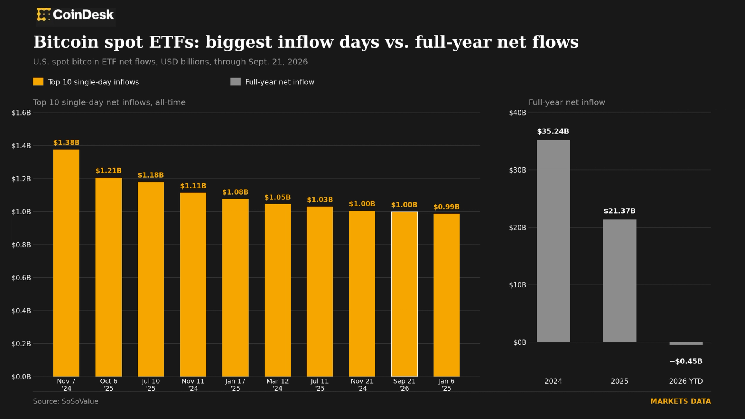
    Demand for spot Bitcoin ETFs has picked up sharply. The Block, using SoSoValue figures, reported that U.S. funds received $2.4 billion of net inflows during the week ending September 25, marking their biggest weekly intake since October 2025. Monday accounted for a large chunk of that money, with the 12 Bitcoin ETFs tracked by SoSoValue collecting $999 million in one day. That marked their strongest daily result since October 6, 2025 and ranked as the ninth-biggest daily inflow since U.S. spot Bitcoin ETFs began trading in January 2024.

    The buybacks put the flows back into positive territory for 2026. Year-to-date net flow figures were around $934.1 million. As of July 13, that same group was showing about $5.8 billion in net outflows. The funds have generated about $57.6 billion in net inflows since inception. Net assets for all funds totaled about $108.4 billion as of Friday.

    According to Bloomberg ETF analyst Eric Balchunas, the change in flows is due to the Treasury’s plans to increase purchases of longer-term Treasuries.

    Defense Secretary Pete Hegseth Discloses Personal Bitcoin Holdings

    Defense Secretary Pete Hegseth has also disclosed personal Bitcoin exposure in his newly released 2025 annual ethics filing. The filing lists at least $3.1 million across cash, retirement investments, and BTC. The disclosure includes more than $1 million sitting in one bank account. Hegseth, a former Fox News host who became Defense secretary in January 2025, is also facing impeachment demands from members of his own party over his handling of the war with Iran.

    Hegseth had a total of five retirement accounts that ranged in value between about $2.05 million and $4.35 million. Three of these accounts, which belonged to Hegseth, were worth about $500,000 to $1.25 million. His wife, Jennifer Hegseth, had a total of two Rollover IRAs that were worth about $1.55 million to $3.1 million.

    The couple also disclosed three cash accounts. One was reported only as being “worth more than $1 million.” Their Bitcoin position was valued between approximately $16,000 and $65,000. The wide range in the federal disclosure forms makes it difficult to make a clear year-to-year wealth comparison. In Hegseth’s nomination form from December 2024, the total amount of financial assets falls within $1.4 million and $3.4 million. In the most recent filing, the lower range is $3.1 million with no upper limit since there is no ceiling for the largest cash account.

    The only major change is in the bank balance. Hegseth’s earlier disclosure reveals an account called “U.S. Bank #2” which ranged from $15,001 to $50,000. In the current filing, the account holding the same name ranges above $1 million.

    Why This Matters

    The convergence of institutional price predictions, expanding crypto-native financial infrastructure, and surging ETF demand signals deepening mainstream integration of Bitcoin into traditional finance. Armstrong’s halving-cycle thesis, while speculative, reflects a widely watched analytical framework among market participants. Coinbase’s launch of fixed-rate borrowing via Morpho Midnight on Base demonstrates how centralized exchanges are bridging into decentralized finance primitives, offering users predictable costs previously unavailable in variable-rate DeFi lending. The record-breaking ETF inflows—reversing months of outflows—suggest renewed institutional appetite, potentially influenced by macro shifts in Treasury policy as noted by Balchunas. Meanwhile, a sitting Cabinet secretary’s disclosed Bitcoin holdings, however modest, mark a notable milestone in political normalization of digital asset ownership.

    Frequently Asked Questions

    What is Brian Armstrong’s Bitcoin price prediction and what is it based on?

    Coinbase CEO Brian Armstrong predicts Bitcoin could reach $400,000 by 2030. His forecast is based on historical halving cycles, where the reduction in new BTC supply every four years has previously been followed by significant price appreciation. Armstrong emphasizes this is a possible outcome if Bitcoin behaves similarly to past cycles, not a guaranteed forecast.

    How do Coinbase’s new fixed-rate Bitcoin-backed loans work?

    Coinbase’s fixed-rate USDC loans allow borrowers to lock in their interest charge and repayment deadline upfront, using Bitcoin as collateral. The product operates through the Morpho Midnight protocol, which does not hold customer funds, and settles transactions on Base, Coinbase’s Ethereum layer-2 blockchain. This fixed-rate option coexists with the existing variable-rate Morpho Blue product.

    What drove the recent surge in U.S. spot Bitcoin ETF inflows?

    U.S. spot Bitcoin ETFs saw $2.4 billion in net inflows for the week ending September 25, the largest weekly intake since October 2025. According to Bloomberg ETF analyst Eric Balchunas, the shift is attributed to the Treasury’s plans to increase purchases of longer-term Treasuries, which may be influencing investor risk appetite and portfolio allocation toward Bitcoin exposure.

  • Positive Trend Continues for US Spot Bitcoin and Ethereum ETFs, Latest Data Shows

    Positive Trend Continues for US Spot Bitcoin and Ethereum ETFs, Latest Data Shows

    Key Highlights

    • U.S. spot Bitcoin ETFs posted a sixth straight day of net inflows on September 24, totaling approximately $190.7 million, led by BlackRock’s IBIT with $162.6 million.
    • Spot Ether ETFs extended their winning streak to five consecutive sessions, attracting roughly $66.1 million in net inflows, with BlackRock’s ETHA ($26.8M) and Fidelity’s FETH ($21.5M) pacing the category.
    • While most Bitcoin funds saw inflows, WisdomTree’s BTCW recorded a $4 million net outflow, highlighting divergent investor preferences within the product lineup.

    Bitcoin ETF Momentum Extends to Six Sessions as BlackRock Dominates Flows

    U.S. spot Bitcoin exchange-traded funds maintained their upward trajectory on September 24, marking the sixth consecutive trading session of positive net capital inflows. According to data compiled by SoSoValue, the cohort of Bitcoin investment products attracted approximately $190.7 million in combined net inflows during the session. The momentum underscores sustained institutional and retail appetite for regulated Bitcoin exposure amid a constructive macro backdrop for digital assets.

    BlackRock’s iShares Bitcoin Trust (IBIT) continued to function as the primary conduit for new capital, capturing $162.6 million of the day’s total — representing roughly 85% of aggregate inflows across all spot Bitcoin ETFs. The fund’s dominance reflects its first-mover advantage, deep liquidity profile, and widespread adoption across advisory platforms. Trailing significantly behind, Fidelity’s Wise Origin Bitcoin Fund (FBTC) recorded $12.9 million in net subscriptions, while Morgan Stanley’s Bitcoin Trust (MSBT) added $10.2 million. Franklin Templeton’s Digital Holdings Trust (EZBC) and Bitwise’s Bitcoin ETF (BITB) rounded out the positive contributors with $4.9 million and $4.1 million, respectively.

    WisdomTree BTCW Bucks Trend With Modest Outflow

    Not every fund participated in the rally. WisdomTree’s Bitcoin Fund (BTCW) registered a net outflow of $4 million, the sole negative print among Bitcoin ETFs on the day. The divergence suggests investors are discriminating based on factors such as expense ratios, custodial arrangements, or distribution reach. Despite the single-fund redemption, the category’s overall net flow remained firmly in positive territory, reinforcing the broader accumulation narrative.

    Ether ETFs Build on Momentum With Fifth Straight Day of Inflows

    A parallel trend emerged in the spot Ether ETF complex, where net inflows reached approximately $66.1 million on September 24 — extending the positive streak to five consecutive trading sessions. BlackRock’s iShares Ethereum Trust (ETHA) led the category with $26.8 million in net creations, followed closely by Fidelity’s Ethereum Fund (FETH) at $21.5 million. Grayscale’s Mini Ethereum Trust (ETHE), the lower-fee successor to the firm’s legacy Grayscale Ethereum Trust, continued to attract capital with a $17.8 million net inflow, signaling successful migration of assets from its higher-cost predecessor.

    The synchronized inflows across both Bitcoin and Ether vehicles indicate broadening demand for diversified crypto exposure within traditional portfolio frameworks. Market participants note that the dual-asset momentum coincides with improved regulatory clarity, evolving institutional custody infrastructure, and growing advisor comfort with digital asset allocations.

    Why This Matters

    The six-day Bitcoin ETF inflow streak and five-day Ether ETF streak represent the longest sustained periods of simultaneous positive flows since the products launched earlier this year. This consistency suggests the initial post-launch volatility has given way to a more structural demand phase, where allocators treat spot crypto ETFs as core portfolio building blocks rather than tactical trades. BlackRock’s outsized share of flows across both asset classes highlights the asset manager’s distribution advantage and the trust advisors place in its brand. Meanwhile, Grayscale’s Mini ETHE success demonstrates that fee competition can recapture assets even from entrenched incumbents. Going forward, market observers will monitor whether inflows persist during periods of price consolidation or if they remain tightly correlated with bullish price action. The next inflection point may come from options approvals on spot ETFs, which could unlock additional institutional strategies and deepen liquidity.

    Frequently Asked Questions

    Which spot Bitcoin ETF attracted the most capital on September 24?

    BlackRock’s iShares Bitcoin Trust (IBIT) led all spot Bitcoin ETFs with a net inflow of $162.6 million on September 24, accounting for the vast majority of the category’s $190.7 million total.

    How many consecutive days of inflows have spot Ether ETFs recorded?

    Spot Ether ETFs posted net inflows for the fifth consecutive trading session on September 24, with total inflows of approximately $66.1 million on that day.

    Did any spot Bitcoin ETFs see outflows on September 24?

    Yes. WisdomTree’s Bitcoin Fund (BTCW) recorded a net outflow of $4 million, making it the only spot Bitcoin ETF with negative flows for the session.

  • Bitcoin ETFs Erase $5.8 Billion Hole

    Bitcoin ETFs Erase $5.8 Billion Hole

    Key Highlights

    • U.S. spot Bitcoin ETFs have reversed a $5.8 billion year-to-date deficit to post nearly $800 million in net inflows, per SoSoValue data.
    • Nearly $4 billion of inflows arrived after Treasury Secretary Scott Bessent’s August announcement of increased bond purchases amid surging yields.
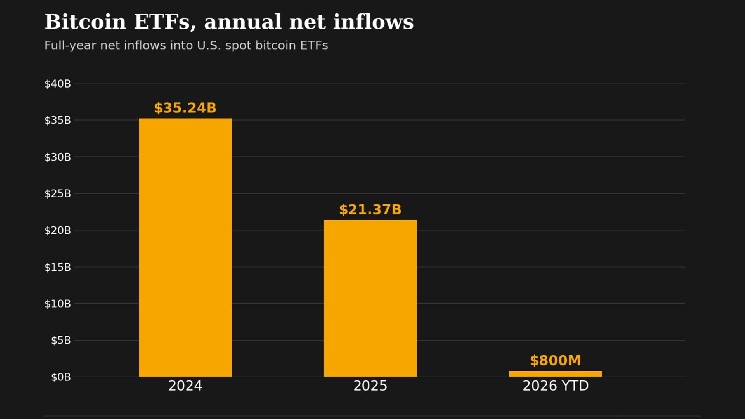
    • Despite a six-day winning streak, 2025 inflows remain far below the $35.2 billion recorded in 2024 and $21.4 billion in 2025 full-year totals.

    Bitcoin ETFs Stage Dramatic Turnaround as Net Inflows Turn Positive for 2025

    Investors in U.S.-listed spot Bitcoin exchange-traded funds have engineered a remarkable reversal. After sitting on a staggering $5.8 billion year-to-date outflow as recently as July 13, according to CoinDesk’s analysis of SoSoValue data, the funds now boast nearly $800 million in net inflows for the year. The swing coincides with Bitcoin’s price recovery to approximately $85,000 from a June low below $58,000, a movement that has led several analysts to declare a new bull market is already underway.

    Liquidity Injection Catalyzes $4 Billion Inflow Surge

    The inflection point aligns closely with a pivotal macroeconomic shift. Since U.S. Treasury Secretary Scott Bessent’s August announcement detailing increased bond purchases—a liquidity management tool deployed as bond yields climbed to multi-year highs—nearly $4 billion has flowed into the ETF complex. This policy-driven liquidity expansion appears to have provided the tailwind necessary to overcome the persistent selling pressure that defined the first half of the year.

    Six-Day Winning Streak Tests Resistance at $85,000

    Momentum remains visible in recent trading sessions. The ETF suite has recorded six consecutive days of net inflows, a streak that has persisted even as Bitcoin’s price rally has stalled near the $85,000 level since Tuesday. The decoupling of fund flows from immediate price action suggests institutional allocation decisions are increasingly driven by strategic portfolio positioning rather than short-term momentum chasing.

    Why This Matters

    The shift from deep negative territory to positive year-to-date flows marks a critical psychological and structural threshold for the digital asset ecosystem. The 2024 calendar year saw $35.2 billion in total net inflows, while the source cites a $21.4 billion figure for 2025—indicating that despite the recent rebound, the current pace remains well below the run-rate established during the peak adoption phase. The sustained inflows following the Treasury’s bond-buying program highlight the sensitivity of Bitcoin-linked products to global liquidity conditions, reinforcing the narrative that Bitcoin functions as a liquidity-sensitive risk asset. Market participants will closely monitor whether the six-day streak can extend into a sustained trend capable of closing the gap with prior-year totals, and whether Bitcoin can decisively break above the $85,000 resistance that has capped gains this week.

    Frequently Asked Questions

    How much have U.S. spot Bitcoin ETFs attracted in net inflows for 2025?

    As of the latest data from SoSoValue, the funds hold nearly $800 million in net inflows year-to-date, a dramatic reversal from a $5.8 billion deficit recorded on July 13.

    What triggered the recent surge in ETF inflows?

    Approximately $4 billion of the inflows occurred after U.S. Treasury Secretary Scott Bessent’s August announcement of increased bond purchases, implemented as bond yields reached multi-year highs.

    How do current 2025 inflows compare to previous years?

    Despite the turnaround, the $800 million year-to-date figure remains significantly smaller than the $35.2 billion recorded for full-year 2024 and the $21.4 billion cited for 2025.

  • ‘Bull Market Confirmed’: Analyst Identifies Bitcoin’s Fifth Historic Signal

    ‘Bull Market Confirmed’: Analyst Identifies Bitcoin’s Fifth Historic Signal

    Key Highlights

    • Cryptoquant contributor Darkfost identifies a fifth historical bull market signal for Bitcoin on September 24, marking the first such crossover since 2023 and joining prior signals in 2012, 2015, 2019, and 2023.
    • The signal triggers when the short-term holder cost basis rises above the active long-term holder cost basis, using a seven-year activity filter that excludes over 3.5 million dormant BTC untouched for a decade or more.
    • U.S. spot Bitcoin ETFs recorded $2.06 billion in net inflows over three consecutive days (Sept. 21–23), led by a record $999 million single-day inflow on Sept. 21, coinciding with the signal’s confirmation.

    Fifth Cost-Basis Crossover Confirms Bull Market Structure

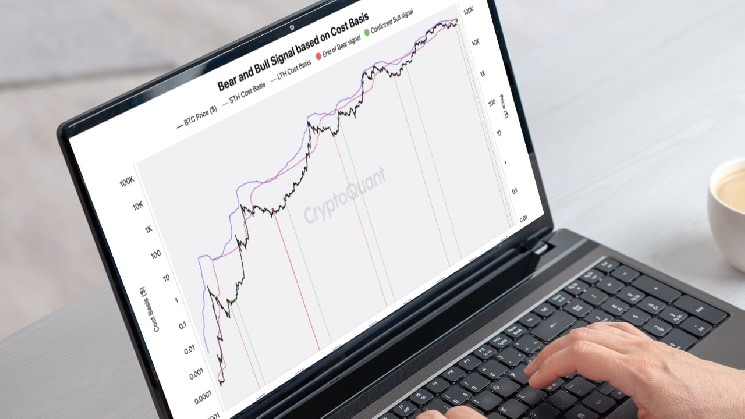
    A new on-chain metric flashed a bullish confirmation for Bitcoin on September 24, marking the fifth time in the asset’s history that the average acquisition cost of short-term holders has surpassed that of active long-term holders. The analysis, published by Cryptoquant contributor Darkfost, identifies the crossover as a recurring structural signal that has preceded sustained upward moves in each of the four prior cycles.

    In a post on X, the analyst stated: “Bull Market Confirmed … This is the 5th occurrence, which gives a bit more credibility to the dynamic bitcoin is putting in place, though there’s always a margin for error, and I prefer to point that out.” The comment underscores both the statistical weight of the pattern and the inherent uncertainty in any single indicator.

    The metric compares two distinct cost bases: the average price paid by short-term holders versus the average price paid by active long-term holders. Crucially, the long-term cohort is filtered to include only coins that have moved at least once in the past seven years. This design excludes deeply dormant supply—estimated at more than 3.5 million BTC older than ten years—which the analyst argues would otherwise distort the measure of genuine holder conviction.

    Defining Active Long-Term Holders: The Seven-Year Filter

    The seven-year activity threshold serves a different analytical purpose than the standard 155-day holding period used by firms such as Glassnode to separate short-term from long-term supply. While Glassnode’s definition classifies any coin held longer than roughly five months as long-term, Darkfost’s additional filter asks whether that long-term coin has shown any on-chain life in the last seven years. Coins that have not are treated as effectively lost or permanently dormant and removed from the active cost-basis calculation.

    The analyst acknowledges the cutoff is arbitrary but notes its practical relevance. The dormant pile grows by an estimated 8,000 to 30,000 BTC each month, and its monthly change has turned negative only once since 2019—when an early miner moved approximately 100,000 BTC. Notably, coins inactive for five to 15 years resumed movement in 2026, demonstrating that even decade-old supply can re-enter circulation and validating the decision to track active versus dormant segments separately.

    ETF Inflows Provide Liquidity Backdrop for the Signal

    The cost-basis crossover arrived alongside a surge of institutional demand via U.S. spot Bitcoin exchange-traded funds. According to daily flow data from Farside, the funds attracted $2.06 billion in net inflows across the three sessions from September 21 through September 23. Every session printed positive flows, though the pace decelerated sharply after the opening day.

    September 21 saw the largest single-day inflow of 2026 at $999 million. The following day added $714.7 million, and September 23 contributed $346.9 million. The three-day sequence coincides with the period in which the on-chain signal confirmed, lending circumstantial support to the argument that fresh ETF liquidity is reinforcing the shift in holder economics. The analyst cautions, however, that the flow data establishes correlation during the signal window, not causation of the crossover itself.

    Spot Bitcoin ETFs allow investors to gain exposure through brokerage-traded shares backed by actual BTC held by the fund, lowering the operational barrier for institutional allocators and wealth managers who cannot or prefer not to custody digital assets directly.

    Cycle Outlook: Tempered Volatility, Multi-Fold Returns

    The bullish signal and ETF momentum are being framed within a broader cycle thesis. In a separate assessment published September 22, Cryptoquant founder and CEO Ki Young Ju argued that the market’s expanding size and deepening institutional ownership could dampen the extreme boom-bust amplitude characteristic of earlier cycles. His base-case forecast projects threefold to fivefold returns for Bitcoin this cycle, followed by a milder bear market drawdown than historical norms.

    Why This Matters

    The fifth cost-basis crossover matters because it represents a rare confluence of on-chain holder behavior and institutional capital flows. Prior occurrences in 2012, 2015, 2019, and 2023 each preceded significant bull-market legs, suggesting the metric captures a fundamental shift in the marginal buyer—from long-term accumulators to newer participants willing to pay higher average prices. The seven-year activity filter refines this insight by focusing on economically active long-term holders, filtering out supply that behaves more like lost coins than invested capital. Meanwhile, the $2.06 billion in ETF inflows over three days—anchored by a record $999 million session—signals that traditional financial infrastructure is now a primary vector for Bitcoin demand. If Ki Young Ju’s cycle thesis holds, the combination of structural on-chain signals and sustained institutional flows could produce a cycle defined by steadier appreciation and shallower corrections, reshaping risk expectations for both retail and institutional participants.

    Frequently Asked Questions

    What exactly is the “fifth bull market signal” identified by Cryptoquant?

    It is the fifth historical occurrence where the short-term holder realized price (average acquisition cost of coins held less than ~155 days) crosses above the active long-term holder realized price (average cost of coins held longer than 155 days that have also moved at least once in the past seven years). Previous crossovers appeared in 2012, 2015, 2019, and 2023.

    Why does the analysis exclude Bitcoin that hasn’t moved in over seven years?

    The analyst treats coins untouched for seven-plus years as dormant or effectively lost supply. Including them in the long-term holder cost basis would dilute the measure of active holder conviction. Over 3.5 million BTC fall into this category, growing by 8,000–30,000 BTC monthly, with only one monthly decline since 2019.

    Did the ETF inflows cause the bullish crossover?

    The data shows the $2.06 billion in net ETF inflows (Sept. 21–23) coincided with the signal’s confirmation, but the analyst explicitly states the flows “do not establish that ETF buying caused the crossover.” The inflows provide liquidity context, not proof of causation.

  • Crypto Bull Market Returns? Three Signals Indicate a Possible Comeback

    Crypto Bull Market Returns? Three Signals Indicate a Possible Comeback

    Key Highlights

    • Total cryptocurrency market capitalization surged nearly $1 trillion in six weeks, climbing from $2.06 trillion to over $2.91 trillion as Bitcoin led a broad-based recovery.
    • Spot Bitcoin ETFs recorded $999 million in net inflows—the largest single-day haul since October 2023—while combined Bitcoin and Ethereum ETF inflows reached $1.27 billion.
    • Bitcoin reclaimed all major long-term moving averages after 300 days below them, trading above both the True Market Mean ($76,746) and short-term holder cost basis ($71,763), signaling potential bull-market onset.

    Market Sentiment Shifts From Fear to Greed as Bitcoin Breaks $85,000

    The cryptocurrency market has entered a pronounced bullish phase since early August, with Bitcoin spearheading a recovery that has erased much of the bear-market damage accumulated since October 2023. In just six weeks, the aggregate crypto market capitalization has swollen from $2.06 trillion to more than $2.91 trillion, according to CoinGecko data, adding nearly $1 trillion in fresh value. The Fear & Greed Index—a widely watched sentiment gauge—has surged to 59, squarely in “greed” territory, up sharply from a “fear” reading of 45 only a week earlier. The inflection point coincided with Bitcoin’s decisive push above the $85,000 psychological threshold, a level that had acted as stiff resistance during the prolonged consolidation.

    Record ETF Inflows Signal Deepening Institutional Conviction

    Underpinning the price action is a torrent of institutional capital flowing into U.S.-listed spot exchange-traded funds. On the most recent trading day, Spot Bitcoin ETFs collectively attracted $999 million in net inflows, marking the largest single-session intake since the products drew $1.21 billion on October 6, 2023, per SoSoValue figures. BlackRock’s iShares Bitcoin Trust led the charge with $381.37 million, followed by the Ark 21Shares Bitcoin ETF at $289.12 million and Fidelity’s Wise Origin Bitcoin Fund at $238.84 million. The momentum was not confined to Bitcoin: Ethereum ETFs simultaneously pulled in $269.98 million, lifting the combined daily net inflow across both asset classes to $1.27 billion. Analysts note that the breadth of participation—spanning both the flagship cryptocurrency and its largest smart-contract rival—suggests the rally is evolving into a genuine altcoin expansion rather than a Bitcoin-only phenomenon.

    On-Chain and Technical Metrics Align With Bull-Market Thesis

    Beyond fund flows, on-chain and technical indicators are flashing constructive signals. Glassnode data shows Bitcoin has now recaptured all of its long-term moving averages after spending roughly 300 days trading beneath them—a duration that historically precedes sustained up-trends. The asset’s spot price sits comfortably above two critical cost-basis benchmarks: the True Market Mean at $76,746 and the short-term holder realized price at $71,763. Holding above these levels implies that the majority of recent acquirers are in profit, a condition that typically reinforces holder conviction and reduces sell-side pressure. Meanwhile, the rally’s breadth has flipped the Bitcoin-cycle signal in favor of altcoins, indicating capital is rotating beyond the dominant store-of-value narrative into the broader ecosystem.

    Why This Matters

    The confluence of improving sentiment, record-breaking ETF flows, and technical breakouts arrives at a pivotal juncture for digital assets. After a grueling 18-month bear market that tested institutional commitment, the simultaneous breach of $85,000 Bitcoin, the reclamation of long-term moving averages, and the rotation into altcoins mirrors the early innings of previous bull cycles in 2017 and 2020-21. However, market veterans caution that the Fear & Greed Index’s rapid ascent toward “extreme greed” (above 70) often coincides with short-term tops or sharp pullbacks. The next few sessions will test whether the current inflow momentum can absorb profit-taking from early-cycle participants without triggering a deeper correction. Regulatory clarity around stablecoins and market structure legislation in the U.S. Congress, coupled with the Federal Reserve’s evolving rate-cut trajectory, remain the key macro variables that could either extend or truncate the advance.

    Frequently Asked Questions

    What triggered the latest surge in crypto market capitalization?
    A combination of Bitcoin breaking above $85,000, record single-day inflows into Spot Bitcoin ETFs ($999M), and concurrent Ethereum ETF inflows ($269.98M) drove the total market cap from $2.06T to over $2.91T in six weeks.
    Which ETF issuers led the Bitcoin inflows?
    BlackRock’s iShares Bitcoin Trust ($381.37M), Ark 21Shares Bitcoin ETF ($289.12M), and Fidelity’s Wise Origin Bitcoin Fund ($238.84M) were the top three recipients of the $999M net inflow.
    Are technical indicators confirming a new bull market?
    Yes. Bitcoin has reclaimed all long-term moving averages after 300 days below them and trades above both the True Market Mean ($76,746) and short-term holder cost basis ($71,763)—conditions historically associated with bull-market starts. However, the Fear & Greed Index at 59 nearing “extreme greed” warrants caution for near-term volatility.
  • Mark Yusko Predicts Bitcoin Will Reach $250,000

    Mark Yusko Predicts Bitcoin Will Reach $250,000

    Key Highlights

    • Morgan Creek Capital Management CEO Mark Yusko signals Bitcoin has transitioned from a “distribution” phase to an “accumulation” phase, citing higher lows, higher highs, and a break above key moving averages.
    • Yusko’s valuation model pegs Bitcoin’s current fair value at approximately $105,000 based on Metcalfe’s Law and network valuation models, suggesting the asset remains undervalued at recent $85,000-$86,000 levels.
    • Global M2 money supply expansion, reduced leverage in crypto markets, and a shift toward institutional ownership are cited as structural tailwinds for a sustainable, albeit slower, long-term uptrend targeting $250,000.

    Yusko Identifies Structural Shift in Bitcoin Market Dynamics

    Mark Yusko, chief executive officer of Morgan Creek Capital Management, has outlined a bullish thesis for Bitcoin arguing that the cryptocurrency’s market structure is undergoing a fundamental shift back in favor of a sustained uptrend. In a recent interview, the veteran investor detailed a significant change in market character compared to just months prior, when he advised caution. Yusko now contends that Bitcoin has moved decisively from a “distribution” phase into an “accumulation” phase, a transition he believes marks the early stages of a new bull run with a long-term price target of $250,000.

    Technical Confirmation and Valuation Metrics Support Thesis

    The Morgan Creek CEO’s analysis rests on a confluence of technical and on-chain metrics. Yusko highlights that Bitcoin price action has begun printing higher lows and higher highs, a classic Dow Theory signal of an emerging uptrend. Critically, the asset has reclaimed both the 200-day moving average and the 50-week moving average, levels widely watched by institutional trend-followers. Bitcoin’s recent surge above $86,000, reaching its highest level since January, has been bolstered by sustained inflows into spot Bitcoin exchange-traded funds and renewed institutional purchasing.

    Despite the recovery from a local low near $58,000 to the current $85,000-$86,000 range, Yusko maintains that Bitcoin trades below its intrinsic “fair value.” Applying Metcalfe’s Law alongside Timothy Peterson’s network valuation model, Yusko calculates a fair value of approximately $105,000. In a separate recent statement, he characterized trading below this level as a compelling accumulation opportunity for long-term allocators.

    Macro Liquidity and Evolving Market Structure Favor Sustainability

    Beyond technicals, Yusko anchors his outlook in the macroeconomic backdrop. He points to a renewed expansion in global M2 money supply, noting that while the Federal Reserve maintains a restrictive posture, aggressive monetary expansion in major economies—particularly China—is driving global liquidity higher. This environment, he argues, historically favors scarce assets.

    Equally important is the changing composition of market participants. Yusko contrasts the current cycle with previous bull runs dominated by speculative retail leverage of 20x to 100x, which precipitated violent liquidation cascades. He observes that the growing dominance of spot ETFs, family offices, and high-net-worth long-term holders has structurally reduced systemic leverage. The sharp correction from a 2025 peak near $125,000-$126,000, in his view, effectively flushed excessive leveraged positions, leaving a healthier base.

    “The Rise in Bitcoin Won’t Come Suddenly”

    Yusko explicitly tempers expectations for explosive, vertical price action. “The Rise in Bitcoin Won’t Come Suddenly” he stated, emphasizing that Bitcoin’s maturation into a major asset class makes the tenfold rallies of prior cycles increasingly improbable. Instead, he envisions a protracted but more durable advance, potentially driving total market capitalization into the tens of trillions of dollars over the long term. This slower grind higher, he argues, is the trade-off for greater institutional participation and reduced volatility.

    Debt Monetization Narrative and Broader Digital Asset Exposure

    The thesis extends beyond Bitcoin-specific factors to a structural critique of the global financial system. Yusko argues that unsustainable sovereign debt loads will ultimately compel governments to devalue fiat currencies, positioning fixed-supply assets like gold and Bitcoin as primary stores of value. While his conviction is strongest on Bitcoin, Yusko also identifies significant roles for smart-contract platforms including Ethereum, Solana, and Avalanche in the evolving digital economy, highlighting tokenization of real-world assets, on-chain securities trading, and decentralized finance as key growth vectors.

    Why This Matters

    Yusko’s analysis reflects a growing consensus among institutional managers that Bitcoin’s market microstructure has fundamentally matured. The approval and success of spot Bitcoin ETFs in the United States have introduced a persistent, price-insensitive buyer base—registered investment advisors, pension funds, and endowments—that did not exist in prior cycles. This structural shift reduces the likelihood of the 80% drawdowns characteristic of Bitcoin’s early history, but also dampens the velocity of upside moves. For allocators, the implication is clear: Bitcoin is transitioning from a speculative vehicle to a strategic portfolio asset, demanding longer time horizons and conviction in the monetary debasement narrative. The $105,000 fair value estimate provides a tangible benchmark for dollar-cost averaging strategies, while the $250,000 long-term target underscores the asymmetric upside still perceived by early institutional adopters.

    Frequently Asked Questions

    What specific technical signals does Mark Yusko cite as confirmation of a new Bitcoin bull market?
    Yusko points to the formation of higher lows and higher highs, a decisive break above both the 200-day moving average and the 50-week moving average, and a second bottom formation with higher volume as primary technical confirmation of a trend change.
    How does Yusko arrive at a $105,000 fair value estimate for Bitcoin?
    The valuation derives from applying Metcalfe’s Law—which values a network proportionally to the square of its users—combined with Timothy Peterson’s network valuation model, which correlates Bitcoin’s price with its address activity and hash rate.
    Why does Yusko expect slower price appreciation in this cycle compared to previous ones?
    He attributes the slower grind to Bitcoin’s larger market capitalization and the dominant presence of institutional investors, ETFs, and family offices who employ little to no leverage and have longer investment horizons, reducing both volatility and the velocity of parabolic rallies.
  • Bitcoin Recovers From Asian-Session Lows as Falling Oil Price Supports Risk Appetite

    Bitcoin Recovers From Asian-Session Lows as Falling Oil Price Supports Risk Appetite

    Key Highlights

    • Bitcoin surged above $86,000 after breaking the May high, driven by nearly $1 billion in single-day spot ETF inflows—the largest since October 2024.
    • WTI crude oil dropped below $90 a barrel on reports Iran may reopen the Strait of Hormuz, easing inflation fears and reducing pressure for further Federal Reserve rate hikes.
    • Broad risk appetite improved as the Nasdaq rallied, global stocks rose, U.S. bond yields fell, and optimism grew over U.S.–China trade negotiations.

    Bitcoin Extends Rally Past $86K on Record ETF Flows and Macro Tailwinds

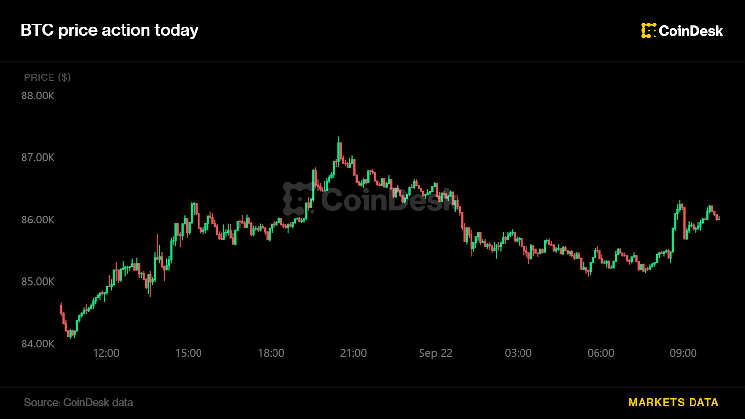
    Bitcoin (BTC) consolidated near $85,927 early Tuesday after a decisive break above its May high during Monday’s session, reinforcing a bullish technical structure that has been building for weeks. The largest cryptocurrency by market capitalization recovered from Asian-session lows around $85,000 and traded within striking distance of the $86,000 psychological level. The broader digital-asset benchmark, the CoinDesk 20 Index (CD20), advanced 2.2% over the past 24 hours, signaling broad-based participation across the crypto complex.

    Spot Bitcoin ETFs Post Largest Daily Inflow Since October

    A primary catalyst for Monday’s surge was extraordinary demand for U.S.-listed spot bitcoin exchange-traded funds. The cohort attracted nearly $1 billion in net inflows in a single trading day, marking the largest one-day haul since October 2024. The magnitude of the flow underscores renewed institutional conviction and suggests that the recent price consolidation was viewed as an accumulation opportunity rather than a distribution phase. Analysts note that sustained inflows of this scale could provide a structural bid underpinning further upside.

    Falling Oil Prices Ease Inflation Concerns and Fed Hawkishness

    Macroeconomic developments provided additional tailwinds. West Texas Intermediate (WTI) crude futures slid more than 2% to dip below $90 per barrel, extending a retreat from a recent peak near $106. The decline followed a Kyodo News report stating that Iran signaled willingness to reopen the Strait of Hormuz within seven days if the United States eased its blockade. A sustained drop in energy costs could alleviate inflationary pressures, weakening the argument for additional Federal Reserve interest-rate increases in the coming months—a scenario historically supportive of risk assets, including cryptocurrencies.

    Risk Appetite Revives on Equities Rally and Geopolitical Optimism

    The crypto advance coincided with a sharp rise in the Nasdaq Composite, rising global equity markets, and declining U.S. Treasury yields. Sentiment was further buoyed by optimism surrounding U.S.–China trade negotiations. Alex Kuptsikevich, chief market analyst at FxPro, summarized the confluence in an email: “The crypto market gained ground against the backdrop of a sharp rise in the Nasdaq index. Falling oil prices and US government bond yields, rising global stock markets and optimism regarding US-China negotiations supported risk appetite.”

    Why This Matters

    The simultaneous break of a key technical level, record-setting ETF inflows, and a favorable macroeconomic backdrop—lower oil, falling yields, and easing geopolitical tension—creates a rare alignment of fundamental and technical tailwinds for bitcoin. If ETF demand persists and the Federal Reserve maintains a dovish tilt amid disinflationary data, the path of least resistance for BTC could remain higher, with the next major resistance zone likely near the all-time high above $108,000. Market participants will closely monitor weekly ETF flow data, upcoming CPI/PCE prints, and any formal progress on the Strait of Hormuz situation for confirmation of the current narrative.

    Frequently Asked Questions

    What triggered Bitcoin’s break above the May high?
    A combination of nearly $1 billion in single-day spot bitcoin ETF inflows—the largest since October 2024—falling oil prices, declining U.S. bond yields, a rallying Nasdaq, and optimism over U.S.–China talks drove the breakout.
    How do lower oil prices affect Bitcoin?
    Lower oil prices reduce inflationary pressure, which lessens the likelihood of further Federal Reserve rate hikes. A more dovish Fed outlook typically supports risk assets, including cryptocurrencies.
    What is the significance of the Strait of Hormuz report?
    The Kyodo report that Iran may reopen the Strait of Hormuz if U.S. sanctions ease triggered a sharp drop in WTI crude below $90 a barrel, directly contributing to the disinflationary narrative benefiting Bitcoin.
  • Spot Bitcoin ETFs Attract Nearly $1 Billion Monday, Marking 9th Largest Inflow Ever

    Spot Bitcoin ETFs Attract Nearly $1 Billion Monday, Marking 9th Largest Inflow Ever

    Key Highlights

    • U.S. spot Bitcoin ETFs recorded a $998.95 million net inflow on Monday, the largest single-day haul since October 6, 2025, when Bitcoin traded near its all-time high of $126,200.
    • BlackRock’s IBIT led the surge with $381.37 million, followed by Ark’s ARKB ($289.12 million) and Fidelity’s FBTC ($238.84 million), marking the ninth-largest inflow day since the funds launched in January 2024.
    • The three-day winning streak lifts month-to-date inflows to $1.31 billion, extending August’s $3.52 billion pace and signaling sustained institutional conviction despite macroeconomic headwinds.

    Record-Breaking Inflow Signals Institutional Conviction

    U.S.-listed spot Bitcoin exchange-traded funds posted a staggering $998.95 million in net inflows on Monday, according to data from SoSoValue, marking the most significant single-day capital allocation since October 6, 2025. That date coincides with Bitcoin’s previous all-time high of approximately $126,200, a level the asset has yet to reclaim. Monday’s haul also ranks as the ninth-largest daily inflow since the ETF suite debuted on January 11, 2024, underscoring the magnitude of institutional appetite returning to the digital asset space.

    BlackRock, Ark, and Fidelity Lead the Charge

    The inflow was broad-based but heavily concentrated among the market’s dominant issuers. BlackRock’s iShares Bitcoin Trust (IBIT) captured $381.37 million, maintaining its position as the primary vehicle for institutional exposure. Ark Invest’s ARKB attracted $289.12 million, while Fidelity’s Wise Origin Bitcoin Fund (FBTC) drew $238.84 million. The combined strength across these three funds alone accounted for more than $900 million of the day’s total, reflecting a flight to liquidity and brand recognition among large allocators.

    Three-Day Streak Defies Legislative and Monetary Headwinds

    Monday’s print extends a three-day streak of positive flows—the first such run in two weeks—and arrives at a pivotal juncture. The cryptocurrency market recently absorbed a dual shock: a failed Senate cloture vote on the Clarity Act, which would have established a regulatory framework for digital assets, and a Federal Reserve interest-rate increase that typically pressures risk assets. Despite these headwinds, the persistent buying pressure suggests institutions are looking past near-term policy uncertainty and focusing on Bitcoin’s long-term portfolio role as a non-sovereign store of value.

    Monthly Momentum Builds on August’s Historic Pace

    The latest surge pushes month-to-date net inflows to $1.31 billion, building directly on August’s record-setting $3.52 billion tally. That two-month cumulative figure exceeds $4.8 billion, a pace that rivals the initial launch frenzy earlier this year. Analysts interpret the sustained flow data as evidence that allocators—ranging from registered investment advisors to hedge funds and corporate treasuries—are treating Bitcoin exposure as a strategic allocation rather than a tactical trade, even as fiscal debt concerns mount across advanced economies.

    Why This Matters

    The resilience of ETF flows amid legislative gridlock and restrictive monetary policy marks a maturation of the Bitcoin investment thesis. With the Clarity Act stalled, regulatory clarity remains elusive, yet capital continues to flow into the regulated ETF wrapper—a sign that institutions are comfortable navigating the current framework. The Fed’s rate hike cycle, while a traditional negative for non-yielding assets, has not deterred buyers, suggesting Bitcoin’s narrative as an inflation hedge and diversification tool is gaining traction in portfolio construction models. Upcoming catalysts include the next Federal Open Market Committee meeting, potential lame-duck session movement on crypto legislation, and the fourth-quarter rebalancing window that could amplify institutional positioning.

    Frequently Asked Questions

    Which Bitcoin ETFs saw the largest inflows on Monday?

    BlackRock’s IBIT led with $381.37 million, followed by Ark’s ARKB at $289.12 million and Fidelity’s FBTC at $238.84 million. These three funds accounted for the vast majority of the $998.95 million total net inflow.

    How does Monday’s inflow compare to historical levels?

    It was the largest single-day net inflow since October 6, 2025—the day Bitcoin hit its all-time high near $126,200—and ranks as the ninth-largest inflow day since the ETFs launched on January 11, 2024.

    What does the current flow trend suggest about institutional sentiment?

    The three-day winning streak and month-to-date total of $1.31 billion—following August’s $3.52 billion—indicate that institutions are maintaining conviction in Bitcoin despite the failed Clarity Act vote, a Fed rate hike, and broader fiscal debt concerns.

  • Bitcoin Surpasses $87,000, Ethereum Tops $2,800: Key Drivers Behind the Rally

    Bitcoin Surpasses $87,000, Ethereum Tops $2,800: Key Drivers Behind the Rally

    Key Highlights

    • Bitcoin surged past $87,000 and Ethereum topped $2,800 as the crypto market extended a powerful rally driven by renewed institutional demand and a massive short squeeze.
    • U.S. spot Bitcoin ETFs recorded approximately $593 million in net inflows over Thursday and Friday, reversing earlier outflows and signaling strengthened institutional appetite.
    • Futures market liquidations reached $926 million in 24 hours, with $785 million in short positions forced to close, accelerating the upward price momentum across major assets.

    Bitcoin and Ethereum Lead Broad Market Rally to Multi-Week Highs

    The cryptocurrency market sustained its vigorous upward trajectory on Monday, with Bitcoin (BTC) breaching the $87,000 threshold and Ethereum (ETH) reclaiming the $2,800 level. According to real-time data from OKX, Bitcoin traded at $87,010, marking a 7.41% gain over the preceding 24 hours, while Ethereum advanced 5.98% to $2,800.26. The synchronized rally across the two largest digital assets by market capitalization underscores a broad-based resurgence in risk appetite among both retail and institutional participants.

    Institutional Demand Rebounds as Spot Bitcoin ETFs See Heavy Inflows

    A primary catalyst for the rally was the sharp reversal of capital flows into U.S. spot Bitcoin exchange-traded funds. Data compiled by Bloomberg revealed that the cohort of U.S.-listed spot Bitcoin ETFs attracted net inflows of approximately $593 million across Thursday and Friday trading sessions. This influx substantially offset the net outflows recorded earlier in the week, renewing market confidence in sustained institutional allocation to Bitcoin as a portfolio asset. The turnaround in ETF flows is widely interpreted by analysts as a leading indicator of renewed long-term conviction among traditional finance allocators.

    Regulatory Green Light for Tokenized Shares Bolsters Sentiment

    Regulatory developments provided an additional tailwind. The U.S. Securities and Exchange Commission (SEC) granted a five-year regulatory exemption to specific platforms permitting the trading of tokenized shares on blockchain infrastructure. Market observers view this decision as a potential milestone in the integration of blockchain-based financial products into the traditional U.S. capital markets framework, potentially paving the way for broader asset tokenization and enhanced market efficiency.

    Macroeconomic Backdrop Shifts in Favor of Risk Assets

    The rally coincided with a constructive shift in the macroeconomic environment. A decline in the U.S. 10-year Treasury yield below 5%, falling oil prices, and a record-high close for the Nasdaq Composite—led by megacap technology stocks—collectively reduced the opportunity cost of holding non-yielding, high-beta assets like Bitcoin. The correlation between tech equities and crypto remained elevated, with Bitcoin outperforming the Nasdaq’s gains by a significant margin, advancing over 6% during the same risk-on window.

    Massive Short Squeeze Amplifies Gains in Futures Markets

    Perhaps the most immediate accelerant was a violent short squeeze in the derivatives market. Data from CoinGlass indicated that $926 million in leveraged positions were liquidated across the cryptocurrency complex in the last 24 hours. Of that total, approximately $785 million represented short positions, compelling bearish traders to buy back exposure aggressively as prices rose. Long liquidations were comparatively modest at roughly $142 million. Bitcoin accounted for $509 million of total liquidations, while Ethereum saw approximately $198 million wiped out. The single largest liquidation event occurred on the BTC/USDT perpetual contract on Binance, involving a position valued at roughly $11.3 million.

    Why This Matters

    The convergence of positive ETF flows, regulatory progress on tokenization, a favorable macro pivot, and a derivatives-driven short squeeze creates a multi-layered bullish structure that is more durable than rallies driven by a single catalyst. The ETF inflow reversal is particularly significant because it reflects discretionary capital allocation decisions by institutional investors, rather than speculative leverage alone. Meanwhile, the SEC’s exemption for tokenized share trading signals a potential thaw in the regulatory stance toward digital asset innovation in the United States, which could unlock a new wave of product development and capital formation. Traders should monitor whether the futures market’s open interest rebuilds on the long side—a sign of fresh conviction—or if the squeeze has exhausted near-term buying pressure.

    Frequently Asked Questions

    What triggered the latest Bitcoin rally above $87,000?
    The rally was driven by a combination of $593 million in net inflows into U.S. spot Bitcoin ETFs, a regulatory exemption for tokenized share trading by the SEC, improving macroeconomic conditions including falling Treasury yields, and a $785 million short squeeze in the futures market.
    How large were the futures liquidations during this move?
    Total liquidations reached $926 million in 24 hours, with $785 million in short positions and $142 million in long positions. Bitcoin accounted for $509 million and Ethereum for $198 million of the total.
    Does the SEC exemption mean all tokenized stocks are now legal in the U.S.?
    No. The SEC granted a five-year exemption to specific platforms for trading tokenized shares on blockchain. It is a targeted regulatory relief, not a blanket legalization of all tokenized securities.