Tag: Ethereum

  • Aave V4 Deposits Surge to $806M on 30% Weekly Gain

    Aave V4 Deposits Surge to $806M on 30% Weekly Gain

    Aave V4 Deposits Surge 30% in a Week to Record $806 Million

    Aave’s Version 4 protocol has reached a new all-time high in user deposits, hitting $806 million according to the platform’s live onchain dashboard. The figure represents a 30% increase over the past seven days and extends a steep growth trajectory that began in mid‑August.

    Rapid August Milestones

    Separate protocol announcements tracked the ascent: V4 deposits crossed $500 million on August 19, breached $600 million two days later, and surpassed $800 million six days after that. A further update noted that Ethereum‑based V4 deposits alone exceeded $500 million on August 25. EtherFi Cash has emerged as the second‑largest market within the V4 ecosystem.

    Borrowing Activity Grows Alongside Deposits

    The dashboard shows $216 million in active loans across V4. In the EtherFi Cash market specifically, Aave measured $62 million of active loans where weETH collateral backs WETH borrowing at 92% utilization.

    Deployment Breakdown by Network and Market

    V4 is currently deployed on Ethereum, Optimism, and Avalanche. The largest market by deposits is Ethereum Core at $378 million, followed by EtherFi Cash on Optimism at $257 million. Ethereum Global Dollar holds $75 million, Ethereum Prime $63 million, while Avalanche Core and Ethereum Plus account for $18 million and $15 million respectively.

    Asset Composition of Deposits

    The deposit mix is led by weETH at $97 million and USDG at $90 million. WETH and USDC each represent $81 million, followed by liquidETH ($77 million), liquidUSD ($58 million), and WBTC ($54 million).

    V3 Still Dominates Total Liquidity

    Despite V4’s rapid growth, Aave’s V3 protocol retains a far larger deposit base. The equivalent V3 dashboard shows $31 billion in user deposits, with Ethereum Core alone holding $25 billion.

    Architectural Shift: Hub‑and‑Spoke vs. Market‑per‑Pool

    The two versions organize liquidity differently. According to Aave’s documentation, V4 replaces V3’s market‑per‑pool design with a hub‑and‑spoke system. Hubs consolidate liquidity and accounting, while spokes apply separate borrowing rules and risk limits to particular markets.

    EtherFi Cash Targets $500 Million Lending Capacity

    On August 27, TokenLogic reported that the EtherFi Cash market had been live for two weeks and was progressing toward a $500 million lending‑capacity target.

  • ETH Price Eyes 35% Upside in September

    ETH Price Eyes 35% Upside in September

    Ethereum Price Analysis: ETH Breaks Out but Faces Critical Supply Zone Test

    Ethereum has traveled a significant distance from June’s $1,510 support level, where a double-bottom pattern initially formed. The subsequent rebound proved gradual, with the token contending with the pattern’s neckline from mid-July through mid-August. A decisive breakout finally arrived in late August, propelling ETH to $2,535.

    Technical Structure Shifts Bullish with Golden Cross Formation

    The chart now presents a cleaner bullish structure. A golden cross has formed between the 50-day and 200-day exponential moving average (EMA) bands, representing an important technical shift that could underpin a longer-term rally provided follow-up demand materializes.

    That conditional demand remains pivotal because ETH is currently wrestling with the $2,383–$2,495 range, which has functioned as supply. Should the price sustain above this zone and flip it into demand, September could become particularly interesting, with $2,791 and $3,381 standing as the next major upside targets. Conversely, losing the range would considerably weaken the setup, potentially sending ETH back toward the 200-day EMA near $2,150.

    Exchange Balance Data Reveals Accumulation Trend

    Beyond the chart, an unusual dynamic is unfolding. Ethereum exchange balances have declined from approximately 7.69 million coins on June 3 to roughly 6.28 million on August 27, an 18% reduction. The withdrawal trend did not pause during the rally; an additional 275,000 ETH left exchanges after August 19, pushing balances to their lowest point of the period.

    The timing is noteworthy because ETH has gained roughly 27% since August 16, meaning the exchange drain continued while prices were rising rather than falling. Meanwhile, Bitcoin exchange balances moved in the opposite direction, increasing approximately 0.25% over the same 12-week window.

    Mixed Indicator Signals Show Strength Alongside Exhaustion Risks

    The technical picture is not entirely one-sided. The Moving Average Convergence Divergence (MACD) is rising, the Awesome Oscillator (AO) histogram is improving, and the golden cross confirms strengthening bullish pressure.

    However, the Relative Strength Index (RSI) at 78.05 signals overheated conditions, while the Chaikin Money Flow (CMF) around 0.33 sits near a peak. These readings suggest the rally may require a cooling-off period before another sustained move higher.

    Key Level to Watch: $2,383–$2,495 Zone Dictates Next Direction

    For ETH price action, everything now hinges on the $2,383–$2,495 zone. Holding this area as demand emerges could open the path toward $2,791 followed by $3,381. Under bullish continuation these levels come into focus, but losing the range would collapse the price toward the 200-day EMA aligning near $2,150.

  • Kalshi and Analysts Eye $2,800 ETH as MemeToro Presale Pushes to $100K

    Kalshi and Analysts Eye $2,800 ETH as MemeToro Presale Pushes to $100K

    The broader cryptocurrency market is experiencing a significant resurgence, with Ethereum leading the charge alongside Bitcoin’s upward momentum. While high-cap assets test critical resistance levels, decentralized finance (DeFi) developers are simultaneously targeting long-standing structural issues within the memecoin ecosystem—specifically the lack of transparency during token launches on the BNB Chain.

    Ethereum Tests Key Resistance Zone Around $2,500

    Following a strong weekly rally of more than 30%, Ethereum ($ETH) has climbed back into the $2,450 to $2,510 trading range after spending several months depressed below these levels. This recovery has been fueled by a combination of robust spot Ethereum ETF inflows, short liquidations, and a broader market rebound led by Bitcoin.

    Market analysts and Kalshi participants are closely monitoring the $2,550 to $2,600 zone, which represents a major technical resistance barrier. A successful breakout above this range could clear the path toward $2,800. Conversely, if Ethereum faces rejection at these current levels, traders expect the $2,300 to $2,400 region to serve as the primary support zone. The sustainability of this rally remains closely tied to macroeconomic factors, including upcoming inflation data and Federal Reserve monetary policy decisions.

    Addressing the Transparency Deficit in Memecoin Launches

    While major assets deal with macro-driven price volatility, the memecoin sector faces a different set of challenges. Historically, participating in new memecoin launches has carried high risk due to information asymmetry. Investors are often required to commit capital with minimal visibility into essential parameters such as token allocations, wallet limits, funding terms, and final distribution schedules.

    To address this issue, a new project called MemeToro is developing an AI-driven launchpad on the BNB Chain designed to standardize and open-source these critical launch conditions before any investor capital is committed.

    How MemeToro Integrates AI with Smart Contract Enforcement

    MemeToro’s proposed ecosystem aims to separate token discovery from contract execution. The platform’s development pipeline utilizes artificial intelligence to scan social media platforms like X (formerly Twitter) and global news outlets for market signals. The AI then compiles these insights, attaches verification links, and drafts a comprehensive “launch manifest” detailing the token’s parameters.

    To prevent bad actors from manipulating the launchpad, the AI system includes built-in verification protocols. The current development build is programmed to reject unverified sources, ticker collisions, and insider allocation attempts. Crucially, the AI is also designed with a refusal mechanism, allowing it to decline a token launch entirely if the underlying market signals appear manipulative, harmful, or unreliable.

    Once a launch proposal is validated by the AI, the terms are hardcoded into smart contracts. This structural division ensures that while the AI acts as the research and screening tool, immutable smart contracts handle the actual enforcement of the fair-launch rules.

    A Fair-Launch Model Without Insider Allocations

    MemeToro’s architecture is structured around a strict fair-launch model. The proposed design eliminates common pain points such as premines and hidden insider allocation tiers. Instead, the platform plans to utilize fixed-rate pricing structures and strict wallet purchase limits, with funding supported via BNB, select stablecoins, and the native MT token.

    It is important to note that these features are still in the development phase. MemeToro’s public repository states that its smart contracts are not yet audited, deployed on the mainnet, or ready to secure live funds. The project’s roadmap outlines a step-by-step rollout, starting with a deployment on the BNB Chain testnet, followed by an independent third-party security audit, and the integration of ERC-8004 standards for decentralized agent identity and reputation management.

    Two Parallel Dynamics Shaping the Crypto Market

    The cryptocurrency space is currently moving in two distinct directions. On one hand, mature assets like Ethereum are navigating liquidations, ETF dynamics, and macroeconomic resistance levels near $2,500. On the other hand, early-stage infrastructure projects like MemeToro are leveraging AI and smart contract automation to bring transparency and security to decentralized token launches.

    While MemeToro’s full technical architecture remains a work in progress, its public repository gives developers and market participants an early look at how AI might soon govern safer, contract-enforced token launches on the BNB Chain.

    For those interested in learning more about the project, watch this detailed video explaining the mechanics of the ecosystem:

    Watch the MemeToro Ecosystem Video on YouTube

    For more updates and details regarding the MemeToro ($MT) presale, visit the official channels:

  • Illegal influence on sec? In addition to XRP, Ethereum should also be classified as securities

    Illegal influence on sec? In addition to XRP, Ethereum should also be classified as securities


    • Coinbase reveals internal discussions of the SEC about the security status of XRP and New York’s advance for ETH classification.
    • The developing attitude of the SEC for crypto regulation in the middle of the XRP and ETH debates generate uncertainty.

    Coinbase has published more than 10,000 documents that disclose the internal communication of the US Securities and Exchange Commission (SEC) with regard to the regulatory status of XRP and Ethereum (ETH). These documents received by inquiries about the Freedom of Information Act (FOIA) show the ongoing discussions about whether XRP should be classified as securities.

    They also revealed the pressure from the New York general prosecutor’s office to classify ETH as security. The disclosure throws a light on regulatory uncertainty in connection with digital assets in the United States.

    Internal SEC debate about the status of XRP

    One of the most important findings from the publication The Coinbase document is an internal SEC discussion about whether XRP can be classified as security. In 2021, the SEC officials examined whether XRP has the characteristics of a securities. An e-mail revealed an inquiry about possible risks for the XRP blockchain if Ripple, the company behind XRP, “went away or disappear.”

    This question arose as part of the ongoing legal dispute of the SEC with Ripple, which began in December 2020 when the SEC Ripple accused a non -registered securities offer.

    The documents show that the SEC has weighed the classification of XRP for years. The ongoing legal case that has attracted great attention in the crypto industry. These internal emails throw a light on the uncertainties with which the regulatory authorities are faced with the determination of the legal status of certain cryptocurrencies.

    New York Attorney General is committed to the classification of ETH as security

    The New York general prosecutor’s office has put pressure on the Sec as securities classifying ETH. This print came to light in a recently published document of Coinbase. In June 2023 demanded Shamiso maswawn, derHead of the investor Protection Bureau in the office of the New York General Prosecutor’s Attorney, the SEC to submit an Amicus letter in which he argues that ether is a securities. This application was part of the state’s procedure against Kucoin, which was accused of violating state securities and goods laws.

    Maswoswe said that the participation of the SEC in the case would have no direct influence on the result, but that a court ruling that ETH classifies as security would be a big cause for the efforts to protect investors. She wants this clarity.

    The SEC has not yet taken a fixed point of view on this matter. First of all, the authority indicated that ETH was probably a goods. Since then, however, she has not made any final statements.

    Further effects of the SEC approach for crypto regulation

    The authority has been trying to classify certain digital assets as securities for some time. But the crypto industry has opposed it and claims that these classifications are unclear and inconsistent. This has led to increased uncertainty in crypto regulation in the United States.

    As shown in our latest reporting, Gary Gensler pursued a more aggressive approach to crypto regulation during his term as a SEC chairman. However, the latest developments indicate a shift towards a more moderate and more flexible approach.

    This change is shown in the recent round table discussion of the SEC entitled “Between a Block and a Hard Place: Tailoring Regulation for Crypto Trading”, which took place in April 2025.

    In the meantime, the SEC recently dropped charges against large crypto companies such as Coinbase. This is followed by Ripple’s legal victory, which forced the Sec to rethink its unclear and inconsistent approach to crypto regulation.

    The Chief Legal Officer of Ripple, Stuart Alderoty, said that the SEC’s decision to drop the XRP case shows that the authority recognizes its failure to determine clear regulations. He believes that it is time for the SEC to go beyond the courtroom and work with the congress in order to create effective, permanent regulations.

    Ripple is progressing. The Hidden Roads takeover worth $ 1.25 billion has been completed and now focuses on the growth of the company and the cooperation with the regulatory authorities in order to create a clear regulatory framework for the industry.

  • Ethereum “Pectra” is there – with scaling and user -friendliness

    Ethereum “Pectra” is there – with scaling and user -friendliness


    • Ethereum’s pectra upgrade increases scalability through higher validator limits and lower L2 costs due to expanded blob capacity.
    • The new EIPS make wallets and the validator operation more flexible and safer and thus lay the foundation for the next phase of Ethereum, “Fulu-Osaka”.

    Ethereum officially started his long-awaited pectra upgrade and thus took an important step to improve the scalability of the network, the staking mechanisms and the usability of accounts. The PECTRA upgrade, which was activated on May 7, 2025 in epoch 364032, integrates a series of 11 Ethereum Improvement Proposals (EIPS) and serves as a combined implementation of the Prague and Electra updates. The rollout introduces far-reaching changes that aim to improve the operation of Ethereum on both the validator and the user level.

    One of the most remarkable upgrades is EIP-7251, which raises the operating limit for validators from 32 ETH to 2,048 ETH. This step is intended to reduce the number of validators required, reduce resource requirements and improve synchronization and efficiency. EIP-6110 deals with the deposit speed by ensuring that the deposit data of the beacon chain are included directly in the blocks, which enables faster onboarding of the validators.

    At the same time, a mechanism controlled by the execution level is introduced to leave the validator. This change offers an additional security and control level for validists who want to withdraw from their tasks and reduces the dependence on the instructions of the consensus level.

    Low L2 costs due to increased blob capacity

    Pectra introduces extensions that focus on the scalability of layer 2. EIP-7691 increases the data blob capacity and thus doubles throughput. This enables cheaper roll-up transaction costs and reduces the dependence on expensive calldata. EIP-7623 promotes the use of blob data by adapting the cost structures, which means that blob data becomes a more efficient option for developers and dapps.

    The changes come at a time when Ethereum’s Layer-2 Ecosystem continues to expand, whereby rollup solutions and application-specific chains depend on the foreseeable and inexpensive availability of data. These suggestions offer improved infrastructure support without changing the rules of consensus or demanding changes to L2 developers.

    Wallet flexibility and smart contract functions for EOAS

    Another important improvement concerns the user accounts and wallet functions. EIP-7702 introduces temporary innovative contract functions for external accounts (EOAS), which enable functions such as bundled transactions and sponsored gas fees. This function improves the interoperability between wallets and decentralized applications and paves the way for more flexible on-chain interactions.

    The developers expect these changes to appear in the user -sided applications as soon as the wallets implement support for the new functions. It is expected that the update also makes it easier for new users to interact with Dapps for the first time.

    Several suggestions improve network security and the skills of the developers. EIP-2537 reduces gas consumption for cryptographic operations such as BLS signatures, an important function for future Ethereum scaling plans. In the meantime, EIP-2935 improves access to historical block-hashes, which supports cross-chain communication and light client functions. EIP-7685 simplifies the communication between different ethershifts and thus reduces friction in development.

    While there were interruptions in some test networks during preparation, the upgrade of the Ethereum inner set was carried out immediately. The developers will continue to observe the effects on the validator memory and the client synchronization in the coming weeks. PECTRA forms the basis for the next major upgrade from Ethereum, Fulu-Osaka, with which Cleet trees are introduced to support decentralization and reducing the state size.

  • With the help of three forces, Ethereum controls the $ 2,000 price target after the upgrade

    With the help of three forces, Ethereum controls the $ 2,000 price target after the upgrade


    • The pectra upgrade increases Ethereum’s course prospects with low L2 costs and wallet smart contracts.
    • Positive technical data and increasing inflows of whales position ETH for an outbreak of over $ 2,000.

    Ethereum targets the $ 2,000 brand, supported by upcoming network changes and growing market optimism. The Blockchain is to receive the PECTRA upgrade on May 7, a development that, in the opinion of analysts, could be an important trigger for a continuing price rally.

    In combination with cheap technical indicators and increasing trust among the large investors, the stage seems to be prepared for a potential outbreak. While retailers weigh up the effects of the macroeconomic signals and the latest trade talks between the USA and China, Ethereum again shows signs of dynamics.

    According to analysts, Ethereum’s PECTRA upgrade is expected to moderate the blockchain considerably. The update introduces six blobs per block to reduce the Layer 2 transaction costs, and enables validists to consolidate up to 2,048 ETH.

    In addition, EIP-7702 should enable Smart Contract functionality directly to Ethereum wallets. These functions are widely regarded as important steps to improve scalability and functionality and could improve the mood of investors. So there are currently three reasons that bring ETH forward again:

    Reason 1: Key figures show positive momentum

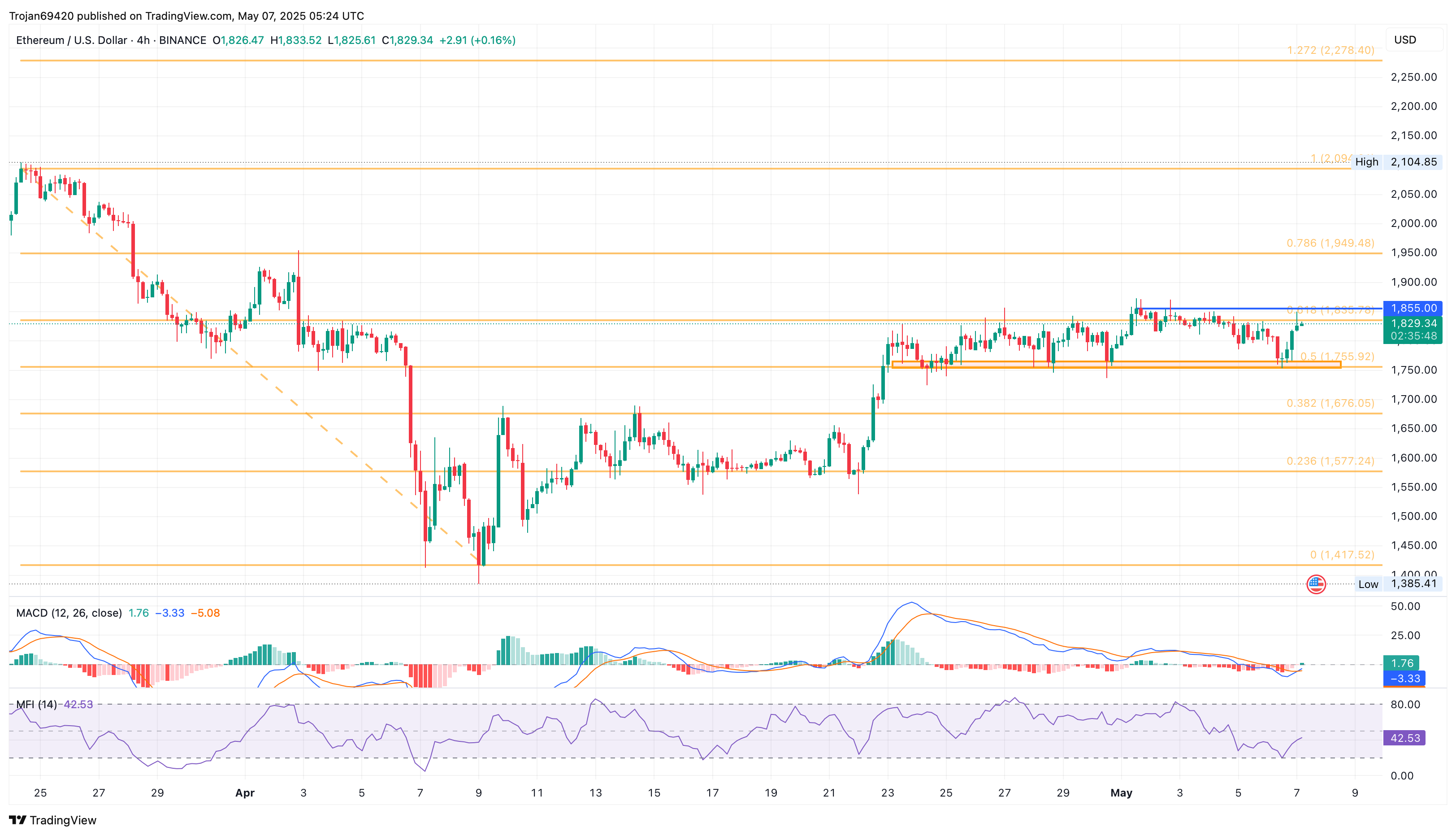
    Market analysts emphasize that the price development of Ethereum reflects an interest bully reverse pattern. The latest evening star formation near the $ 1,755 demand zone was followed by a V-shaped recovery. This movement brought ETH back to the 61.80%fibonacci retracement level at $ 1,835, which indicates strong buyer interest.

    Technical indicators such as an interest bullish MacD crossover and an RSI that has recovered from the oversold area speak for a continuing upward movement. If ETH brings the $ 1,855 brand through, analysts see the next resistance at $ 1,949, with the potential to achieve the previous swing high of $ 2,100, which means an upward potential of 25 % compared to the current level.

    Reason 2: Onchain data suggest coming Bullrun

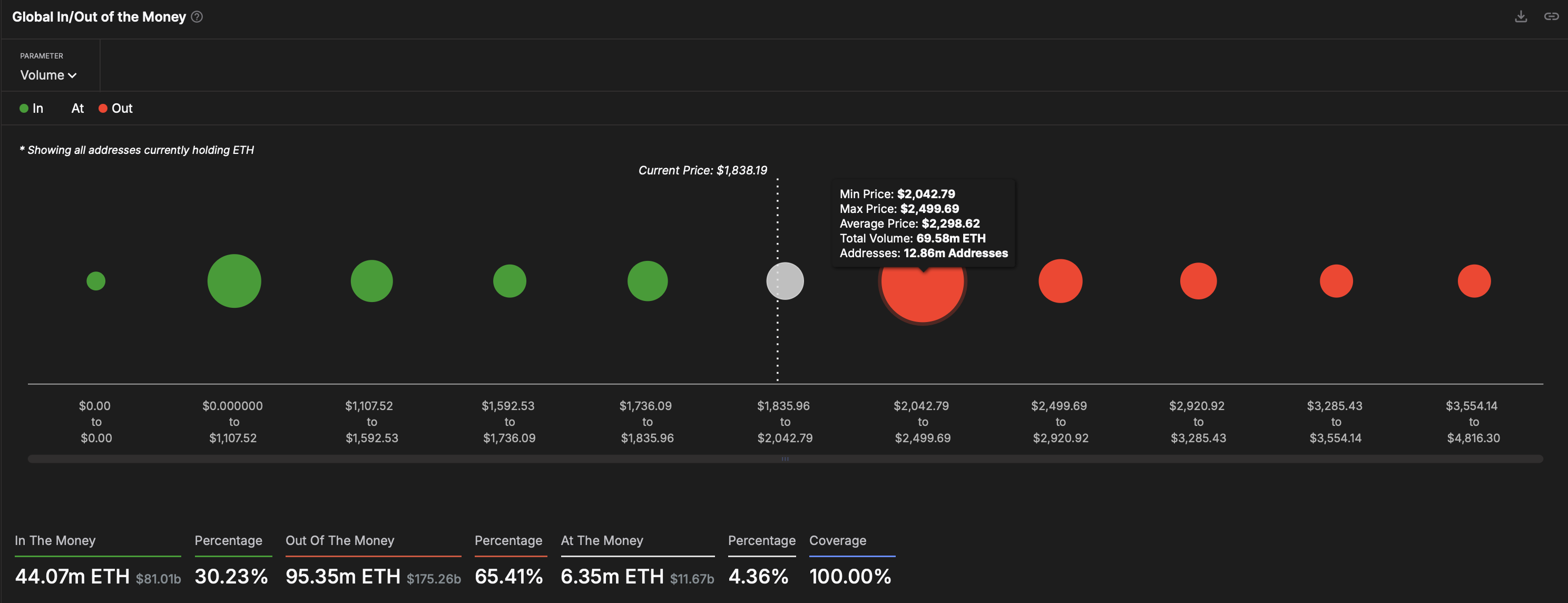
    Ethereum’s on-chain indicators further increase the potential for an outbreak. The Global in/Out of the Money Around Price (GIOM) Data from Intothlock show that 13 million addresses bought 70 million ETH between $ 2,042 and $ 2,499.

    This group of owners could create short -term resistance because they try to compensate for their losses. However, the support of around $ 1,794 marks remains Stark, where almost 7 million addresses hold 8 million ETH. This buyer concentration represents a critical price limit, which indicates that Ethereum could continue to rise if it approaches the $ 2,000 mark.

    Reason 3: whales hoard again

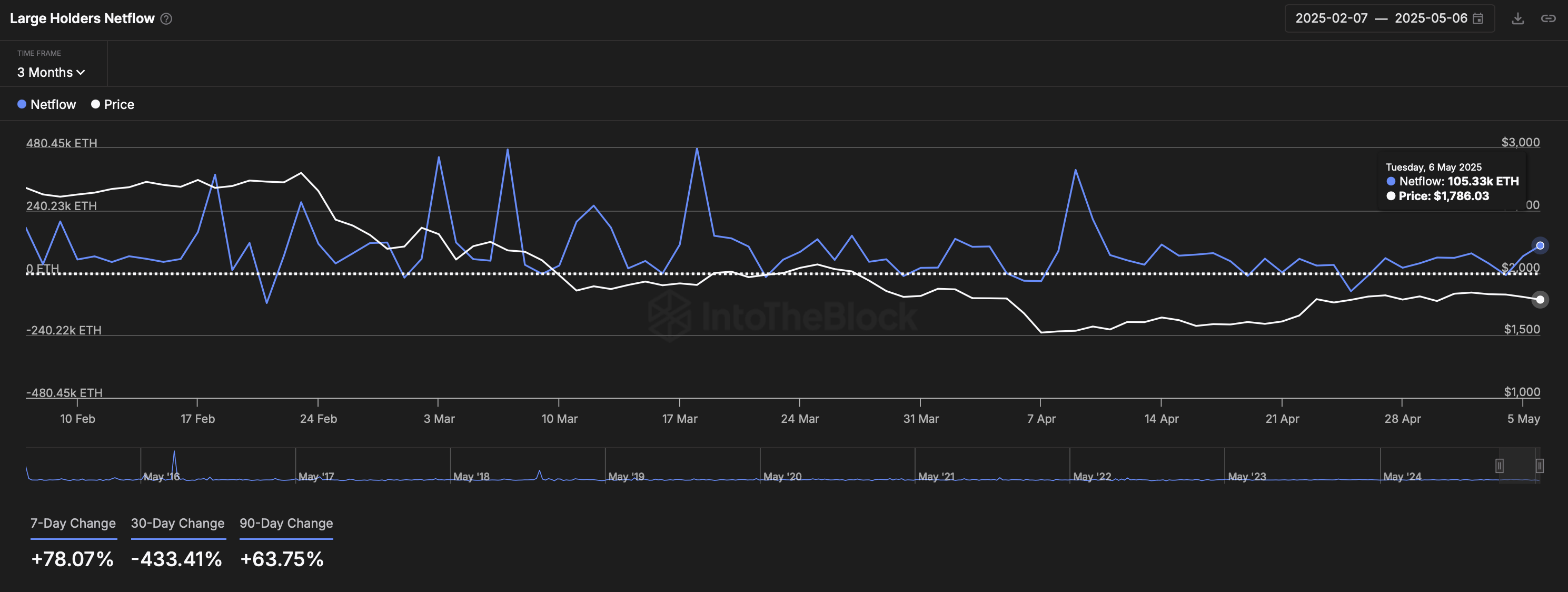
    The trust of the great Ethereum investors has also grown significantly in the run-up to the PECTRA upgrade. The net inflow of large investors rose by 78.07 % between April 29 and May 6th and rose from 37.12k to 105.33k ETH.

    These wallets, each with at least 0.1 % of the total ETH offer, usually represent institutional or long-term investors. Their increased activity is seen as a bullish signal that matches the positive technical and on-chain prospects.

    Since the PECTRA upgrade is only a few hours away, the course of Ethereum depends on both the successful implementation of these improvements and the general market mood.

  • Today is the day of the PECTRA HARD FORK for Ethereum – and for ETH there is a lot at stake for ETH

    Today is the day of the PECTRA HARD FORK for Ethereum – and for ETH there is a lot at stake for ETH


    • The first 12 minutes of the PECTRA upgrade are crucial for the stability of the network and the performance of the validator.
    • The complex client system from Ethereum requires perfect coordination of 25 possible configurations.

    The eagerly awaited Pectra Hard Fork from Ethereum comes today. The upgrade marks an important Ethereum development step and is intended to bring more scalability and security, fewer transaction costs and the introduction of smart accounts.

    The success of the Hard Fork will determine the development of Ethereum in the coming years. The PECTRA use also tests the resistance of the network after earlier test network complications have made the technical complexity of Ethereum clear.

    The first few minutes decide the network stability

    The first 12 minutes after the PECTRA upgrade are considered the most critical. This time window that includes 64 Validator slots decides whether the validators can successfully propose and attest new blocks without interruption. According to Nixo, a member of the Ethereum Foundation Protocol Support, this short time window lets the developers keep their breath because mistakes or missing blocks can occur.

    Mallesh Pai, Senior Director at Consensys, referred to the risks but also to the decades of Ethereum without a Leveness error. In previous upgrades, including Shanghai in 2023 and Altair in 2021, problems arose during similar transition windows that ranged from delays in completion and missing blocks.

    Despite extensive tests, Pectra met with considerable hurdles in the test nets. At Holesky, an error delayed the completion by two weeks. At Sepolia there were problems with the execution client due to configuration errors. These incidents meant that a third test network was set up to fix the remaining problems. The complexity of the Ethereum ecosystem-five consensus clients and five execution clients-leads to 25 combinations that have to work without errors. Pai warned that a single error could endanger the entire system.

    Long-fresh upgrade strategy

    Pectra has been in development for over 18 months and claims resources and energy from the developer community. Nixo admitted that the core teams are tired and that many “are simply tired of working on something for a year or a year and a half.. ” In order to counteract this, Ethereum plans to carry out smaller, more frequent upgrades.

    Despite these challenges, Ethereum developers continue to focus on long-term protocol improvements. The upcoming Fusaka upgrade will build on the foundation of PECTRA and aim to further improve Ethereum’s performance and security. Ethereum is dependent on stable and secure upgrades with more than $ 123 billion of stable coins and 57 % of the tokenized assets of the real world that are secured on the blockchain. Pai emphasized the importance of trust:

    “We appreciate people’s trust and will not gamble it.”

  • Ethereum pectra-upgrade comes on May 7

    Ethereum pectra-upgrade comes on May 7


    • PECTRA-UPGRADE von Ethereum is For the 7thMore gapwhereby the EOF proposal discussed is excluded.
    • Der ETH/BTC-Chart signaled potentially high volatility and pulls the Attention of the dealers.

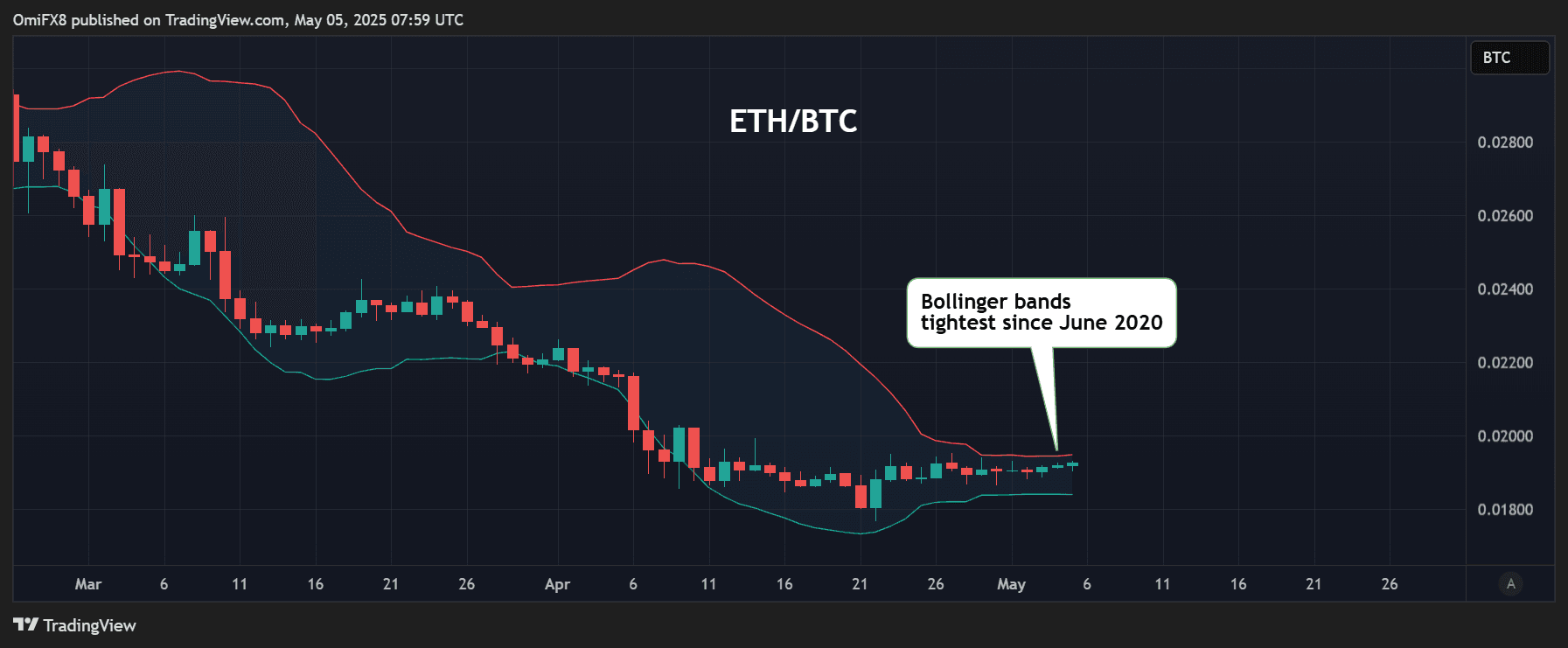
    The Ethereum-Zu-Bitcoin ratio (ETH/BTC) is currently being critically examined because a technical setup was observedthat indicates an upcoming volatility increase. The trading couple is currently on Binanceand it is obvious that the couple’s Bollinger ligaments have reached the slightest width since June last year.

    This Squeeze phase, which some referred to by some as an early sign of an outbreak, indicates that in Future big Course fluctuations are possible.

    The Bollinger ligaments, one of the most frequently used technical analysis instruments, wise an extreme notch on. This is a sign of one Lower market volatility and a recovery of the courses at the average.

    ETH/BTC's daily chart. (TradingView/CoinDesk)

    Such patterns usually occur if a asset shortly before one significant movement standsbecause he gains swing. The current signal of the indicator has prompted people to advise whether Ethereum In the near future, the upper hand will probably win from Bitcoin.

    The dealers observe The market situation with a view to the decisive outbreak. Historically means As a rule, there is a large price rash when the Bollinger tapes contract significantly.

    For some from them Could this be an opportunity for short -term trading, while estimating whether ETH will win the upper hand or fall back on BTC.

    Ethereum Pectra-Upgrade am 7. Mai

    At the same time Pectra, the next big upgrade From Ethereumconfirmed for May 7th. Tomasz Kajetan StańczakaktwitterteThe fact that the progress of the PECTRA upgrade is based on plan and that the EVM Object Format (EOF) will not use a technical standard that has been controversial recently.

    The update focuses primarily on the performance of the validator and the To improve the scalability of the blockchain and at the same time the complexity to To limit minimum.

    The ETH developers have EOF considered too problematic for the recording of this technology in the protocol. Es Could for further delays When implementing the Roadmap have led although at the beginning it should provide better smart contract efficiency.

    Fusaka time plan and development priorities

    Die next Important development, Fusaka, is provisionally intended for the third or fourth quarter of 2025. The original plan for the DEV was to start EOF together with Fusaka, but they decided this plan moving .

    During the ACDT 34 examined ETH developer Like Tim Beilko and Stanczakthat the integration of EOF in the process would only lead to delays, especially during Peerdas, a completely independent critically Development for the scalability of Ethereum, should be completed.

    As indicated by Beiko, the his Explanation on Github posted, he was not for the premature assumption of EOF; Deleting the element was the result of a technical matter that was unclear And the unexplained effects of this support.

    A number of developers the way did not like how The evaluation process was carried outand Beiko admitted that no adequate communication and planning took place.

    Ethereum now tends to stability rather than innovation. Fusaka continues without EOF and the preparation will be Before the upgrade Glamsterdam revised become.

  • Ethereum news: Does a system simplification strengthen the trust of investors?

    Ethereum news: Does a system simplification strengthen the trust of investors?


    • Vitalik Buterin proposes Beam Chain and RISC-V to reduce the complexity of the Ethereum system protocol.
    • Despite ETF inflows and positive signals, ETH fights under $ 2,000 before the Pectra upgrade on May 7th.

    Ethereum is traded near $ 1,800 because investors are waiting for the Pectra upgrade on May 7th and Vitalik Buterins evaluate proposed protocol changes.

    Buterin has proposed to replace the Beacon Chain with Beam Chain and switch the EVM to RISC-V to reduce complexity.

    Redesign should reduce complexity

    In a recently published Blog post He wrote that the complexity of Ethereum leads to security and cost problems in the long term. He says the Bitcoin protocol is much easier:

    “Every clever high school student could understand it, and hobby programmers could easily create clients.”

    This is not the case with Ethereum’s execution layer, which the Ethereum Virtual Machine (EVM) uses. According to the butterin, this is because she is still optimized for outdated cryptographic operations. He wants to change that. He suggests taking over the RISC-V architecture, which could make the execution up to 100 times more efficient.

    That would have some problems with the downward compatibility, but he has a gradual approach in mind to migrate the consensus to a native RISC V environment. He also suggests replacing the Beacon Chain with the Beam Chain to simplify the peer-to-peer infrastructure.

    In this way, Ethereum, in his opinion, could reduce the development costs, minimize the risk of errors and achieve a stronger participation of the community in protocol development. He believes that this could happen with some coordinated upgrades within five years.

    Technical charts show uncertainty – ETH tests support zones

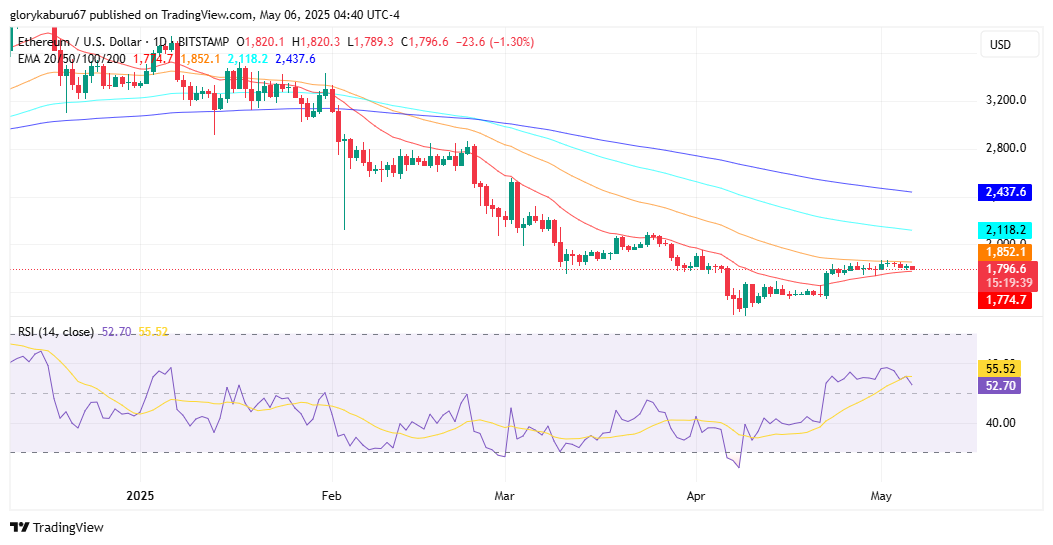
    According to Buterin’s blog post, the price of Ethereum fell 1 % and is currently traded at $ 1,803.51. ETH has not managed to rise over the 9-week exponential moving average (EMA) since January. Ethereum printed a Doji candle last week, which reflects the uncertainty between buyers and sellers. A rejection of the EMA level indicates a declining upward moment.

    ETH/USD Daily Chart.quelle: Tradingview

    According to the youngest CNF-Analyse ETH shows a tight Bollinger band squeeze at the ETH/BTC couple, which was last observed in June 2020. Such a squeeze usually precedes a volatility outbreak.

    On the downward side, support levels must be observed at $ 1,785, $ 1,750 and $ 1,685. The resistance is $ 1,830 and $ 1,880, a further increase is limited at $ 1,920. The technical indicators show the MACD on the daily chart in the declining area and the RSI under the 50 mark, which indicates continuing pressure.

    The ETH liquidations of the last 24 hours amounted to $ 44.45 million, with $ 35.71 million in long positions. The futures data of Coinglass show the continued restraint of the dealers. The current range between $ 1,749 and $ 1,855 indicates a low pressure to buy.

    Institutional demand speaks for a positive outlook

    Sea Socal recorded US spot ETFs for Ethereum last week net inflows of $ 106.75 million. This is the second week in a row with positive tributaries and reflects the traditional interest of investors despite the recent price stagnation.

    As CNF reported, the historical performance speaks for a bullish May. Since 2016, ETH has increased an average of 27.36 % in May, and 24.65 % last year. Technical analysts indicate that the relative strength index (RSI) has once again tested a multi-level level of support, a pattern that preceded earlier relaxation.

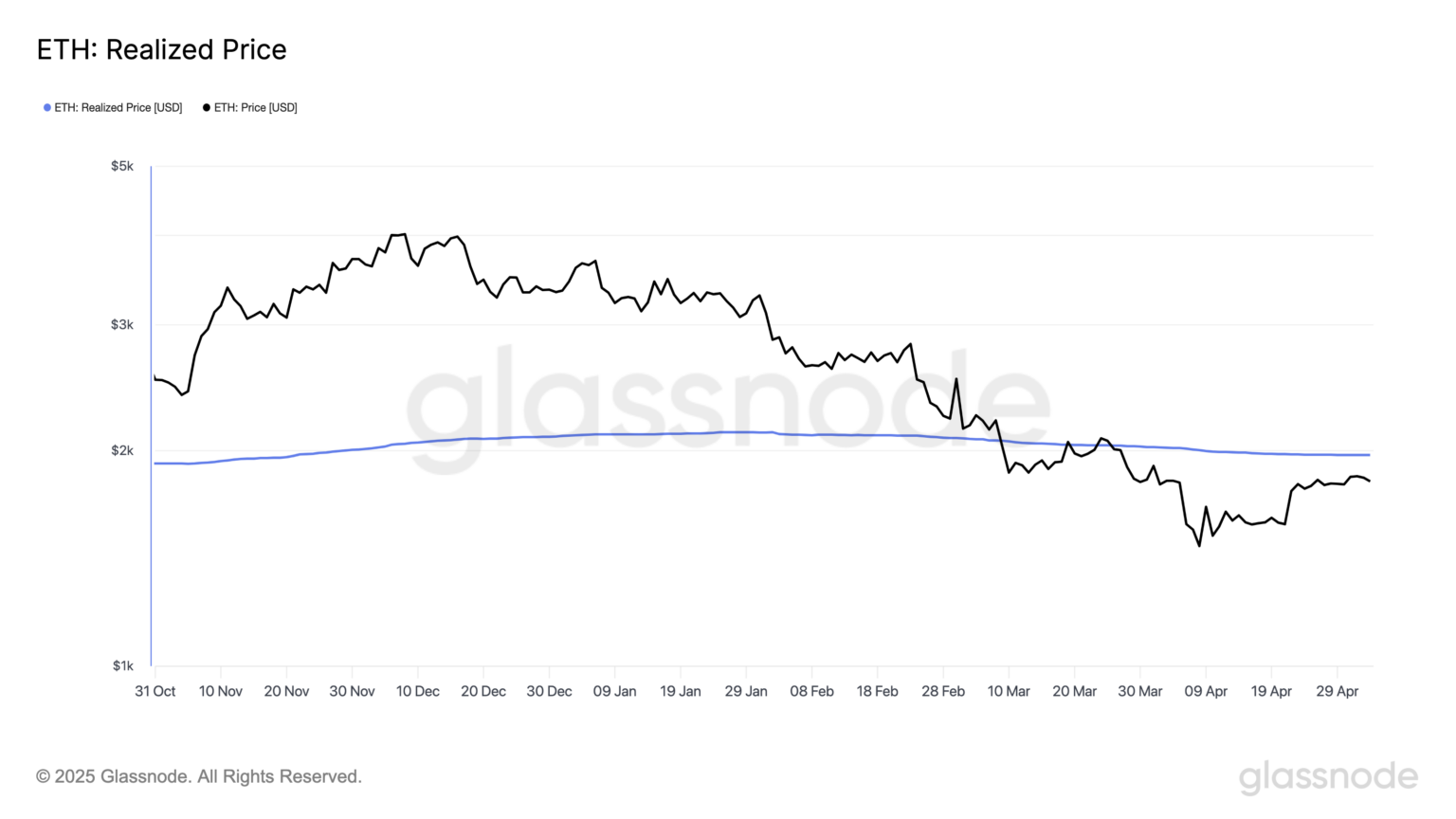
    In the meantime, Ethereum continues to act under his on-chain Realized Price of $ 1,972. This level, as from Glass node defined, the average cost basis for ETH represents in circulation. Remaining under this brand signals a weak upward dynamics and underlines the bearish mood.

    Ethereum-realized-price. Quelle. Coinglass

    The Pectra upgrade, which is planned for May 7th, aims to increase the ETH operating limits from 32 to 2,048 per validator. In addition, the number of “Blob” data units per block is increased and the transition to the EVM object format (EOF) is carried out. These changes aim at improved scalability, lower Layer 2 costs and improved Smart Contract efficiency.

    Despite these upgrades and institutional interest, Ethereum has not yet recaptured the psychological brand of $ 2,000. An outbreak of $ 1,880 could trigger a movement towards $ 2,050. Until then, the market remains careful in the run-up to the Pectra introduction.