Tag: Ethereum

  • Consensys Spins Off MetaMask as Independent Firm, Stays Silent on IPO

    Consensys Spins Off MetaMask as Independent Firm, Stays Silent on IPO

    Ethereum development firm Consensys announced plans to split into two independently operated companies, separating its MetaMask wallet business from the Ethereum protocols and institutional blockchain infrastructure it has built over the past decade.

    New Corporate Structure

    The existing company, Consensys Software Inc., will rebrand as MetaMask under Ethereum co-founder Joe Lubin as chairman and CEO.

    Its protocols group and institutional infrastructure business, including the Linea blockchain, will move into a newly formed company retaining the Consensys name.

    Leadership Changes

    The separation, expected to be completed by the end of 2026, would see Mike Kriak lead the new Consensys as CEO. That firm would include David Cunningham as president and Lubin as executive chairman.

    The new Consensys entity will focus on developing Ethereum infrastructure and helping financial institutions deploy blockchain systems for tokenized assets, stablecoins, and settlement.

    IPO Plans Delayed

    The restructuring comes after Consensys pushed back a potential U.S. initial public offering (IPO) until this fall at the earliest, citing poor market conditions. The company had reportedly engaged JPMorgan and Goldman Sachs to lead the process.

  • Assessing Ethereum’s 2027 Upgrade: How It Could Redefine ETH Utility

    Assessing Ethereum’s 2027 Upgrade: How It Could Redefine ETH Utility

    Scalability remains a perpetual challenge for every Layer 1 blockchain. As competition intensifies, demonstrating network capabilities becomes critical to attracting users. For most blockchains, this means improving fundamentals such as speed, throughput, and finality. Ethereum, however, appears to be pursuing a different strategy.

    Ethereum’s Frames Upgrade Introduces Stablecoin Gas Payments

    In the Frames (EIP-8141) upgrade shared by Vitalik Buterin on X, Ethereum developers are working on a transaction model that would allow users to pay gas fees with stablecoins instead of $ETH. The update immediately drew market attention, with the reaction being generally bullish.

    Fee Market Implications: Decoupling Gas from $ETH

    When analyzing the upgrade’s impact on the fee market, the narrative may surprise some observers. The reasoning is purely logical: Ethereum fees are linked to the value of $ETH because they are paid directly in the native cryptocurrency. Every transaction creates demand for $ETH, directly affecting its price. The proposed upgrade changes this dynamic by allowing users to pay fees in stablecoins, which decouples gas costs from the value of Ethereum’s native token.

    Stablecoin Dominance Fuels Ethereum’s Utility Narrative

    Despite a recent slowdown in stablecoin market capitalization, the sector still hit a record $320 billion in H1. This matters because financial institutions globally continue to view stablecoins as a more efficient tool for cross-border payments and settlements. Naturally, the Layer 1 networks capturing the most stablecoin liquidity are becoming the key utility networks.

    The logic is straightforward: the more stablecoins move through a chain, the more relevant that network becomes for overall DeFi activity. Ethereum already holds a significant advantage in this regard. The network hosts nearly 50% of total stablecoin liquidity, totaling approximately $147 billion. Given this substantial concentration, Ethereum’s ‘utility’ narrative is clearly picking up.

    EIP-8141 Targets Mass Adoption for Next DeFi Cycle

    This context likely explains the thinking behind EIP-8141. As the analyst pointed out, the ultimate goal is “mass adoption.” The stablecoin market is growing, use cases are expanding, and Ethereum already hosts over 50% of this segment. Enabling users to pay gas fees in stablecoins could make Ethereum significantly more accessible.

    Users would no longer need to buy $ETH solely to cover transaction fees. Instead, they could make payments directly with the stablecoins they already hold. In this context, EIP-8141 is positioned to become a critical layer for $ETH‘s next growth phase. With rising stablecoin adoption, the upgrade will enable Ethereum to capture more utility and potentially facilitate an $ETH-based DeFi cycle in late 2026 and 2027.

  • Trezor Expands Clear Signing Support with ERC-7730 Integration

    Trezor Expands Clear Signing Support with ERC-7730 Integration

    Trezor has officially integrated clear signing support through the ERC-7730 standard, marking a significant advancement for transaction transparency on the Ethereum network. The announcement, highlighted by the Ethereum Foundation, addresses a critical need for users to fully comprehend the details of what they are authorizing, thereby fostering a safer environment for decentralized finance (DeFi) interactions.

    Hardware Wallet Leader Advances Transaction Clarity

    As a prominent hardware wallet provider recognized for its security-first approach, Trezor’s adoption of ERC-7730 is effective immediately. This functionality allows the device to display human-readable transaction data, moving away from opaque hexadecimal strings that can obscure malicious intent or simple errors. The move underscores the growing industry consensus that clear signing is essential infrastructure for the next phase of crypto adoption.

    Ethereum Foundation Backs User Safety Standards

    The Ethereum Foundation’s endorsement of this initiative reflects its ongoing commitment to user safety and network integrity. By encouraging broader participation from hardware wallet manufacturers and decentralized application (dApp) developers, the Foundation aims to establish clear signing as a baseline expectation across the ecosystem. This collaboration signals a maturing market where user experience and security are converging to lower barriers to entry.

    Market Context and Potential Impact

    The rollout arrives while the broader cryptocurrency market exhibits mixed signals. However, analysts suggest that tangible user experience improvements—such as verifiable transaction details—could serve as a catalyst for positive sentiment. Enhanced clarity reduces the cognitive load on users and mitigates the risk of “blind signing” exploits, a persistent threat in the DeFi sector. Observers will be monitoring developer adoption rates and subsequent user engagement metrics to gauge the tangible impact on Ethereum’s transactional velocity and overall ecosystem robustness.

    What This Means for Traders and Developers

    For market participants, the focus shifts to how widely this standard is implemented across competing wallets and integrated into dApp interfaces. A critical mass of adoption could drive increased transaction volumes by restoring trust among retail and institutional users alike. Developers building on Ethereum are now incentivized to support ERC-7730 to ensure compatibility with leading hardware devices, creating a positive feedback loop for the standard’s proliferation.

    This article is for informational purposes only and does not constitute financial advice.

  • Tom Lee Outlines $6,000 Ethereum Scenario, Cites 4 Catalysts

    Tom Lee Outlines $6,000 Ethereum Scenario, Cites 4 Catalysts

    Bitcoin dipped below the $80,000 threshold as markets brace for upcoming U.S. inflation data and rising expectations of a Federal Reserve interest rate hike. While altcoins displayed mixed performance, Ethereum consolidated around the $2,480 level.

    BitMine President Tom Lee Identifies Four Catalysts for Ethereum Upside

    In a recent interview, BitMine President Tom Lee outlined a bullish case for Ethereum, suggesting the asset could climb to approximately $6,000. Lee cited four key catalysts that he believes could drive significant appreciation in the $ETH price.

    First Catalyst: The CLARITY Act

    Lee highlighted the CLARITY Act as the most critical development, describing it as the most important legislation expected to define the regulatory framework for cryptocurrencies in the United States. He projects that the bill’s passage in September could substantially increase Wall Street’s engagement with the crypto market. According to Lee, removing regulatory uncertainty would clear the path for major financial institutions to expand their operations in the digital asset space.

    Second Catalyst: Sidelined Capital Re-entering the Market

    The second catalyst involves the unwinding of idle capital and short positions that have remained on the sidelines. Lee noted that some investors exited the crypto market following the previous downturn. A sustained price recovery could compel these participants to re-enter. He specifically pointed to investors anticipating a potential cycle bottom in October based on the traditional four-year crypto cycle; if the market maintains strength, these investors may be forced to cover positions earlier than planned, adding upward pressure on prices.

    Third Catalyst: Asian Capital Rotation

    Lee identified a rotation of Asian capital toward crypto assets as the third driver. He observed that investors in markets such as South Korea, who had previously concentrated on local equities, are refocusing on cryptocurrencies. Lee believes this inflow could boost demand across the market, with Ethereum standing as a primary beneficiary.

    Fourth Catalyst: Institutional FOMO into Quarter-End

    The final catalyst centers on corporate FOMO (fear of missing out). Lee argued that if Ethereum sustains its momentum through the end of the third quarter in September, underperforming fund managers may pivot into $ETH and other digital assets to salvage fourth-quarter returns. This institutional chasing of performance could trigger a notable price rally.

    The $6,000 Price Target Scenario

    Lee’s $6,000 price target is derived from a valuation model based on the ETH/BTC trading pair. He calculates that if the ratio rises from current levels to 0.04 while Bitcoin reaches $150,000, Ethereum would trade near $6,000. Lee characterized this scenario as conservative, noting that the ETH/BTC ratio peaked near 0.08 during the 2021 bull market. He maintains that the four catalysts outlined above provide fundamental support for such a move.

    Disclaimer: This content is for informational purposes only and does not constitute investment advice.

  • BlackRock’s BUIDL Outpaces Circle’s USYC as Tokenized Treasury Race Heats Up

    BlackRock’s BUIDL Outpaces Circle’s USYC as Tokenized Treasury Race Heats Up

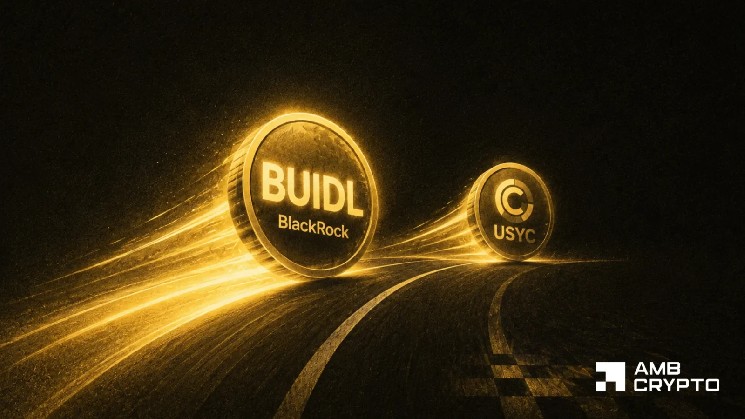
    BlackRock’s USD Institutional Digital Liquidity Fund (BUIDL) has narrowly overtaken Circle’s USYC to become the second-largest tokenized U.S. Treasury fund, highlighting the accelerating competition in the tokenized real-world asset (RWA) market.

    BUIDL and USYC compete for market share

    According to Token Terminal data, the total tokenized U.S. Treasury market is worth approximately $15.1 billion. BUIDL accounts for about $2.8 billion, giving it an estimated 18.5% market share. Nearly one-fifth of all tokenized Treasury assets are therefore held through BlackRock’s fund.

    USYC also recorded rapid growth in 2025, rising from roughly $600 million to nearly $3 billion. By late August 2026, the fund had reached approximately $2.9 billion, slightly above BUIDL’s estimated $2.7 billion at that point.

    In a separate market snapshot, Sky’s uSDS ranked first with a value of $4.4 billion, followed by BUIDL at $2.28 billion. Tether’s XAUT ranked third at $2.8 billion, while Circle’s USYC was listed fourth at $2.28 billion.

    However, XAUT is classified as a tokenized commodity rather than a tokenized fund. Excluding uSDS and XAUT, BUIDL and USYC remain closely matched, meaning new institutional inflows or withdrawals could quickly change their rankings.

    BlackRock’s position may also shift rapidly because the asset manager frequently records significant inflows and outflows across its Bitcoin [BTC] and Ethereum [$ETH] exchange-traded funds (ETFs), affecting their cumulative flow totals.

    BlackRock expands its tokenized fund offering

    The competition comes as BlackRock recently launched BSTBL on Ethereum and BRSRV on Solana [$SOL]. The tokenized money market funds are designed to serve as reserve assets for stablecoins.

    The development is significant because stablecoins now represent approximately $305 billion and have become a major source of on-chain liquidity. By offering similar institutional products on both Ethereum and Solana, BlackRock is providing capital access to both ecosystems while reinforcing the competition between $ETH and $SOL for liquidity.

    By late August, USYC had reached approximately $2.9 billion, slightly above BUIDL’s estimated $2.7 billion. BUIDL has since narrowly overtaken USYC, underscoring the growing competition among tokenized Treasury funds and the broader expansion of institutional RWAs.

  • Tom Lee Makes a “Massive Bull” Bitcoin and Ethereum Prediction With One Condition

    Tom Lee Makes a “Massive Bull” Bitcoin and Ethereum Prediction With One Condition

    Tom Lee, Fundstrat’s head of research and chief investment officer, outlined his latest outlook for the Federal Reserve’s September policy decision, U.S. stocks and global markets in an interview with CNBC.

    Although September has historically been a weak month for financial markets and uncertainty remains over the path of interest rates, Lee said markets could deliver an upside surprise contrary to prevailing expectations.

    September Fed meeting seen as market turning point

    Lee described the Fed meeting on September 15th as a critical turning point. He said that if the central bank leaves interest rates unchanged, stock markets could trigger a very strong rally.

    According to Lee, a major market correction could be delayed until October. Alternatively, stocks could see only a limited pullback after the S&P 500 rises above the 8,000-point level.

    Crypto market recovery could accelerate

    Lee also said the periodic slowdown in the cryptocurrency market, often referred to as a “crypto winter,” had been relatively shallow and was approaching its end. He noted that crypto assets became the best-performing macro asset class during the third quarter of the year.

    With institutional investors increasingly turning to crypto stocks, Lee said investor interest could return quickly as the four-year crypto cycle reaches its conclusion in the coming days.

    The analyst identified potential regulatory changes as the sector’s biggest catalyst, stating:

    “If the CLARITY Bill passes Congress this year, Bitcoin and Ethereum will have an extremely strong and massive fourth quarter.”

    This is not investment advice.

  • Analyst Reveals Top Altcoins to Buy as Market Enters an Altcoin Supercycle

    Analyst Reveals Top Altcoins to Buy as Market Enters an Altcoin Supercycle

    Crypto Analyst Says Altcoin Super Cycle Has Begun, Names Four Coins He Holds

    Crypto analyst Ran Neuer says the market has entered a distinct altcoin super cycle, supported by a nine-year technical breakout that many traders have overlooked. He also identified the specific cryptocurrencies he is personally holding for the current phase of the market.

    According to Neuer, the cycle is being driven by renewed enthusiasm for altcoins rather than Bitcoin strength. He pointed to the ETH/BTC ratio as evidence, tracing its long-term pattern to Ethereum’s earliest use case: transferring digital value through smart contracts without human intervention.

    That use case helped trigger the 2017 initial coin offering boom before the ratio entered a prolonged downtrend as the technology struggled to deliver on its promises.

    “After a 9-year downtrend on the weekly, this is now breaking out,”

    Neuer said the breakout confirms a structural rotation into altcoins rather than a temporary market bounce.

    1. Solana

    Neuer named Solana as one of two winners of what he describes as the completed “L1 war.” He holds Solana directly and calls it “the second winner” in his broader investment thesis.

    He argues that Solana has effectively captured crypto-native onboarding, giving the network a strong position among users entering the cryptocurrency ecosystem through blockchain-native applications.

    2. Ethereum

    Alongside Solana, Neuer identified Ethereum as the other Layer 1 winner. He credited Ethereum’s integration with Base and Robinhood with helping it capture real-world asset onboarding, a channel that differs from Solana’s crypto-native user base.

    Neuer argues that the two networks have absorbed most of the long-term value in the Layer 1 sector, leaving him uninterested in other Layer 1 tokens.

    “I wouldn’t really invest in any other L1s because I just don’t think there’s any upside in the L1s,”

    Neuer said.

    3. Hyperliquid

    Neuer described Hyperliquid as the strongest active use case in crypto and said he holds the token directly. He cited its tokenomics and its role as an exchange as key reasons for his conviction.

    He also said he would buy Hyperliquid even at its current all-time high, arguing that the market is mispricing the token by focusing on fully diluted valuation, or FDV, without accounting for staking-driven scarcity.

    “Crypto is a function of scarcity times pressure,”

    Neuer said.

    “The buying pressure plus the staking pressure plus the actual buying pressure divided by the number of tokens in circulation creates insane pressure on the way up.”

    4. Zcash

    Neuer’s most aggressive individual call focuses on Zcash, the privacy-focused cryptocurrency that recently gained ETF backing. He argued that Zcash could develop into a dominant form of “private money” and outlined a specific scaling scenario linked to Bitcoin’s market capitalization.

    “I think the upside on Zcash from here is 10x, maybe 100x,”

    Neuer said.

    Neuer Still Holds Bitcoin

    Neuer’s confidence in altcoins does not come at Bitcoin’s expense. He remains bullish on Bitcoin because of continuing concerns about currency debasement, but views it as one component of a broader portfolio rather than the primary growth trade of the current cycle.

    What Comes Next for the Altcoin Market

    Beyond his four named holdings, Neuer believes investor attention is moving away from competition between blockchain infrastructure projects and toward application-layer projects that operate more like businesses.

    In his view, the strongest opportunities will involve assets with genuine user growth, sustainable revenue and a mechanism for distributing that revenue to token holders.

  • Ethereum Reclaims Key Level After 108 Days: Why $2,500 Matters Next

    Ethereum Reclaims Key Level After 108 Days: Why $2,500 Matters Next

    Ethereum’s 30% weekly rally has brought its first major conviction test at $2,500. The level remains important because demand had been building for months near the lower end of the $1,900-$2,050 range.

    After that supply was absorbed, buyers moved quickly through $2,568 as trading volume surged, signaling stronger participation behind the breakout. However, Ethereum’s advance stalled just below $2,458, suggesting that bulls had not yet established a firm support floor at $2,500.

    Ethereum faces key support and resistance levels

    The pause remains significant because price is currently absorbing activity near the approach to the breakout highs. Even so, the market structure does not yet indicate that the rally has triggered widespread profit-taking.

    Ethereum’s Relative Strength Index also appeared to support this view. The RSI declined from above 90 to 70.81 at the time of writing without a corresponding drop in price.

    If buyers can reclaim $2,500, Ethereum could gain momentum for a continuation toward the previous breakout area near $2,568. Conversely, a decline below $2,426 could signal increasing bearish pressure.

    Ethereum reclaims realized price after 108 days

    Ethereum’s move toward $2,500 has also changed the position of holders relative to their average cost basis. After spending 108 days below it, ETH reclaimed its realized price—the average amount collectively paid by all holders for their ETH.

    When the market price moves back above the realized price, holders are collectively positioned with at least some unrealized gain. This can reduce selling pressure because investors near breakeven have less incentive to sell merely to recover their initial capital.

    With fewer holders underwater, Ethereum could see lower selling pressure and stronger buying demand. However, this shift will become meaningful only if ETH remains above its realized price. Sustained closes above that level would reinforce the recovery, while a renewed decline could place sellers back into an unrealized-loss position.

    Ethereum ETF inflows strengthen institutional demand

    Institutional investors are adding fresh capital to Ethereum as the broader market trend improves. Weekly inflows into Ethereum investment products reached $824.42 million, up from $697.18 million the previous week.

    These inflows indicate that institutions increased their exposure as ETH approached $2,500 rather than reducing their positions after the rally.

    SoSoValue data shows that total ETF assets rose from $10.52 billion on August 14 to $15.23 billion, representing a reported 5.28% increase and strengthening institutional ownership.

    Sustained ETF buying can absorb available supply and help buyers defend higher prices during pullbacks. However, the strength of recent inflows has not yet secured a lasting move above $2,500.

    Continued inflows combined with closes above that level would provide stronger evidence that institutional demand is supporting lasting price acceptance.

    Ethereum has reclaimed its realized price as ETF demand supports the recovery. Rising institutional inflows and improving holder profitability are strengthening ETH’s attempt to break above $2,500.

    Source: cryptonews.net
  • BNB Chain Captures 50% of Tokenized Equities: What’s Driving the Surge?

    BNB Chain Captures 50% of Tokenized Equities: What’s Driving the Surge?

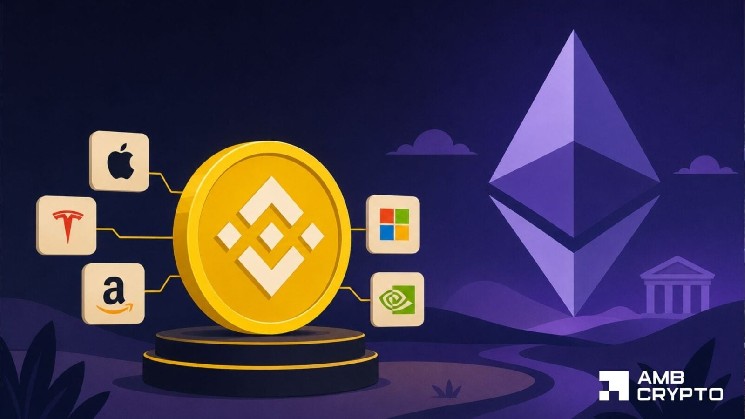
    BNB Chain has emerged as the leading blockchain for tokenized equities after the launch of bStocks, overtaking Ethereum in total tokenized-equity supply. Before bStocks launched, Ethereum held the largest supply, while BNB Chain remained below $500 million despite months of gradual growth.

    Growth accelerated after June. By the end of August, BNB Chain’s tokenized-equity supply had surpassed $1.3 billion, compared with approximately $800 million on Ethereum. Solana also increased its tokenized-equity supply to around $550 million, while Avalanche remained near $170 million and smaller networks attracted only minimal amounts.

    According to BlockWorks data, BNB Chain now accounts for nearly 50% of the sector’s total supply, which stands at approximately $2.9 billion. In addition to providing greater liquidity, bStocks offers two advantages that traditional shares do not: 24/7 settlement and composability.

    bStocks drives BNB Chain’s tokenized-equity growth

    BNB Chain’s broader lead is largely concentrated in bStocks rather than being evenly distributed across the network’s tokenized-equity ecosystem.

    bStocks has accumulated more than $500 million in assets under management (AUM) since June and now supports more than 67 active assets, according to data from BNBChain.org.

    Trading volume has already exceeded $19 billion, indicating that the assets are actively circulating rather than simply remaining issued on-chain. On a narrower measure of tokenized equities and assets, bStocks typically represents more than half of the available tokenized-equity supply.

    Continued use of bStocks for new issuances and trading could further strengthen BNB Chain’s position as the leading decentralized exchange platform. However, a slowdown in bStocks activity would highlight the network’s reliance on the bStocks product family.

    BNB Chain’s broader RWA market share still trails Ethereum

    BNB Chain’s tokenized-equity lead becomes less dominant when viewed across the wider real-world asset (RWA) market. BNB Chain represents $5.7 billion of the $38.4 billion total distributed RWA market, giving it approximately 15% of the sector.

    Ethereum remains the largest RWA network, with $17.27 billion and an estimated 45% market share. Solana follows BNB Chain with $4.06 billion. As a result, BNB Chain’s leadership in tokenized equities has not yet translated into comparable dominance across the broader RWA market, according to RWA.xyz.

    BNB Chain continues to expand in tokenized equities, while Ethereum attracts capital across multiple asset classes. That broader diversification increases Ethereum’s overall liquidity and reduces its reliance on a single RWA segment.

    Expansion into Treasuries and funds could help BNB Chain diversify demand and retain more capital. Without that growth, a slowdown in tokenized-equity activity could limit BNB Chain’s ability to close Ethereum’s overall RWA lead.

    Key takeaway

    BNB Chain now leads the tokenized-equity market, largely because of bStocks’ rapid growth. Ethereum, however, continues to dominate the broader RWA market with an approximately 45% share.

  • BlackRock Secures Over $3.1 Billion in Cryptocurrency Inflows in 8 Days

    BlackRock Secures Over $3.1 Billion in Cryptocurrency Inflows in 8 Days

    Bitcoin (BTC) and Ethereum (ETH) have spearheaded a broad cryptocurrency market recovery over the past two weeks, prompting a massive accumulation spree by BlackRock Inc. (NYSE: BLK). The asset management giant acquired more than $3.1 billion in crypto assets across eight consecutive trading sessions, according to on-chain data analyzed by Finbold on August 28.

    BlackRock’s Bitcoin and Ethereum ETFs Lead $3.16 Billion Buying Spree

    Data from Arkham Intelligence reveals that BlackRock’s iShares Bitcoin Trust (IBIT) purchased a total of 22,722 BTC, valued at approximately $2.2 billion, during the eight-day window. Simultaneously, the iShares Ethereum Trust ETF (ETHA) accumulated 385,633 ETH, worth roughly $961 million. Combined, the purchases total approximately $3.161 billion. Both funds received the assets from Coinbase Prime, the institutional prime brokerage platform operated by Coinbase Global Inc. (NASDAQ: COIN).

    IBIT and ETHA on-chain transactions. Source: Arkham Intelligence.

    Record Inflows Swell IBIT Holdings to $62.3 Billion

    The buying pressure aligns with historic cash inflows into BlackRock’s Bitcoin vehicle. Metrics from SoSoValue show IBIT recorded nine consecutive days of net inflows totaling $2.302 billion between August 17 and August 27. Consequently, IBIT’s total Bitcoin holdings surged to $62.29 billion at the time of reporting.

    IBIT daily cash flow. Source: SoSoValue.

    Ethereum Products See Sustained Momentum

    BlackRock’s Ethereum exposure is also expanding rapidly. The iShares Staked Ethereum Trust ETF (ETHB) has attracted $130.54 million in net inflows over the past two months, lifting its total net assets to $872 million. Since inception, ETHB has experienced only a single month of outflows—$10.06 million in June.

    ETHB daily cash flow. Source: SoSoValue.

    Meanwhile, the flagship iShares Ethereum Trust (ETHA) posted nine straight days of inflows amounting to a net $1.02 billion. This streak pushed ETHA’s net assets to approximately $8.63 billion.

    ETHA daily cash flow. Source: SoSoValue.

    Total Crypto Portfolio Nears $72 Billion

    Cumulatively, BlackRock’s cryptocurrency portfolio across its exchange-traded products reached nearly $71.79 billion as of Friday, underscoring the firm’s dominant position in the institutional digital asset landscape.

    Featured image via Shutterstock.