Tag: Ethereum

  • Bitcoin Price Gains 44% for Second-Best Q3 as Ethereum Jumps 71%

    Bitcoin Price Gains 44% for Second-Best Q3 as Ethereum Jumps 71%

    Key Highlights

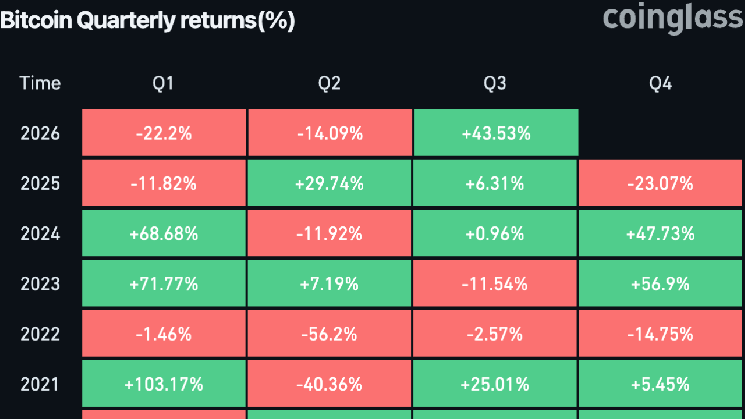
    • Bitcoin surged approximately 43.5% in Q3 2026, rising from roughly $58,500 to around $84,000, marking its second-best third quarter on record behind only the 80.4% gain in 2017.
    • Ethereum outperformed with a 71% quarterly advance, surpassing its previous Q3 record of 66.5% set in 2025 and establishing its strongest summer rally ever.
    • Both assets cleared key technical hurdles including the September 25 quarterly options expiry, with Bitcoin reclaiming critical investor cost-basis levels and showing strengthened ETF demand alongside restrained profit-taking.

    Bitcoin and Ethereum Break Historical Q3 Patterns

    Cryptocurrency markets have transformed what is typically one of the calendar’s quieter quarters into one of the strongest periods in digital asset history. Bitcoin’s price has gained roughly 43.5% during Q3 2026, climbing from about $58,500 at the quarter’s start to approximately $84,000 as of September 26. This performance puts the quarter on track to become Bitcoin’s second-best Q3 ever, trailing only the approximately 80.4% surge recorded in 2017.

    Ethereum has delivered an even more remarkable showing. According to Coinglass data, ETH has risen 71% this quarter, exceeding its previous Q3 record of about 66.5% set in 2025. The move marks Ethereum’s strongest summer rally on record, defying the historical pattern where July, August, and September often produce flat or modest returns compared with typically stronger fourth-quarter periods.

    Analysts Call Performance Extraordinary

    The combination of both major assets posting historic quarterly gains simultaneously has drawn significant attention from market observers. Crypto analyst Luciano described the developments as extraordinary, writing on X that this is the 2nd best quarter ever recorded for BTC and the best quarter $ETH has ever had. The significance extends beyond raw percentage gains, as both assets enter the final stretch of September with established momentum ahead of a quarter that has historically attracted greater speculative interest.

    Bitcoin Clears Technical Hurdles and Cost Bases

    The rally’s foundation appears to rest on more than derivatives speculation alone. Bitcoin has moved back above several investor cost-basis levels that previously capped recovery attempts. Exchange-traded fund demand has strengthened, spot trading volume has increased, and profit-taking remains relatively restrained compared with previous market peaks.

    Bitcoin’s price also held firm through the large September 25 quarterly options expiry, an event carrying substantial open interest that had the potential to generate significant short-term volatility. With that hurdle now behind the market, attention is shifting toward the next major onchain resistance level near the mean MVRV price around $96,700. A move toward that zone would again place Bitcoin within striking distance of the psychological $100,000 level.

    Why This Matters

    The historic Q3 performance fundamentally alters the setup for what has traditionally been cryptocurrency’s strongest seasonal quarter. Q4 has historically outperformed Q3 for digital assets, and the current momentum—combined with stronger ETF demand, improving spot market activity, and lighter profit-taking than at prior peaks—creates a potentially powerful launching pad. However, the immediate test centers on whether buyers can continue absorbing supply as Bitcoin trades in the mid-$80,000 range. If demand sustains, what is already a historic third quarter could become the foundation for an even more consequential fourth quarter, potentially accelerating institutional adoption narratives and broader market participation.

    Frequently Asked Questions

    How does Bitcoin’s Q3 2026 performance compare historically?

    Bitcoin’s approximately 43.5% gain in Q3 2026 represents its second-best third quarter on record, behind only the 80.4% surge in Q3 2017. It also marks Bitcoin’s best Q3 performance since 2013.

    What records did Ethereum set this quarter?

    Ethereum’s 71% quarterly advance surpassed its previous Q3 record of 66.5% set in 2025, establishing its strongest summer rally on record according to Coinglass data.

    What technical levels are traders watching next for Bitcoin?

    The next major onchain resistance sits near the mean MVRV price around $96,700. A move toward that level would bring Bitcoin back within striking distance of the psychologically significant $100,000 threshold.

  • Peter Brandt Labels XRP “Fool Coin” in Controversial Comments

    Peter Brandt Labels XRP “Fool Coin” in Controversial Comments

    Key Highlights

    • Veteran trader Peter Brandt reiterated his long-standing skepticism toward XRP, labeling it a “dumb coin” and questioning its tokenomics despite Ripple’s expanding bank partnerships.
    • Brandt draws a sharp fundamental distinction between Bitcoin as a “store of value” and XRP as a transaction-focused asset, arguing utility alone does not drive token price appreciation.
    • The trader expressed a more favorable view on Ethereum and Solana, calling Ethereum a “good asset” with upside potential, while maintaining Bitcoin as his preferred core portfolio holding.

    Brandt Doubles Down on XRP Skepticism Amid Ripple Progress

    Senior market trader Peter Brandt has reaffirmed his bearish stance on XRP, stating that recent developments within the Ripple ecosystem—including widespread collaborations with global banking institutions—have failed to alter his fundamental assessment of the asset. During a recent interview, Brandt was pressed on whether Ripple’s institutional momentum and technological advancements warranted a reassessment. He responded by maintaining his skepticism, emphasizing that structural questions surrounding the token’s supply dynamics and value accrual mechanism remain unresolved.

    A Fundamental Taxonomy: Store of Value vs. Transaction Utility

    Central to Brandt’s thesis is a categorical distinction between crypto assets based on their primary utility. He characterizes Bitcoin primarily as a “store of value,” acknowledging its current speculative trading nature while attributing to it monetary properties akin to digital gold. In contrast, he views XRP as an asset designed explicitly for transactional throughput and cross-border settlement. This classification leads him to a blunt appraisal: he directly referred to XRP as a “dumb coin,” arguing that its transactional efficiency does not inherently translate into investment merit.

    Utility Does Not Equal Value Accrual

    When challenged on XRP’s proven ability to facilitate cheap, rapid transactions, Brandt conceded the technical point but rejected the investment conclusion. He cited the U.S. dollar as a parallel: a fiat currency used globally for highly effective transactions that no holder expects to appreciate in value solely because of its velocity. “Just because something can be used in transactions doesn’t automatically mean it has to be more valuable,” Brandt stated. He posited that the critical unanswered question for XRP is at what inflection point transactional volume converts into genuine economic value for the token itself, rather than merely benefiting the Ripple network infrastructure.

    Diverging Views on Ethereum and Solana

    Brandt’s critique does not extend uniformly across the altcoin landscape. He spoke positively of Ethereum, describing it as a “good asset” and expressing confidence that both Ethereum and Solana possess the potential to reach higher valuation levels. He places these networks in a separate category from both Bitcoin and XRP—platforms upon which applications are built—suggesting they warrant a distinct valuation framework. Ultimately, Brandt disclosed a personal portfolio preference heavily weighted toward Bitcoin, reinforcing his conviction in the premier cryptocurrency’s monetary role over utility-focused alternatives.

    Why This Matters

    Peter Brandt’s commentary carries weight due to his decades-long track record in commodity and futures trading, offering a traditional market perspective on digital asset classification. His insistence on separating “store of value” narratives from “utility token” mechanics highlights a persistent debate in crypto valuation methodologies. As Ripple continues to secure regulatory clarity—most notably the July 2023 court ruling that XRP is not inherently a security—and expands its On-Demand Liquidity (ODL) corridors with financial institutions, the market is actively testing whether enterprise adoption creates token holder value. Brandt’s dollar analogy underscores a critical tokenomics question: velocity and utility are necessary but not sufficient conditions for price appreciation without a mechanism capturing that value (e.g., fee burns, staking yields, or supply constraints). Meanwhile, his endorsement of Ethereum and Solana reflects growing institutional comfort with smart contract platforms as programmable settlement layers, a narrative driving ETF filings and allocation shifts in 2024.

    Frequently Asked Questions

    What specific concerns did Peter Brandt raise about XRP’s tokenomics?
    Brandt highlighted “question marks regarding the total supply and whether it would expand in the future,” suggesting uncertainty over XRP’s emission schedule and escrow release mechanism undermines its credibility as a scarce store of value.
    How does Brandt differentiate Bitcoin from XRP and Ethereum?
    He categorizes Bitcoin as a “store of value” asset, XRP as a transaction-focused utility token, and Ethereum (alongside Solana) as an application platform layer—arguing each requires a distinct valuation framework rather than a one-size-fits-all approach.
    Does Peter Brandt hold any XRP or recommend it as an investment?
    No. Brandt explicitly maintained his skepticism, called XRP a “dumb coin,” and stated he prefers Bitcoin for the majority of his cryptocurrency portfolio. The source includes a disclaimer: “This is not investment advice.”
  • Circle Executive Warns Germany’s 50% Crypto Tax Rule Could Hit Retail Investors

    Circle Executive Warns Germany’s 50% Crypto Tax Rule Could Hit Retail Investors

    Key Highlights

    • Germany proposes a 50% default tax base for crypto assets acquired after December 31, 2026, combined with a flat 25% capital gains tax plus solidarity surcharge totaling 26.375%.
    • Circle’s Patrick Hansen warns the framework will disproportionately hit retail investors who cannot provide clean acquisition cost documentation, potentially taxing nonexistent gains.
    • The regime is projected to generate €160 million ($182.2 million) in 2028, rising to €350 million ($398.7 million) annually by 2031, with withholding mechanisms starting in 2028.

    Germany’s Proposed Crypto Tax Framework Sparks Industry Concern

    Germany’s proposed cryptocurrency taxation framework has placed local industry stakeholders on high alert due to its significant implications for retail investors. The draft legislation introduces a default 50% tax base for crypto assets where acquisition costs cannot be verified, alongside a flat 25% levy on capital gains plus a 5.5% solidarity surcharge—bringing the effective rate to 26.375%. This represents a fundamental shift from the current framework, under which retail investors generally owe no tax when cashing out Bitcoin or other cryptocurrencies after holding them for the required period.

    Circle’s Patrick Hansen Warns of Disproportionate Impact on Retail Investors

    Patrick Hansen, who leads policy and strategy at Circle—the largest issuer of stablecoins licensed under the EU’s Markets in Crypto-Assets (MiCA) framework—has emerged as a vocal critic of the proposal. In a post on X, Hansen detailed why the default 50% tax base is problematic for ordinary investors.

    “This will hit normal consumers/investors particularly hard. People who don’t even notice this regulatory change, who can’t technically provide their acquisition costs in a clean way, and who in recent years have sometimes bought with little profit or even at a loss,”

    Hansen wrote.

    Hansen emphasized that he wishes the tax draft would not come into effect. He explained that once the provisions take effect, failure to provide evidence of purchase costs will result in tax authorities treating assets purchased after 2026 as taxable, effectively taxing half of the income earned based on the state’s assumption that the asset’s value has doubled. Hansen argued this assumption appears overly optimistic given Bitcoin’s annual declines and the poor performance of many altcoins, noting the framework could force people to pay taxes on nonexistent gains.

    “In my view, the average Joe will end up paying far too much tax if this isn’t adjusted, especially if – as I fear for many – he can’t provide his acquisition costs in a clean and convincing way,”

    he further asserted.

    Legal Expert Highlights Documentation Requirements and Uncertainty

    Dr. David Hötzel, associate partner at the Poellath law firm, contended that the 50% figure is not yet finalized. However, he echoed Hansen’s concerns about the practical impact on traders.

    “The protection of existing holdings effectively depends on reliable documentation,”

    he said.

    Dr. Hötzel pointed out that a 50% baseline imposes a substantial upfront tax burden on trades that might have generated only minimal real profit, creating a significant compliance challenge for investors with incomplete records.

    Record-Keeping Becomes Critical for Compliance

    The documentation requirement could become one of the most consequential practical changes for German crypto investors. The Finance Ministry has ruled that taxpayers must maintain records of acquisition dates, quantities, purchase costs, transaction fees, and the platforms or wallets involved. Acceptable evidence includes tax returns, exchange transaction records, and structured personal spreadsheets.

    Under the reported draft, the new regime would apply to crypto assets acquired after December 31, 2026, while holdings acquired before January 1, 2027, would generally remain subject to current rules. The withholding mechanism would reportedly begin in 2028. This distinction means investors may need to separate older holdings from new purchases and maintain clearer records of every transaction. Reconstructing acquisition history for those who have traded across multiple exchanges and used self-custody wallets represents a substantial tax compliance undertaking.

    Flat Tax Structure and Exemptions Detailed

    Germany is proposing a flat 25% levy on crypto capital gains, plus the 5.5% solidarity surcharge for a total of 26.375%. Cryptocurrencies such as Bitcoin and Ethereum would be subject to this rate. However, certain digital assets—including NFTs, certain stablecoins, security tokens, and real-world asset (RWA) tokens—would continue to enjoy exemption from the proposed legislation. Day traders are likely to benefit from the change, as they currently pay the maximum personal income tax rate of 45%, which would be replaced by the flat rate.

    For long-term holders, the shift is dramatic. A taxpayer with €100,000 in long-term capital gains would face approximately €26,375 in combined flat tax and solidarity surcharges, eliminating the current tax exemption on capital gains for qualifying holding periods.

    Revenue Projections and Implementation Timeline

    Government estimates project the new tax regime will generate €160 million ($182.2 million) in revenue in 2028, rising to as much as €350 million ($398.7 million) annually by 2031. The withholding mechanism is slated to begin in 2028, giving exchanges and custodial service providers time to implement the necessary reporting infrastructure.

    Why This Matters

    Germany’s proposed framework signals a broader European trend toward harmonizing crypto taxation as the MiCA regulatory regime takes full effect. The 50% default tax base creates a de facto presumption of guilt for investors without perfect records, shifting the burden of proof onto taxpayers—a significant departure from traditional capital gains taxation principles. For the estimated millions of German retail crypto holders, the compliance burden could be substantial, particularly for early adopters who acquired assets across multiple platforms before standardized reporting existed. The exemption of certain stablecoins and tokenized assets suggests regulators are attempting to distinguish between speculative trading instruments and payment or utility tokens, though the boundaries remain contested. As the legislative process advances, industry lobbyists and tax advisors will likely push for higher documentation thresholds or grandfathering provisions to protect long-term holders who acted in good faith under previous rules.

    Frequently Asked Questions

    When would Germany’s new crypto tax rules take effect?

    The proposed framework would apply to crypto assets acquired after December 31, 2026. Existing holdings acquired before January 1, 2027, would generally remain under current tax rules. The withholding mechanism is scheduled to begin in 2028.

    Which crypto assets would be exempt from the proposed flat tax?

    According to the draft, NFTs, certain stablecoins, security tokens, and real-world asset (RWA) tokens would continue to enjoy exemption from the proposed 25% flat capital gains tax plus solidarity surcharge.

    How does the 50% default tax base work if I cannot prove my acquisition costs?

    If you cannot provide documentation of your purchase price for assets acquired after December 31, 2026, tax authorities would assume your asset value doubled and tax 50% of the proceeds at the flat 25% rate plus solidarity surcharge—effectively applying a 26.375% tax on half the sale value regardless of actual profit or loss.

  • Ethereum Exchange Supply Hits Record Low, Fueling ETH Price Speculation

    Ethereum Exchange Supply Hits Record Low, Fueling ETH Price Speculation

    Key Highlights

    • Ethereum exchange reserves have fallen to a historic low of 3.49% of total supply, with 1.16% withdrawn since June 1, according to Santiment data.
    • Approximately 35% of ETH is now staked, while decentralized finance (DeFi) protocols absorb significant additional supply, reducing centralized exchange liquidity.
    • Analysts caution that declining exchange balances alone do not guarantee price appreciation, as staking withdrawals or renewed exchange deposits could quickly reverse the supply dynamic.

    Ethereum Exchange Supply Hits Record Low Amid Staking and DeFi Migration

    On-chain analytics provider Santiment reports that the percentage of Ethereum (ETH) held on centralized cryptocurrency exchanges has dropped to just 3.49% of the total circulating supply, marking the lowest level recorded. The data reveals that an amount equivalent to 1.16% of the entire ETH supply has been withdrawn from trading platforms since June 1, signaling a sustained shift away from custodial holdings. This decline follows a volatile period for the asset: after breaking its 2021 all-time high in August 2025, ETH experienced a sharp correction in 2026, falling to price levels around $1,500.

    Staking and DeFi Drive Structural Supply Shift

    The migration of ETH off exchanges is not solely driven by holder sentiment. Santiment highlights that staking and decentralized finance (DeFi) activity play a major role in the supply redistribution. Approximately 35% of all ETH is currently staked, locking those tokens into the network’s consensus mechanism rather than leaving them available for immediate sale on centralized venues. Additional supply is deployed across DeFi protocols for lending, borrowing, and yield generation, further reducing the float accessible on traditional order books. This structural relocation means a growing portion of ETH is utilized within blockchain-native applications instead of sitting on exchange wallets.

    Price Implications: Sensitivity Over Certainty

    A shrinking exchange reserve typically indicates a reduction in the immediately available sell-side supply, which can amplify price movements during periods of strong buying pressure. With fewer coins on order books, large market orders may produce more pronounced price swings. However, Santiment and market observers emphasize that low exchange balances should not be interpreted as an outright bullish signal. The liquid supply can rebound rapidly if stakers unstake en masse, DeFi positions are liquidated, or holders redeposit funds to exchanges to capture profits or hedge risk. Consequently, the trajectory of ETH price depends on the interplay between exchange flows, staking participation rates, DeFi utilization, and fresh demand entering the market.

    Why This Matters

    The ongoing decline in Ethereum exchange reserves reflects a maturation of the asset’s holder base and infrastructure. As staking becomes mainstream — reinforced by the Shanghai and subsequent upgrades enabling withdrawals — and DeFi ecosystems deepen, the traditional metric of exchange supply loses some of its predictive power for short-term price action. Investors and analysts must now monitor a broader dashboard: validator queue dynamics, liquid staking token (LST) adoption, DeFi total value locked (TVL), and net exchange flows in concert. The current 3.49% exchange supply ratio represents a multi-year low, but the market’s next directional move will hinge on whether new demand absorbs the illiquid supply or whether latent supply re-enters centralized venues.

    Frequently Asked Questions

    What percentage of Ethereum supply is currently on exchanges?

    According to Santiment, only 3.49% of the total Ethereum supply is held on centralized exchanges as of the latest data, the lowest level on record.

    Why is ETH leaving exchanges if the price fell to $1,500 in 2026?

    The outflow is driven primarily by structural factors: approximately 35% of ETH is staked for network security, and significant additional supply is deployed in DeFi protocols. These movements are largely independent of short-term price action.

    Does low exchange supply guarantee ETH price will rise?

    No. While reduced exchange reserves can increase price sensitivity to buying pressure, supply can return to exchanges quickly through staking withdrawals, DeFi liquidations, or holder deposits. Price direction depends on the balance of all supply sources and demand.

  • Ripple CEO Brad Garlinghouse Unveils 5-Year Crypto Strategy Featuring Bitcoin, XRP, Three Altcoins

    Ripple CEO Brad Garlinghouse Unveils 5-Year Crypto Strategy Featuring Bitcoin, XRP, Three Altcoins

    Key Highlights

    • Ripple CEO Brad Garlinghouse proposes a simple five-year “buy and hold” strategy focusing on the top five cryptocurrencies by market capitalization: Bitcoin, Ethereum, Tether, BNB, and XRP.
    • Garlinghouse emphasizes he is not an “XRP maximalist,” reveals he personally holds a small amount of Solana, and argues different blockchain projects can succeed simultaneously without being direct competitors.
    • The executive cites “trust, utility, speed, and liquidity” as the fundamental drivers of XRP’s long-term value, asserting that the most liquid assets tend to become the most valuable over time.

    Garlinghouse Unveils Long-Term ‘Top Five’ Crypto Portfolio Strategy

    Speaking at a recent industry event, Ripple CEO Brad Garlinghouse outlined a straightforward investment thesis for long-term cryptocurrency holders, suggesting that a diversified basket of the five largest digital assets by market capitalization could yield “great results” over a five-year horizon. The strategy moves away from concentrated bets on single tokens, instead advocating for exposure to the established market leaders: Bitcoin (BTC), Ethereum (ETH), Tether (USDT), BNB, and XRP.

    XRP Inclusion Notable Amid ‘Non-Maximalist’ Stance

    The inclusion of XRP in Garlinghouse’s proposed top-five basket draws particular attention given his previous public stance. The Ripple chief has explicitly stated in the past that he does not define himself as an “$XRP maximalist,” signaling a broader market perspective rather than singular allegiance to the token native to the Ripple ecosystem. This approach underscores a philosophy of market-cap-weighted diversification rather than thematic or ecosystem-specific concentration.

    Solana Acknowledged as Valid, Non-Competitive Peer

    Addressing the inevitable comparisons between XRP and other high-throughput blockchains, specifically Solana (SOL), Garlinghouse declined to frame the relationship as a zero-sum competition. When asked why an investor should prefer XRP over Solana, he stated he was not trying to convince anyone to choose one over the other. He revealed he personally owns a small amount of Solana and maintains a positive view of various cryptocurrencies for different reasons. “He stated that he does not see Solana as a direct competitor to $XRP and that different crypto projects can be successful simultaneously,” reinforcing a multi-chain future thesis.

    Liquidity, Trust, and Utility Cited as XRP Value Drivers

    Concluding his remarks, Garlinghouse expressed strong optimism regarding XRP’s specific fundamentals. He argued that the determinants of a currency’s enduring value are “trust, utility, speed, and liquidity“—effectively, how liquid the asset is. He posited a direct correlation between liquidity and value, asserting that the most liquid currencies tend to be the most valuable because liquidity is the primary reason investors seek to hold an asset. This framework positions XRP’s design for institutional cross-border payments as its core competitive advantage.

    Why This Matters

    Garlinghouse’s comments arrive as institutional adoption of digital assets accelerates, with major financial firms increasingly treating cryptocurrency as a distinct asset class requiring diversified allocation strategies rather than speculative single-token bets. His “top five” framework mirrors traditional finance index-investing principles applied to the crypto market cap leaderboard. Furthermore, his explicit refusal to engage in tribalistic “maximalist” rhetoric—and his acknowledgment of holding Solana—signals a maturing industry leadership mindset focused on interoperability and collective ecosystem growth. For market participants, the remarks reinforce the narrative that regulatory clarity (particularly surrounding XRP’s status in the U.S.) and deepening liquidity pools are critical milestones for the next phase of crypto market development.

    Frequently Asked Questions

    What are the five cryptocurrencies Brad Garlinghouse includes in his proposed long-term strategy?
    The basket consists of Bitcoin (BTC), Ethereum (ETH), Tether (USDT), BNB, and XRP, ranked by current market capitalization.
    Does Brad Garlinghouse consider himself an XRP maximalist?
    No. Garlinghouse has previously stated he does not define himself as an “$XRP maximalist,” and he confirmed he personally holds a small amount of Solana (SOL).
    What fundamental factors does Garlinghouse believe drive XRP’s value?
    He cites “trust, utility, speed, and liquidity” as the primary drivers, arguing that the most liquid assets tend to become the most valuable over time.
  • MOVE Index Surges Past 130, Fueling Bailout Speculation

    MOVE Index Surges Past 130, Fueling Bailout Speculation

    Key Highlights

    • The $MOVE Index has surged above 130, signaling heightened implied volatility in bond markets and growing liquidity concerns.
    • Traders and analysts, including prominent voice @CryptoHayes, are flagging the move as a potential precursor to policy intervention or regulatory action.
    • Historical patterns show similar index spikes have preceded central bank support measures, making current levels a critical watchpoint for market participants.

    $MOVE Index Breaches 130 Threshold, Triggering Policy Speculation

    The $MOVE Index — a widely tracked gauge of implied volatility in U.S. Treasury markets managed by ICE (Intercontinental Exchange) — has climbed above the 130 level, a threshold that market veterans associate with acute stress in fixed-income liquidity. The move was amplified across financial social media after a post by @CryptoHayes, the pseudonymous founder of BitMEX and a closely followed macro commentator, drew attention to the index’s rapid ascent. His tweet catalyzed a wave of discussion among rates traders, hedge fund managers, and crypto-market participants who monitor the $MOVE as a leading indicator of systemic funding pressure.

    Unlike the VIX, which reflects equity volatility, the $MOVE Index captures expected swings in Treasury yields across the 2-, 5-, 10-, and 30-year maturities. A reading above 130 has historically coincided with episodes such as the March 2020 pandemic liquidity crunch, the September 2022 U.K. gilt crisis, and the regional banking turbulence of early 2023. In each case, the Federal Reserve or other major central banks responded with emergency lending facilities, quantitative easing restarts, or explicit backstops — actions that subsequently stabilized markets but also reshaped asset-price trajectories across equities, credit, and digital assets.

    Mixed Crypto Signals Complicate the Picture

    The broader cryptocurrency market is sending conflicting signals as the $MOVE rises. Bitcoin (BTC) has shown resilience near recent range highs, while Ethereum (ETH) and major altcoins exhibit divergent momentum, reflecting uncertainty over whether tighter financial conditions or imminent policy relief will dominate. Liquidity in on-chain markets remains thinner than in 2021, and the correlation between crypto risk assets and rates volatility has strengthened since the 2022 bear market. Traders are parsing whether a sustained $MOVE elevation will force the Federal Reserve to signal a pause or pivot — a development that could inject fresh risk appetite into digital assets — or whether the index simply reflects transient positioning ahead of key economic data.

    Market structure analysts note that the $MOVE’s jurisdiction falls under the purview of the SEC, CFTC, and the Federal Reserve Bank of New York, all of which monitor fixed-income volatility as a barometer of dealer balance-sheet capacity. With primary dealers already managing elevated Treasury supply, a further $MOVE spike could strain market-making ability, widening bid-ask spreads and increasing the odds of an official-sector response.

    Why This Matters

    The $MOVE Index’s breach of 130 is not merely a technical milestone — it is a signal that the world’s deepest, most liquid bond market is pricing in exceptional uncertainty around interest-rate paths. For institutional allocators, this raises the specter of forced deleveraging in strategies reliant on stable funding, from basis trades to mortgage-backed securities hedging. For crypto-native funds, it underscores the growing integration of digital-asset pricing with traditional macro liquidity cycles. Policymakers at the Fed and Treasury will likely reference the $MOVE in upcoming FOMC discussions and Financial Stability Oversight Council (FSOC) meetings as they assess whether current market functioning warrants intervention. The next two weeks — featuring CPI, PPI, and retail sales data — will be decisive in determining whether the index retraces or consolidates at elevated levels, setting the stage for either a policy calm or a repeat of 2020-2023 crisis playbooks.

    Frequently Asked Questions

    What is the $MOVE Index and why does 130 matter?
    The $MOVE Index (Merrill Lynch Option Volatility Estimate) measures implied volatility across key U.S. Treasury maturities. A level above 130 has historically signaled severe fixed-income stress, often preceding central bank liquidity interventions.
    Who is @CryptoHayes and why did his post move markets?
    @CryptoHayes is Arthur Hayes, co-founder of BitMEX and chief investment officer of Maelstrom. His macro commentary commands a large following among crypto and rates traders, and his highlight of the $MOVE surge amplified institutional attention to the signal.
    How could a policy response affect cryptocurrency markets?
    If the Fed or Treasury acts to ease funding pressure — via swap lines, standing repo facilities, or balance-sheet expansion — risk assets including Bitcoin and Ethereum typically benefit from improved dollar liquidity. Conversely, inaction could prolong volatility and correlation-driven selloffs.
  • ARK Invest Tokenizes ARK Venture Fund on Ethereum via Securitize

    ARK Invest Tokenizes ARK Venture Fund on Ethereum via Securitize

    Key Highlights

    • ARK Invest has tokenized its ARK Venture Fund (ARKVX) via Securitize, marking the first time one of Cathie Wood’s flagship actively managed strategies is available onchain.
    • Tokenized fund interests launch on Ethereum, giving eligible investors blockchain-based exposure to private tech holdings including OpenAI, Anthropic, Stripe, and Databricks.
    • The move follows the SEC’s innovation exemption for tokenized securities and expands Securitize’s regulated digital-asset infrastructure across the U.S. and EU, with partners such as BlackRock, Apollo, and KKR.

    ARK Invest Brings Flagship Venture Fund Onchain Through Securitize Partnership

    ARK Invest, the disruptive-innovation investment manager founded by Cathie Wood, announced on 24 September that it has tokenized the ARK Venture Fund (ARKVX) through Securitize Corp. (NYSE: SECZ). The transaction brings an actively managed, closed-end interval fund onto a public blockchain for the first time, with tokenized interests initially issued on Ethereum. Securitize handles the onchain issuance and the end-to-end investor experience, reflecting a shared conviction between the two firms that tokenization can modernize how investment products are accessed, owned, and managed.

    What the Tokenized Fund Holds

    ARKVX invests across private and public companies aligned with disruptive innovation. Its portfolio includes stakes in OpenAI, Anthropic, Stripe, and Databricks, among others, so eligible investors who access the fund through Securitize gain exposure to leading private technology companies through blockchain-based infrastructure. Fund holdings are subject to change. ARK, which Wood founded in 2014 and is headquartered in St. Petersburg, Florida, focuses solely on disruptive innovation, targeting large-scale opportunities across artificial intelligence, robotics, energy storage, and blockchain technology. As an interval fund, ARKVX offers limited liquidity through periodic repurchase offers, and its shares are not listed on an exchange; the tokenized interests represent a stake in the fund itself rather than direct ownership of the underlying companies.

    Leadership Frames the Move as a Capital-Markets Evolution

    “Tokenizing the $ARK Venture Fund puts our conviction in the evolution, if not revolution, of capital markets into practice,” said Cathie Wood, $ARK’s founder, CEO and chief investment officer. “Making the $ARK Venture Fund available onchain is a natural extension of our mission to democratize access to technologically enabled disruptive innovation.”

    Securitize co-founder and CEO Carlos Domingo framed the launch as proof that established managers can move existing products onto modern rails. “Bringing ARKVX onchain demonstrates how leading asset managers can use tokenization to move established investment products onto modern capital markets infrastructure,” he said.

    Why This Matters: Institutional Tokenization Gains Momentum

    The tokenization follows the U.S. Securities and Exchange Commission’s innovation exemption for tokenized stock trading and extends Securitize’s regulatory footprint, including a memorandum of understanding with Dubai’s Virtual Assets Regulatory Authority (VARA) signed in September. Securitize, which reports roughly $5 billion in assets under management as of August, says it is the only company operating regulated digital-securities infrastructure in both the U.S. and the EU. Its partner roster includes Apollo, BlackRock, BNY, Hamilton Lane, KKR, and VanEck, signaling broad institutional adoption of blockchain-based fund distribution. For investors, the development lowers barriers to accessing private-market innovation strategies that were previously limited to large institutions or high-net-worth individuals, while also introducing 24/7 settlement and programmable compliance features native to blockchain rails.

    Frequently Asked Questions

    What exactly does an investor own when purchasing tokenized ARKVX interests?

    The tokenized interests represent a stake in the ARK Venture Fund itself, not direct ownership of the underlying portfolio companies such as OpenAI or Stripe. The fund remains an actively managed, closed-end interval vehicle with periodic repurchase offers and no exchange listing.

    On which blockchain are the tokenized interests initially available?

    The tokenized ARKVX interests are available initially on Ethereum, with Securitize managing the onchain issuance and investor onboarding experience.

    How does this launch fit into the broader regulatory landscape?

    The offering leverages the SEC’s innovation exemption for tokenized securities and builds on Securitize’s dual U.S.–EU regulated infrastructure, reinforced by a recent MOU with Dubai’s VARA. This positions the ARKVX tokenization as a compliant, institutionally viable model for bringing traditional fund products onto blockchain rails.

  • Bitget Crypto Exchange Exploited for $351M as Hacker Swaps Stolen Funds for Ethereum

    Bitget Crypto Exchange Exploited for $351M as Hacker Swaps Stolen Funds for Ethereum

    Key Highlights

    • Crypto exchange Bitget confirmed a $351.6 million security breach involving multiple hot wallets
    • Attackers moved stolen assets across chains and converted stablecoins into Ethereum through rapid transactions
    • The breach represents one of the largest exchange hot wallet compromises in recent crypto history

    Bitget Confirms Major Hot Wallet Security Breach

    Cryptocurrency exchange Bitget has officially confirmed a massive security breach resulting in the loss of $351.6 million from its hot wallet infrastructure. According to the exchange’s disclosure, attackers successfully drained several hot wallets before moving the stolen assets across multiple blockchain networks and converting stablecoin holdings into Ethereum through a series of rapid transactions.

    Attack Methodology and Asset Movement

    The breach involved a coordinated exploitation of Bitget’s hot wallet systems, which are internet-connected wallets used for daily trading operations and withdrawals. The attackers executed a sophisticated multi-chain strategy, transferring compromised funds across different blockchain networks to obscure the trail before consolidating the value into Ethereum. This conversion of stablecoins into ETH suggests the perpetrators sought to move into a more liquid, widely accepted asset that can be more easily mixed or bridged to other ecosystems.

    Why This Matters

    This incident ranks among the largest centralized exchange hot wallet compromises on record, surpassing many previous high-profile breaches in sheer dollar value. The scale underscores persistent vulnerabilities in hot wallet architectures despite industry advances in multi-signature schemes, threshold signatures, and hardware security modules. For the broader crypto market, the breach reinforces concerns about custodial risk and may accelerate user migration toward self-custody solutions or exchanges with proven reserve transparency. Regulators will likely scrutinize Bitget’s security practices and incident response, potentially influencing forthcoming exchange compliance standards globally.

    Frequently Asked Questions

    How much was stolen in the Bitget hot wallet breach?

    Bitget confirmed a loss of $351.6 million from several compromised hot wallets.

    What did the attackers do with the stolen funds?

    The attackers moved assets across chains and converted stablecoins into Ethereum during rapid transactions.

    Which exchange was hacked?

    Crypto exchange Bitget was the victim of this security breach.

  • US Banks Shift From Bitcoin to Altcoins as Three Tokens Gain Attention

    US Banks Shift From Bitcoin to Altcoins as Three Tokens Gain Attention

    Key Highlights

    • Bitcoin’s share of US banks’ cryptocurrency exposure dropped sharply from 75.8% to 44.2%, according to new Basel Committee on Banking Supervision data cited by Ledger Insights.
    • Ethereum’s allocation surged to 38.5%, while Solana (7.8%) and XRP (5.6%) entered bank portfolios as notable holdings.
    • Client-driven crypto transaction volumes at American banks jumped 93% to €6.4 billion, contrasting with a 25% decline in Europe to €1.9 billion.

    US Banks Drastically Reduce Bitcoin Exposure in Favor of Ethereum, Solana, and XRP

    New regulatory data published by the Basel Committee on Banking Supervision (BCBS) reveals a profound rotation in how financial institutions across the Americas are allocating capital across digital assets. According to analysis by Ledger Insights, Bitcoin’s ($BTC) dominance within bank cryptocurrency risk portfolios has nearly halved, falling from 75.8% to 44.2% — a shift that signals growing institutional comfort with alternative Layer 1 networks and a diversification away from the original cryptocurrency as a sole reserve asset.

    Ethereum Emerges as Primary Beneficiary of Portfolio Rebalancing

    The decline in Bitcoin’s weighting has coincided with a substantial rise in Ethereum ($ETH) exposure, which now accounts for 38.5% of banks’ crypto risk portfolios in the Americas. This near-parity with Bitcoin marks a watershed moment for institutional adoption of the second-largest blockchain by market capitalization. Additionally, Solana ($SOL) and XRP have established measurable footholds, registering 7.8% and 5.6% allocations respectively. The presence of these assets in regulated bank portfolios suggests evolving risk frameworks that now accommodate a broader spectrum of crypto assets beyond Bitcoin.

    Total Crypto Risk Exposure Remains Stable Amid Allocation Shift

    Notably, the BCBS data indicates no material change in the aggregate cryptocurrency risk held by banks during the reporting period. This stability implies that the observed rebalancing reflects strategic asset rotation rather than a net reduction in digital asset engagement. Banks appear to be actively managing concentration risk by redistributing exposure across multiple protocols, a development consistent with maturing institutional custody and risk management practices.

    Client-Driven Trading Activity Surges in Americas, Contracts in Europe

    Beyond proprietary holdings, the data captures a sharp divergence in client-facing crypto activity. Transaction volumes executed by banks on behalf of customers in the Americas surged 93% period-over-period, reaching €6.4 billion. In contrast, European banks saw a 25% decline in similar client flows, falling to €1.9 billion. The asymmetry underscores differing regulatory climates and market appetites across jurisdictions, with U.S. institutions capturing a growing share of institutional and high-net-worth crypto order flow.

    Why This Matters

    The BCBS portfolio data offers the most transparent window yet into how globally systemically important banks are treating digital assets under the evolving Basel III prudential framework. The rotation from Bitcoin toward Ethereum, Solana, and XRP suggests that regulatory capital rules — which assign higher risk weights to less liquid or more volatile assets — may be influencing allocation decisions as much as market conviction. Meanwhile, the explosion in Americas-based client volumes signals that U.S. banks are increasingly acting as on-ramps for institutional capital, even as Europe’s Markets in Crypto-Assets (MiCA) regime continues to take shape. Future BCBS disclosures will be critical for tracking whether this diversification trend accelerates or stabilizes.

    Frequently Asked Questions

    What does the BCBS data measure exactly?
    The data tracks the composition of cryptocurrency risk exposures held by banks in the Americas, expressed as percentage allocations across specific assets, as reported under Basel Committee supervisory standards.
    Did banks sell Bitcoin to buy Ethereum, Solana, and XRP?
    The data shows a shift in portfolio weightings but does not confirm net buying or selling of any specific asset, as total crypto risk exposure remained stable. The rebalancing could reflect valuation changes, new allocations, or a combination of both.
    Why did client transaction volumes rise in the Americas but fall in Europe?
    The divergence likely reflects differences in regulatory clarity, institutional adoption curves, and market structure. The U.S. has seen growing custodial and prime brokerage services for crypto, while Europe’s MiCA framework is still being implemented.
  • Mystery Whale Shifts $104 Million: Sells Bitcoin, Buys This Altcoin

    Mystery Whale Shifts $104 Million: Sells Bitcoin, Buys This Altcoin

    Key Highlights

    • A cryptocurrency whale has rotated approximately $104 million from Bitcoin into Ethereum over six days, with the latest swap converting 200.71 BTC ($17.2 million) into 6,247 ETH.
    • On-chain analytics platform Lookonchain reports the whale staked all 40,670 ETH acquired, signaling a long-term yield strategy rather than short-term speculation.
    • The move comes as Bitcoin has outperformed Ethereum in recent price action despite Ethereum’s larger market capitalization, though profitability of the rotation remains uncertain.

    Whale Executes Multi-Day Bitcoin-to-Ethereum Rotation Worth $104 Million

    Blockchain analytics firm Lookonchain has flagged a series of large-scale transactions by a single wallet address that has systematically exchanged Bitcoin for Ethereum over the past week. According to on-chain data shared by the platform, the entity—commonly referred to as a whale due to its substantial holdings—completed its most recent swap by converting 200.71 BTC, valued at roughly $17.2 million, into 6,247 ETH.

    This latest transaction is part of a broader pattern. Lookonchain’s analysis reveals that over a six-day window, the same address sold a cumulative 1,308 BTC and accumulated 40,670 ETH in return. At the time of execution, the total notional value of the assets involved was estimated at approximately $104 million. The consistent directionality of the flows suggests a deliberate portfolio rebalancing rather than opportunistic trading.

    Full Staking Deployment Indicates Long-Term Yield Focus

    A critical detail emerging from the on-chain data is the immediate deployment of all acquired Ethereum into staking. The whale staked the entire 40,670 ETH haul, a move that locks the assets into Ethereum’s proof-of-stake consensus mechanism to earn validator rewards. This behavior strongly implies a strategic horizon measured in months or years, as staked ETH typically faces withdrawal queues and is ill-suited for rapid liquidation.

    By committing the full position to staking, the whale is effectively betting on Ethereum’s long-term network security, adoption trajectory, and the sustainability of staking yields—currently hovering around 3% to 4% annually—rather than seeking short-term price arbitrage between the two largest cryptocurrencies by market capitalization.

    Why This Matters: Market Structure and Narrative Shifts

    The rotation arrives at a notable juncture in crypto market dynamics. Despite Ethereum’s larger market capitalization and its position as the primary settlement layer for decentralized finance and tokenized assets, Bitcoin has recently demonstrated stronger price momentum. The whale’s decision to rotate out of the outperforming asset into the laggard runs counter to simple trend-following logic and may reflect a fundamental reassessment of risk-adjusted returns, regulatory clarity around Ethereum’s status, or anticipation of upcoming protocol upgrades such as the Pectra hard fork.

    Large on-chain movements by identifiable entities are closely monitored by market participants because they can signal institutional-grade conviction shifts. While a single whale’s actions do not dictate market direction, the scale—$104 million in six days—and the staking commitment provide a data point suggesting that at least one sophisticated actor views Ethereum’s staking yield and roadmap as more compelling than Bitcoin’s current price trajectory over their investment horizon.

    Frequently Asked Questions

    Who is Lookonchain and why is their data significant?

    Lookonchain is a blockchain analytics platform that tracks and labels on-chain activity of notable addresses, including whales, institutions, and project treasuries. Their findings are widely cited in the crypto industry because they provide verified, real-time transaction data sourced directly from public blockchains.

    What does it mean that the whale staked all 40,670 ETH?

    Staking involves locking ETH to participate in Ethereum’s proof-of-stake consensus as a validator, earning protocol rewards in return. The decision to stake the entire acquired amount indicates the whale intends to hold the position long-term and generate yield, as staked ETH cannot be instantly sold and is subject to withdrawal queues.

    Does this transaction guarantee Ethereum will outperform Bitcoin going forward?

    No. The source explicitly notes that the whale’s purchase “doesn’t necessarily mean the transaction will be profitable.” Large investor moves reflect conviction at a point in time but are subject to market risk, regulatory changes, and protocol developments. Past performance and whale activity are not reliable predictors of future price action.