Tag: Ethereum

  • Lido DAO Proposes Contingent LDO Market-Making Mandate

    Lido DAO Proposes Contingent LDO Market-Making Mandate

    Lido DAO contributors have published a governance proposal authorizing a contingent market-making mandate for the $LDO token on centralized exchanges (CEXs). The measure is designed as a precaution against pair degradation and potential delistings as trading activity declines.

    Proposal Details and Timeline

    The proposal, titled “Authorize a Contingent $LDO CEX Liquidity Market-Making Mandate”, was posted to the Lido Governance forum on September 16, 2026. It has not yet proceeded to a formal vote.

    Why the DAO Is Acting: Declining Liquidity Metrics

    The proposal cites a sharp decline in $LDO trading volume, a trend the Lido Growth Committee says has made organic market making less profitable and left centralized-exchange pairs more vulnerable to exchange reviews. A delegate analysis included in the forum thread highlights the magnitude of the drop:

    • Average daily volume was roughly $96 million a year ago.
    • Over the past three months, that figure has fallen to approximately $33 million.
    • ±2% order-book depth on the $LDO/USDT pair stood at only $50,000–$90,000 per side as of early September.

    The Lido Ecosystem Foundation does not currently engage any market makers on $LDO pairs. The proposal frames the mandate as a preventive measure rather than an immediate commitment to activate a market-making agreement.

    How the Mandate Would Work: Structure and Limits

    If approved, the authorization would carry strict financial and temporal caps:

    • Stablecoin cap: 480,000 USDC.
    • Token cap: Up to $1.5 million in $LDO equivalent, limited to 7.5 million $LDO.
    • Expiration: The mandate expires two years after approval if never activated.

    The proposal favors a fixed-retainer compensation structure over option-based models. Disbursements would be executed through Easy Track motions to the Liquidity Observation Lab multisig.

    Activation Criteria

    Activation is not automatic. It depends on the Growth Committee determining that $LDO liquidity is insufficient or likely to become so. The committee would weigh factors including:

    • Order-book depth
    • Volume trends
    • Signals from exchanges regarding pair status

    If activated, the committee would negotiate with one or more professional market makers, evaluating venue coverage, reliability, creditworthiness, cost, and reporting quality.

    Scope, Governance Controls, and Next Steps

    The mandate does not approve any specific market maker, exchange, call option, or price-support activity. Delegates have pressed for tighter controls before offering support, specifically requesting:

    • Enhanced activation transparency
    • Token-denominated caps
    • Clear recall terms
    • Defined inventory handling procedures

    A pre-approved, capped response aims to avoid rushing governance decisions during a potential venue review or delisting process.

    Lido remains the largest liquid staking protocol on Ethereum, a position reinforced by its V3 mainnet launch. The DAO maintains an active history of treasury motions, as detailed in recent weekly DAO recaps.


  • Velodrome and Aerodrome to Merge, Launching Aero

    Velodrome and Aerodrome to Merge, Launching Aero

    Velodrome and Aerodrome Merge to Launch Aero, a Unified Ethereum Liquidity Layer

    Velodrome Finance, a prominent decentralized exchange in the Ethereum ecosystem, has announced a strategic merger with Aerodrome to create Aero, a unified liquidity layer designed to consolidate liquidity and streamline the user experience across the network. The news broke via a post from the official @VelodromeFi account on X, generating immediate buzz among traders and DeFi participants eager to understand the implications for Ethereum’s liquidity infrastructure.

    Key Details of the Velodrome-Aerodrome Merger

    • New Entity: The combined protocol will operate under the name Aero.
    • Core Objective: Enhance Ethereum’s liquidity infrastructure by unifying fragmented liquidity pools.
    • Account Transition: The existing Velodrome account will be deprecated as part of the transition.
    • Official Channel: Users are encouraged to follow @aeroxyz for real-time updates on the migration and launch timeline.

    Market Context and Trader Sentiment

    The broader cryptocurrency market is showing mixed signals, yet Ethereum continues to command significant attention following the announcement. While no immediate price action or drastic fluctuations in ETH valuation have been reported, the merger has sparked considerable discussion on social media. Market participants are focused on the structural implications: specifically, how a consolidated liquidity layer could reshape trading volumes, capital efficiency, and user engagement within the Ethereum DeFi landscape.

    Why Liquidity Consolidation Matters for Ethereum

    Ethereum functions as the foundational settlement layer for smart contracts and decentralized applications (dApps), hosting a vast array of financial activities. Liquidity depth is critical for maintaining tight spreads, minimizing slippage, and ensuring the network retains its competitive edge against alternative Layer 1s and Layer 2s. By merging Velodrome’s established ve(3,3) tokenomics and gauge system with Aerodrome’s optimized iteration on Base, Aero aims to solve the persistent issue of liquidity fragmentation that often plagues multi-chain deployments.

    What Traders and Stakeholders Are Monitoring Next

    Market observers are closely tracking several key developments:

    • Migration Mechanics: The technical process for migrating existing VELO and AERO token holdings, as well as locked positions.
    • Incentive Alignment: How the new tokenomics will balance emissions, bribes, and voting power to sustain deep liquidity.
    • Volume Impact: Whether the unified frontend and backend architecture attracts net new volume or simply consolidates existing flow.
    • Ecosystem Adoption: Integration timelines for major DeFi protocols, aggregators, and wallet interfaces.

    If Aero successfully executes on its vision of a seamless, high-efficiency liquidity layer, the market reaction could be positive, potentially reinforcing Ethereum’s position as the premier hub for on-chain finance. Stakeholders should monitor official communications from @aeroxyz for the confirmed launch date and detailed migration guides.

    Disclaimer: This article is for informational purposes only and does not constitute financial advice.

  • Bitcoin, Ethereum, XRP Plunge After CLARITY Act Fails in Senate Vote

    Bitcoin, Ethereum, XRP Plunge After CLARITY Act Fails in Senate Vote

    Bitcoin, Ethereum, XRP Face Selling Pressure After Senate CLARITY Act Vote Fails

    Major cryptocurrencies including Bitcoin (BTC), Ethereum (ETH), and XRP came under fresh selling pressure Thursday after the U.S. Senate failed to advance the CLARITY Act, a key piece of digital-asset market structure legislation.

    Senate Procedural Vote Falls Short of 60-Vote Threshold

    A procedural vote on the bill did not secure the 60 votes needed to overcome a filibuster, effectively stalling the legislation. The defeat concludes months of negotiations between Republicans and Democrats over the regulatory framework for digital assets.

    Market Reaction Reflects Regulatory Uncertainty

    The immediate market reaction underscores how sensitive crypto prices remain to policy developments in Washington. Traders had been monitoring the CLARITY Act closely, viewing its passage as a potential catalyst for institutional adoption and clearer compliance guidelines.

    According to the latest market data, the three assets erased earlier gains following news of the vote’s failure, with selling pressure accelerating during the U.S. trading session.

    What the CLARITY Act Would Have Done

    The bipartisan bill aimed to establish clear jurisdictional boundaries between the Securities and Exchange Commission (SEC) and the Commodity Futures Trading Commission (CFTC) for digital asset oversight. It also sought to define when a token qualifies as a security versus a commodity — a distinction that has been central to enforcement actions and industry uncertainty.

    Outlook for Crypto Regulation in Congress

    With the legislative calendar tightening ahead of the November elections, the path forward for comprehensive crypto market structure legislation remains unclear. Market participants will now watch for potential attachment to must-pass spending bills or renewed bipartisan efforts in the next session.

  • Ethereum Tests $2,434 Support as Sellers Return

    Ethereum Tests $2,434 Support as Sellers Return

    Ethereum Price Drops 2.7% to $2,446 Amid Pre-Vote Caution

    Ethereum (ETH) fell 2.7% to $2,446 on Tuesday, September 15, extending its pullback from the $2,500 resistance zone. The decline came as traders braced for a pivotal U.S. Senate vote on the CLARITY Act, with broader crypto market caution weighing on sentiment.

    Session Price Action and Key Levels

    ETH opened the session at $2,515, touching an intraday high of $2,519 before selling pressure pushed the price down to a low of $2,431. The move briefly pierced the closely watched $2,434 support level, though buyers quickly stepped in to lift the price back above that threshold by the close.

    Earlier in the day, ETH had already slipped 1.07% to $2,492, signaling persistent selling interest. Volume reached 81,970 ETH, notably lighter than the levels seen during the August rally.

    Macro Catalyst: CLARITY Act Senate Vote

    Investors exercised caution ahead of Tuesday’s critical U.S. Senate vote that could determine whether the CLARITY Act advances to formal debate. The legislation, aimed at providing regulatory clarity for digital assets, requires sufficient senator endorsements to proceed.

    Bitcoin also declined ahead of the vote, indicating the Ethereum drop was part of a broader risk-off move across the crypto market rather than an isolated ETH-specific event.

    Technical Analysis: Has $2,434 Support Held?

    The intraday dip to $2,431 briefly broke below the key $2,434 support, but the recovery to $2,446 suggests buyers defended the area during the session. A brief breach does not confirm a breakdown; the daily close will determine whether the level holds.

    According to TradingView data, the momentum oscillator stood at 54, placing ETH in neutral territory — not at an extreme that would typically signal an imminent short-term rebound.

    Despite the near-term decline, Ethereum continues to trade above its long-term moving averages, meaning the broader recovery from the June lows remains structurally intact.

    Next Levels to Watch

    • Downside: A daily close below $2,434 with follow-through selling could shift focus to the $2,385 support zone.
    • Upside: A recovery above $2,500 would ease immediate pressure, while a sustained move above $2,520 would signal buyers have regained control.

    Summary

    • ETH down 2.7% to $2,446.
    • Briefly traded below key $2,434 support.
    • Close below $2,434 risks a move toward $2,385.
    • $2,500 remains the first recovery hurdle; $2,520 would confirm buyer strength.
  • Ethereum Trader 0x6910 Nets $201K Profit on $STANDARD

    Ethereum Trader 0x6910 Nets $201K Profit on $STANDARD

    Crypto Trader 0x6910 Nets $201K Profit on $STANDARD Token in One Hour

    An Ethereum trader identified by the wallet address 0x6910 has captured market attention after securing a $201,000 profit on the $STANDARD token within a single hour. The rapid trade, first highlighted by on-chain analyst @lookonchain, underscores the high-speed profit potential — and inherent risk — present in the current cryptocurrency landscape.

    Inside the Trade: 80 ETH to 160 ETH in 60 Minutes

    According to on-chain data, the transaction unfolded as follows:

    • Entry: 0x6910 spent 80 ETH to acquire 1.14 million $STANDARD tokens.
    • Exit: The same tokens were sold shortly after for 160 ETH.
    • Net Profit: 80 ETH (approximately $201K at current valuations).
    • Timeframe: The entire round trip was completed within one hour.

    This sequence illustrates how certain traders are exploiting short-term price volatility in newer Ethereum-based tokens. $STANDARD, which has been gaining traction among Ethereum enthusiasts, served as the vehicle for this exceptionally fast flip.

    Ethereum’s Role as a High-Velocity Trading Layer

    The trade reinforces Ethereum’s standing as the primary settlement layer for rapid, high-value token swaps. Despite subdued overall trading volume across broader crypto markets, individual opportunities like this continue to surface, drawing attention to the dynamic nature of on-chain activity.

    As more participants leverage Ethereum for near-instant execution, the ecosystem’s utility for speculative trading deepens — even amid mixed macro signals.

    What Market Watchers Are Monitoring Next

    Analysts and traders are now tracking $STANDARD’s liquidity depth and short-term volume trends to gauge whether this move signals sustained interest or an isolated spike. The visibility of such wins may attract additional speculative flow, potentially increasing near-term volatility for the token and similar low-cap assets.

    Both new and veteran participants are likely to watch for follow-through, as quick-profit patterns often precede clustered entry attempts that can amplify price swings.


    Disclaimer: The information provided is for educational purposes only and should not be considered financial advice.

  • Bitcoin Holds Firm as Ethereum Attracts Inflows: Crypto Positioning Analysis

    Bitcoin Holds Firm as Ethereum Attracts Inflows: Crypto Positioning Analysis

    Bitcoin briefly dipped to $76,700 following the release of fresh inflation data before recovering toward the $78,000 level. According to QCP Capital, this “contained” reaction signals that markets have largely priced in the prospect of a 25-basis-point rate hike.

    Technical Setup Remains Constructive

    The firm explained that $BTC‘s technical setup remains constructive at current levels, although conviction is still dependent on the broader market response to this week’s events.

    Two Very Different Bets: Bitcoin vs. Ethereum Flows

    Bitcoin is trading above a major support zone between $75,000 and $76,000, while resistance sits at $80,000 to $82,000. Ethereum, however, is showing a significantly different flow picture.

    Spot Bitcoin ETFs See Outflows Slow

    Spot $BTC ETFs recorded $462.7 million in net outflows during the holiday-shortened week. Notably, Friday’s withdrawal slowed sharply to $13.2 million compared with $282.7 million on Thursday, suggesting selling pressure may be exhausting.

    Ethereum ETFs Attract Strong Inflows

    Ethereum ETFs, meanwhile, recorded nearly $197 million in net inflows for the week. Friday’s $216.4 million influx helped drive the weekly total higher despite earlier outflows. QCP Capital said that the divergence indicated differentiated positioning between the two crypto assets. Ethereum is facing resistance at $2,500 to $2,550, while support sits at $2,400 to $2,425, with a secondary support zone located at $2,300 to $2,350.

    Low Volatility Points to Hedged Positioning

    Bitcoin volatility also remains relatively low. QCP Capital stated that the volatility curve is still upward sloping while the 25-delta risk reversal is around negative 3 volatility points. Puts are therefore moderately more expensive than calls, even as positioning remains well below stressed levels. The firm added that traders are staying hedged rather than taking a strong directional position.

    Bitcoin’s Resilience Against Tech Rout

    Several factors could influence risk appetite for crypto assets. Oil prices have moved higher following a drone attack that temporarily shut Saudi Arabia’s East-West pipeline. A prolonged disruption could add pressure to risk assets through higher energy costs and tighter financial conditions.

    At the same time, artificial intelligence-linked equities have come under pressure following public discussions about slowing AI development over safety concerns. QCP Capital said that Bitcoin’s relative resilience compared with the sharper declines across technology and semiconductor stocks is a constructive sign for its “uncorrelated positioning.” However, a deeper unwind in crowded technology trades could still spill into crypto through weaker overall risk appetite and tighter liquidity.

    Regulatory Catalyst: CLARITY Act Senate Vote

    Crypto markets also have a separate regulatory catalyst in Washington. Tuesday’s expected Senate procedural vote on the updated CLARITY Act could clarify the respective roles of the SEC and CFTC. This is expected to strengthen the medium-term case for institutional adoption by reducing regulatory uncertainty, though procedural progress would not guarantee final passage.

    More on the crypto market’s state and the upcoming key events can be found in our video below.

  • Aave V4 Proposal Would Put DAO Funds First in Line to Absorb Lending Losses

    Aave V4 Proposal Would Put DAO Funds First in Line to Absorb Lending Losses

    Aave V4 Umbrella Proposal Introduces Bad-Debt Backstop for Core Lending Markets

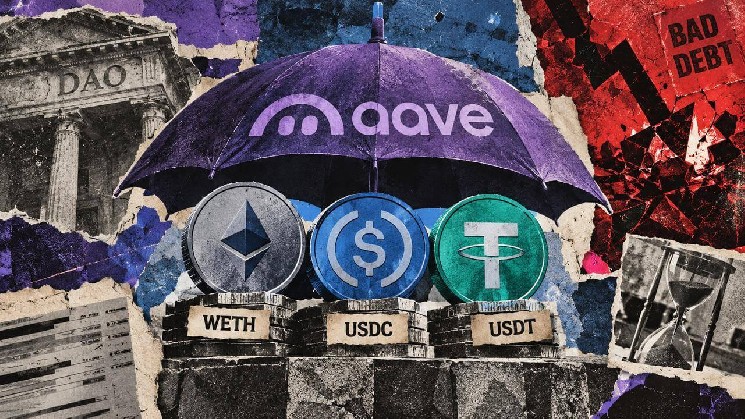
    Aave V4 lenders supplying wrapped Ether (WETH), USDC, or USDT to the protocol’s Core liquidity Hub on Ethereum would gain a bad-debt backstop under a September 11 proposal from governance delegate TokenLogic. The “Umbrella” framework designates the Aave DAO as the first line of defense against losses, followed by volunteer underwriters, with initial coverage restricted to those three lending markets.

    Proposed Underwriting Targets and Scope

    The proposed underwriting targets are set at 800 ETH for Core WETH, 400,000 USDC for Core USDC, and 400,000 USDT for Core USDT. TokenLogic sized these amounts to cover six to eight weeks of expected loan growth. The figures represent targets for a proposed configuration, not capital already committed to protecting lenders.

    For suppliers, the coverage boundary is the specific reserve, or asset pool, receiving their deposit. Coverage for Core USDC would not extend to USDC supplied to another Hub, even though the token is identical. Capital allocated to one Hub asset cannot clear another reserve’s deficit.

    How Losses Would Be Absorbed

    Bad debt arises when liquidation exhausts a borrower’s collateral but leaves debt unpaid. Under the proposed framework, the Aave DAO would absorb an initial layer through “deficit offsets” of 33 ETH for Core WETH, 15,000 USDC for Core USDC, and 15,000 USDT for Core USDT.

    Umbrella underwriters could then lose their committed capital to cover deficits beyond that layer. Their funds would continue earning supply yield until used, with coverage implemented by burning supplied Hub shares. Additional rewards compensate participants for accepting that loss risk.

    Coverage Eligibility Extends to Spoke-Borrowed Assets

    Eligibility for that coverage would include all borrowing from each protected reserve. That includes loans originated through Spokes, the components where debt is created, whose collateral sits in other Hubs. Those credit lines still expose the Core reserve supplying the borrowed asset.

    Underwriter Exit Terms Include Cooldown and Withdrawal Window

    Underwriters would face a structured exit process. Each proposed market specifies a 20-day cooldown followed by a two-day withdrawal window. Aave’s withdrawal guidance states that participants who miss the window must activate another cooldown and wait a further 20 days.

    Starting that exit process does not remove risk exposure. Aave’s Umbrella documentation notes that staked assets remain exposed to slashing during cooldown while continuing to earn rewards. The extra yield therefore comes with both potential capital loss and restricted access to funds.

    Initial Plan Excludes USDG, frxUSD, and Other Hubs

    TokenLogic does not recommend initial general-purpose coverage for USDG or frxUSD. The delegate cites uncertainty over incentive-sensitive lending activity and the ability to attract underwriters who transfer risk away from existing suppliers. For frxUSD, it highlights a concentrated, issuer-linked supplier base.

    The assessment also leaves other Hubs’ reserves outside the initial plan, for varying reasons including limited incremental protection and narrow supplier bases. These exclusions do not mean the loans lack collateral or that losses are imminent.

    Monitoring and Reassessment Timeline

    TokenLogic proposes monitoring conditions after activation and reassessing the framework after three months, with excluded markets reconsidered as lending activity matures and supplier bases diversify.

  • Ethereum Layer 1 Sets Record 25.9 TPS as Q2 Transactions Hit 203.9 Million

    Ethereum Layer 1 Sets Record 25.9 TPS as Q2 Transactions Hit 203.9 Million

    Ethereum’s Layer-1 network achieved fresh usage milestones in the second quarter of 2026, even as the count of monthly active users contracted sharply. According to Token Terminal data, the blockchain processed 203.9 million transactions during the quarter, representing a 68.4% increase year-over-year. Average throughput also hit a record high of 25.9 transactions per second.

    Transaction Volume Surges Despite User Decline

    Despite the surge in on-chain activity, monthly active users fell 30% quarter-over-quarter to 9.2 million. This divergence indicates that the remaining user base generated significantly more transactions per capita. Network fees climbed 31.6% to $52.5 million, while ETH burn revenue more than doubled to $17.1 million, underscoring the intensified economic activity on the base layer.

    Tokenization Bolsters Ethereum’s Dominance

    Ethereum’s position as the primary settlement layer for tokenized assets strengthened further. The market for tokenized assets on Ethereum averaged $203.1 billion during Q2. Stablecoins continued to dominate this segment, accounting for $176.8 billion, while tokenized funds reached $20.8 billion. Notably, tokenized U.S. Treasury funds hit a record average of $7.5 billion.

    The network retained the largest share of both stablecoins and tokenized funds among leading blockchain ecosystems. Total value locked (TVL) across Ethereum’s ecosystem averaged $287.2 billion, though this figure declined 9.2% compared to the previous quarter.

    Staking Growth Signals Network Confidence

    Participation in network security reached a new high, with Ethereum’s staking ratio climbing to a record 32%. The number of addresses holding ETH also expanded, rising 6.6% to 312.1 million. These metrics suggest a deepening commitment from token holders to secure the proof-of-stake consensus mechanism.

    ETH Price Reaction and Outlook

    At the time of reporting, ETH trades around $2,538, marking a 1.18% gain over the preceding 24 hours. The combination of stronger network usage, rising staking participation, and expanding tokenization activity could provide fundamental support for Ethereum’s long-term market position.

    Related: Strive Adds 469 BTC, Bringing Bitcoin Holdings to 25,000

  • Critical Week for Altcoins: Analyst Assesses Ethereum (ETH), XRP, SUI Outlook

    Critical Week for Altcoins: Analyst Assesses Ethereum (ETH), XRP, SUI Outlook

    A pivotal week is unfolding for Bitcoin and the broader cryptocurrency market, with a convergence of major financial events and key technical setups drawing intense trader focus. The calendar kicks off on September 15 with the highly anticipated Clarity Act vote, followed by the Federal Reserve’s interest rate decision on Wednesday. Against this macroeconomic backdrop, prominent cryptocurrency analyst Ali Martinez has issued updated technical analyses for Ethereum (ETH), XRP, and Sui (SUI), highlighting specific price levels and chart patterns that could dictate near-term market direction.

    Ethereum Eyes $3,000 on Ascending Triangle Breakout

    Martinez has identified a developing ascending triangle formation on the Ethereum 12-hour chart. According to his analysis, a decisive break above the pattern’s upper resistance zone could trigger a significant upward leg. The analyst draws a historical parallel, noting that ETH previously surged approximately 31 percent in just three days following a breakout from a similar structure. Should history rhyme, Martinez projects a measured move targeting the psychological $3,000 resistance level.

    SUI Flashes Potential Reversal Signal at Key Support

    For Sui, the TD Sequential indicator on the 12-hour timeframe has presented a new signal, which the analyst suggests could indicate a possible trend reversal. This signal materialized after SUI pulled back to the critical $0.70–$0.72 support zone. However, Martinez cautions that this single indicator does not, by itself, confirm the establishment of a new uptrend, urging traders to seek additional confirmation before committing capital.

    XRP Consolidates Ahead of Potential Triangle Apex Breakout

    Martinez also highlighted a significant technical formation for XRP. In a recent post, he outlined a scenario where the asset holds above the $1.31–$1.35 support zone. If this floor remains intact, the price action could compress toward the apex of the prevailing triangle formation. The analyst identifies $1.38 as the crucial resistance level to watch. A strong breakout above this threshold would strengthen the bullish case, potentially clearing a path for a rally toward the $1.60 region. Martinez notes that while he expects price to migrate toward the triangle’s peak if support holds, no specific ultimate price target was provided in the analysis.

    Disclaimer: This content is for informational purposes only and does not constitute investment advice.

  • ETH/BTC Ratio Surges 25% in Q3 as Ethereum Targets Strongest Quarter on Record

    ETH/BTC Ratio Surges 25% in Q3 as Ethereum Targets Strongest Quarter on Record

    Ethereum has significantly outperformed Bitcoin during the third quarter, with data suggesting a pronounced capital rotation into $ETH and higher-beta assets as $BTC stalled near the $80,000 resistance level.

    Dominance Metrics Signal Major Rotation

    According to a quarterly framework analysis, Bitcoin’s dominance grew by a modest 1.5% quarter-over-quarter. In contrast, Ethereum’s dominance surged over 25% during the same period. The $ETH/$BTC trading pair mirrored this strength, rising more than 25% in Q3—its highest quarterly increase since Q3 2025.

    However, the ratio remains capped near the 0.03 resistance area. A decisive break above this level would be required to confirm a sustained, bullish rotation into Ethereum.

    Source: TradingView ($ETH/$BTC)

    On-Chain Dynamics Favor Ethereum

    Bitcoin’s on-chain metrics provide further context for the shift. The asset’s True Market Mean Price is gradually approaching $76,921.27. Analysts suggest that if $BTC reaches this level, a fresh wave of selling pressure could trigger new exchange deposits, creating the liquidity conditions necessary for capital to rotate into Ethereum.

    One analyst predicts Ethereum will outperform Bitcoin once the broader market flips to a “risk-on” stance, driven by a confluence of on-chain and technical factors. With $ETH already delivering a 58%+ return in Q3, the question arises: is this growing fear of missing out (FOMO) setting the stage for Ethereum’s strongest third quarter on record?

    Ethereum Dominance and ROI Near Historic Highs

    On the technical front, Ethereum dominance ($ETH.D) has risen over 25% this quarter, aligning with the gain in the $ETH/$BTC ratio. Ethereum’s Q3 return on investment (ROI) is nearing 60%, closing in on the Q3 2025 record of over 66%. Should $ETH surpass that threshold, it would mark the asset’s best third-quarter performance in history.

    The concurrent rise in both dominance and absolute returns indicates that Ethereum’s ascent is not solely a byproduct of Bitcoin’s weakness. Instead, it reflects a genuine increase in investor appetite for the altcoin itself.

    Source: Coinglass

    ETF Inflows Validate Underlying Demand

    Recent exchange-traded fund (ETF) inflows corroborate the thesis of strong fundamental demand for Ethereum. While rotational flows from Bitcoin account for a portion of the quarter’s gains, the sustained institutional interest suggests a structural shift. Bitcoin’s relative stagnation may continue to provide Ethereum with room to attract fresh capital as investors chase higher beta returns.

    Key Takeaways

    • $ETH.D and $ETH/$BTC are both up over 25% in Q3.
    • Strong ETF demand shows growing interest in Ethereum.