Tag: Bitcoin price

  • Bitcoin Holds Above $78K as U.S.–Iran Clash Pushes Oil Prices Higher

    Bitcoin Holds Above $78K as U.S.–Iran Clash Pushes Oil Prices Higher

    Bitcoin traded near $77,900 on Aug. 31 as renewed fighting between the United States and Iran pushed oil prices higher and pressured global equity markets. The cryptocurrency remained relatively stable despite sharp moves across energy, bond and stock markets after U.S. strikes on Iran’s Larak Island.

    Bitcoin holds near $78,000 as oil prices climb

    Bitcoin was down approximately 0.4% over 24 hours after trading between $77,162 and $79,343. The limited move contrasted with a stronger reaction in other markets following the strikes.

    An unnamed U.S. official confirmed that American forces targeted two Iranian rocket launchers. According to Reuters, the official claimed Iran’s Islamic Revolutionary Guard Corps was preparing rockets carrying sea mines for deployment in the Strait of Hormuz.

    Iran said the attack killed and wounded soldiers and civilians. The Revolutionary Guards promised a “response and punishment,” but did not immediately provide casualty figures or details of further action.

    Brent crude climbed approximately 2.7% to $90.51 per barrel during Monday’s Asian session. West Texas Intermediate traded near $85.23 after gaining more than 2%.

    The oil price increases reflected renewed concern about shipping through the Strait of Hormuz, a key route for global oil and liquefied natural gas movements. Military activity near the waterway can therefore affect energy prices and inflation expectations.

    Asian equities declined, while Nasdaq 100 futures fell between 0.5% and 0.7% across early market readings. Gold also failed to attract sustained safe-haven demand, falling approximately 0.8% to around $4,418 per ounce in the cited market snapshot.

    Bitcoin remained close to $78,000. Its stability does not prove that $BTC has permanently become a geopolitical hedge, but it shows that the latest escalation did not trigger the immediate cryptocurrency sell-off seen during some earlier risk events.

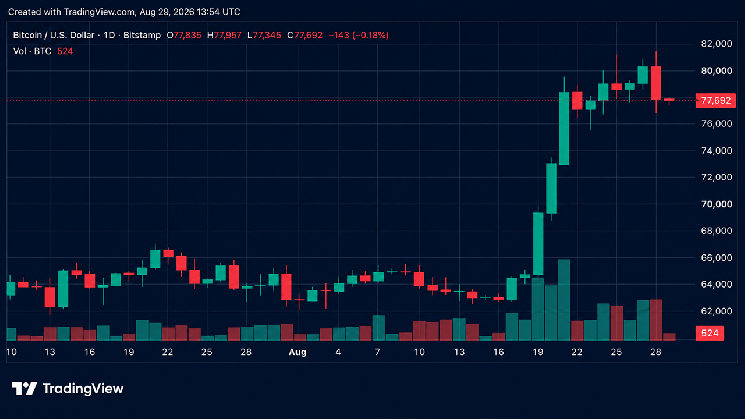
    Bitcoin’s daily chart also pointed to short-term strength. $BTC traded near $78,084, comfortably above the Bollinger Bands’ $72,471 midpoint but below the $86,255 upper band. The bands widened after the latest rally, indicating higher volatility.

    The relative strength index stood at 69.91, just below overbought territory, after recently crossing 70. The reading reflects strong momentum but also leaves Bitcoin vulnerable to consolidation. Daily volume of about 4,200 $BTC remained below the initial breakout spike, suggesting buyers may need stronger participation to challenge $80,000.

    Bitcoin ($BTC) price chart, source: crypto.news

    Bitcoin also held above $62,000 during July’s U.S.–Iran strikes, even as oil, bonds and Asian stocks recorded larger moves.

    Bitcoin outperformed gold and Nasdaq in August

    Bitcoin gained approximately 23% during August, compared with reported advances of 9% for gold and 4% for the Nasdaq. The cryptocurrency was therefore the strongest performer among the three assets over the month.

    The broader crypto market showed less resilience on Monday. XRP declined approximately 0.8%, while Solana lost around 0.6%. Ether traded near $1,625 as traders reduced exposure to several major altcoins.

    Part of Bitcoin’s monthly performance followed renewed institutional demand through U.S. spot exchange-traded funds. The products accumulated approximately $2.8 billion across eight consecutive inflow sessions during the recovery from Bitcoin’s August lows.

    The streak ended on Friday. U.S. spot Bitcoin ETFs recorded an estimated $201.9 million in net outflows on Aug. 28, according to Farside. The reversal indicates that ETF demand should not be characterized as uninterrupted.

    Bitcoin’s rally from approximately $63,500 had previously been supported by eight consecutive ETF inflow sessions, although declining futures exposure indicated that leverage was not the only source of demand.

    Federal Reserve policy adds uncertainty to Bitcoin’s outlook

    The geopolitical escalation followed Federal Reserve Chair Kevin Warsh’s restrictive policy message at the Jackson Hole symposium on Aug. 28.

    Warsh said inflation remained too high, while labor markets were stable and economic output was solid. According to his published remarks, he said most Federal Open Market Committee members preferred to await more information before deciding whether another policy change was appropriate.

    Markets interpreted the speech as increasing the possibility of another interest-rate rise. Fed funds futures placed the probability of a September increase near 57% to 60%, up from approximately 35% before the address. The estimate represents market pricing rather than a Federal Reserve commitment.

    Higher oil prices could further complicate the outlook. Sustained energy price increases can raise transportation and production costs, making it more difficult for inflation to return toward the Federal Reserve’s 2% objective.

    Sept. 4 jobs report is the next major Bitcoin catalyst

    The next major U.S. market catalyst is the August employment report, scheduled for Sept. 4 at 8:30 a.m. ET, according to the Bureau of Labor Statistics calendar.

    Strong employment data could reinforce expectations for tighter monetary policy. A weaker report could reduce rate-hike forecasts, although the market response would also depend on wage growth and unemployment.

    Bitcoin’s immediate technical range remains between support around $77,000 and resistance extending from approximately $79,400 to $80,800. These levels are market observations rather than guaranteed reversal points.

    The durability of Bitcoin’s relative strength will depend on whether it remains stable if oil prices continue rising, equity losses deepen or interest-rate expectations move higher. ETF flows and the Sept. 4 labor report will provide the next evidence.
  • September Fed Rate Hike Fears Look Overblown as Probability Stands at Just 58%, Not 90%

    September Fed Rate Hike Fears Look Overblown as Probability Stands at Just 58%, Not 90%

    Inflation concerns are weighing more heavily on Federal Reserve policy expectations than labor-market trends, according to Warsh, who said inflation is unlikely to return to the central bank’s target without intervention.

    Warsh pointed to the Federal Reserve’s preferred inflation gauge, the Personal Consumption Expenditures (PCE) index, which stood at 3.7%. He described the reading as “are more concerning” relative to the Fed’s 2% inflation target.

    Broad-based price increases raise Fed concerns

    Over the past year, more than half of the goods and services tracked by the government recorded price increases of 3% or more. That compares with roughly one-third experiencing similar increases during the two decades before the pandemic.

    The comments were quickly interpreted as hawkish, or supportive of higher interest rates, fueling expectations on social media that the Fed could deliver a 25-basis-point rate hike in September. The benchmark borrowing rate currently stands in a range of 3.5% to 3.75%.

    Bitcoin fell 3% to below $77,000 on Friday, marking its first significant pullback after a sharp rally from approximately $63,000 to more than $80,000 earlier this month. Gold also declined, while the U.S. Dollar Index and Treasury yields both increased.

    Analysts question rate-hike fears

    Bianco is not alone in downplaying concerns about a potential rate increase. Firms including ABN AMRO Investment Solutions and Brandywine Global Investment Management have expressed similar skepticism.

    Robin Brooks, a senior fellow at the Brookings Institution and former chief economist at the IIF, said a possible rate hike would be intended to calm volatility in the Treasury market rather than represent outright monetary-policy tightening.

    Such a move could reinforce confidence in the Fed’s commitment to controlling inflation, potentially reducing the additional premium investors demand to hold long-term bonds and limiting further increases in Treasury yields.

  • Bitcoin Barely Moves as U.S. Hits Iran, Sending Oil Prices Higher and Stocks Lower

    Bitcoin Barely Moves as U.S. Hits Iran, Sending Oil Prices Higher and Stocks Lower

    Geopolitical tensions have returned to financial markets, pushing oil prices higher. Bitcoin, however, remained steady during Asian trading hours, demonstrating resilience and continuing to outperform gold and equities—a trend that has persisted throughout August.

    Oil prices climbed on both sides of the Atlantic after the United States attacked an Iranian island in the Strait of Hormuz, a major oil-tanker route that has faced disruption since the conflict began six months ago. Iran responded with retaliatory action.

    Oil rises as markets react to Strait of Hormuz tensions

    WTI crude futures jumped nearly 2% to $85.10, while Brent crude rose 1.9% to $92.39, according to TradingView. Gold fell 0.8% to $4,418 per ounce, and Nasdaq futures slipped 0.5% amid declines across Asian equity markets.

    Bitcoin outperforms gold and stocks

    Bitcoin traded near $77,580, remaining largely unchanged since midnight UTC, according to CoinDesk. $BTC’s price has risen 23% this month, compared with a 9% gain for gold and a 4% increase for the Nasdaq.

    Other major cryptocurrencies traded slightly lower. Payments-focused $XRP ($XRP) declined 0.8%, while Solana (SOL) fell 0.6%.

    Bitcoin’s continued outperformance may be linked to strong inflows into spot exchange-traded funds and expectations of aggressive Federal Reserve intervention following the Treasury’s bond buyback program.

  • Options Bets Turn Defensive Ahead of Bitcoin Price Showdown

    Options Bets Turn Defensive Ahead of Bitcoin Price Showdown

    Bitcoin futures open interest across major derivatives venues stood at 695,020 BTC, equivalent to $54.82 billion, according to weekend data from Coinglass. Aggregate open interest declined 0.26% over one hour and 0.38% over four hours, but remained 1.15% higher over the past 24 hours. The mixed readings suggest traders are trimming exposure at the margins rather than making a broad exit from the market.

    Binance Leads as $54.82 Billion Remains at Stake

    Binance, the largest cryptocurrency exchange by trading volume, held the biggest share of tracked futures open interest, with 142,500 BTC valued at $11.24 billion. That represented 20.5% of the total. CME followed with 116,040 BTC worth $9.15 billion on Sunday, giving it a 16.69% share. CME’s position is particularly significant because it offers a useful measure of institutional positioning.

    MEXC accounted for another $5.01 billion, followed by Bybit with $4.58 billion and Gate with $4.57 billion. OKX held $2.79 billion, while Bitget and KuCoin accounted for $2.16 billion and $1.62 billion, respectively.

    Most major venues recorded lower open interest over the previous four hours on Sunday. BingX, however, posted a 34.50% increase, while Bitunix rose approximately 1.29%.

    The broader futures market has recovered substantially from its June lows. Historical data shows Bitcoin futures open interest falling toward the mid-$40 billion range in June before recovering above $54 billion in late August, as Bitcoin rebounded past $81,000. The key concern is that leverage has returned alongside the price, leaving more capital exposed if volatility suddenly increases.

    One popular crypto X account this weekend wrote:

    “Leverage is piling up over the weekend. This won’t end well.”

    Calls Dominate Open Interest as New Flows Seek Protection

    Bitcoin options are showing a similarly leveraged setup. Total options open interest approached approximately $44 billion over the weekend, recovering sharply from around $25 billion in early August.

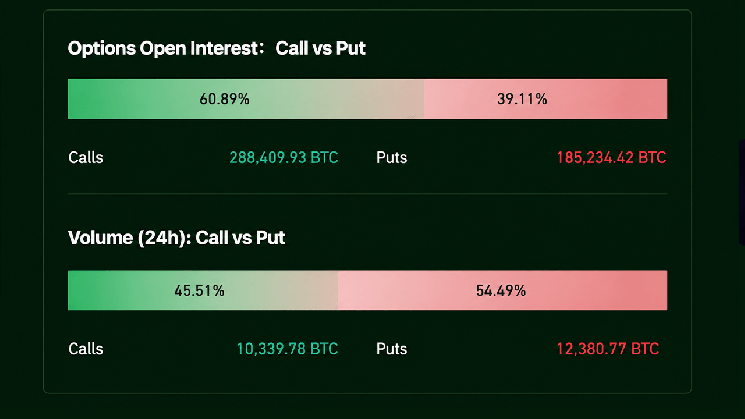
    The latest call-and-put breakdown showed 288,409.93 BTC in calls versus 185,234.42 BTC in puts. Calls therefore represented 60.89% of outstanding options open interest, compared with 39.11% for puts.

    Bitcoin options data via Coinglass.com.

    Trading volume presents a more defensive picture. Over the latest 24-hour period, puts represented 54.49% of options volume, with 12,380.77 BTC traded, compared with 10,339.78 BTC in calls. While the existing options book remains tilted toward upside exposure, newer trading flows are leaning toward downside protection.

    At Deribit, the largest individual open-interest contract is the Sept. 25 $70,000 call, with 11,018.2 BTC. It is followed by the Dec. 25 $80,000 call at 8,590 BTC, the Sept. 25 $85,000 call at 8,373.9 BTC and the Sept. 25 $100,000 call at 7,323.4 BTC. The Sept. 25 $70,000 put holds 7,227.3 BTC, indicating substantial positioning on both sides of the market.

    CME adds another institutional dimension. Expiration-stacked data shows CME options open interest rebuilding into late August, with contracts expiring within one to two months forming the largest visible block. Position-stacked data also shows calls expanding sharply during the final August sessions, while puts remain active but account for a smaller share of the newest bars.

    Max Pain Creates a Volatile September Setup for Bitcoin

    Max pain refers to the strike price at which option holders would theoretically face the greatest aggregate losses at expiration. Data from the largest Bitcoin options exchanges, including Coinbase and Deribit, shows near-term max-pain levels ranging from $70,000 to $80,000.

    Deribit’s levels include approximately $78,500 for Aug. 31 and Sept. 1, $75,000 for Sept. 4 and $70,000 for Sept. 25. Longer-dated Deribit expirations generally cluster near $70,000, with the exception of Nov. 27, which is positioned around $80,000.

    Binance and OKX show a similarly uneven distribution. Binance’s max pain is near $78,500 for Aug. 31, $75,000 for Sept. 4, $80,000 for Sept. 11 and Sept. 18, and approximately $73,000 for Sept. 25. On OKX, Aug. 31 is near $78,500, Sept. 4 is around $75,000, Sept. 11 is near $80,000 and Sept. 25 is around $70,000.

    With Bitcoin trading at $78,425, derivatives traders are not positioned for a quiet September. Futures exposure remains elevated, calls control most outstanding options open interest, puts lead the latest volume figures, and several max-pain levels sit below the current spot price. The positioning indicates that traders continue to seek upside, while significant capital is also buying downside protection.

    Feature/Hero image via Coinglass.com

  • Bitcoin, Ethereum and XRP Prices Brace for Jobs Report Week as Fed Decision Looms

    Bitcoin, Ethereum and XRP Prices Brace for Jobs Report Week as Fed Decision Looms

    Bitcoin is trading at $78,796.58, while Ethereum stands at $2,478.28 and $XRP at $1.40 as traders prepare for a week packed with U.S. labor-market data. The figures could influence the Federal Reserve’s next policy decision and, in turn, determine the near-term direction of the cryptocurrency market.

    Current Cryptocurrency Market Snapshot

    • Bitcoin: $78,796.58, up 1.7% over seven days, with a market capitalization of $1.58 trillion
    • Ethereum: $2,478.28, up 0.7% over seven days, with a market capitalization of $299 billion
    • $XRP: $1.40, up 7.7% over seven days, with a market capitalization of $87.78 billion
    • Solana: $106.44, up 12.0% over seven days
    • BNB: $698.37, roughly unchanged over seven days

    Economic Data Traders Are Watching

    According to The Kobeissi Letter, six major economic releases are scheduled this week, with employment data expected to be the main focus for financial markets:

    • Monday: August Chicago PMI data
    • Tuesday: August ISM Manufacturing PMI and Prices data, along with July JOLTS Job Openings data
    • Wednesday: August ADP Nonfarm Employment data
    • Thursday: August ISM Non-Manufacturing PMI and Prices data
    • Friday: July Jobs Report

    Why the Labor Market Matters for Crypto

    Employment data carries particular importance for cryptocurrency markets because it can directly affect expectations for the Federal Reserve’s interest-rate decision at the next FOMC meeting.

    Unexpected strength in the labor market could support the hawkish tone Fed Chair Kevin Warsh struck at Jackson Hole. That scenario could keep expectations for rate cuts subdued and place additional pressure on risk assets such as Bitcoin, Ethereum and $XRP.

    Bitcoin Price Technical Outlook

    Bitcoin remains range-bound, with support around $73,000 to $75,000 and resistance between $80,000 and $82,000. Technical analysts generally view a move above approximately $82,500 as necessary to confirm a broader bullish trend shift on higher timeframes.

    A significant pocket of liquidation liquidity is located between $76,400 and $76,700. Analysts have identified that zone as a potential near-term target if short-term weakness continues.

    Ethereum and $XRP Price Levels

    Ethereum is holding above $2,400, preserving its bullish breakout structure. The next major resistance area is positioned between $2,750 and $2,800.

    $XRP is testing support in the $1.30 to $1.40 range after being rejected near $1.60 to $1.70. The retreat followed an extended overbought signal that triggered the recent pullback.

    The current cooldown does not necessarily indicate a trend reversal. Instead, it may represent a reset before the broader trend potentially resumes.

    What the Data Could Mean for Bitcoin and Crypto

    With five separate labor and manufacturing data points scheduled from Monday through Friday, volatility in Bitcoin, Ethereum and $XRP could increase ahead of Friday’s Jobs Report. The report is widely regarded as the most important release of the week.

    Whether the data comes in above or below market expectations could determine whether the recent cryptocurrency consolidation breaks higher or develops into a longer cooling-off period.

  • Michael Saylor Hints at First Bitcoin Purchase in Two Months as Bitcoin Nears $79,000

    Michael Saylor Hints at First Bitcoin Purchase in Two Months as Bitcoin Nears $79,000

    Michael Saylor has hinted that Strategy may have made its first bitcoin purchase since June 22, as bitcoin approached $79,000.

    Bitcoin was up nearly 1% over the previous 24 hours and more than 2.5% from Friday’s low, following Federal Reserve Chair Kevin Warsh’s hawkish speech at Jackson Hole.

    Strategy executive chairman Saylor posted “We’re Back” on X, suggesting that the company may have resumed its bitcoin purchases after a two-month pause.

    Strategy shifts focus back to bitcoin purchases

    The bitcoin accumulation company had spent the past few months, beginning in May, selling part of its bitcoin holdings to strengthen its balance sheet. More recently, Strategy stopped selling bitcoin and instead sold MSTR shares to increase its U.S. dollar reserves. It also began buying back its preferred stock, STRC.

    Strategy now has nearly four years of preferred-dividend coverage. As a result, any new capital raised is likely to support additional bitcoin purchases and further STRC preferred-stock buybacks rather than increase the company’s U.S. dollar reserves.

    STRC climbed as high as $98 on Friday, but Strategy is likely to continue its buybacks in an effort to help the preferred stock return to $100.

    Read more: Strategy cuts net leverage to near zero as cash nearly matches convertible debt

    Source: cryptonews.net

  • Wall Street Altcoin Picks: Charles Schwab Backs Ethereum, Solana, XRP, and Hyperliquid

    Wall Street Altcoin Picks: Charles Schwab Backs Ethereum, Solana, XRP, and Hyperliquid

    Schwab Identifies Five Distinct Crypto Portfolio Roles

    Charles Schwab director of global equity research Adam Lynch recently outlined the firm’s approach to crypto allocation, separating five digital assets that it believes serve fundamentally different portfolio purposes: Bitcoin, Ethereum, Solana, $XRP and Hyperliquid.

    Schwab Says Crypto Assets Are Not the Same Trade

    Lynch described Bitcoin as the “classic” hedge against currency debasement, making it the asset investors may turn to when concerned about fiat currency devaluation. He said Ethereum offers greater functional utility than Bitcoin while still fitting within the broader debasement narrative.

    Lynch classified Solana, $XRP and Hyperliquid as higher-volatility, higher-risk allocations. He suggested pairing them with core positions in larger digital assets rather than using them as replacements.

    Goldman Sachs’ Solana ETF Exposure Draws Attention

    Goldman Sachs has become the largest disclosed holder of spot Solana ETFs, with $88 million in exposure, according to disclosure filings referenced in the discussion. Since not all institutional holders must disclose their positions, Wall Street’s actual Solana exposure could be significantly greater than the amount currently visible in public filings.

    Separately, Schwab confirmed that it is adding Solana, Avalanche and Chainlink to its crypto trading platform. The move expands the platform’s offering beyond the Bitcoin and Ethereum access it already provided.

    Grayscale Research has identified Bitcoin, Ethereum and Zcash as the assets most likely to benefit from what it calls the “debasement trade,” a trend linked to U.S. national debt exceeding $40 trillion and ongoing fiscal deficits.

    Solana’s Planned Token Supply Falls After Validator Vote

    In a separate development, Solana validators approved a proposal to double the network’s disinflation rate to 30%. Yes votes surpassed the 66.6% threshold during the final hour of voting.

    The change is expected to reduce planned SOL issuance by nearly 20 million tokens over the next six years, representing an estimated $1.4 billion in value. A reduction in newly issued tokens entering circulation is widely viewed as a structurally bullish development for Solana’s long-term valuation.

    Bitcoin Falls Below $77,000 as Fed Chair Warsh Signals Hawkish Stance

    The bullish crypto outlook met broader macroeconomic pressure on Friday, when Bitcoin dropped below $77,000 after Fed Chair Kevin Warsh signaled that a rate hike could be possible during his Jackson Hole keynote. Warsh has maintained a hawkish tone in each of his public appearances since taking the role.

    U.S. inflation has remained above the Federal Reserve’s 2% target for 65 consecutive months, according to the discussion. That persistent inflation continues to complicate the outlook for interest-rate cuts.

    What the Developments Mean for Crypto Investors

    Schwab’s differentiated crypto allocation strategy, Goldman Sachs’ growing Solana exposure, Solana’s reduced planned token issuance and a bipartisan regulatory bill receiving support from banks all point to expanding institutional infrastructure around digital assets.

    That infrastructure is developing even as short-term crypto prices respond to Federal Reserve commentary. Whether the structural momentum leads to sustained price strength could depend less on any single Fed speech and more on how quickly the CLARITY Act advances through Congress.

  • Bitcoin Price Falls After Warsh’s Hawkish Jackson Hole Keynote

    Bitcoin Price Falls After Warsh’s Hawkish Jackson Hole Keynote

    Bitcoin has pulled back from its weekly high of $81,455, but its August gains remain substantial. As of Aug. 29, 2026, at 8:30 a.m., bitcoin was trading at approximately $77,588 to $77,984 per coin. The leading cryptocurrency had declined about 2% to 2.5% over the previous 24 hours, while still gaining 23.2% against the U.S. dollar since Aug. 15.

    Bitcoin’s initial rally followed the Treasury’s mid-August announcement about expanding bond buybacks. During the same week, U.S. President Donald Trump met with several cryptocurrency industry executives and made positive comments about the sector. He discussed bringing Hyperliquid to the United States and remained open to acquiring substantial amounts of $BTC after receiving advice from members of his administration.

    Those developments helped drive demand for spot bitcoin exchange-traded funds (ETFs), which recorded nine consecutive days of inflows. The streak ended Friday, when spot bitcoin ETFs posted their first day of outflows, with approximately $202 million leaving the funds.

    Sticky Inflation Meets Positive Crypto News

    Several developments put pressure on bitcoin toward the end of the week. U.S. inflation remained persistent, with the personal consumption expenditures (PCE) price index rising in July. Bitcoin initially absorbed the news and recovered from a modest decline before reaching its weekly high of $81,455.

    Additional positive developments supported the market, including a proposed draft to rewrite U.S. Securities and Exchange Commission (SEC) custody rules and Charles Schwab’s expansion of its digital asset offerings.

    Hawkish Jackson Hole Speech Pressures Bitcoin

    Market sentiment shifted during the Jackson Hole Economic Policy Symposium, where Federal Reserve Chair Kevin Warsh delivered his first speech at the annual event. Speaking at 10 a.m. EDT on Friday, Warsh addressed the symposium’s theme, “Financial Innovation: Implications for Payments and Policy.”

    The keynote was viewed as hawkish. Warsh said the U.S. central bank has “work to do” and argued that specific financial conditions remain difficult. He also said forward guidance had “overstayed its welcome.”

    Following the speech, the probability of a rate hike rose immediately from 35% to the mid-50% range. Treasury yields increased, while precious metals such as gold posted modest declines.

    Before Warsh’s keynote, bitcoin was trading sideways near $79,500. After the speech, its price briefly fell below $77,000 before buyers absorbed the intraday selling pressure. The move also coincided with the first day spot bitcoin ETFs recorded outflows after their extended inflow streak.

    Despite the break in consecutive inflow days, August remains a strong month for spot bitcoin ETF demand, with approximately $3.1 billion to $3.3 billion entering the funds.

    Bitcoin Tests $77,000 Support as Technical Indicators Signal Overheating

    Bitcoin’s immediate resistance this weekend is positioned between $79,500 and $80,300, a range the cryptocurrency lost following the Federal Reserve chair’s speech. Resistance becomes stronger at higher price levels.

    Support is currently holding near the $76,800 to $77,000 zone. Bitcoin’s 24-hour trading volume was approximately $28.731 billion. Technical indicators suggest momentum had already become stretched before the keynote. The daily relative strength index (RSI) was at 70, while the Stochastic indicator was higher at 85, indicating overbought conditions.

    Although the RSI is neutral and the Stochastic indicator points to overheating, the moving average convergence divergence (MACD) remains positive. Taken together, the oscillators and moving averages suggest bullish momentum is still intact despite bitcoin’s latest decline—at least for now.

  • Bitcoin Drops After Warsh Speech as Rate-Hike Odds Reach 57% — Can BTC Reclaim $80K?

    Bitcoin Drops After Warsh Speech as Rate-Hike Odds Reach 57% — Can BTC Reclaim $80K?

    Bitcoin price fell 3% to $77,000 after Federal Reserve Chair Kevin Warsh delivered a hawkish speech at the Jackson Hole event, signalling that the central bank may not be finished fighting inflation despite recent macroeconomic data.

    We must be confident that underlying inflation is moving to our objective, clearly and at sufficient speed. Otherwise, we have work to do.

    Discussing the latest summer inflation data, Warsh added:

    While this summer’s PCE and CPI readings were better than expected, they do not tell me that underlying trends have meaningfully improved.

    Why did Bitcoin fall below $80,000?

    U.S. equities and cryptocurrency markets interpreted Warsh’s comments as hawkish. The tech-heavy Nasdaq fell 0.52%, while the S&P 500 declined 0.25%. Crypto markets followed, with Bitcoin leading the downturn with a 3% drop.

    Source: $BTC/USDT, TradingView

    Bitcoin had rallied 30% in the second half of August, supported by the Treasury’s planned $1 trillion intervention to curb rising bond yields. The upswing also helped BTC reclaim its crucial 200-day moving average.

    However, the rally has stalled below $80,000, delaying Bitcoin’s attempt to reclaim the 50-week moving average at $81,800 and officially mark the end of the BTC bear-market cycle.

    Can Bitcoin rally despite September Fed rate hike fears?

    Inflation directly influences Federal Reserve interest-rate policy and risk sentiment across financial markets. Following Warsh’s speech, interest-rate traders raised the probability of a September Fed rate hike to 57%, a 20% increase from the previous week. The repricing reinforced renewed fears of another rate hike.

    Source: CME FedWatch

    Bitcoin options traders, including sophisticated professionals and institutional investors, also moved to increase downside protection.

    This was reflected in the BTC 25 Delta Skew, which rose from -10% to nearly 5%, representing a 15% increase and signalling renewed demand for downside hedging.

    During Bitcoin’s explosive rally last week, the metric fell below 0% for the first time this year. That indicated traders were reducing their downside hedges as many analysts expected the rally, supported by the so-called debasement trade, to continue amid concerns over U.S. fiscal debt and turmoil in the bond market.

    Source: Velo

    The metric’s weekend spike now suggests that Warsh has forced Bitcoin bulls to reassess their strategy.

    Analyst Luke Gromen, however, believes the bond-market crisis will overshadow Federal Reserve rate decisions in the short term.

    It remains a variant perception that both Fed hikes or cuts will cause the long end to rise…even as long bond yields are now up on Warsh’s ‘hawkish’ speech today.

    If fears of a Fed rate hike intensify and weigh on market sentiment, Bitcoin’s price could retrace toward its 200-day moving average at $69,300.

    However, if the debasement-trade narrative continues, the $80,000 level could become support for the next leg of the uptrend.

    Bitcoin price outlook

    Bitcoin fell 3% to $77,000 after Kevin Warsh’s hawkish Jackson Hole speech. The Nasdaq declined 0.52%, while the S&P 500 fell 0.25%. Meanwhile, the probability of a September Fed rate hike increased to 57%.

  • Warsh at Jackson Hole: ‘We have work to do’ on inflation

    Warsh at Jackson Hole: ‘We have work to do’ on inflation

    Federal Reserve Chairman Kevin Warsh said the central bank’s “predominant focus” should remain on inflation, striking a hawkish tone in closely watched remarks at the Kansas City Fed’s annual Jackson Hole symposium.

    “The responsibility for 65 months of sustained, elevated inflation sits squarely with the central bank,” said Warsh, delivering his keynote address at the Kansas City’s Fed Jackson Hole symposium.

    “We must be confident that underlying inflation is moving to our objective, clearly and at sufficient speed. Otherwise, we have work to do. That’s our job . . . our mandate . . . and our charge to keep.”

    Markets react to Warsh’s hawkish remarks

    Bitcoin fell to $78,700 following the comments. U.S. stocks were modestly lower, while bond yields moved slightly higher as investors assessed the Federal Reserve chairman’s inflation-focused message.

    Warsh’s speech had been highly anticipated because the Kansas City Fed’s annual Jackson Hole symposium has often served as a venue for U.S. central bank chiefs to prepare markets for major policy changes.