Category: Coins

Digital assets, cryptocurrencies, blockchain, and currency news.

  • Ethereum Liquidity Surges: Can ETH Steal Bitcoin’s Spotlight in Q4?

    Ethereum Liquidity Surges: Can ETH Steal Bitcoin’s Spotlight in Q4?

    Bitcoin’s August Surge Masks Weak Spot Demand and Liquidity Concerns

    Bitcoin closed August over 25% higher compared to the previous month, recording its best monthly performance since November 2024. However, the stablecoin market cap only managed to grow by 0.5% and failed to hold above $310 billion, which suggests that the inflow of liquidity is happening at a slow pace.

    On-Chain Metrics Reveal Lack of Spot Buying Pressure

    The same pattern is evident on the on-chain level. As the chart below shows, Bitcoin rose by around 45% from its recent low, but there is a lack of spot demand, as evidenced by the 90-day CVD being neutral. Liquidity across exchanges is also weak, as seen in Binance’s stablecoin reserves, which dropped nearly $7 billion from their cycle peak above $50 billion.

    Source: CryptoQuant

    Technical Bullishness Contrasts with Speculative Positioning Risks

    So, while Bitcoin’s technical structure has turned bullish, liquidity and spot demand remain muted. At the same time, rising Open Interest suggests growing speculative positioning, which makes $BTC vulnerable to a long squeeze if $80k resolves as the ceiling, especially with the FOMC meeting approaching.

    Ethereum’s Liquidity Divergence Signals Potential Shift from Bitcoin

    However, the bigger signal may be the growing liquidity divergence between Bitcoin and Ethereum. If capital continues to rotate towards $ETH and away from $BTC, this could set up the conditions for altcoins to outperform Bitcoin in the coming Q4, particularly as macro volatility drives risk appetite shifts. If this trend holds, it could provide the first confirmation that Bitcoin’s [$BTC] current rally is a bull trap.

    Ethereum Derives Liquidity from Both Speculation and On-Chain Utility

    Unlike Bitcoin, Ethereum is capable of deriving liquidity from both speculative demand and on-chain utility. The promise of Ethereum as a platform for stablecoins, tokenized assets, and DeFi creates additional demand for the asset.

    For instance, the total stablecoin supply in the Euro minted on the Ethereum blockchain increased by 347.3% over the past three years to reach $848.1 million. Ethereum hosts 69.4% of the total, surpassing all other blockchains combined by more than double. Similarly, stablecoins on the Robinhood Chain exceeded the $1 billion mark, illustrating the strong demand for on-chain liquidity.

    Record ETH Staking Underscores Capital Commitment to Ethereum

    In addition, as depicted in the chart below, staking $ETH is yet another example of increased demand for Ethereum. According to the chart, the amount of $ETH staked saw yet another ATH. Specifically, 42.95 million $ETH or $105.96 billion were deposited across all validators, representing 35.21% of $ETH’s supply.

    Source: ValidatorQueue

    Capital Flows Into Ethereum Ecosystem Drive ETH/BTC Ratio Higher

    Taken together, improving stablecoin liquidity and record $ETH staking suggest that capital is flowing into the Ethereum ecosystem. Not only are traders fueling demand, but holders are also locking up significant amounts on-chain and committing them to the network.

    This helps explain why the $ETH/$BTC ratio keeps trending higher. While Bitcoin is seeing rising bull trap fears and weak spot buy, Ethereum has seen increased liquidity and capital inflows. If the divergence persists, then $ETH/$BTC ratio could very well have the momentum to break above 0.031.

    Altcoin Outperformance Potential in Q4 Hinges on Sustained Liquidity Rotation

    More importantly, a sustained rotation of liquidity into Ethereum [$ETH] can spill over into the broader altcoin market. And if Bitcoin continues to lose liquidity share to $ETH, it could be a major catalyst for altcoins to outperform $BTC in the fourth quarter.

    Final Summary

    • Ethereum is seeing more liquidity, with stablecoin growth and record $ETH staking showing stronger demand.
    • If this trend continues, $ETH could keep gaining on $BTC and help drive an altcoin rally in Q4.
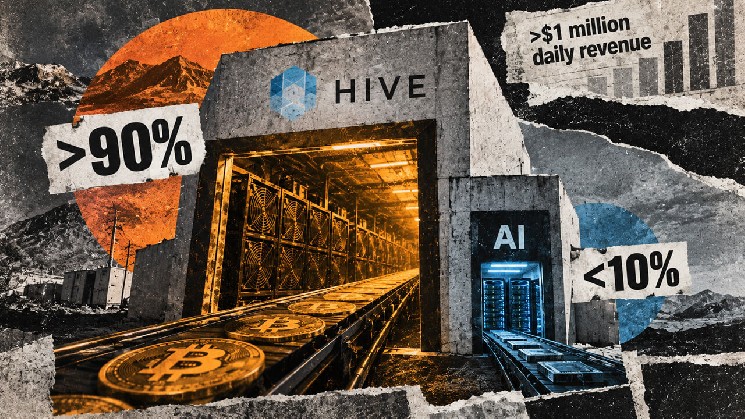
  • Bitcoin Mining Generates 90% of HIVE’s $1 Million Daily Revenue Amid Ongoing AI Expansion

    Bitcoin Mining Generates 90% of HIVE’s $1 Million Daily Revenue Amid Ongoing AI Expansion

    HIVE Digital Technologies Reports $1 Million Daily Revenue Average, Driven by Bitcoin Mining

    HIVE Digital Technologies disclosed that its combined Bitcoin mining and GPU cloud operations generated more than $1 million in average daily revenue from August 21 through September 10, offering a concrete measure of how the company’s artificial intelligence pivot is contributing to current results.

    GPU Cloud Contributes Roughly 10% of Daily Revenue

    According to the company’s September 10 update, the GPU cloud segment produced approximately $100,000 per day during the period. That figure represents an operating revenue stream from AI infrastructure, though it accounted for less than roughly 10% of the reported total. Bitcoin mining supplied more than nine-tenths of the daily average.

    An accompanying infographic illustrated the split, showing HIVE averaging over $1 million in daily revenue with approximately 90% derived from Bitcoin mining and 10% from GPU cloud services.

    Mining Output Tied to Network Conditions

    HIVE reported mining an average of about 12 Bitcoin per day during the window, equal to roughly 2% of global network production. The company emphasized that the revenue figures are preliminary, unaudited management estimates, and tied the results to prevailing Bitcoin prices, network difficulty, and operating conditions. The dollar value of mining output can change with Bitcoin’s price and network economics.

    While GPU cloud gives HIVE an operating foothold in AI infrastructure, Bitcoin mining remained the financial engine during the period.

    $600 Million Contract Pipeline Not Yet Recognized Revenue

    HIVE said it had closed more than $600 million in GPU-cloud total contract value year to date, combining signed customer agreements and letters of intent. The company warned that total contract value is not recognized revenue and does not guarantee future revenue.

    That distinction follows August reports of a $350 million AI cloud agreement and the financing and execution demands of a related $185 million GPU buildout. The new disclosure shows the AI business generating revenue, but the much larger commercial pipeline still depends on delivery over time.

    Wind-Down of Legacy Facilities Underway

    HIVE said those operations contributed less than 5% of the company’s global daily revenue in August and that it intends to wind down mining at the facilities. The company is evaluating whether to repurpose the sites for high-performance computing, the data-intensive infrastructure used for services such as AI. It has not said the conversion is complete, and its release cautioned that the wind-down and repurposing may not proceed as planned.

    Two-Speed Transition Continues

    For now, the operating numbers show a two-speed transition. AI cloud has become a revenue-producing business, while Bitcoin mining remains the financial engine carrying the shift. The next test is whether HIVE can turn more of its signed agreements and letters of intent, along with its existing infrastructure, into recognized GPU-cloud revenue without losing the mining cash flow that supports the transition.

  • MemeToro News: Every Development Update in One Place; Why MemeToro Tops Best Crypto Presale List in September

    MemeToro News: Every Development Update in One Place; Why MemeToro Tops Best Crypto Presale List in September

    MemeToro Advances to Stage 7 of Presale as AI Agent Development Accelerates

    As of September 9, 2026, MemeToro has entered Stage 7 of its presale campaign, pricing the $MT token at $0.00430. The project reports raising over $122,810.33 toward its current milestone, with a stated exchange launch target of $0.05186. While the presale continues to attract participation, the project emphasizes that fundraising alone does not guarantee product success; the critical factor remains how the team deploys capital to deliver a usable ecosystem.

    Roadmap Focuses on Utility Beyond the Token

    MemeToro positions $MT within a broader memecoin ecosystem that includes AI tools, prediction-market features, staking mechanisms, and blockchain infrastructure. This utility-focused roadmap makes tangible development progress a key metric for evaluating the project’s trajectory.

    Open-Source Code Commit Signals AI Agent Milestone

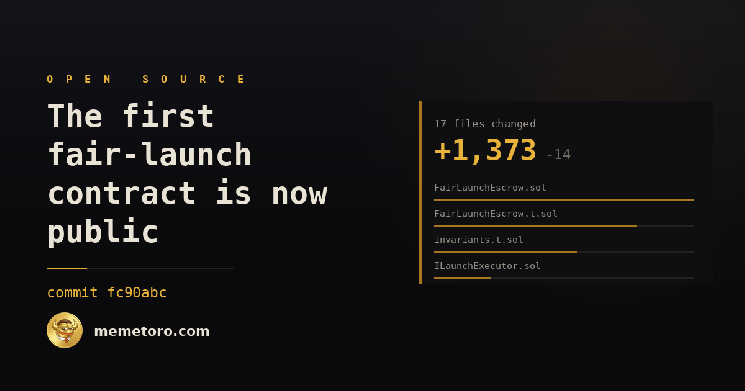
    A significant development update is the addition of 1,373 lines of open-source code to the project’s public GitHub repository. The commit is directly tied to the Memecoin AI Agent and encompasses a fair-launch contract, funding escrow, and testing components.

    The project states the fair-launch system is designed to enforce zero insider allocation through programmed rules, describing the draft as having no owner, admin role, or upgrade path. This approach offers visibility, allowing developers to inspect public code and track changes rather than relying solely on forward-looking statements.

    However, the update does not indicate the full AI agent is complete. It represents a specific milestone within the wider project—a distinction that matters when assessing crypto presale opportunities. A code commit provides useful evidence, but it must be followed by rigorous testing, audits, deployment, and user adoption.

    Security Landscape: Reviews and Outstanding Audits

    MemeToro’s security narrative includes reviews from Coinsult, BlockSAFU, and SOLIDProof. These reviews should not be automatically treated as coverage for every future component. The newly developed fair-launch code exists in a separate development area and has been described by the project as unaudited and undeployed, meaning additional security work remains essential before production use.

    Open-source code enhances transparency, but transparency is not equivalent to a completed security audit. The project has outlined several milestones to watch:

    • Independent review of new contracts
    • Mainnet deployment
    • Token-claim functionality
    • Working AI-agent features
    • Continued code development

    These steps can provide stronger evidence than promotional claims alone.

    Why MemeToro Is on the September Watchlist

    MemeToro’s current relevance stems from concurrent developments: continued presale progression, Stage 7 entry, new public code releases, and expanded fair-launch architecture. The stated $0.05186 launch target draws attention due to its significant premium over the current $0.00430 presale price, though the target is not a guarantee—post-launch market dynamics will determine the actual trading price.

    For September, the strongest reason to monitor MemeToro is its verifiable development record. The project has provided specific, checkable milestones. If future updates demonstrate audited contracts, successful deployment, and real-world usage, the project’s case could strengthen. Until then, market participants should view current news as evidence of progress rather than proof of future returns.

    More Information on MemeToro ($MT) Presale

  • $45M Zcash Whale Short Pressured as ZEC Surges Past $1,200, MemeToro Advances Open-Source AI Agent

    $45M Zcash Whale Short Pressured as ZEC Surges Past $1,200, MemeToro Advances Open-Source AI Agent

    Zcash Surges Above $1,200 as $45M Whale Short Faces Liquidation Pressure

    Zcash (ZEC) has captured market attention after breaking above the $1,200 threshold, reaching a decade-high trading range between $1,223 and $1,229. The rally has placed a reported $45 million whale short position under significant liquidation pressure, while open interest has climbed to an all-time high near $2.15 billion, signaling unusually elevated leverage around the asset.

    Short Squeeze Dynamics Drive Volatility

    When a heavily shorted asset rallies sharply, short sellers often rush to close positions to limit losses, creating additional buying pressure known as a short squeeze. The current Zcash price action reflects this dynamic, with the $45 million short position adding fuel to the upward move.

    For traders monitoring the setup, several key technical levels remain in focus:

    • $1,200: Major breakout area now cleared
    • $1,223–$1,229: Recent high zone and decade-high resistance
    • $1,254: Important confirmation level for next leg higher
    • $1,023: Major downside support area if momentum fades

    A daily close above $1,254 would strengthen the technical structure and could open a path toward the $1,400–$1,450 region. However, failure to hold elevated levels risks a sharp correction given the overextended leverage metrics.

    Spot Zcash ETF Listing Adds Institutional Demand

    The rally is not solely driven by short covering. Institutional inflows have followed the listing of the first spot Zcash ETF (ZCSH) on NYSE Arca, providing traditional market participants with regulated exposure to the privacy-focused cryptocurrency. ETF accessibility typically broadens the investor base and can sustain demand beyond speculative positioning.

    Combined with forced short covering, this new demand source has intensified upward pressure. Still, the speed of the advance warrants caution.

    Overbought Conditions Signal Mean Reversion Risk

    The daily Relative Strength Index (RSI) sits at approximately 86.47, a highly overbought reading. While an overbought RSI does not guarantee an immediate decline, it indicates that traders should prepare for potential mean reversion, particularly if broader cryptocurrency markets weaken.

    The $1,023 support level identified in the current outlook could become critical if momentum dissipates and a deeper pullback materializes.

    MemeToro Advances Open-Source AI Agent Infrastructure

    While Zcash navigates price discovery and leverage dynamics, MemeToro is pursuing a separate development track focused on technology infrastructure. The project has reached Stage 7 of its presale, reporting more than $121,000 raised at a token price of $0.00430.

    A key milestone is the publication of FairLaunchEscrow, an initial 1,373-line Solidity framework released via GitHub. The contract includes a hardcoded zero-insider-allocation mechanism designed to prevent hidden developer allocations, reinforcing transparent distribution rules for AI-driven token launches.

    MemeToro’s open-source AI agent scripts are intended to support its broader AI memecoin launch infrastructure, positioning the project as a tooling provider rather than a standalone token play.

    Market Outlook: Competing Forces at Play

    The current Zcash narrative combines multiple catalysts: a decade-high price break, a large short position under duress, record open interest, and fresh ETF-driven institutional demand. While a close above $1,254 could support further upside, the extreme RSI reading demands disciplined risk management.

    MemeToro’s developments represent infrastructure progress for a different market segment—AI-enabled fair launches on BNB Chain—and do not directly signal direction for ZEC.

    Frequently Asked Questions

    Why is the $45M Zcash short under pressure?

    ZEC’s rapid rise above $1,200 can force short sellers to close positions, adding buying pressure.

    What is ZEC’s important next level?

    A daily close above $1,254 is highlighted as an important technical confirmation level today.

    What is MemeToro’s AI agent work?

    MemeToro is developing open-source AI agent scripts as part of its planned AI memecoin launch infrastructure.

    More Information on MemeToro ($MT) Presale

  • MemeToro’s Agent Develops Fair Launch Protocol to Improve Memecoin Investing on BNB Chain in 2026

    MemeToro’s Agent Develops Fair Launch Protocol to Improve Memecoin Investing on BNB Chain in 2026

    Why Fair Launches Matter on BNB Chain

    BNB Chain has emerged as a highly active environment for new token and memecoin launches. The network’s low transaction costs and high speed lower the barrier to entry for creators and traders alike, but these same characteristics can expose retail investors to opaque launch mechanics and hidden insider advantages.

    A fair-launch model addresses this by codifying the rules of a token launch before buyers participate. The objective is to eliminate scenarios where insiders receive undisclosed allocations or where launch parameters can be altered without community knowledge. MemeToro’s approach replaces verbal promises with programmed rules enforced by smart contracts. Its new architecture incorporates an escrow mechanism designed to hold launch funds strictly under predefined conditions.

    The project states its system aims for zero insider allocation. In practical terms, the goal is to prevent a hidden group of insiders from securing a preferential token allocation before public participants. For BNB Chain traders, this structure makes launch conditions significantly easier to audit and verify.

    How the MemeToro AI Agent Fits Into the Process

    The fair-launch protocol operates as a core component of MemeToro’s broader AI Memecoin Agent. The agent is engineered around the end-to-end lifecycle of memecoin creation and launch, combining automated software tooling with immutable blockchain-based rules.

    The latest development update discloses 1,373 additional lines of open-source code. This work encompasses the fair-launch contract, the funding escrow module, and a comprehensive test suite. A critical architectural distinction is that the AI agent is not positioned as a substitute for blockchain-layer security. Rather, software automation handles operational aspects of the launch process while smart contracts enforce the defined ruleset.

    MemeToro says the new fair-launch contract has no owner, admin role, or upgrade path. This design choice is intended to remove the capacity for any single party to modify critical launch parameters post-deployment. However, the current implementation remains a development draft. It requires independent security review and mainnet deployment before traders should consider it production-ready infrastructure.

    How Programmatic Rules Could Improve Investor Trust

    Memecoin investing presents acute information asymmetry for newer traders. Launch decisions—token distribution, team allocations, liquidity handling—are frequently controlled opaquely by project teams. A buyer often cannot verify who holds tokens, whether allocations are mutable, or how funds are managed during the launch event.

    Programmatic rules encoded into smart contracts mitigate this opacity by making system behavior inspectable and verifiable. MemeToro’s model is built on five transparency pillars:

    • Public source code
    • Defined launch conditions
    • Funding escrow
    • No stated insider allocation
    • Automated enforcement

    This framework does not eliminate all risk. Smart contracts may contain vulnerabilities, and even well-designed systems remain subject to post-launch market dynamics. Consequently, the next development phase is critical: an independent audit must examine the production contract before users commit real capital.

    What the Latest Memecoin News Means for Traders

    The prevailing narrative in memecoin news is shifting from pure hype toward infrastructure development. MemeToro’s progress illustrates a targeted attempt to solve a specific structural problem: how to make new token launches more intelligible and trustworthy for retail participants.

    The 1,373-line code milestone provides tangible, measurable evidence of development velocity. Yet code volume alone is not a safety guarantee. Traders must continue to perform due diligence on contract addresses, liquidity depth, token distribution metrics, audit status, and prevailing market conditions before participating in any new memecoin launch.

    If MemeToro successfully transitions the fair-launch protocol from public repository to audited production infrastructure, it could establish itself as a significant primitive in the BNB Chain launch ecosystem. For now, its strongest signal is not a price projection, but the demonstrable effort to encode launch rules into visible, testable, and verifiable software.

    Frequently Asked Questions

    What is MemeToro’s fair-launch protocol?

    It is a planned system that uses smart-contract rules and escrow to make token launches more transparent.

    Why is BNB Chain important?

    BNB Chain supports fast, lower-cost token activity, making it a major environment for memecoin launches.

    Is the new protocol already fully live?

    The latest information describes the new fair-launch code as a development draft that still needs independent review and deployment.

    More Information on MemeToro ($MT) Presale

  • Altcoin Market Nears $1.07T Breakout as Warning Signs Emerge

    Altcoin Market Nears $1.07T Breakout as Warning Signs Emerge

    Altcoin Market Cap Reaches $1.77 Trillion, Barely Surpassing 2021 Peak

    On October 7, 2025, TOTAL2 — the market capitalization metric tracking altcoins including Ethereum (ETH) — hit an all-time high of $1.77 trillion. The new peak edged out the previous record of $1.71 trillion set on November 8, 2021, by a razor-thin margin.

    Altcoins Lag Bitcoin’s Recovery

    The minimal gain underscores a punishing bear market for long-term altcoin holders. While Bitcoin (BTC) shattered its 2021 all-time high by 58.8%, the collective altcoin market — long viewed by investors and traders as offering greater upside potential — has largely disappointed as an asset class.

    TOTAL2 Trapped in Multi-Year Range

    Source: TOTAL2 on TradingView

    Since 2022, TOTAL2 has consolidated within a long-term range. Its failure to decisively clear the prior peak confirms the range-bound structure. At the time of writing, the mid-range level at $1.07 trillion was being tested as resistance — a level that previously capped advances in May and could do so again.

    A sustained breakout above the mid-range would signal improving conditions for altcoins in the weeks ahead. However, on-chain metrics suggest such a move faces significant headwinds.

    Rising Exchange Inflows Signal Caution

    Source: CryptoQuant

    Crypto analyst Arab Chain highlighted a surge in addresses depositing altcoins to exchanges, reaching the highest level since May. Binance alone recorded 25,856 deposit addresses — the most among tracked platforms.

    This uptick indicates increased movement of altcoins onto trading venues, though it does not necessarily imply an imminent sell-off. The analyst noted the flows could also reflect heightened trader activity or liquidity provisioning.

    Declining Stablecoin Reserves Point to Weaker Buying Power

    Source: CryptoQuant

    Meanwhile, Tether (USDT) reserves across all exchanges have trended downward since December 2024. A brief period of stablecoin inflows during summer 2025 lasted only a few weeks before reversing.

    Falling stablecoin balances on exchanges typically signal reduced dry powder — the capital ready to deploy into crypto assets. Unlike the second half of 2025, the market currently lacks a strong directional bias according to this metric.

    Bullish Sentiment Tempered by Structural Warnings

    Despite growing confidence in broader crypto market sentiment, several warning signs warrant attention. Conditions remain constructive, but a clear, sustained bull run has yet to materialize.

    Key Levels to Watch

    • Altcoin market cap: $1.07 trillion (mid-range resistance)
    • Breakout catalyst: Rising demand and expanding purchasing power

    A meaningful altcoin advance depends on a reversal of current exchange inflow trends and a rebuilding of stablecoin reserves — signals that fresh capital is returning to the market with conviction.

  • Iran-Linked Ripple XRP Study Reveals Surprising Facts as US-Iran War Escalates

    Iran-Linked Ripple XRP Study Reveals Surprising Facts as US-Iran War Escalates

    Escalating tensions between the United States and Iran have renewed interest in an Iran-backed study examining Ripple’s XRP for cross-border payments. The research has resurfaced as financial sanctions and disruptions to international money transfers dominate headlines, drawing fresh scrutiny to the digital asset’s potential utility in restricted financial corridors.

    Sanctions Pressure Highlights Alternative Payment Rails

    The recent conflict has thrust the mechanics of global value transfer into sharp focus. As traditional banking channels face restrictions, analysts and policymakers are revisiting technical assessments of blockchain-based settlement systems. The Iranian study, which evaluates XRP’s speed and cost efficiency for cross-border transactions, is being cited in discussions about circumventing financial blockades.

    XRP Gains Attention Amid Financial Uncertainty

    Market observers note that the geopolitical climate has turned heads toward XRP specifically. The asset’s design for institutional liquidity management and its existing partnerships with financial institutions position it as a frequently referenced case study in debates over the future of sanctioned economies’ access to global markets.

  • FARTCOIN Falls 20% as 6.5M Tokens Hit Exchanges; Rebound Possible If…

    FARTCOIN Falls 20% as 6.5M Tokens Hit Exchanges; Rebound Possible If…

    FARTCOIN’s price decline accelerated after more than 6.5 million tokens reportedly moved into centralized exchange hot wallets within a 24-hour period. The transfers followed a price rejection near the $0.181 level, where sellers disrupted the memecoin’s previous recovery attempt.

    Large Token Transfers to Major Exchanges

    According to on-chain data, approximately 957,090 FARTCOIN valued at nearly $164,800 were transferred from Coinbase Prime Custody into a Coinbase hot wallet. Additionally, another 3.48 million tokens worth over $600,000 entered Gate.io through three coordinated transfers. These transactions included 1.733 million FARTCOIN from address CGbHc and another 932,700 tokens from a separate depositor. Wintermute also moved around 824,000 FARTCOIN toward Gate.io, amplifying potential exchange-side supply pressure.

    Meanwhile, trading volume climbed 22.13% to $23.87 million as FARTCOIN fell 20% toward $0.144 in 24 hours. The decline placed FARTCOIN among the top losers in the memecoin sector, highlighting stronger selling pressure across its market.

    Exchange Spot Flows Signal Bearish Bias

    The exchange spot flows added another bearish indicator while the large token transfers already challenged FARTCOIN’s ability to stabilize. At the time of writing, the memecoin had recorded around $1.15 million in inflows versus $859,330 in outflows. Clearly, the inflows exceeded the outflows, producing positive netflow and increasing the tokens available across tracked exchanges.

    Notably, several earlier periods reflected considerably larger flows, yet the recent imbalance came at a time of heightened selling pressure. This timing reinforced the significance of the exchange supply as FARTCOIN pushed toward its key technical support area. Continued positive netflows could preserve supply pressure as fresh exchange deposits continue exceeding withdrawals. Stronger outflows, on the other hand, could reduce available supply and improve conditions necessary for buyers to defend support.

    Source: CoinGlass

    Price Tests Crucial Order Block Near $0.140

    The token’s decline pushed price toward the $0.14497 zone, placing it directly inside the order block above the $0.140 support level. On the daily timeframe chart, this zone had previously supported a consolidation before August’s price expansion, making its defense very important for the broader technical structure.

    However, FARTCOIN price remained within a descending channel structure after a pullback from the $0.22319 resistance region. Selling strength persisted as the MACD indicator stayed bearish, with its histogram in negative territory at -0.00527. The RSI also declined toward 41.08 and remained below its 51.41 moving average, reflecting weaker buying pressure. Notably, the RSI had not hit oversold conditions, leaving sellers room to extend the correction deeper.

    Holding the order block could support a reversal toward the upper boundary of the descending channel. Consequently, a structure breakout could then likely reopen the path to the $0.180 resistance zone. Failure below the $0.140 support would instead weaken the order block and expose the $0.11773 lower support.

    Source: TradingView

    Liquidation Heatmap Reveals Overhead Liquidity Targets

    Despite continued selling, the Binance Liquidation Heatmap positioning presented several potential recovery targets above FARTCOIN’s current market price. The 24-hour heatmap chart showed a notable liquidation liquidity cluster between the price range of $0.156 and $0.161. Additional clusters appeared around the $0.165 area extending toward $0.170, indicating further upside liquidity pools.

    These upper concentration clusters could pull the price higher if the order block holds and buyers regain market control. A price recovery through the $0.161 level could increase pressure on short positions clustered across the higher liquidity zones.

    Source: CoinGlass

    Key Takeaways

    • Over 6.5 million FARTCOIN tokens reaching exchanges strengthened immediate selling pressure.
    • Holding the $0.140 level could support recovery toward liquidation liquidity clustered above the current price.
  • Ringleader of $245M Crypto Theft Pleads Guilty

    Ringleader of $245M Crypto Theft Pleads Guilty

    Malone Lam, a 22-year-old Miami resident originally from Singapore, pleaded guilty Tuesday to orchestrating one of the largest Bitcoin thefts in history. Lam admitted to serving as the ringleader of an international cybercrime group that stole 4,100 bitcoins — valued at over $230 million at the time of the theft — to finance an extravagant lifestyle.

    Multi-Year Scheme Targeted Crypto Holders

    According to the U.S. Department of Justice, the criminal conspiracy operated from October 2023 through at least May 2025. Lam and his co-conspirators hacked databases to obtain cryptocurrency users’ personal information, then used social engineering tactics to trick victims into surrendering login credentials and private keys. The total haul across Bitcoin and other cryptocurrencies reached $245 million.

    In one brazen incident detailed by prosecutors, a co-defendant physically broke into a residence in New Mexico to steal a hardware wallet while Lam tracked the victim’s movements by compromising their iCloud account.

    Prosecutors Emphasize Scope of Operation

    “This defendant led an international network that preyed on victims through deception, invaded their privacy, and stole hundreds of millions of dollars in cryptocurrency,” U.S. Attorney Jeanine Ferris Pirro said in a statement.

    “If you build a cybercrime empire, we will find you, dismantle your operation, and hold you accountable,” Attorney Pirro added.

    The DOJ characterized the case as a Racketeer Influenced and Corrupt Organizations Act conspiracy: “The Racketeer Influenced and Corrupt Organizations Act conspiracy used social engineering and occasional home break-ins to obtain information that allowed the conspirators to drain their victims’ cryptocurrency wallets.”

    From Online Gaming to Organized Cybercrime

    The indictment reveals the group’s origins trace back to online gaming communities, where the defendants initially connected as friends before pivoting to coordinated cybercrime operations.

    Stolen Funds Financed Lavish Lifestyle

    Lam and his associates laundered the stolen Bitcoin and spent proceeds on bottle-service parties, private jet charters, personal security details, luxury handbags and watches, and real estate acquisitions in Los Angeles, the Hamptons, and Miami. According to Tuesday’s announcement, the defendants routinely spent up to $500,000 per night on parties and distributed designer handbags worth tens of thousands of dollars as gifts.

    Lam was arrested in 2024 at his Miami rental property.

  • Republicans Introduce New Version of Key Crypto Bill for BTC, XRP, ETH

    Republicans Introduce New Version of Key Crypto Bill for BTC, XRP, ETH

    Senate Republicans have circulated a revised 630-page version of the CLARITY Act mere days before a pivotal procedural vote that could shape the regulatory future of the broader cryptocurrency market, including major assets such as Bitcoin, XRP, and Ethereum.

    Partisan Dynamics Remain Unresolved

    Journalist Brendan Pedersen reported Thursday that the latest legislative text remains a Republican proposal rather than a bipartisan agreement. Democrats who have previously expressed interest in crypto legislation remain skeptical, according to Pedersen. A Democratic aide characterized the unresolved ethics dispute as the “biggest stumbling block by far.”

    “This latest proposal does nothing to resolve those concerns,” the aide said.

    Sept. 15 Cloture Vote Looms as Critical Test

    The Senate’s cloture motion on the motion to proceed to the CLARITY Act is scheduled to ripen on Sept. 15 at 2:15 p.m. ET. This procedural vote determines whether debate on the legislation can advance; it is not a final vote on passage. With the current draft still lacking bipartisan support, Republicans will need to persuade enough Democrats to allow the legislation to move forward.

    Key Revisions in the Updated Draft

    The updated legislation introduces several notable changes to the regulatory framework:

    Decentralization Definitions Refined

    The revised draft draws a clearer distinction between genuinely decentralized protocols and what it terms “non-decentralized finance trading protocols.” The text specifies that merely participating in a decentralized governance mechanism or an incident-response security council does not automatically constitute control.

    Developer Protections Retained

    The bill maintains significant protections for software developers, a provision viewed as critical for innovation in the digital asset space.

    Focus on Digital-Commodity Markets

    The revised DeFi language explicitly focuses parts of the regulatory regime on digital-commodity cash and spot markets, narrowing the scope of certain oversight mechanisms.

    Credit Union Provisions Strengthened

    Another notable revision strengthens language concerning credit unions. Regulators, including the National Credit Union Administration (NCUA), would retain their full supervisory and enforcement powers. The bill also makes technical changes to the GENIUS Act intended to place credit-union accounts on more equal footing with bank deposits when dealing with tokenized financial products.

    Political Hurdle Outweighs Technical Changes

    While the updated draft modifies several regulatory mechanics of the CLARITY Act, it does not resolve the core political dispute most likely to determine whether the legislation can advance. The Sept. 15 cloture vote represents the next major test, and the outcome will signal whether a path forward exists for comprehensive crypto market structure legislation in the current Congress.